Lapsed, fee not paid9 drawings
Medical Devices · US 8,778,001 B2
Cervical plate
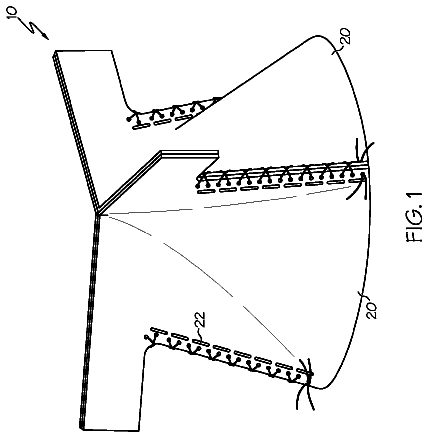
A cervical plate having backout or reverse threading protection is provided.
US 8,778,326 B2 · Assignee: Actamax Surgical Materials, LLC · Inventors: Lu; Helen S. M. et al.
Claude can sketch it from the patent text.
A hydrogel tissue adhesive formed by reacting an aldehyde-functionalized polysaccharide containing pendant aldehyde groups with a water-dispersible, multi-arm amine is described. The hydrogel may be useful as a tissue adhesive or sealant for medical applications that require a more rapid degradation time, such as the prevention of undesired tissue-to tissue adhesions resulting from trauma or surgery.
Tissue adhesives have many potential medical applications, including wound closure, supplementing or replacing sutures or staples in internal surgical procedures, preventing leakage of fluids such as blood, bile, gastrointestinal fluid and cerebrospinal fluid, adhesion of synthetic onlays or inlays to the cornea, drug delivery devices, and as anti-adhesion barriers to prevent post-surgical adhesions. Conventional tissue adhesives are generally not suitable for a wide range of adhesive applications. For example, cyanoacrylate-based adhesives have been used for topical wound closure, but the release of toxic degradation products limits their use for internal applications. Fibrin-based adhesives are slow curing, have poor mechanical strength, and pose a risk of viral infection. Additionally, fibrin-based adhesives do not bond covalently to the underlying tissue. Several types of hydrogel ti
Ask Claude for concept sketches based only on the patent's text. They are not part of the patent.
What the patent claimed, word for word. All of it is now free to use.
The invention relates to the field of medical adhesives. More specifically, the invention relates to a hydrogel tissue adhesive formed by reacting an aldehyde-functionalized polysaccharide containing pendant aldehyde groups with a water-dispersible, multi-arm amine.
Tissue adhesives have many potential medical applications, including wound closure, supplementing or replacing sutures or staples in internal surgical procedures, preventing leakage of fluids such as blood, bile, gastrointestinal fluid and cerebrospinal fluid, adhesion of synthetic onlays or inlays to the cornea, drug delivery devices, and as anti-adhesion barriers to prevent post-surgical adhesions. Conventional tissue adhesives are generally not suitable for a wide range of adhesive applications. For example, cyanoacrylate-based adhesives have been used for topical wound closure, but the release of toxic degradation products limits their use for internal applications. Fibrin-based adhesives are slow curing, have poor mechanical strength, and pose a risk of viral infection. Additionally, fibrin-based adhesives do not bond covalently to the underlying tissue.
Several types of hydrogel tissue adhesives have been developed, which have improved adhesive and cohesive properties and are nontoxic (see for example Sehl et al., U.S. Patent Application Publication No. 2003/0119985, and Goldmann, U.S. Patent Application Publication No. 2005/0002893). These hydrogels are generally formed by reacting a component having nucleophilic groups with a component having electrophilic groups, which are capable of reacting with the nucleophilic groups of the first component, to form a crosslinked network via covalent bonding. However, these hydrogels typically swell, dissolve away too quickly, or lack sufficient adhesion or mechanical strength, thereby decreasing their effectiveness as surgical adhesives.
Kodokian et al. (copending and commonly owned U.S. Patent Application Publication No. 2006/0078536) describe a polysaccharide-based hydrogel tissue adhesives formed by reacting an oxidized polysaccharide with a water-dispersible, multi-arm polyether amine. These adhesives provide improved adhesion and cohesion properties, crosslink readily at body temperature, maintain dimensional stability initially, do not degrade rapidly, and are nontoxic to cells and non-inflammatory to tissue. However, for certain applications, such as the prevention of undesired tissue-to tissue-adhesions resulting from trauma or surgery, a more rapidly degrading hydrogel tissue adhesive is needed. For example, an adhesion prevention composition should not persist at the site once the healing process has begun, typically not longer than 1 to 3 weeks.
Therefore, the need exists for a hydrogel tissue adhesive that has the desirable properties of the oxidized polysaccharide-based tissue adhesives described by Kodokian et al., supra, but has a shorter degradation time.
The present invention addresses the above need by providing a hydrogel tissue adhesive that has good adhesion and cohesion properties, crosslinks readily at body temperature, maintains dimensional stability initially, is nontoxic to cells and non-inflammatory to tissue, and degrades more rapidly than the oxidized polysaccharide-based hydrogel tissue adhesives.
Accordingly, in one embodiment the invention provides a kit comprising: a) at least one aldehyde-functionalized polysaccharide containing pendant aldehyde groups, said aldehyde-functionalized polysaccharide having a weight-average molecular weight of about 1,000 to about 1,000,000 Daltons and a degree of aldehyde substitution of about 10% to about 200%; and b) at least one water-dispersible, multi-arm amine wherein at least three of the arms are terminated by at least one primary amine group, said multi-arm amine having a number-average molecular weight of about 450 to about 200,000 Daltons.
In another embodiment, the invention provides a dried hydrogel formed by a process comprising the steps of: a) combining in a solvent (i) at least one aldehyde-functionalized polysaccharide containing pendant aldehyde groups, said aldehyde-functionalized polysaccharide having a weight-average molecular weight of about 1,000 to about 1,000,000 Daltons and a degree of aldehyde substitution of about 10% to about 200% with (ii) at least one water-dispersible, multi-arm amine, wherein at least three of the arms are terminated by at least one primary amine group, said multi-arm amine having a number-average molecular weight of about 450 to about 200,000 Daltons, to form a hydrogel; and b) treating said hydrogel to remove at least a portion of said solvent to form the dried hydrogel.
In another embodiment, the invention provides a composition comprising the reaction product of: a) at least one aldehyde-functionalized polysaccharide containing pendant aldehyde groups, said aldehyde-functionalized polysaccharide having a weight-average molecular weight of about 1,000 to about 1,000,000 Daltons and a degree of aldehyde substitution of about 10% to about 200%, and b) at least one water-dispersible, multi-arm amine wherein at least three of the arms are terminated by at least one primary amine group, said multi-arm amine having a number-average molecular weight of about 450 to about 200,000 Daltons.
In another embodiment, the invention provides a crosslinked hydrogel composition comprising: a) at least one aldehyde-functionalized polysaccharide containing pendant aldehyde groups, said aldehyde-functionalized polysaccharide having a weight-average molecular weight of about 1,000 to about 1,000,000 Daltons and having a degree of aldehyde substitution of about 10% to about 200%; and b) at least one water-dispersible, multi-arm amine wherein at least three of the arms are terminated by at least one primary amine group, said multi-arm amine having a number-average molecular weight of about 450 to about 200,000 Daltons; wherein said at least one aldehyde-functionalized polysaccharide and said at least one water-dispersible, multi-arm amine are crosslinked through covalent bonds formed between the pendant aldehyde groups of the polysaccharide and the primary amine groups of the water-dispersible, multi-arm amine.
As used above and throughout the description of the invention, the following terms, unless otherwise indicated, shall be defined as follows:
The term "aldehyde-functionalized polysaccharide" as used herein, refers to a polysaccharide that has been chemically modified to introduce pendant aldehyde groups into the molecule. The pendant aldehyde groups may be single aldehyde groups or dialdehydes. As defined herein, aldehyde-functionalized polysaccharides do not include polysaccharides that are oxidized by cleavage of the polysaccharide rings to introduce aldehyde groups. Oxidation of the polysaccharide rings results in dialdehydes formed by opening the rings of the polysaccharide.
The term "pendant aldehyde group" refers to an aldehyde group that is attached to the carbohydrate of the polysaccharide via one of the ring hydroxyl groups.
The term "degree of aldehyde substitution" refers to the mole percent of pendant aldehyde groups per mole of carbohydrate repeat units, i.e., (moles of pendant aldehyde groups/moles of carbohydrate repeat units).times.100.
The term "water-dispersible, multi-arm amine" refers to a polymer having three or more polymer chains ("arms"), which may be linear or branched, emanating from a central structure, which may be a single atom, a core molecule, or a polymer backbone, wherein at least three of the branches ("arms") are terminated by at least one primary amine group. The water-dispersible, multi-arm amine is water soluble or is able to be dispersed in water to form a colloidal suspension capable of reacting with a second reactant in aqueous solution or dispersion.
The term "dispersion" as used herein, refers to a colloidal suspension capable of reacting with a second reactant in an aqueous medium.
The term "water-dispersible, multi-arm polyether amine" refers to a water-dispersible, multi-arm amine wherein the polymer is a polyether.
The term "polyether" refers to a polymer having the repeat unit [--O--R]-, wherein R is a hydrocarbylene group having 2 to 5 carbon atoms. The polyether may also be a random or block copolymer comprising different repeat units which contain different R groups.
The term "hydrocarbylene group" refers to a divalent group formed by removing two hydrogen atoms, one from each of two different carbon atoms, from a hydrocarbon.
The term "branched polyether" refers to a polyether having one or more branch points ("arms"), including star, dendritic, comb, highly branched, and hyperbranched polyethers. Branches radiate from one or more trifunctional or higher functional branch points.
The term "dendritic polyether" refers to a highly branched polyether having a branching structure that repeats regularly with each successive generation of monomer radiating from a core molecule.
The term "comb polyether" refers to a branched polyether in which linear side-chains emanate from trifunctional branch points on a linear polymer backbone.
The term "star polyether" refers to a branched polyether in which linear side-chains emanate from a single atom or a core molecule having a point of symmetry.
The term "hyperbranched polyether" refers to a highly branched polyether which is more branched than "highly branched," with order approaching that of an imperfect dendrimer.
The term "highly branched polyether" refers to a branched polyether having many branch points, such that the distance between branch points is small relative to the total length of arms.
The term "primary amine" refers to a neutral amino group having two free hydrogens. The amino group may be bound to a primary, secondary or tertiary carbon.
The term "multi-functional amine" refers to a chemical compound comprising at least two functional groups, at least one of which is a primary amine group.
The term "crosslink" refers to a bond or chain of atoms attached between and linking two different polymer chains.
The term "crosslink density" is herein defined as the reciprocal of the average number of chain atoms between crosslink connection sites.
The term "% by weight", also referred to herein as "wt %" refers to the weight percent relative to the total weight of the solution or dispersion, unless otherwise specified.
The term "anatomical site" refers to any external or internal part of the body of humans or animals.
The term "tissue" refers to any biological tissue, both living and dead, in humans or animals.
The term "hydrogel" refers to a water-swellable polymeric matrix, consisting of a three-dimensional network of macromolecules held together by covalent crosslinks that can absorb a substantial amount of water to form an elastic gel.
The term "dried hydrogel" refers to a hydrogel that has been treated to remove at least a portion of the solvent contained therein. Preferably, substantially all of the solvent is removed from the hydrogel.
The term "PEG" as used herein refers to poly(ethylene glycol).
The term "M.sub.w" as used herein refers to the weight-average molecular weight.
The term "M.sub.n" as used herein refers to the number-average molecular weight.
The term "M.sub.z" as used herein refers to the z-average molecular weight.
The term "medical application" refers to medical applications as related to humans and animals.
The meaning of abbreviations used is as follows: "min" means minute(s), "h" means hour(s), "sec" means second(s), "d" means day(s), "mL" means milliliter(s), "L" means liter(s), ".mu.L" means microliter(s), "cm" means centimeter(s), "mm" means millimeter(s), ".mu.m" means micrometer(s), "mol" means mole(s), "mmol" means millimole(s), "g" means gram(s), "mg" means milligram(s), "mol %" means mole percent, "Vol" means volume, "w/w" means weight per weight, "Da" means Daltons, "kDa" means kiloDaltons, the designation "10K" means that a polymer molecule possesses a number-average molecular weight of 10 kiloDaltons, "M" means molarity, "kPa" means kilopascals, "psi" means pounds per square inch, "rpm" means revolutions per minute", ".sup.1H NMR" means proton nuclear magnetic resonance spectroscopy, "13-C NMR" means carbon 13 nuclear magnetic resonance spectroscopy, "ppm" means parts per million, "cP" means centipoise, PBS'' means phosphate-buffered saline, "MWCO" means molecular weight cut off.
A reference to "Aldrich" or a reference to "Sigma" means the said chemical or ingredient was obtained from Sigma-Aldrich, St. Louis, Mo.
Disclosed herein is a hydrogel tissue adhesive formed by reacting an aldehyde-functionalized polysaccharide containing pendant aldehyde groups with a water-dispersible, multi-arm amine. The hydrogel may be useful as a tissue adhesive or sealant for medical applications that require more rapid degradation, including but not limited to, prevention of undesired tissue-to tissue adhesions resulting from trauma or surgery.
Aldehyde-Functionalized Polysaccharides
Aldehyde-functionalized polysaccharides suitable for use herein are polysaccharides that have been chemically modified to introduce pendant aldehyde groups into the molecule. The pendant aldehyde groups may be single aldehyde groups or dialdehydes. The pendant aldehyde groups of the aldehyde-functionalized polysaccharides disclosed herein are attached to the polysaccharide through linking groups. In one embodiment, the linking groups comprise carbon, hydrogen, and oxygen atoms, but do not contain a nitrogen atom, and are attached to the polysaccharide by ether linkages. As demonstrated in the Examples herein below, aldehyde-functionalized polysaccharides having these types of linking groups are more stable in aqueous solution that oxidized polysaccharides or aldehyde-functionalized polysaccharides having other types of linking groups, such as those that contain a nitrogen atom or are linked to the polysaccharide by other chemical linkages (e.g., amide or urethane). In one embodiment, the linking group contains an alkoxy group alpha to the pendant aldehyde group (i.e., on an adjacent carbon atom). In another embodiment, the linking group does not contain an alkoxy group beta to the pendant aldehyde group (i.e., on the second carbon atom from the aldehyde group).
As used herein, aldehyde-functionalized polysaccharides do not include polysaccharides that are oxidized by cleavage of the polysaccharide rings to introduce aldehyde groups. Oxidation of the polysaccharide rings results in dialdehydes formed by opening the rings of the polysaccharide. Therefore, the dialdehyde groups formed by oxidation of polysaccharide rings are not pendant aldehyde groups as defined herein.
Aldehyde-functionalized polysaccharides may be prepared by chemically modifying a polysaccharide to introduce pendant aldehyde groups. Useful aldehyde-functionalized polysaccharides include, but are not limited to, aldehyde-functionalized derivatives of: dextran, carboxymethyldextran, starch, agar, cellulose, hydroxyethylcellulose, carboxymethylcellulose, pullulan, inulin, levan, and hyaluronic acid. The starting polysaccharides are available commercially from sources such as Sigma Chemical Co. (St. Louis, Mo.). Typically, polysaccharides are a heterogeneous mixture having a distribution of different molecular weights, and are characterized by an average molecular weight, for example, the weight-average molecular weight (M.sub.w), or the number average molecular weight (M.sub.n), as is known in the art. Therefore, the aldehyde-functionalized polysaccharides prepared from these polysaccharides are also a heterogeneous mixture having a distribution of different molecular weights. Suitable aldehyde-functionalized polysaccharides have a weight-average molecular weight of about 1,000 to about 1,000,000 Daltons, more particularly about 3,000 to about 250,000 Daltons, more particularly about 5,000 to about 60,000 Daltons, and more particularly about 7,000 to about 20,000 Daltons. In one embodiment, the aldehyde-functionalized polysaccharide is aldehyde-functionalized dextran. In another embodiment, the aldehyde-functionalized polysaccharide is aldehyde-functionalized inulin.
Aldehyde-functionalized polysaccharides may be prepared using methods known in the art. Aldehyde-functionalized polysaccharides may be prepared using any of the methods described by Mehta et al. (WO 99/07744). For example, dextran may be reacted with allyl glycidyl ether in an acid aqueous medium to form allyloxy dextran which is then oxidized by ozonolysis to cleave the double bond and introduce a terminal aldehyde group, as described in detail in the Examples herein below. Additionally, glycidol may be reacted with a polysaccharide, such as dextran, in a basic aqueous medium to give an alkylated polysaccharide, as described by Chen (Biotechnology Techniques 3:131-134, 1989). Periodate oxidation of the alkylated polysaccharide yields an aldehyde-functionalized polysaccharide having pendant aldehyde groups. The aldehyde-functionalized polysaccharides may also be prepared by the method described by Solarek et al. (U.S. Pat. No. 4,703,116) wherein a polysaccharide is reacted with a derivatizing acetal reagent in the presence of base and then the acetal is hydrolyzed by adjusting the pH to less than 7.0.
Aldehyde-functionalized polysaccharides having dialdehyde functional groups can be prepared by first attaching a pendant group containing either a terminal diene or by attaching a cyclic, disubstituted olefin to the polysaccharide ring. Attachment of the pendant groups can be accomplished using a variety of methods, including reaction of the polysaccharide with glycidyl ethers containing cyclic olefins or terminal dienes, or reaction with carboxylic acids or derivatives thereof which also contain cyclic olefins or terminal dienes. Oxidation of the polysaccharides derivatized with cyclic olefins or terminal dienes using methods known in the art, such as ozonolysis, yield polysaccharides derivatized with pendant dialdehydes.
The degree of aldehyde substitution may be determined using methods known in the art. For example, the degree of aldehyde substitution may be determined by titrating the aldehyde-functionalized polysaccharide with hydroxyl amine hydrochloride according to the method of Zhao and Heindel (Pharmaceutical Research 8:400, 1991). Suitable aldehyde-functionalized polysaccharides have a degree of aldehyde substitution of about 10% to about 200%, more particularly about 30% to about 200%, more particularly about 35% to about 120%, and more particularly about 40% to about 120%.
Water-Dispersible, Multi-Arm Amines:
Suitable water-dispersible, multi-arm amines include, but are not limited to, water-dispersible multi-arm polyether amines, amino-terminated dendritic polyamidoamines, and multi-arm branched end amines. Typically, multi-arm amines suitable for use herein have a number-average molecular weight of about 450 to about 200,000 Daltons, more particularly from about 2,000 to about 40,000 Daltons.
In one embodiment, the water-dispersible, multi-arm amine is a multi-arm polyether amine, which is a water-dispersible polyether having the repeat unit [-O-R]-, wherein R is a hydrocarbylene group having 2 to 5 carbon atoms. Suitable multi-arm polyether amines include, but are not limited to, amino-terminated star polyethylene oxides, amino-terminated dendritic polyethylene oxides, amino-terminated comb polyethylene oxides, amino-terminated star polypropylene oxides, amino-terminated dendritic polypropylene oxides, amino-terminated comb polypropylene oxides, amino-terminated star polyethylene oxide-polypropylene oxide copolymers, amino-terminated dendritic polyethylene oxide-polypropylene oxide copolymers, amino-terminated comb polyethylene oxide-polypropylene oxide copolymers, and polyoxyalkylene triamines, sold under the trade name Jeffamine.RTM. triamines, by Huntsman LLC. (Houston, Tex.). Examples of star polyethylene oxide amines, include, but are not limited to, various multi-arm polyethylene glycol amines, and star polyethylene glycols having 3, 4, 6, or 8 arms terminated with primary amines (referred to herein as 3, 4, 6, or 8-arm star PEG amines, respectively). Examples of suitable Jeffamine.RTM. triamines include, but are not limited to, Jeffamine.RTM. T-403 (CAS No. 39423-51-3), Jeffamine.RTM. T-3000 (CAS No. 64852-22-8), and Jeffamine.RTM. T-5000 (CAS No. 64852-22-8). In one embodiment, the water-dispersible multi-arm polyether amine is an eight-arm polyethylene glycol having eight arms terminated by a primary amine group and having a number-average molecular weight of about 10,000 Daltons.
The multi-arm polyether amines are either available commercially, as noted above, or may be prepared using methods known in the art. For example, multi-arm polyethylene glycols, wherein at least three of the arms are terminated by a primary amine group, may be prepared by putting amine ends on multi-arm polyethylene glycols (e.g., 3, 4, 6, and 8-arm star polyethylene glycols, available from companies such as Nektar Transforming Therapeutics; SunBio, Inc., Anyang City, South Korea; NOF Corp., Tokyo, Japan; or JenKem Technology USA, Allen, Tex.) using the method described by Buckmann et al. (Makromol. Chem. 182:1379-1384, 1981). In that method, the multi-arm polyethylene glycol is reacted with thionyl bromide to convert the hydroxyl groups to bromines, which are then converted to amines by reaction with ammonia at 100.degree. C. The method is broadly applicable to the preparation of other multi-arm polyether amines. Additionally, multi-arm polyether amines may be prepared from multi-arm polyols using the method described by Chenault (copending and commonly owned U.S. Patent Application Publication No.2007/0249870). In that method, the multi-arm polyether is reacted with thionyl chloride to convert the hydroxyl groups to chlorine groups, which are then converted to amines by reaction with aqueous or anhydrous ammonia. Other methods that may be used for preparing multi-arm polyether amines are described by Merrill et al. in U.S. Pat. No. 5,830,986, and by Chang et al. in WO 97/30103.
Water-dispersible, multi-arm amines suitable for use herein may also be amino-terminated dendritic polyamidoamines, sold under the trade name Starburst.RTM. Dendrimers (available from Sigma-Aldrich, St Louis, Mo.).
In one embodiment, the water-dispersible, multi-arm amine is a multi-arm branched end amine, as described by Arthur (copending and commonly owned International Patent Application Publication No. WO 2008/066787). The multi-arm branched end amines are branched polymers having two or three primary amine groups at the end of each of the polymer arms. The multiplicity of functional groups increases the statistical probability of reaction at a given chain end and allows more efficient incorporation of the branched molecules into a polymer network. The starting materials used to prepare the branched end amines may be branched polymers such as multi-arm polyether polyols including, but not limited to, comb and star polyether polyols. The branched end amines can be prepared by attaching multiple amine groups to the ends of the polymer by reaction with the hydroxyl groups using methods well known in the art. For example, a branched end amine having two amine functional groups on each end of the polymer arms can be prepared by reacting the starting material, as listed above, with thionyl chloride in a suitable solvent such as toluene to give the chloride derivative, which is subsequently reacted with tris(2-aminoethyl)amine to give the branched end reactant having two primary amine groups at the end of the polymer arms.
In one embodiment, the water-dispersible, multi-arm amine is an eight-arm branched end polyethylene glycol amine having two primary amine groups at the end of the polymer arms and having a number-average molecular weight of about 10,000 Daltons.
In another embodiment, the water-dispersible, multi-arm amine is a mixture of an eight-arm branched end polyethylene glycol amine having two primary amine groups at the end of the polymer arms and having a number-average molecular weight of about 10,000 Daltons, and an eight-arm polyethylene glycol amine having eight arms terminated by a primary amine group and having a number-average molecular weight of about 10,000 Daltons.
It should be recognized that the water-dispersible, multi-arm amines are generally a somewhat heterogeneous mixture having a distribution of arm lengths and in some cases, a distribution of species with different numbers of arms. When a multi-arm amine has a distribution of species having different numbers of arms, it can be referred to based on the average number of arms in the distribution. For example, in one embodiment the multi-arm amine is an 8-arm star PEG amine, which comprises a mixture of multi-arm star PEG amines, some having less than and some having more than 8 arms; however, the multi-arm star PEG amines in the mixture have an average of 8 arms. Therefore, the terms "8-arm", "6-arm", "4-arm" and "3-arm" as used herein to refer to multi-arm amines, should be construed as referring to a heterogeneous mixture having a distribution of arm lengths and in some cases, a distribution of species with different numbers of arms, in which case the number of arms recited refers to the average number of arms in the mixture.
Methods of Using the Hydrogel Tissue Adhesive
The hydrogel tissue adhesive disclosed herein may be used in various forms. In one embodiment, the aldehyde-functionalized polysaccharide containing pendant aldehyde groups and the water-dispersible, multi-arm amine are used as components of aqueous solutions or dispersions. To prepare an aqueous solution or dispersion comprising an aldehyde-functionalized polysaccharide (referred to herein as the "first aqueous solution or dispersion"), at least one aldehyde-functionalized polysaccharide is added to water to give a concentration of about 5% to about 40%, more particularly from about 5% to about 30%, and more particularly from about 10% to about 30% by weight relative to the total weight of the solution or dispersion. Additionally, a mixture of at least two different aldehyde-functionalized polysaccharides having different weight-average molecular weights, different degrees of aldehyde substitution, or both different weight-average molecular weights and degrees of aldehyde substitution may be used. Where a mixture of aldehyde-functionalized polysaccharides is used, the total concentration of the aldehyde-functionalized polysaccharides is about 5% to about 40% by weight, more particularly from about 5% to about 30%, and more particularly from about 10% to about 30% by weight relative to the total weight of the solution or dispersion.
Similarly, to prepare an aqueous solution or dispersion comprising a water-dispersible, multi-arm amine (referred to herein as the "second aqueous solution or dispersion"), at least one water-dispersible, multi-arm amine is added to water to give a concentration of about 5% to about 70% by weight, more particularly from about 20% to about 50% by weight relative to the total weight of the solution or dispersion. The optimal concentration to be used depends on the intended application and on the concentration of the aldehyde-functionalized polysaccharide used in the first aqueous solution or dispersion. Additionally, a mixture of different water-dispersible, multi-arm amines having different number-average molecular weights, different numbers of arms, or both different number-average molecular weights and different numbers of arms may be used. Where a mixture of water-dispersible, multi-arm amines is used, the total concentration of the multi-arm amines is about 5% to about 70% by weight, more particularly from about 20% to about 50% by weight relative to the total weight of the solution or dispersion.
For use on living tissue, it is preferred that the first aqueous solution or dispersion and the second aqueous solution or dispersion be sterilized to prevent infection. Any suitable sterilization method known in the art that does not adversely affect the ability of the components to react to form an effective hydrogel may be used, including, but not limited to, electron beam irradiation, gamma irradiation, ethylene oxide sterilization, or filtration through a 0.2 .mu.m pore membrane.
The first aqueous solution or dispersion and the second aqueous solution or dispersion may further comprise various additives depending on the intended application. Preferably, the additive does not interfere with effective gelation to form a hydrogel. The amount of the additive used depends on the particular application and may be readily determined by one skilled in the art using routine experimentation. For example, the first aqueous solution or dispersion and/or the second aqueous solution or dispersion may comprise at least one additive selected from pH modifiers, antimicrobials, colorants, surfactants, pharmaceutical drugs and therapeutic agents.
The first aqueous solution or dispersion and/or the second aqueous solution or dispersion may optionally include at least one pH modifier to adjust the pH of the solution(s) or dispersion(s). Suitable pH modifiers are well known in the art. The pH modifier may be an acidic or basic compound. Examples of acidic pH modifiers include, but are not limited to, carboxylic acids, inorganic acids, and sulfonic acids. Examples of basic pH modifiers include, but are not limited to, hydroxides, alkoxides, nitrogen-containing compounds other than primary and secondary amines, and basic carbonates and phosphates.
The first aqueous solution or dispersion and/or the second aqueous solution or dispersion may optionally include at least one antimicrobial agent. Suitable antimicrobial preservatives are well known in the art. Examples of suitable antimicrobials include, but are not limited to, alkyl parabens, such as methylparaben, ethylparaben, propylparaben, and butylparaben; triclosan; chlorhexidine; cresol; chlorocresol; hydroquinone; sodium benzoate; and potassium benzoate.
The first aqueous solution or dispersion and/or the second aqueous solution or dispersion may optionally include at least one colorant to enhance the visibility of the solution(s) or dispersion(s). Suitable colorants include dyes, pigments, and natural coloring agents. Examples of suitable colorants include, but are not limited to, FD&C and D&C colorants, such as FD&C Violet No. 2, FD&C Blue No. 1, D&C Green No. 6, D&C Green No. 5, D&C Violet No. 2; and natural colorants such as beetroot red, canthaxanthin, chlorophyll, eosin, saffron, and carmine.
The first aqueous solution or dispersion and/or the second aqueous solution or dispersion may optionally include at least one surfactant. Surfactant, as used herein, refers to a compound that lowers the surface tension of water. The surfactant may be an ionic surfactant, such as sodium lauryl sulfate, or a neutral surfactant, such as polyoxyethylene ethers, polyoxyethylene esters, and polyoxyethylene sorbitan.
Additionally, the first aqueous solution or dispersion and/or the second aqueous solution or dispersion may optionally include at least one pharmaceutical drug or therapeutic agent. Suitable drugs and therapeutic agents are well known in the art (for example see the United States Pharmacopeia (USP), Physician's Desk Reference (Thomson Publishing), The Merck Manual of Diagnosis and Therapy 18th ed., Mark H. Beers and Robert Berkow (eds.), Merck Publishing Group, 2006; or, in the case of animals, The Merck Veterinary Manual, 9th ed., Kahn, C. A. (ed.), Merck Publishing Group, 2005). Nonlimiting examples include anti-inflammatory agents, for example, glucocorticoids such as prednisone, dexamethasone, budesonide; non-steroidal anti-inflammatory agents such as indomethacin, salicylic acid acetate, ibuprofen, sulindac, piroxicam, and naproxen; fibrinolytic agents such as a tissue plasminogen activator and streptokinase; anti-coagulants such as heparin, hirudin, ancrod, dicumarol, sincumar, iloprost, L-arginine, dipyramidole and other platelet function inhibitors; antibodies; nucleic acids; peptides; hormones; growth factors; cytokines; chemokines; clotting factors; endogenous clotting inhibitors; antibacterial agents; antiviral agents; antifungal agents; anti-cancer agents; cell adhesion inhibitors; healing promoters; vaccines; thrombogenic agents, such as thrombin, fibrinogen, homocysteine, and estramustine; radio-opaque compounds, such as barium sulfate and gold particles and radiolabels.
Additionally, the second aqueous solution or dispersion comprising the multi-arm amine may optionally comprise at least one other multi-functional amine having one or more primary amine groups to provide other beneficial properties, such as hydrophobicity or modified crosslink density. The multi-functional amine is capable of inducing gelation when mixed with an oxidized polysaccharide in an aqueous solution or dispersion. The multi-functional amine may be a second water-dispersible, multi-arm amine, such as those described above, or another type of multi-functional amine, including, but not limited to, linear and branched diamines, such as diaminoalkanes, polyaminoalkanes, and spermine; branched polyamines, such as polyethylenimine; cyclic diamines, such as N, N'-bis(3-aminopropyl)piperazine, 5-amino-1,3,3-trimethylcyclohexanemethylamine, 1,3-bis(aminomethyl)cyclohexane, 1,4-diaminocyclohexane, and p-xylylenediamine; aminoalkyltrialkoxysilanes, such as 3-aminopropyltrimethoxysilane and 3-aminopropyltriethoxysilane; aminoalkyldialkoxyalkylsilanes, such as 3-aminopropyldiethoxymethylsilane, dihydrazides, such as adipic dihydrazide; linear polymeric diamines, such as linear polyethylenimine, .alpha.,.omega.-amino-terminated polyethers, .alpha.,.omega.-bis(3-aminopropyl)polybutanediol, .beta.,.omega.-1-amino-terminated polyethers (linear Jeffamines.RTM.); comb polyamines, such as chitosan, polyallylamine, and polylysine, and di- and polyhydrazides, such as bis(carboxyhydrazido)polyethers and poly(carboxyhydrazido) star polyethers. Many of these compounds are commercially available from companies such as Sigma-Aldrich and Huntsman LLC. Typically, if present, the multi-functional amine is used at a concentration of about 5% by weight to about 1000% by weight relative to the weight of the multi-arm amine in the aqueous solution or dispersion.
When the first aqueous solution or dispersion and the second aqueous solution or dispersion are mixed they react to form a crosslinked hydrogel composition comprising at least one aldehyde-functionalized polysaccharide containing pendant aldehyde groups; and at least one water-dispersible, multi-arm amine wherein at least three of the arms are terminated by at least one primary amine group, and wherein the at least one aldehyde-functionalized polysaccharide and the at least one water-dispersible, multi-arm amine are crosslinked through covalent bonds formed between the pendant aldehyde groups of the aldehyde-functionalized polysaccharide and the primary amine groups of the water-dispersible, multi-arm amine. The covalent bonds may be imine, aminal or hemiaminal bonds. The degradation time of the hydrogel may be tuned for the needs of the intended application by using different amounts of the aldehyde-functionalized polysaccharide in the first aqueous solution or dispersion and the water-dispersible, multi-arm amine in the second aqueous solution or dispersion in terms of weight percent and/or by altering the amount of funtionalization of either amine on the water-dispersible, multi-arm amine or aldehyde on the aldehyde-functionalized polysaccharide, as shown in the Examples herein below.
The first aqueous solution or dispersion and the second aqueous solution or dispersion may be used to apply a coating to an anatomical site on tissue of a living organism. The two aqueous solutions or dispersions may be applied to the site in any number of ways. Once both solutions or dispersions are combined on a site, they crosslink to form a hydrogel which provides a coating on the site.
In one embodiment, the two aqueous solutions or dispersions are applied to the site sequentially using any suitable means including, but not limited to, spraying, brushing with a cotton swab or brush, or extrusion using a pipette, or a syringe. The solutions or dispersions may be applied in any order. Then, the solutions or dispersions are mixed on the site using any suitable device, such as a cotton swab, a spatula, or the tip of the pipette or syringe.
In another embodiment, the two aqueous solutions or dispersions are mixed manually before application to the site. The resulting mixture is then applied to the site before it completely cures using a suitable applicator, as described above.
In another embodiment, the first aqueous solution or dispersion and the second aqueous solution or dispersion are applied to the site simultaneously where they mix to form a hydrogel. For example, the two aqueous solutions or dispersions may be contained in separate barrels of a double-barrel syringe. In this way the two aqueous solutions or dispersions are applied simultaneously to the site with the syringe. Suitable double-barrel syringe applicators are known in the art. For example, Redl describes several suitable applicators for use in the invention in U.S. Pat. No. 6,620,125, (particularly FIGS. 1, 5, and 6, which are described in Columns 4, line 10 through column 6, line 47). The two aqueous solutions or dispersions may also be applied to the site using a dual-lumen catheter, such as those available from Bistech, Inc. (Woburn, Mass.). Additionally, injection devices for introducing two liquid components endoscopically into the body simultaneously are known in the art and may be adapted for the delivery of the two aqueous solutions or dispersions disclosed herein (see for example, Linder et al., U.S. Pat. No. 5,322,510).
In another embodiment, the first aqueous solution or dispersion and the second aqueous solution or dispersion may be premixed and delivered to the site using a double barrel syringe containing a motionless mixer, such as that available from ConProtec, Inc. (Salem, N.H.) or Mixpac Systems AG (Rotkreuz, Switzerland). Alternatively, the mixing tip may be equipped with a spray head, such as that described by Cruise et al. in U.S. Pat. No. 6,458,147. Additionally, the mixture of the two aqueous solutions or dispersions from the double-barrel syringe may be applied to the site using a catheter or endoscope. Devices for mixing a two liquid component tissue adhesive and delivering the resulting mixture endoscopically are known in the art and may be adapted for the mixing and delivery of the two aqueous solutions or dispersions disclosed herein (see for example, Nielson, U.S. Pat. No. 6,723,067; and Redl et al., U.S. Pat. No. 4,631,055).
In another embodiment, the two aqueous solutions or dispersions may be applied to the site using a spray device, such as those described by Fukunaga et al. (U.S. Pat. No. 5,582,596), Delmotte et al. (U.S. Pat. No. 5,989,215) or Sawhney (U.S. Pat. No. 6,179,862).
In another embodiment, the two aqueous solutions or dispersions may be applied to the site using a minimally invasive surgical applicator, such as those described by Sawhney (U.S. Pat. No. 7,347,850).
The description continues in the full USPTO document.
About 5,669 words. The USPTO PDF has it with every drawing.
Fees are due 3.5, 7.5 and 11.5 years after grant. This patent expired on July 15, 2026, so the fee marked "not paid" was the one that went unpaid.
HYDROGEL TISSUE ADHESIVE FOR MEDICAL USE
Filed Jun 2010 · published Jun 2012Hydrogel tissue adhesive for medical use
Filed Jun 2010 · granted Jul 2014Earlier publications, parents and continuations. None of them can still be enforced, or this patent would not be listed.
Prior art cited by the examiner or applicant. Useful when you check your own idea for novelty.
Everything on this page comes from the documents linked above.