 Lapsed, fee not paid6 drawings
Cameras, Displays & Optics · US 8,768,137 B2
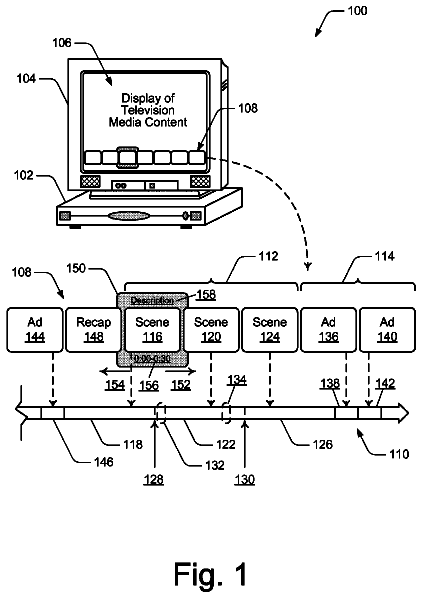
Program segments display bar
A program segments display bar is described.
US 8,768,146 B2 · Assignee: Microsoft Corporation · Inventors: Wagner; Mark et al.
Sheet 1 of 9 from the published document. All sheets in the USPTO PDF
Functionality is described for controlling the playback of a recorded media program. The functionality formulates initial playback decisions that govern the playback of the program based on a set of initial assumptions. The functionality then formulates modified playback decisions that define the manner in which the program should actually be played back. The modified playback decisions can be formed based on the playback-related behavior of a population of users who have previously consumed the same program. The functionality makes modifications which affect the playback of the recorded program based on the modified playback decisions, such as by bookmarking or truncating the recorded program.
Digital recording devices (e.g., DVRs) allow users to record media programs and to play back the media programs at times that are convenient for the users. More specifically, in a typical use scenario, a user identifies a program to be recorded from an electronic program guide (EPG). The DVR device then records the identified program at its scheduled presentation date and time. The DVR commonly records the program in its local store. At a later time, the user can activate the program, at which time the DVR plays the program from its local store. In actual practice, the EPG data contained in the EPG guide for a program may not exactly coincide with the actual presentation times of the program. For instance, the EPG guide may indicate that a program begins at 8:00 PM and ends at 10:00 PM, but the source which supplies the program may start the program at a time slightly prior to 8:00 PM, o
1 of 9 drawing sheets so far from the published document, cropped to the drawing. Every sheet is in the USPTO PDF.
What the patent claimed, word for word. All of it is now free to use.
This subject matter relates to strategies for presenting information to users. In a more particular implementation, this subject matter pertains to strategies for controlling the playback of media information to users at respective client devices.
Digital recording devices (e.g., DVRs) allow users to record media programs and to play back the media programs at times that are convenient for the users. More specifically, in a typical use scenario, a user identifies a program to be recorded from an electronic program guide (EPG). The DVR device then records the identified program at its scheduled presentation date and time. The DVR commonly records the program in its local store. At a later time, the user can activate the program, at which time the DVR plays the program from its local store.
In actual practice, the EPG data contained in the EPG guide for a program may not exactly coincide with the actual presentation times of the program. For instance, the EPG guide may indicate that a program begins at 8:00 PM and ends at 10:00 PM, but the source which supplies the program may start the program at a time slightly prior to 8:00 PM, or at a time slightly after 8:00 PM. Similarly, the source may potentially end the program at a time slightly prior to 10:00 PM, or at a time slightly after 10:00 PM. Typically these offset times are short, e.g., a few minutes, but these times can also be longer (e.g., in the case of sporting events that last longer than scheduled).
DVR devices are known to account for variation in presentation times by "padding" the starting and ending times of recorded programs. Consider the scenario shown in FIG. 1. As indicated there, EPG data indicates that a program 102 is scheduled to air from 8:00 PM to 10:00 PM. However, to account for the fact that this program 102 may potentially start slightly earlier than 8:00 PM or run slightly later than 10:00 PM, the DVR device can start recording the program 102 at a padded starting time 106, and stop recording the program 102 at a padded ending time 108. In operation, the DVR device will begin playing the program at the padded starting time 106, and will continue playing the program until the padded ending time 108 (unless, of course, the user stops the program 102 before then).
In many (and perhaps most) instances, however, the program may actually start at the scheduled starting time and terminate at the scheduled ending time. These times correspond to the actual starting time 110 and the actual ending time 112. In this scenario, when the user activates the program, the user will be presented with a terminal portion of a program 114 which precedes the program 102 on this channel. And if the user watches all of the recorded content, the user will eventually advance to a program 116 which follows the program 102.
The above-described kind of DVR behavior is disadvantageous for at least three reasons. First, the user may be displeased and/or confused to see the ending part of program 114 when the user activates the program 102. If the user understands why he or she is being presented with the program 114, the user can quickly advance forward in the recorded content to find the actual starting time 110, e.g., by activating a fast forward playback mode. Nevertheless, this operation may be cumbersome, especially if the user is required to frequently perform this operation. Second, the user may also be displeased to see the end of the program 114 because this might spoil the user's enjoyment of the program 114 (that is, if the user has also recorded this program 114 and intends to watch it in its entirety). Third, recording the program 102 such that it begins at the padded starting time 106 and ends at the padded ending time 108 is not efficient, as the DVR is consuming storage space to store superfluous content. For instance, for a 30 minute program, recording a five minute padding at the start of the program and at the end of the program increases the disk consumption for that recording by 33%.
For at least the above-identified exemplary reasons, there is a need for more efficient strategies for recording and playing back media information, as well as other kinds of information.
Functionality is described herein which address the needs set forth above, as well as other needs.
According to one exemplary implementation, functionality is described for recording a program based on initial playback decisions. For example, the initial playback decisions may specify that the program is to be recorded starting at a padded starting time and terminating at a padded ending time. The functionality then monitors the manner in which a population of users actually consumes the program, to provide actual event data. The functionality forms modified playback decisions based on the actual event data. Then, based on the modified playback decisions, the functionality makes modifications that may affect the playback of the recorded program. For example, the functionality can adjust the bookmarking of the recorded program such that the program begins to play at the actual starting time of the program and stops playing at the actual ending time of the program. In addition, or alternatively, the functionality can truncate the recorded program such that it conforms to the actual starting time and actual ending time of the program. Generally, in this approach, the actual starting and ending times are defined based on the collective behavior of the population of users.
According to another exemplary implementation, the functionality can collect actual event data that describes other aspects of the users' behavior as they consume the program. For instance, the actual event data can identify the fact that a statistically significant sample of users skipped over one or more parts of the program (corresponding to, for example, one or more commercials).
The above strategies confer a number of benefits. According to one exemplary benefit, the functionality eliminates or reduces the need for the users to manually scan through an initial padded portion of a recorded program to find the true start of the program. The users can advance automatically (or semi-automatically) to the true starting point of the program. According to another exemplary benefit, the recorded program can be trimmed to coincide with its true starting time and ending time. This helps reduce the amount of unnecessary program content that is stored by the functionality.
Additional exemplary implementations and attendant benefits of the functionality are described in the following, including a manual mode of operation in which a user is allowed to manually advance to the actual starting time of a recorded program.
The subject matter set forth in this Summary section refers to exemplary manifestations of the invention, and hence does not limit the scope of the invention set forth in the Claims section. More specifically, the Claims section may set forth aspects of the invention which are broader in scope than the concepts described in this Summary section.
FIG. 1 shows an example of a known technique for padding the starting and ending times of a recorded program.
FIG. 2 shows an exemplary system for controlling the presentation of a recorded program based on modified playback decisions, which, in turn, are derived from actual event data that reflects the playback behavior of a population of users.
FIG. 3 shows exemplary event processing functionality (EPF) for use in the system of FIG. 2, for producing the modified playback decisions.
FIG. 4 shows one example of the application of the EPF functionality of FIG. 3.
FIG. 5 shows exemplary details of client-side functionality for use in the system of FIG. 2.
FIG. 6 shows an exemplary user interface presentation that allows a user to invoke modified playback decisions produced by the EPF of FIG. 3.
FIG. 7 shows an exemplary procedure for forming the modified playback decisions.
FIG. 8 shows an exemplary procedure for processing, at the client device, the modified playback decisions produced according to the procedure of FIG. 7.
FIG. 9 shows an exemplary procedure for manually advancing to an actual starting time of a recorded program.
The same numbers are used throughout the disclosure and figures to reference like components and features. Series 100 numbers refer to features originally found in FIG. 1, series 200 numbers refer to features originally found in FIG. 2, series 300 numbers refer to features originally found in FIG. 3, and so on.
The following description sets forth strategies for recording information and controlling the playback of the information. In the context most often evoked in this discussion, the information corresponds to media information. The media information can include any information that conveys audio and/or video information, such as audio resources (e.g., music, spoken word subject matter, etc.), moving picture resources (e.g., audio-visual television programs, movies, etc.), computer programs (e.g., games, etc.), and so on. However, in a broader context, the information can correspond to any kind of data that can be consumed by a user in any fashion and in any environment.
This disclosure includes the following sections. Section A explains an exemplary system for governing the recording and playback of media information. Section B presents various flowcharts that describe the exemplary operation of the system of Section A.
A. Exemplary System (FIGS. 2-6)
Generally, any of the functions described with reference to the figures can be implemented using software, hardware (e.g., fixed logic circuitry), manual processing, or a combination of these implementations. The term "logic, "module" or "functionality" as used herein generally represents software, hardware, or a combination of software and hardware. For instance, in the case of a software implementation, the term "logic," "module," or "functionality" represents program code (and/or declarative-type instructions) that performs specified tasks when executed on a processing device or devices (e.g., CPU or CPUs). The program code can be stored in one or more computer readable memory devices.
More generally, the illustrated separation of logic, modules and functionality into distinct units may reflect an actual physical grouping and allocation of such software and/or hardware, or can correspond to a conceptual allocation of different tasks performed by a single software program and/or hardware unit. The illustrated logic, modules and functionality can be located at a single site (e.g., as implemented by a processing device), or can be distributed over plural locations.
A.1. Overview of the System (FIG. 2)
FIG. 2 shows one exemplary system 200 among many possible systems that can be used to record media information and govern the playback of the media information. By way of overview, the system 200 includes an operations center 202 for delivering streams of media information to a collection of client devices (204, . . . 206) via a coupling mechanism 208. In general, the indicated allocation of processing functionality (to be described) between the operations center 202 and the client devices (204, . . . 206) is merely exemplary; different implementations can vary the illustrated allocation of functionality in various ways.
The operations center 202 includes acquisition functionality 210 for supplying the media information from one or more sources 212 of such information. The sources 212 can represent any kind of entity which produces or provides media information, such as cable or satellite television providers, one or more Video-On-Demand (VOD) providers, one or more publishing houses of information, one or more library sources, any kind of Internet-enabled repository, and so on. The acquisition functionality 210 can comprise one or more server computers or other functionality dedicated to the task of retrieving the media information. The operations center 202 can optionally also include an information content store 214 for storing the media information prior to its dissemination to the client devices (204, . . . 206). The information content store 214 can be implemented as one or more databases and associated database management functionality.
The system operations center 202 also can include information dissemination functionality 216 for supplying media information to the client devices (204, . . . 206) via the coupling mechanism 208. This path is illustrated in FIG. 2 as path 218. Different systems may use the information dissemination functionality 218 in different ways. One exemplary system may use the information dissemination functionality 216 to transmit media information received from the acquisition functionality 210 in unicast fashion, multicast fashion, or a combination of unicast and multicast fashion. For example, co-pending and commonly assigned U.S. patent application Ser. No. 10/010,200, entitled, "ACCELERATED CHANNEL CHANGE IN RATE-LIMITED ENVIRONMENTS," naming the inventors of Geoffrey R. Smith et al., filed on Dec. 10, 2004, provides further exemplary details regarding one protocol for delivering resource information using a combination of unicast and multicast techniques. The information dissemination functionality 216 can be implemented as a collection of server modules (not shown) that facilitate the transmission of media information to the client devices (204, . . . 206).
Whatever delivery strategy is used, the operations center 202 can deliver media information to the client devices (204, . . . 208) using a variety of packaging paradigms. The media information can be expressed in any format, including, but not limited to, the MPEG-2 standard, Microsoft Corporation's VC-1 standard, the ISO/ITU H.264 standard, and so forth. The coded media information can be encapsulated into packets using any format, including, but not limited to, the Real Time Transport Protocol (RTP), the Real Time Streaming Protocol (RTSP), the Advanced Streaming Format (ASF), and so forth.
Finally, the operations center 202 also includes event processing functionality (EPF) 220. This functionality 220 is more specifically referred to as operations center (OC) event processing functionality (EPF) 220 to distinguish this functionality from counterpart functionality deployed at the local client sites. The purpose of the OC EPF 220 is to coordinate the recording and playback of programs. In the specific context of the present invention, the OC EPF 220 collects so-called actual event data which reflects the manner in which a pool of users have chosen to play back programs. The OC EPF 220 makes playback decisions based on this actual event data, and communicates such playback decisions to the client devices (204, . . . 206). The client devices (204, . . . 206) can use these playback decisions to govern the playback of recorded programs, such as by playing back the programs at starting and ending times that correspond to the actual starting and ending times of the programs. Additional information regarding the role of the OC EPF 220 is provided in the context of FIG. 3, to be discussed in turn.
The coupling mechanism 208 couples the operations center (OC) 202 to the client devices (204, . . . 206), and is therefore labeled in FIG. 2 as an OC-to-local coupling mechanism. This coupling mechanism 208 can be implemented in different ways to suit different technical and commercial environments. For instance, the coupling mechanism 208 can include any kind of network (or combination of networks), such as a wide area network (e.g., the Internet), an intranet, Digital Subscriber Line (DSL) network infrastructure, point-to-point coupling infrastructure, and so on. The coupling mechanism 208 can use or involve any kind of protocol or combination of protocols. In the case where one or more digital networks are used to disseminate information, the coupling mechanism 208 can include various hardwired and/or wireless links, routers, gateways, name servers, and so on. In the case where DSL infrastructure is used to disseminate information, the coupling mechanism 208 can utilize the services, in part, of telephone coupling infrastructure and DSL processing functionality.
The above-described architecture corresponds to a digital implementation of the invention, in which the operations center 202 forwards packetized media information to the users over a digital network. However, the principles described herein can be implemented in many other kinds of architectures. For instance, the principles can be implemented in a cable system architecture, in which the operations center 202 delivers media information (in analog and/or digital form) to cable set-top boxes via a cable routing infrastructure.
In any event, the architecture shown in FIG. 2 includes one or more downlink paths and one or more uplink paths. The downlink paths are used to forward media information to the client device (204, . . . 206). This is the use of path 218. In the context of the present invention, the downlink paths can also be used to forward modified playback decisions that are used by the client devices (204, . . . 206) to modify recorded programs. This is the use of path 222. The uplink paths can be used by the client devices (204, . . . 206) to forward various reporting data (such as actual event data) to the operations center 202. This is the use of path 224. The uplink and downlink paths can be implemented by the same communication mechanism, or by different respective communication mechanisms. For example, in one case, the operations center 202 can disseminate media information to the client devices (204, . . . 206) via a cable infrastructure, but rely on a telephone coupling path to transmit the actual event data from the client devices (204, . . . 206) to the operations center 202. Many other implementations are possible.
Now referring to the client-side aspects of the system 200, the client devices (204, . . . 206) can be implemented in different ways. A given client device (204, . . . 206) can represent a television set with integral IP interfacing/processing functionality, a television set with an associated set-top box coupled thereto, a digital video recorder (DVR) device, a rewritable digital video disc (DVD-RW) device, a personal computer having AV processing functionality, and so forth (as well as any combination of these devices). In whatever manner the client devices (204, . . . 206) are implemented, they can comprise a media processing module that is communicatively coupled to a media presentation module. For instance, the client device 204 includes media processing module 226 coupled to media presentation module 228, and the client device 206 includes media processing module 230 coupled to a media presentation module 232. The media processing modules (226, . . . 230) comprise functionality for processing the media information and performing other data processing functions, and the media presentation modules (228, . . . 232) comprise functionality for presenting the output of the media processing modules (226, . . . 230). The media processing modules (226 . . . 230) can be integrated with the media presentation modules (228, . . . 232), or the media processing modules (226, . . . 230) can be separate from (but coupled to) the media presentation modules (228, . . . 232).
FIG. 2 shows an overview of the exemplary composition of the representative client device 204. This device 204 includes the media processing module 226, which, in turn, can comprise client-side event processing functionality (EPF) 234. This functionality 234 performs whatever tasks are required to cooperate with the operations center 202 to record and play back media information according to the principles described herein. For example, the client-side EPF 234 can coordinate the user's selection of programs to be recorded, and the activation of previously recorded programs. The client-side EPF 234 can also coordinate the transmission of actual event data to the operations center via path 224; this data identifies the behavior of the user in consuming a program. The client-side EPF 234 can also govern the modification of stored programs in response to the modified playback decisions received via path 222.
In one implementation, the client device 204 records programs in a local content store 236. In another implementation, the operations center 202 can maintain a store (not shown in FIG. 2) for recording programs to be played back at the client devices (204, . . . 206).
As mentioned, the principles described herein can be implemented in many other kinds of architectures. In one alternative architecture, modified playback decisions can be formed in a distributed peer-to-peer (P2P) manner, that is, without the use of an operations center, or with at least reduced reliance on an operations center. In this case, client devices can directly transmit actual event data to peer client devices that reflect the users' behavior in consuming a program. The EPFs of the recipient client devices can each locally determine whether the actual event data exhibits statistically significant trends. If so, the EPFs of the client devices can generate modified playback decisions which will govern subsequent program playback. Any P2P routing paradigm can be used to distribute actual event data among the peers (e.g., CHORD, TAPESTRY, etc.).
Indeed, in a minimal case of local EPF implementation, a single client device can aggregate actual event data created by a user or users who watch a program using that client device. If a user or users consistently exhibit the same behavior while watching the program, then this pattern of behavior can be detected by the client device's local EPF and applied to subsequent viewings of the program. In this implementation, the client device need not transmit any actual event data to any other entity.
In another alternative architecture, multiple event processing functionalities (EPFs) can be used. These different EPFs can perform different tasks. For example, different EPFs can be used to process different kinds of programs. Or different EPFs can be used to process different kinds of events. These different EPFs can be administered by the same entity or possibly different respective entities. Moreover, EPFs can be administered by the same entity which delivers the media information, or by a different entity or entities. In any of these scenarios, users may be permitted to subscribe to one or more EPFs by paying a subscription fee. For example, a user can pay a monthly fee to receive an EPF that eliminates commercials in programs recorded on a given channel.
While various architectures can be used, to facilitate discussion, this disclosure will continue to feature the exemplary implementation shown in FIG. 2 in which a singular OC EPF 220 plays the primary role in forming modified playback decisions.
A.2. Exemplary Operating Center EPF (FIGS. 3 and 4)
FIG. 3 provides additional details regarding the operations center (OC) EPF 220 introduced in the context of FIG. 2. This functionality 220 can be implemented by one or more computer devices or other kind of processing functionality. One or more aspects of the OC EPF 220 can be alternatively allocated to the client-side EPF, e.g., client-side EPF 234.
To begin with, it is assumed that a pool of users 302 have recorded one or more programs to be consumed at times based on the individual respective preferences of the users 302. The system 200 (of FIG. 2) can store these programs at an operations center store 304 and/or at each of the client devices' (204, . . . 206) respective local stores (e.g., at the store 236 of client device 204). The system 200 stores these programs in accordance with so-called initial playback decisions. The initial playback decisions specify a default manner in which the programs are to be presented by the client devices (204, . . . 206). For example, the initial playback decisions might specify that each program is to be recorded based on the starting and ending times specified in an EPG guide, as modified by a leading padded offset and a trailing padded offset. In one example, this offset can comprise a five minute interval added to the beginning and end of the programs.
By way of overview, the basic purpose of the OC EPF 220 is to collect actual event data from the pool of users 302, and to use this data to make modifications which potentially affect the playback of the programs stored in the stores (304, 236). In other words, the OC EPF 220 receives event data from the pool of users 302, forms modified playback decisions based on this data, and uses the modified playback decisions to modify the initial playback decisions. Consider the following example. Based on received actual event data, the OC EPF 220 may determine that a statistically significant number of the users 302 actually started a program at the EPG-specified starting time, rather than the padded started time. The OC EPF 220 can marshal this event data to form modified playback decisions for this program. Namely, the modified playback decisions may specify, among other instructions, that the program should start at the EPG-specified starting time, rather than the padded starting time specified by the initial playback decisions. The OC EPF 220 can make modifications which will potentially affect the playback of the program stored in the stores (304, 236) based on the modified playback decisions, such as by bookmarking the program in accordance with the modified playback decisions, truncating the program in accordance with the modified playback decisions, and so forth. In general, some of these modifications affect the manner in which the program is played back without changing the actual content of the program itself. Other modifications may affect the recorded program content, such as by erasing part of the program.
When a user subsequently activates the program to consume it, the program can be played back in accordance with the modified playback decisions, eliminating the need for the user to manually find the starting point of the program. That is, in this approach, users who view the recorded program can effectively draw on the collective decision-making of a large number of users 302. This strategy also potentially reduces the amount of storage required to record the program by eliminating superfluous padding content (if this is appropriate).
Each of the components of the OC EPF 220 that enable the above-described manner of operation will be described in turn. In general, the OC EPF 220 itself includes an event data reception module 306, an event data store 308, an event analysis module 310, and a playback experience modification module 312.
To begin with, the event data reception module 308 collects so-called actual event data from a pool of users 310. The actual event data reflects the behavior of the users 302 when consuming programs. Exemplary behavior of these users can encompass a wide variety of actions, including, by not limited to the following actions: Actual event data may reflect the users' actions in advancing from a padded starting time (specified by the initial playback decisions) to an actual starting time. For example, assume that a user activates a program and notices that the end portion of a preceding program is being played. The user can advance to the actual starting time of the desired program by activating any type of program advancement command, such as a fast forward command, a skip command, and so forth. Actual event data may reflect the users' actions in ending their consumption of a program before the padded ending time (specified by the initial playback decisions). For example, assume that a user notices that the recorded program content runs beyond the end of the desired program. The user can terminate the recorded program by activating a stop command or a like command. Actual event data may reflect the users' actions in skipping portions of the program. For example, assume that the program contains one or more commercials that the user does not wish to watch. The user can skip these commercials by activating any type of program advancement command, such as a fast forward command, a skip command, and so forth. Actual event data may reflect the users' actions in performing any other program playback commands that deviate from the normal (1.times.) playback of the program. For instance, assume that a program contains a particularly interesting portion. The user might respond by activating a pause command or a slow-motion advancement command. Or perhaps the user might decide to "rewind" (move back) and watch an interesting portion of the program again. Alternatively, assume that a program contains a portion that does not interest the user. The user might respond by activating a fast forward command to quickly advance through this portion. These scenarios are merely illustrative; the user can activate a great variety of commands which temporally affect the playback of the program, deviating from the normal 1.times. playback of the program. Actual event data may reflect the users' actions that affect some non-temporal aspect of the playback of the program. For example, the user may decide to adjust the video component and/or the audio component of the program for any reason. The user may also activate close-captioning, high-definition mode, and so forth. These are merely illustrative examples of the manner in which the user can manipulate the program upon playback (without necessarily affecting the temporal aspects of the program's playback). Actual event data may reflect the users' actions that affect the manner in which the program is archived. For example, the user may consider a portion of a sports program as particularly noteworthy, and, in response, decide to more permanently archive this portion so that it can be repeatedly viewed without risk of erasure. Actual event data may reflect the timing at which users play back a recorded program. This might prove useful in various circumstances. For instance, suppose that a statistically significant number of users record a program on Saturday night, but actually watch the program on Monday night. Once this trend is detected on Monday night, modified playback decisions can be formulated to increase the "visibility" of this program within a user interface presentation used to select recorded programs. This provision potentially makes it easier for other users (who have not yet watched the program) to also select the program on Monday night.
Users can produce still other kinds of actual event data.
Moreover, as used herein, the term "program" should be liberally construed. In one case, a program refers to a unique piece of media content. In another case, a "program" may generally refer to a group of programs that bear some relationship, such as a series that includes multiple episodes. For example, assume that the program corresponds to a late night talk show, which reliably starts at 11:35 PM each day of the work week, although the EPG data states that this show begins at 11:30 PM. In this context, the users' behavior in watching this program, regardless of the specific content of the episodes, can be mined to extract meaningful trends, which can then be applied to improve user experience for future episode recordings of this program, regardless of the specific content of the future episodes.
Indeed, certain trends may even appear regardless of the programs that the users are watching. For example, users that watch programs late at night might decrease the volume so as to not disturb others in the household. Actual event data can be collected which reflects these kinds of program-independent trends. These trends can then be applied to formulate modified playback decisions that apply to program consumption late at night, independent of the programs being watched.
In any case, the event data reception module 308 can receive actual event data from the client devices (204, . . . 206) via any channel or mechanism, such as via exemplary path 224 shown in FIG. 2. The client device (204, . . . 206) can send event data to the event data reception module 308 on their own initiative in response to the occurrence of events during playback. Or the event data reception module 308 can periodically poll the client devices (204, . . . 206) to collect any new actual event data.
The event data reception module 306 can also receive actual event data from one or more so-called authorities 314. An authority may represent an individual who is entrusted to review a recorded program and to make various playback actions that govern the playback of the program for others. For example, this user may be entrusted to identify the starting and ending times of the program, to mark the locations of commercials, and so forth. The entity that administers the OC EPF can "hire" such an individual. Alternatively, one or more users in the general pool of users 302 may volunteer to serve the role of authoritative consumers of the program. Actual event data received from the authority 314, even though not endorsed by the behavior of a large number of users, may be heavily weighted by the OC processing functionality 220, because, by definition, the authority 314 is authorized to make qualified decisions regarding the manner in which the program should be played back.
In any case, the event data reception module 306 can store the actual event data in an event data store 308. This event data can be expressed in any manner, such as by bookmark data. The bookmark data identifies the temporal locations in the program at which events occur, and also identifies what is to happen at these locations.
The event module 310 retrieves the actual event data from the event data store 308 and performs analysis on this data. The basic role of the event analysis module 310 is to identify trends in the actual event data. That is, the event analysis module 310 attempts to determine whether a statistically significant number of users performed the same action at the same juncture in the playback of a program. If so, the event analysis module 310 makes the determination that this event is a significant event that should be potentially applied in automatic fashion or semi-automatic fashion to the recorded program, thus eliminating the need for future viewers to manually duplicate the actions made by the pool of prior users 302.
The event analysis module 310 can identify statistically significant events in different ways depending on different environments and other considerations. In one case, the event analysis module 310 can apply thresholding rules to determine when an event is statistically significant. For example, the event analysis module 310 can determine that a program actually starts later than a padded starting time by observing that more than a prescribed number of users have activated the fast forward command immediately after the program begins to play, or by observing that more than a prescribed percentage of the users who have recorded the program have made such an action, and so on. The event analysis module 310 can define the actual starting time in these circumstances by averaging the times at which the respective users began playing the program at a normal 1.times. playback mode. In another implementation, the event analysis module 310 can apply more advanced tools to determine the presence of statistically significant trends, such as by using clustering analysis, and so forth. The event analysis module 310 can also apply additional weight to any actual event data collected form authority sources 314, e.g., without requiring that such data meet prescribed significance-related thresholds, or by requiring that such data meet more relaxed significance-related thresholds.
The event analysis module 310 can formulate its conclusions regarding statistically significant events as so-called modified playback decisions. These decisions are "modified" in the sense that they may potentially be used to modify the initial playback decisions that were used to record the program. The event analysis module 310 can register these modified playback decisions in various ways. In one such technique, the event analysis module 310 can store the modified playback decisions in a table 316. In this example, the table 316 identifies actual starting times and actual ending times for a collection of programs, produced by averaging the starting times and ending times identified by the pool of users 302. Although not shown, this table 316 can store any other statistically significant event that has occurred during the playback of the program, such as the skipping of commercials, the activation of various so-called trick play modes, the activation of close-captioning, and so on.
In one exemplary variation, the event analysis module 310 can apply different rules, considerations, and interpretations to different types of programs. For instance, the event analysis module 310 can be configured such that different rules apply to actual event data collected during a sports program compared to actual event data collected during a movie, and so forth.
The playback experience modification module 312 uses the modified playback decisions to make modifications which potentially affect the playback of the programs that were stored in the OC content store 304 and/or the local content stores (e.g., local content store 236 of client device 204). As described above, modification can take various forms, such as by altering the bookmarking of the programs (which may or may not affect the content of the recorded programs), truncating the programs (by deleted certain superfluous portions from the programs), and so forth. In one case, the playback experience modification module 312 can automatically perform these modifications. In another case, the playback experience modification module 312 can give future consumers of the programs the option of invoking the modified playback decisions, such that these decisions are not automatically applied.
More specifically, in one implementation, the playback experience modification module 312 can make the modifications by actually executing the instructions associated with the modified playback decisions, sending instructions that may affect the OC content store 304 and/or the local content stores of the clients (204, . . . 206). In another scenario, the playback experience modification module 312 can make the modifications by forwarding the modified playback decisions to the client devices (204, . . . 206), upon which the client devices (204, . . . 206) execute the instructions associated with the modified playback decisions (possibly in an "offline" manner after receipt). In other words, in this latter case, the playback experience modification module 312 acts principally as a conduit for the decisions, not the actual executor of the decisions. As a definitional matter, any information transmitted by the operations center 202 to the client devices (204, . . . 206) is referred to as "modified playback decisions," whether such information pertains to the yet-to-be executed decisions, or instructions generated in response to the execution of those decisions. In another implementation, the entire playback experience modification module 312, or parts thereof, can be implemented on a local level by the client devices (204, . . . 206).
The description continues in the full USPTO document.
About 6,377 words. The USPTO PDF has it with every drawing.
Fees are due 3.5, 7.5 and 11.5 years after grant. This patent expired on July 1, 2026, so the fee marked "not paid" was the one that went unpaid.
Strategies for controlling presentation of media information based on a sampling of customer playback behavior
Filed Oct 2005 · published Apr 2007Strategies for controlling presentation of media information based on a sampling of customer playback behavior
Filed Oct 2005 · granted Jul 2014Earlier publications, parents and continuations. None of them can still be enforced, or this patent would not be listed.
Prior art cited by the examiner or applicant. Useful when you check your own idea for novelty.
Everything on this page comes from the documents linked above.