 Lapsed, fee not paid22 drawings
Industrial Equipment · US 8,764,884 B2
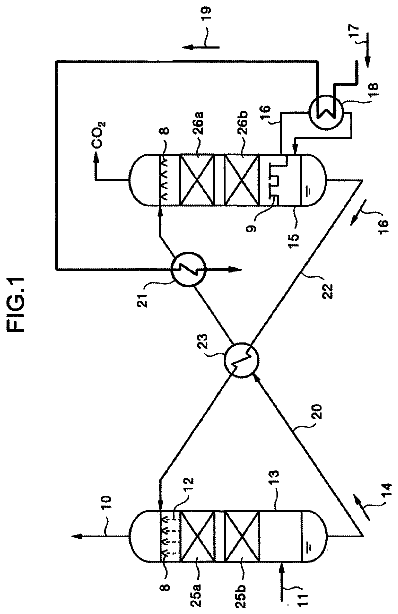
CO.sub.2 recovery system and method
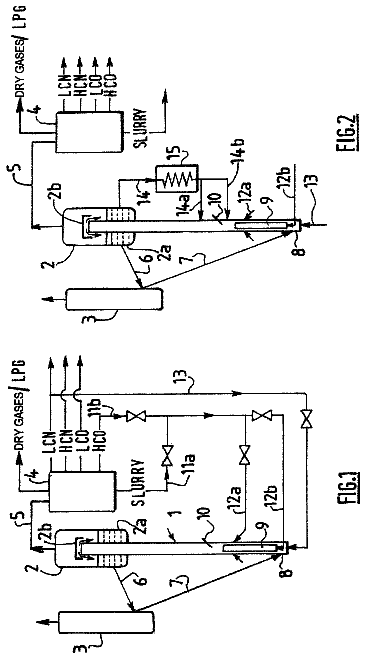
A CO.sub.2 recovery system includes an absorption tower and a regeneration tower.
US 8,764,897 B2 · Assignee: Aoki Science Institute Co., Ltd. · Inventors: Aoki; Hisaharu et al.
Sheet 1 of 6 from the published document. All sheets in the USPTO PDF
An oil type release agent is provided, containing 70 to 98 parts by weight of solvents having dynamic viscosity of 2 to 10 mm.sup.2/s at 40.degree. C. and a flash point in the range of 70 to 170.degree. C., 1 to 10 parts by weight of high viscosity mineral oils and/or synthetic oils having dynamic viscosity of 100 mm.sup.2/s or higher at 40.degree. C., 15 parts by weight or less of a silicone oil having dynamic viscosity of 150 mm.sup.2/s or higher at 40.degree. C., and 1 to 5 parts by weight of additives having a lubricating function. The flash point of the agent is in the range of 70 to 170.degree. C., and the dynamic viscosity of the agent is 2 to 30 mm.sup.2/s or higher at 40.degree. C.
As is well known, in die casting, to lubricate the cavity part of a die, an oil film is formed on the cavity surface of the die by spraying a lubricant called as a release agent after die opening. The oil film prevents a cavity from soldering of a non-ferrous molten metal of such as aluminum, magnesium and zinc on the cavity and makes possible casting continuously. The release agents for die casting are broadly classified into the oil type release agent and a water soluble type release agent. In terms of the productivity, the safety, and the work environments, the water soluble type release agent has often been used in recent years. However, before 40 years ago, a release agent was only oil type (hereinafter, referred to as old oil type release agent) containing solid matters of lard, powder and graphite with which machinery is made sticky after use. Users diluted the agent with an econo
1 of 6 drawing sheets so far from the published document, cropped to the drawing. Every sheet is in the USPTO PDF.
What the patent claimed, word for word. All of it is now free to use.
This application is based upon and claims the benefit of priority from prior Japanese Patent Applications No. 2004-252056, filed Aug. 31, 2004; No. 2005-107556, filed Apr. 4, 2005; and No. 2005-157616, filed May 30, 2005, the entire contents of all of which are incorporated herein by reference.
The present invention relates to an oil type release agent for die casting, a method for setting a solvent mixing ratio, a casting method using the oil type release agent, and a spray unit. The invention is also applicable for a plunger chip as a lubricant.
As is well known, in die casting, to lubricate the cavity part of a die, an oil film is formed on the cavity surface of the die by spraying a lubricant called as a release agent after die opening. The oil film prevents a cavity from soldering of a non-ferrous molten metal of such as aluminum, magnesium and zinc on the cavity and makes possible casting continuously. The release agents for die casting are broadly classified into the oil type release agent and a water soluble type release agent. In terms of the productivity, the safety, and the work environments, the water soluble type release agent has often been used in recent years.
However, before 40 years ago, a release agent was only oil type (hereinafter, referred to as old oil type release agent) containing solid matters of lard, powder and graphite with which machinery is made sticky after use. Users diluted the agent with an economical kerosene or solvent and sprayed the diluted agent. However since the old oil type release agent contained a powder, the powder scattered in the peripheral areas of the die during casting, worsened the work environments and deposited on the die. Thus frequent cleaning was indispensable. The old oil type release agent was mixed with kerosene which had a low flash point. It was so risky as to cause a fire and thus made automation of die casting difficult. Because of this reason, the old oil type release agent was applied manually, resulting in low production efficiency. Further, since the refining degree of the kerosene was low and trace components such as sulfur or the like were contained, the agent might inevitably cause adverse effects on the human body and emitted intense oily smell. That is, the old oil type release agent had risks of fire and explosion, was unsuitable for automation, polluted the working environments with oil and powders, and inevitably required periodic cleaning works.
Because of the above described situations, the old oil type release agent was changed to the water soluble type release agent with less risk of firing for automation. It is no exaggeration to say that 99% of release agents made commercially available are water-soluble-type release agents now. On the other hand, very a few oil type release agents containing no solid matter (hereinafter, referred to simply as highly viscid oil type release agent) have continuously been used. Such oil type release agents have an excellent lubricating property. However, the viscosity is very high (dynamic viscosity at 40.degree. C. is 100 mm.sup.2/s or higher) and even if they are sprayed, the produced mist has a large diameter. Therefore, the agents are unsuitable for automatic spraying and consequently consumed much, and the oil components of them are entrained and gasified in the flow of molten metal to remain in the form of gas in cast products and accordingly result in increase of the porosity. Consequently, utilizing the excellent lubricating property of them, the old oil type release agents have presently been used only for warm-up operation before applying the water soluble type release agent.
On the other hand, the water soluble type release agent free from the risk of the fire has a crucial defective point in the capability. Since the agent is diluted with water about 80 times as much at the time of use, 99% of the main component are water and therefore the agent causes Leidenfrost phenomenon on the die at around 150.degree. C. That is, the release agent mist is explosively evaporated around 150.degree. C. and the die surface is covered with a steam film. Therefore the release agent mist, which comes next, cannot arrive at the die surface. This causes the decrease of the adhesion amount of active components in the release agent on the die surface. To increase the adhesion amount, the die temperature is kept below the Leidenfrost temperature by spraying a large quantity of the water soluble type release agent while scarifying the adhesion efficiency. As a matter of fact, presently the spray amount is approximately the same as the number of the tons of the locking force of a casting machine (e.g. about 350 cc for a 350 t-machine, about 2500 cc for a 2500 t-machine). Naturally, the peripheral areas of the machine become dirty, the waste fluid is much, thereby it is required much labor and cost for cleaning and waste fluid treatment. Also, since almost all the water soluble type release agents contain waxes, solidified waxes adhere to the die surface and deposit to peripheral areas of the machine. It requires frequent cleaning. Not only the pollution in the peripheral areas of the machine due to the precipitation and adhesion of the release agent's components, but also oxidation deterioration of the components has to be taken into consideration. Patent Document 1 (Jpn. Pat. Appln. KOKAI Publication No. 8-103913) describes the use of an oxidation prevention agent for suppressing oil component deterioration in the water soluble type release agent. The invention aims the pollution prevention of a die in a rubber vulcanization process. And it also discloses a countermeasure for apparently decreasing stains on the die.
Further, the die is heated to about 200 to 350.degree. C. with aluminum molten metal every shot and thereafter cooled to about 100 to 150.degree. C., with the water soluble type release agent. The temperature of the die surface fluctuates from 100 to 200.degree. C. in every shot. Consequently, after continuous casting for a long duration (several thousand times for a large scale die and several ten thousand times for a small scale die), thermal fatigue is accumulated in the die surface, so-called cracks are formed and finally the costly die is broken. This is the present situation.
Further, since the water soluble type release agent has a strong cooling capability, the molten aluminum injected into the cavity is cooled within a short time. The viscosity of the molten metal is increased to disturb the molten metal flow. Finally the molten metal can not reach to every fine corner of the cavity. As a result, so-called "misrun" and "shrinkage" phenomena occur and make it impossible to produce a complete cast product. Also, since the adhesion efficiency of the water soluble type release agent is low, the oil film on the metal surface is thin. Soldering may often occur at high temperature portions of the die, especially thin parts like core pins.
Porosity, which decreases the strength of the cast product, is also a problem. The cause of the porosity is to entrain organic matters and water into turbulent flow of the molten metal and to gasify in the casting product. If an excessive amount of the release agent is sprayed, the porosity increases. In the past, to lower the porosity, Patent Document 2 (Jpn. Pat. Appln. KOKAI Publication No. 2000-33457) disclosed a powder type release agent having excellent releasing capabilities.
In the above-mentioned current situation, it has been desired to improve the disadvantageously low adhesion efficiency of the water soluble type release agent, to improve the spraying property of highly viscus oil type release agent while keeping the excellent lubrication property, and to make it possible to achieve "very small amount of spray", "long die lie" and "less waste fluid".
The present invention aims to provide the oil type release agent without formulating water. The oil type release agent enables the long die, life less waste fluid, excellent releasing lubricating property at a high temperature and very small amount of spray. By setting appropriate viscosity at 40.degree. C., very small amount of spray is achieved resulting in less vapor scatting in air.
Also, the invention aims to provide a setting method of a solvent mixing ratio at which the Leidenfrost phenomenon can be avoided by setting the mixing ratio of two kinds of solvents, or a solvent with mineral oils and/or synthetic oils at the time of die casting using the above-mentioned oil type release agent for die casting.
Further, the invention aims to provide the oil type release agent for die casting, a casting method, and a spraying unit by which the spraying amount can be saved as compared with that in conventional methods and problems such as galling, flow line, metal wave, and porosity can be solved.
1) In order to achieve the above-described objects, the oil type release agent of the invention (first invention) contains: (a) 70 to 98 parts by weight of solvents having dynamic viscosity of 2 to 10 mm.sup.2/s at 40.degree. C. and having the flash point in the range of 70 to 170.degree. C.; (b) 1 to 10 parts by weight of a high viscosity mineral oils and/or synthetic oils having dynamic viscosity of 100 mm.sup.2/s or higher at 40.degree. C.; (c) 15 parts by weight or less of a silicone oil having dynamic viscosity of 150 mm.sup.2/s or higher at 40.degree. C.; and (d) 1 to 5 parts by weight of the additives having a lubricating capability, wherein the flash point of the agent is in the range of 70 to 170.degree. C., and dynamic viscosity of the agent is 2 to 30 mm.sup.2/s at 40.degree. C.
According to the first invention, the oil type release agent contains no water to avoid inhibition of the lubricating property and provides lubrication because of oil components. It is particularly excellent in the releasing lubricating property at the high temperature. Further, since no water is contained, the die is not cooled with the release agent. Thus the die life is prolonged, the scattering of the agent in air is decreased and the die casting is carried out free from the waste fluid. Particularly, the agent is suitable for automatic continuous spraying and excellent in application of a small amount of a neat liquid and wettability. Further, according to the first invention, the oil type release agent enables the smaller spraying amount than the conventional agent and the reduction of die casting problems such as galling, flow line, metal wave and porosity.
2) The invention (the second invention) provides a method for setting a mixing ratio of the solvent in the oil type release agent to avoid Leidenfrost phenomenon at the time of die casting. Two or more kinds of solvents can be used as the solvents for mixing. The method consists of the first, second, third and fourth steps. The first step is to interpolate the expected highest use temperature (S) in the following equations
and
for calculating a needed flash point (F) of the release agent to be formulated. The second step is to measure flash points for three or more different release agents having different concentrations of the respective solvents. The third step is to make a graph on the correlation between the % values by weight of the solvent in each release agent and the flash point of each release agent. The fourth step is to estimate the % value by weight of the solvent in the release agent to be formulated from the graph and the needed flash point which was calculated from in the first step. S+80=L
L=4.4.times.F+36
where S denotes the highest temperature for use of a release agent; L denotes Leidenfrost phenomenon temperature; and F denotes the flash point of the release agent.
According to the second invention, it is possible to avoid Leidenfrost phenomenon at the time of die casting using the oil type release agent.
3) The invention (the third invention) provides a method for setting a mixing ratio of the solvent with the mineral oil and/or synthetic oil. The purpose is to avoid Leidenfrost phenomenon at the time of die casting using the oil type release agent according to claim 1. The method comprises the steps of interpolating an expected highest use temperature (S) in the above equations
and
for calculating an flash point (F) of a release agent; preparing three or more different release agents having different concentrations of the respective solvents, mineral oils and/or synthetic oils; investigating the flash point for each prepared release agent; producing a graph of the correlation of the % by weight of the solvent in each release agent and the flash point of each release agent; and calculating the % by weight of the solvent in the release agent from the graph and the flash point calculated from the equations
and (2).
The third invention has the same effect as that of the second invention.
4) A casting method of the invention (the fourth invention) involves die casting by using the oil type release agent of the above-mentioned 1) with a release agent application machine. According to the fourth invention, the casting method capable of die casting using the oil type release agent of the first invention is provided.
5) A spray unit of the invention (the fifth invention) is the spray system for spraying and applying the oil type release agent according to the above-described 1) to a die. This system comprises a release agent spray unit with multiple spray nozzles to apply the oil type release agent to the die surface and a pressurized delivery unit which supplies the release agent under a low pressure condition to the spray unit and applies the small amount of the release agent to the die. According to the fifth invention, it is possible to spray the oil type release agent which is described in the first invention.
6) The invention (the sixth invention) provides a casting method for carrying out die casting using the spray unit according to the above-described 4) and the oil type release agent.
FIG. 1A is a front view of a movable die employed in Examples of the invention.
FIG. 1B is a front view of a fixed die employed in Examples of the invention.
FIG. 2 is a schematic explanatory drawing of a spray system of the invention.
FIG. 3 is an explanatory drawing of the spray unit, one of constituents of the spray system drawn in FIG. 2.
FIG. 4 is an explanatory drawing of a pressurized delivery unit, one of constituents of the spray system drawn in FIG. 2.
FIG. 5 is a schematic explanatory drawing of an adhesion tester to be used for measuring the adhesion amount of releasing agent of the invention.
FIG. 6A is an explanatory drawing showing the state that a release agent is sprayed from a nozzle for measuring the friction force over a specimen.
FIG. 6B is an explanatory drawing showing the state that a ring is put on a tester main body through a test stand.
FIG. 6C is an explanatory drawing showing the state that the friction force is measured.
FIG. 7 is a characteristic graph showing the correlation of the flash points of various kinds of release agents with Leidenfrost temperature and maximum use temperature.
FIG. 8 is an explanatory drawing of an apparatus for measuring the Leidenfrost temperature.
FIG. 9 is a characteristic graph showing the correlation between the solvent concentration and the flash point.
Hereinafter the invention will be described in detail.
The oil type release agent for die casting of the invention (the first invention) contains (a) 70 to 98 parts by weight of solvents having dynamic viscosity of 2 to 10 mm.sup.2/s at 40.degree. C. and the flash point in the range of 70 to 170.degree. C.; (b) 1 to 10 parts by weight of the mineral oils and/or synthetic oils having dynamic viscosity of 100 mm.sup.2/s or higher at 40.degree. C.; (c) 15 parts by weight or less of a silicone oil having dynamic viscosity of 150 mm.sup.2/s or higher at 40.degree. C.; and (d) 1 to 5 parts by weight of additives having a lubricating function, wherein the flash point of the agent is in the range of 70 to 170.degree. C., and dynamic viscosity of the agent is 2 to 30 mm.sup.2/s at 40.degree. C.
The component (a) of the above-mentioned
is a highly volatile and low viscosity component and is to be evaporated in the die surface. In this connection, taking the effect on the human body into consideration, any solvents with high polarity such as alcohols, esters, and ketones should not be used, and a petroleum type solvent containing mostly saturated components and a low viscosity base oil are preferable. Examples of them are saturated solvents and low viscosity synthetic oils which are highly refined to suppress a sulfur component to 1 ppm or lower. The dynamic viscosity at 40.degree. C. is specified to be of 2 to 10 mm.sup.2/s in the above-mentioned (a). When the viscosity of the solvent is too low like 2 mm.sup.2/s or lower, the viscosity of entire release agent becomes too low as well. On the other hand, when the viscosity of the solvent is too viscous like 10 mm.sup.2/s or higher, the viscosity of entire release agent becomes too viscous as well. Further, the ratio of the above-mentioned (a) is adjusted to be 70 to 97 parts by weight for optimizing volatile of the entire release agent.
The flash point of the above-mentioned component (a) of
is adjusted to be in the range of 70.degree. C. to 170.degree. C. because of the following reasons. That is, to form a thick oil film on the die surface, just like the case of a quick dry type paint, it is better to evaporate solvents so quickly as to avoid dripping of once adhered components from the die surface. Therefore it is desirable to have a high evaporation speed. However, if the evaporation speed is too fast, Leidenfrost phenomenon may occur as seen with the water soluble type release agent. Therefore those solvents having a high evaporation speed like gasoline are not preferable. Further, if the evaporation is fast, the flash point becomes low resulting in a high risk of a fire accident. Accordingly, the flash point is adjusted to be higher 43.degree. C., which is the flash point of old oil type release agents containing kerosene. And it is preferable to be higher than the flash point (70.degree. C.) of automotive diesel fuel from the practical standpoint. Therefore, the flash point of the composition of the invention is defined to be 70.degree. C. or higher.
On the other hand, in the case of the die with a high temperature, the higher flash point is preferable to suppress the evaporation property of the release agent. However the viscosity of the release agent also becomes higher. If the viscosity is high, the sprayed state of the release agent is worsened. There should be an upper limit on viscosity. The upper limit of the viscosity corresponds to the flash point of 170.degree. C. and accordingly, the flash point is determined to be 170.degree. C. or lower.
With respect to the (a) component of the above-mentioned (1), mineral oils and/or synthetic oils with low viscosity may be added to the above-mentioned solvents to adjust the amount to be 70 to 98 parts by weight in total. In the case where the (a) component is only solvent, two or more kinds of solvents may be used. In the case of no adjustment on the basis of Leidenfrost phenomenon, one kind of solvent may be used alone.
The mineral oils and/or synthetic oils with high viscosity, which are the component (b) of the above-mentioned (1), are adhered on the die surface. The adhered components consequently make the lubricating film thick at a temperature range of about 150 to 300.degree. C. and accordingly take a role of keeping the lubrication. These components are required to have an appropriate viscosity at the die temperature to prevent dripping of the adhering oil from the die surface for several seconds which correspond to the time from spray to injection of molten metal. However, the die temperature differs in a respective die machine. Even in the same machine, the temperature differs in the portions of the die. Therefore, the die temperature is assumed to be 150.degree. C. or higher in the entire body and the dynamic viscosity of the mineral oils and/or synthetic oils with high viscosity at 40.degree. C. is adjusted to be 100 mm.sup.2/s or higher.
Further, if the mixing amount of the (b) component is low, the lubricating film on the die surface becomes thin. If the mixing amount is too high, problems may occur. One is that spraying state becomes instable. The other is that the thick lubricating film may causes the appearance change of a cast product partially (so-called remaining color). To deal with these problems, the addition amount of the component (b) is determined to be 1 to 10 parts by weight. Examples to be used as the component (b) are petroleum type mineral oils, synthetic oils, and cylinder oils.
The silicone oil, which is the component (c) of the above-mentioned (1), is for fortifying the lubricating property at a high temperature. The component is determined to be silicone oil having a dynamic viscosity of 150 mm.sup.2/s or higher at 40.degree. C. in an amount of 15 parts by weight or less. This component is also for keeping the lubricating property at a temperature as high as about 250.degree. C. to 400.degree. C. by adhering to the die surface. Since it is expected to keep the lubricating property in a higher temperature range than that of the highly viscous mineral oil of the component (b), the dynamic viscosity at 40.degree. C. is preferably higher than that of the component (b), that is 150 mm.sup.2/s or higher.
With respect to the "silicone oil" of the component (c) of the above-mentioned (1), in the case where a cast product is not coated, any commercialized silicone oils including dimethyl silicone may be used. However, in the case of coating, it sometimes becomes difficult to form a coating with good adhesion. Therefore dimethyl silicone is undesirable in some cases, although its acceptability depends on the coating amount to the die casting product. In such a case, it is preferable to select alkyl silicone oil having alkyl-aralkyl or a long chain alkyl group longer than dimethyl function.
The amount of the component (c) of the above-mentioned
is determined to be "15 parts by weight or less". The reason is that silicon itself or silicon decomposition products are deposited on the die surface to cause a bad effect on the shape of the cast product if it exceeds 15 parts by weight. In the case where the die is used at a low to middle temperature (lower than 250.degree. C.), silicon oil is not necessary to formulate since additives having the lubricating property are added as the component (d). In the case of the use at a high temperature (250.degree. C. or higher) silicone oil, which is hard to be decomposed, should be formulated. However, in terms of the cost, the addition amount of the silicone oil is preferable to be low. The additive having the lubricating property, which are the component (d), may include, for example, an organic molybdenum.
The additives having the lubricating property, which are the component (d) of the above (1), fortifies the lubricating property at a low to middle temperature. The additives may include, for examples, animal and plant fats such as rapeseed oil, soybean oil, coconut oil, palm oil, beef tallows oil, and lard; esters of monohydric alcohol or polyhydric alcohols with higher fatty acids such as fatty acid esters, coconut oil fatty acids, oleic acid, stearic acid, lauric acid, palmitic acid, and beef tallow fatty acids; organic molybdenum; oil-soluble soaps and oily waxes. The organic molybdenum is preferably, for example, MoDDC and MoDTC, but MoDDP and MoDTP are not preferable due to a possibility to cause reaction of aluminum and a phosphorus component. Examples of the oil-soluble soaps may include sulfonated salts, phinate salts, and salicylate salts of Ca or Mg. Organic acid metal salts can be exemplified, although the solubility is not satisfactory.
For the invention, the combinations of the above-mentioned solvent having the described viscosity and flash point with mineral oils and/or the synthetic oils may be four kinds; a solvent alone, a solvent in combination with mineral oils, a solvent in combination with a synthetic oils, and a solvent in combination with a mineral oil and a synthetic oil. The solvent is not limited to one kind and two or more kinds of solvents may be used in combination. But, petroleum type solvents are preferable from a viewpoint of health of workers. The above-mentioned mineral oils may include machine oils, turbine oils, spindle oils and cylinder oils. Synthetic esters can also be used.
In the invention, the flash point of the release agent is required to be from 70 to 170.degree. C. Herein the lower limit value of 70.degree. C. is for lowering the risk of a fire. This value is higher than the flash point of kerosene (about 40.degree. C.), which was used in the old type release agents. Therefore, this enables to apply the oil type release agent to the automatic die casting process. The upper limit value of the flash point is determined to be 170.degree. C. because of the following reasons. That is, if mineral oils or synthetic oils with a high viscosity (that is high flash point) are used, the oil film adhering to the die cannot be dried out resulting in dripping off from the die surface. Due to the dripped-off oil portion, the adhesion efficiency on the die surface becomes worsen and ambient environments become worsen. Accordingly, to avoid the problem, the flash point should be 170.degree. C. or lower.
The dynamic viscosity of the release agent at 40.degree. C. has to be 2 to 30 mm.sup.2/s. The reasons are as follows. If the dynamic viscosity is lower than 2 mm.sup.2/s, pump wear increases at the time of applying the release agent. If it exceeds 30 mm.sup.2/s, pumping up of the agent at the time of application of the release agent becomes difficult resulting in instable. If the control becomes instable, application of 20 cc or less becomes difficult. If the control becomes difficult, spray amount of the release agent fluctuates every shot and accordingly stable castability cannot be maintained. The dynamic viscosity is more preferably in the range of 2 to 20 mm.sup.2/s for more stable spray amount and more finer mist formation.
The oil type release agent of the first invention has following merits against conventional water soluble type release agents:
1) The oil type release agent does not cause quenching reaction;
2) The agent has a high heat resistance and anti-soldering property;
3) The agent prolongs the die life and contributes to no waste fluid disposal;
4) The adhesion efficiency can be kept at an appropriate oil film thickness by the flash point adjustment from 70 to 170.degree. C. level. Thus the high temperature lubricating property can be ensured;
5) It makes possible to optimize spraying characteristics and minimize scattering of the agent in air by setting the dynamic viscosity at 40.degree. C. within a proper range from 2 to 30 mm.sup.2/s;
6) It reduces die casting problems such as galling, and soldering by forming and uniform oil film on the die surface even the spray amount is small and the oil film is thin; and
7) It also reduces a blister problem at the time of thermal treatment process for the die casting product because of thin oil film.
In the first invention, the spray amount of the release agent to the die is desirably 20 cc or less, more preferably 1 cc or less, and more preferably 0.5 cc or less for every shot on the basis of the neat liquid. The reason for this is because if the spray amount exceeds 20 cc, it becomes difficult to carry out casting with no waste fluid generation, and the amount of the gas entrained in a cast product is high level resulting in high level of the porosity. As described, since the spray amount is 20 cc or less, waste liquid-free casting can be achieved. Also for the same reason, the gas entrainment in a cast product is decreased. Further, since neither powder nor wax is used, too much adhesion and solid accumulation on the die casting machine are prevented.
The reason of the above-mentioned soldering is supposed to occur with too thin oil film between the cast product and the die surface. Particularly, the soldering occurs frequently in the projection parts just like core pins. Generally, it is said that the core pins are in portions where sprayed mist is less led and the oil film there becomes thinner than other portions. Additionally, if the continuous casting is started using the oil type release agent, the die gradually becomes hot because no external cooling function is with the agent. The adhesion amount of the release agent on the die surface decreases with the temperature increase, oil film is thermally deteriorates and thus the oil film becomes thinner. To solve such a problem, there are methods in which a wettability improving additive is added to increase the adhesion amount for fortifying the oil film or an antioxidant is added to retard the thermal deterioration of the oil film.
Accordingly, in the first invention, it is preferable to add the wettability improving additive or antioxidants besides the respective components (a) to (d) of the above-mentioned (1). As the wettability-improving additive, for example, 0.1 to 3 parts by weight of acrylic copolymers or acryl-modified polysiloxanes with the flash point of 100.degree. C. or lower may be added. In the above-mentioned range on the addition, the wettability improving additive has an adhesive effect although it is an agent for improving the wettability. Herein, if the wettability improving additive is added, the wettability of the release agent to the metal surface is improved resulting in the increase of adhesion amount on the metal surface. Especially, if the metal surface is quite hot, the phenomenon (Leidenfrost phenomenon) occurs. Because of this, that lightweight components of the release agent are bumped abruptly and oil mist droplets are kept from wetting the metal surface. Thus the film formation on the metal surface is inhibited. Since the wettability is improved due to the wettability improving additive, such a phenomenon is suppressed and the oil film is made thicker.
It is also preferable to add the antioxidants, 0.2 to 2 parts by weight in total of one or more kinds of antioxidants which are selected from a group consisting of amine type, phenol type and cresol type antioxidants. This component is added for preventing or retarding the oxidation deterioration at the time of high temperature operation, keeping the thickness of the oil film, ensuring the lubricating function, and inhibiting a soldering occurrence.
Examples of the above-mentioned amine type antioxidants are monoalkyldiphenylamine types such as monononyldiphenylamine; dialkyldiphenylamine types such as 4,4'-dibutylphenlamine, 4,4'-dipentyldiphenylamine, 4,4'-dihexyldiphenylamine, 4,4'-diheptyldiphenylamine, 4,4'-dioctyldiphenylamine, and 4,4'-dinonyldiphenylamine; polyalkyldiphenylamines such as tetrabutyldiphenylamine, tetrahexyldiphenylamine, tetraoctyldiphenylamine, and tetranonyldiphenylamine; .alpha.-naphthylamine, phenyl-.alpha.-naphthylamine, butylphenyl-.alpha.-naphthylamine, pentylphenyl-.alpha.-naphthylamine, hexylphenyl-.alpha.-naphthylamine, heptylphenyl-.alpha.-naphthylamine, and octylphenyl-.alpha.-naphthylamine.
Examples of the above-mentioned phenyl type antioxidants are 2,6-di-tert-butyl-4-methylphenol, 2,6-di-tert-butyl-4-ethylphenol, 4,4-methylenebis(2,6-di-tert-butylphenol), 2,2-methylenebis(4-ethyl-6-butylphenol), high molecular weight mono-cyclic phenols, polycyclic tert-butylphenols, BHT (butylated hydroxy toluene), BHA (butylated hydroxy anisole). Examples of cresol type antioxidants are di-tert-butyl-p-cresol and 2,6-di-tert-butyl-dimethylamino-p-cresol. Among the above-mentioned antioxidants, mixtures of BHT with alkyldiphenylamines are preferable.
In the invention, antirust agents, surfactants, preservers, defoaming agents, and other additives (e.g., extreme pressure additives, viscosity index improvers, cleaning dispersants, coloring agents, and fragrant agents) may be added properly.
In the invention, with respect to the above-mentioned oil type release agent containing the respective components (a) to (d), after one to three optional components among these components are previously mixed to obtain a mixture and then the remaining components may be mixed with the mixture to obtain the release agent. Specifically, the components (b), (c), and (d) are previously mixed to obtain a mixture 1 and successively a user may mix the component (a) with the mixture 1 to form the release agent. Also the components (a) and (b) are mixed to obtain a mixture 2 and later a user may mix a mixture 3 of the components (c) and (d) with the mixture 2 to obtain the release agent.
Also, among the five components including the respective components (a), (b), (c), and (d) and additionally a wettability improving additive or an antioxidant (defined as a component [e]), one to four optional components are previously mixed to obtain a mixture. And then the remaining components may be mixed with the previous mixture to obtain the release agent.
A low viscosity oil type release agent has many advantageous points. However it also has disadvantageous points due to a small amount spray of water free type agent. The die surface is not cooled externally. The die temperature fluctuation is slight in one cycle of die casting. And then the steady state is kept at a high temperature. Herein, if the temperature is about 350.degree. C. or lower, there is no problem at all and the advantageous points of the low viscosity oil type release agent can be utilized as they are. However, if the temperature is higher than that, soldering sometimes occurs between the cast product and the die, and it becomes difficult to carry out continuous casting. As another inferior point, it is sometimes required to reform a die system for reinforcing internal cooling for the oil type release agent where an oil type release agent is to be used for an already existing casting machine which is operated mainly in an external cooling manner by spraying a large amount of the water soluble type release agent to a die. Further, for reasons relevant to the die structure or product shape, inner cooling is sometimes impossible. Therefore, it is desired to develop an oil type release agent provided with a high temperature lubricating property and capable of dealing with the Leidenfrost problem without reforming the machine.
A setting method of the solvent mixing ratio of the invention (the second invention) is carried out based on the above-mentioned background. That is, the second invention is the method for setting a mixing ratio of the above-mentioned solvent to avoid Leidenfrost phenomenon at the time of die casting using the oil type release agent of the first invention. Two or more kinds of solvents are used for the above-mentioned solvent. The invention involves the first, second, third and fourth steps. The first step is to interpolate the expected highest use temperature (S) in the following equations
and
for calculating the flash point (F) of a release agent. The second step is to investigate the flash point for three or more different release agents having different concentrations of the respective solvents. The third step is to make a graph of the correlation of the % value by weight of the solvent in each release agent. The fourth step is to calculate the % value by weight of the solvent in the release agent to be formulated from the graph and the flash point calculated from the equations
and (2). S+80=L
L=4.4.times.F+36
where S denotes the highest temperature for use of a release agent; L denotes Leidenfrost phenomenon temperature; and F denotes the flash point of the release agent.
The setting method of the solvent mixing ratio of the third invention is the method for setting the mixing ratio of the above-mentioned solvents with the above-mentioned mineral oil and/or synthetic oil to avoid Leidenfrost phenomenon at the time of die casting using the oil type release agent of the first invention. The invention involves the first, second, third and fourth steps. The first step is to interpolate the expected highest use temperature (S) in the above-mentioned equations
and
for calculating the flash point (F) of a release agent. The second step is to investigate the flash point for three or more different release agents having different concentrations of the respective solvents, mineral oils and/or synthetic oils. The third step is to make a graph of the correlation of the % value by weight of the solvent in each release agent. The fourth step is to calculate the % value by weight of the solvent in the release agent from the graph and the flash point calculated from the equations
and (2).
Next, the Leidenfrost phenomenon of the above-mentioned
is described below.
When the oil type release agent is brought into contact with a hot die, lightweight hydrocarbon components in the agent bump abruptly. Those hydrocarbon components make a rising gas current and other parts of the hydrocarbon components are in the air as oil droplets. Because of the rising gas current, oil droplets float up from the die surface to worsen the contact of the droplets with the die surface. As a result, the heat is not transmitted to the oil droplets to make the evaporation speed slow down. Since active components of the oil droplets are inhibited from the adhesion on the die, the adhesion amount is decreased to worsen the releasing property. This phenomenon is called the Leidenfrost phenomenon and it has been known well in the case of water soluble type release agents. This phenomenon occurs around 150 to 200.degree. C. in the case of water soluble type release agents, while the phenomenon occurs at 350.degree. C. or higher in the case of the oil type release agent invented. This was found based on the investigations carried out for the invention.
The present inventors have investigated the temperature at which the Leidenfrost phenomenon occurs in an experimental scale. In addition, the inventors studied the highest use temperature in an actual die casting machine and the flash point of release agent. The results are shown in FIG. 7. As shown in FIG. 7, when the flash point rises, the Leidenfrost phenomenon temperature goes up and the highest useable temperature becomes higher in the actual machine. In this case, the temperature, at which the Leidenfrost phenomenon occurs, is defined as a point at which the evaporation speed becomes the slowest. But the evaporation speed is found to be retarded when the temperature is still lower before that point. That is, it can be said that at the temperature lower than the Leidenfrost phenomenon temperature by about 80.degree. C., the release agent reaches its practical use limit. From FIG. 7, the following correlation can be assumed: S+80=L
L=4.4.times.F+36
where S denotes the highest temperature for use of the oil type release agent (.degree. C.); L denotes the Leidenfrost phenomenon temperature (.degree. C.); and F denotes the flash point (.degree. C.).
The description continues in the full USPTO document.
About 6,518 words. The USPTO PDF has it with every drawing.
Fees are due 3.5, 7.5 and 11.5 years after grant. This patent expired on July 1, 2026, so the fee marked "not paid" was the one that went unpaid.
Oil type release agent for die casting method for getting solvent mixing ratio, casting method, and spray unit
Filed Feb 2007 · published Jun 2007Oil type release agent for die casting method for setting solvent mixing ratio, casting method, and spray unit
Filed Feb 2007 · granted Feb 2012Oil Type Release Agent for Die Casting Method for Getting Solvent Mixing Ratio, Casting Method, and Spray Unit
Filed Feb 2012 · published Aug 2012Oil type release agent for die casting method for getting solvent mixing ratio, casting method, and spray unit
Filed Feb 2012 · granted Jul 2014Earlier publications, parents and continuations. None of them can still be enforced, or this patent would not be listed.
Prior art cited by the examiner or applicant. Useful when you check your own idea for novelty.
Everything on this page comes from the documents linked above.