Background of the invention
1. Field of the invention
The present invention relates generally to compositions for use in making golf ball cores. In particular, the invention relates to such golf ball cores having a difference in hardness between the core's surface and the core's center point. The present invention also relates to methods for manufacturing these golf ball cores.
2. Description of related art
Golf balls generally include a core and at least one cover layer surrounding the core. Material characteristics of the compositions used in the core, and the resulting mechanical properties of the core, are important in determining the golf ball's performance. For example, the core's composition affects the golf ball's coefficient of restitution (C.O.R.), i.e., the ratio of the ball's post-impact speed to pre-impact speed. The C.O.R. affects the ball's speed and distance when hit. The core's composition also affects the ball's compression, i.e., a measure of the deflection of the ball when a standard force is applied to the ball. Cores exhibiting low compression provide for improved ball feel, but also tend to exhibit reduced C.O.R., which results in reduced ball flight distance.
Golf ball cores generally incorporate polybutadiene rubbers cross-linked with sulfur compounds, or peroxides, and a metal salt of an acrylate, such as zinc diacrylate ("ZDA") or zinc dimethacrylate ("ZDMA"). These compositions provide for improved properties; however, despite years of continual improvements in rubber core formulations, ideal properties have not yet been achieved for golf balls. Increasing the loading levels of sulfur compounds, peroxides, or acrylate metal salts in the polybutadiene rubber used for a core composition is known to increase C.O.R. However, this also leads to increased compression, resulting in poorer ball feel and increased driver spin rate, which results in reduced flight distance. This relationship between C.O.R. and compression can be adjusted only to a limited extent using known accelerators, cross-linking agents, and co-cross-linking agents.
In view of the above, it is apparent that improved golf ball cores that result in golf balls having optimal performance, e.g., spin rate value, hit-feel characteristics, and durability, while demonstrating ease of manufacture, as well as methods for making these cores are needed. The present invention fulfills these needs and provides further related advantages.
Summary of the invention
Embodiments of the present invention include golf balls having improved golf ball cores that result in the golf balls having improved spin rate values, hit-feel characteristics, and durability. An exemplary golf ball core that embodies the invention includes a center point having a first hardness value, and a surface having a second hardness value. The first hardness value is different from the second hardness value.
In other, more detailed features of the invention, the second hardness value is greater than the first hardness value, or the second hardness value is less than the first hardness value. Also, a gradient in hardness value between the first hardness value and the second hardness value across a radius of the golf ball core occurs in discrete increments.
In other, more detailed features of the invention, the golf ball core further includes regions of the golf ball core having discrete hardness values that are arranged concentrically about the center point. When a colorant is dispersed throughout the golf ball core, the resulting golf ball core can include visually distinguishable regions, each having discrete hardness values.
In other, more detailed features of the invention, the golf ball core is formed from a single compression molding step. Also, the golf ball core can be formed from one slug of material.
In other, more detailed features of the invention, the golf ball core has a point along a radius between the center point and the surface that has a third hardness value that is different in value from the first hardness value and the second hardness value. The third hardness value can be between the first hardness value and the second hardness value. Also, the third hardness value can be greater than the first hardness value. In addition, the third hardness value can be greater than both the first hardness value and the second hardness value.
In other, more detailed features of the invention, the golf ball core includes an unsaturated polymer and a peptizer. The unsaturated polymer can be selected from the group consisting of 1,2-polybutadiene, cis-1,4-polybutadiene, trans-1,4-polybutadiene, cis-polyisoprene, trans-polyisoprene, polychloroprene, polybutylene, styrene-butadiene rubber, block copolymer of styrene and butadiene, block copolymer of styrene and isoprene, nitrile rubber, silicone rubber, polyurethane, and mixtures thereof. Also, the golf ball core can include greater than about 0.1 part by weight of the peptizer per 100 parts by weight of the unsaturated polymer. The peptizer can be selected from the group consisting of pentachlorothiophenol, a metal salt of pentachlorothiophenol, a non-metal salt of pentachlorothiophenol, and dibenzamido diphenyldisulfide.
In other, more detailed features of the invention, the golf ball core further includes an accelerator. The golf ball core can include greater than about 0.1 part by weight of the accelerator per 100 parts by weight of the unsaturated polymer. Also, the accelerator can be selected from the group consisting of mercapto-accelerator, sulfenamide-accelerator, thiuram accelerator, dithiocarbamate accelerator, dithiocarbamylsulfenamide accelerator, xanthate accelerator, guanidine accelerator, amine accelerator, thiourea accelerator, and dithiophosphate accelerator.
In other, more detailed features of the invention, the golf ball core further includes a cross-linking agent. The cross-linking agent can be an organic peroxide. The cross-linking agent can be selected from the group consisting of diacetyl peroxide, di-tert-butyl peroxide, dibenzoyl peroxide, dicumyl peroxide, 2,5-dimethyl-2,5-di-(benzoylperoxy)hexane, 1,4-bis-(t-butylperoxyisopropyl)benzene, t-butylperoxybenzoate, 2,5-dimethyl-2,5-di-(t-butylperoxy)hexyne-3,1,1-bis-(t-butylperoxy)-3,3,5- -trimethylcyclohexane, di-(2,4-dichlorobenzoyl)peroxide, and mixtures thereof. The golf ball core can include greater than about 0.1 part per hundred of the cross-linking agent per 100 parts by weight of the unsaturated polymer. The cross-linking agent can be a mixture of organic peroxides, with each organic peroxide having a different activation temperature.
In other, more detailed features of the invention, the golf ball core further includes a constituent selected from the group consisting of an initiator, a co-cross-linking agent, an anti-oxidant, a filler, a colorant, and a processing aid. The constituent can be a filler that when added to the unsaturated polymer adjusts the density of the golf ball core. The filler can be selected from the group consisting of zinc oxide, tungsten, and barium sulfate. The core can include from about 10 parts to about 100 parts by weight of the filler per 100 parts per hundred of the unsaturated polymer.
In other, more detailed features of the invention, the golf ball core further includes a nanofiller. The nanofiller can be present in an amount between about 0.1% and about 20% by weight, between about 0.1% and about 15% by weight, between about 0.1% and about 10% by weight, and between about 0.5% and about 5% by weight. Also, the unsaturated polymer in the golf ball core can used to form a matrix polymer. In addition, the nanofiller can be intercalated with the matrix polymer. In addition, the nanofiller can be exfoliated with the matrix polymer.
In other more detailed features of the invention, the nanofiller includes particles of inorganic material, where each particle of inorganic material has a largest dimension that is about one micron or less, and the largest dimension of the particle of inorganic material is at least one order of magnitude greater than a smallest dimension of the particle of inorganic material. In other embodiments, the nanofiller is clay, and the clay can be selected from the group consisting of hydrotalcite, montmorillonite, phyllosilicate, saponite, hectorite, beidellite, stevensite, vermiculite, halloysite, mica, micafluoride, and ostosilicate.
Another exemplary golf ball core that embodies the invention includes a center point having a first specific gravity value, and a surface having a second specific gravity value. The first specific gravity value is different from the second specific gravity value.
In other, more detailed features of the invention, the second specific gravity value is greater than the first specific gravity value. Also, a gradient in the specific gravity value between the first hardness value and the second hardness value across a radius of the golf ball core can occur in discrete increments. In addition, the golf ball core can further include regions of the golf ball core having discrete specific gravity values that are arranged concentrically about the center point.
In other, more detailed features of the invention, a discrete specific gravity value for a region of the golf ball core is determined based on the equation Y=0.03*X+B, where: Y is the specific gravity value of the region of the golf ball core, Y is greater than about 1, and Y is less than about 1.3; X is a distance of the region from the center point of the golf ball core, X is greater than about 1 inch, and X is less than about 1.62 inches, and the value of X can vary in value plus or minus 0.02 inch; and B is greater than about 0.95, and B is less than about 1.27. Also, a discrete specific gravity value for a region of the golf ball core can be determined based on the equation Y=0.04*X+B, where: Y is the specific gravity value of the region of the golf ball core, Y is greater than about 1, and Y is less than about 1.3; X is a distance of the region from the center point of the golf ball core, X is greater than about 1 inch, and X is less than about 1.62 inches, and the value of X can vary in value plus or minus 0.02 inch; and B is greater than about 0.935, and B is less than about 1.26. In addition, a discrete specific gravity value for a region of the golf ball core can be determined based on the equation Y=0.05*X+B, where: Y is the specific gravity value of the region of the golf ball core, Y is greater than about 1, and Y is less than about 1.3; X is a distance of the region from the center point of the golf ball core, X is greater than about 1 inch, and X is less than about 1.62 inches, and the value of X can vary in value plus or minus 0.02 inch; B is greater than about 0.919, and B is less than about 1.25.
In other more detailed features of the invention, a colorant is dispersed throughout the golf ball core resulting in visually distinguishable regions each having discrete specific gravity values. Also, the golf ball core includes a point along a radius between the center point and the surface that has a third specific gravity value that is different in value from the first specific gravity value and the second gravity value.
An exemplary golf ball that embodies the invention includes a golf ball core having a center point with a first hardness value, and a surface with a second hardness value; and one or more layers that enclose the golf ball core. The first hardness value is different from the second hardness value.
In other, more detailed features of the invention, the one or more layers that enclose the golf ball core include an outermost layer. The outermost layer can include a polymer selected from the group consisting of thermoplastic elastomer, thermoset elastomer, synthetic rubber, thermoplastic vulcanizate, copolymeric ionomer, terpolymeric ionomer, polycarbonate, polyolefin, polyamide, copolymeric polyamide, polyesters, polyvinyl alcohols, acrylonitrile-butadiene-styrene copolymers, polyarylate, polyacrylate, polyphenylene ether, impact-modified polyphenylene ether, high impact polystyrene, diallyl phthalate polymer, metallocene catalyzed polymers, styrene-acrylonitrile (SAN) (including olefin-modified SAN and acrylonitrile-styrene-acrylonitrile), styrene-maleic anhydride (S/MA) polymer, styrenic copolymer, functionalized styrenic copolymer, functionalized styrenic terpolymer, styrenic terpolymer, cellulose polymer, liquid crystal polymer (LCP), ethylene-propylene-diene terpolymer (EPDM), ethylene-vinyl acetate copolymers (EVA), ethylene-propylene copolymer, ethylene vinyl acetate, polyurea, polysiloxane, and any metallocene-catalyzed polymers of these species. Also, the outermost layer can include an ionomeric polymer selected from the group consisting of .alpha.-olefin/unsaturated carboxylic acid, copolymer-type ionomeric resin, and terpolymer-type ionomeric resin.
In other, more detailed features of the invention, the one or more layers that enclose the golf ball core includes an intermediate layer located between the outermost layer and the golf ball core. The intermediate layer can include a polymer selected from the group consisting of thermoplastic elastomer, thermoset elastomer, synthetic rubber, thermoplastic vulcanizate, copolymeric ionomer, terpolymeric ionomer, polycarbonate, polyolefin, polyamide, copolymeric polyamide, polyesters, polyvinyl alcohols, acrylonitrile-butadiene-styrene copolymers, polyarylate, polyacrylate, polyphenylene ether, impact-modified polyphenylene ether, high impact polystyrene, diallyl phthalate polymer, metallocene catalyzed polymers, styrene-acrylonitrile (SAN) (including olefin-modified SAN and acrylonitrile-styrene-acrylonitrile), styrene-maleic anhydride (S/MA) polymer, styrenic copolymer, functionalized styrenic copolymer, functionalized styrenic terpolymer, styrenic terpolymer, cellulose polymer, liquid crystal polymer (LCP), ethylene-propylene-diene terpolymer (EPDM), ethylene-vinyl acetate copolymers (EVA), ethylene-propylene copolymer, ethylene vinyl acetate, polyurea, polysiloxane, and any metallocene-catalyzed polymers of these species. Also, the intermediate layer can include an ionomeric polymer selected from the group consisting of .alpha.-olefin/unsaturated carboxylic acid, copolymer-type ionomeric resin, and terpolymer-type ionomeric resin.
In other, more detailed features of the invention, the intermediate layer and or outermost layer can include the nanofiller, as discussed previously.
Another exemplary golf ball that embodies the invention includes a golf ball core having a center point with a first specific gravity value, and a surface with a second specific gravity value; and one or more layers that enclose the golf ball core. The first specific gravity value is different from the second specific gravity value.
An exemplary method for processing a golf ball core according to the invention includes the steps of providing a material that includes an unsaturated polymer and a peptizer, and molding the material into the golf ball core that has a center point and a surface. After processing the golf ball core, the center point has a first hardness value and the surface has a second hardness value, where the first hardness value is different from the second hardness value.
In other, more detailed features of the invention, the step of providing the material includes the addition of a colorant to the material. Also, the step of providing the material can include the addition of an accelerator to the material. In addition, the step of providing the material can include the addition of a cross-linking agent to the material.
In other, more detailed features of the invention, the step of providing the material includes the addition of a constituent selected from the group consisting of an initiator, a co-cross-linking agent, an anti-oxidant, a filler, a colorant, and a processing aid. Also, the step of providing the material can include the mixing of the material. In addition, the material can be molded in a single compression molding step. Also, the method can further include the step of applying energy selected from the group consisting of thermal energy and radiational energy to the material to induce cross-linking.
Another exemplary method for processing a golf ball core according to the invention includes the step of providing a material that includes an unsaturated polymer and a peptizer, and molding the material into the golf ball core that has a center point and a surface. After processing the golf ball core, the center point has a first specific gravity value and the surface has a second specific gravity value, where the first specific gravity value is different from the second specific gravity value.
Another exemplary golf ball that embodies the invention includes a golf ball core, a cover layer that encloses the golf ball core, and one or more intermediate layer(s) located between the cover layer and the golf ball core. The golf ball core includes a core center piece that, in turn, includes a center point, and one or more core layer(s) that enclose the core center piece and include a surface. The core center point has a first hardness value and/or first specific gravity value, and the surface has a second hardness value and/or second specific gravity value. The first hardness value, or first specific gravity value, is different from the second hardness value, or second specific gravity value, respectively.
For purposes of summarizing the invention and the advantages achieved over the prior art, certain advantages of the invention have been described herein above. Of course, it is to be understood that not necessarily all such advantages can be achieved in accordance with any particular embodiment of the invention. Thus, for example, those skilled in the art will recognize that the invention can be embodied or carried out in a manner that achieves or optimizes one advantage or group of advantages as taught herein without necessarily achieving other advantages as may be taught or suggested herein. All of these embodiments are intended to be within the scope of the invention herein disclosed. These and other embodiments of the present invention will become readily apparent to those skilled in the art from the following description of the preferred embodiments and drawings, the invention not being limited to any particular preferred embodiment(s) disclosed.
Brief description of the drawings
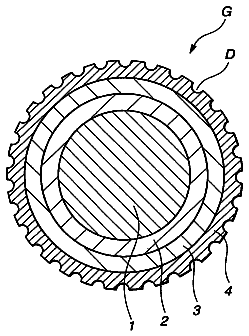
FIG. 1 is a cross-sectional view of a two-piece golf ball.
FIG. 2 is a cross-sectional view of a two-piece golf ball core.
FIG. 3 is a cross-sectional view of a three-piece golf ball core.
FIG. 4 is a cross-sectional view of a three-piece golf ball.
FIG. 5 is a cross-sectional view of a four-piece golf ball.
FIG. 6 is a cross-sectional view of a five-piece golf ball.
Detailed description of the preferred embodiments and methods
Referring to the cross-sectional view of a golf ball illustrated in FIG. 1, the present invention is embodied in golf balls 10, each having a core 12. The core includes a core outer surface 14 where a surface hardness value can be measured that is different in value from the hardness value measured at the center point 16 of the core, the center hardness value. Likewise, a surface specific gravity value can be measured on the core's surface that is different in value from a center specific gravity value measured at the center point. For example, the surface hardness value, or the surface specific gravity value, can be greater than, or less than, the center hardness value, or the center specific gravity value, respectively. The change in hardness value and specific gravity value between the surface and center point across a radius of the golf ball core results in a hardness gradient and a specific gravity gradient, respectively, that can occur in discrete increments, which can result in regions (not shown) of the core having discrete hardness and specific gravity values that are concentrically arranged about the core's center point.
Also, the golf ball core 12 can include a point (not shown) along a radius (not shown) between the center point 16 and the surface 14 of the core that has an additional hardness value and specific gravity value that are different from the surface hardness and specific gravity values, respectively, and the center hardness and specific gravity values, respectively. These additional hardness and specific gravity values can have the following: a value between the value measured at the surface and the value measured at the center point; a value greater than the value measured at the center point; or greater than both the value measured at the center point and the value measured at the surface.
The golf ball core 12 can include regions (not shown) that have discrete hardness value and/or specific gravity values, which are arranged concentrically about the center point 16 of the core. In particular, a discrete specific gravity value for a region of the golf ball core can be determined based on the equation Y=0.03*X+B, where: a. Y is the specific gravity value of the region of the golf ball core, Y is greater than about 1, and Y is less than about 1.3; b. X is a distance of the region from the center point of the golf ball core, X is greater than about 1 inch, X is less than about 1.62 inches, and the value of X can vary in value plus or minus 0.02 inch; and c. B is greater than about 0.95, and B is less than about 1.27.
More preferably, a discrete specific gravity value for a region (not shown) of the golf ball core 12 can be determined based on the equation Y=0.04*X+B, where: a. Y is the specific gravity value of the region of the golf ball core, Y is greater than about 1, and Y is less than about 1.3; b. X is a distance of the region from the center point 16 of the golf ball core, X is greater than about 1 inch, X is less than about 1.62 inches, and the value of X can vary in value plus or minus 0.02 inch; and c. B is greater than about 0.935, and B is less than about 1.26.
Most preferably, a discrete specific gravity value for a region (not shown) of the golf ball core 12 can be determined based on the equation Y=0.05*X+B, where: a. Y is the specific gravity value of the region of the golf ball core, Y is greater than about 1, and Y is less than about 1.3; b. X is a distance of the region from the center point 16 of the golf ball core, X is greater than about 1 inch, X is less than about 1.62 inches, and the value of X can vary in value plus or minus 0.02 inch; and c. B is greater than about 0.919, and B is less than about 1.25.
The golf ball core 12 can include more than one piece. For example, referring to FIG. 2, the golf ball core can include two pieces; a core center piece 18 and a core layer 20, which surrounds the core center piece. In other embodiments, referring to FIG. 3, the golf ball core can include three pieces; a core center piece and two core layer(s). While FIGS. 1, 2, and 3 show golf ball cores made up a single piece, two pieces, and three pieces, respectively, embodiments of the golf ball core can include more than three pieces.
The golf ball 10 also includes a golf ball cover layer 22, the outermost layer, that surrounds the core 12, and can include, as shown in FIGS. 4 and 5, one or more golf ball intermediate layer(s) 24, which are located between the golf ball's cover layer and the golf ball's core. The golf ball components, i.e., the golf ball core, including the core center piece 18 and core layer(s) 20; intermediate layer(s); and cover layer are not drawn to scale in FIGS. 1-5. The diameters or thicknesses of each of the golf ball components can take on a wide range of values.
The difference in hardness and specific gravity between the core's surface 14 and the center point 16 is correlated to optimal performance characteristics for the golf ball 10. More specifically, in the present invention, the difference between the surface hardness and the center hardness, or the surface specific gravity and the center specific gravity, can be adjusted during fabrication to affect overall ball properties, e.g., hit-feel characteristics, C.O.R. value, compression value, and durability.
The difference in hardness and specific gravity between the surface 14 and center point 16 of the core 12, or between other points in the core, is obtained when the cross-linking density and/or chain length between cross-linked junctions measured at the one point in the core is different from another point in the core. This difference can be controlled by changing the density of the rubber in the core and/or changing the cross-linking conditions, e.g., the cross-linking temperature and/or the cross-linking time during fabrication of the core. Decreasing the cross-linking temperature and/or increasing the cross-linking time during fabrication of the core will lower the difference in hardness and specific gravity between the core's surface and the center point of the core. Another factor affecting the difference in hardness and specific gravity between the surface and center point of the core, or other parts of the core is the cooling rate of the core. The difference in hardness and specific gravity increases in value when the cooling rate of the core is increased.
When a dye, colorant, is added to a material that makes up the core 12, regions (not shown) of the core are visually distinguishable from other regions of the core that have a different density, and thus, a different hardness value and specific gravity value. In particular, a region of the core that has a higher density, and thus, a higher hardness value and specific gravity value will include more colorant than a region of the core that has a lower density, and thus, a lower hardness value and specific gravity value. Therefore, the use of the colorant in the core can result in visually distinct regions in the core that have discrete hardness and specific gravity values. In particular, because regions in the core that have discrete hardness and specific gravity values tend to form concentrically about the core's center point 16, the use of colorant in the core typically results in visually distinct concentric regions (not shown) about the core's center point.
The golf ball cores 12 of the present invention incorporate a composition that includes an unsaturated polymer and a peptizer. The golf ball composition can also include an accelerator. The core compositions can be cured by a single organic peroxide or a mixture of organic peroxides having different activation temperatures. The composition of the unsaturated polymer, with the peptizer, and with or without the accelerator, allows for the adjustment of the difference in hardness and specific gravity between the golf ball core's center point 16 and surface 14 during manufacturing, while providing for increased C.O.R. and compression. The present invention also resides in methods of manufacture for the golf ball cores. These golf ball cores are easy to prepare, and they can tailored to meet a wide range of specifications and preferred performance.
Unsaturated polymers suitable for use in the golf ball cores 12 of the present invention include any polymeric material having an unsaturation, either hydrocarbon or non-hydrocarbon, capable of participating in a cross-linking reaction initiated thermally, chemically, by irradiation, or by a combination of these methods. Non-limiting examples of suitable unsaturated polymers include 1,2-polybutadiene, cis-1,4-polybutadiene, trans-1,4-polybutadiene, cis-polyisoprene, trans-polyisoprene, polychloroprene, polybutylene, styrene-butadiene rubber, styrene-butadiene-styrene block copolymer, styrene-isoprene-styrene block copolymer, nitrile rubber, silicone rubber, polyurethane, as well as functionalized equivalents and mixtures of these.
The base rubber used herein can be any rubber commonly used in golf ball cores 12. Polybutadiene rubbers, especially 1,4-polybutadiene rubbers containing at least 40 mol %, and more preferably 80 to 100 mol % of cis-1,4 bonds, are preferred because of their high rebound resilience, extrusion moldability, and high strength after vulcanization. The 1,4-polybutadiene rubbers can be blended with natural rubber, polyisoprene rubber, styrene-butadiene rubber, or the like. At least 80% by weight of 1,4-polybutadiene rubber should be present in the base rubber, because base rubbers containing less 1,4-polybutadiene rubber often fail to take advantage of the rebound resilience of the polybutadiene rubber.
Many different types of 1,2-polybutadienes exist, having widely varying physical properties as a result of their differing tacticity, crystallinity, and molecular weight. Examples of 1,2-polybutadienes having differing tacticity, all of which are suitable as unsaturated polymers for use in the present invention, are atactic 1,2-polybutadiene, isotactic 1,2-polybutadiene, and syndiotactic 1,2-polybutadiene. Syndiotactic polymers include alternating base units that are enantiomers of each other. These 1,2-polybutadienes are also differentiated by their crystallinity, which ranges from amorphous 1,2-polybutadiene that essentially lacks crystallinity to semi-crystalline 1,2-polybutadiene that has different crystalline structures. The molecular weights of these 1,2-polybutadienes vary greatly. The various combinations of tacticity, crystallinity, and molecular weight provide for many different types of 1,2-polybutadienes having very different processability, as well as other chemical, thermal, mechanical, and rheological properties.
Syndiotactic 1,2-polybutadiene having a crystallinity suitable for use as an unsaturated polymer in compositions within the scope of the present invention are polymerized from a 1,2-addition of butadiene. Golf ball cores 12 within the scope of the present invention include syndiotactic 1,2-polybutadiene having crystallinity and greater than about 70% of 1,2-bonds, more preferably greater than about 80% of 1,2-bonds, and most preferably greater than about 90% of 1,2-bonds. Also, golf ball cores within the scope of the present invention include syndiotactic 1,2-polybutadiene having crystallinity between about 5% and about 50%, more preferably between about 10% and about 40%, and most preferably between about 15% and about 30%. In addition, golf ball cores within the scope of the present invention include syndiotactic 1,2-polybutadiene having crystallinity and a mean molecular weight between about 10,000 and about 350,000, more preferably between about 50,000 and about 300,000, more preferably between about 80,000 and about 200,000, and most preferably between about 100,000 and about 150,000. An example of a suitable syndiotactic 1,2-polybutadiene having crystallinity for use in golf ball cores within the scope of the present invention is sold under the trade name RB810, RB820, and RB830 by JSR Corporation of Tokyo, Japan. These have more than 90% 1,2 bonds, a mean molecular weight of approximately 120,000, and a crystallinity between about 15% and about 30%.
Peptizers can be defined as chemicals that inhibit cross-linking during the processing of unsaturated polymers, and then further participates in the cross-linking of the unsaturated polymer when cross-linking does begin. The peptizer comprises an organic sulfur compound and/or its metal or non-metal salt. Examples of the organic sulfur compound include: thiophenols, such as pentachlorothiophenol and its metal and non-metal salts, 4-butyl-o-thiocresol, 4 t-butyl-p-thiocresol, and 2-benzamidothiophenol; thiocarboxylic acids, such as thiobenzoic acid; 4,4' dithio dimorpholine; sulfides, such as dixylyl disulfide, dibenzoyl disulfide; dibenzothiazyl disulfide; di(pentachlorophenyl) disulfide; dibenzamido diphenyldisulfide (DBDD); and alkylated phenol sulfides, such as VULTAC marketed by Atofina Chemicals, Inc. of Philadelphia, Pa. Examples of the metal salts of an organic sulfur compound include zinc salts of the above-mentioned thiophenols and thiocarboxylic acids. Examples of non-metal salts of an organic sulfur compound include the amine or ammonium salts of the above-mentioned thiophenols and thiocarboxylic acids. Preferred peptizers include pentachlorothiophenol, its metal salts and its non-metal salts, and dibenzamido diphenyldisulfide. Peptizers can be used alone or in an admixture of two or more peptizers. When the golf ball core composition includes a peptizer, the composition has greater than about 0.1 part by weight of the peptizer per 100 parts the unsaturated polymer.
Accelerators, which can be defined as chemicals that increase the vulcanization rate and/or decrease the vulcanization temperature of the unsaturated polymers, can be of any class known for rubber processing including mercapto-, sulfenamide-, thiuram, dithiocarbamate, dithiocarbamylsulfenamide, xanthate, guanidine, amine, thiourea, and dithiophosphate accelerators. Specific commercial accelerators include 2-merpatobenzothiazole and its metal or non-metal salts such as Vulkacit Mercapto C, Mercapto MGC, Mercapto ZM-5, and ZM marketed by Bayer AG of Leverkusen, Germany; Nocceler M, Nocceler MZ, and Nocceler M-60 marketed by Ouchisinko Chemical Industrial Company, Ltd. of Tokyo, Japan; and MBT and ZMBT marketed by Akrochem Corporation of Akron, Ohio. A more complete list of commercially available accelerators is given in The Vanderbilt Rubber Handbook: 13.sup.th Edition (1990, R.T. Vanderbilt Co.), pp. 296-330, the Encyclopedia of Polymer Science and Technology, Vol. 12 (1970, John Wiley & Sons), pp. 258-259, and the Rubber Technology Handbook (1980, Hanser/Gardner Publications), pp. 234-236. Preferred accelerators include 2-mercaptobenzothiazole (MBT) and its salts. The golf ball core composition can incorporate greater than about 0.1 part by weight of the accelerator per 100 parts by weight of the unsaturated polymer.
Suitable cross-linking agents for use in the golf ball cores 12 of the present invention include any sulfur compounds, peroxides, or other known chemical cross-linking agents, as well as mixtures of these. Non-limiting examples of suitable cross-linking agents include primary, secondary, or tertiary aliphatic or aromatic peroxides. Peroxides containing more than one peroxy group can be used, such as 2,5-dimethyl-2,5-di(tert-butylperoxy)hexane and 1,4-di-(2-tert-butyl peroxyisopropyl)benzene. Both symmetrical and asymmetrical peroxides can be used, for example, tert-butyl perbenzoate and tert-butyl cumyl peroxide. Peroxides incorporating carboxyl groups also are suitable. The cross-linking agent can be an organic peroxide, or a mixture of organic peroxides. When the golf ball core includes a mixture of organic peroxides, each organic peroxide can have a different activation temperature. The decomposition of peroxides used as cross-linking agents in the present invention can be brought about by applying thermal energy, shear, irradiation, reaction with other chemicals, or any combination of these.
Both homolytically and heterolytically decomposed peroxide can be used in the golf ball cores 12 of the present invention. Non-limiting examples of suitable peroxides include: diacetyl peroxide; di-tert-butyl peroxide; dibenzoyl peroxide; dicumyl peroxide; 2,5-dimethyl-2,5-di(benzoylperoxy)hexane; 1,4-bis-(t-butylperoxyisopropyl)benzene, t-butylperoxybenzoate; 2,5-dimethyl-2,5-di-(t-butylperoxy)hexyne-3; 1,1-bis(t-butylperoxy)-3,3,5 tri-methylcyclohexane, such as Varox 231-XL, marketed by R.T. Vanderbilt Co., Inc. of Norwalk, Conn.; di-(2,4-dichlorobenzoyl)peroxide; and mixtures thereof. The cross-linking agent can be blended in amounts greater than about 0.1 part per hundred of the cross-linking agent per 100 parts by weight of the unsaturated polymer.
The metal salt of unsaturated carboxylic acid can be blended with the rubber of the golf ball core 12 as a co-cross-linking agent. Examples of these include zinc and magnesium salts of unsaturated fatty acids having 3 to 8 carbon atoms, such as acrylic acid, methacrylic acid, maleic acid, palmitic acid, and fumaric acid, with the zinc salts of acrylic and methacrylic acid being most preferred. The unsaturated carboxylic acid metal salt can be blended in a rubber either as a preformed metal salt, or by introducing an .alpha.,.beta.-unsaturated carboxylic acid and a metal oxide or hydroxide into the rubber composition, and allowing them to react in the rubber composition to form a metal salt. The unsaturated carboxylic acid metal salt can be blended in any desired amount, but preferably in amounts of about 20 parts to about 60 parts by weight of the unsaturated carboxylic acid per 100 parts by weight of the unsaturated polymer.
Besides the use of chemical cross-linking agents, exposure of the golf ball core composition to radiation also can serve as a cross-linking agent, with or without a chemical cross-linking agent. Radiation can be applied to the unsaturated polymer and peptizer mixture, with or without a chemical cross-linking agent, by any known method, including using microwave or gamma radiation, or an electron beam device.
Golf ball cores 12 within the scope of the present invention also can include, in suitable amounts, one or more additional ingredients generally employed in golf ball compositions. Agents provided to achieve specific functions, such as additives and stabilizers, can be present. Suitable ingredients include initiators, colorants, UV stabilizers, photo stabilizers, antioxidants, dispersants, mold releasing agents, processing aids, fillers, and fibers. The golf ball core compositions can incorporate, for example, inorganic fillers, such as titanium dioxide, calcium carbonate, zinc sulfide, or zinc oxide. Additional fillers can be chosen to adjust the density of the golf ball core composition, such as zinc oxide, barium sulfate, tungsten, or any other metallic powder having a density higher than that of the base polymeric resin. Any organic, inorganic, or metallic fibers, either continuous or non-continuous, also can be in the composition. An example of these is silica-containing filler, which preferably is selected from finely divided, heat-stable minerals, such as fumed and precipitated forms of silica, silica aerogels, and titanium dioxide having a specific surface area of at least about 10 m.sup.2/gram. Preferred examples of fillers include metal oxides, such as zinc oxide and magnesium oxide. The filler can be blended in amounts of about 10 parts by weight per 100 parts by weight of the unsaturated polymer. If desired, the rubber composition can additionally contain a plasticizer, an antioxidant, and any other additives generally employed in the preparation of one-piece balls or the cores of multi-layered balls. The appropriate amounts for these materials can be readily determined without undue experimentation.
The description continues in the full USPTO document.
 Lapsed, fee not paid1 drawing