Lapsed, fee not paid34 drawings
Lapsed, fee not paid
Stud bingo
US 8,764,540 B2 · Assignee: IGT · Inventors: Hollibaugh; Larry et al.
Overview
Sheet 1 of 13 from the published document. All sheets in the USPTO PDF
Abstract From the patent
The present invention provides methods and devices for providing wagering games having aspects of card games, such as poker games. Some implementations of the present invention involve methods and devices for providing such wagering games on a network of gaming machines. In some implementations, players can view a first M playing cards from each of N hands of playing cards, then must select one (or more) of the hands. Thereafter, a playing card hand (e.g., a poker hand) is made up for the selected hand from the N cards and from additional cards that are revealed after the hand is selected. Some implementations provide a bingo game in which areas of each bingo card correspond with playing cards, wherein players may establish interim wins that correspond to poker hands. Some such implementations include displaying N bingo cards, each of which corresponds to one of the N hands of playing cards.
Why it's free to use
- The USPTO Official Gazette of August 25, 2026 lists it as expired on July 1, 2026 for an unpaid maintenance fee.
- It isn't on any reinstatement notice published since.
- Its 3 US relatives have also lapsed, expired or never issued.
- It lapsed only recently. Owners can still pay late and reinstate it, most often in the first months; we check every new notice. We check US rights only. Check foreign counterparts before selling abroad.
FiledJanuary 10, 2012
GrantedJuly 1, 2014
Expired (fee)July 1, 2026
Application number13/347591
Classification (CPC)G07F17/3293 +2 more
Length18 claims · 25 pages
Background From the patent
The present disclosure relates to methods and devices for providing wagering games, particularly via a gaming network. Gaming in the United States is divided into Class I, Class II and Class III games. Class I gaming includes social games played for minimal prizes, or traditional ceremonial games. Class II gaming includes bingo and bingo-like games. Bingo includes games played for prizes, including monetary prizes, with cards bearing numbers or other designations in which the holder of the cards covers such numbers or designations when objects, similarly numbered or designated, are drawn or electronically determined, and in which the game is won by the first person covering a previously designated arrangement of numbers or designations on such cards. Such an arrangement will sometimes be referred to herein as a "game-winning pattern" or a "game-ending pattern." Class II gaming may also i
Drawings 13
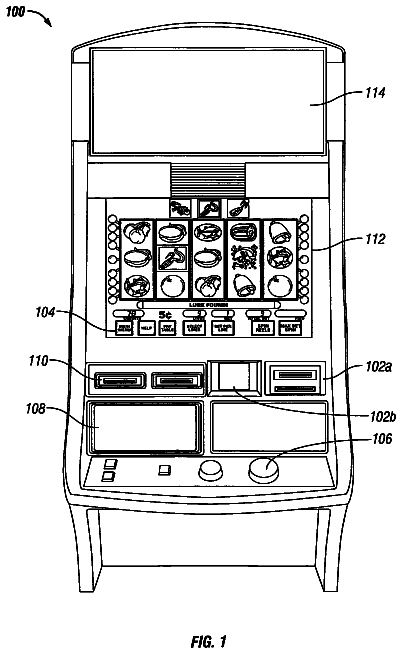
1 of 13 drawing sheets so far from the published document, cropped to the drawing. Every sheet is in the USPTO PDF.
Figures as described
- FIG. 1 is a flow chart that outlines some methods of the present invention
- FIG. 1A illustrates a display at an early stage of play according to some implementations of the invention
- FIG. 1B illustrates a display at a later stage of play according to some implementations of the invention
- FIG. 1C illustrates a display at a later stage of play according to some implementations of the invention
- FIG. 2 is a flow chart that outlines some alternative methods of the present invention
- FIG. 2A illustrates a display at an early stage of play according to some implementations of the invention
- FIG. 2B illustrates a display at a later stage of play according to some implementations of the invention
- FIG. 2C illustrates a display at a later stage of play according to some implementations of the invention
- FIG. 2D illustrates a display at a later stage of play according to some implementations of the invention
- FIG. 3 is a flow chart that outlines other methods of the present invention
- FIG. 4 is a block diagram of a number of gaming machines in a gaming network that may be configured to implement some methods of the present invention
- FIG. 5 illustrates an exemplary gaming machine that may be configured to implement some methods of the present invention
Claims 18 total, 3 independent
What the patent claimed, word for word. All of it is now free to use.
- 1Independent claimA method of operating a gaming machine, said method comprising: receiving, by the gaming machine that controls a display device, a game outcome; thereafter, displaying, on the display device, face values for M cards for each of N hands of cards, wherein: M and N are integers, N is at least two, M cards are less than a quantity of cards which form a complete card hand, and the displayed M cards are based on the received game outcome; thereafter, receiving an indication of a player selection of one of the displayed a N hands of cards; selecting face values of a quantity of cards to complete the selected hand of cards on the display device, wherein a value of a hand rank of the face values of the completed selected hand of cards corresponds with a value of the received game outcome; after receiving the indication of the player selection, displaying, on the display device, the face values of the quantity of cards selected to complete the selected hand of cards; and after receiving the indication of the player selection, indicating whether the player is entitled to an award based on the game outcome, wherein the game outcome is unaffected by which of the N hands of cards is the selected hand of cards.
- 2The method of claim 1, further comprising awarding a player associated with the selected hand of cards with at least a threshold card combination.
- 3The method of claim 1, further comprising displaying face values of the quantity of cards to complete at least one of the N hands of cards that is not the selected hand of cards.
- 4The method of claim 1, further comprising offering, prior to receiving the indication of the player selection, to display face values for one or more additional cards in at least one of the N hands of cards.
- 5The method of claim 3, wherein the face values of the quantity of cards to complete the at least one of the N hands of cards that is not the selected hand of cards are selected to produce a higher-ranked hand of cards than that of the selected hand of cards.
- 6The method of claim 3, wherein the face values of the quantity of cards to complete all of the N hands of cards that are not the selected hand of cards are selected to produce a lower-ranked hand of cards than that of the selected hand of cards.
- 7Independent claimA gaming network for playing electronic wagering games, said gaming network comprising: a plurality of gaming machines, each gaming machine comprising: a master gaming controller; a display device; and an input device, wherein the master gaming controller, the display device, and the input device are operably connected; and a game server configured to transmit a plurality of game outcomes to the plurality of gaming machines, wherein the master gaming controller of each of the plurality of gaming machines is configured to: receive a game outcome from the game outcomes; thereafter, cause the display device to display, on the display device, face values for M cards for each of N hands of cards, wherein: M and N are integers, N is at least two, M cards are less than a quantity of cards which form a complete card hand, and the displayed M cards are based on the received game outcome; thereafter, receive an indication, via the input device, of a player selection of one of the displayed N hands of cards; select face values of a quantity of cards to complete the selected hand of cards on the display device, wherein a value of a hand rank of the face values of the completed selected hand of cards corresponds with a value of the received game outcome; after receiving the indication of the player selection, cause the display device to display, the face values of the quantity of cards selected to complete the selected hand of cards; and after receiving the indication of the player selection, indicate whether the player is entitled to an award based on the game outcome, wherein the game outcome is unaffected by which of the N hands of cards is the selected hand of cards.
- 8The gaming network of claim 7, wherein the master gaming controller of each gaming machine is further configured to award a player associated with the selected hand of cards with at least a threshold card combination.
- 9The gaming network of claim 7, wherein the master gaming controller of each gaming machine is further configured to, on the display device of said gaming machine, display face values of the quantity of cards to complete at least one of the N hands of cards displayed on the display device that is not the selected hand of cards.
- 10The gaming network of claim 7, wherein the master gaming controller of each gaming machine is further configured to offer, prior to receiving the indication of the player selection, to display face values for one or more additional cards in at least one of the N hands of cards on the display device of the gaming machine.
- 11The gaming network of claim 9, wherein the face values of the; quantity of cards to complete at least one of the N hands of cards that is not the selected hand of cards are selected to produce a higher-ranked hand of cards than that of the selected hand of cards.
- 12The gaming network of claim 9, wherein the face values of the quantity of cards to complete all of the N hands of cards that are not the selected hand of cards are selected to produce a lower-ranked hand of cards than that of the selected hand of cards.
- 13Independent claimA wager gaming machine comprising: a master gaming controller; a display device; and an input device, wherein the master gaming controller, the display device, and the input device are operably connected and the master gaming controller is configured to: receive a game outcome; thereafter, cause the display device to display, on the display device, face values for M cards for each of N hands of cards, wherein: M and N are integers, N is at least two, M cards are less than a complete card hand, and the displayed M cards are based on the received game outcome; thereafter, receive an indication, via the input device, of a player selection of one of the display N hands of cards; select face values of a quantity of cards to complete the selected hand of cards on the display device, wherein a value of hand rank of the face values of the completed selected hand of cards corresponds with a value of the received game outcome; after receiving the indication of the player selection, cause the display device to display the face values of the quantity of cards selected to complete the selected hand of cards; and after receiving the indication of the player selection indicate, after receiving the indication of the player selection, whether the player is entitled to an award based on the game outcome, wherein the game outcome is unaffected by which of the N hands of cards is the selected hand of cards.
- 14The wager gaming machine of claim 13, wherein the master gaming controller is further configured to award a player associated with the selected hand of cards with at least a threshold card combination.
- 15The wager gaming machine of claim 13, wherein the master gaming controller is further configured to, on the display device of said gaming machine, display face values of the quantity of cards to complete at least one of the N hands of cards displayed on the display device that is not the selected hand of cards.
- 16The wager gaming machine of claim 13, wherein the master gaming controller is further configured to offer, prior to receiving the indication of the player selection, to display face values for one or more additional cards in at least one of the N hands of cards on the display device of the gaming machine.
- 17The wager gaming machine of claim 15, wherein the face values of the quantity of cards to complete at least one of the N hands of cards that is not the selected hand of cards are selected to produce a higher-ranked hand of cards than that of the selected hand of cards.
- 18The wager gaming machine of claim 15, wherein the face values of the quantity of cards to complete all of the N hands of cards that are not the selected hand of cards are selected to produce a lower ranked hand of cards than that of the selected hand of cards.
Description
Background of the invention
The present disclosure relates to methods and devices for providing wagering games, particularly via a gaming network.
Gaming in the United States is divided into Class I, Class II and Class III games. Class I gaming includes social games played for minimal prizes, or traditional ceremonial games. Class II gaming includes bingo and bingo-like games. Bingo includes games played for prizes, including monetary prizes, with cards bearing numbers or other designations in which the holder of the cards covers such numbers or designations when objects, similarly numbered or designated, are drawn or electronically determined, and in which the game is won by the first person covering a previously designated arrangement of numbers or designations on such cards. Such an arrangement will sometimes be referred to herein as a "game-winning pattern" or a "game-ending pattern." Class II gaming may also include pull tab games if played in the same location as bingo games, lotto, punch boards, tip jars, instant bingo, and other games similar to bingo. Class III gaming includes any game that is not a Class I or Class II game, such as games of chance typically offered in non-Indian, state-regulated casinos.
Two basic forms of bingo exist. In traditional bingo, the players purchase cards after which a draw takes place. The first player to achieve a designated pattern wins. In one type of bingo game known as Bonanza Bingo, the draw for the game takes place before the players know the arrangements on their bingo cards. After the draw occurs, the players may purchase cards and compare the arrangements on the cards to the drawn numbers to determine whether predetermined patterns are matched. Play continues in Bonanza Bingo until at least one of the players matches a designated game-winning pattern. Bonanza Bingo may also encompass bingo variations wherein a partial draw is conducted for some numbers (generally fewer than the number of balls expected to be necessary to win the game) prior to selling the bingo cards. After the bingo cards are sold, additional numbers are drawn until there is a winner.
As indicated above, a bingo game is played until at least one player covers a predetermined game-winning pattern on the player's bingo card. The game may also include interim winners of prizes based on matching predetermined interim patterns on the bingo card using the same ball draw. The interim pattern wins do not terminate the bingo game. For interim pattern awards, players covering certain interim patterns may receive an additional award as the game continues. Some exceptional bingo versions may allow bingo draws beyond those needed to achieve the bingo game win so as to pay out interim pattern wins at a desired rate. The game-winning awards are generally pari-mutuel in nature. That is, the bingo win award is based upon the total amount wagered on a given occurrence of the bingo game. However, interim pattern awards typically are not pari-mutuel.
Gaming machines such as slot machines and video poker machines have proven to be very popular. However, many games of chance that are played on gaming machines fall into the category of Class III games, which may be subject to stricter approval and regulation. Many gaming establishments have a limited number of gaming machines for playing Class III games and a greater number of gaming machines for playing Class II games, such as bingo.
As such, it would be desirable to provide a Class II game with at least some of the "look and feel" of a Class III game. For example, it would be desirable to provide a gaming system wherein a Class II game with characteristics of a Class III game may be played on a gaming machine. For example, prior art systems have failed to provide a bingo game on a network of gaming machines that satisfies the regulatory requirements for a Class II game while simulating important aspects of a Class III card game, such as a poker game.
Summary of the invention
The present invention provides methods and devices for providing wagering games having aspects of card games, such as poker games. Some implementations of the present invention involve methods and devices for providing such wagering games on a network of gaming machines.
In some implementations, players can view a first M playing cards from each of N hands of playing cards, then must select one (or more) of the hands. Thereafter, a playing card hand (e.g., a poker hand) is made up for the selected hand from the N cards and from additional cards that are revealed after the hand is selected. Some implementations provide a bingo game in which areas of each bingo card correspond with playing cards, wherein players may establish interim wins that correspond to poker hands. Some such implementations include displaying N bingo cards, each of which corresponds to one of the N hands of playing cards. Some implementations provide for automatic daubing of the best cards in the final hand. In some implementations, only the highest-ranking interim win results in a payout. Players may also be eligible for a system win and, in some implementations, a progressive win.
Some methods of the invention provide a wagering game. The wagering game includes the following steps: displaying M cards for each of N hands of cards; allowing a player to choose at least one of the N hands; displaying remaining cards to complete a chosen hand; and determining whether the player is entitled to an award for a chosen hand. The allowing step may involve allowing the player to choose more than one of the N hands.
The wagering game may also involve awarding a player having a chosen hand with at least a threshold card combination. Remaining cards may be displayed to complete a non-chosen hand. A player may be offered, prior to the allowing step, to view one or more additional cards in at least one of the N hands of cards.
The displaying steps may involve making displays on a display device. The wagering game may also include the steps of providing a game outcome to a machine that controls the display device and displaying cards on the display device that correspond with the game outcome.
The player's award, if any, may or not depend on which hand is chosen. For example, when the wagering game is a central determination game, the award will not depend on which hand is chosen. The wagering game preferably includes the step of displaying cards to complete a non-chosen hand. The remaining cards in at least one non-chosen hand may be selected to have a higher card combination than that of the chosen hand.
Alternative gaming methods are provided herein. Some such methods include these steps: displaying N bingo cards to each of a plurality of bingo players, where N is a first predetermined integer; drawing M random bingo numbers corresponding to areas of at least some of the M bingo cards, where M is a second predetermined integer; displaying hits on the N bingo cards based on the M random bingo numbers; allowing each player an opportunity to select at least one bingo card for continued game play; and drawing one or more additional random bingo numbers and displaying hits on each player's selected bingo card until at least one interim win pattern is completed. The displays may be presented on a display device.
The player may be allowed to choose more than one of the N bingo cards. An interim win award may be made to a player having a chosen bingo card with at least a threshold interim win pattern. Hits may be displayed on non-selected bingo cards. Random bingo numbers may be drawn until a game-winning pattern is completed on a player's selected bingo card.
The method may include the following steps: providing a game outcome to the player; and receiving the game outcome by a machine that controls the display device, wherein the displaying steps comprise displaying game results on the display device that correspond with the game outcome.
The player's award, if any, may or may not depend on which hand is chosen. The remaining hits in at least one non-chosen bingo card may be selected to have a higher-level pattern than that of the chosen bingo card.
Some implementations of the invention provide a gaming network for playing electronic wagering games. The gaming network includes a plurality of gaming machines and at least one network device, such as a game server. The game server may be configured to transmit game data to control the plurality of gaming machines to conduct an electronic game of chance that allows one of a plurality of players to achieve a game-winning outcome.
In some such implementations, the game server controls each of the plurality of gaming machines to do the following: display M cards for each of N hands of cards; allow a player to choose at least one of the N hands; and display remaining cards to complete a chosen hand; wherein the game server is configured to determine whether a player is entitled to an award for a chosen hand.
Some embodiments of the invention provide a gaming machine. The gaming machine includes a port, a scanner, or some other device for receiving a game determination. For example, the gaming machine may include a port configured for receiving the game determination from a game server. Alternatively, or additionally, the gaming machine may include a scanner, card reader, etc., for receiving the game determination from a ticket or other medium provided by the player.
The gaming machine includes a display device for displaying M cards for each of N hands of cards and at least one interface for allowing a player to choose at least one of the N hands. The gaming machine is configured to display remaining cards to complete a chosen hand and to indicate whether a player is entitled to an award in accordance with the game determination.
Some implementations of the invention provide other hardware or software for providing wagering games according to any of the methods described herein. These and other features and advantages of the invention will be described in more detail below with reference to the associated drawings.
Brief description of the drawings
FIG. 1 is a flow chart that outlines some methods of the present invention.
FIG. 1A illustrates a display at an early stage of play according to some implementations of the invention.
FIG. 1B illustrates a display at a later stage of play according to some implementations of the invention.
FIG. 1C illustrates a display at a later stage of play according to some implementations of the invention.
FIG. 2 is a flow chart that outlines some alternative methods of the present invention.
FIG. 2A illustrates a display at an early stage of play according to some implementations of the invention.
FIG. 2B illustrates a display at a later stage of play according to some implementations of the invention.
FIG. 2C illustrates a display at a later stage of play according to some implementations of the invention.
FIG. 2D illustrates a display at a later stage of play according to some implementations of the invention.
FIG. 3 is a flow chart that outlines other methods of the present invention.
FIG. 4 is a block diagram of a number of gaming machines in a gaming network that may be configured to implement some methods of the present invention.
FIG. 5 illustrates an exemplary gaming machine that may be configured to implement some methods of the present invention.
FIG. 6 is a block diagram of an exemplary network device that may be configured as a game server to implement some methods of the present invention.
Description of the preferred embodiments
Reference will now be made in detail to some specific embodiments of the invention including the best modes contemplated by the inventors for carrying out the invention. Examples of these specific embodiments are illustrated in the accompanying drawings. While the invention is described in conjunction with these specific embodiments, it will be understood that it is not intended to limit the invention to the described embodiments. On the contrary, it is intended to cover alternatives, modifications, and equivalents as may be included within the spirit and scope of the invention as defined by the appended claims. Moreover, numerous specific details are set forth below in order to provide a thorough understanding of the present invention. The present invention may be practiced without some or all of these specific details. In other instances, well known process operations have not been described in detail in order not to obscure the present invention.
FIG. 1 is a flowchart that provides an overview of some methods of the present invention. Method 100 may be performed manually, by a gaming machine, by devices in a gaming network such as those described below, or otherwise. Those of skill in the art will appreciate that the steps of method 100 need not be performed (and in some implementations are not performed) in the order shown. Moreover, some implementations of method 100 may include more or fewer steps than those shown in FIG. 1.
In step 101, N decks of playing cards are shuffled and players place their bets. N may be any convenient integer. Step 105 is merely representative of a step of preparing to display playing cards (or representations of playing cards) in a random or quasi-random manner. Step 101 may be performed, for example, by one or more logic devices of a game server or another computing device in communication with a game server. In some implementations, representations of a random sequence of playing cards are generated using one or more RNG (random number generating) seeds, each of which will provide a known outcome. U.S. Pat. No. 6,533,664, entitled "Gaming System with Individualized Centrally Generated Random Number Generator Seeds," describes the use of RNG seeds and is hereby incorporated by reference for all purposes. Each of the RNG seeds has been pre-calculated to produce a predetermined outcome when processed by a pre-programmed "deterministic RNG." The RNG seeds may be transmitted, for example, from a gaming server to a gaming machine or similar device. The RNG seeds are advantageous for security purposes. Moreover, they are easy to implement because most existing gaming machines use an RNG. Replacing this with a deterministic RNG allows central determination games to be implemented with minimal changes to existing Class III gaming machines.
In step 105, M playing cards are displayed for each of the N hands, so that a player may identify each of the M playing cards. M may be any convenient integer. FIG. 1A depicts one such display, wherein N is 4 and M is 3. Hands 135, 145, 155 and 165 have been dealt from decks 130, 140, 150 and 160, respectively. FIG. 1A may be, for example, a display shown on a display device, e.g., of a gaming machine. In FIG. 1A, all cards that have been dealt are displayed; in other implementations, a full hand may be dealt, with M playing cards displayed and the rest of the playing cards dealt face down.
In step 110, a player selects at least one of the hands for continued play. In some implementations, a player may select more than one hand, e.g., for an additional payment. In some implementations, a player may make an additional wager at or near the time of selecting the hand, even if only one hand is selected for continued play. In this example, the player selects hand 135 for continued play because a pair of Queens is already displayed.
In step 115, the remaining playing cards of at least the selected hand are displayed. In the example shown in FIG. 1B, only the remaining playing cards of at least the selected hand are displayed. However, a player will quite naturally be curious about the hands not chosen. Accordingly, some implementations also display the remaining playing cards, as illustrated in FIG. 1C.
The best card combination in the player's final hand
is the same pair of Queens that was displayed in step 105, Ace high. In this example, a pair of Queens is not a good enough card combination for the player to win, so in step 120 it is determined (e.g., by a dealer or by a game server) that the player does not have a winning hand. However, if the player had chosen hand 165, the best card combination of the player's final hand would have been a Queen-high straight. In step 120, it would have been determined that the player had a winning hand and the player would have received an award (step 125).
FIG. 2 is a flow chart that depicts method 200 according to the present invention. Method 200 may be performed manually, by devices in a gaming network such as those described below, or otherwise. Those of skill in the art will appreciate that the steps of method 200 need not be performed (and in some implementations are not performed) in the order shown. Moreover, some implementations of method 200 may include more or fewer steps than those shown in FIG. 2.
In step 205, N bingo cards are displayed to a player, e.g., on a display device of a gaming machine. Here, the player has already made a wager and the wager prompted the display. Some implementations of method 200 include an optional previous step 201, wherein a player is presented with additional bingo cards and selects N bingo cards for the initial steps of game play. N may be any convenient integer.
One display of N bingo cards according to method 200 is shown in FIG. 2A, wherein N is 3. After a player has made a wager and activated pressing Play/Daub button 275, display 251 depicts bingo cards 255, 260 and 265. In this example, each bingo card includes a correspondence or "mapping" between areas (e.g., squares) on the bingo cards and playing cards. Preferably, each area of a bingo card will correspond to a particular playing card. The playing cards may be, for example, the cards of a standard playing card deck. In some implementations, one or more areas of a bingo card may correspond to a "wild" card of the player's choice.
The type of mapping can vary, according to various implementations of the invention. In some implementations (e.g., as illustrated in FIGS. 2A through 2D), the bingo cards are 4.times.13 (or 13.times.4) cards formatted such that rows or columns of the card correspond to playing card suits or denominations, e.g., 2 through Ace. Such implementations provide a bingo card with a square corresponding to all 52 cards of a standard deck. In other implementations, the bingo card is a standard 5.times.5 bingo card and not all playing cards of a standard deck are mapped to squares of the bingo card. Other implementations use yet other formats of bingo cards. U.S. patent application Ser. No. 10/925,710, filed Aug. 24, 2004 and entitled "Draw Bingo," describes relevant methods and devices and is hereby incorporated in its entirety and for all purposes.
Here, the displayed bingo cards 255, 260 and 265 include game-winning pattern 285, which corresponds to a hand of 4 Aces. Bingo cards 255, 260 and 265 also indicate progressive pattern 290, which includes game-winning pattern 285.
Ball drop display 270 indicates the numbers to be used in playing the bingo game. Those of skill in the art will realize that the numbers used in an electronic bingo game may be displayed in any convenient fashion and that a simulated "ball drop" is merely one such example. As discussed below, the number of balls displayed and the timing of the ball drops may vary according to the implementation.
In step 210, M random bingo numbers are drawn, where M is any convenient integer. In preferred implementations, step 210 will take place after a predetermined number of players has initiated game play. In this example, M is 4 and the random bingo numbers are displayed as numbered balls 280 in ball drop display 270. (See FIG. 2B.) After the ball drop, "hits" are displayed on bingo cards 255, 260 and 265. (Step 212.) Here, the hits on bingo card 255 correspond to a pair of Tens, which is the best card combination indicated on bingo cards 255, 260 and 265.
Accordingly, the player selects bingo card 255 for continued play. (Step 215.) In this example, the player selects bingo card 255 by using a mouse to move arrow 282 near the display of bingo card 255, then pressing Play/Daub button 275. In some preferred implementations, the player selects bingo card 255 by touching areas of a "touch screen" video display screen that is capable of recognizing and identifying the location of the player's touch. For example, when the player touches the areas of the screen where bingo card 255 and Play/Daub button 275 are displayed, the gaming machine receives input similar to a mouse-click in the location of the player touch.
In alternative implementations, the player may use panel buttons to select which bingo card to play. For example, there may be a certain number of buttons (e.g., 4) that light up to prompt the player to make a decision. When the player presses one of the buttons, the card corresponding to that button is selected. According to some such implementations, both touch screen and panel button functionality is provided. For example, when a player wants to select a card to hold or discard, the player can either use the touch screen (e.g., by touching an area of the screen corresponding to the card) or can press a panel button corresponding to the card.
In preferred implementations, each player must select a bingo card within a certain time, so that the bingo game will not be delayed. Otherwise, the player will not be eligible for continued game play.
Non-chosen bingo cards do not count for continued play. In some implementations, non-chosen or "slept" bingo cards are displayed differently (e.g., with a different color, contrast and/or brightness) as compared to selected bingo cards. For example, non-chosen bingo cards may be labeled "slept," as shown in FIG. 2B or other wise.
In step 220, P additional bingo numbers are drawn. Again, P may be any convenient integer. In some implementations, M and P are selected to total a number of cards in a familiar poker game (e.g., 5 or 7). In other implementations, P is not predetermined, but instead additional bingo numbers are drawn until at least one player has at least a threshold interim win pattern. Because in this implementation areas of the bingo cards map to playing cards, a threshold interim win pattern corresponds to a threshold rank or level of card combination. For example, the threshold card combination could be 3 of a kind, 2 pair, a Flush, or any other predetermined card combination.
In this example, P is a predetermined number (4), as shown in FIG. 2C. Accordingly, there is no guarantee that any player will have an interim pattern after the additional P bingo numbers are drawn. In step 225, it is determined (e.g., by a game server) whether any player has an interim win pattern. If so, the player is awarded. In alternative implementations, the player may need to refuse an offer of an interim win award in order to have a continued chance for a system win.
In step 235, it is determined whether any player has a system win. Here, a player would need to complete pattern 285, corresponding to 4 Aces, in order to have a system win. If no system win is determined at this stage (e.g., as shown in FIG. 2C), additional bingo numbers are drawn. (Step 240.) In this implementation, hits continue to be displayed on slept bingo cards 260 and 265.
The additional bingo numbers are drawn until there one of the players has a system win, at which time the winning player is awarded. (Step 245.) As shown on FIG. 2D, the system win occurred after game-winning pattern 285 on slept bingo card 260 had already been completed: game-winning pattern 285 on slept bingo card 260 was completed after bingo number 13 was drawn. Therefore, the player viewing display 251 would realize that if she had chosen bingo card 260, she might have won the bingo game. (It is possible, however, that another player's slept bingo card would have had its game-winning pattern 285 completed first.)
Some implementations of the present invention may be practiced in the context of central determination games with predetermined outcomes. The following co-pending and commonly owned patent applications describe relevant methods and devices and are hereby incorporated by reference: "GAMING DEVICE INCLUDING OUTCOME POOLS FOR PROVIDING GAME OUTCOMES," Ser. No. 10/261,744, "APPARATUS AND METHOD FOR GENERATING A POOL OF SEEDS FOR A CENTRAL DETERMINATION GAMING SYSTEM," Ser. No. 10/371,722, "CENTRAL DETERMINATION GAMING SYSTEM WITH A CENTRAL CONTROLLER PROVIDING A GAME OUTCOME AND A GAMING TERMINAL DETERMINING A PRESENTATION OF THE PROVIDED GAME OUTCOME," Ser. No. 10/371,723, "CENTRAL DETERMINATION GAMING SYSTEM WHERE THE SAME SEED IS USED TO GENERATE THE OUTCOMES FOR A PRIMARY GAME AND A SECONDARY GAME," Ser. No. 10/371,958, "CENTRAL DETERMINATION GAMING SYSTEM WHICH PROVIDES A PLAYER A CHOICE IN OUTCOMES," Ser. No. 10/442,318, "CENTRAL DETERMINATION GAMING SYSTEM WITH A GAME OUTCOME GENERATED BY A GAMING TERMINAL AND APPROVED BY A CENTRAL CONTROLLER," Ser. No. 10/383,423, "CENTRAL DETERMINATION GAMING SYSTEM WITH A GAMING TERMINAL ASSISTING THE CENTRAL CONTROLLER IN THE GENERATION OF A GAME OUTCOME," Ser. No. 10/431,755, "CENTRAL DETERMINATION GAMING SYSTEM WITH A KENO GAME," Ser. No. 10/601,482, "GAMING DEVICE HAVING AN INTERACTIVE POKER GAME WITH PREDETERMINED OUTCOMES," Ser. No. 10/934,258, "CENTRAL DETERMINATION POKER GAME," Ser. No. 10/945,642, "METHOD FOR DISPLAYING AN INTERACTIVE GAME HAVING A PREDETERMINED OUTCOME," Ser. No. 10/829,578, "METHOD FOR DISPLAYING AN INTERACTIVE GAME HAVING A PREDETERMINED OUTCOME," Ser. No. 10/846,448, and "METHOD FOR DISPLAYING AN INTERACTIVE GAME HAVING A PREDETERMINED OUTCOME," Ser. No. 10/864,784.
One such method 300 is outlined in the flow chart of FIG. 3. Method 300 may be performed manually, but is preferably performed by devices in a gaming network such as those described below, or by similar devices.
Accordingly, the example described below will be described with reference to a gaming network. The steps of method 300 need not be performed (and in some implementations are not performed) in the order shown. Some implementations of method 300 may include more or fewer steps than those shown in FIG. 3.
In step 301, a player purchases a game outcome. In some implementations, the game outcome may be manifested in the form of a tangible medium such as ticket, an RFID card, etc., and may be purchased, for example, from a gaming machine, from a video lottery terminal ("VLT"), from a vendor or from a vending machine. The tangible medium could be inserted into and/or read by the gaming machine or VLT, which would display the outcome as described below. In other implementations, the game outcome may be manifested in electronic form, e.g. as an RNG seed. In such implementations, the game outcome may be requested by the player's gaming machine, VLT, etc., and transmitted from a local or a central server to the requesting machine. U.S. patent application Ser. No. 10/925,727, entitled "PULLTAB/BINGO CONTROLLER," and filed on Aug. 24, 2004, describes relevant methods and devices and is hereby incorporated by reference and for all purposes.
In steps 303 and 305, M playing cards are displayed for each of N hands, so that a player may identify each of the M playing cards. Although M and N may be any convenient integers, the factors noted below should be considered when determining which integers should be selected for M and N. At this point, the display could look similar to FIG. 1A, wherein M is 3 and N is 4.
In step 310, the player selects a hand for continued play. If the player were presented with hands 135, 145, 155 and 165, as shown in FIG. 1A, the player would probably select hand 135 in step 310. However, the card combination in the player's final hand must correspond with the purchased game outcome, regardless of which hand the player selects.
In step 315, the remaining cards in the player's hand are displayed. In this example, the threshold card combination for winning some amount of money was two pair and the game outcome was a "loser." Accordingly, a hand having a card combination rank of less than two pair is displayed in step 315, e.g., as shown in FIG. 1B wherein a pair of Queens, Ace high are displayed.
Preferably, the playing cards in the non-chosen hands are also displayed (optional step 318), because this will create more interest on the part of the player. Moreover, in some implementations, the displays of the non-chosen hands may be selected to suggest that the player could have received a better game outcome than the one revealed in step 315. According to some such implementations, for example, a non-chosen hand could be displayed as a winning hand, whereas different cards would be displayed for the same hand if it had been a chosen hand.
For example, hand 165 might be displayed as a winning hand (e.g., as shown of FIG. 1C) if hand 165 were a non-chosen hand. However, if the player had chosen hand 165 in step 310, hand 165 would need to correspond with the purchased game outcome and therefore would need to have a card combination with a lower rank than two pair. For example, if hand 165 had been chosen it might have been displayed, for example, with a King of Diamonds instead of a Queen of Diamonds. This would have left the player tantalizingly close to having a straight, but still with a losing hand that corresponds to the game outcome purchased in step 301. Accordingly, it would be determined in step 320 that the player has a losing hand.
Conversely, suppose that the player had purchased a winning outcome in step 301 corresponding to a straight. If the player chose hand 165 in step 310, hand 165 could have been displayed as shown in FIG. 1C. It would be determined in step 320 that the player has a winning hand and the player would be awarded in step 325.
It may be seen from the foregoing discussion that M and N should be selected so that it is possible to display a card combination that corresponds to the purchased game outcome regardless of the hand selected in step 310. The fewer cards that are initially displayed, the more options there are for displaying the remaining cards in the chosen and non-chosen hands.
One example of a gaming machine network that may be used to implement methods of the invention is depicted in FIG. 4. Gaming establishment 401 could be any sort of gaming establishment, such as a casino, a card room, an airport, a store, etc. However, the methods and devices of the present invention are intended for gaming networks (which may be in multiple gaming establishments) in which there is a sufficient number of Class II gaming machines for bingo play. In this example, gaming network 477 includes more than one gaming establishment, all of which are networked to game server 422.
Here, gaming machine 402, and the other gaming machines 430, 432, 434, and 436, include a main cabinet 406 and a top box 404. The main cabinet 406 houses the main gaming elements and can also house peripheral systems, such as those that utilize dedicated gaming networks. The top box 404 may also be used to house these peripheral systems.
The master gaming controller 408 controls the game play on the gaming machine 402 according to instructions and/or game data from game server 422 and receives or sends data to various input/output devices 411 on the gaming machine 402. Details of exemplary systems for using a game server to control a network of gaming machines to implement bingo games are described in U.S. Patent Application No. 60/503,161, filed Sep. 15, 2003 and entitled "Gaming Network with Multi-Player Bingo Game." This application is hereby incorporated by reference for all purposes. The master gaming controller 408 may also communicate with a display 410.
A particular gaming entity may desire to provide network gaming services that provide some operational advantage. Thus, dedicated networks may connect gaming machines to host servers that track the performance of gaming machines under the control of the entity, such as for accounting management, electronic fund transfers (EFTS), cashless ticketing, such as EZPay.TM., marketing management, and data tracking, such as player tracking. Therefore, master gaming controller 408 may also communicate with EFT system 412, EZPay.TM. system 416 (a proprietary cashless ticketing system of the present assignee), and player tracking system 420. The systems of the gaming machine 402 communicate the data onto the network 422 via a communication board 418.
It will be appreciated by those of skill in the art that the present invention could be implemented on a network with more or fewer elements than are depicted in FIG. 4. For example, player tracking system 420 is not a necessary feature of the present invention. However, player tracking programs may help to sustain a game player's interest in additional game play during a visit to a gaming establishment and may entice a player to visit a gaming establishment to partake in various gaming activities. Player tracking programs provide rewards to players that typically correspond to the player's level of patronage (e.g., to the player's playing frequency and/or total amount of game plays at a given casino). Player tracking rewards may be free meals, free lodging and/or free entertainment.
Moreover, DCU 424 and translator 425 are not required for all gaming establishments 401. However, due to the sensitive nature of much of the information on a gaming network (e.g., electronic fund transfers and player tracking data) the manufacturer of a host system usually employs a particular networking language having proprietary protocols. For instance, 10-20 different companies produce player tracking host systems where each host system may use different protocols. These proprietary protocols are usually considered highly confidential and not released publicly.
Further, in the gaming industry, gaming machines are made by many different manufacturers. The communication protocols on the gaming machine are typically hard-wired into the gaming machine and each gaming machine manufacturer may utilize a different proprietary communication protocol. A gaming machine manufacturer may also produce host systems, in which case their gaming machine are compatible with their own host systems. However, in a heterogeneous gaming environment, gaming machines from different manufacturers, each with its own communication protocol, may be connected to host systems from other manufacturers, each with another communication protocol. Therefore, communication compatibility issues regarding the protocols used by the gaming machines in the system and protocols used by the host systems must be considered.
A network device that links a gaming establishment with another gaming establishment and/or a central system will sometimes be referred to herein as a "site controller." Here, site controller 442 provides this function for gaming establishment 401. Site controller 442 is connected to a central system and/or other gaming establishments via one or more networks, which may be public or private networks. Among other things, site controller 442 communicates with game server 422 to obtain game data, such as ball drop data, bingo card data, etc.
In the present illustration, gaming machines 402, 430, 432, 434 and 436 are connected to a dedicated gaming network 422. In general, the DCU 424 functions as an intermediary between the different gaming machines on the network 422 and the site controller 442. In general, the DCU 424 receives data transmitted from the gaming machines and sends the data to the site controller 442 over a transmission path 426. In some instances, when the hardware interface used by the gaming machine is not compatible with site controller 442, a translator 425 may be used to convert serial data from the DCU 424 to a format accepted by site controller 442. The translator may provide this conversion service to a plurality of DCUs.
Further, in some dedicated gaming networks, the DCU 424 can receive data transmitted from site controller 442 for communication to the gaming machines on the gaming network. The received data may be, for example, communicated synchronously to the gaming machines on the gaming network.
Here, CVT 452 provides cashless and cashout gaming services to the gaming machines in gaming establishment 401. Broadly speaking, CVT 452 authorizes and validates cashless gaming machine instruments (also referred to herein as "tickets" or "vouchers"), including but not limited to tickets for causing a gaming machine to display a game result and cashout tickets. Moreover, CVT 452 authorizes the exchange of a cashout ticket for cash. These processes will be described in detail below. In one example, when a player attempts to redeem a cashout ticket for cash at cashout kiosk 444, cashout kiosk 444 reads validation data from the cashout ticket and transmits the validation data to CVT 452 for validation. The tickets may be printed by gaming machines, by cashout kiosk 444, by a stand-alone printer, by CVT 452, etc. Some gaming establishments will not have a cashout kiosk 444. Instead, a cashout ticket could be redeemed for cash by a cashier (e.g. of a convenience store), by a gaming machine or by a specially configured CVT.
Turning to FIG. 5, more details of gaming machine 402 are described. Machine 402 includes a main cabinet 4, which generally surrounds the machine interior (not shown) and is viewable by users. The main cabinet 4 includes a main door 8 on the front of the machine, which opens to provide access to the interior of the machine.
Attached to the main door are player-input switches or buttons 32, a coin acceptor 28, and a bill validator 30, a coin tray 38, and a belly glass 40. Viewable through the main door is a video display monitor 34 and an information panel 36. The display monitor 34 will typically be a cathode ray tube, high resolution flat-panel LCD, or other conventional electronically controlled video monitor. In some preferred embodiments, display monitor 34 is a "touch screen" video display screen that is capable of recognizing and identifying the location of a player touch. The information panel 36 may be a back-lit, silk screened glass panel with lettering to indicate general game information including, for example, the number of coins played. The bill validator 30, player-input switches 32, video display monitor 34, and information panel are devices used to play a game on the game machine 402. The devices are controlled by circuitry housed inside the main cabinet 4 of the machine 402.
The gaming machine 402 includes a top box 6, which sits on top of the main cabinet 4. The top box 6 houses a number of devices, which may be used to add features to a game being played on the gaming machine 402, including speakers 10, 12, 14, a ticket printer 18 which may print bar-coded tickets 20 used as cashless instruments. The player tracking unit mounted within the top box 6 includes a key pad 22 for entering player tracking information, a florescent display 16 for displaying player tracking information, a card reader 24 for entering a magnetic striped card containing player tracking information, a microphone 43 for inputting voice data, a speaker 42 for projecting sounds and a light panel 44 for display various light patterns used to convey gaming information. In other embodiments, the player tracking unit and associated player tracking interface devices, such as 16, 22, 24, 42, 43 and 44, may be mounted within the main cabinet 4 of the gaming machine, on top of the gaming machine, or on the side of the main cabinet of the gaming machine.
The description continues in the full USPTO document.
In this description
About 6,655 words. The USPTO PDF has it with every drawing.
Timeline & family
Timeline From USPTO dates
Maintenance fees
Fees are due 3.5, 7.5 and 11.5 years after grant. This patent expired on July 1, 2026, so the fee marked "not paid" was the one that went unpaid.
3.5-year feeDue January 1, 2018Paid
7.5-year feeDue January 1, 2022Paid
11.5-year feeDue January 1, 2026Not paid
US family 4 documents, by filing date
Published applicationUS 2006/0025189 A1
Stud bingo
Filed Jan 2005 · published Feb 2006Published application
PatentUS 8,123,606 B2
Stud bingo
Filed Jan 2005 · granted Feb 2012Patent, expired (term ended)
Published applicationUS 2012/0108310 A1
STUD BINGO
Filed Jan 2012 · published May 2012Published application
This documentUS 8,764,540 B2
Stud bingo
Filed Jan 2012 · granted Jul 2014Lapsed, fee not paid
Earlier publications, parents and continuations. None of them can still be enforced, or this patent would not be listed.
US patents it cites 2
Prior art cited by the examiner or applicant. Useful when you check your own idea for novelty.
Sources & verification
Verification
- The USPTO Official Gazette of August 25, 2026 lists it as expired on July 1, 2026 for an unpaid maintenance fee.
- It isn't on any reinstatement notice published since.
- Its 3 US relatives have also lapsed, expired or never issued.
- Rechecked against USPTO records every day.
- It lapsed only recently. Owners can still pay late and reinstate it, most often in the first months; we check every new notice. We check US rights only. Check foreign counterparts before selling abroad.
Confirm it yourself
- Open the file history on Patent Center.
- The status should read "Patent Expired Due to NonPayment of Maintenance Fees Under 37 CFR 1.362".
- Check the documents for any later petition to revive or reinstate.
Official USPTO records
USPTO Official GazetteNotice of Expiration of Patents Due to Failure to Pay Maintenance Fee, issue of August 25, 2026.Where this listing came fromMaintenance fee recordEnter the patent number to see its fee history.USPTO FeesFull published documentText and every drawing sheet as a PDF.USPTOFile historyStatus, office actions, notices, fee records and petitions.USPTO Patent CenterPatent Public Search recordSearchable full text and bibliographic data.USPTO
Everything on this page comes from the documents linked above.