 Lapsed, fee not paid7 drawings
Telecom & Networks · US 8,762,557 B2
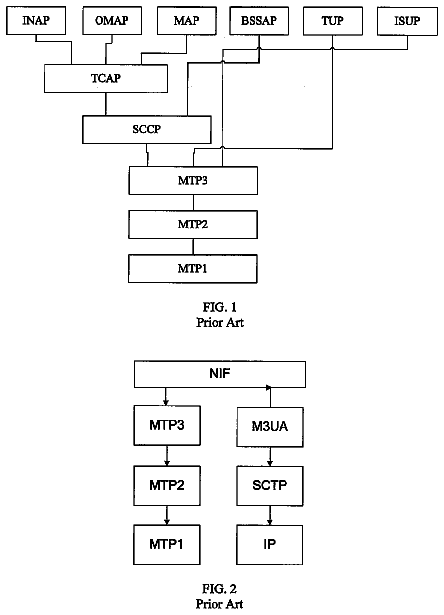
Signaling gateway and its signaling processing method
A signaling gateway (SG) and a method for the SG to process signaling.
US 8,762,570 B2 · Assignee: Futurewei Technologies, Inc. · Inventors: Qian; Haiyang et al.
Sheet 1 of 8 from the published document. All sheets in the USPTO PDF
A named-data networking (NDN) node, comprising a plurality of faces each of which is coupled to a different node in a content-centric network, and a processor coupled to the faces, wherein the processor is configured to probe the performance of each of the faces for an interest, wherein the interest is associated with multiple ones of the faces, wherein a next-hop is identified by the face, wherein a one of the faces associated with the interest is used to forward the interest when the interest is received by the NDN node, and wherein the one of the faces used is determined based on a selection probability determined from feedback from the probe of the performance of the faces.
In a content-oriented network (CON), a content-centric network (CCN), an information-centric network (ICN), which collectively may be referred to as named-data networks (NDNs), a content router is responsible for routing user requests and content to proper recipients. In the NDN, a domain-wide unique name is assigned to each entity that is part of a content delivery framework. The entities may comprise data content, such as video clips or web pages, and/or infrastructure elements, such as routers, switches, or servers. The content router uses name prefixes, which can be full content names or proper prefixes of content names instead of network addresses, to route content packets within the content network. In NDNs, content delivery including publishing, requesting, managing (e.g., signature, verification, modification, deletion, etc.) may be based on content name and not content location.
All 8 drawing sheets from the published document, cropped to the drawing.
What the patent claimed, word for word. All of it is now free to use.
Not applicable.
Not applicable.
In a content-oriented network (CON), a content-centric network (CCN), an information-centric network (ICN), which collectively may be referred to as named-data networks (NDNs), a content router is responsible for routing user requests and content to proper recipients. In the NDN, a domain-wide unique name is assigned to each entity that is part of a content delivery framework. The entities may comprise data content, such as video clips or web pages, and/or infrastructure elements, such as routers, switches, or servers. The content router uses name prefixes, which can be full content names or proper prefixes of content names instead of network addresses, to route content packets within the content network. In NDNs, content delivery including publishing, requesting, managing (e.g., signature, verification, modification, deletion, etc.) may be based on content name and not content location. One aspect of NDNs that may be different from traditional Internet Protocol (IP) networks is the ability of NDNs to interconnect multiple geographical points and cache content temporarily or store content on a more persistent basis. This may allow content to be served from the network instead of an original server, and thus may substantially improve user experience. The caching/storing may be used for real time data that is fetched by the user or for persistent data that belongs to the user or to a content provider, e.g., a third party provider.
A forecast from Cisco Visual Networking Index shows that in 2015, the Internet will deliver 7.3 petabytes of movies every 5 minutes. However, the Internet was designed based on a host-to-host model, not for content delivery which requires support of one-to-many and many-to-many delivery. Moreover, an IP network has limited support for functions mobility, and security. Often, the Transmission Control Protocol (TCP) session gets timed-out when the device is mobile and undergoes a handoff. The service interruption occurs either due to a change in the IP address or issues such as network congestion. Furthermore, the forecast from Cisco shows that the traffic from wireless devices accessing the Internet will exceed the traffic from wired devices by the year 2015.
It should be noted that for purposes of this disclosure, the terms, CON, CCN, ICN, and NDN may be used interchangeably since the disclosed methods, systems, and apparatuses may be applied and incorporated into each.
In one embodiment, the disclosure includes a named-data networking (NDN) node, comprising a plurality of faces each of which is coupled to a different node in a content-centric network, and a processor coupled to the faces, wherein the processor is configured to probe the performance of each of the faces for an interest, wherein the interest is associated with multiple ones of the faces, wherein a next-hop is identified by the face, wherein a one of the faces associated with the interest is used to forward the interest when the interest is received by the NDN node, and wherein the one of the faces used is determined based on a selection probability determined from feedback from the probe of the performance of the faces.
In another embodiment, the disclosure includes a method in a network node for forwarding data in a content centric network, comprising associating an interest with multiple faces in the network node, probing with a processor each of the faces with a probe interest corresponding to the interest to determine the performance of each of the faces, and updating a selection probability entry for an interest in a forwarding information base (FIB) based on the feedback from probing the faces.
In another embodiment, the disclosure includes a network node, comprising a plurality of faces each providing a communication path to a corresponding node, a control plane routing level wherein multiple faces are associated with a prefix of a content name corresponding (in terms of longest match) to an interest, a probe engine to probe the interest for each of the multiple faces, and a forwarding layer comprising strategy information to determine which one of the multiple faces to use for forwarding an incoming interest corresponding to the prefix, wherein the strategy information is determined based on results of the probe.
These and other features will be more clearly understood from the following detailed description taken in conjunction with the accompanying drawings and claims.
For a more complete understanding of this disclosure, reference is now made to the following brief description, taken in connection with the accompanying drawings and detailed description, wherein like reference numerals represent like parts.
FIG. 1 is a block diagram of an exemplary network node depicting functional modules in the forwarding plane (comprised of forwarding and strategy layers) of a node in accordance with a disclosed embodiment.
FIG. 2 is a diagram illustrating how regular and probe interests are handled at an NDN layer in the independent mode in accordance with a disclosed embodiment.
FIG. 3 is a diagram depicting an example of propagating probe/regular interests and sending probe/regular data in the independent mode with the broadcast option in accordance with a disclosed embodiment.
FIG. 4 is a diagram depicting an example of propagating probe/regular interests and sending probe/regular data in the dependent mode in accordance with a disclosed embodiment.
FIG. 5 is a diagram illustrating an exemplary manner of recording time stamps during interest propagation and data return in accordance with a disclosed embodiment.
FIG. 6 is a diagram illustrating an exemplary manner of recording time stamps and average queuing delay during interest propagation and data return in accordance with a disclosed embodiment.
FIG. 7 is a diagram illustrating prefix aggregation in the FIB according to a disclosed embodiment.
FIG. 8 is a diagram of a wireless network in which the adaptive forwarding strategies may be implemented in accordance with a disclosed embodiment.
FIG. 9 illustrates an embodiment of a network node, which may be any device that transports and processes data through a network.
FIG. 10 illustrates a typical, general-purpose network node suitable for implementing one or more embodiments of the components disclosed herein.
It should be understood at the outset that although an illustrative implementation of one or more embodiments are provided below, the disclosed systems and/or methods may be implemented using any number of techniques, whether currently known or in existence. The disclosure should in no way be limited to the illustrative implementations, drawings, and techniques illustrated below, including the exemplary designs and implementations illustrated and described herein, but may be modified within the scope of the appended claims along with their full scope of equivalents.
NDN addresses the problem of information dissemination by routing on names that identify content objects, disassociating the content object from the content object's location. An NDN router may have a Pending Interest Table (PIT), a Forwarding Information Base (FIB), and a Content Store (CS). An NDN-enabled device may look for the closest copy of content by multicasting the interest packets with the content name into the network. Content may reside in any host at the producers end or may be cached in CSs of the NDN-routers. This feature allows users to retrieve the same content without introducing replicated traffic into the network. As long as some users have retrieved the content, the content may be cached in the network and may be fetched by any number of users.
One technical challenge for NDN is that of content placement and dissemination in the network considering a significant fraction of the content is dynamic and unpredictable in nature in terms of its popularity. For example, when a user requests to retrieve named content, the user does not know who may have asked for the same content beforehand. In addition for unknown content locations and dynamic traffic situations, such as in an ad-hoc wireless network like a vehicle-to-vehicle network, the situation introduces certain dynamics due to the mobility changes and the varying air-link quality. Unpredictable dynamics in NDN networks create a dilemma to the content router as to which is the best direction to forward the "interest" for the desired content. The challenge leads to a "strategic layer" design that implements opportunistic intelligence functions and algorithms to help the content router to determine an optimal/sub-optimal route for content retrieval and data forwarding in the NDN.
Loop free data forwarding in NDN provides the flexibility of selecting interfaces (or faces) from the list of faces for a certain prefix in FIB and is an inherent virtue of NDN. The terms interface, face, and port may be used interchangeably herein. How to utilize this feature is left to the strategy layer in "Networking Named Content," CoNEXT'09, ACM, Rome, Italy, 2009, pp. 1-12 by Jacobson, et al., which is incorporated herein by reference as if reproduced in its entirety. There may be two implementations of forwarding strategies that may represent two extremes. A first implementation may be to broadcast interest via all faces at the same time where the data returned from the fastest faces is accepted and the data returned from other faces is discarded. This way, the fastest face is automatically used and delay perceived by the CCN router is minimized. In addition, the goals of being resilient to network failure and adaptive to network condition changes may be achieved. However, this naive technique introduces an inordinate amount of copies of interest and data into the network. Multiple copies of data consume bandwidth, increase the network delay, and cause energy inefficiency. The second implementation may be to unicast interests to a randomly selected face where only one copy of an interest and data is transmitted in the network. However, there may be no mechanism to guarantee that the selected face yields the best performance, e.g., minimal delay, load balancing. Therefore one possible solution may combine the advantages of the two extreme cases.
Disclosed herein are methods, systems, and apparatuses that advance forwarding strategies for NDN beyond what exists today. Disclosed herein is strategic data forwarding layer for NDN using intelligent opportunistic-enabled algorithms and protocols. The disclosed strategic layer may be expected to show better results than the prior art. In addition, state-of-the-art technologies may be leveraged to implant the disclosed forwarding strategies on production routers. Also disclosed herein is a method, system, and apparatus to unicast the interest to the face which has the least delay (probabilistically) at the current moment, while at the same time exploring other potential better paths. This way, the delay may be minimized and the number of copies of data for each request may be minimized in the network. Towards this end, more control functionalities may be added. In addition, the selection preference in the strategy layer may be adaptive to changes in network conditions. In this disclosure, the terminology "network condition" may refer to all factors that have influence on the performance perceived by the routers. For example, such factors may include changes to network topology, node/link failure situations, traffic pattern, traffic load, content distribution. In addition to these factors, the content distribution in NDN is also prone to change due to caching and the NDNs caching management policies. Hence the network condition may be more dynamic in NDN than that in an IP network. The disclosed methods, systems, and apparatuses may make the forwarding strategy aware of the changes of network condition.
A relationship between routing and forwarding strategy in NDN is described below. In an IP network, the routing plane may be responsible to find the shortest path and the forwarding plane simply follows it. However, in NDN, the forwarding plane may be equipped with a partial/full distributed or centralized strategy plane to make forwarding intelligent decisions in real time. In this case, the routing plane's role may be limited to achieve prefix reachability and react to coarse time granularity (of the order of tens of seconds) changing network conditions, such as, a long-term network topology change. For instance, for a given prefix, the routing plane may be populated with a list of faces by a K-shortest path routing algorithm; and a forwarding strategy may select face(s) from this list to react to the network condition changes in a fine time granularity (of the order of a few Round-Trip Time (RTT)). Therefore, the response to network condition changes performed by a forwarding strategy may be more agile than that of the routing plane. Due to the dynamics of NDN, it may be worthwhile to have this two level "routing" mechanism: one at the control plane routing level wherein multiple faces are associated with each prefix and the other at the forwarding plane where the strategy level decisions influence the decision on the subset of faces to use for the incoming interest based on its own sense of the network states for both wireline and wireless networks.
In this disclosure, parallel-forwarding is referred to as multicasting and sequential mode of interest forwarding is referred to as unicasting, which may mimic the fail-and-try behavior. In the CCNx implementation, a sequential forwarding strategy is implemented. Additional information concerning PARC's CCNx implementation may be found in "The NDN Project Team Named Data Networking (NDN) Project," PARC Technical Report, NDN-001, October 2010, both of which are incorporated herein by reference as if reproduced in its entirety. In PARC's CCNx implementation, a random number may be generated as the initial value of the prediction time of RTT. If the content is returned from the same face as previous, the predicted time may be stringently decremented by a value until a time out occurs, then the next face in the face list may be tried and the predicted time may be increased. In this way, the utilization of faces may be proportional to the delay of the faces, that is, the face introducing lowest delay may be utilized the most. However, this method still may not distinguish faces when their delay is close and its adaptability to the changing network conditions may not be agile enough.
In an embodiment of this disclosure, the forwarding strategies may be aided by probing other potential paths. The probing functionality may be responsible for finding a best face in terms of a predefined metric, e.g., delay by learning the network conditions (this may be referred to as "reinforcement learning" in machine learning jargon). Although, in an embodiment, the performance metric used for the disclosed forwarding strategy is delay, the disclosed methods, systems, and apparatuses may be easily extended to include other performance metrics as well as described in more detail below. The forwarding functionality may follow the decision made by probing functionality. The disclosed forwarding functionality may be agile to network condition changes and may pose very little traffic overhead to the network. In addition, the traffic may be well balanced automatically by probabilistic forwarding. The disclosed methods, systems, and apparatuses have the flexibility to satisfy performance requirements by adjusting the strategies and adapting the strategies to various network situations both wireline and ad-hoc situations. For example, in an embodiment, the interest may be forwarded to more than one face at the same time to improve the delay and reliability by trading off the network traffic load.
In embodiment, at each NDN node, the next-hop may be identified by the face. Functionally, a special interest/data may be used to probe the performance (e.g., delay) of the faces. Efficient algorithms that consume very little Central Processing Unit (CPU) time may be used to update the selection probability for each face according to the feedback from probe interest/data. Interests may be sent probabilistically according to the selection probability.
FIG. 1 is a block diagram of an exemplary network node 100 depicting functional modules in the forwarding plane of the node 100 in accordance with a disclosed embodiment. Node 100 may comprises a forwarding information based (FIB) 110 in a forwarding layer 108, a selection probability computer (SPC) 120, a probe engine (PrE) 106, and a delay statistics computer (DSC) 116. The node 100 may comprise two sub-layers: one is the strategy sub-layer 122 which manages the forwarding policy and the other is the forwarding sub-layer 108 which may comprise the FIB 110 implementing the policies of the strategy layer 122. Compared to current CCN proposals, the FIB 110 may be modified to maintain a probing probability 130 for each prefix, a selection probability 132 per face for a probe, and a probability 134 per face and associated policies 136 for regular interest forwarding. PrE 106 takes care of sending probe interests, receiving probe data, and post-processing on them. Based on the desired tradeoff between efficiency and overhead, there are at least three manners in which the probes may be used. In a first manner of use, the probes may only be injected by the edge nodes and core nodes leverage these probes for tuning interest forwarding for the prefixes in the core nodes' FIB. Edge nodes are nodes at the edge of a domain that are coupled to nodes inside the domain. In a second manner of use, besides the edge nodes, probes may also be injected by the core nodes. In this case, each node may use its probe to update its forwarding policies. A third approach is to use a combination of the above two cases where all nodes also leverage the probes injected by each other to tune their local forwarding policies.
PrE 106 may use forwarding frequency and selection probability for probe interest to generate probe interests. PrE 106 processes the information returned back from probe data and sends latest probed delay to the SPC 120 as well as to the DSC 116. In the meantime, PrE 106 informs the SPC 120 about probed heuristics 112. The computation and update of selection probability 132 and 134 is performed by the SPC 120. The SPC 120 uses statistics of the delay, latest probed delay (adjusted by probed heuristics 112) and local heuristics 118 to compute a selection probability 132. Approaches used to compute selection probability are provided later in this document.
To practically implement the methods of this disclosure in various NDN environments, the tunable parameters that determine the schemes properties related to network stability, overhead and efficiency are summarized in Table 1 below. These parameters may be adjusted (or tuned) to optimize the performance of the disclosed adaptive forwarding strategy in different NDN environments.
TABLE-US-00001 TABLE 1 A list of tunable parameters Notation Range Description .alpha. [0, 1] Weight governing the new arrival and weighted accumulated arrivals to compute probe probability for a prefix in the independent mode .eta. [0, 1] Weight per face per prefix governing latest probed and history metrics to update mean and variance of the metric for a face of a prefix .phi. (0, 1] Parameter adjusting the window size of the observation to evaluate the stability of the network for a face of a prefix .beta. [0, 1] Weight governing the goodness of probed metric and network stability for a face of a prefix .epsilon. (1, .infin.) Parameter tuning the degree of depressing low probabilities when computing selection probability for regular interests for a face of a prefix .rho..sub.m [0, 1] Weight of different metrics when computing composite metric for a face of a prefix .gamma. (0, 1) The threshold of reinforcement cannot exceed for a face of a prefix .pi. (0, 1) The threshold of selection probability cannot exceed for a face of a prefix
Next, the manner in which probe interests are generated, handled by intermediate node and the way delay is calculated using the probe interests and related data-responses is described. A node in the network is denoted by i,i.epsilon./={1, 2, . . . , I} A content prefix in node i is denoted by j,j.epsilon..sub.i={1, 2, . . . , J.sub.i}. A face for prefix j at node i is denoted by k,k.epsilon..sub.ij={1, 2, . . . , K.sub.ij}. That is, .sub.ij is the set of faces that can be forwarded to for prefix j at node i, Further the statistics for prefixes can be managed at any level. The subscript for the face and node (i.e., .sub.ij in k.sub.ij) is omitted for the sake of brevity. Unless stated otherwise, subscripts are used to represent nodes, content prefixes, and faces. Also, unless stated otherwise, the time label is represented in a pair of parentheses following the variable. The tunable parameters are named by Greek alphabet. Exceptions are made for mean and variance notations to conform to the conventions.
There may be two modes to initiate probe interests. The first mode is where the PrE 106 initiates a probe interest independently of the regular interest. Here, the objectives of the probe interest packets are not to fetch the content but to find an efficient path to the content. This may be referred to as the independent mode. The other mode is to sample the incoming interest traffic and use the incoming interest traffic to probe other paths. This mode may be referred to as the dependent mode. The following further described the independent mode.
The prefixes that match the incoming interest traffic may be probed more frequently; generally the granularity of the probed prefix could be at any level. Therefore the probing probability for prefix j should be proportional to the frequency that prefix j is consulted to propagate since probing probability directly reflects the frequency of the FIB 110 lookup. Note that this frequency of consulting the FIB 110 may not (in most cases, it is not since popular content tend to be stored in CS) directly relate to the content popularity. A probe frequency may be added to the FIB 110. In one implementation, a counter may be kept for each prefix and an appropriate weighted moving average used to adjust the counter. In an example, an exponentially weighted moving average (EWMA) may be used such that weight for a previous counter decrease exponentially. Let .DELTA.t be the time interval between two continuous forward requests for prefix j at node i. Because the interval is not deterministic, the notation of .DELTA.t may be used to represent the time interval between two events in this disclosure. Let c.sub.ij(t) be the immediate previous forward counter for prefix j; then the next forward counter, c.sub.ij(t+.DELTA.t) is updated by: c.sub.ij(t+.DELTA.t)=.alpha..times.c.sub.ij(t)+(1-.alpha.), where .alpha. is the decreasing weight of previous weighted accumulative counter. And the counter for all the other prefixes in node i is updated by: c.sub.i j(t+.DELTA.t)=.alpha..times.c.sub.i j(t), j.epsilon.J.sub.i\j Updating the prefix probing probability may be at different granularities. For example, it can be updated every one consultant on a prefix every 10 consultant on a prefix. The prefix probe probability is calculated by normalizing the latest counter (denoted by c.sub.ij') over the sum of the counters of all prefixes in node i:
'.di-elect cons..times..times.' ##EQU00001## The frequency of initiating a probe interest may be tuned based on network stability. For a stable network, the frequency should be relatively low while for an unstable network, the frequency should be relatively high. The probe interest may be probabilistically unicasted via a face according to the selection probability for a face, probabilistically multi-casted via multiple faces according to the selection probabilities for faces, or broadcast via all faces deterministically. These three options are called unicast, multicast and broadcast options, respectively. In the order of unicast, multicast and broadcast, the traffic overhead increases while the sensitivity (adaptively) to network conditions improves. The broadcast mode may be used for explore new paths. In dependent mode, the probe activity adapts to the prefix forwarding frequency and incurs no overhead to the network. Prefix probe probability is not used in dependent mode.
FIG. 2 is a diagram illustrating how probe and regular interests are handled at NDN (CCN) layer in the independent mode in accordance with a disclosed embodiment. In independent mode, a marker (e.g., a bit) may be used in the interest/data to identify the interest/data as a probe. This bit may be referred to as a Probe Identifier (PI) 232, 242. If the PI 242 is set, the interest/data is a probe interest/data 240. If the PI 232 is unset, the interest/data is a regular interest/data 230. The sequence of checking the CS 210, 220, the PIT 212, 222, and the FIB 218, 228 for the probe follows the sequence detailed in "Networking Named Content," by Jacobson, et al., CoNEXT'09, Rome, Italy, ACM, 2009, pp. 1-12, hereinafter "Jacobson," which is incorporated herein by reference as if reproduced in its entirety. Upon receiving an interest 230, 240, the CS 210, 220 is checked for an exact match. If the content is available, the CS 210, 220 sends the requested data. Otherwise, the CCN layer in the node 202, 204 checks the PIT 212, 222 by exact match to know whether another interest for the same content is still active. If so, the incoming face is added to the matching PIT 212, 222 entry. If no PIT 212, 222 entry is found, a new entry is created in the PIT 212, 222 and the interest packet 230, 240 is forwarded by consulting FIB 218, 228 and corresponding forwarding policy for the prefix. There are at least two differences on handling the probe interest 240 and the regular interest 230. One is that the probe interest 240 and the regular interest 230 for the same prefix have their own PIT entries 214, 216, 224, 226. In an embodiment, the two PIT entries 214, 216, 224, 226 may also be logically separated for efficient implementation. As shown in FIG. 2, the PIT entries 214, 216, 224, 226 for the probes can be logically separated in the PIT 212, 222 using the PI 232, 242 marking (interests that have been marked as a Probe Identifier (PI) using the PI bit). Hence the PIT 212, 222 may now be seen to have different tables for regular interests 230 and probe interests 240. The PIT 212, 222 for probe interests 240 and regular interests 230 are specified by PIT-P 214, 224 and PIT-R 216, 226, respectively. For a probe interest 240, the data returned does not contain the real data payload to save bandwidth. This data type is called probe-data. When a router receives a probe-data, the CS 210, 220 is not updated. Only the time at which the probe-data is received is recorded by PrE. As described herein, the term "regular" is omitted from "regular interest/data" unless ambiguity rises or emphasis is needed. Note that in the described embodiment, one interest to one data paradigm is maintained in the NDN to maintain flow balance.
In dependent mode, the sampled interest/data is identified by the PI bit as well. The sampled interest/data is treated the same as regular interest/data except the sending and receiving time is recorded by PrE.
If a probe-interest belonging to either an independent or a dependent mode of operation is propagated to an upstream node and the upstream node does not have the content as well, the value of PI is inherited and further propagated to upstream nodes.
FIG. 3 is a diagram depicting an example of propagating probe/regular interests and sending probe/regular data in the independent mode with broadcast option in accordance with a disclosed embodiment. The dependent mode may act similarly. In the example, the interest on huawei.com/music/favorite is expressed from router-0 302. At an instant in time, the FIB 320 entry for huawei.com/music/favorite/ in router-0 302 may indicate that face 1 is used 60% of the time, face 2 is used 10% of the time and face 3 is used 30% of the time, where face 1 is the interface with router-00 304, face 2 is the interface with router-01 306, and face 3 is the interface for router-02 308. To probe the performance of faces, the PE of router-0 302 sets the PI bit in the interest and selects all faces to probe. Once the upstream routers 304, 306, 308 receive the probe interest, the probe interest goes through the standard procedure of interest processing. Because the CS of the router 304, 308 has the content, the router 304, 308 responds with probe-data. Since the router 306 does not have the content, it checks the PIT. If the entry exactly matches with an entry in the PIT-P, the requesting face is added to requesting face list of the entry in the PIT-P of the router 306. If this entry is not found in the PIT-P of router 306, a new entry is created in the PIT-P of the router 306 and the FIB of the router 306 is consulted. If there is a longest match entry in the FIB, the probe interest is further propagated to router-010 310 according to the forwarding strategy and the PI is inherited. It may be feasible to probe all faces in independent mode since the probe interest/data is lightweight. Probe-data may also be utilized to carry other information that may be collected from the data source node or any other nodes en route.
FIG. 4 is a diagram depicting an example of propagating probe/regular interests and sending probe/regular data in the dependent mode with broadcast option in accordance with a disclosed embodiment. In dependent mode, time stamp data indicating the length of time an interest takes to reach a router and return from the router are obtained from regular interest and regular data. This mode does not incur any overhead since no additional interests or data are inserted into the network. However, the accuracy of the information about the faces at a given instant in time may not be as great since some faces (and its corresponding upstream routers) are probed less often due to the FIB 420 entries in router-0 402 indicating the face 1 is used 60% of the time, face 2 is used 10% of the time and face 3 is used 30% of the time where face 1 corresponds to router-00 404, face 2 corresponds to router-01 406, and face 3 corresponds to router-02 408. Thus, interests are sent router-00 404 60% of the time, to router-01 406 10% of the time, and to router-02 408 30% of the time. In this example, both router-00 404 and router-02 408 have the content corresponding to the interest in the CS of the respective router-00 404 and router-02 406. The CS for router-01 406 does not contain the content and thus, the interest received by router-01 406 is firstly exact-matched with the PIT. If there is a match, updated the matched PIT entry. If there is no match in the PIT, create a new PIT entry and check the FIB. By finding a longest match in the FIB, the interest is forwarded to router-010 410 which does contain the data in the CS of router-010 410. The cases for uni-cast and multi-cast options are similar.
Table 2 summarizes the pros and cons of Independent Mode and Dependent Mode. Generally speaking, in either an unstable network or with non-stationary traffic, as the probe frequency increases, accuracy increases, but overhead also increases. Thus, there is a tradeoff between performance and network overhead. It is important to keep in mind that more network overhead burdens the network load and increases delay.
TABLE-US-00002 TABLE 2 The pros and cons of Independent Mode and Dependent Mode Independent Mode Dependent Mode PIT Size 2 X 1 X Overhead to the Yes (Depends on Almost None Network Traffic Probing Frequency) Adaptive to Network Tunable (tradeoff with Bad (awkwardly in line Stability traffic overhead) with forward pattern NOT with network stability) The Need to calculate Yes No Forward Probability The need to compute Yes Yes Selection Probability Tunable Parameters Probing Frequency Sampling Rate (tunable to in line with (NOT in line with network stability); network stability); Unicast/Multicast/ Unicast/MultiCast/ Broadcast Options* Broadcast Options** *In the order of unicast, multicast and broadcast, the traffic overhead introduced to the network increases while the sensitivity (adaptivity) to network condition improves. Use of these options is independent of the way regular interests are casted. **The use of Unicast/Multicast/Broadcast options causes the regular interests to be casted in the same way.
Next, the manner in which the "raw" RTT is obtained for the node initiating probe interests and also for nodes in the path from initiator to data source is described. A difference between AntNet (Di Caro, 2004) and this disclosure is highlighted. The manner of how time stamps are recorded during interest propagation and data return is described using the example in FIG. 5. Let t.sub.ij be the time stamp of probe-interests while t'.sub.ij is the time stamp of the probe-data received at node i for prefix j. As shown in the upper part of FIG. 5, a probe interest may be initiated by node-1 502 and the time stamp of initiating the probe-interest, t.sub.1j, may be recorded in the data structure maintained in the probe interest. At node-2 504, node-3 506, and node-4 508, the probe-interest is propagated and the time stamps of receiving the probe interests are recorded in the same data structure. When the probe interest reaches the node which has the content (e.g., node-4 508 in FIG. 5), the probe interest is transformed into probe data and the data structure in the probe interest is inherited by the probe data. At the lower part of FIG. 5, the probe data follows exactly the same path as the probe interest due to the inherent design of CCN. The time stamp of initiating the probe data, t'.sub.4j, may be recorded by the same data structure at node-4 508. If the processing time from receiving probe interest to initiating probe data is negligible, then t.sub.4j=t'.sub.4j. The time stamps of receiving the probe data are recorded in the data structure at node-3 506, node-2 504, and node-1 502 along with the path probe data returning.
The probed delay for content j at source node s, which is equivalent to the round trip time from source node s to destination node d, is calculated by: d.sub.sj=RTT.sub.sd=t'.sub.sj-t.sub.sj In addition, because each node autonomously selects the face (according to selection probability), the delay for the same content j at intermediate node i en route to the destination node d is calculated by: d.sub.ij=RTT.sub.id=t'.sub.ij-t.sub.ij,i.epsilon.P.sub.sd, where P.sub.sd denotes the set of all nodes in the path from s to d inclusively. For node d, it is the processing time from receiving the interest to initiating the data. This delay for intermediate nodes to the destination may be collected to update the selection probability (a node CPU may compute the selection probability) since these nodes may leverage the probe originated by node i. Note that due to the location diversity of the content, the dynamics of NDN, and probabilistic selection, these nodes may not be in the path towards content for following regular interests from node s. There are at least three alternatives in terms of which node should send probe interests: 1) only edge nodes send probe-interest and core nodes leverage the probe interest sent by edge nodes; 2) all nodes send probe interest autonomously and do not leverage the probe interest from others (that is, the selection probabilities of nodes on the path are not updated); and 3) all nodes probe and also leverage other probe interests. The best alternative may depend on the specific network setup.
The above calculated delay is based on the assumption that the content corresponding to the probe-interest is not cached in any node in the path towards the content. That is a host-oriented measurement. However, this assumption does not hold if the data is cached during the time between sending the probe-interest and receiving the response. Furthermore, this is only true for the dependent mode since in the independent mode, the probe data does not contain actual data. If the data is cached in any of the downstream nodes other than the one responding to the probe-interest, the following modification may be used. Let s.sub.ij denote if content j is stored in node i. The information recorded in the probe data becomes a 2-tuple: <t'.sub.ijk,s.sub.ij>. Then, s.sub.dj.ident.1 since the destination node is known to have the data at the moment when the probe happens. The probed delay for content j is adjusted as: d.sub.ij=RTT.sub.ii'=RTT.sub.id-RTT.sub.i'd=(t'.sub.id-t.sub.id)-(t'.sub.- i'd-t.sub.i'd),i'=arg min.sub.i''.epsilon.P.sub.sd{s.sub.i''j=1}, Where arg min.sub.i''.epsilon.P.sub.sd{s.sub.i''j=1} returns the node storing the requested data and that is closest to source node s. The source-destination node may be used to illustrate a specific process of probe interest propagation and probe data returning. It is important to keep in mind that what is being requesting is specific named content and not specific IP-addressed nodes.
An algorithm to compute and update the face selection probability may be characterized by "AAAA" properties: 1) Accurate: The path quality may be inferred in a probabilistic sense. 2) Agile: The algorithm may be sensitive to network condition changes (traffic pattern, bandwidth utilization, link/node failure, etc.) to a certain extent. 3) Adept: The computation and update of a selection preference should be fast enough to prevent the selection preference from being stale and the overhead due to the probe-interest and the probe-data should be minimized. 4) Adaptive: Since the NDN network conditions are dynamic (e.g., driven by user behavior the traffic may fluctuate) and objectives inherently contradictory (e.g., more frequently sending probe interests improves accuracy of the preference but takes more bandwidth at the same time), the algorithm should provide tunable parameters to network operators to suit their requirement.
Each entry in the FIB (or entries inheriting from it) may maintain the mean and variance of the delay (.mu..sub.ij, and .sigma..sub.ij) such that the information of average delay and stability of delay is known. Upon receiving the probe data from arbitrary face k, the FIB updates .mu..sub.ij and .sigma..sub.ij.sup.2 for prefix j. Previous and latest information may be differentially weighted by using a moving window. In an embodiment, EWMA may be adopted, as used to compute the frequency of consulting FIB. Let .mu..sub.ij(t) be the mean at time t for entry j at router i and .mu..sub.ij(t+.DELTA.t) be the updated mean when next probe data returns, say time t+.DELTA.t. Assuming the probe data comes from face k, the delay probed at time t+.DELTA.t be d.sub.ijk(t+.DELTA.t), the update for the mean of the delay may be computed as follows: .mu..sub.ij(t+.DELTA.t)=.eta..times.d.sub.ijk(t+.DELTA.t)+(1-.eta.).times- ..mu..sub.ij(t) where .eta. can be proportional to the elapsed time since last update since the more time elapsed the less we should trust history information or .eta. can simply be a constant. Similarly, the update for variance may be computed as follows: .sigma..sub.ij.sup.2(t+.DELTA.t)=.eta..times.(d.sub.ijk(t+.DELTA.t)-.mu..- sub.ij(t)).sup.2+(1-.eta.).times..sigma..sub.ij.sup.2(t). The statistics model of a certain prefix in a certain router may be updated by all probe data (regular data in dependent mode) from all faces for that prefix and router.
The description continues in the full USPTO document.
About 6,433 words. The USPTO PDF has it with every drawing.
Fees are due 3.5, 7.5 and 11.5 years after grant. This patent expired on June 24, 2026, so the fee marked "not paid" was the one that went unpaid.
Method and Apparatus for Adaptive Forwarding Strategies in Content-Centric Networking
Filed Nov 2012 · published Aug 2013Method and apparatus for adaptive forwarding strategies in content-centric networking
Filed Nov 2012 · granted Jun 2014Earlier publications, parents and continuations. None of them can still be enforced, or this patent would not be listed.
Prior art cited by the examiner or applicant. Useful when you check your own idea for novelty.
Everything on this page comes from the documents linked above.