Field of the invention
The present invention relates to methods of producing calcipotriol {(5Z, 7E, 22E, 24S)-24-cyclopropyl-9,10-secochola-5,7,10(19),22-tetraene-1.alph- a.-3.beta.-24-triol} or calcipotriol monohydrate by stereoselective reduction. The present invention further provides novel intermediates and methods for the synthesis of the intermediates useful for producing calcipotriol or calcipotriol monohydrate.
Background of the invention
Calcipotriol or calcipotriene (structure I) [CAS 112965-21-6] shows a strong activity in inhibiting undesirable proliferation of epidermal keratinocytes [F. A. C. M. Castelijins, M. J. Gerritsen, I. M. J. J. van Vlijmen-Willems, P. J. van Erp, P. C. M. van de Kerkhof; Acta Derm. Venereol. 79, 11, 1999]. The efficiency of calcipotriol and calcipotriol monohydrate (II) in the treatment of psoriasis was shown in a number of clinical trials [D. M. Ashcroft et al.; Brit. Med. J. 320, 963-67, 2000] and calcipotriol is currently used in several commercial drug formulations.
##str00001##
In the preparation of calcipotriol, the specific stereochemistry for the hydroxyl group at C-24 is necessary for full expression of the biological activity. Under current methodology, the required stereochemistry is introduced by one of the following methods:
(i) non-diastereoselective reduction of C-24 keto-trienes followed by the separation of diastereomeric mixtures of the C-24 hydroxyl epimers obtained via chromatography (WO 87/00834 & M. J. Calverley; Tetrahedron, 43 (20), 4609-19, 1987);
(ii) attachment of an enantiopure C-24-hydroxyl-carrying side chain to the vitamin D skeleton (M. J. Calverley, Synlett, 157-59, 1990);
(iii) selective enzymatic esterification of one of C-24 hydroxyl epimers followed by chromatographic separation (WO 03/060094).
The non-diastereoselective reduction of C-24 keto-trienes followed by chromatographic separation of the epimeric mixture (i) is the most widely practiced procedure for obtaining the desired epimer. This reduction process yields mainly the undesired C-24 epimeric alcohol (typically about 60% of the unwanted 24-R epimer) and it is difficult to separate the desired S-epimer from such a mixture by chromatography on a production scale.
The stereoselective synthesis (ii) is still an unfavourable process for scale up due to its multi step nature and cost and due to the fact that toxic intermediates are used.
The enzymatic esterification process (iii) has the disadvantage, apart from the high cost of the enzymes employed, that it introduces, depending on the selectivity of the enzyme, 1-2 additional reaction steps which adds even further costs to the process.
The stereoselective reduction of C-24 ketones directly to the desired C-24 hydroxyl epimers has for example been described for cholesterol derivatives in WO 98/24800 and by M. Ishiguro et al., J. C. S. Chem. Comm., 115-117, 1981. The stereoselective reduction of a side chain triple bond analogue of calcipotriol with unprotected triene system using S-alpine borane has been described by by M. J. Calverly et al. in Bioorg. Med. Chem. Lett., 1841-1844, 3(9), 1993.
A major technical problem of using stereoselective reduction methods for the synthesis of calcipotriol stems from the fact that the unsaturated triene system of hitherto known intermediates for the synthesis of calcipotriol are chemically labile, such as towards Lewis acidic conditions, that they are relatively easily oxidised, and that they are usually not compatible with the typical reduction reaction conditions employed. This results in reduced yields, impure products and tedious work-up procedures, especially on large-scale.
It is an object of this invention to provide an alternative process for the synthesis of calcipotriol, which may overcome one or more of the various problems and disadvantages described above.
The present invention provides a novel process to produce diastereomerically enriched C-24 hydroxyl epimers of calcipotriol derivatives using a novel synthetic pathway comprising a stereoselective reduction step. The present invention further provides novel chemically more stable intermediates where the labile triene system is protected as sulphur dioxide adduct. By producing diastereomerically enriched C-24 hydroxyl epimers of calcipotriol derivatives the yield and the efficacy of the subsequent separation of the desired C-24 S-hydroxyl epimer may be greatly improved.
Summary of the invention
It has surprisingly been found that compounds of general structure III,
##str00002##
wherein X represents either hydrogen or OR.sub.2,
and wherein R.sub.1 and R.sub.2 may be the same or different and represent hydrogen, or a hydroxy protecting group,
in an inert solvent with a reducing agent or with a reducing agent in the presence of a chiral auxiliary,
to give a mixture of compounds of general structure IVa and IVb,
##str00003##
which is enriched with IVa, wherein X, R.sub.1, and R.sub.2 are as defined above.
In a first aspect, this invention relates to a method for producing calcipotriol {(5Z, 7E, 22E, 24S)-24-cyclopropyl-9,10-secochola-5,7,10(19),22-tetraene-1.alpha.-3.beta- .-24-triol} or calcipotriol monohydrate comprising the steps of:
(a) reducing a compound of general structure III,
wherein X represents OR.sub.2,
and wherein R.sub.1 and R.sub.2 may be the same or different and represent hydrogen or a hydroxy protecting group,
in an inert solvent with a reducing agent or with a reducing agent in the presence of a chiral auxiliary,
to give a mixture of compounds of general structure IVa and IVb,
which is enriched with IVa,
wherein X, R.sub.1 and R.sub.2 are as defined above;
(b) reacting the mixture of compounds of general structure IVa and IVb, which is enriched with IVa, in the presence of a base to give a mixture of compounds of general structure Va and Vb, which is enriched with Va,
##str00004##
wherein X, R.sub.1 and R.sub.2 are as defined above;
(c) separating the compound of general structure Va from the mixture of compounds of general structure Va and Vb which is enriched with Va, wherein X, R.sub.1 and R.sub.2 are as defined above;
(d) isomerising the compound of general structure Va to the compound of general structure VIa,
##str00005##
wherein X, R.sub.1 and R.sub.2 are as defined above; and
(e) when R.sub.1 and/or R.sub.2 are not hydrogen, removing the hydroxy protecting group(s) R.sub.1 and/or R.sub.2 of the compound of general structure VIa to generate calcipotriol or calcipotriol monohydrate.
In a further aspect, this invention relates to a method for producing calcipotriol or calcipotriol monohydrate comprising steps (a)-(b) above and further comprising the steps of:
(f) isomerising the mixture of compounds of general structure Va and Vb, wherein X, R.sub.1 and R.sub.2 are as defined in claim 2, which is enriched with Va, to a mixture of compounds of general structure VIa and VIb, which is enriched with VIa,
##str00006##
wherein X, R.sub.1 and R.sub.2 are as defined above;
(g) separating the compound of general structure VIa from the mixture of compounds of general structure VIa and VIb which is enriched with VIa, wherein X, R.sub.1 and R.sub.2 are as defined above;
(h) when R.sub.1 and/or R.sub.2 are not hydrogen, removing the hydroxy protecting group(s) R.sub.1 and/or R.sub.2 of the compound of general structure VIa to generate calcipotriol or calcipotriol monohydrate.
In a still further aspect, this invention relates to a method for producing calcipotriol {(5Z, 7E, 22E, 24S)-24-cyclopropyl-9,10-secochola-5,7,10(19),22-tetraene-1.alpha.-3.beta- .-24-triol} or calcipotriol monohydrate comprising the steps of:
(j) reducing a compound of general structure III,
wherein X represents hydrogen,
and wherein R.sub.1 represents hydrogen or a hydroxy protecting group,
in an inert solvent with a reducing agent or with a reducing agent in the presence of a chiral auxiliary,
to give a mixture of compounds of general structure IVa and IVb,
which is enriched with IVa,
wherein X and R.sub.1 are as defined above;
(k) reacting the mixture of compounds of general structure IVa and IVb, which is enriched with IVa, in the presence of a base to give a mixture of compounds of general structure Va and Vb, which is enriched with Va,
wherein X and R.sub.1 are as defined above;
(l) separating the compound of general structure Va from the mixture of compounds of general structure Va and Vb which is enriched with Va, wherein X and R.sub.1 are as defined above;
(m) hydroxylating the compound of general structure Va with a suitable hydroxylating agent, wherein X and R.sub.1 are as defined above to give a compound of general structure Va, wherein X represents OR.sub.2 and R.sub.2 represents hydrogen, and wherein R.sub.1 is as defined above;
(o) isomerising the compound of general structure Va to the compound of general structure VIa,
wherein X, R.sub.1 and R.sub.2 are as defined above; and
(p) when R.sub.1 is not hydrogen, removing the hydroxy protecting group R.sub.1 of the compound of general structure VIa to generate calcipotriol or calcipotriol monohydrate.
In a still further aspect, this invention relates to a method for producing calcipotriol or calcipotriol monohydrate comprising steps (j)-(l) of claim 4 and further comprising the steps of:
(q) protecting the C-24 hydroxy group of the compound of general structure Va, wherein X represents hydrogen, and wherein R.sub.1 represents hydrogen or a hydroxy protecting group, with a hydroxy protecting group;
(r) hydroxylating the C-24 hydroxy protected compound of general structure Va with a suitable hydroxylating agent, wherein X and R.sub.1 are as defined above to give a C-24 hydroxy protected compound of general structure Va, wherein X represents OR.sub.2 and R.sub.2 represents hydrogen, and wherein R.sub.1 is as defined above;
(s) removing the C-24 hydroxy protecting group of the compound of general structure Va;
(t) isomerising the compound of general structure Va to the compound of general structure VIa,
wherein X, R.sub.1 and R.sub.2 are as defined above; and
(u) when R.sub.1 is not hydrogen, removing the hydroxy protecting group R.sub.1 of the compound of general structure VIa to generate calcipotriol or calcipotriol monohydrate.
In a still further aspect, this invention relates to a method for producing a compound of general structure III,
wherein X represents either hydrogen or OR.sub.2,
and wherein R.sub.1 and R.sub.2 may be the same or different and represent hydrogen, or a hydroxy protecting group,
by reacting a compound of general structure VII or VIII,
##str00007##
wherein R.sub.1 and R.sub.2 are as defined above,
with sulphur dioxide.
In a still further aspect, this invention relates to a method of reacting the mixture of compounds of general structure IVa and IVb,
wherein X represents either hydrogen or OR.sub.2,
and wherein R.sub.1 and R.sub.2 may be the same or different and represent hydrogen, or a hydroxy protecting group,
which is enriched with IVa, in the presence of a base to give a mixture of compounds of general structure Va and Vb, which is enriched with Va,
wherein X, R.sub.1, and R.sub.2 are as defined above.
In a still further aspect, this invention relates to a method for producing calcipotriol {(5Z, 7E, 22E, 24S)-24-cyclopropyl-9,10-secochola-5,7,10(19),22-tetraene-1.alpha.-3.beta- .-24-triol} or calcipotriol monohydrate comprising any one of the methods above.
In a still further aspect, this invention relates to a compound of general structure IIIa or IIIb, or mixtures thereof,
##str00008##
wherein X represents either hydrogen or OR.sub.2,
and wherein R.sub.1 and R.sub.2 may be the same or different and represent hydrogen, or a hydroxy protecting group.
In a still further aspect, this invention relates to a compound of general structure IVaa, IVab, IVba, IVbb, IVb, or mixtures thereof,
##str00009##
wherein X represents either hydrogen or OR.sub.2,
and wherein R.sub.1 and R.sub.2 may be the same or different and represent hydrogen, or a hydroxy protecting group.
In a still further aspect, this invention relates to the use of a compound of general structure IIIa, IIb, IVaa, IVba, IVab, IVbb as an intermediate in the manufacture of calcipotriol or calcipotriol monohydrate.
Detailed description of the invention
Definitions
As used herein a "hydroxy protecting group" is any group which forms a derivative that is stable to the projected reactions wherein said hydroxy protecting group can be selectively removed by reagents that do not attack the regenerated hydroxy group. Said derivative can be obtained by selective reaction of a hydroxy protecting agent with a hydroxy group. Silyl derivatives, such as tert-butyldimethylsilyl forming silyl ethers are examples of hydroxy protecting groups. Silyl chlorides such as tert-butyldimethylsilyl chloride (TBSCl), trimethylsilylchloride, triethylsilylchloride, diphenylmethylsilylchloride, triisopropylsilylchloride, and tert-butyldiphenylsilylchloride are examples of hydroxy protecting agents. Hydrogen fluoride, such as aqueous HF in acetonitrile, or tetra n-butylammonium fluoride are examples of reagents which can remove sibyl groups. Other hydroxy protecting groups include ethers, such as tetrahydropyranyl (THP) ether, including alkoxyalkyl ethers (acetals), such as methoxymethyl (MOM) ether, or esters, such as chloroacetate ester, trimethylacetate, acetate or benzoate ester. Non-limiting examples of hydroxy protecting groups and methods of protection and removal, all included in the scope of this application, can for example be found in "Protective Groups in Organic Synthesis", 3.sup.rd ed., T. W. Greene & P. G. M. Wuts eds., John Wiley 1999 and in "Protecting Groups", 1.sup.st ed., P. J. Kocienski, G. Thieme 2000.
As used herein, "alkyl" is intended to mean a linear or branched alkyl group, which may be cyclic or acyclic, having one to twenty carbon atoms, preferably one to seven carbon atoms. The methyl group, ethyl group, n-propyl group, isopropyl group, pentyl group, hexyl group, and the tert-butyldimethyl group are non-limiting examples of alkyl groups.
As used herein "reducing agent" is intended to mean any agent capable of reducing, including enantioselectively or diastereoselectively reducing, the C-24 keto group of a compound of general structure III to give a compound of general structure IV. In one embodiment, the reducing agent may reduce the C-24 keto group of a compound of general structure III without a chiral auxiliary to yield a mixture of compounds of general structure IV, wherein said mixture is enriched for the desired epimer IVa (preferably yielding the 24-S isomer). In another embodiment, the reducing agent may reduce the C-24 keto group of a compound of general structure III in the presence of a chiral auxiliary to yield a mixture of compounds of general structure IV, wherein said mixture is enriched for the desired epimer IVa (preferably yielding the 24-S isomer) The reducing agent may be chiral or non-chiral. Examples of reducing agents include, but are not limited to borane reducing agents, metallic hydrides, such as lithium aluminium hydride, sodium borohydride, or AlH.sub.3, optionally in the presence of lanthanide salts (e.g. LaCl.sub.3, CeBr.sub.3, CeCl.sub.3), or NaBH.sub.3(OAc), Zn(BH.sub.4).sub.2, and Et.sub.3SiH. Other reducing agents include, but are not limited to, hydrogen in the presence of a catalyst, such as platinum or ruthenium, sodium in ethanol, isopropyl alcohol and aluminium isopropoxide, and zinc powder in water or alcohol.
As used herein "borane reducing agent" includes borane or any borane derivative, such as borane complexes with amines or ethers. Non-limiting examples of borane reducing agents e.g. include N,N-diethylaniline-borane, borane-tetrahydrofuran, 9-borabicyclononane (9-BBN), or borane dimethylsulfide.
As used herein, "chiral auxiliary" means any chiral compound or optically active catalyst, e.g. a compound comprising asymmetrically substituted carbon atoms or axially chiral compounds, or mixtures of chiral compounds and/or optically active catalysts, which will improve the yield of a compound of general structure IVa with respect to its epimer (increase the molar ratio IVa:IVb) in the reduction of a compound of general formula III with said reducing agent. Said chiral auxiliaries will thus be any compound which is capable of increasing the stereoselectivity, in the reduction reaction of a compound of general structure III in comparison to the yield or stereoselectivity for IVa without the chiral auxiliary present or involved. Non-limiting examples of chiral auxiliaries include chiral 1,2-amino-alcohols, such as chiral cis-1-amino-2-indanol derivatives, such as (1S,2R)-(-)-cis-1-amino-2-indanol, or cis-1-amino-1,2,3,4-tetrahydronaphthalen-2-ol, such as (1S,2R)-cis-1-amino-1,2,3,4-tetrahydronaphthalen-2-ol. Other examples are binaphthyl derivatives, such as (R)-2,2'-bis(diphenylphosphino)-1,1'-binaphthyl-ruthenium acetate 2,2'-dihydroxy-1,1'binaphthyl derivatives. Further examples include but are not limited to (R)-(+)-.alpha.,.alpha.-diphenyl-2-pyrrolidinmethanol, (R)-(+)-2-amino-4-methyl-1,1-diphenyl-1-pentanol, (R)-(-)-2-amino-3-methyl-1,1-diphenyl-1-butanol, (R)-(+)-2-amino-1,1,3-triphenyl-1-propanol, and (1R,2S)-(-)-2-amino-1,2-diphenyl ethanol.
As used herein, "inert solvent" means any organic solvent compatible with said reducing agent under the reaction conditions employed, or mixtures of such solvents. The choice of such solvent will depend on the specific reducing agent used. Non-limiting examples of inert solvents include hydrocarbons, such as toluene, and ethers, such as tert-butyl methyl ether or tetrahydrofuran.
A mixture of compounds of general structure IVa and IVb, which is enriched with IVa, means a mixture, optionally comprising other compounds or solvents, were the molar ratio (diastereomer ratio) of IVa/IVb is one (50:50) or larger than one, thus that the mixture contains at least 50% of the compound of general structure IVa (containing 50% or less of the compound of general structure IVb).
A mixture of compounds of general structure Va and Vb, which is enriched with Va, means a mixture, optionally comprising other compounds or solvents, were the molar ratio (diastereomer ratio) of Va/Vb is one (50:50) or larger than one, thus that the mixture contains at least 50% of the compound of general structure Va (containing 50% or less of the compound of general structure Vb).
A mixture of compounds of general structure VIa and VIb, which is enriched with VIa, means a mixture, optionally comprising other compounds or solvents, were the molar ratio (diastereomer ratio) of VIa/VIb is one (50:50) or larger than one, thus that the mixture contains at least 50% of the compound of general structure VIa (containing 50% or less of the compound of general structure VIb).
As used herein, "separating a compound" includes the purification and/or isolation of a compound, e.g. to at least 90% purity, such as to at least 95% purity, such as 97% purity, 98% purity, or 99% purity. The term "separating a compound" also includes the meaning of enhancing the concentration of the compound in a mixture of such compounds, optionally comprising solvents, such that the mixture is further enriched with a desired or preferred compound or isomer, such as an epimer, after said separation.
Embodiments
In a currently most preferred embodiment of the present invention X represents OR.sub.2.
In a currently preferred embodiment of the present invention R.sub.1 and/or R.sub.2 represent alkylsilyl, such as tert-butyldimethylsilyl, most preferably R.sub.1 and R.sub.2 are the same.
In another embodiment of the present invention R.sub.1 and R.sub.2 represent hydrogen.
In a currently preferred embodiment of the present invention the reducing agent is a borane reducing agent, such as N,N-diethylaniline-borane, borane-tetrahydrofuran, or borane dimethylsulfide.
In a currently preferred embodiment of the invention, the reducing step is carried out with a chiral reducing agent or in the presence of a chiral auxiliary.
In a currently preferred embodiment of the present invention the chiral auxiliary is a chiral 1,2-amino-alcohol, such as a chiral cis-1-amino-2-indanol derivative, such as (1S,2R)-(-)-cis-1-amino-2-indanol.
In a currently preferred embodiment of the present invention the reducing step is carried out at a temperature between 10-20.degree. C., in particular 15-20.degree. C.
In another embodiment of the present invention the molar ratio (diastereomer ratio IVa/IVb) of a mixture of compounds of general structure IVa and IVb, which is enriched with IVa, is larger than 55:45, such as 56:44, such as 57:43, such as 59:41, such as 60:40, such as 63:37, such as 65:35, such as 68:32, such as 70:30, such as 72:28, such as 73:27, such as 74:26, such as 75:25, such as 76:24, such as 77:23, such as 78:22, such as 79:21, such as 80:20.
In another embodiment of the present invention the molar ratio (diastereomer ratio Va/Vb) of a mixture of compounds of general structure Va and Vb, which is enriched with Va, is larger than 55:45, such as 56:44, such as 57:43, such as 59:41, such as 60:40, such as 63:37, such as 65:35, such as 68:32, such as 70:30, such as 72:28, such as 73:27, such as 74:26, such as 75:25, such as 76:24, such as 77:23, such as 78:22, such as 79:21, such as 80:20.
In another embodiment of the present invention the molar ratio (diastereomer ratio VIa/VIb) of a mixture of compounds of general structure VIa and VIb, which is enriched with VIa, is larger than 55:45, such as 56:44, such as 57:43, such as 59:41, such as 60:40, such as 63:37, such as 65:35, such as 68:32, such as 70:30, such as 72:28, such as 73:27, such as 74:26, such as 75:25, such as 76:24, such as 77:23, such as 78:22, such as 79:21, such as 80:20.
In one embodiment of the present invention, the compound of general structure Va is separated, e.g. by chromatography, from the mixture of compounds of general structure Va and Vb which is enriched with Va, wherein X, R.sub.1 and R.sub.2 are as defined above in (step (c)).
In another embodiment of the present invention, the compound of general structure VIa is separated, by chromatography, from the mixture of compounds of general structure VIa and VIb which is enriched with VIa, wherein X, R.sub.1 and R.sub.2 are as defined above in (step (g)).
Synthetic Methods
The compounds of general structure III can for example be synthesized via Diels-Alder reaction by treatment of a compound of general structure VII or VIII with sulphur dioxide. The sulphur dioxide used can be liquid, gaseous or being dissolved in a suitable solvent. Suitable solvents for the Diels-Alder reaction are all solvents, which are compatible with the reaction conditions, such as alkanes, such as hexane or heptane, hydrocarbons, such as xylenes, toluene, ethers, such as diethyl ether or methyl-tert-butyl ether (MTBE), acetates, such as ethyl acetate or 2-propyl acetate, halogenated solvents such as dichloromethane, or mixtures of said solvents. In a preferred embodiment the solvent is toluene. In another preferred embodiment the solvent is a mixture of a water immiscible solvent and water, such as toluene and water. The reaction can also be carried out in neat sulphur dioxide without a solvent. A suitable reaction temperature of the process is -50.degree. C. to 60.degree. C., such as -30.degree. C. to 50.degree. C., such as -15.degree. C. to 40.degree. C., such as -5.degree. C. to 30.degree. C., such as 0.degree. C. to 35.degree. C., such as 5.degree. C. to 30.degree. C. most such as 10.degree. C. to 25.degree. C., such as 15.degree. C. to 20.degree. C. In one embodiment the sulphur dioxide is used in excess (mol/mol), such as 5-100 molar excess, such as 7-30 molar excess, such as 10-15 molar excess. Any excess of unreacted sulphur dioxide may be removed from the reaction mixture by e.g. washing with aqueous base, such as aqueous sodium hydroxide or by distilling the sulphur dioxide off, optionally together with a solvent, optionally under reduced pressure. The compounds of general structure III are usually obtained as a mixture of their epimers IIIa and IIIb.
##str00010##
The molar ratio IIIa/IIIb of the mixture of the epimers obtained in the Diels-Alder reaction will depend on the groups X, R.sub.1 and R.sub.2 and the reaction conditions used. The present invention includes mixtures of all possible compositions (molar ratio IIIa/IIIb), such as 1:99, such as 2:98, such as 3:97, such as 4:96, such as 5:95, such as 10:90, such as 85:15, such as 80:20, such as 75:25, such as 30:70, such as 35:65, such as 40:60, such as 45:55, such as 50:50, such as 55:45, such as 60:40, such as 65:35, such as 70:30, such as 75:25, such as 80:20, such as 85:10, such as 90:10, such as 95:5, such as 96:4, such as 97:3, such as 98:2, such as 99:1.
The general formula III includes mixtures of all possible compositions (molar ratio IIIa/IIIb) as above. In an embodiment of the present invention, compounds IIIa and IIIb are used as a mixture, as indicated in the general formula III in the following reduction step. The mixture of IIIa and IIIb may optionally be purified or separated, such as by chromatography or crystallisation. In another embodiment compound IIIa is used in the following reduction step. In yet another embodiment compound IIIb is used in the following reduction step.
Compounds of general structure VII can for example be synthesised according to methods disclosed for example by M. J. Calverley, Tetrahedron, Vol. 43, No. 20, pp. 4609-4619, 1987 or in WO 87/00834 and references cited therein. For example, compound VII, wherein X is OR.sub.2 and both R.sub.1 and R.sub.2 are tert-butyldimethylsilyl which is described in these references can be deprotected with aqueous hydrofluoric acid in acetonitrile to give a mixture of compounds wherein X is OR.sub.2 and either R.sub.1 or R.sub.2 are hydrogen, or to give a compound wherein X is OR.sub.2 and R.sub.1 and R.sub.2 are both hydrogen.
This mixture of compounds can for example be separated by chromatography or crystallised as generally described herein. By reaction of said compounds of general structure VII, wherein R.sub.1 and/or R.sub.2 are hydrogen with a suitable protecting agent, new groups R.sub.1 and/or R.sub.2 can be introduced. Depending on the stoichiometry of the protecting agent used and the reaction conditions, mixtures of unprotected, monoprotected, and diprotected compounds can be obtained. Any intermediate of a mixture wherein X is OR.sub.2 and one of R.sub.1 or R.sub.2 is hydrogen can then be isolated by chromatography and reacted with suitable protecting agent different from the first one used, to give compounds of general structure VII, wherein X is OR.sub.2 and R.sub.1 is different from R.sub.2. Compounds of general structure VII wherein X is hydrogen and R.sub.1 is hydrogen or a hydroxy protecting group can for example be prepared starting from compound 7a and/or 7b described by M. J. Calverley, Tetrahedron, Vol. 43, No. 20, p. 4610, 1987 and following analogues procedures and general synthetic methods as above and as described in the above cited references.
The reducing process of the present invention can for example be carried out by reacting a prochiral ketone of general structure III with a chiral borane reducing agent or a borane reducing agent in the presence of a chiral auxiliary. The process results in the enantioselective/diastereoselective reduction of the prochiral ketone, such that one of the two possible epimers IVa or IVb is formed in preference to the corresponding epimer. The degree of enantioselectivity/diastereoselectivity will depend on the reducing agent used, the chiral auxiliary and the reaction conditions.
The reduction reaction of a compound of general structure III is usually carried out in a temperature interval between -80.degree. C. to 70.degree. C., such as -40.degree. C. to 60.degree. C., such as -15.degree. C. to 50.degree. C., such as -5.degree. C. to 40.degree. C., e.g. 0.degree. C. to 5.degree. C. or 5.degree. C. to 35.degree. C. In one embodiment the temperature interval is between 10.degree. C. to 30.degree. C., such as 15.degree. C. to 25.degree. C., such as 15.degree. C. to 20.degree. C. The optimum temperature will depend on the specific reaction condition and reagents used. In one embodiment of the present invention, the reaction mixture is immediately cooled to 0-10.degree. C. after completion to avoid the formation of by-products. If N,N-diethylaniline is used as reducing agent, the N,N-diethylaniline formed can be easily removed from the reaction mixture by extraction with aqueous hydrochloric acid. One molar equivalent with respect to the base to be extracted of 1M hydrochloric acid is preferred.
The reducing agent, optionally dissolved or mixed with an inert solvent, may be added to the compound of general structure III optionally dissolved or mixed with an inert solvent, e.g. under an inert atmosphere, such as nitrogen. Alternatively the compound of general structure III, optionally dissolved or mixed with an inert solvent, may be added to the reducing agent, optionally dissolved or mixed with an inert solvent (reversed order).
In one embodiment of the present invention, the reducing agent is used in an equimolar amount or in molar excess to a compound of general structure III. In a specific embodiment of the present invention, the molar ratio of reducing agent/compound of general structure III is 1.0-5.0. In a presently preferred embodiment, the molar ratio of reducing agent/compound of general structure III is 1.8-3.0, such as 2.3-2.9, such as 2.5-2.7.
The chiral auxiliary may react with the reducing agent prior to the reduction in situ to form a chiral reducing agent or the chiral auxiliary may for example serve as a chiral ligand in a complex with the reducing agent, i.e. for example to give a chiral reducing agent. The present invention includes the use of such chiral reducing agents or chiral ligand-reducing agent complexes, which were prepared and isolated separately before being used for the reduction of a compound of general structure III.
The term "reducing agent in the presence of a chiral auxiliary" thus includes any chiral reducing agent. For example, the chiral auxiliary may react with a borane reducing agent prior to the reduction in situ to form a chiral borane reducing agent or the chiral auxiliary may serve as a chiral ligand in a borane complex. Examples of such chiral borane reducing agents are chiral oxaborolidines or oxazaborolidines, such as chiral oxazaborolidine reagents derived from (1R,2S)-cis-1-amino-2-indanol, (1S,2R)-cis-1-amino-2-indanol, (S)-prolinol, (R)-prolinol or B-(3-pinanyl)-9-borabicyclo[3.3.2]nonane (alpine-borane), or e.g. 5,5-diphenyl-2-methyl-3,4-propano-1,3,2-oxazaborolidine, (S)-2-methyl-CBS-oxazaborolidine, (R)-2-methyl-CBS-oxazaborolidine. The present invention therefore includes the use of such chiral reducing agents, such as chiral borane reducing agents, or chiral ligand-reducing agent complexes, such as chiral ligand-borane complexes, which were prepared and isolated before being used for the reduction of a compound of general structure III.
Another example of a chiral ligand in a complex with the reducing agent is the complex of LiAlH.sub.4 and 2,2'-dihydroxy-1,1'binaphthyl.
The molar ratio of reducing agent/chiral auxiliary is typically in the range of 0.1-20.0, such as 0.4-10.0, such as 0.3-5.0, such as 0.5-4.5, such as 1.0-4.0, such as 1.9-3.1, such as 2.1-2.9, such as 2.3-2.7, e.g. 10.8, 5.4, 2.6, 2.5, or 1.6.
The chiral auxiliary may be present in catalytic amounts, such as substoichiometric, or equimolar or in molar excess referring to a compound of general structure III or to the reducing agent. E.g. the ratio of chiral auxiliary/compound III may be 0.25-2.5, such as 0.5-2.0, such as 0.8-1.3, such as 0.9-1.2, such as 1.0-1.1.
The selection of a particular enantiomer of the chiral auxiliary will determine the stereoselective orientation of the hydroxy group of the compound of general structure IV with respect to C-24. Chiral auxiliaries which predominantly yield the S-configuration at C-24 are preferred.
Borane-catalysed reactions were for example reviewed by Deloux and Srebnik [Chem. Rev. 93, 763, 1993]. Examples of efficient catalysts based on chiral modified borane can for example be found in [A. Hirao, J. Chem. Soc. Chem. Commun. 315, 1981; E. J. Corey, J. Am. Chem. Soc. 109, 7925, 1987].
Examples of the synthesis and/or use of e.g. 1,2- and 1,3-amino alcohols in stereoselective reduction with borane can e.g. be found in [E. Didier et al.; Tetrahedron 47, 4941-4958, 1991; C. H. Senanayake et al., Tetrahedron Letters, 36(42), 7615-18, 1995, EP 0698028, EP 0640089, EP 0305180, WO 93/23408, WO 94/26751]. The synthesis and/or use of chiral cis-1-amino-2-indanol derivatives in borane reductions can e.g. be found in [C. H. Senanayake, Aldrichimica Acta, 31 (1), 1-15, 1998; A. K. Ghosh et. al., Synthesis, 937-961, 1998; Y. Hong et. al., Tetrahedron Letters, 35(36), 6631-34, 1994; B. Di Simone, Tetrahedron Asymmetry, 6
301-06, 1995; Y. Hong et al., Tetrahedron Letters, 36(36), 6631-34, 1994; R. Hett et al., Org. Process Res. & Dev., 2, 96-99, 1998; or EP 0763005], and references cited therein.
The methods for producing calcipotriol as described herein may be modified with regard to the order of the reaction steps, by omitting one or more reaction steps, or by introducing additional purification or reaction steps at any stage of the reaction sequence. The present invention includes all such modifications.
The method for producing calcipotriol as described herein includes further all variants, where the hydroxy protecting groups R.sub.1 and/or R.sub.2 for compounds or intermediates, where R.sub.1 and/or R.sub.2 are not hydrogen, are removed at any stage of the reaction sequence. Compounds or intermediates, wherein R.sub.1 and/or R.sub.2 are hydrogen may be protected with protecting agents at any stage of the reaction sequence, including protecting agents which yield different protecting groups than those removed earlier in the reaction sequence.
Compounds and intermediates of the present invention may comprise asymmetrically substituted (chiral) carbon atoms and carbon-carbon double bonds which may give rise to the existence of isomeric forms, e.g. enantiomers, diastereomers and geometric isomers.
Epimers are known as diastereomers that have opposite configuration (R or S) at only one of multiple tetrahedral stereogenic centres in molecules having multiple stereogenic centres, such as the vitamin D analogues to which the present invention is directed.
Designation of, for example, C-24 as the epimeric centre of a pair of enantiomers therefore implies that the configuration at the other stereogenic centres of the pair are identical.
The present invention relates to all isomeric forms, such as epimers, either in pure form or as mixtures thereof.
The indication of a specific conformation or configuration either in the formulas or the names of compounds or intermediates of the present invention shall indicate that this specific conformation or configuration is a preferred embodiment of the invention. The indication of a specific conformation or configuration either in the formulas or the names of compounds or intermediates of the present invention shall include any other isomer than specifically indicated, either in pure form or as mixtures thereof, as another embodiment of the present invention.
The indication of an unspecific conformation or configuration either in the formulas or the names of compounds or intermediates of the present invention shall indicate that a mixture of these specific conformations or configurations is a preferred embodiment of the invention. For example, the compound of general formula III is a mixture of the epimers of general formula IIIa and IIIb.
The indication of an unspecific conformation or configuration either in the formulas or the names or numbering of compounds or intermediates of the present invention shall include any specific isomer although not specifically indicated in pure form, e.g. as another embodiment of the present invention.
For example, the compound of general formula IVa includes the following two epimers IVaa and IVab.
##str00011##
The meaning of compound of general formula III thus includes epimers IIIa and IIIb.
Pure stereoisomeric forms of the compounds and the intermediates of this invention may be obtained by the application of procedures known in the art, such as by chromatography or crystallisation, or by stereoselective synthesis.
The separation, isolation, and purification methods of the present invention include, but are not limited to chromatography, such as adsorption chromatography (including column chromatography and simulated moving bed (SMB)), crystallisation, or distillation. The separation, isolation, and purification methods may be used subsequently and in combination.
Column chromatography, useful for the separation of vitamin D analogues of the present invention is well known to those skilled in the art of pharmaceutical chemistry. The technique employs a column packed with a stationary phase, for example silica, such as pretreated silica onto which sample to be separated is loaded. The sample is then eluted with a suitable eluent. Elution can be isocratic or so-called solvent programmed (gradient), wherein the composition of the eluent is varied regularly (e.g. linearly) or irregularly (e.g. stepwise over time. Pretreated silica gel, well known to a person skilled in the art of chromatography, is a suitable stationary phase. Elution with 5% (v:v) ethyl acetate in hexane or heptane followed by neat ethyl acetate is but one example of an elution program that produces the desired separation. Other suitable eluents will be deduced by the skilled person through routine methods of development, e.g. by using mixtures of heptane and ethylacetate of suitable polarity.
For the chromatography step, any combination of stationary phase (packing) and eluent that is capable of resolving the mixture of C-24 epimers can be used. Such combinations can be readily determined by the skilled person by routine experimentation. An example of a preferred stationary phase is silica, such as treated silica.
The retro Diels-Alder reaction of the mixture of compounds of general structure IVa and IVb, which is enriched with IVa, in the presence of a base to give a mixture of compounds of general structure Va and Vb, which is enriched with Va, wherein X, R.sub.1, and R.sub.2 are as defined above, may be carried out in all solvents, which are compatible with the reaction conditions, such as alkanes, such as hexane or heptane, hydrocarbons, such as xylenes, toluene, ethers, such as diethyl ether or methyl-tert-butyl ether (MTBE), acetates, such as ethyl acetate or 2-propyl acetate, halogenated solvents such as dichloromethane, water or mixtures of said solvents.
Methods of said retro Diels Alder reaction are well known to a person skilled in the art of vitamin D synthesis (see e.g. M. J. Calverley, Tetrahedron, Vol. 43, No. 20, pp. 4609-4619, 1987 or in WO 87/00834).
Preferred solvents are toluene, tert-butyl methyl ether, water, or mixtures thereof.
Suitable bases to be used in the retro Diels-Alder reaction include, but are not limited to NaHCO.sub.3, KHCO.sub.3, Na.sub.2CO.sub.3, or K.sub.2CO.sub.3. In one embodiment of the present invention, the base is aqueous NaHCO.sub.3 and/or the retro Diels-Alder reaction is run above 60.degree. C., such as above 70.degree. C., such as between 70.degree. C. and 120.degree. C., such as between 74.degree. C. and 79.degree. C., such as between 72.degree. C. and 78.degree. C.
In one embodiment of the present invention, the temperature range of extractions and phase separations after the completion of the retro Diels-Alder reaction during reaction work-up are about 30.degree. C.-40.degree. C.
The description continues in the full USPTO document.
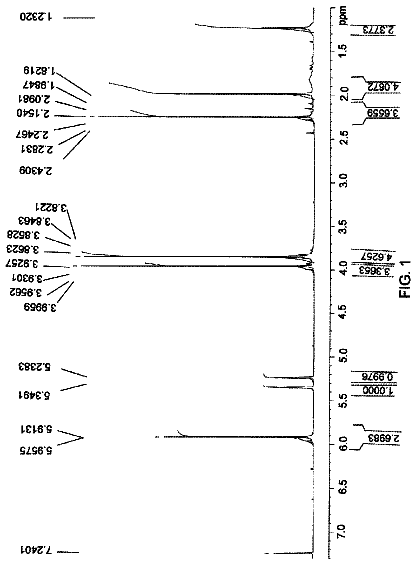 Lapsed, fee not paid7 drawings