 Lapsed, fee not paid9 drawings
Hardware & Electronics · US 8,755,036 B2
Active imaging system and method
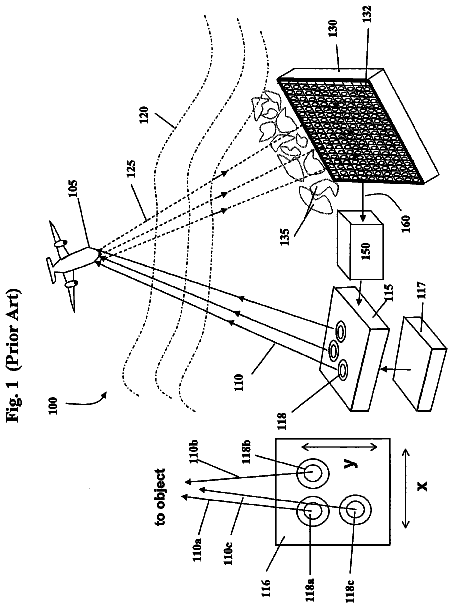
An active imaging system includes a laser transmitter configured to emit light in a plurality of beamlets.
US 8,755,048 B2 · Assignee: Toyota Jidosha Kabushiki Kaisha · Inventors: Funayama; Ryuji et al.
Sheet 1 of 17 from the published document. All sheets in the USPTO PDF
A movable body spectrum measuring apparatus including a dictionary data storing unit for storing spectrum data containing wavelength information and light intensity information of an object being measured, and a limitation information storing unit for storing limitation information to regulate the wavelength information into partial wavelength information. The movable body spectrum measuring apparatus further including a discrimination level setting unit for setting selectively the limitation information corresponding to the discrimination level required of the object being measured, a restricting unit for restricting the spectrum data regarding the observation light to the spectrum data composed exclusively of the wavelength information limited by the limitation information, and a discrimination unit for discriminating the object being measured based on the comparison between the restricted spectrum data and the spectrum data regarding the dictionary data storing unit.
In recent years, vehicles such as automobiles have been often provided with a drive assisting device that recognizes the state of a pedestrian, a traffic light or the like, which dynamically varies around the vehicle, and assists driving and decision making for the driver. Most of such apparatuses take an image of the state of a traffic light, a pedestrian or the like by use of a CCD camera, processes the taken image in real time to recognize the state and uses the recognition result for the above-mentioned assistance for driving. However, since the shape of a pedestrian generally varies depending on size, orientation or presence or absence of his/her belongings, it is difficult to correctly recognize the existence of a pedestrian on the basis of the shape obtained by the above-mentioned image processing. Although traffic lights are highly standardized in size and color, the shapes disad
1 of 17 drawing sheets so far from the published document, cropped to the drawing. Every sheet is in the USPTO PDF.
What the patent claimed, word for word. All of it is now free to use.
The present invention relates to a movable body spectrum measuring apparatus for discriminating a measuring object on the basis of spectrum data regarding the measuring object as measured by a spectrum sensor mounted on a movable body such as a vehicle, in particular, an automobile.
In recent years, vehicles such as automobiles have been often provided with a drive assisting device that recognizes the state of a pedestrian, a traffic light or the like, which dynamically varies around the vehicle, and assists driving and decision making for the driver. Most of such apparatuses take an image of the state of a traffic light, a pedestrian or the like by use of a CCD camera, processes the taken image in real time to recognize the state and uses the recognition result for the above-mentioned assistance for driving. However, since the shape of a pedestrian generally varies depending on size, orientation or presence or absence of his/her belongings, it is difficult to correctly recognize the existence of a pedestrian on the basis of the shape obtained by the above-mentioned image processing. Although traffic lights are highly standardized in size and color, the shapes disadvantageously vary depending on the viewing angle, and shape recognition through the above-mentioned image processing has its limits.
Patent Document 1 describes a remote sensing technique using spectrum data collected by a spectrum sensor as one technique for recognizing a measuring object. According to this technique, measuring objects such as woods, agricultural fields and urban areas, which are difficult to be recognized only by a visible light region, are discriminated by classifying and characterizing multi-spectrum image data also including invisible light regions photographed by the spectrum sensor mounted on an airplane, an artificial satellite, or the like.
Patent Documents
Patent Document 1: Japanese Laid-Open Patent Publication No. 2000-251052
Patent Document 2: Japanese Laid-Open Patent Publication No. 2006-145362
Problems to be Solved by the Invention
Since a spectrum sensor observes a brightness value (light intensity) of each wavelength range also including the invisible light region, characteristics of the measuring object can be found by comparing brightness values of wavelengths with each other and furthermore, allowing the measuring object to be discriminated. In addition, in recent years, a hyper spectrum sensor having a wide imageable bandwidth and a high resolution of a few nm to a dozens of nm has been put into practical use as the above-mentioned spectrum sensor (refer to Patent Document 2).
Thus, it has been recently considered that such a spectrum sensor mounted on a vehicle such as an automobile, and various measuring objects around the vehicle are discriminated on the basis of spectrum data taken by the spectrum sensor. However, since the amount of such spectrum data, especially spectrum data obtained by the above-mentioned hyper spectrum sensor is enormous, an increase in time required to process the data is not negligible and real-time adequacy regarding discriminating the measuring object is necessarily lowered.
Accordingly, it is an objective of the present invention to provide a movable body spectrum measuring apparatus that can discriminate a measuring object with high accuracy on the basis of photographic data taken by a spectrum sensor mounted on a movable body such as a vehicle and can process photographic data in real time.
To achieve the foregoing objective and in accordance, a movable body spectrum measuring apparatus according to the present invention has a spectrum sensor mounted on a movable body, and the spectrum sensor is capable of measuring wavelength information and light intensity information. The movable body spectrum measuring apparatus discriminates a measuring object in the surroundings of the movable body based on spectrum data regarding an observation light detected by the spectrum sensor. The movable body spectrum measuring apparatus includes a first storing unit, a second storing unit, a discrimination level setting unit, a restricting unit, and a discrimination unit. The first storing unit stores, as dictionary data, spectrum data including wavelength information and light intensity information for a plurality of predetermined measuring objects. The second storing unit stores limitation information for limiting wavelength information included in a wavelength region of the spectrum data regarding the observation light to a part of the wavelength information classified based on an attribute of the measuring object. The discrimination level setting unit selectively sets limitation information corresponding to a required discrimination level of the measuring object from the limitation information stored in the second storing unit. The restricting unit restricts the spectrum data regarding the observation light to spectrum data consisting of only the wavelength information limited based on the selectively set limitation information. The discrimination unit discriminates the measuring object based on comparison between the spectrum data restricted by the restricting unit and the spectrum data stored in the first storing unit.
With such a configuration, the wavelength information on the spectrum data regarding the observation light is limited to the spectrum data consisting of only a part of the wavelength information based on the limitation information. Consequently, the amount of data on the wavelength information of the spectrum data is reduced. The discrimination unit compares only the wavelength information included in the restricted spectrum data with the spectrum data regarding the measuring object, thereby reducing the amount of the computation required for the comparison. Thus, for the time necessary for computational processing to be performed for discriminating the measuring object is also reduced spontaneously and the processing related to the discrimination of the measuring object can also be performed based on the spectrum data regarding the observation light in real time. As a result, even when the spectrum measuring apparatus is mounted on the vehicle as the movable body, the vehicle can discriminate the measuring object in real time, thereby increasing the adoptability of the spectrum measuring apparatus for drive assistance requiring real-time processing.
Moreover, reduction in the amount of the spectrum data or the amount of the computation required for discriminating the measuring object results in reduction in storage capacity of a storing device such as a memory, which can simplify configuration of the spectrum measuring apparatus, thereby improving flexibility. Thus, the adoptability of the spectrum measuring apparatus for the movable body is increased.
In accordance with one aspect of the present invention, the wavelength information limited by the limitation information includes at least one of wavelength band information and wavelength resolution information. The wavelength band information is information indicative of a partial wavelength band obtained by reducing a wavelength region of the spectrum data regarding the observation light, and wavelength resolution information is information indicative of a wavelength resolution as the spectrum data.
With such a configuration, the spectrum data regarding the observation light can also be limited by the limitation information including at least one of the wavelength band information indicative of a wavelength region required for the comparison and the wavelength resolution information indicative of a wavelength resolution required for the comparison. The spectrum data thus restricted can adequately maintain precision in the discrimination of the measuring object in the comparison and can reduce the amount of the data.
Moreover, the number of wavelengths used in the comparison can be optionally set based on the wavelength band information or the wavelength resolution information. In addition, in the case where the wavelength band information and the wavelength resolution information are included in the limitation information, it is also possible to optionally set the number of the wavelengths used in the comparison by a combination of the wavelength band information and the wavelength resolution information, thereby increasing the degree of freedom in selection of the time necessary for the discrimination processing of the measuring object.
In accordance with one aspect of the present invention, a required discrimination level of the measuring object is divided into a plurality of hierarchies as discrimination level data, and at least one of the wavelength band information and the wavelength resolution information is respectively caused to correspond to the hierarchized discrimination level data and is stored in the second storing unit.
With such a configuration, the discrimination level determined based on the precision in the discrimination or the like is set hierarchically. Accordingly, the measuring object can be selected by switching among the hierarchies of the discrimination level in the discrimination processing of the measuring object in addition to the selection in the same discrimination level. For example, an upper class is caused to correspond to a rough classification or a schematic classification and a lower class is caused to correspond to a small classification or a detailed classification with respect to the upper class. As a result, when a discrimination level for a measuring object is moved from an upper part to a lower part based on a hierarchical structure, the classification of the measuring object is made fine or a state is known in detail. Thus, the measuring object is spontaneously narrowed down so that the measuring object can also be discriminated quickly. Consequently, in the case where the spectrum measuring apparatus is employed for a vehicle, drive assistance can be rapidly performed.
In accordance with one aspect of the present invention, the wavelength band information or the wavelength resolution information which is respectively caused to correspond to the discrimination level data is separately changed into map data in the second storing unit.
With such a configuration, the wavelength band information and the wavelength resolution information are separately changed into map data, respectively. Therefore, it is also possible to manage the wavelength band information and the wavelength resolution information separately.
By performing the comparison in the order of an array of the measuring object in the map data, it is also possible to set the arrangement order as a priority of the measuring object and to preferentially perform the discrimination of the measuring object having a high priority which is desired for drive assistance or the like, for example. Alternatively, if the array of the map data is adequately set in accordance with the occurrence ratio of a measuring object, it is also possible to reduce the number of the data comparisons for the discrimination of the measuring object, thereby reducing the time necessary for the computation. In any case, it is possible to shorten the time necessary for discriminating the measuring object by the spectrum measuring apparatus, thereby increasing the feasibility still more for real-time processing.
In accordance with one aspect of the present invention, at least one of the wavelength band information and the wavelength resolution information is set in such a manner that spectrum data to be restricted through the restricting unit has an equal data amount in all discrimination levels.
With such a configuration, at least one of the wavelength band information and the wavelength resolution information is set to cause the amounts of the spectrum data to be equal to each other irrespective of the hierarchy of the discrimination level. Accordingly, the amounts of the spectrum data are equal to each other irrespective of the hierarchy of the discrimination level. Consequently, the time necessary for the discrimination processing is made uniform irrespective of the hierarchy of the discrimination level.
In accordance with one aspect of the present invention, the restricting unit restricts spectrum data output from the spectrum sensor such that the restricted spectrum data at least has a wavelength band designated by the wavelength band information or a wavelength resolution designated by the wavelength resolution information.
With such a configuration, also in a large amount of the spectrum data regarding the observation light which is detected by the spectrum sensor, the amount of the data is restricted by the restricting unit. Therefore, the amount of data is reduced, resulting in reduction in the time necessary for computational processing to be performed for discriminating the measuring object. Consequently, it is possible to improve the feasibility of the real-time processing to be performed by the spectrum measuring apparatus.
In accordance with one aspect of the present invention, the movable body is provided with a spectrum sensor control device for causing at least one of an observation wavelength band and an observation wavelength resolution in the spectrum sensor to be variable, and, through the spectrum sensor control device, the restricting unit restricts spectrum data regarding an observation light detected by the spectrum sensor such that the restricted spectrum data has a wavelength band designated by the wavelength band information or a wavelength resolution designated by the wavelength resolution information.
With such a configuration, the spectrum data regarding the observation light which is detected by the spectrum sensor is restricted based on at least one of the wavelength band information and the wavelength resolution information. Accordingly, the amount of data is reduced and the time necessary for a computational discrimination process for a measuring object is reduced, thereby increasing the feasibility for real-time processing to be performed by the spectrum measuring apparatus.
In accordance with one aspect of the present invention, the required discrimination level of the measuring object is automatically updated recursively in accordance with a discrimination content of the measuring object discriminated by the discrimination unit.
With such a configuration, the discrimination level is automatically updated recursively. Accordingly, in the case where the hierarchized discrimination level is moved from an upper class to a lower class, the discrimination of the measuring object can be further divided in more detail and can be made in more detail with the movement of the class. Consequently, the measuring object is spontaneously narrowed down so that the measuring object can be discriminated quickly.
In accordance with one aspect of the present invention, the movable body is further provided with an object detecting device for detecting the measuring object, and a measuring object is set by the spectrum sensor in accordance with the measuring object detected by the object detecting device.
With such a configuration, the discrimination processing is preferentially performed for the measuring object detected by the object detecting device. Accordingly, it is possible to discriminate the measuring object quickly. In addition, it is also possible to omit the processing for recognizing a measuring object having a low occurrence ratio, resulting in reduction in the time necessary for the discrimination processing.
In accordance with one aspect of the present invention, the movable body is provided with an environment information acquiring device for acquiring surrounding environment information, and a measuring object is set by the spectrum sensor in accordance with the environment information acquired by the environment information acquiring device.
With such a configuration, in accordance with the environmental information acquired by the environment information acquiring device, the measuring object having a high occurrence ratio or the measuring object having a high priority is preferentially subjected to the discrimination processing, for example. This enables the discrimination of the measuring object quickly. Consequently, the recognition processing of the measuring object having a low occurrence ratio is omitted, thereby reducing the time necessary for the discrimination processing.
In accordance with one aspect of the present invention, the environment information acquired by the environment information acquiring device is at least one of weather information and position information of the movable body.
With such a configuration, when the acquired environment information is weather information, by increasing the priority of an umbrella, a puddle or the wet measuring object that has a high occurrence ratio in the case of rainy weather and has a low priority in the case of sunny weather, the measuring object can be discriminated quickly. When the environmental information is position information of the movable body, by setting the measuring object to have a high priority for an automobile or a white line on a road in the case of motor highways, a road in the case of agricultural fields, a person or a traffic light in the case of urban areas and a person, especially, a child or an older person in the case of residential streets, the measuring object can be discriminated quickly.
In accordance with one aspect of the present invention, the movable body is provided with an intended purpose selecting device for selecting an intended purpose of the spectrum sensor, and a measuring object is set by the spectrum sensor in accordance with the intended purpose selected through the intended purpose selecting device.
With such a configuration, the measuring measures set by the intended purpose selecting device can be preferentially discriminated. Thus, by preferentially discriminating the measuring object requiring assistance of the spectrum measuring apparatus in the movable body, the measuring object can be discriminated quickly. Furthermore, the recognition processing of the measuring object having a low occurrence ratio is omitted, thereby reducing the time necessary for the discrimination processing.
In accordance with one aspect of the present invention, the intended purpose selecting device includes a group of selecting switches to be manually operated by a driver of the movable body, and a measuring object selected through the selecting switch group is set as a measuring object through the spectrum sensor.
With such a configuration, assistance can be performed by the spectrum measuring apparatus at a request of a driver, and it is also possible to discriminate the measuring object quickly by preferentially performing the discrimination processing over a measuring object having a high priority for the driver.
In accordance with one aspect of the present invention, the movable body is provided with a drive assistance system for assisting driving, and the intended purpose selecting device selects a measuring object to meet an intended purpose in cooperation with the drive assistance system.
With such a configuration, by preferentially discriminating the measuring object having a high priority, which is determined according to the intended purpose of the drive assistance system, the measuring object can be discriminated quickly. Further, recognition processing for a measuring object having a low occurrence ratio is omitted, thereby reducing the time necessary for the discrimination processing. For example, when drive assistance is performed by adaptive cruise control (ACC) to control a distance from the vehicle ahead, an automobile is selected as the measuring object having a high priority. When drive assistance is performed by lane keeping assistance control (LKA) to control a lane for the vehicle, a white line on the road surface is selected as the measuring object having a high priority. When drive assistance is performed by on-vehicle night vision device (night view), a pedestrian is selected as the measuring object having a high priority. Consequently, the measuring object is discriminated in cooperation with a drive assistance system in this manner to attain an object of the assistance. This increases the adoptability of the movable body spectrum measuring apparatus.
In accordance with one aspect of the present invention, the movable body is provided with a moving state acquiring device for acquiring information on a moving state of the movable body, and a measuring object is set by the spectrum sensor in accordance with the moving state of the movable body which is acquired by the moving state acquiring device.
With such a configuration, by preferentially discriminating the measuring object having a high priority, which is determined according to the moving state acquired by the moving state acquiring device, the measuring object can be discriminated quickly. Furthermore, the recognition processing of the measuring object having a low occurrence ratio is omitted, thereby reducing the time necessary for the discrimination processing.
In accordance with one aspect of the present invention, information on the moving state of the movable body, which is acquired by the moving state acquiring device, is at least one of speed information, acceleration information, and steering information of the movable body.
With such a configuration, a measuring object having a high priority is determined based on speed information, acceleration information or steering information of the movable body. For example, by changing a discrimination level based on the speed information or the acceleration information, the discrimination processing can be finished within a predetermined period. Further, on the basis of the steering information, the measuring object can be set to the car in the case of driving across a motorway and to the pedestrian in the case of driving across a sidewalk.
According to an aspect of the present invention, the movable body is an automobile driving on a road surface.
With such a configuration, even the spectrum measuring apparatus mounted on the automobile can recognize the measuring object that sequentially approaches during driving on the road in real time to achieve adequate drive assistance. This increases the adoptability of the spectrum measuring apparatus in the automobile.
FIG. 1 is a block diagram showing a movable body according to a first embodiment provided with a movable body spectrum measuring apparatus of the present invention;
FIG. 2 is a block diagram showing a functional block of the spectrum measuring apparatus in the first embodiment;
FIG. 3 are graphs showing a spectrum waveform as dictionary data in the first embodiment, where FIG. 3(a) shows a spectrum waveform with a low resolution, FIG. 3(b) shows a spectrum waveform with an almost middle resolution and FIG. 3(c) shows a spectrum waveform with a high resolution;
FIG. 4 is a graph showing an example of spectrum data for an observation light which is output from a spectrum sensor in the first embodiment;
FIG. 5 is a table showing an example of a hierarchical state of a discrimination level in the first embodiment;
FIG. 6 is a map showing an example of a wavelength region map in the first embodiment;
FIG. 7 is a map showing an example of a wavelength resolution map in the first embodiment;
FIG. 8 is a flowchart showing discrimination processing in the first embodiment;
FIG. 9 are diagrams for describing the discrimination processing in the first embodiment, where FIG. 9(a) is a view showing a visible state of a measuring object, FIG. 9(b) is a graph showing a spectrum of the measuring object in the case of a wide wavelength region and a low wavelength resolution, FIG. 9(c) is a graph showing a spectrum of the measuring object in the case of a middle wavelength region and a middle wavelength resolution, and FIG. 9(d) is a graph showing a spectrum of the measuring object in the case of a narrow wavelength region and a high wavelength resolution;
FIG. 10 is a block diagram showing a movable body according to a second embodiment equipped with a functional block for a movable body spectrum measuring apparatus of the present invention;
FIG. 11 is a flowchart showing discrimination processing in the second embodiment;
FIG. 12 is a block diagram showing a movable body according to a third embodiment provided with a movable body spectrum measuring apparatus of the present invention;
FIG. 13 is a block diagram showing a movable body according to a fourth embodiment provided with a movable body spectrum measuring apparatus of the present invention;
FIG. 14 is an explanatory view showing an example of map information for acquiring position information in the fourth embodiment;
FIG. 15 are graphs showing a spectrum waveform as dictionary data regarding an LED type traffic light in the fourth embodiment, where FIG. 15(a) shows spectrum data on a green lamp, FIG. 15(b) shows spectrum data on an yellow lamp and FIG. 15(c) shows spectrum data on a red lamp;
FIG. 16 are graphs showing a spectrum waveform as dictionary data regarding an incandescent light bulb type traffic light in the fourth embodiment, where FIG. 16(a) shows spectrum data regarding a green lamp, FIG. 16(b) shows spectrum data regarding an yellow lamp and FIG. 16(c) shows spectrum data regarding a red lamp;
FIG. 17 is a graph showing an example of spectrum data regarding an observation light in the case where a traffic light output from a spectrum sensor is set to be a measuring object in the fourth embodiment;
FIG. 18 is a flowchart showing discrimination processing in the fourth embodiment;
FIG. 19 is a block diagram showing a movable body according to a fifth embodiment provided with a movable body spectrum measuring apparatus of the present invention;
FIG. 20 is a schematic view showing a selecting button as an example of a using state measuring apparatus in the fifth embodiment;
FIG. 21 are graphs showing a spectrum waveform as dictionary data regarding an LED type traffic light in the fifth embodiment, where FIG. 21(a) shows spectrum data regarding a vehicle, FIG. 21(b) shows spectrum data regarding a person and FIG. 21(c) shows spectrum data regarding a white line on a road surface;
FIG. 22 is a graph showing an example of spectrum data regarding an observation light in the case where a pedestrian output from a spectrum sensor is a measuring object in the fifth embodiment;
FIG. 23 is a flowchart showing discrimination processing in the fifth embodiment;
FIG. 24 is a block diagram showing a movable body according to a sixth embodiment provided with a movable body spectrum measuring apparatus of the present invention;
FIG. 25 is a flowchart showing discrimination processing in the sixth embodiment;
FIG. 26 are views for describing the case where a steering angle is used as a state of a vehicle in the sixth embodiment, wherein FIG. 26(a) is a view of the vehicle moving across a driveway and FIG. 26(b) is a view of a vehicle moving across a sidewalk.
FIG. 27 is a flowchart showing the discrimination processing in the sixth embodiment.
(First Embodiment)
A movable body provided with a movable body spectrum measuring apparatus according to a first embodiment of the present invention will be described with reference to FIGS. 1 to 9.
FIG. 1 is a diagram showing the schematic configuration of functions of the movable body spectrum measuring apparatus provided on a vehicle as a movable body including the apparatus. As shown in FIG. 1, a vehicle 10 is provided with a spectrum measuring apparatus 11 for acquiring optical information including visible light and nonvisible light outside of the vehicle, a human machine interface 12 for transmitting the information output from the spectrum measuring apparatus 11 to an occupant of the movable body and a vehicle control device 13 for reflecting the information output from the spectrum measuring apparatus 11 in vehicle control.
The human machine interface 12 is a publicly-known interface device that transmits the state of the vehicle to the occupant, in particular, a driver through light, color, sound or the like, and is provided with an operating device such as a push button or a touch panel so as to transmit the occupant's decision to the vehicle control device 13 or the like via a button or the like.
The vehicle control device 13 is one of control devices mounted on the vehicle and is a device such as an engine control device, which is connected to other various control devices mounted on the vehicle directly or via an on-vehicle network and can communicate necessary information with each other. In this embodiment, the vehicle control device 13 transmits input information for an object discriminated by the spectrum measuring apparatus 11 to the other various control devices and allows the vehicle 10 to perform drive assistance as required according to the discriminated measuring object.
The spectrum measuring apparatus 11 is provided with a spectrum sensor 14 for detecting spectrum data regarding observation light and a spectrum data processor 15 for receiving the spectrum data regarding the observation light, which is detected by the spectrum sensor 14, and processing the data. The spectrum sensor 14 separates the observation light consisting of visible light and nonvisible light into predetermined wavelength bands. Then, the observation light is output as spectrum data configured of wavelength information indicating each wavelength forming the wavelength band by the light separation and light intensity information indicating the light intensity of the separated observation light at each wavelength. The spectrum sensor 14 may measure the wavelength information and the light intensity information at the same time or may measure the information as necessary.
Next, the spectrum data processor 15 will be described with reference to FIG. 2. FIG. 2 is a diagram showing a detailed block structure of the spectrum data processor 15.
The spectrum data processor 15 mainly includes a microcomputer having, for example, a computation device and a storing device. The spectrum data regarding the observation light, which is detected by the spectrum sensor 14, is input into the spectrum data processor 15. By discriminating the observed measuring object based on the input spectrum data regarding the observation light and outputting a result, the spectrum data processor 15 outputs the result to the human machine interface 12 and the vehicle control device 13. The spectrum data processor 15 is provided with a dictionary data storing unit 16 for storing spectrum data regarding each of the plurality of measuring objects as dictionary data therein and an computation device 17 for discriminating the measuring object based on a comparison computation for comparing the spectrum data regarding the measuring object as dictionary data with the spectrum data regarding the observation light. Moreover, the spectrum data processor 15 is provided with limitation information storing unit 18 for storing limitation information for reducing the amount of computational processing in the comparison computation in the computation device 17.
The dictionary data storing unit 16 is formed by all or part of a storage area provided in a publicly-known storing device and stores the spectrum data as dictionary data in the storage area. The dictionary data consists of pieces of the spectrum data regarding the measuring objects as the objects to be discriminated and is previously prepared for the number of measuring objects to be discriminated. That is, the storage area as the dictionary data storing unit 16 may be configured of storage areas of one or more storing device(s) so as to satisfy a storage capacity capable of storing the previously prepared plurality of dictionary data.
The spectrum data as dictionary data has the wavelength information and the light intensity information. For example, data regarding one measuring object as dictionary data includes the light intensity information found by dividing the wavelength band that can be measured by the spectrum sensor by a wavelength resolution of the spectrum sensor and the corresponding wavelength information, which forms a pair, and the amount of data is large. For example, given that the wavelength band to be used in the comparison computation is 400 nm to 2500 nm and the wavelength resolution is 5 nm, the spectrum data regarding one measuring object contains 420 pairs of the wavelength information and the light intensity information.
FIG. 3 shows an example of the spectrum data as dictionary data. FIG. 3 are graphs showing the spectrum data having a plurality of wavelength resolutions, and FIG. 3(a) is a graph showing the case where the resolution is low, FIG. 3(b) is a graph showing the case where the resolution is medium and FIG. 3(c) is a graph showing the case where the resolution is high. In FIG. 3(a), a graph LM0 shows an example of spectrum data in the case where a measuring object is "person" and a graph LC0 shows an example of spectrum data in the case where the measuring object is "car". In FIG. 3(b), a graph LM1 shows an example of spectrum data in the case where the measuring object is "small person", a graph LM2 shows an example of the spectrum data in the case where the measuring object is "large person", and a graph LC1 shows an example of the spectrum data in the case where the measuring object is "station wagon type car". In FIG. 3(c), a graph LM3 shows an example of the spectrum data in the case where the measuring object is "child", a graph LM4 shows an example of the spectrum data in the case where the measuring object is "adult", and a graph LC2 shows an example of the spectrum data in the case where the measuring object is "ambulance". Thus, if the measuring object is "person", it also includes "child", "adult" or the like which is subdivided in addition thereto. Dictionary data as spectrum data for discriminating the measuring objects is provided. If the measuring object is "car", "ambulance" or the like which is classified more finely in addition thereto is also the object. Dictionary data as each spectrum data is provided to discriminate the measuring objects.
As shown in FIG. 2, the computation device 17 is provided with a discrimination unit 30 for discriminating a measuring object based on spectrum data regarding an observation light and outputting a result of the discrimination, and a discrimination level setting unit 31 for giving the discrimination unit limitation information for limiting the amount of a comparison computation. The discrimination unit 30 is provided with a restricting unit 32 for directly inputting the spectrum data regarding the observation light, and a comparing unit 33 for comparing the spectrum data sent from the restricting unit 32 with dictionary data sent from the dictionary data storing unit 16. Moreover, the limitation information storing unit 18 is provided with a discrimination level data storing unit 20, a wavelength band map storing unit 21 and a wavelength resolution map storing unit 22.
The discrimination level data storing unit 20 of the limitation information storing unit 18 retains discrimination level data. The discrimination level data is obtained by disposing a discrimination level required for discriminating a measuring object with a classification into a plurality of hierarchies.
Next, a relationship between the discrimination level in the discrimination level data and the measuring object will be descried with reference to FIG. 5. FIG. 5 shows a discrimination level map 25 as an example embodying the discrimination level data. As shown in FIG. 5, a discrimination level having the highest hierarchy is set to be a discrimination level 1, a discrimination level having a lower hierarchy is set to be a discrimination level 2, a discrimination level having a further lower hierarchy is set to be a discrimination level 3, and a discrimination level having the lowest hierarchy is set to be a discrimination level 4. In this embodiment, the hierarchization is performed in accordance with a wavelength resolution in such a manner that a discrimination level having a low wavelength resolution is set to have a high hierarchy and a discrimination level having a high wavelength resolution is set to have a low hierarchy. In this embodiment, for convenience of explanation, a discrimination level having a relatively high hierarchy is indicated as a higher discrimination level and a discrimination level having a relatively low hierarchy is indicated as a lower discrimination level. Consequently, a lower discrimination level has a lower hierarchy with respect to the higher discrimination level and a higher wavelength resolution. Description will be given by using an example of the dictionary data. The higher discrimination level is required for the measuring object of "person" or "car" shown in FIG. 3(a), a lower discrimination level is required for the measuring object of "small person", "large person" or "station wagon type car" shown in FIG. 3(b), and a further lower discrimination level is required for the measuring object of "child", "adult" or "ambulance" shown in FIG. 3(c).
By using the discrimination level map 25 shown in FIG. 5, description will be given of a hierarchical arrangement of the measuring object. In this embodiment, a measuring object classified roughly or schematically is arranged in a higher hierarchy shown in the discrimination level map 25, and a measuring object obtained by classifying the high-order measuring object finely or in detail is arranged in a lower hierarchy. Such a relationship is applied between two discrimination levels which are higher and lower classes, respectively. In other words, it is possible to discriminate the measuring object discriminated based on the discrimination level 1 into a more detailed measuring object through a further discrimination based on the discrimination level 2. As compared with the case where a comparison computation is performed to discriminate any of the measuring objects with high precision from the beginning at this time, the amount of the computation is reduced so that the measuring objects are spontaneously discriminated quickly. This is the same between the discrimination level 2 and the discrimination level 3 and between the discrimination level 3 and the discrimination level 4.
Detailed description will be given. As measuring objects classified roughly, "animal", "plant", "artifact", "others" and the like are set to the discrimination level 1 in the discrimination level map 25. Measuring objects obtained by classifying "animal" or the like in the discrimination level 1 in detail are set to the discrimination level 2. For example, "person", "dog", "cat", "deer", "wild boar" and the like are set as the measuring objects obtained by classifying "animal" in detail. Moreover, measuring objects obtained by classifying "person" or the like in the discrimination level 2 are set to the discrimination level 3. For example, "Asian", "American", "European" and the like are set as measuring objects obtained by measuring "person" in detail. For example, measuring objects obtained by classifying "Asian" or the like regarding the discrimination level 3 in detail are set to discrimination level 4. For example, "older person", "adult", "child", "disabled person" and the like are set as the measuring objects obtained by classifying "Asian" in detail.
The description continues in the full USPTO document.
About 6,216 words. The USPTO PDF has it with every drawing.
Fees are due 3.5, 7.5 and 11.5 years after grant. This patent expired on June 17, 2026, so the fee marked "not paid" was the one that went unpaid.
SPECTRUM MEASURING APPARATUS FOR MOVER
Filed May 2009 · published Jul 2012Spectrum measuring apparatus for mover
Filed May 2009 · granted Jun 2014Earlier publications, parents and continuations. None of them can still be enforced, or this patent would not be listed.
Prior art cited by the examiner or applicant. Useful when you check your own idea for novelty.
Everything on this page comes from the documents linked above.