The present invention relates to a hand tool for squeezing, chopping and pureeing food. The tool allows a user to chop, drain and/or puree food with one tool and can be used in conjunction with an ordinary bowl or colander.
Many culinary recipes call for hand squeezing of cooked greens, such as spinach or chard in order to extract all the liquids from the food. With hand squeezing, a cook often has to wait several minutes until the food is cool enough to comfortably handle before continuing with the recipe. In addition, hand squeezing is a messy procedure, as bits of the food always stick to the hands. Recipes often advise hand squeezing of cooked greens and salted foods (e.g., cucumbers, eggplant and squash) because currently available implements such as spoons, ladles and spatulas don't do a good job of squeezing the liquid out of the food. The handle placement of spoons, ladles and spatulas is generally off to the side of the pressing surfaces and there isn't enough force applied to the food for adequate squeezing, so too much liquid remains in the food. Excess liquid can have an adverse effect in some recipes.
Many pestles and mashers are suitable for pressing food and pureeing. However none of the commercially available devices have blades and the shapes are not optimized for use with a colander or large bowl.
Summary
The hand tool of the present invention has a blade, which allows the user to chop the food, and a scraping edge that allows the user to scrape food along the sides of the bowl or colander. Thus, a user can press, chop and puree with one tool in the same colander or bowl thereby eliminating the need to wash multiple implements, such as cutting boards, ricers, or food mills.
The hand tool of the present invention has a head
portion having a convex pressing surface
and a handle
portion. A user holds the grip
end of the handle
and applies force directly over the pressing surface to squeeze food such as, for example, cooked greens against a colander surface to remove the moisture. Thus, allowing moisture to be expelled through the holes of the colander. At the junction of the lower sidewall
of the convex pressing surface
and the under side
of the head
is the scraping edge (20). This edge scrapes food against the holes in a strainer or colander. It can also be used to scrape food particles from the sides of a bowl. A blade
is attached to the head portion of the tool. The blade can be used to chop and puree food. By nature of the curved blade, the user can chop in an ergonomically desirable rolling motion.
Brief description of the drawings
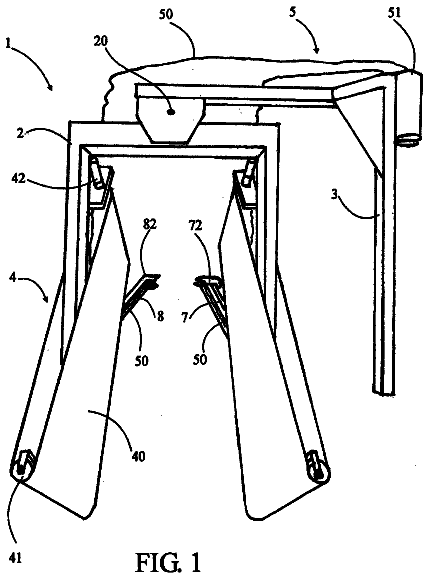
FIG. 1--shows a representative embodiment of the hand tool having a head
and a handle (40). A convex pressing surface
forms the top of the head. The bottom of the head has an underside (2). The handle
is attached to the underside
of the head (1). A blade
extends radially away from the head and extends beyond the convex pressing surface (10). A scraping edge
is formed at the juncture of the convex pressing surface
and the underside (2). The blade is parallel to the underside (2).
FIG. 2--shows the hand tool with a convex pressing surface
as viewed from above.
FIG. 3--shows the hand tool with a non-circular convex pressing surface
as viewed from above.
FIG. 4--shows the hand tool with a pistol like grip handle
attached to the under side
of the head ((1).
FIG. 5--shows the hand tool with a handle
that's attached to the underside
at two points of attachment.
FIG. 6--shows a hand tool of the present invention in use in a colander.
FIG. 7--shows an embodiment of the hand tool, which has raised bumps
distributed along the convex pressing surface.
Description
The present invention relates to a hand tool for squeezing, chopping and pureeing food. The hand tool consists of a head
having a convex pressing surface
for pressing against food and a handle
attached to the underside
of the head. The handle allows the user to grip the hand tool and exert pressure centrally over the head (1). Any handle position that allows the user to grip the tool without interfering with the squeezing, chopping and pureeing functions is contemplated. At least one curved blade
extends radially outward from and is preferably affixed to a section along the underside
of the head (1). Preferably, the blade is attached to the underside by screws (35), although any secure means of attachment is contemplated. In certain embodiments, the curved blade
may also be affixed to or inserted into the convex pressing surface
of the head (1), or formed integrally with the body material of the head (1). The curved blade may follow the shape of the pressing surface and extend outward from 0.25 to 1.5 inches beyond the juncture or the underside and the convex pressing surface. The blade may cover a portion of the underside or alternatively the blade may cover the entire underside and extend beyond the entire circumference of the head. In a preferred embodiment, the convex pressing surface
is circular in shape. Non-circular shapes are also contemplated for the head circumference. For example, an oval shaped head circumference is also contemplated. Any convex head that conforms to the side of a colander or bowl is suitable. Preferably the circumference of the head is from about 2.5-6 inches. Most preferably the head circumference is from 3 to 5 inches. In a preferred embodiment the pressing surface is smooth. In an alternative embodiment, smooth rounded raised bumps
may be distributed over the convex pressing surface. In yet another embodiment the convex pressing surface is perforated, allowing food to pass through the perforations. Preferably, the stem of the handle is attached to the center of the underside
of the head, i.e. the surface opposing the pressing surface. However, the handle can be attached to any point on the head as long as the handle position does not interfere with the pressing, scraping or chopping functions. A scraping edge
is formed at the juncture of the convex pressing surface
and the underside
of the head. Alternatively, the scraping edge can be formed from the same piece of material as the blade and is attached below and parallel to the underside (2). In another embodiment, the scraping edge (20), which is formed at the juncture of the convex pressing surface
and the underside
of the head, may be further machined to create different or sharper angles. The scraping edge
allows the user to scrape food particles from the sides of the cooking bowl or to press food through the holes of a colander.
A variety of materials may be used to create the hand tool. Durable dishwasher safe materials are preferred, as are materials that inhibit microbial growth. The head and the handle can be made from wood, silicone, metal, ceramic, plastic or any combination thereof. The blade can be formed of standard blade materials, such as high carbon steel, high carbon stainless steel, stainless steel, surgical stainless steel, titanium, titanium carbides, plastic and ceramic materials. If the head and blade are formed of the same material the blade can be formed integrally with the head. Alternatively, if the handle is made of the same material as the head it can be formed integrally with the head portion of the tool.
Without further elaboration, it is believed that one skilled in the art can, using the preceding description, utilize the present invention to its fullest extent. The preferred specific embodiments are, therefore, to be construed as merely illustrative, and not limitative of the remainder of the disclosure in any way whatsoever. The preceding embodiments can be repeated with similar success by substituting the generically or specifically described elements of this invention for those used in the preceding embodiments.
The entire disclosure[s] of all applications, patents and publications, cited herein and of corresponding Provisional Application Ser. No. 60/834,332, filed 31 Jul. 2006, are incorporated by reference herein.
From the foregoing description, one skilled in the art can easily ascertain the essential characteristics of this invention and, without departing from the spirit and scope thereof, can make various changes and modifications of the invention to adapt it to various usages and conditions.
 Lapsed, fee not paid8 drawings