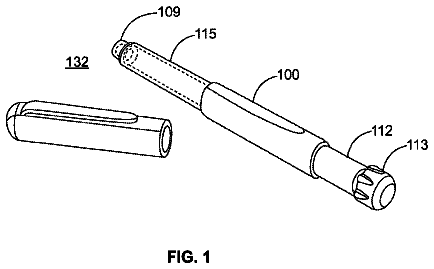
The present invention generally relates to devices which are adapted for application to a skin surface of a subject and comprise a transcutaneous device which can be used for e.g. introduction of a fluid through the skin of the subject or as a sensor. In specific aspects, such devices may comprise a reservoir adapted to contain a fluid drug, and expelling means for expelling fluid drug out of the reservoir and through the skin of the subject via the transcutaneous device.
Background of the invention
In the disclosure of the present invention reference is mostly made to the treatment of diabetes by injection or infusion of insulin, however, this is only an exemplary use of the present invention.
Portable drug delivery devices for delivering a drug to a patient are well known and generally comprise a reservoir adapted to contain a liquid drug and having an outlet in fluid communication with a hollow infusion needle, as well as expelling means for expelling a drug out of the reservoir and through the skin of the subject via the hollow needle. Such devices are often termed infusion pumps.
Basically, infusion pumps can be divided into two classes. The first class comprises infusion pumps which are relatively expensive pumps intended for 3-4 years use, for which reason the initial cost for such a pump often is a barrier to this type of therapy. Although more complex than traditional syringes and pens, the pump offer the advantages of continuous infusion of insulin, precision in dosing and optionally programmable delivery profiles and user actuated bolus infusions in connections with meals.
Addressing the above problem, several attempts have been made to provide a second class of drug infusion devices that are low in cost and convenient to use. Some of these devices are intended to be partially or entirely disposable and may provide many of the advantages associated with an infusion pump without the attendant cost and inconveniencies, e.g. the pump may be prefilled thus avoiding the need for filling or refilling a drug reservoir. Examples of this type of infusion devices are known from U.S. Pat. Nos. 4,340,048 and 4,552,561 (based on osmotic pumps), U.S. Pat. No. 5,858,001 (based on a piston pump), U.S. Pat. No. 6,280,148 (based on a membrane pump), U.S. Pat. No. 5,957,895 (based on a flow restrictor pump (also know as a bleeding hole pump)), U.S. Pat. No. 5,527,288 (based on a gas generating pump), or U.S. Pat. No. 5,814,020 (based on a swellable gel) which all in the last decades have been proposed for use in inexpensive, primarily disposable drug infusion devices, the cited documents being incorporated by reference. U.S. Pat. No. 6,364,865 discloses a manually held infusion device allowing two vial-type containers to be connected and a pressure to be build up in one of the containers to thereby expel a drug contained in that container.
The disposable pumps generally comprises a skin-contacting mounting surface adapted for application to the skin of a subject by adhesive means, and with the infusion needle arranged such that in a situation of use it projects from the mounting surface to thereby penetrate the skin of the subject, whereby the place where the needle penetrates the skin is covered while the appliance is in use. The infusion needle may be arranged to permanently project from the mounting surface such that the needle is inserted simultaneously with the application of the infusion pump, this as disclosed in U.S. Pat. Nos. 2,605,765, 4,340,048 and in EP 1 177 802, or the needle may be supplied with the device in a retracted state, i.e. with the distal pointed end of the needle "hidden" inside the pump device, this allowing the user to place the pump device on the skin without the possibility of observing the needle, this as disclosed in U.S. Pat. Nos. 5,858,001 and 5,814,020. In addition to pumps, alternative means for transporting a fluid drug may be used, e.g. iontophoresis as discussed below.
Although it can be expected that the above described second class of fully or partly disposable infusion devices can be manufactured considerably cheaper than the traditional durable infusion pump, they are still believed to be too expensive to be used as a real alternative to traditional infusion pumps for use on an every-day basis.
Before turning to the disclosure of the present invention, a different type of device relying on the insertion of a needle or needle-like structure will be described.
Although drug infusion pumps, either disposable or durable, may provide convenience of use and improved treatment control, it has long been an object to provide a drug infusion system for the treatment of e.g. diabetes which would rely on closed loop control, i.e. being more or less fully automatic, such a system being based on the measurement of a value indicative of the condition treated, e.g. the blood glucose level in case of insulin treatment of diabetes.
A given monitor system for measuring the concentration of a given substance may be based on invasive or non-invasive measuring principles. An example of the latter would be a non-invasive glucose monitor arranged on the skin surface of a patient and using near-IR spectroscopy, however, the present invention is concerned primarily with devices comprising a transcutaneous device such as a needle-formed sensor element.
The sensor may be placed subcutaneously being connected to external equipment by wiring or the substance (e.g. fluid) to be analysed may be transported to an external sensor element, both arrangements requiring the placement of a subcutaneous component (e.g. small catheter or tubing), the present invention addressing both arrangements. However, for simplicity the term "sensor" is used in the following for both types of elements introduced into the subject.
Disclosure of the invention
Having regard to the above-identified problems, it is an object of the present invention to provide a skin mountable drug delivery device or system and components therefore, which allow such a device or system to be used in a convenient and cost-effective manner. The configuration of the system and the components therefore should contribute in providing a medical delivery means which allows for easy and swift operation yet being reliable in use.
In the disclosure of the present invention, embodiments and aspects will be described which will address one or more of the above objects or which will address objects apparent from the below disclosure as well as from the description of exemplary embodiments.
Thus, corresponding to a first aspect, a medical device comprising a transcutaneous unit and a process unit is provided, wherein the transcutaneous device unit comprises a mounting surface adapted for application to the skin of the subject, and a transcutaneous device comprising a distal end adapted to be inserted through the skin of a subject, the distal end being movable between an initial position in which the distal end is retracted relative to the mounting surface, and an extended position in which the distal end projects relative to the mounting surface, and wherein the process unit comprises a process assembly adapted to cooperate with the transcutaneous device, wherein the transcutaneous device unit and the process unit are adapted to be secured to each other to form a unitary device. By the term "unitary" is indicated that the two units are not merely physically connected by some kind of "loose" structure such as a flexible wire or a flexible fluid conduit as when connecting a conventional infusion set to a conventional infusion pump.
When it is defined that the two units are adapted to be secured to each other, this also covers the situation in which a portion of the transcutaneous device unit has to be removed prior to securing the process unit. This may e.g. be the case where the transcutaneous device unit comprises a removable inserter portion.
The transcutaneous device unit may be provided with actuation means for moving the distal end of the transcutaneous device between the initial and the extended position when the actuation means is actuated.
The term "process assembly" covers an aggregation of components which are adapted to interact with the transcutaneous device to provide a given functionality. For example, the transcutaneous device may be in the form of a transcutaneous sensor device, and the process assembly comprises a processor adapted to transmit and/or process data acquired via the sensor device.
In another example, the transcutaneous device is in the form of a transcutaneous access device, and the process assembly comprises a reservoir adapted to contain a fluid drug, an expelling assembly adapted for cooperation with the reservoir to expel fluid drug out of the reservoir and through the skin of the subject via the transcutaneous access device, and a processor for controlling the expelling assembly. A transcutaneous device may also be combined with a sensor element to form a combined transcutaneous device. Such a medical device may be used in a system further comprising a remote control unit comprising a processor, the medical device and the remote control unit being adapted to transmit data therebetween. The remote control unit may be adapted to receive externally supplied values and calculate a bolus amount of drug to be infused based upon the externally supplied values, e.g. it may be adapted to calculate a bolus amount of drug to be infused based upon externally supplied values representing material to be ingested by the body of the subject. The system may comprise a first analyte sensor device adapted to provide data indicative of a concentration of the first analyte in the user, the remote control unit comprising an infusion calculator for calculating a bolus or infusion rate on the basis of data supplied by the first analyte sensor. The system may also comprise a second analyte sensor device adapted to provide data indicative of a concentration of the second analyte in the user, the remote control unit comprising an infusion calculator for calculating a bolus or infusion rate on the basis of data supplied by the first and second analyte sensors. The first and second analytes may be blood glucose, in which case the first analyte sensor is a BGM, the second analyte sensor is a CGM, and the remote control unit is adapted to calculate an amount or infusion rate of insulin.
For the different embodiments described above, the medical device or system may comprise releasable mating coupling means for securing the transcutaneous device unit and the process unit to each other to form a substantially rigid connection therebetween.
In a further aspect a system is provided comprising a first transcutaneous device unit and a first process unit as described above, and at least one further transcutaneous device unit being different from the first transcutaneous device unit, whereby each combination of a transcutaneous device unit and a process unit provides different capabilities. Alternatively, a system is provided comprising a first transcutaneous device unit and a first process unit as described above, and at least one further process unit being different from the first process unit, whereby each combination of a transcutaneous device unit and a process unit provides different capabilities.
The term "capabilities" is used to denote a set of actions or functions resulting from a combination of the two units. The different capabilities may be based on structure (e.g. different patch units having different transcutaneous devices) or functionality (e.g. different pump units being programmed to deliver at different infusion rates). In the context of the present application, the term "different capabilities" is also used to indicate that the "potential" capabilities are different, however, in case the capabilities are overlapping, the user may e.g. choose to operate a given pump unit corresponding to the capabilities of another pump unit, or two different pump units may be used in the same way. For example, a pump unit allowing user-programming of infusion profiles as well as a bolus function may be used to activate a simple constant flow rate corresponding to the capabilities of a simple pump unit.
The present invention also provides a method of using the components comprising the steps of (i) providing a transcutaneous device unit comprising a transcutaneous device and a mounting surface, the transcutaneous device having retracted position relative to the mounting surface, and an extended position in which a distal end projects relative to the mounting surface, (ii) providing a process unit comprising a process assembly adapted to cooperate with the transcutaneous device, (iii) mounting the mounting surface to a skin surface of a subject, (iv) inserting the transcutaneous device into the subject by moving the transcutaneous device from the retracted position to the extended position, and (v) assembling the transcutaneous device unit and the process unit to provide a functional communication between the process assembly and the inserted transcutaneous device. The insertion step may take place after the assembling step, just as the insertion may be automatically activated when the two units are assembled. Alternatively, the two units may be assembled before they are mounted to the skin surface and the transcutaneous device inserted.
Corresponding to a further aspect, a medical device comprising a transcutaneous unit and a reservoir unit is provided, wherein the transcutaneous unit comprises transcutaneous means for transporting a fluid through a skin portion of a subject, and a mounting surface adapted for application to the skin of the subject. The reservoir unit comprises a reservoir adapted to contain a fluid drug, the reservoir comprising an outlet allowing the transcutaneous means to be arranged in fluid communication with an interior of the reservoir, and expelling means for, in a situation of use, expelling a fluid drug out of the reservoir and through the skin of the subject via the transcutaneous means. The transcutaneous unit and the reservoir unit further comprise coupling means allowing the reservoir unit to be secured to the transcutaneous unit in the situation of use.
The term "transcutaneous" covers all forms of administration in which a fluid is transported through a portion of the skin, e.g. intradermal or subcutaneous administration. The transcutaneous means may be in the form of a transcutaneous device, a jet injection means or electrodes allowing an ionic agent to permeate from a predetermined site on the surface of skin into the subcutaneous tissue of the subject by using the principle of iontophoresis. For a more thorough discussion of iontophoresis reference is made to U.S. Pat. No. 6,622,037 hereby incorporated by reference. Depending on the nature of the transcutaneous means the expelling means may be of different configuration and nature. For example, when one or more hollow infusion needles or cannulas are used, the expelling means may be arranged to force or suck the fluid drug from the reservoir, whereas in the case of iontophoresis the expelling means would be means for applying a current over a set of electrodes, i.e. "driving" means.
Corresponding to a further aspect, a medical device comprising a transcutaneous device unit and a reservoir unit is provided, wherein the transcutaneous device unit comprises a transcutaneous device, and a mounting surface for application to the skin of the subject. The reservoir unit comprises a reservoir adapted to contain a fluid drug, and an expelling assembly adapted for cooperation with the reservoir to expel the fluid drug out of the reservoir and through the skin of the subject via the transcutaneous device. The transcutaneous device unit and the reservoir unit are further adapted to be secured to each other in a situation of use thereby allowing a fluid communication to be established between the reservoir and the transcutaneous device. The transcutaneous device unit and the reservoir unit may comprise releasable coupling means allowing the reservoir unit to be secured to the transcutaneous device unit in a situation of us. Such a medical device comprising two units may also be considered a medical system. The transcutaneous device unit and the reservoir unit may each comprise a housing within which the transcutaneous device respectively the reservoir and the expelling assembly are arranged.
The term expelling assembly covers an aggregation of components or structures which in combination provides that a fluid can be expelled from the reservoir. The expelling assembly may e.g. be a mechanical pump (e.g. a membrane pump, a piston pump or a roller pump) in combination with electronically controlled actuation means, a mechanically driven pump (e.g. driven by a spring), a gas driven pump or a pump driven by an osmotic engine. The expelling assembly may also me in the form of an aggregation of components or structures which in combination provides that a fluid can be expelled from the reservoir when the expelling assembly is controlled or actuated by a controller external to the expelling assembly.
The transcutaneous device (which term also covers the similar terms transcutaneous access device and transcutaneous access tool traditionally used in this technical field) may be in the form of a pointed hollow infusion needle, a micro needle array, or a relatively flexible per se blunt cannula (or sensor) may be provided in combination with a pointed insertion needle, the insertion needle being retractable after insertion of the blunt portion of the transcutaneous device. The term "transcutaneous device" may also be used to denote such a combination although only a part of it is adapted to be inserted for an extended period of time. The cannula is advantageously soft and flexible relative to the insertion needle which typically is a solid steel needle. Especially when the transcutaneous device is in the form of a rigid needle it may be advantageous to provide retraction means for such a needle. In the disclosure of the present invention as well as in the description of the exemplary embodiments, reference will mostly be made to a transcutaneous device in the form of an infusion needle or cannula. The length of the transcutaneous device may be chosen in accordance with the actual application, e.g. a hollow steel needle which may be inserted at a substantially right angle relative to the skin surface may have an inserted length of 2-8 mm, preferably 3-5 mm, whereas a cannula which may also be inserted at an oblique angle relative to the skin surface may be somewhat longer, e.g. 4-20 mm.
In an exemplary embodiment the insertion needle is a hollow needle arranged coaxially with and outside the transcutaneous device and being axially movable relative thereto, the needle comprising a distal portion adapted to penetrate the skin of the subject, wherein the medical device is transformable between (a) a first state in which the transcutaneous device and the needle are retracted relative to the mounting surface, (b) a second state in which the transcutaneous device and the needle are extended relative to the mounting surface with the distal end of the needle projecting relative to the distal portion of the transcutaneous device thereby allowing the transcutaneous device to be introduced through the skin of the subject, and (c) a third state in which the distal end of the needle is retracted relative to the distal portion of the transcutaneous device. The process unit may be adapted to be releasably coupled to the transcutaneous device unit thereby, in a situation of use, substantially covering an introduction site of the transcutaneous device through the skin, wherein at least partial removal of the process unit from the transcutaneous device unit at least partially uncovers the introduction site.
The mounting surface is adapted for application against the skin of a subject (e.g. user or patient) and may be held in contact with the skin by attaching means external to the mounting surface (e.g. coupling means allowing the medical device to be coupled to a skin mountable device, or an adhesive bandage or a dressing) or by adhesive means provided on the mounting surface. The mounting surface may also be adapted for mounting towards the skin via an interposed component of a skin mountable device, e.g. a skin mountable device may comprise a receiving portion to which the medical device is attached, the transcutaneous device being inserted into the skin through an aperture in the receiving portion.
By the above arrangement different concepts can be realized. For example, by providing at least two different of one of the units, it will be possible to provided two or more combinations, wherein each combination of a transcutaneous device unit and a reservoir unit provides an assembly will have different capabilities as discussed in further detail below. In case the units are provided with releasable coupling means, one of the units can be exchanged with a new or different unit yet allowing the other unit to be re-used, thereby lengthening the operational life of the re-used unit. Thus, the present invention provides in an exemplary embodiment a device in which the components providing the interface with the user is incorporated in a first unit whereas the components providing the drug delivery per se is incorporated in a second unit, this allowing the combined components to be combined or exchanged in a simple, reliable and user-friendly way.
For example, the reservoir unit may be provided with an amount of drug and a delivery pump comprising an energy source allowing the drug to be delivered over e.g. 10 days, whereas the transcutaneous device unit may be provided with a transcutaneous device and an adhesive surface on the mounting surface having an expected (or recommended) operational life of 2 days, this allowing the reservoir unit to be used with 5 transcutaneous device units over a period of 10 days, this considerably lowering the total costs of using the combined device. The reservoir may be pre-filled or adapted to be filled one or more times.
On the other hand, a transcutaneous device unit may be provided with e.g. a needle or a soft cannula, and adhesive means (e.g. of the type used for attaching colostomy bags) allowing the needle unit to be mounted and used over an extended period of time, the reservoir unit having a shorter expected operational life, e.g. when relatively large amounts of drugs have to be infused. Alternatively, different reservoir units with different types of drugs may be used in combination with such a "long-term" mounted needle unit.
For ease of use, the fluid communication between the needle and the reservoir may be established when the needle unit and the reservoir unit are secured to each other, just as the expelling means may be activated when the needle unit and the reservoir unit are secured to each other and de-activated when the units are released from each other. Indeed, one or both of the operations may also be performed manually by the user.
In an exemplary embodiment the expelling assembly comprises a pump having an inlet adapted to be arranged in fluid communication with the outlet of the reservoir, and an outlet adapted to be arranged in fluid communication with the transcutaneous device, thereby allowing the transcutaneous device to be arranged in fluid communication with the interior of the reservoir. By such an arrangement the pump will serve as a suction pump drawing drug from the reservoir which consequently will have to be either collapsible or vented in case a non-collapsible reservoir is used. The expelling assembly may also be in the form of an arrangement adapted to pressurize the reservoir, e.g. an arrangement for driving a piston in a reservoir comprising a displaceable piston. The reservoir unit may comprise more than one reservoir and more than one expelling assembly. For example, a single expelling assembly may be used to expel drug from more than one reservoir, either simultaneously thereby mixing drugs or alternating, or each reservoir may be provided with an expelling assembly which may be connected to a common transcutaneous device or to individual transcutaneous devices, e.g. the transcutaneous device unit may comprise more than one transcutaneous device adapted to be connected to a expelling assembly.
In order to provide an initially sterile flow path through the pump, the flow path may be arranged between the inlet and outlet such that the inlet and outlet seal the interior of the pump and thereby the flow path in an initial sterile state. By this arrangement it will not be necessary to provide the reservoir unit as an entirely sterile--unit indeed, the drug will have to be provided in a sterile state.
In an exemplary embodiment, the reservoir unit is transformable from an initial condition in which there is no fluid communication between the pump and the reservoir to a non-reversible operating condition in which fluid communication is established between the inlet means of the pump and the outlet means of the reservoir when the pump unit is secured to a needle unit for the first time. By this arrangement it is avoided that undesired matter is introduced into the reservoir during re-connection between the pump and the reservoir.
To secure a clean connection between the pump and the reservoir, a separate fluid connector may be arranged within the interior of the pump in the initial condition. Such a fluid connector may comprise a pointed inlet end and an outlet, whereas the inlet of the pump and the outlet of the reservoir may be in the form of two needle-penetratable septa. By this arrangement the pointed end of the fluid connector, e.g. a connection needle, can be moved through the two septa and thus between the initial condition and an operating condition in which fluid communication is established between the interior of the reservoir and the interior of the pump via the fluid connector, the outlet of the fluid connector being arranged in the flow path. Advantageously the fluid connector is moved between its two positions as the reservoir unit is connected to a transcutaneous device unit for the first time. Correspondingly, during such a first connection two fluid communications will be established (between the transcutaneous device of the transcutaneous device and the pump, and between the pump and the reservoir), whereas during subsequent connections only a single new fluid communication will be established (between the transcutaneous device of the transcutaneous device unit and the pump).
In an exemplary embodiment the transcutaneous device comprises a first portion having a pointed distal end, and a second portion in fluid communication with the first portion and having a second end. Advantageously the second end of the transcutaneous device is pointed and the outlet means of the pump comprises a needle-penetratable septum allowing a fluid communication to be established between the second end of the transcutaneous device and the interior of the pump, preferably as the two units are connected to each other.
Correspondingly, in a further aspect the present invention provides a pump having an inlet means adapted to be arranged in fluid communication with a fluid supply, and an outlet means, the pump comprising an internal flow path arranged between the inlet and outlet means, the inlet and outlet means sealing the interior of the pump and thereby the flow path in an initial sterile condition, wherein a fluid connection means is arranged within the interior of the pump in the initial condition, the fluid connection means comprising an inlet end and an outlet, whereby the fluid connection means is arranged to be moved between the initial condition and to an operating condition in which the inlet end projects from the pump inlet means, whereby a fluid communication can be established between the fluid supply and the interior of the pump via the fluid connection means and with the outlet of the fluid connection means being arranged in the flow path.
The transcutaneous device unit may be supplied with e.g. a needle projecting from the mounting surface, however, to limit the risk of accidental needle injuries, the distal end of the transcutaneous device is advantageously movable between an initial position in which the distal end is retracted relative to the mounting surface, and an extended position in which the distal end projects relative to the mounting surface. Depending on the intended method of mounting the device on the user, the transcutaneous device may be moved between the two positions as the two units are connected to each, as would be appropriate in case the transcutaneous device unit is mounted on the skin of the user before the reservoir unit is connected. However, in case the two units are intended to be connected to each other before assembled units are mounted on the skin of the user, the transcutaneous device unit advantageously comprises user-actuatable actuation means for moving the pointed end of the transcutaneous device between the initial and the extended position.
To prevent inadvertent actuation of the transcutaneous device before the two units are assembled, the transcutaneous device unit may comprise means for blocking the actuation means, the blocking means being released when the transcutaneous device unit and the reservoir unit are secured to each other, thereby allowing the actuation means to be actuated.
To further reduce the likelihood of transcutaneous device injuries, the distal end of the transcutaneous device may be movable between the extended position in which the distal end projects relative to the mounting surface, and a retracted position in which the distal end is retracted relative to the mounting surface. Correspondingly, the combined device may comprise user-actuatable retraction means for moving the distal end of the transcutaneous device between the extended and the retracted position when the retraction means is actuated. To prevent re-use of the transcutaneous device, the transcutaneous device may be permanently locked in its retraced position.
To prevent user-errors the actuation means for introducing the transcutaneous device may in an initial condition cover the retraction means, actuation of the actuation means uncovering the retraction means. For example, the actuation means may be in the form of gripping means (e.g. a strip) which is removed from the device, whereby removal triggers transcutaneous device insertion and at the same time uncovers the retraction for withdrawing the transcutaneous device.
As described above, the expelling assembly may be activated and deactivated when the two units are assembled and disassembled, however, the actuation and retraction means may also be used to activate respectively deactivate the expelling assembly. Just as for the initial connection between the pump and the reservoir, the initial activation of the expelling assembly may result in electronic control means being activated resulting in start of pumping action, whereas subsequent deactivation will only deactivate the actual pump action, the control means still being active (e.g. counting the time since initial activation of the control means).
In the above disclosure of the invention the two units have been described primarily as "unitary" units, however, this is only an exemplary configuration and these two "main" units may in case it is deemed desirable be subdivided into further units. For example, the reservoir unit may be provided with an exchangeable control unit, this allowing different types of control units to be connected to the reservoir unit per se. e.g. a first type of control unit may provide a single delivery profile, a second control unit may be programmable to thereby modify the delivery pattern, or a control third unit may comprise means allowing the control unit to communicate with external means. In the latter case the control unit may be controlled using a cordless remote control. Correspondingly, the reservoir may be exchangeable allowing different sizes of reservoirs or different types of drugs to be used.
In a further aspect of the invention, a transcutaneous device unit is provided as described above and being adapted to be used in combination with a reservoir unit as disclosed above. Correspondingly, the invention also provides a reservoir unit as disclosed above, the reservoir unit being adapted to be used in combination with a transcutaneous device unit as disclosed above. In an exemplary embodiment such a transcutaneous device unit may be provided with a hollow needle comprising a pointed distal end with an outlet opening and being adapted to penetrate the skin of a subject, and a pointed proximal end with an inlet opening forming a fluid inlet means, the fluid inlet means being adapted to be arranged in fluid communication with a fluid supply. By this arrangement the needle provides a hydraulically stiff fluid communication between the needle inlet and outlet openings (e.g. made from metal), this allowing early occlusion detection by monitoring a pressure build-up upstream of the needle.
In a yet further aspect, a system is provided comprising a first needle unit and a first reservoir unit as disclosed above in combination with a least one further needle unit or reservoir unit as disclosed above, the further unit(s) having different capabilities than the first units. The different capabilities may relate to any constructional feature of the units, e.g. the type of needle, the type of user-actuatable means, the type of delivery/pump means, or the type of reservoir/drug.
More specifically, in an exemplary embodiment a system is provided comprising a transcutaneous device unit as disclosed above, and a plurality of reservoir units, each comprising a reservoir containing a fluid drug, and an expelling assembly for expelling fluid drug from the reservoir. The transcutaneous device unit and the reservoir units comprise mating coupling means allowing a reservoir unit to be secured to the transcutaneous device unit to provide fluid communication between the reservoir and the transcutaneous device, wherein each combination of a transcutaneous device unit and a reservoir unit provides an assembly having different capabilities. The different capabilities may be realized providing e.g. reservoir units with different amounts of the same drugs, reservoir units with different drugs or variants of a given drug, reservoir units adapted to expel drug at different preset rates, reservoir units adapted to expel at fixed respectively selectable rates. One of the reservoir units may be provided with a processor controlling the expelling assembly and a receiver operatable coupled to the controller for receiving flow instructions from a separate control device and delivering the flow instructions to the processor. The receiver may be a wireless receiver. The reservoir units may further be provided with different input means (e.g. for wireless or non-wireless connection, or manual input), or different output means (e.g. for wireless or non-wireless connection, different display means, or different alarm means).
In a further exemplary embodiment, a system is provided comprising a plurality of transcutaneous device units as described above, and a reservoir unit comprising a reservoir containing a fluid drug, and an expelling assembly for expelling fluid drug from the reservoir. The transcutaneous device units and the reservoir unit comprise mating coupling means allowing a transcutaneous device unit to be secured to the reservoir unit to provide fluid communication between the reservoir and the transcutaneous device, wherein each combination of a transcutaneous device unit and a reservoir unit provides an assembly having different capabilities. The different capabilities may be realized by providing the transcutaneous device units with different transcutaneous devices such as a hollow subcutaneous needle, a cannula and insertion needle assembly, and a micro needle array, by providing different adhesives, by providing different insertion or retraction means, or by providing different coupling means.
In a yet further exemplary embodiment, a system is provided comprising a transcutaneous device unit comprising a transcutaneous device and a mounting surface adapted for application to the skin of a subject, a reservoir unit comprising a reservoir containing a fluid drug, and at least a portion of an expelling assembly for expelling fluid drug from the reservoir, and a plurality of control units, each comprising a controller for controlling an expelling assembly, each having different capabilities. The transcutaneous device unit and the reservoir unit comprise mating coupling means allowing the reservoir unit to be secured to the transcutaneous device unit to provide fluid communication between the reservoir and the transcutaneous device, and the controller units and the reservoir unit comprise mating coupling means allowing a controller unit to be secured to the reservoir unit to control the expelling assembly, whereby each combination of a transcutaneous device unit, a reservoir unit and a control unit provides an assembly having different capabilities. The control units may have different control functions as described above in respect of a system comprising a plurality of reservoir units. In an alternative configuration the reservoir unit and the transcutaneous device unit may be provided as a unitary structure adapted to cooperate with the control unit.
The present invention also provides a method comprising the steps of providing a transcutaneous device unit comprising a transcutaneous device and a mounting surface, providing a reservoir unit comprising a reservoir adapted to contain a fluid drug, and an expelling assembly for expelling fluid drug from the reservoir, the method comprising the further step of assembling the transcutaneous device unit and the reservoir unit to provide a fluid communication between the reservoir and the transcutaneous device. The fluid communication between the transcutaneous device and the reservoir may be established when the two units are assembled or it may be established when the assembled device is further actuated, both options being covered by the above definition. The method may comprise the further steps of mounting the mounting surface to a skin surface of a subject, and, after mounting the mounting surface to the skin surface of the subject, actuating the transcutaneous device to establish a fluid communication between the reservoir and the subject.
A further method provides a drug delivery device dispensing a drug at a preset rate, the method comprising the steps of providing a system comprising a transcutaneous device unit comprising a transcutaneous device and a mounting surface adapted for application to the skin of a subject, the system further comprising a plurality of reservoir units, each comprising a reservoir containing a fluid drug, and an expelling assembly for expelling fluid drug from the reservoir at a preset rate, selecting a reservoir unit having a desired preset rate, and assembling the transcutaneous device unit and the selected reservoir unit to provide a fluid communication between the reservoir and the transcutaneous device.
In the above disclosure the present invention has been described with reference to a drug delivery device, however, the concept of the invention can be regarded as a modular system providing a number of advantages. Thus, the transcutaneous device unit may also be in the form of a needle sensor and the "reservoir unit" may correspondingly be in the form of a device adapted to transmit and/or process data acquired via the sensor.
The description continues in the full USPTO document.
 Lapsed, fee not paid7 drawings