 Lapsed, fee not paid22 drawings
Agriculture & Food Tech · US 8,739,771 B2
Portable cooking apparatus
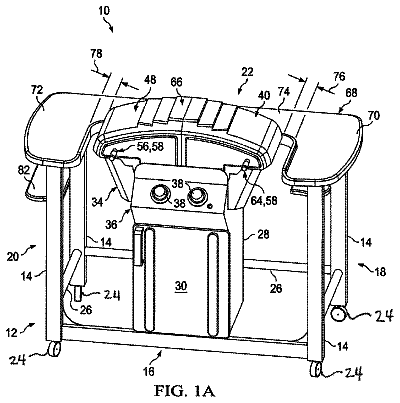
A portable cooking apparatus which is designed for sport fishermen.
US 8,740,109 B2 · Assignee: Steamwand International Pty Ltd · Inventors: Muston; Philip et al.
Sheet 1 of 2 from the published document. All sheets in the USPTO PDF
Apparatus producing superheated water and/or steam for weed (36) killing, etc. has diesel fired boiler (30), which, via pump (32), generates hot water at a pressure of 40-52 bar and temperature of 90-115.degree. C. This passes down tube (12) and encounters the constriction provided by nozzle (14). Passing through nozzle (14) into depressurization chamber (16), which is at atmospheric pressure, the water boils. When the super heated water exits ports (20) of distribution pipe (18) it encounters ambient temperature and is transformed into high temperature water vapor and/or water droplets. The apparatus controls or kill weeds (36) using a smaller volume of water and less energy.
Various methods are known and recognised as being effective for controlling the growth of weeds and other undesirable substances. These methods are used in the agricultural industry and also by state and government bodies such as local councils for keeping paths and other areas free from weeds. Many existing methods involve the application of aqueous solution of chemicals onto the weeds. Recently, the application of chemical weed killers has become less desirable, both from a health and safety point of view in terms of the health of the person applying the chemicals, but also from the point of view of the damage to the environment caused by the use of chemicals. One known method for killing weeds which does not utilise chemicals, is the application of steam and/or hot water to kill vegetation. U.S. Pat. No. 213,255 (Simpson) for example, discloses an apparatus which uses steam and/or hot
All 2 drawing sheets from the published document, cropped to the drawing.
What the patent claimed, word for word. All of it is now free to use.
This invention relates to improved apparatus for producing superheated water and/or steam. In a particular aspect, it relates to the use of such an apparatus to destroy vegetation, particularly weeds, although other uses, such as cleaning are envisaged.
Various methods are known and recognised as being effective for controlling the growth of weeds and other undesirable substances. These methods are used in the agricultural industry and also by state and government bodies such as local councils for keeping paths and other areas free from weeds. Many existing methods involve the application of aqueous solution of chemicals onto the weeds. Recently, the application of chemical weed killers has become less desirable, both from a health and safety point of view in terms of the health of the person applying the chemicals, but also from the point of view of the damage to the environment caused by the use of chemicals.
One known method for killing weeds which does not utilise chemicals, is the application of steam and/or hot water to kill vegetation. U.S. Pat. No. 213,255 (Simpson) for example, discloses an apparatus which uses steam and/or hot water to kill vegetation on railroad beds.
Australian patent application No. 65573/99, entitled "A method of generating a treatment fluid" discloses a method for combining compressed air with heated water at an applicator nozzle.
A number of other patents also describe apparatus for applying heated pressurised water to vegetation including AU 668291 which discloses an apparatus for controlling vegetation by the application of a high pressure water or liquid spray delivering the liquid to a spray tip at a pressure of 100 psi to about 4,000 psi. AU 709493 discloses a method of killing or controlling weeds in which pressurised hot water is applied to weeds of a temperature of 75.degree. C. or above delivered at a pump pressure of in excess of 200 psi and at a flow rate in excess of 4 liters per minute.
However, one major problem with existing hot water and steam applicator and generator means, is that a considerable amount of energy is required to heat the water due to the high specific heat capacity of water and the even higher specific latent heat as water changes from a liquid to a gas, thus the energy consumption of such devices is a major disadvantage of hot water or steam weed control.
An apparatus that was able to control or kill weeds using a smaller volume of water, would not only be more efficient in terms of use of water as a commodity but also more energy efficient.
Any discussion of documents, acts, materials, devices, articles or the like which has been included in the present specification is solely for the purpose of providing a context for the present invention. It is not to be taken as an admission that any or all of these matters form part of the prior art base or were common general knowledge in the field relevant to the present invention as it existed before the priority date of each claim of this application.
In a first aspect of the present invention, there is provided an apparatus for generating superheated hot water and/or steam comprising;
an inlet tube for heated pressured water;
a nozzle constricting flow through the input tube;
a depressurisation chamber; and
means for delivering superheated hot water and/or steam to ambient atmospheric temperature from the depressurisation chamber.
The inlet tube may have a diameter of 8 mm to 25 mm most preferably 10 to 15 mm.
The nozzle may define an aperture in the tube having a diameter of from 0.5 mm to 3 mm, most preferably about 1 mm.
The apparatus may be used with a diesel boiler and a pump to heat and pressurize the water.
The water may be supplied at a temperature of 90 to 150.degree. but typically, water is delivered to the depressurising chamber at a temperature of 100-115.degree. C. and at a pressure of 30 to 100 bar or more, most preferably around 40 to 52 bar.
Typically, the apparatus utilises a diesel fired boiler to heat the water, although other heating means such as LPG could be used.
The apparatus maintains the pressure in the heating, boiler and delivery hose to keep the water exceeding 100.degree. in temperature prior to release of the super heated water to atmosphere where it turns to steam. This allows the delivery of hotter saturated steam than would be possible if the water were not pressurised. The super heated water may be delivered to vegetation at a pressure at in the range of 0 to 99 psi (0 to 6.7 bar) above atmospheric pressure, but most preferably at a pressure in the range of 1 to 10 psi, 0 to 1 bar, approximately above atmospheric pressure. In use, the apparatus typically delivers from 2 to 13 liters of water per minute.
In a related aspect there is provided a method of producing saturated water and/or steam using an apparatus according to the first aspect of the present invention comprising the steps of:
supplying pressurised heated water to the inlet tube at a pressure of 30 to 100 bar and a temperature above 100.degree. C.;
flowing the water past the constricting nozzle into the depressurisation chamber; and
delivering superheated hot water and/or steam to ambient atmospheric temperature from the depressurisation chamber.
Specific embodiments of the present invention will now be described, by way of example only and with reference to the accompanying drawings, in which:
FIG. 1 is a section through a first steam and water applicator head/nozzle; and
FIG. 2 is a schematic drawing illustrating a steam and water applicator head in use.
Referring to the drawings, FIG. 1 shows an applicator head 10 for a steam/water droplet generator for use in killing or controlling vegetation. The application head includes an input feed tube 12 along which superheated water is pumped under pressure from a boiler. Typically the input feed tube 12 is a cylindrical tube having an annular cross section and a 12 mm inside diameter and is manufactured from stainless steel and is capable of operating at water pressures in excess of 150 bar.
Located inside the tube 12, close to one end 12a, is a depressurising/restriction nozzle 14 which constricts flow of water through the tube 12 and helps maintain the pressure between the tube and the boiler. The internal diameter 15 of the nozzle may be varied depending on the desired water flow rate and pressure required. In the specific embodiment, the aperture 15 has a diameter of 1.0 mm, but may vary between 0.5 mm and 3.0 mm.
Adjacent the depressurising nozzle 14, is a depressurising chamber 16 in the form of a rectangular box like chamber having increased diameter relative to the diameter of the input tube 12. The volume of the chamber is not critical as long as it is a larger volume than the volume of the water that the restricting nozzle can release. The chamber may be manufactured from any material which is capable of sustaining water pressures in excess of 52 bar and temperatures of up to 150.degree. C., stainless steel being one suitable material.
An outlet 17 having a size from 2 mm to 10 mm, and being larger than the aperture defines by the nozzle 14, preferably at least twice the diameter, from the depressurising chamber 16 is in fluid communication with a distribution bar or pipe 18. The distribution pipe 18 defines a series of ports or holes 20, having a diameter of 6 mm but which may be varied to suit the volume of water flow required and may typically range from 3 mm to 15 mm in diameter The distribution pipe comprises a hollow cylindrical tube made from a malleable non-corrosive material. The number and size of the delivery holes 20 is matched to suit the water flow ensuring that no back pressure is created. The distribution pipe 18 can be made into any desired shape to suit different applications.
Operation of the system will now be described with reference to FIG. 2. A diesel fired boiler 30 and a pump 32 are used to generate pressurized water at a temperature of between 90.degree. to 115.degree. C. and at a pressure of 40 to a 52 bar. At atmospheric pressure, water of that temperature would turn to steam; however, because the water is under pressure, it remains liquid. The water passes down the input feed tube 12 until it reaches the nozzle 14. The water passes through the nozzle 14 and then enters the depressurising chamber 16 where the pressure is approximately ambient atmospheric pressure. As described above, the depressurising nozzle 14 helps maintain the pressure of the water in the input tube at 40 to 52 bar. However, once the water is past the nozzle 14, it enters the depressurising chamber 16 where the pressure reduces to approximately ambient atmospheric pressure. This reduction of the water to ambient atmospheric pressure lowers the boiling point of the water creating water 34 in a superheated condition. When the super heated water exits the ports 20 in the distribution pipe it comes into contact with normal atmospheric temperature and is transformed into a combination of water vapour and water droplets to be applied to weeds 36 to be killed. The distribution pipe is preferably partly covered by an insulating hood 22 for conserving heat and maintaining a superheated environment.
The applicator head can operate effectively delivering water at a rate of anything from 2 liters per minute up to about 13 liters per minute, and typically operates at around 5.5 liters of water per minute. Larger machines which produce higher liters per minute output for use in vineyards or broad acre agriculture are envisage. The provision of the depressurising nozzle 14 and the depressurising chamber allows the delivery of hotter saturated steam 34 than would be possible if the water were not pressurised. However, by depressurising the water prior to application of the super heated steam water 34 to weeds, improves the efficiency of the apparatus and reduces the amount of water required.
The application can be used for weed control in both urban and rural/agricultural environments. It is also envisaged that the apparatus would have applications in the field of cleaning or in other fields it is desired to deliver water vapour and water droplets efficiently.
It will be appreciated by persons skilled in the art that numerous variations and/or modifications may be made to the invention as shown in the specific embodiments without departing from the spirit or scope of the invention as broadly described. The present embodiments are, therefore, to be considered in all respects as illustrative and not restrictive.
About 1,809 words. The USPTO PDF has it with every drawing.
Fees are due 3.5, 7.5 and 11.5 years after grant. This patent expired on June 3, 2026, so the fee marked "not paid" was the one that went unpaid.
Apparatus producing superheated water and /or steam for weed killing and other applications
Filed Jun 2004 · published Aug 2007Apparatus producing superheated water and /or steam for weed killing and other applications
Filed Jun 2004 · granted Jun 2014Earlier publications, parents and continuations. None of them can still be enforced, or this patent would not be listed.
Prior art cited by the examiner or applicant. Useful when you check your own idea for novelty.
Everything on this page comes from the documents linked above.