Technical field
The subject matter disclosed herein relates to code assignment in multiple-access communication systems. In particular, the subject matter disclosed herein relates to methods and systems for interference-minimizing code assignment, bit epoch acquisition, and system parameter selection for code division multiple access (CDMA) networks.
Background
A multiple-access communication system is a system in which multiple users can simultaneously communicate over the same channel. A code division multiple access (CDMA) system is a multiuser system in which signals of different users are spread over a wide frequency band using different spreading codes. The despreader in such a system uses the spreading code of each individual user to despread that user's signal and obtain the originally transmitted data.
The widespread acceptance of wireless technologies has triggered a huge demand for bandwidth that is expected to grow well into the future [1]. The traditional approach to ensure coexistence of diverse wireless systems is spectrum licensing. However, after many years of spectrum assignment to meet the ever increasing demand, the Federal Communications Commission's (FCC's) frequency allocation chart [2] now shows a heavily crowded spectrum with most frequency bands already assigned to different primary users for specific services. Cognitive radios have been proposed as a technology to allow secondary wireless devices to coexist with the primary users of the spectrum without disrupting the communications between them.
The underlay approach allows concurrent primary and secondary transmissions [1,3]. The underlay system for cognitive radio network was proposed using ultra wide band (UWB) signaling in [4,5]. CDMA systems with high spreading factors may also be considered as underlay networks. Underlay systems protect primary users by requiring the secondary signals to operate at transmit powers that result in interference levels that are below the acceptable noise floor for the primary users of the spectrum [6].
The opportunistic approach in cognitive radio is where spectrum sensing occurs followed by spectral allocation for transmission by secondary users in sub-bands that are perceived to be empty. The detection process suffers from both a probability of not detecting an active primary user or mistakenly marking a sub-band as occupied by a primary user. Furthermore, the spectrum sensing must continue periodically to detect the event of primary users arriving at, or leaving, the network. This requires dynamic re-allocation of spectrum and secondary users will regularly change their transmit frequencies, and reduces throughput due to the quiet periods required for sensing. Oftentimes, only highly fragmented bands are available. In [7], adaptively changing bandwidth and power of sub-bands in multi-carrier CDMA is proposed to improve performance, but the spectral map is assumed to be perfectly known to the secondary network.
The underlay approach may be advantageous over the opportunistic approach due to the above and particularly in some specific scenarios. For example, it is preferable if spectral conditions are changing very fast or the primary user is highly mobile. Its main disadvantage is the strict transmit power and large bandwidth spread requirements on the secondary users.
In CDMA systems, including those with underlay networks and those with only a single class of users, it is desirable to assign spreading codes to users in a manner that minimizes multiple access interference. It is also required to maintain service parameters, such as bit error rate, at an acceptable level. Accordingly, there exists a need for interference-minimizing code assignment and system parameter selection in CDMA networks.
Summary
In accordance with this disclosure, methods, systems, and non-transitory computer readable media for interference-minimizing code assignment and system parameter selection in CDMA networks are disclosed.
A method for interference-minimizing spreading code assignment is disclosed. The method is performed at a base station or mobile station configured to operate in a code division multiple access (CDMA) radio network. We shall describe the method from the perspective of the base station which will assign, based on the method, spreading codes for uplink transmissions by users who will be served, or are already being served, by the base station. A mobile station executing the method, would request from its serving base station, or the base station that will serve it, that the base station use a particular spreading code on the downlink transmission to that mobile station. Henceforth, we shall describe the method as executed at the base station. The method includes receiving transmissions from user devices seeking to access the CDMA radio network. A spreading code is selected for a first user device seeking to access the network, using at least one cross-correlation parameter, to reduce multiple access interference between communications involving the first user device and other devices using the CDMA network.
A base station configured to operate in a code division multiple access (CDMA) radio network for interference-minimizing spreading code assignment is also disclosed. The base station includes a communications module for receiving transmissions from user devices seeking to access the CDMA radio network. An interference-minimizing code assignment (IMCA) module is configured to select, using at least one cross-correlation parameter, a spreading code for a first user device seeking to access the network to reduce multiple access interference between communications involving the first user device and other devices using the CDMA network.
The subject matter described herein for interference-minimizing code assignment and system parameter selection in CDMA networks may be implemented using a non-transitory computer readable medium to having stored thereon executable instructions that when executed by the processor of a computer control the processor to perform steps. Exemplary non-transitory computer readable media suitable for implementing the subject matter described herein include chip memory devices or disk memory devices accessible by a processor, programmable logic devices, and application specific integrated circuits. In addition, a computer readable medium that implements the subject matter described herein may be located on a single computing platform or may be distributed across plural computing platforms.
Brief description of the drawings
Preferred embodiments of the subject matter described herein will now be explained with reference to the accompanying drawings of which:
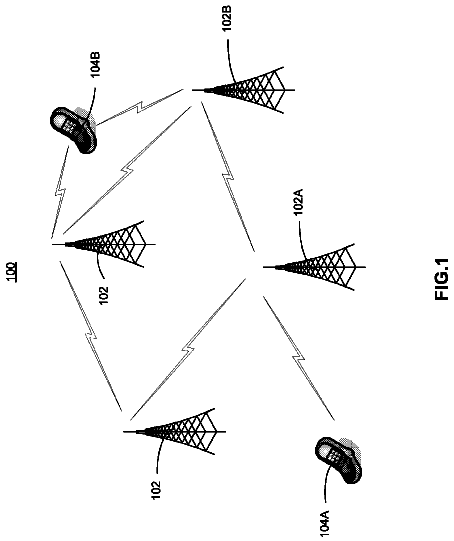
FIG. 1 is an exemplary cognitive network scenario suitable for performing interference-minimizing code assignment in CDMA networks according to an embodiment of the subject matter disclosed herein;
FIG. 2 is a block diagram of an exemplary receiver for performing interference-minimizing code assignment in CDMA networks according to an embodiment of the subject matter disclosed herein;
FIG. 3 is a diagram showing the performance of IMCA and RCA schemes using matched filter (MF) receiver in Rayleigh fading channel N=8, K.sub.p=7, K.sub.s=1 according to an embodiment of the subject matter disclosed herein;
FIG. 4 is a diagram showing the performance of IMCA and RCA schemes using minimum output energy (MOE) receiver in Rayleigh fading channel N=6 (dotted), N=8 (solid), K.sub.p=7, K.sub.s=1 according to an embodiment of the subject matter disclosed herein;
FIG. 5 is a diagram showing the normalized objective function J in Rayleigh fading channel N=8, K.sub.p=7, K.sub.s=1 according to an embodiment of the subject matter disclosed herein;
FIG. 6 is a diagram showing summation of squared cross-correlations of user 1 (secondary) against number of primary users in fading channels N=8 according to an embodiment of the subject matter disclosed herein;
FIG. 7 is a diagram showing the performance of IMCA and RCA schemes for successively arriving secondary users using MOE receiver in Rayleigh fading channel N=8, K.sub.p=4, SNR=10 dB according to an embodiment of the subject matter disclosed herein;
FIG. 8 is a diagram showing user1 performance with MOE+PIC in Rayleigh fading using improved log-likelihood ratio (ILLR) and noise LLR (NLLR) N=6, Kp=2, Ks=2, IMCA (exhaustive search) and a single random code assignment, where other users' SNR is 3 dB higher than user1 according to an embodiment of the subject matter disclosed herein;
FIG. 9 is a diagram showing performance of the IMCA and RCA schemes using MF receiver in Rayleigh fading channel N=7, K.sub.p=3, K.sub.s=1 (synchronous primary users without knowledge of the bit boundary) according to an embodiment of the subject matter disclosed herein;
FIG. 10 is a diagram showing performance of the IMCA and RCA schemes using MF receiver in Rayleigh fading channel N=7, K.sub.p=3, K.sub.s=1 (bit- and ship-asynchronous primary users) according to an embodiment of the subject matter disclosed herein;
FIG. 11 is a diagram showing performance of the IMCA and RCA schemes using MF receiver in multipath Rayleigh fading channel N=7, K.sub.p=3, K.sub.s=1 (chip asynchronous primary users) according to an embodiment of the subject matter disclosed herein;
FIG. 12 is a diagram showing performance of the IMCA and RCA schemes using MF receiver in Rayleigh fading channel N=7, K.sub.p=5, K.sub.s=1 according to an embodiment of the subject matter disclosed herein;
FIG. 13 is a diagram showing performance of the IMCA and RCA schemes using MF receiver in Rayleigh fading channel N=7, K.sub.p=3, K.sub.s=1 (synchronous primary user with a carrier different by R.sub.cp from the secondary system) according to an embodiment of the subject matter disclosed herein;
FIG. 14 is a diagram showing performance of the IMCA and RCA schemes using MF receiver in Rayleigh fading channel N=7, K.sub.p=3, K.sub.s=1 (asynchronous primary user with a carrier different by R.sub.cp from the secondary system) according to an embodiment of the subject matter disclosed herein;
FIG. 15 is a diagram showing performance of the IMCA and RCA schemes using MF receiver in Rayleigh fading channel N=7, K.sub.p=2, K.sub.s=3, R.sub.cs=6, R.sub.cp, SNR=20 dB according to an embodiment of the subject matter disclosed herein;
FIG. 16 is a diagram showing performance of the IMCA and RCA schemes using MF receiver in Rayleigh fading channel N=7, K.sub.p=2, K.sub.s=3, R.sub.cs=6, R.sub.cp, R.sub.bs=R.sub.bp, SNR=20 dB according to an embodiment of the subject matter disclosed herein; and
FIG. 17 is a diagram showing performance of the IMCA and RCA schemes using MF receiver in Rayleigh fading channel N=7, K.sub.p=2, K.sub.s=3, .beta.=12, R.sub.cp, SNR=20 dB according to an embodiment of the subject matter disclosed herein.
Detailed description
Improved systems and methods for interference-minimizing code assignment and system parameter selection in CDMA networks are disclosed herein.
Overview
In one exemplary implementation, a CDMA network in which the subject matter described herein may be operable includes a code-division multiple-access (CDMA) secondary network to operate cognitively as an underlay for a primary network. The interference-minimizing code assignment (IMCA) for secondary users described herein minimizes interference from existing primary and secondary users onto arriving secondary users. Furthermore, the interference from such arriving secondary users onto existing primary and secondary users is reduced. Moreover, IMCA may be used to re-assign spreading codes to existing secondary users if conditions change, e.g. locations and transmit powers of users change, or the set of active codes changes due to arrival and departure of users, both primary and secondary. IMCA is accomplished by minimizing the mean square cross-correlations between the candidate codes and the received signal. Since the codes of the primary CDMA network are unknown to the secondary network, the scheme may be said to operate blindly.
One advantage of the subject matter described herein includes significant performance gains compared to random code assignment (RCA).
According to one aspect, constraints on the user code space may be relaxed and a near-optimal solution may be obtained with complexity that is linear in the spreading factor.
According to the subject matter described herein, an underlay system using direct-sequence code-division multiple-access (DS-CDMA) is disclosed. For purposes of illustration, a CDMA signaling in both primary and secondary networks may be considered and equal spreading may be assumed in the derivations shown below. However, it may be appreciated that the subject matter described herein may be extensible to primary and secondary CDMA networks with unequal spreading factors and to other primary networks.
Assumptions
The basic premise of underlay systems is that the interference to the primary network is negligible by limiting the secondary network transmit powers. This may be compensated for by having lower data transmission rates and/or higher spreading factors for the secondary users. Hence, the interference problem we deal with is that from the primary to the secondary network as well as the multiple-access interference (MAI) within the secondary network itself. However, as mentioned earlier, the methods described herein result in further reducing the interference from the secondary network onto the primary network compared to random code assignment. In the initial problem formulation, we assume no information is passed from the primary network to the secondary network base station. However, we later show how such information, if available, may be used to advantage. This network structure is shown in FIG. 1.
In order to minimize the interference from the primary CDMA network, a cognitive method referred to as interference-minimizing code assignment (IMCA) for underlay secondary networks is disclosed. According to one aspect, spreading codes are assigned to each newly arriving secondary user such that the interference due to existing primary and secondary users experienced by that user is minimized. This may be accomplished by measuring the covariance matrix for the received signal from the existing primary and secondary user transmissions and selecting the code that minimizes the mean square cross-correlation between the received signal and the candidate codes.
Since the primary user spreading codes are unknown to the secondary network, a blind approach may be adopted and the problem may be formulated as a constrained minimization problem over the space of available codes. The complexity of such a search is exponential in the spreading factor, i.e. O(2.sup.N). It may then be possible to formulate a slightly relaxed constraint and obtain a much simpler problem whose complexity is O(N) where N is the spreading factor in the secondary network. Fortunately, the performance using this near optimal method is found to be very close to that when using codes obtained from the exact solution. The performance gains due to IMCA measured in terms of error probability compared to random code assignment (RCA) are impressive.
It may be appreciated that, in addition to minimizing the effect of primary user transmissions on secondary users, the IMCA scheme described herein also reduces the interference caused by the secondary network onto the primary network. As a result, one advantage of the subject matter described herein includes higher throughput for the secondary network.
The comparison is between typical cognitive networks (e.g., spectrum sensing, radio, etc.), and the IMCA underlay network described.
One advantage of the subject matter described herein is that the IMCA scheme described herein does not suffer from sensing errors that result in either misallocated or under-allocated spectrum. Furthermore, no dynamic re-assignment of spectrum is needed. Instead, the base station will re-assign an existing user with a new spreading code on an as-needed basis. This re-assignment is a simple baseband operation that does not require any change in the radio front end. Furthermore, the threshold for re-assigning a code is under the control of the secondary base station and is a `soft` threshold that does not require immediate action on the part of the secondary network as, for example, in the case of vacating a channel due to the arrival of a primary user in opportunistic scheduling.
The IMCA scheme described herein may be applied for synchronous primary networks using short spreading codes and for asynchronous primary networks as well. For example, in UMTS cellular networks a short code option is available on the uplink and the IMCA scheme is directly applicable. Even with networks that use long cover codes, the IMCA is applicable after removing, i.e. de-spreading, the cover code. On the downlink, cellular standards, e.g. UMTS, use a pilot channel that transmits the cover code. This cover code is acquired by the mobile stations as a necessary step for subsequent communications. Since the downlink transmissions are synchronous, the cover code may be easily removed, and the IMCA scheme applied by the mobile station. In other cellular standards, there is a synchronous mode on the uplink, in which the base station sends periodic timing adjustments to the mobiles so that they maintain synchronization. In that case, the long cover code, if it exists, may be removed and the IMCA scheme applied.
System
FIG. 1 is an exemplary cognitive network scenario suitable for performing interference-minimizing code assignment in CDMA networks according to an embodiment of the subject matter disclosed herein. In a CDMA network architecture, there may be a primary network and a secondary underlay network. The basic premise of underlay networks is that the interference to the primary network is limited to acceptable values by limiting the network transmit powers of user devices operating in the secondary network (secondary users or secondary devices). This may be compensated for by having lower transmission rate and/or higher spreading factors for the secondary users. The subject matter described herein may be applied to primary and secondary CDMA networks with equal or unequal spreading factors and to other primary networks. In order to illustrate these various scenarios, FIG. 1 shows an infrastructure-based framework where a secondary base station applies interference mitigation techniques to improve secondary network capacity. It may be appreciated that unless otherwise noted, exemplary scenarios assume that no information is passes from the primary network to the secondary network base station. However, the interference mitigation techniques described in greater detail below may also be used when the secondary network does have some knowledge of the primary network without departing from the scope of the subject matter described herein.
Referring to FIG. 1, primary base station 100 may be responsible for providing wireless communications access to primary user devices to a CDMA network. Primary base station 100 may assign spreading codes and select system parameters in order to reduce multiple access interference between communications involving the first user device and other devices using the CDMA network. For example, base station 100 may serve primary user K.sub.p 102, user1 104, and user2 106. Secondary underlay network may be served by secondary base station 108 which may be geographically located in proximity to primary base station 100. Secondary base station 108 may be configured to provide similar functionality as primary base station 100 but taking into account transmissions by primary user devices 102-106 as well. Secondary base station 108 may be associated with secondary users K.sub.p+1 112, K.sub.p+2 114, through K.sub.p+K.sub.s 110.
FIG. 2 is a block diagram of an exemplary receiver for performing interference-minimizing code assignment in CDMA networks according to an embodiment of the subject matter disclosed herein. Referring to FIG. 2, base station 100 may be configured to operate in a code division multiple access (CDMA) radio network for performing interference-minimizing spreading code assignment. Base station 100 may include a communications module 200 for receiving transmissions from user devices seeking to access the CDMA radio network. An interference-minimizing code assignment (IMCA) module 202 may be configured to select, using at least one cross-correlation parameter, a spreading code for a first user device seeking to access the network to reduce multiple access interference between communications involving the first user device and other devices using the CDMA network. Bit epoch acquisition module 204 may be configured to derive a bit or chip epoch if the network is either bit-synchronous or chip-synchronous. System parameter selection module 206 may be configured to adjust at least one system parameter of the first and at least one second user device to achieve a desired network performance parameter. The network performance parameter may include a bit error rate, which is often fixed to a maximum acceptable level by network operators. For example, system parameter selection module 206 may be configured to adjust at least one of a bit rate and a chip rate of user devices 102-106 and 110-114. User devices 102-106 and 110-114 may also belong to the same class or divided into multiple classes and system parameters may be selected on a per class basis. Thus, system parameter selection module 206 may be configured to adjust the system parameter for users within the same user class.
IMCA--Interference-Minimizing Code Assignment
As mentioned in the introduction underlay networks avoid some of the problems with spectrum sensing cognitive networks. In this section, we describe the IMCA scheme used for spreading code selection in the underlay CDMA network in order to achieve the goal of minimizing interference. Any arriving secondary user is assigned a spreading code such that the mean square cross-correlation between the received signal and that code is minimized. This is accomplished by minimizing an objective function subject to confining the codes elements (chips) to take values of .+-.1. For clarity, we start with the case of a single arriving secondary user with Kp active primary users then discuss the case of multiple secondary users.
IMCA--First Arriving Secondary User
Let the first arriving secondary user be user 1. Then we seek to assign user 1 an optimal spreading code s.sub.1 where the optimality criterion is to minimize the average square cross-correlation between the spreading code s.sub.1 and the received signal r. We consider Kp primary users and Ks secondary users transmitting bit-synchronously using binary CDMA signaling over a frequency-nonselective Rayleigh fading channel with additive white Gaussian noise. At any bit interval, the un-normalized received signal vector is given by
.times..times..times..times..times..times. ##EQU00001## where c.sub.j=|c.sub.j|exp(i.theta..sub.j) is the complex Gaussian fading coefficient for user j, b.sub.j is the bit of user j(b.sub.j=.+-.1) using BPSK symbol, s.sub.j is the spreading code of user j with spreading factor equal to N, and n is the thermal Gaussian noise vector with distribution N(0, No.sup.2I). All spreading codes are short codes that repeat every bit. With 1 sample per chip, the signal r is an (N.times.1) vector. Equation
can be alternatively represented in the following matrix format: r=S.sub.sC.sub.sb.sub.s=S.sub.pC.sub.pb.sub.p+n (0.2) In the above equation, S.sub.s=[s.sub.1s.sub.2s.sub.3 . . . s.sub.K.sub.s] represents the matrix containing all the spreading codes of the secondary users, Cs=diag([c.sub.1c.sub.2c.sub.3 . . . c.sub.K.sub.s] is the matrix for the fading coefficients of the secondary users, and bs=[b.sub.1 b.sub.2 b.sub.3 . . . b.sub.K.sub.s] is the vector of the secondary users' bits. The symbols S.sub.p, C.sub.p, and b.sub.p are defined similarly for the primary users. In particular, our objective is to find the cognitive secondary user code s1 that minimizes the following:
.times..times..times..times..function..function..times..times..times..fun- ction..times..times..times..times..times. ##EQU00002## where s.sub.1.sup.H denotes the conjugate transpose of s.sub.1 and A is the covariance matrix of the vector r defined earlier. The minimization is subject to the constraint that the individual component of s.sub.1 takes the value .+-.1 or equivalently the individual components of the vector s1 should satisfy the following relation: s.sub.1i.sup.2=1 for i=1,2, . . . N
The process of finding the optimal code s.sub.1 can be obtained using two different methods. The first one is to conduct an exhaustive search on all the possible values of the vector s.sub.1 to find the optimal one. Although, this approach is useful in performing system simulations and assessing the performance, it is not yet practical in real implementation as it suffers from a complexity order that is exponential in N. The second method can be developed by formulating the problem as a Lagrangian optimization problem where the Lagrangian objective function to be minimized is given as follows:
.times..times..lamda..function..times. ##EQU00003##
where .lamda.i are the Lagrangian multipliers. The code s.sub.1 may then be obtained by applying the standard method of differentiating the Lagrangian function with respect to the individual components of s.sub.1 and the Lagrangian multipliers .lamda.i. This results in 2N nonlinear equations that must be solved simultaneously to find the code. It is obvious that obtaining the optimal s.sub.1 using this method is computationally tedious as it involves the solution of nonlinear equations. This is equivalent to the well-known problem of minimizing a quadratic Boolean form such as s.sub.1.sup.HAs.sub.1. Some methods have been proposed for obtaining near-optimal solutions such as semi-definite programming [19] but they remain quite complex. There is a need to find an alternative method that can more efficiently find a near-optimal code s.sub.1, that is, resulting in a near-minimum value for the quadratic form s.sub.1.sup.HAs.sub.1.
IMCA--Near-Optimal Method for Code Assignment
A near-optimal method is developed that finds the vector s.sub.1 that almost achieves the minimum mean square cross-correlation. This method depends on the observation that since the vector s.sub.1 satisfies the relation
then subsequently the vector s.sub.1 must satisfy the following: s.sub.1.sup.Hs.sub.1=N
Hence, rather than finding the optimal s1 vector whose elements obey the relations
we develop an optimization problem that finds the code s.sub.1 and satisfies the single constraint (13). In particular, we find the code s.sub.1 that minimizes the following Lagrangian function: J=s.sub.1.sup.HAs.sub.1+.lamda.(s.sub.1.sup.Hs.sub.1-N)
Due to this relaxed constraint we have a single Lagrangian multiplier. It can be easily shown that the eigenvectors of the covariance matrix A minimize the above Lagrangian function where the Euclidean norms of the eigenvectors are scaled to satisfy the relation (4). However, the resulting eigenvectors may not satisfy the relation (2). Hence, we apply a hard limiter, sgn(.) function, to the eigenvectors to make them acceptable as spreading codes and then select from the among them the spreading code that minimizes the objective function J. Note that the number of eigenvectors available is at most N and therefore the search space is among N candidate spreading codes, that is, complexity O(N). It is clear that this method may not result in finding the same s.sub.1 that results from solving the original optimization problem which is equivalent to what the exhaustive search would produce. However, as our simulation results show, the near-optimal method performance is very close to that of the optimal method in terms of bit error rates.
IMCA--Multiple Secondary Users
In the case of multiple existing secondary users in addition to K.sub.p existing primary users. There are two approaches to assigning the jth arriving secondary user. The first is to solve the same minimization problem of Equation
without changing the spreading codes assigned to the previous j-1 secondary users. Knowledge of the codes of those previous secondary users is available to the secondary network base station but is not needed explicitly since the received signal and the computed covariance matrix A includes the contributions of those secondary users. The second approach is to jointly re-assign all spreading codes for all previous j-1 secondary users whenever a user j arrives. The joint code assignment may be also be formulated as a relaxed Lagrangian optimization problem but its solution is somewhat tedious even while using the near-optimal approach as its complexity is O(Nj). The exhaustive method is of course prohibitive even for small N since the search space now contains 2.sup.Nj vectors. Fortunately, we are able to show by simulations that the first approach where no re-assignment of secondary codes takes place for new secondary arrivals is near-optimal.
The above scenario assumes that the primary network conditions have not changed significantly until the arrival of the j.sup.th secondary user, i.e. the covariance matrix is almost the same. It should be noted that with mobility of users and the arrivals and departures of primary and secondary users, the covariance matrix due to primary and secondary users will change with time. This also means that re-assignment of secondary codes would be needed. This re-assignment may occur in several ways. For example, it may occur jointly as described above. In that case, knowledge of the secondary user may be used to carry out subtractive interference cancellation of the secondary user signals, then estimate the covariance matrix due to primary users only, and then jointly re-assign the secondary users' spreading codes. Another method would be to successively re-assign the secondary user codes. A reasonable criteria would be to select the worst-performing secondary user, based on estimation of its bit error rate, and re-assign it a new code using the IMCA method based on the latest update of the covariance matrix. The process may be repeated for as many secondary users as needed based on some criteria, e.g. their BER estimates.
Obtaining updates of the covariance matrix may be based on well-known methods in updating estimates of time-varying quantities. This means that updates of the covariance matrix will take less time than estimating it for the first time. Furthermore, another method to use knowledge of the secondary user codes may be to approximate the covariance matrix as the sum of two parts. The first part is due to the primary user transmissions and is estimated or update as described above. The second part is due to secondary user transmissions and is computed directly, not estimated, using knowledge of the secondary user codes, their timings, and estimates of received powers.
It may be appreciated that the above-described scenario for multiple secondary users may also be applied to multiple primary users in a single network (i.e., no secondary underlay network) without departing from the scope of the subject matter described herein.
IMCA--Simulation Results
A comparison of the error probability performance, with and without channel coding, of the IMCA and RCA schemes is shown. In all the simulation comparisons, we shall assume equal user SNR except for the coded case where we also include a case in which the primary users have higher SNR. As well, the spreading factors for both primary and secondary users are the same for convenience. For the uncoded case, the performance is averaged over an ensemble that varies from 20 to 100 randomly generated primary codes with 20,000 bits for each realization.
FIG. 3 shows the uncoded BER for a single secondary user applying conventional matched filter detection with the proposed IMCA system compared to RCA on a Rayleigh fading channel. The number of primary users K.sub.p=7, and the spreading factor N=8. The IMCA is obtained using the exhaustive and near-optimal methods. As shown in the figure, the performance of the IMCA method is significantly better than RCA method. The near optimal method gives performance that is very close to the optimum exhaustive search method.
FIG. 4 shows the same comparisons as FIG. 3 but using an MOE receiver instead of the matched filter. It is clear that the performance of the proposed IMCA scheme is again superior to that of RCA. The near-optimal method is almost identical to that of the optimum exhaustive code searching scheme. FIG. 4 also shows the performance for an overloaded system with spreading factor of N=6 and the same number of users. The proposed IMCA scheme still gives superior performance to RCA.
FIG. 5 illustrates the value of the normalized objective function J for the same parameters as in FIG. 3. It is an indication of the multiple access interference plus noise variance experienced by an arriving user using the assigned code for the different code assignment schemes. The IMCA system gives much better performance over the entire SNR range. Furthermore, the difference between the exhaustive and near-optimal schemes is very small, validating the IMCA as a near-optimal scheme.
FIG. 6 shows the summation of the squared cross-correlations (SSXC) between the assigned spreading code for user 1 (secondary) and the codes of all other primary users on a Rayleigh fading channel. There is a single secondary user, the spreading factor N=8, the SNR=10 dB and the number of primary users is varied from 1 to 11. Hence, the total number of users in the system varies from 2 to 12. The IMCA scheme results in significantly smaller SSXC than in the RCA schemes. Furthermore, the difference between the exhaustive and near-optimal schemes is insignificant even in overloaded networks, which again shows that the IMCA scheme results in very near-optimal code assignment. Note that the SSXC for the case of RCA may be computed analytically as (K-1)/N using the standard Gaussian approximation where K=K.sub.p+K.sub.s is the total number of primary and secondary users. The slope of the IMCA curve is less than the slope of the RCA curve which indicates the higher advantage with increasing the number of users. Finally, we investigate the performance of the IMCA when successively assigning several secondary codes.
FIG. 7 shows the uncoded BER of each arriving secondary user as the number of secondary users is increased. The number of primary users K.sub.p is fixed at 4 and the spreading factor N=8 and the SNR=10 dB. We note that the performance of the IMCA is again clearly superior to the RCA scheme. Also, the slope of the BER curves is lower for the IMCA indicating the robustness of the IMCA for heavily loaded networks. More importantly, the BERs for all secondary users are similar indicating that secondary users are not significantly disadvantaged due to arriving early or late. It may be perceived that secondary users arriving later face a more constrained code assignment problem. While that is true by itself, secondary users arriving early will suffer from secondary users arriving later whose code assignments they, that is, the early users, do not determine. Fortunately, the code assignment exercised by secondary users arriving later results in codes that also have reduced cross-correlations from the perspective of the early users, both primary and secondary. Finally, in FIG. 7 the small increase in average BER with increasing number of secondary users from K.sub.s=1 to 4 shows that the re-assignment of all secondary codes whenever a secondary user arrives will not lead to large improvements. Such a reassignment would involve added complexity. This is not to be confused with code re-assignment that would be needed due to changing conditions that would result in significant changes in the covariance matrix, as described earlier.
In FIG. 8, we plot the performance for IMCA applied to user 1 and for a specific RCA with the following cross-correlation matrix
##equ00004##
The parallel concatenated Turbo encoder of the UMTS standard is used with code rate 1/2 and using a random turbo inter-leaver of size 500. Five iterations internal to the Turbo decoder are used using the maxstar log-MAP decoder. The simulation is stopped after we obtain 100 errors from the lowest BER scheme. The improved LLR (ILLR) of
as well as the LLR used in [8], which assumes all MAI has been removed, are plotted. We call the latter BER curve noise LLR (NLLR) since it uses the noise term only in place of the variance of the RMAI plus noise. The performance advantage of the MOE is clear. There is not a significant difference between the performance of the ILLR and NLLR techniques, particularly in the RCA case. The IMCA scheme improves the performance significantly for both MOE plus parallel interference cancellation (PIC) and matched filter detectors. For the MOE plus PIC, a 2 dB gain in BER is achieved. For the matched filter, the gain is greater. This indicates that, with IMCA, conventional matched filter detection may be a viable option.
Asynchronous Multipath Fading Channels
A secondary CDMA network is proposed that operates as an underlay for an asynchronous primary CDMA network where the code assignment for the secondary network is done cognitively. We consider the different cases where the primary users are bit- and chip-synchronous, chip-synchronous but bit-asynchronous, and chip-asynchronous over multi-path fading channels. We propose a method for blind epoch acquisition by processing the covariance matrix of the received signal. In all cases the performance improvement of the interference-minimizing code assignment over random code assignment is significant reaching over 3 dB for coded systems.
Introduction
We propose an interference-minimizing code assignment (IMCA) scheme for assigning spreading codes in asynchronous CDMA underlay networks. In this section, we extend the IMCA scheme to the case where knowledge of the primary user bit boundaries is unavailable. In particular, we devise a simple method for blind bit epoch acquisition of synchronous CDMA networks. Next, we consider chip-synchronous bit-asynchronous primary networks. We show that, while there is no primary users' bit epoch in this case, the same blind method may be used to identify the best bit epoch for each arriving secondary user. We then generalize the IMCA scheme for chip-asynchronous primary networks in multipath fading channels. Significant performance gains over the case of RCA are obtained in all cases. We find that RCA closely models practical CDMA system in asynchronous channels. This was verified using the short spreading codes of WCDMA in the TDD mode [23].
Bit-Asynchronous Model
We consider a CDMA-based cognitive network setting that involves a primary network and a secondary network composed of K.sub.p primary users and K.sub.s secondary users, respectively. The primary and secondary users transmit data concurrently using binary CDMA signaling. The secondary system can apply the IMCA scheme in a centralized or distributed manner. In our exposition of IMCA we shall first consider bit-asynchronous chip-synchronous networks over frequency non-selective Rayleigh fading channels corrupted with additive white Gaussian noise. In particular, for the chip-synchronous case the received signal after sampling with one sample per chip results in the following (Nx1) vector r whose k.sup.th element is given by
The description continues in the full USPTO document.
 Lapsed, fee not paid20 drawings