 Lapsed, fee not paid6 drawings
Hardware & Electronics · US 8,736,408 B2
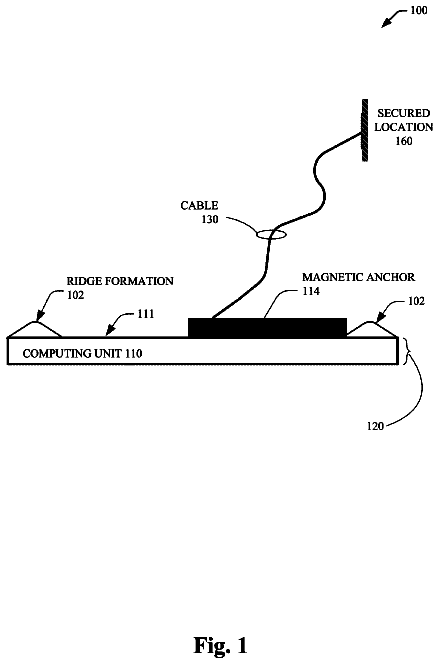
Magnetic anchor
A magnetic anchor that is attachable to a computing unit via a magnetic field.
US 8,736,419 B2 · Assignee: Zonar Systems · Inventors: McQuade; Charles Michael et al.
Sheet 1 of 3 from the published document. All sheets in the USPTO PDF
Position data received wirelessly from a vehicle enrolled in an inspection waiver program are employed to determine when the enrolled vehicle is approaching an inspection station. After determining that the enrolled vehicle is approaching an inspection station, and if the enrolled vehicle has a valid inspection waiver, a bypass confirmation can selectively be provided to the vehicle operator, authorizing the operator to bypass the inspection station. The task of determining when an enrolled vehicle is approaching the location of an inspection station can be performed using a processor disposed in the vehicle, or at a remote location separate from both the vehicle and the inspection station, or at the inspection station. The inspection stations can be mobile so that their locations are varied to prevent operators from intentionally avoiding an inspection, as may occur with fixed inspection stations.
Federal and State Departments of Transportation (DOT) and the law enforcement agencies of the various states inspect many commercial heavy vehicles annually. In the past, most such inspections have been performed at weigh stations located on interstate highways. Trucks passing the weigh station must pull over, and wait in line to be weighed and possibly inspected. Inspections on selected vehicles are performed based on weight violations or random sampling. Because of the sheer number of trucks operating on U.S. highways, only a fraction of the entire trucking fleet is inspected each year. There have been screening systems and waiver inspection systems developed that have received support from regulatory agencies and the trucking industry, to make inspections more efficient. Such systems attempt to reduce the number of trucks potentially needing inspections, by removing vehicles from sele
1 of 3 drawing sheets so far from the published document, cropped to the drawing. Every sheet is in the USPTO PDF.
What the patent claimed, word for word. All of it is now free to use.
Federal and State Departments of Transportation (DOT) and the law enforcement agencies of the various states inspect many commercial heavy vehicles annually. In the past, most such inspections have been performed at weigh stations located on interstate highways. Trucks passing the weigh station must pull over, and wait in line to be weighed and possibly inspected. Inspections on selected vehicles are performed based on weight violations or random sampling. Because of the sheer number of trucks operating on U.S. highways, only a fraction of the entire trucking fleet is inspected each year.
There have been screening systems and waiver inspection systems developed that have received support from regulatory agencies and the trucking industry, to make inspections more efficient. Such systems attempt to reduce the number of trucks potentially needing inspections, by removing vehicles from selected operators meeting defined criteria from the pool of vehicles potentially needing inspections.
One such screening system is based on a review of a trucking company's safety performance. If an operator can show that they have a good safety and compliance record, and are properly permitted and insured, the operator may be eligible to participate in the screening system. Specific equipment is added to their fleet vehicles. At about 300 weigh stations in the U.S., the added vehicle equipment communicates with the weigh station as the vehicle approaches. The weigh station component automatically reviews the operator's credentials, and if the operator is approved to bypass the weigh station, then a message to that effect is sent to the driver. The government regulatory agencies like this approach, because it reduces the number of trucks entering the weigh stations, enabling the regulatory agencies to focus their inspection efforts on vehicle operators who have not been prequalified. The trucking industry likes this approach because minimizing idle time while waiting in line for an inspection increases operating efficiency.
While this screening system has worked for years, it has several flaws. First, the equipment is dated and will soon need to be replaced. Equipping each participating weigh station with the required equipment costs hundreds of thousands of dollars. Also, marginal operators, who don't want to be inspected because their equipment would likely fail the inspection, generally know the physical locations of the weigh stations, and can actively plan their routes to bypass these fixed facilities.
It would be desirable to provide method and apparatus that enables reliable operators to be efficiently prescreened, so that regulatory or enforcement agencies can focus their time and effort performing inspections on vehicle operators that may be statistically more likely to be operating with one or more safety conditions that place the public at risk. Regulatory and enforcement agencies might then devote more resources to preventing the marginal operators from avoiding inspections.
The concepts disclosed herein provides method and apparatus that addresses the concerns leading to the development of prior art screening systems, in a more cost effective and efficient manner, while offering enhanced capabilities.
A key aspect of the concepts disclosed herein is to equip each participating vehicle with a position sensing system, such as a Global Positioning System (GPS), that enables the enrolled vehicle to communicate its position in real-time with a remote computing device (such as a networked server or data center). A regulatory agency (such as the Federal DOT, a State DOT, or a State Patrol) has access to the position data for each enrolled vehicle, even if the server (i.e., the remote computing device) is operated by a third party. As many fleet operators understand the benefits of including such GPS systems in their vehicles, this requirement will not add significant costs to the participation of fleet operators. Some fleet operators will need to replace older GPS units with a GPS unit having a transmitter and receiver that are able to bi-directionally communicate wirelessly with a remote computing system, but the benefits of being able to participate in a regulatory agency approved inspection waiver program will likely be sufficient to offset such costs. Costs for the regulatory agencies should be minimal, since rather than requiring the addition or replacement of expensive equipment dedicated to the prior art screening systems, weigh stations or inspection stations will only need to be able to communicate with a computing system where information on the prequalification status of operators is stored, and a computing system where current GPS data from enrolled vehicles are stored. In other words, the inspection stations would only need a computing device with an Internet connection, or the inspection stations can simply communicate with a user having access to a remote computing device at a different location via telephone, or even allow a remote computing device at a different location to manage the inspection waiver program altogether, without direct involvement by the inspection station.
The functions of comparing the real-time position data of enrolled vehicles with the locations of inspection stations (to identify enrolled vehicles approaching an inspection station) and of determining if a bypass confirmation should be sent to the approaching enrolled vehicle can be implemented using the same computing device, or different computing devices disposed at different locations. In some embodiments, the regulatory agency operates the computing system where the prequalification status of operators is stored (enabling the regulatory agency's computing system to perform the function of determining if a bypass confirmation should be sent to the approaching enrolled vehicle), and a vendor managing the inspection waiver program operates the computing system where the current GPS data from enrolled vehicles are stored (enabling the vendor's computing system to perform the function of comparing the real-time position data of enrolled vehicles with the locations of inspection stations), but various combinations and permutations can be implemented, so long as the required data (the prequalification status of a vehicle operator, position data from enrolled vehicles, and position data defining the location of inspection locations) are accessible to enable the functionality described to be implemented.
In the context of a fixed inspection station (such as a weigh station), data defining the real-time location of enrolled vehicles (i.e., the GPS data communicated from enrolled vehicles to a remote computing device) are analyzed, and data identifying a enrolled vehicle approaching a fixed inspection station are flagged. In one exemplary embodiment, the prequalified status of a specific vehicle or vehicle operator is assumed to be unchanged, and a communication is transmitted to the vehicle instructing the driver that the inspection station can be bypassed, whenever it is determined that the specific enrolled vehicle is approaching an inspection station. In at least some embodiments, the identity of vehicles approaching the inspection station is conveyed to either a vendor managing the inspection waiver program or the operator of the inspection station, so that a determination can be made as to whether specific approaching vehicles should be allowed to bypass the inspection station. (As used herein, the term "operator of an inspection station" is intended to encompass any authorized personnel working at the inspection station.) In another exemplary embodiment, which recognizes that there may be instances where the prequalification status of an operator is subject to change (exemplary, but not limiting causes for revoking prequalification or inspection waiver privileges include the vehicle operator suffering a plurality of accidents, the vehicle operator being in financial distress, or the vehicle operator having failed to make required tax or permit payments), as the vehicle approaches an inspection station, the prequalified status of the vehicle/operator is verified by consulting data that include the current status of the operator (i.e., data that will indicate whether the prequalification for that operator has been revoked), before communicating with the vehicle that bypassing the inspection station has been approved. If the prequalification status has been revoked for some reason, a communication is sent to the vehicle telling the driver that the inspection station cannot be bypassed.
Because the relative positions of the inspection station and each vehicle being tracked in real-time are known, it is a relatively simple computational task to identify vehicles that are approaching the inspection station along adjacent roads.
The system discussed above relies on knowing the location of the inspection facility and the location of enrolled vehicles that are part of the prequalification/inspection waiver program, which offers a very significant advantage over prior art screening systems, since new inspection stations can be defined without any capital investment beyond the cost for a simple programming change. To define a new inspection station, the regulatory agency simply adds the geographical coordinates corresponding to the new inspection station to the computing system that analyzes the real-time locations of the enrolled vehicles (note that the use of geographical coordinates for defining the location of the new or mobile inspection station is exemplary, as other techniques, such as providing a street address or an intersection, could also be used to define the location of an inspection station). This benefit has significant implications with respect to the ability of regulatory agencies to inspect vehicles that may be intentionally bypassing known weigh stations or known inspection stations, in an attempt to avoid an inspection. For example, for a specific fixed inspection station, the regulatory agency managing that inspection station may determine that there are three different logical routes a vehicle could use to bypass the fixed inspection station. The regulatory agency can dispatch a mobile inspection team to set up a temporary inspection station along one or more of those alternate routes. As soon as the mobile inspection team is ready, the coordinates of the new inspection station are added to the system tracking the real-time locations of the enrolled vehicles. The system analyzes the data defining the relative positions of the participating vehicles and all identified inspection stations (including the newly identified mobile inspection station). A communication is sent to each preapproved enrolled vehicle as it approaches the new mobile inspection station(s), generally as discussed above, informing the driver of the enrolled vehicle that he can bypass the new inspection station. Vehicles that are not preapproved (or whose preapproval/inspection waiver status has been revoked) are required to stop at the new inspection station(s). The regulatory agency can change the locations of the mobile inspection stations very easily, and drivers who actively seek to avoid inspections will have a very difficult time predicting where future inspection points may be located. A mobile inspection station for temporary use can be implemented using a vehicle for the inspection crew, a data link (which can be omitted if a remote computing device at a different location is handling the task of tracking enrolled vehicle locations and issuing bypass confirmations), and minimal traffic directing equipment (such as traffic cones). Mobile inspection stations can quickly be set up where there is a level area (preferably paved) on which vehicles can pull off a road or freeway to wait for inspection. Parking lots, rest areas, and roads carrying relatively small volumes of traffic can be employed for this purpose, as well as parking lots at public areas such as libraries and schools.
The advantages to the regulatory community are significant, perhaps sufficiently so that incentives will be provided to encourage vehicle operators to participate. Rather than investing money in replacing equipment at weigh stations, whose fixed locations can be bypassed by operators wanting to avoid inspections, the regulatory agency can set up random mobile inspection stations (these inspection stations can be moved periodically, and can be positioned along routes that might be used to bypass the fixed weigh stations). These mobile inspection stations may not always be able to actually weigh vehicles (portable scales are available, and can be employed if the operator of the mobile inspection station wants to have that capability), but can enable safety and compliance inspections to be performed at locations that vehicle drivers attempting to avoid fixed inspection locations will have difficulty avoiding.
In at least one exemplary embodiment, based on information from the regulatory agency regarding the location of the mobile or temporary inspection station, the computing device analyzing the location of participating vehicles based on using real-time GPS data will define a geofence, and monitor the real-time position data from all enrolled vehicles, so that the inspection waiver system knows when an enrolled vehicle is approaching one of the inspection stations.
Basic elements in a system for implementing the concepts disclosed herein include at least one enrolled vehicle, a position tracking component in each enrolled vehicle (such as a GPS tracking device), a bi-directional communication link in each enrolled vehicle for communicating with a remote computing device (which in an exemplary embodiment is integrated into the GPS unit as a wireless bi-directional data link), and a remote computing device with a processor for analyzing the real-time locations of participating vehicles and defined inspection stations (permanent or mobile). It should be recognized that these basic elements can be combined in many different configurations to achieve the exemplary method discussed above. Thus, the details provided herein are intended to be exemplary, and not limiting on the scope of the concepts disclosed herein.
The term "real-time" is not intended to imply the data are transmitted instantaneously, but instead indicate that the data are collected over a relatively short period of time (over a period of seconds or minutes), and transmitted to the remote computing device on an ongoing basis, as opposed to being stored at the vehicle for an extended period of time (hour or days), and then transmitting to the remote computing device as an extended data set, after the data set has been collected.
This Summary has been provided to introduce a few concepts in a simplified form that are further described in detail below in the Description. However, this Summary is not intended to identify key or essential features of the claimed subject matter, nor is it intended to be used as an aid in determining the scope of the claimed subject matter.
Various aspects and attendant advantages of one or more exemplary embodiments and modifications thereto will become more readily appreciated as the same becomes better understood by reference to the following detailed description, when taken in conjunction with the accompanying drawings, wherein:
FIG. 1 is a high level logic diagram showing exemplary overall method steps implemented in accord with the concepts disclosed herein to increase the efficiency of vehicle inspections, by enabling selected prescreened vehicles to bypass fixed or mobile inspection stations;
FIG. 2 is a functional block diagram of an exemplary computing device that can be employed to implement some of the method steps disclosed herein;
FIG. 3 is a functional block diagram of an exemplary vehicle employed to implement some of the concepts disclosed herein;
FIG. 4 is an exemplary functional block diagram showing the basic functional components used to implement the method steps of FIG. 1; and
FIG. 5 is a high level logic diagram showing exemplary overall method steps implemented in accord with the concepts disclosed herein to manage a vehicle inspection waiver program.
Figures and Disclosed Embodiments Are Not Limiting
Exemplary embodiments are illustrated in referenced Figures of the drawings. It is intended that the embodiments and Figures disclosed herein are to be considered illustrative rather than restrictive. Further, it should be understood that any feature of one embodiment disclosed herein can be combined with one or more features of any other embodiment that is disclosed, unless otherwise indicated.
As used herein and in the claims that follow, a reference to an activity that occurs in real-time is intended to refer not only to an activity that occurs with no delay, but also to an activity that occurs with a relatively short delay (i.e., a delay or lag period of seconds or minutes, but with less than an hour of lag time).
FIG. 1 is a high level flow chart showing exemplary overall method steps implemented in accord with one aspect of the concepts disclosed herein, to collect position data from vehicles enrolled in an inspection waiver program, to determine which enrolled vehicles are approaching a fixed or mobile inspection station, so that vehicles having a valid waiver receive a bypass confirmation before they reach the inspection station. Vehicles that do not receive such a bypass confirmation are required to stop at the inspection station, where the operator of the inspection station determines whether an inspection will be performed. The delay at the inspection station reduces the efficiency of the vehicle operator, which reduces income, so vehicle operators are motivated to participate in the inspection waiver program, as long as the costs associated with the waiver program are offset by the productivity savings. Regulators operating the inspection stations are motivated to participate in the inspection waiver program, because the capital costs are modest, and allowing prescreened vehicles to bypass the inspection stations enables the staff of the inspection station to focus their efforts on vehicle operators who have not been prescreened, and who may be more likely to be operating with one or more defects that puts the public at risk. The concepts disclosed herein offer regulators the ability to use mobile inspection stations as well as fixed inspection stations. One significant problem with past inspection waiver programs limited to fixed inspection stations was that because the whereabouts of the fixed inspection stations were widely known, vehicle operators who wanted to avoid inspection could easily change their route to bypass the fixed inspection stations, specifically for the purpose of avoiding inspection.
Referring to FIG. 1, in a block 10, each enrolled vehicle is equipped with a geographical position sensor/position tracking component (a GPS unit being an exemplary type of position sensor, but other sensor technology might be used instead, such as cell tower triangulation), so that geographical position data can be collected when the vehicle is being operated, and a bi-directional data link. The position tracking component and the bi-directional data link can be integrated into a single device, or these components can be implemented as separate devices (it should be noted that the bi-directional data link could even be implemented as a discrete receiver and a discrete transmitter). A wireless radio frequency (RF) transmitter/receiver combination represents an exemplary bi-directional data link. The bi-directional data link enables the vehicle to convey the position data collected by the position tracking component to a remote computing device, as indicated in a block 12, and enables the vehicle to receive a bypass confirmation when a qualified vehicle is allowed to bypass a particular inspection station, as indicated in a block 16. It should be recognized that the use of RF data transmission is exemplary, and not limiting, as other types of wireless data transmission (such as, but not limited to, optical data transmission) can be employed.
In a block 14, a processor is used to automatically compare position data from each enrolled vehicle with the known position of each inspection station (in some exemplary embodiments there is only a single inspection station, while in other exemplary embodiments, there are a plurality of inspection stations), to identify each enrolled vehicle that is approaching an inspection station. It should be recognized that the concepts disclosed herein encompass embodiments where a vehicle relatively far away (i.e., a mile or more) from an inspection station is considered to be approaching the inspection station, as well as embodiments where the enrolled vehicle must be substantially closer to the inspection station (i.e., much less than a mile) to be considered to be approaching the inspection station. Where the inspection station is located proximate a freeway, and the enrolled vehicles are likely to be moving at freeway speeds (e.g., 55-70 mph), then the relative distance between an enrolled vehicle and the inspection station will likely be greater than for an inspection station located on a secondary road where traffic moves at a much slower pace. In at least some embodiments, the approaching parameter will not be evaluated based on any specific distance, but rather based on the local conditions of a specific road where the inspection station is located. For example, if the inspection station is located on a north bound freeway, and is accessible using an off ramp, any enrolled vehicle traveling on that freeway in the northbound direction that has passed the freeway exit immediately south of the inspection station can be considered to be approaching the inspection station, even if that specific exit is miles away (because there is no way for the vehicle to continue making northbound progress without passing the inspection station). Thus, it should be understood that the concept of determining whether a vehicle is approaching an inspection station can be determined in terms of absolute distance, as well as in terms of the position of the vehicle relative to a specific reference location (such as a particular freeway off ramp, or a particular intersection). As discussed below, a geofence can be used to evaluate whether a vehicle is approaching an inspection station.
As noted above, once it has been determined that a specific enrolled vehicle is approaching an inspection station, then a bypass confirmation is conveyed to the vehicle over the bi-directional data link in block 16, to inform the operator of the enrolled vehicle that the enrolled vehicle is approved to bypass the inspection station. As discussed in detail below, in some embodiments, the bypass confirmation will generally be sent to any enrolled vehicle that approaches the inspection stations, while in other embodiments, the current status of the vehicle or vehicle operator is reviewed (after it is determined the enrolled vehicle is approaching the inspection station), to verify that inspection waiver status of that enrolled vehicle (or operator) has not been revoked, before a bypass confirmation is sent to the approaching enrolled vehicle. In at least some embodiments, operators of an inspection station can elect to prevent a bypass confirmation from being conveyed to an enrolled vehicle, if the inspection station determines that they want to inspect that vehicle despite the waiver.
In at least some embodiments, the steps noted above are implemented for a plurality of enrolled vehicles and a plurality of inspection stations. Note that in some instances, more than one enrolled vehicle can be approaching the same inspection station at about the same time. It should be understood that the position data conveyed to the remote computing device by each enrolled vehicle uniquely identifies that vehicle (by including identification (ID) data along with the position data), so that the bypass confirmation can be conveyed to the appropriate enrolled vehicle, and so that any enrolled vehicle for which the inspection waiver status has been revoked can be distinguished from enrolled vehicles for which the inspection waiver status is still valid.
In general, the analysis of the position data received from enrolled vehicles, to identify enrolled vehicles approaching an inspection station, will be carried out by a remote computing device. The remote computing device in at least one embodiment comprises a computing system controlled by the personnel located at the inspection station, while in other exemplary embodiments, the remote computing device is controlled by a third party or vendor who manages the inspection waiver program for the benefit of the operators of the enrolled vehicles and the operators of the inspection stations (in some embodiments, the third party bills the vehicle operators/owners and/or the inspection station agencies a subscription fee). The remote computing device can be operating in a networked environment. FIG. 2 schematically illustrates an exemplary computing system 250 suitable for use in implementing the method of FIG. 1 (i.e., for executing at least block 14 of FIG. 1, and in some embodiments, block 16 as well). Exemplary computing system 250 includes a processing unit 254 that is functionally coupled to an input device 252 and to an output device 262, e.g., a display (which can be used to output a result to a user, although such a result can also be stored or transmitted to a different site). Processing unit 254 comprises, for example, a central processing unit (CPU) 258 that executes machine instructions for carrying out an analysis of position data collected from enrolled vehicles, to determine which enrolled vehicles are approaching an inspection station. The machine instructions implement functions generally consistent with those described above with respect to block 14 of FIG. 1. CPUs suitable for this purpose are available, for example, from Intel Corporation, AMD Corporation, Motorola Corporation, and other sources, as will be well known to those of ordinary skill in this art.
Also included in processing unit 254 are a random access memory (RAM) 256 and non-volatile memory 260, which can include read only memory (ROM) and may include some form of non-transitory memory storage, such as a hard drive, optical disk (and drive), etc. These non-transitory memory devices are bi-directionally coupled to CPU 258. Such storage devices are well known in the art. Machine instructions and data are temporarily loaded into RAM 256 from non-volatile memory 260. Also stored in the non-volatile memory are software for an operating system run by the CPU, and ancillary software. While not separately shown, it will be understood that a generally conventional power supply will be included to provide electrical power at voltage and current levels appropriate to energize computing system 250.
Input device 252 can be any device or mechanism that facilitates user input into the operating environment, including, but not limited to, one or more of a mouse or other pointing device for manipulating a cursor and making selections for input, a keyboard, a microphone, a modem, or other input device. In general, the input device will be used to initially configure computing system 250, to achieve the desired processing (i.e., to analyze position data collected from enrolled vehicles, to determine which enrolled vehicles are approaching an inspection station). Configuration of computing system 250 to achieve the desired processing includes the steps of loading appropriate processing software that includes machine readable and executable instructions into non-volatile memory 260, and launching the processing application (e.g., executing the processing software loaded into RAM 256 with the CPU) so that the processing application is ready for use. Output device 262 generally includes any device that produces output information, but will most typically comprise a monitor or computer display designed for human visual perception of output text and/or graphics. Use of a conventional computer keyboard for input device 252 and a computer display for output device 262 should be considered as exemplary, rather than as limiting on the scope of this system. Data link 264 is configured to enable position data collected in connection with operation of enrolled vehicles to be input into computing system 250 for analysis to determine which enrolled vehicles are approaching an inspection station. Those of ordinary skill in the art will readily recognize that many types of data links can be implemented, including, but not limited to, universal serial bus (USB) ports, parallel ports, serial ports, inputs configured to couple with portable non-transitory memory storage devices, FireWire ports, infrared data ports, wireless data communication such as Wi-Fi and Bluetooth.TM., network connections via Ethernet ports, and other connections that employ the Internet or couple to some local area or wide area network. Position data from the enrolled vehicles is communicated wirelessly, either directly to the remote computing system that analyzes the position data to determine the enrolled vehicles that are approaching an inspection station, or to some short-term storage location or remote computing system that is linked to computing system 250.
It should be understood that the term "remote computer" and the term "remote computing device" are intended to encompass networked computers, including servers and clients, in private networks or as part of the Internet. The position data for enrolled vehicles and the location data of each inspection station can be stored by one element in such a network, retrieved for review by another element in the network, and analyzed by yet another element in the network--all in rapid sequence. In at least one embodiment, a vendor is responsible for storing the position data in a network accessible storage, and clients of the vendor are able to access and manipulate the data in the storage. While implementation of the method noted above has been discussed in terms of execution of machine instructions by a processor or CPU (i.e., the computing device implementing machine instructions to implement the specific functions noted above), the method could alternatively be implemented using a custom hardwire logic circuit (such as an application specific integrated circuit), or other type of dedicated logic device.
FIG. 3 is a functional block diagram of exemplary components used in vehicles enrolled in the inspection waiver program, which are used in each enrolled vehicle 41 to implement some of the method steps shown in FIG. 1. An exemplary inspection waiver program is based on use of a position sensing system 40 (which in this embodiment is a GPS device, noting that the use of a GPS device is exemplary but not limiting, since other types of position sensing systems could instead be employed) and a bi-directional data link 42 to each enrolled vehicle. As noted above, in an exemplary embodiment, this data link is a combination RF transmitter and receiver, although separate transmitters and receivers could instead be used. It should be recognized that the one or more RF transmitters/receivers could be included in the GPS unit to achieve lower cost functionality.
An output 46 is also included, to provide the bypass confirmation to the driver in a form that can be easily (and safely) perceived by the driver. For example, output 46 can be implemented using one or more light sources (for example, a green light can indicate that the bypass confirmation was received and/or a red light can be used to indicate the bypass confirmation was not received (or that a bypass denial communication was received)), using a speaker providing an audible output indicating either that the bypass confirmation was received or that it was denied, and a display providing a visual output indicating in text and/or graphics that the bypass confirmation was either received, or denied. Output 46 can be incorporated into position sensing system 40, if desired. Thus, the concepts disclosed herein encompass embodiments where the functions of user output, position tracking, and bi-directional communication can be implemented within a single component. Bi-directional data link 42 is used to convey real-time position data from the enrolled vehicle to a remote computing device 44 (which can then determine the enrolled vehicles that are approaching an inspection location), and to receive the confirmation.
In a related embodiment, position sensing system 40 includes a processor that performs the function of determining if the enrolled vehicle is approaching an inspection station. In such an embodiment, when position sensing system 40 determines that the enrolled vehicle is approaching an inspection station, the position sensing system uses the bi-directional data link to ask a remote computing device for a bypass confirmation, which shifts some of the data processing to the enrolled vehicle. Note that such an embodiment requires the position sensing system processor (or some other vehicle processor logically coupled to the position sensing system, which is used to implement the function of determining if the vehicle is approaching an inspection station) to be able to receive regular updates for the inspection stations, whose positions may vary over time (i.e., in some embodiments the inspection stations are mobile, and the inspection station operator will move the inspection station at their discretion). Data relating to the inspection stations can be stored in each enrolled vehicle, with the bi-directional data link being used to acquire updated inspection station data. Alternatively, the inspection station may transmit a signal to enrolled vehicles to indicate that the inspection station is in the vicinity of the vehicle. Note that using a remote computer to determine if an enrolled vehicle is approaching an inspection station is somewhat easier to implement, since data defining the inspection stations would not need to be stored or updated in the enrolled vehicles, or the cost of a transmitter or other signal source to alert the enrolled vehicle of the nearby inspection station would not need to be incurred.
As noted above, the position data in at least some (if not all) embodiments will include an ID component that enables each enrolled vehicle to be uniquely identified. Thus, position sensing system 40 can include an ID data input device that is used to uniquely identify the vehicle. In one embodiment, the ID data input device comprises a numeric or alphanumeric keypad, or function keys logically coupled to position sensing system 40. It should be recognized, however, that other data input devices (i.e., devices other than keypads) can instead be employed to input the ID data for a vehicle, and the concepts disclosed herein are not limited to any specific ID data input device.
FIG. 4 is a functional block diagram of an exemplary system 50 that can be employed to implement the method steps of FIG. 1. The components include at least one enrolled vehicle 52, at least one inspection station 54, a component 56 that implements the function of identifying enrolled vehicles approaching an inspection station, a component 58 that implements the function of verifying whether an inspection waiver for a particular enrolled vehicle is valid, and a component 60 that conveys a bypass confirmation to the enrolled vehicle approaching the inspection station.
Vehicle 52 includes the position sensing component, and bi-directional data link 42 discussed above in connection with FIG. 3 (and, in at least some embodiments, the output component, while at least some embodiments will include the ID data input device). It should be recognized that the functions implemented by components 56, 58, and 60 can be performed by a single component, or different combinations of the components as integral devices.
In a first exemplary embodiment of system 50, the functions of components 56, 58, and 60 are implemented by a remote computing device disposed at a location spaced apart from vehicle 52 and from inspection station 54. That remote computing device has access to the position data collected by and received from enrolled vehicle 52, and access to a data link capable of conveying the bypass confirmation to enrolled vehicle 52. In this exemplary embodiment, the function of component 58 can be implemented by consulting a non-transitory memory in which the identity of each vehicle having a valid waiver is stored. If desired, the function of component 58 can also be implemented by sending a query from the remote computing device to personnel at inspection station 54, to let the personnel of inspection station 54 make the determination as to whether the bypass confirmation should be conveyed to enrolled vehicle 52.
In a second exemplary embodiment of system 50, the function of component 56 is implemented by a remote computing device disposed at a location spaced apart from both vehicle 52 and inspection station 54. That remote computing device has access to position data collected by and received from enrolled vehicle 52, and access to a data link capable of conveying data to inspection station 54, which itself has access to a data link capable of conveying the bypass confirmation to enrolled vehicle 52. In this exemplary embodiment, once the remote computing device disposed at a location spaced apart from vehicle 52 and inspection station 54 determines that an enrolled vehicle is approaching inspection station 54, the remote computing device conveys that data to the inspection station. The operator or other personnel at inspection station 54 can then make the determination as to whether the bypass confirmation should be conveyed to enrolled vehicle 52. Thus, in this embodiment, the functions implemented by components 58 and 60 occur at the inspection station.
In a third exemplary embodiment of system 50, the functions of components 56, 58, and 60 are implemented by a computing device disposed at inspection station 54. That computing device has access to position data collected by and received from enrolled vehicle 52, and access to a data link capable of conveying the bypass confirmation to enrolled vehicle 52. In this exemplary embodiment, the function of component 58 can be implemented by consulting a non-transitory memory in which the identity of each vehicle having a valid waiver is stored, or by allowing the operator or other personnel at inspection station 54 to make the determination as to whether the bypass confirmation should be conveyed to enrolled vehicle 52.
The description continues in the full USPTO document.
About 6,054 words. The USPTO PDF has it with every drawing.
Fees are due 3.5, 7.5 and 11.5 years after grant. This patent expired on May 27, 2026, so the fee marked "not paid" was the one that went unpaid.
METHOD AND APPARATUS FOR IMPLEMENTING A VEHICLE INSPECTION WAIVER PROGRAM
Filed Dec 2010 · published Jun 2012Method and apparatus for implementing a vehicle inspection waiver program
Filed Dec 2010 · granted May 2014Method and apparatus for implementing a vehicle inspection waiver program
Filed May 2014 · granted Aug 2017Earlier publications, parents and continuations. None of them can still be enforced, or this patent would not be listed.
Prior art cited by the examiner or applicant. Useful when you check your own idea for novelty.
Everything on this page comes from the documents linked above.