 Lapsed, fee not paid35 drawings
Biotech & Lab · US 8,729,256 B2
Isomerization of sugars
Disclosed are processes for isomerizing saccharides.
US 8,729,299 B2 · Assignee: Celanese International Corporation · Inventors: Mueller; Sean et al.
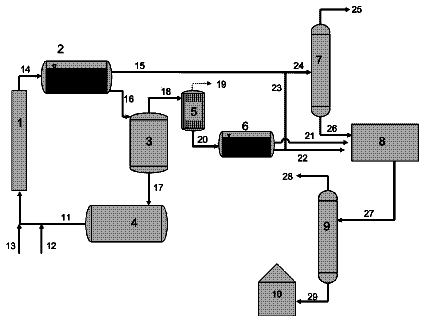
Sheet 1 of 5 from the published document. All sheets in the USPTO PDF
In one embodiment, the invention is to a process for producing an acrylate product. The process comprises the step of reacting a reaction mixture comprising an alkanoic acid, an alkylenating agent, and oxygen over a catalyst and under conditions effective to form a crude acrylate product. Preferably, the reaction mixture comprises from 0.5 wt % to 10 wt % oxygen. The crude acrylate product comprises acrylate product and alkylenating agent. The process further comprises the step of separating at least a portion of the crude product to form at least one alkylenating agent stream and at least one purified acrylate product stream. The purified acrylate product stream comprises acrylate product.
.alpha.,.beta.-unsaturated acids, particularly acrylic acid and methacrylic acid, and the ester derivatives thereof are useful organic compounds in the chemical industry. These acids and esters are known to readily polymerize or co-polymerize to form homopolymers or copolymers. Often the polymerized acids are useful in applications such as superabsorbents, dispersants, flocculants, and thickeners. The polymerized ester derivatives are used in coatings (including latex paints), textiles, adhesives, plastics, fibers, and synthetic resins. Because acrylic acid and its esters have long been valued commercially, many methods of production have been developed. One exemplary acrylic acid ester production process utilizes: the reaction of acetylene with water and carbon monoxide; and/or the reaction of an alcohol and carbon monoxide, in the presence of an acid, e.g., hydrochloric acid, and nicke
All 5 drawing sheets from the published document, cropped to the drawing.
What the patent claimed, word for word. All of it is now free to use.
This application claims priority to U.S. patent application Ser. No. 13/251,623, which was filed on Oct. 3, 2011. The entirety of this application is incorporated by reference herein.
The present invention relates generally to the production of acrylic acid via the condensation reaction of an alkanoic acid and an alkylenating agent, and oxygen. More specifically, the present invention relates to use of specific concentrations of oxygen in the condensation reaction mixture.
.alpha.,.beta.-unsaturated acids, particularly acrylic acid and methacrylic acid, and the ester derivatives thereof are useful organic compounds in the chemical industry. These acids and esters are known to readily polymerize or co-polymerize to form homopolymers or copolymers. Often the polymerized acids are useful in applications such as superabsorbents, dispersants, flocculants, and thickeners. The polymerized ester derivatives are used in coatings (including latex paints), textiles, adhesives, plastics, fibers, and synthetic resins.
Because acrylic acid and its esters have long been valued commercially, many methods of production have been developed. One exemplary acrylic acid ester production process utilizes:
the reaction of acetylene with water and carbon monoxide; and/or
the reaction of an alcohol and carbon monoxide, in the presence of an acid, e.g., hydrochloric acid, and nickel tetracarbonyl, to yield a crude product comprising the acrylate ester as well as hydrogen and nickel chloride. Another conventional process involves the reaction of ketene (often obtained by the pyrolysis of acetone or acetic acid) with formaldehyde, which yields a crude product comprising acrylic acid and either water (when acetic acid is used as a pyrolysis reactant) or methane (when acetone is used as a pyrolysis reactant). These processes have become obsolete for economic, environmental, or other reasons.
More recent acrylic acid production processes have relied on the gas phase oxidation of propylene, via acrolein, to form acrylic acid. The reaction can be carried out in single- or two-step processes but the latter is favored because of higher yields. The oxidation of propylene produces acrolein, acrylic acid, acetaldehyde and carbon oxides. Acrylic acid from the primary oxidation can be recovered while the acrolein is fed to a second step to yield the crude acrylic acid product, which comprises acrylic acid, water, small amounts of acetic acid, as well as impurities such as furfural, acrolein, and propionic acid. Purification of the crude product may be carried out by azeotropic distillation. Although this process may show some improvement over earlier processes, this process suffers from production and/or separation inefficiencies. In addition, this oxidation reaction is highly exothermic and, as such, creates an explosion risk. As a result, more expensive reactor design and metallurgy are required. Also, the cost of propylene is often prohibitive.
The aldol condensation reaction of formaldehyde and acetic acid and/or carboxylic acid esters has been disclosed in literature. This reaction forms acrylic acid and is often conducted over a catalyst. For example, condensation catalysts consisting of mixed oxides of vanadium and phosphorus were investigated and described in M. Ai, J. Catal., 107, 201 (1987); M. Ai, J. Catal., 124, 293 (1990); M. Ai, Appl. Catal., 36, 221 (1988); and M. Ai, Shokubai, 29, 522 (1987). The acetic acid conversions in these reactions, however, may leave room for improvement. Although this reaction is disclosed, there has been little if any disclosure relating to: 1) the effects of reactant feed parameters on the aldol condensation crude product; or 2) separation schemes that may be employed to effectively provide purified acrylic acid from the aldol condensation crude product.
Thus, the need exists for a process for producing purified acrylic acid, which provides improvements in yield, catalyst performance, and/or separation efficiencies.
The references mentioned above are hereby incorporated by reference.
The invention is described in detail below with reference to the appended drawings, wherein like numerals designate similar parts.
FIG. 1 is a process flowsheet showing an acrylic acid reaction/separation system in accordance with an embodiment of the present invention.
FIG. 2 is a schematic diagram of an acrylic acid reaction/separation system in accordance with one embodiment of the present invention.
FIG. 3 is a graph showing the reaction yields over time achieved by a process in accordance with one embodiment of the present invention.
FIG. 4 is a graph showing the reaction yields over time achieved by a process in accordance with one embodiment of the present invention.
FIG. 5 is a graph showing the reaction yields over time achieved by a process in accordance with one embodiment of the present invention.
FIG. 6 is a graph showing the reaction yields over time achieved by a process in accordance with one embodiment of the present invention.
FIG. 7 is a graph showing the reaction yields over time achieved by a process in accordance with one embodiment of the present invention.
In one embodiment, the invention relates to a process for producing an acrylate product. The process comprises the step of reacting a reaction mixture comprising an alkanoic acid, an alkylenating agent, and oxygen over a catalyst and under conditions effective to form a crude acrylate product. Preferably, the reaction mixture comprises from 0.5 wt % to 10 wt % oxygen. The crude acrylate product comprises acrylate product and alkylenating agent. The process further comprises the step of separating at least a portion of the crude product to form at least one alkylenating agent stream and at least one purified acrylate product stream. The purified acrylate product stream comprises acrylate product. Preferably, reaction yield varies by less than 50% over a lifetime of the catalyst.
In another embodiment, the process comprises the step of determining a reaction selectivity to carbon monoxide and/or carbon dioxide. The process further comprises the step of adjusting the oxygen concentration in the reaction mixture based on the selectivity to carbon monoxide and/or carbon dioxide.
Introduction
Production of unsaturated carboxylic acids such as acrylic acid and methacrylic acid and the ester derivatives thereof via most conventional processes have been limited by economic and environmental constraints. In the interest of finding a new reaction path, the aldol condensation reaction of acetic acid and an alkylenating agent, e.g., formaldehyde, has been investigated. This reaction may yield a unique crude product that comprises, inter alia, a higher amount of (residual) formaldehyde, which is generally known to add unpredictability and problems to separation schemes. Although the aldol condensation reaction of acetic acid and formaldehyde is known, there has been little if any disclosure relating to the effects of reactant feed parameters on the aldol condensation crude product.
It has now been discovered that the amount of oxygen that is fed to the aldol condensation reaction may significantly affect, inter alia, catalyst stability as well as overall reaction yield. As one example, in cases where little or no oxygen is utilized in the reaction mixture, the catalyst stability reduces very quickly, e.g., the reaction yield decreases significantly over a short time period. It has now been discovered, surprisingly, that when the oxygen content of the reaction mixture is increased to a certain level however, the drop off in catalyst stability over time, surprisingly, is reduced, e.g. the yield achieved by the catalyst increases and/or becomes more consistent over time. These unexpected improvements in yield and stability increase as oxygen concentration is increased, at least to a certain point. Reaction yield may be defined in terms of moles of a particular reactant. For example, reaction yield may be defined as the number of moles of acrylate product, e.g., acrylic acid, that is formed compared to the number of moles of reactant, e.g., acetic acid, that is fed to the reactor. It has further been found that, as the oxygen content in the reaction mixture continues to increase, yields unexpectedly begin to again decrease. Without being bound by theory, it is believed that as oxygen levels increase past a certain level, e.g., 10 wt %, selectivity toward by-products, e.g., carbon monoxide and carbon dioxide, increases. As a result, less acrylic acid is produced and yield decreases. Surprisingly, when the amount of oxygen in the reaction mixture is maintained at specific levels, e.g., within specific ranges, 1) catalyst stability over time is significantly improved, e.g., catalyst decay is reduced; and 2) overall reaction yield is improved, as compared to a similar process employing oxygen concentrations outside of the inventive range.
In one embodiment, the present invention relates to a process for producing acrylic acid, methacrylic acid, and/or the salts and esters thereof. As used herein, acrylic acid, methacrylic acid, and/or the salts and esters thereof, collectively or individually, may be referred to as "acrylate product" or "acrylate products." The use of the terms acrylic acid, methacrylic acid, or the salts and esters thereof, individually, does not exclude the other acrylate products, and the use of the term acrylate product does not require the presence of acrylic acid, methacrylic acid, and the salts and esters thereof.
The process comprises the step of reacting a reaction mixture comprising an alkanoic acid, an alkylenating agent, and oxygen over a catalyst and under conditions effective to form a crude acrylate product. Preferably, the reaction mixture comprises from 0.5 wt % to 10 wt % oxygen, e.g., from 0.5 wt % to 6 wt %, from 0.5 wt % to 5 wt %, from 0.5 wt % to 4 wt %, from 1 wt % to 3 wt %, or from 1 wt % to 2 wt %. These weight percentages may be based on the total weight of the reaction mixture. The amount of oxygen in the reaction mixture may also be characterized in terms of molar ratios. In one embodiment, a molar ratio of acetic acid to oxygen in the reaction mixture ranges from 2:1 to 30:1, e.g., from 5:1 to 25:1. In one embodiment, a molar ratio of acetic acid and alkylenating agent, combined, to oxygen in the reaction mixture ranges from 3:1 to 60:1, e.g., from 10:1 to 50:1.
By employing the inventive oxygen ranges, catalyst stability over time is beneficially improved. For example, catalyst stability may vary by less than 50%, e.g., less than 25% or less than 10%, over a predetermined period of time, e.g., a lifetime of the catalyst. In one embodiment, the predetermined period of time is at least 1 hour, e.g., at least 5 hours, at least 10 hours, at least 25 hours, or at least 50 hours. In terms of ranges the predetermined period of time may range from 1 hour to 100 hours, e.g., from 1 hour to 50 hours, or from 1 hour to 10 hours. It is also within the contemplation of the invention for the catalyst to demonstrate improved stability for greater than 100 hours and/or less than 1 hour. In conventional processes wherein oxygen concentration is maintained at levels outside the inventive levels, catalyst performance may show a significant decrease over time, e.g., greater than 50% after 5 hours. Catalyst stability may, in some embodiments, be characterized in terms of variance of conversion, selectivity, and/or yield. For example, the acetic acid conversion achieved when using the catalyst may vary by less than 50% over the lifetime of the catalyst.
In addition to the improvement in stability, the overall catalyst performance is also improved by employing the inventive oxygen concentration ranges. Catalyst performance may, in some embodiments, be determined based on overall yield of the reaction, which may be based on acetic acid fed to the reaction. Preferably, reaction yield is greater than 20%, e.g., greater than 25%, greater than 30%, greater than 35%, greater than 40%, or greater than 50%. In terms of ranges, reaction yield may range from 20% to 99%, e.g., from 20% to 75% or from 25% to 50%. In one embodiment, reaction yield is consistent over a predetermined period of time. For example yield may decrease (or increase) by less than 5% after the predetermined time, e.g., less than 4%, less than 3%, or less than 1%. In one embodiment, the overall reaction yield achieved by utilizing the inventive oxygen concentration ranges is at least 3% greater than yields achieved using oxygen concentrations outside of the inventive range, e.g., at least 5% greater than, at least 7% greater than, or at least 10% greater than.
In addition to oxygen, the reaction mixture may further comprise an alkanoic acid, e.g., acetic acid, and an alkylenating agent, e.g., formaldehyde. In one embodiment, the reaction mixture comprises from 1 wt % to 40% alkanoic acid, e.g., from 1 wt % to 30 wt % or from 5 wt % to 20 wt %; and from 0.5 wt % to 35 wt % alkylenating agent, e.g., from 0.5 wt % to 25 wt % or from 1 wt % to 15 wt %.
Water may also be present in the reactor. For example, the reaction mixture may comprise from 1 wt % to 60 wt % water, e.g., from 1 wt % to 40 wt % or from 5 wt % to 20 wt %. At least a portion of the water, however, is preferably removed prior to the condensation reaction for the reasons discussed above.
In one embodiment, a non-reactive gas e.g., an inert gas, is supplied to the reactor. Examples of non-reactive gases include, but are not limited to, nitrogen, helium, argon, and methane. For example, the reaction mixture may comprise from 25 wt % to 97.5 wt % inert gas, e.g., from 33 wt % to 90 wt %, from 40 wt % to 90 wt % or from 65 wt % to 85 wt %. Preferably, the inert gas is nitrogen. In a preferred embodiment, higher amounts of nitrogen are employed to dilute the reaction mixture, e.g., nitrogen dilution conditions. For example, the reaction mixture may comprise at least 74 wt % nitrogen, e.g., at least 80 wt %, at least 85 wt %, or at least 90 wt %.
In one embodiment, a reactive gas (other than the reactant gases) is supplied to the reactant stream. Examples of reactive gases or vapors include, but are not limited to, carbon oxides, sulfur oxides, and alkyl halides. When reactive gases are added to the reactor, these gases, in some embodiments, may be added in stages throughout the catalyst bed at desired levels as well as feeding with the other feed components at the beginning of the reactors. The addition of these additional components may improve reaction efficiencies.
Preferred embodiments of the inventive process demonstrate a low selectivity to undesirable products, such as carbon monoxide and carbon dioxide. The selectivity to these undesirable products preferably is less than 29%, e.g., less than 25%, less than 20%, less than 15%, or less than 10%. More preferably, these undesirable products are not detectable.
In one embodiment, the inventive process is controlled based on the carbon monoxide and/or carbon dioxide selectivity, which is decreased when the inventive oxygen amounts are utilized. As this selectivity exceeds a particular limit, the oxygen content of the reaction mixture is adjusted accordingly. In some embodiments, the process comprises the step of reacting the reaction mixture as discussed herein. The process may further comprise the step of determining the reaction selectivity to carbon monoxide and/or carbon dioxide. In some embodiments an acetic acid conversion is determined. The process further comprises the step of adjusting the oxygen concentration in the reaction mixture based on the selectivity determination. In these cases, as selectivity to carbon monoxide and/or carbon dioxide exceeds a predetermined level, the amount of oxygen fed to the reaction may be increased or decreased accordingly, e.g., the oxygen concentration is adjusted to be within the ranges discussed herein. In one embodiment, the oxygen concentration in the reaction mixture is reduced when the selectivity to carbon monoxide and/or carbon dioxide is greater than 29%.
Crude Acrylate Product
The aldol condensation reaction of the present invention, unlike most conventional acrylic acid-containing crude products, yields a crude acrylate product comprising acrylate product and a significant portion of at least one alkylenating agent. Preferably, the at least one alkylenating agent is formaldehyde. For example, the crude product stream may comprise at least 0.5 wt % alkylenating agent(s), e.g., at least 1 wt %, at least 5 wt %, at least 7 wt %, at least 10 wt %, or at least 25 wt %. In terms of ranges, the crude product stream may comprise from 0.5 wt % to 50 wt % alkylenating agent(s), e.g., from 1 wt % to 45 wt %, from 1 wt % to 25 wt %, from 1 wt % to 10 wt %, or from 5 wt % to 10 wt %. In terms of upper limits, the crude product stream may comprise at most 50 wt % alkylenating agent(s), e.g., at most 45 wt %, at most 25 wt %, or at most 10 wt %.
The crude acrylate product comprises at least 1 wt % acrylate product, e.g., at least 5 wt % or at least 10 wt %. In terms of ranges, the crude product stream may comprise from 1 wt % to 75 wt % acrylate product, e.g., from 1 wt % to 50 wt %, from 5 wt % to 50 wt %, or from 10 wt % to 40 wt %. In terms of upper limits, the crude product stream may comprise at most 75 wt % alkylenating agent(s), e.g., at most 50 wt %, or at most 40 wt %. Preferably the acrylate product is acrylic acid.
In one embodiment, the crude product stream of the present invention further comprises water. For example, the crude product stream may comprise less than 50 wt % water, e.g., less than 40 wt %, less than 30 wt %, or less than 25 wt %. In terms of ranges, the crude product stream may comprise from 1 wt % to 50 wt % water, e.g., from 5 wt % to 40 wt %, from 10 wt % to 30 wt %, or from 15 wt % to 25 wt %. In terms of upper limits, the crude product stream may comprise at least 1 wt % water, e.g., at least 5 wt %, at least 10 wt %, or at least 15 wt %.
In one embodiment, the crude product stream of the present invention comprises very little, if any, of the impurities found in most conventional acrylic acid crude product streams. For example, the crude product stream of the present invention may comprise less than 1000 wppm of such impurities (either as individual components or collectively), e.g., less than 500 wppm, less than 100 wppm, less than 50 wppm, or less than 10 wppm. Exemplary impurities include acetylene, ketene, beta-propiolactone, higher alcohols, e.g., C.sub.2+, C.sub.3+, or C.sub.4+, and combinations thereof. Importantly, the crude product stream of the present invention comprises very little, if any, furfural and/or acrolein. In one embodiment, the crude product stream comprises substantially no furfural and/or acrolein, e.g., no furfural and/or acrolein. In one embodiment, the crude product stream comprises less than less than 500 wppm acrolein, e.g., less than 100 wppm, less than 50 wppm, or less than 10 wppm. In one embodiment, the crude product stream comprises less than less than 500 wppm furfural, e.g., less than 100 wppm, less than 50 wppm, or less than 10 wppm. Furfural and acrolein are known to act as detrimental chain terminators in acrylic acid polymerization reactions. Also, furfural and/or acrolein are known to have adverse effects on the color of purified product and/or to subsequent polymerized products.
In addition to the acrylic acid and the alkylenating agent, the crude product stream may further comprise acetic acid, water, propionic acid, and light ends such as oxygen, nitrogen, carbon monoxide, carbon dioxide, methanol, methyl acetate, methyl acrylate, acetaldehyde, hydrogen, and acetone. In one embodiment, because the exemplary oxygen amounts are employed, carbon monoxide and/or carbon dioxide production in inhibited. For example, the crude acrylate product may comprise less than 20 wt % carbon monoxide and/or carbon dioxide, e.g., less than 15 wt %, less than 10 wt % or less than 5 wt %. In one embodiment, a weight ratio of carbon monoxide and carbon dioxide, combined, to acrylate product is less than 0.50, e.g., less than 0.46, less than 0.4, or less than 0.25.
Exemplary compositional data for the crude product stream are shown in Table 1. The compositional data in Table 1 reflects the composition of the crude product stream that is fed to the separation zone if 1) nitrogen dilution conditions are not employed; or 2) nitrogen dilution conditions are employed and at least a major portion, preferably substantially all, of the nitrogen used in the nitrogen dilution is removed from the crude product stream before being fed to the separation zone. Components other than those listed in Table 1 may also be present in the crude product stream.
TABLE-US-00001 TABLE 1 CRUDE ACRYLATE PRODUCT STREAM COMPOSITIONS Conc. Conc. Conc. Conc. Component (wt %) (wt %) (wt %) (wt %) Acrylic Acid 1 to 75 1 to 50 5 to 50 10 to 40 Alkylenating Agent(s) 0.5 to 50 1 to 45 1 to 25 1 to 10 Acetic Acid 1 to 90 1 to 70 5 to 50 10 to 50 Water 1 to 50 5 to 40 10 to 30 15 to 25 Propionic Acid 0.01 to 10 0.1 to 10 0.1 to 5 0.1 to 1 Oxygen 0.01 to 10 0.1 to 10 0.1 to 5 0.1 to 1 Nitrogen 0.1 to 20 0.1 to 10 0.5 to 5 0.5 to 4 Carbon Monoxide 0.01 to 10 0.1 to 10 0.1 to 5 0.5 to 3 Carbon Dioxide 0.01 to 10 0.1 to 10 0.1 to 5 0.5 to 3 Other Light Ends 0.01 to 10 0.1 to 10 0.1 to 5 0.5 to 3
Any suitable reaction and/or separation scheme may be employed to form the crude product stream as long as the reaction provides the crude product stream components that are discussed above. For example, in some embodiments, the acrylate product stream is formed by contacting an alkanoic acid, e.g., acetic acid, or an ester thereof with an alkylenating agent, e.g., a methylenating agent, for example formaldehyde, under conditions effective to form the crude acrylate product stream. Preferably, the contacting is performed over a suitable catalyst. The crude product stream may be the reaction product of the alkanoic acid-alkylenating agent reaction. In a preferred embodiment, the crude product stream is the reaction product of the aldol condensation reaction of acetic acid and formaldehyde, which is conducted over a catalyst comprising vanadium and titanium. In one embodiment, the crude product stream is the product of a reaction where methanol and acetic acid are combined to generate formaldehyde in situ. The aldol condensation then follows. In one embodiment, a methanol-formaldehyde solution is reacted with acetic acid to form the crude product stream.
The alkanoic acid, or an ester of the alkanoic acid, may be of the formula R'--CH.sub.2--COOR, where R and R' are each, independently, hydrogen or a saturated or unsaturated alkyl or aryl group. As an example, R and R' may be a lower alkyl group containing for example 1-4 carbon atoms. In one embodiment, an alkanoic acid anhydride may be used as the source of the alkanoic acid. In one embodiment, the reaction is conducted in the presence of an alcohol, preferably the alcohol that corresponds to the desired ester, e.g., methanol. In addition to reactions used in the production of acrylic acid, the inventive catalyst, in other embodiments, may be employed to catalyze other reactions.
The alkanoic acid, e.g., acetic acid, may be derived from any suitable source including natural gas, petroleum, coal, biomass, and so forth. As examples, acetic acid may be produced via methanol carbonylation, acetaldehyde oxidation, ethylene oxidation, oxidative fermentation, and anaerobic fermentation.
As petroleum and natural gas prices fluctuate, becoming either more or less expensive, methods for producing acetic acid and intermediates such as methanol and carbon monoxide from alternate carbon sources have drawn increasing interest. In particular, when petroleum is relatively expensive compared to natural gas, it may become advantageous to produce acetic acid from synthesis gas ("syngas") that is derived from any available carbon source. U.S. Pat. No. 6,232,352, which is hereby incorporated by reference, for example, teaches a method of retrofitting a methanol plant for the manufacture of acetic acid. By retrofitting a methanol plant, the large capital costs associated with carbon monoxide generation for a new acetic acid plant are significantly reduced or largely eliminated. All or part of the syngas is diverted from the methanol synthesis loop and supplied to a separator unit to recover carbon monoxide and hydrogen, which are then used to produce acetic acid.
In some embodiments, at least some of the raw materials for the above-described aldol condensation process may be derived partially or entirely from syngas. For example, the acetic acid may be formed from methanol and carbon monoxide, both of which may be derived from syngas. For example, the methanol may be formed by steam reforming syngas, and the carbon monoxide may be separated from syngas. In other embodiments, the methanol may be formed in a carbon monoxide unit, e.g., as described in EP2076480; EP1923380; EP2072490; EP1914219; EP1904426; EP2072487; EO2072492; EP2072486; EP2060553; EP1741692; EP1907344; EP2060555; EP2186787; EP2072488; and U.S. Pat. No. 7,842,844, which are hereby incorporated by reference. Of course, this listing of methanol sources is merely exemplary and is not meant to be limiting. In addition, the above-identified methanol sources, inter alia, may be used to form the formaldehyde, e.g., in situ, which, in turn may be reacted with the acetic acid to form the acrylic acid. The syngas, in turn, may be derived from variety of carbon sources. The carbon source, for example, may be selected from the group consisting of natural gas, oil, petroleum, coal, biomass, and combinations thereof. Syngas or hydrogen may also be obtained from bio-derived methane gas, such as bio-derived methane gas produced by landfills or agricultural waste.
In another embodiment, in addition to the acetic acid formed via methanol carbonylation, some additional acetic acid may be formed from the fermentation of biomass and may be used in the hydrogenation step. The fermentation process preferably utilizes an acetogenic process or a homoacetogenic microorganism to ferment sugars to acetic acid producing little, if any, carbon dioxide as a by-product. The carbon efficiency for the fermentation process preferably is greater than 70%, greater than 80% or greater than 90% as compared to conventional yeast processing, which typically has a carbon efficiency of about 67%. Optionally, the microorganism employed in the fermentation process is of a genus selected from the group consisting of Clostridium, Lactobacillus, Moorella, Thermoanaerobacter, Propionibacterium, Propionispera, Anaerobiospirillum, and Bacteriodes, and in particular, species selected from the group consisting of Clostridium formicoaceticum, Clostridium butyricum, Moorella thermoacetica, Thermoanaerobacter kivui, Lactobacillus delbrukii, Propionibacterium acidipropionici, Propionispera arboris, Anaerobiospirillum succinicproducens, Bacteriodes amylophilus and Bacteriodes ruminicola. Optionally in this process, all or a portion of the unfermented residue from the biomass, e.g., lignans, may be gasified to form hydrogen that may be used in the hydrogenation step of the present invention. Exemplary fermentation processes for forming acetic acid are disclosed in U.S. Pat. Nos. 6,509,180; 6,927,048; 7,074,603; 7,507,562; 7,351,559; 7,601,865; 7,682,812; and 7,888,082, the entireties of which are incorporated herein by reference. See also U.S. Pub. Nos. 2008/0193989 and 2009/0281354, the entireties of which are incorporated herein by reference.
Examples of biomass include, but are not limited to, agricultural wastes, forest products, grasses, and other cellulosic material, timber harvesting residues, softwood chips, hardwood chips, tree branches, tree stumps, leaves, bark, sawdust, off-spec paper pulp, corn, corn stover, wheat straw, rice straw, sugarcane bagasse, switchgrass, miscanthus, animal manure, municipal garbage, municipal sewage, commercial waste, grape pumice, almond shells, pecan shells, coconut shells, coffee grounds, grass pellets, hay pellets, wood pellets, cardboard, paper, plastic, and cloth. See, e.g., U.S. Pat. No. 7,884,253, the entirety of which is incorporated herein by reference. Another biomass source is black liquor, a thick, dark liquid that is a byproduct of the Kraft process for transforming wood into pulp, which is then dried to make paper. Black liquor is an aqueous solution of lignin residues, hemicellulose, and inorganic chemicals.
Methanol carbonylation processes suitable for production of acetic acid are described in U.S. Pat. Nos. 7,208,624, 7,115,772, 7,005,541, 6,657,078, 6,627,770, 6,143,930, 5,599,976, 5,144,068, 5,026,908, 5,001,259, and 4,994,608, all of which are hereby incorporated by reference.
U.S. Pat. No. RE 35,377, which is hereby incorporated by reference, provides a method for the production of methanol by conversion of carbonaceous materials such as oil, coal, natural gas and biomass materials. The process includes hydrogasification of solid and/or liquid carbonaceous materials to obtain a process gas which is steam pyrolized with additional natural gas to form syn gas. The syn gas is converted to methanol which may be carbonylated to acetic acid. U.S. Pat. No. 5,821,111, which discloses a process for converting waste biomass through gasification into syn gas, as well as U.S. Pat. No. 6,685,754 are hereby incorporated by reference.
In one optional embodiment, the acetic acid that is utilized in the condensation reaction comprises acetic acid and may also comprise other carboxylic acids, e.g., propionic acid, esters, and anhydrides, as well as acetaldehyde and acetone. In one embodiment, the acetic acid fed to the condensation reaction comprises propionic acid. For example, the acetic acid fed to the reaction may comprise from 0.001 wt % to 15 wt % propionic acid, e.g., from 0.001 wt % to 0.11 wt %, from 0.125 wt % to 12.5 wt %, from 1.25 wt % to 11.25 wt %, or from 3.75 wt % to 8.75 wt %. Thus, the acetic acid feed stream may be a cruder acetic acid feed stream, e.g., a less-refined acetic acid feed stream.
As used herein, "alkylenating agent" means an aldehyde or precursor to an aldehyde suitable for reacting with the alkanoic acid, e.g., acetic acid, to form an unsaturated acid, e.g., acrylic acid, or an alkyl acrylate. In preferred embodiments, the alkylenating agent comprises a methylenating agent such as formaldehyde, which preferably is capable of adding a methylene group (.dbd.CH.sub.2) to the organic acid. Other alkylenating agents may include, for example, acetaldehyde, propanal, butanal, aryl aldehydes, benzyl aldehydes, alcohols, and combinations thereof. This listing is not exclusive and is not meant to limit the scope of the invention. In one embodiment, an alcohol may serve as a source of the alkylenating agent. For example, the alcohol may be reacted in situ to form the alkylenating agent, e.g., the aldehyde.
The alkylenating agent, e.g., formaldehyde, may be derived from any suitable source. Exemplary sources may include, for example, aqueous formaldehyde solutions, anhydrous formaldehyde derived from a formaldehyde drying procedure, trioxane, diether of methylene glycol, and paraformaldehyde. In a preferred embodiment, the formaldehyde is produced via a methanol oxidation process, which reacts methanol and oxygen to yield the formaldehyde.
In other embodiments, the alkylenating agent is a compound that is a source of formaldehyde. Where forms of formaldehyde that are not as freely or weakly complexed are used, the formaldehyde will form in situ in the condensation reactor or in a separate reactor prior to the condensation reactor. Thus for example, trioxane may be decomposed over an inert material or in an empty tube at temperatures over 350.degree. C. or over an acid catalyst at over 100.degree. C. to form the formaldehyde.
In one embodiment, the alkylenating agent corresponds to Formula I.
In Formula I, R.sub.5 and R.sub.6 may be independently selected from C.sub.1-C.sub.12 hydrocarbons, preferably, C.sub.1-C.sub.12 alkyl, alkenyl or aryl, or hydrogen. Preferably, R.sub.5 and R.sub.6 are independently C.sub.1-C.sub.6 alkyl or hydrogen, with methyl and/or hydrogen being most preferred. X may be either oxygen or sulfur, preferably oxygen; and n is an integer from 1 to 10, preferably 1 to 3. In some embodiments, m is 1 or 2, preferably 1.
In one embodiment, the compound of formula I may be the product of an equilibrium reaction between formaldehyde and methanol in the presence of water. In such a case, the compound of formula I may be a suitable formaldehyde source. In one embodiment, the formaldehyde source includes any equilibrium composition. Examples of formaldehyde sources include but are not restricted to methylal (1,1 dimethoxymethane); polyoxymethylenes --(CH.sub.2--O).sub.i-- wherein i is from 1 to 100; formalin; and other equilibrium compositions such as a mixture of formaldehyde, methanol, and methyl propionate. In one embodiment, the source of formaldehyde is selected from the group consisting of 1,1 dimethoxymethane; higher formulas of formaldehyde and methanol; and CH.sub.3--O--(CH.sub.2--O).sub.i--CH.sub.3 where i is 2.
The alkylenating agent may be used with or without an organic or inorganic solvent.
As discussed above, in some embodiments, the alkylenating agent that is reacted with the alkanoic acid may be provided to the process in the form of a crude alkylenating agent stream. The crude alkylenating agent stream comprises alkylenating agent, e.g., formaldehyde, and at least one other impurity, e.g., water and/or methanol. Preferably, the crude alkylenating agent stream comprises formalin. The term "formalin," refers to a mixture of formaldehyde, methanol, and water. In one embodiment, formalin comprises from 37 wt % to 55 wt % formaldehyde, from 44 wt % to 60 wt % water, and from 0.01 wt % to 25 wt % methanol. In cases where a mixture of formaldehyde, methanol, and methyl propionate is used, the mixture comprises less than 10 wt % water, e.g., less than 5 wt % or less than 1 wt %. In accordance with the present invention, the crude alkylenating agent may be dehydrated to reduce impurity content in the crude alkylenating agent stream, e.g., to remove water from the crude alkylenating agent stream.
In some embodiments, the condensation reaction may achieve favorable conversion of acetic acid and favorable selectivity and productivity to acrylates. For purposes of the present invention, the term "conversion" refers to the amount of acetic acid in the feed that is converted to a compound other than acetic acid. Conversion is expressed as a percentage based on acetic acid in the feed. The conversion of acetic acid may be at least 10%, e.g., at least 20%, at least 40%, or at least 50%.
Selectivity, as it refers to the formation of acrylate product, is expressed as the ratio of the amount of carbon in the desired product(s) and the amount of carbon in the total products. This ratio may be multiplied by 100 to arrive at the selectivity. Preferably, the catalyst selectivity to acrylate products, e.g., acrylic acid and methyl acrylate, is at least 40 mol %, e.g., at least 50 mol %, at least 60 mol %, or at least 70 mol %. In some embodiments, the selectivity to acrylic acid is at least 30 mol %, e.g., at least 40 mol %, or at least 50 mol %; and/or the selectivity to methyl acrylate is at least 10 mol %, e.g., at least 15 mol %, or at least 20 mol %.
The terms "productivity" or "space time yield" as used herein, refers to the grams of a specified product, e.g., acrylate products, formed per hour during the condensation based on the liters of catalyst used. A productivity of at least 20 grams of acrylate product per liter catalyst per hour, e.g., at least 100 grams of acrylates per liters catalyst per hour or at least 200 grams of acrylates per liter catalyst per hour, is preferred. In terms of ranges, the productivity preferably is from 20 to 1000 grams of acrylates per liter catalyst per hour, e.g., from 20 to 700 grams of acrylates per liter catalyst per hour or from 100 to 600 grams of acrylates per liter catalyst per hour or from 200 to 600 grams of acrylates per liter catalyst per hour or from 300 to 700 grams of acrylates per liter catalyst per hour.
In one embodiment, the inventive process yields at least 1,800 kg/hr of finished acrylic acid, e.g., at least 3,500 kg/hr, at least 18,000 kg/hr, or at least 37,000 kg/hr.
Formation of alkanes, e.g., ethane, may be low, and ideally less than 2%, less than 1%, or less than 0.5% of the acetic acid passed over the catalyst is converted to alkanes, which have little value other than as fuel.
The alkanoic acid or ester thereof and alkylenating agent may be fed independently or after prior mixing to a reactor containing the catalyst. The reactor may be any suitable reactor or combination of reactors. Preferably, the reactor comprises a fixed bed reactor or a series of fixed bed reactors. In one embodiment, the reactor is a packed bed reactor or a series of packed bed reactors. In one embodiment, the reactor is a fixed bed reactor. Of course, other reactors such as a continuous stirred tank reactor or a fluidized bed reactor, may be employed.
In some embodiments, the alkanoic acid, e.g., acetic acid, and the alkylenating agent, e.g., formaldehyde, are fed to the reactor at a molar ratio of at least 0.10:1, e.g., at least 0.75:1 or at least 1:1. In terms of ranges the molar ratio of alkanoic acid to alkylenating agent may range from 0.10:1 to 10:1 or from 0.75:1 to 5:1. In some embodiments, the reaction of the alkanoic acid and the alkylenating agent is conducted with a stoichiometric excess of alkanoic acid. In these instances, acrylate selectivity may be improved. As an example the acrylate selectivity may be at least 10% higher than a selectivity achieved when the reaction is conducted with an excess of alkylenating agent, e.g., at least 20% higher or at least 30% higher. In other embodiments, the reaction of the alkanoic acid and the alkylenating agent is conducted with a stoichiometric excess of alkylenating agent.
The condensation reaction may be conducted at a temperature of at least 250.degree. C., e.g., at least 300.degree. C., or at least 350.degree. C. In terms of ranges, the reaction temperature may range from 200.degree. C. to 500.degree. C., e.g., from 250.degree. C. to 400.degree. C., or from 250.degree. C. to 350.degree. C. Residence time in the reactor may range from 1 second to 200 seconds, e.g., from 1 second to 100 seconds. Reaction pressure is not particularly limited, and the reaction is typically performed near atmospheric pressure. In one embodiment, the reaction may be conducted at a pressure ranging from 0 kPa to 4100 kPa, e.g., from 3 kPa to 345 kPa, or from 6 kPa to 103 kPa. The acetic acid conversion, in some embodiments, may vary depending upon the reaction temperature.
In one embodiment, the reaction is conducted at a gas hourly space velocity ("GHSV") greater than 600 hr.sup.-1, e.g., greater than 1000 hr.sup.-1 or greater than 2000 hr.sup.-1. In one embodiment, the GHSV ranges from 600 hr.sup.-1 to 10000 hr.sup.-1, e.g., from 1000 hr.sup.-1 to 8000 hr.sup.-1 or from 1500 hr.sup.-1 to 7500 hr.sup.-1. As one particular example, when GHSV is at least 2000 hr.sup.-1, the acrylate product STY may be at least 150 g/hr/liter.
In one embodiment, the unreacted components such as the alkanoic acid and formaldehyde as well as the inert or reactive gases that remain are recycled to the reactor after sufficient separation from the desired product.
The description continues in the full USPTO document.
About 6,534 words. The USPTO PDF has it with every drawing.
Fees are due 3.5, 7.5 and 11.5 years after grant. This patent expired on May 20, 2026, so the fee marked "not paid" was the one that went unpaid.
PROCESSES FOR THE PRODUCTION OF ACRYLIC ACIDS AND ACRYLATES
Filed Mar 2012 · published Apr 2013Processes for the production of acrylic acids and acrylates
Filed Mar 2012 · granted May 2014Earlier publications, parents and continuations. None of them can still be enforced, or this patent would not be listed.
Prior art cited by the examiner or applicant. Useful when you check your own idea for novelty.
Everything on this page comes from the documents linked above.