Cross reference to related applications
The subject matter of this application is related to that of commonly owned patent application Ser. No. 12/689,162, entitled "Method for Configuring a Physical Adapter with Virtual Function (VF) and Physical Function (PF) for Controlling Address Translation Between Virtual Disks and Physical Storage Regions," filed on Jan. 18, 2010 (now U.S. Pat. No. 8,473,947, Issued Jun. 25, 2013). The subject matter of this application is related to that of commonly owned patent application Ser. No. 12/689,152, entitled "Virtual Target Addressing During Direct Data Access Via VF of IO Storage Adapter," filed on Jan. 18, 2010 (now U.S. Pat. No. 8,239,655, Issued Aug. 7, 2012).
Background
The advantages of virtual machine technology have become widely recognized. Among these advantages is the ability to run multiple virtual machines on a single host platform. This can make better use of the capacity of the hardware, while still ensuring that each user enjoys the features of a "complete" computer. An additional benefit of virtualization, in some implementations, is greater security. For instance, virtualization increases security by isolating potentially unstable or unsafe software so that it cannot adversely affect the hardware state or system files required for running the physical (as opposed to virtual) hardware. A virtual machine (VM) is a software abstraction, or "virtualization," of an actual physical computer system. Multiple virtual machines (VMs) can be installed on a physical host machine, referred to as a `host`, which includes physical system hardware. The physical system hardware typically includes one or more physical processors and physical memory and various other physical devices, such as an IO storage adapter to perform protocol conversions required to access a remote storage such as over a shared storage access network (SAN). The virtual system hardware ordinarily includes one or more virtual processors, virtual memory, at least one virtual disk, and one or more virtual devices all of which may be implemented using software to configure physical components of a physical machine to emulate the virtual components. One or more layers of co-resident software components comprising a virtualization intermediary, e.g. a virtual machine monitor (VMM), hypervisor or some combination thereof acts to instantiate and provision VMs and to allocate host resources dynamically and transparently among the VMs so that their respective guest operating systems can run concurrently on a single physical machine.
Physical storage shared among multiple VMs often is emulated so as to present virtual storage resources to the VMs. In some virtualization embodiments, a virtualization intermediary which manages interaction between VMs and physical storage, "traps" (intercepts) virtual storage requests issued by individual VMs and redirects the requests from virtual disks to physical storage regions such as a logical block addresses or sectors of a physical disk, for example. Such earlier virtualization intermediary uses trap handlers during emulation to redirect input/output (IO) commands to prevent storage access violations, for example. This emulation can be expensive in terms of instructions processed. Overall performance may decline when many VMs seek to access physical storage at the same time. The many storage requests can result in data access delays due to the compute cycles required by the virtualization intermediary to trap and translate simultaneous data requests from many VMs.
One solution to this problem has been proposed in the Single Root Virtualization I/O and Sharing Specification, Revision 1.0, Sep. 11, 2007 (PCI SR-IOV) specification. The PCI SR-IOV specification proposes providing each of one or more VMs with direct access to physical storage through its own storage adapter instance as a designated virtual function (VF) running on a physical storage adapter so as to avoid the need for heavy intervention by the virtualization intermediary to gain access to physical storage.
Direct access that bypasses the virtualization intermediary also may bypass certain storage virtualization benefits such as multipath IO capability of a virtualization intermediary. Multipath IO is a fault tolerance and performance enhancement technique in which a physical storage region may be associated with multiple SCSI paths. In general, multipathing provides redundancy and automatic fail-over by providing at least two physical paths to a target resource. Multipathing provides redundancy allowing for re-routing in the event of component failure, enabling higher availability for storage resources. Multipathing also allows for the parallel routing of data allowing increased scalability and faster throughput to overcome network congestion. Multiple paths can be achieved from host or storage controllers having more than one port, redundancy in the fabric, or having multiple controllers or buses (on the target controllers), for example.
In a direct access virtualized storage environment, each SCSI path that associates a virtual disk with a physical storage region is defined by a triplet (initiator, target, LUN). In a virtualized storage environment, multipathing techniques may associate a virtual disk with multiple SCSI paths. A virtual machine configured with multipathing software can select from among multiple SCSI paths to the same given physical storage region. A virtual machine configured with multipath software can leverage redundant paths to provide failover recovery and dynamic load balancing, for example.
Multipathing ordinarily involves the capability to perform SCSI path selection and SCSI path routing across the multiple paths of a high availability shared storage area network (SAN) configured with redundant physical paths between a SCSI initiator and SCSI target. Since in a PCI SR-IOV environment, VMs configured for direct-access to storage typically will be expected to co-exist on the same virtualization intermediary instance with VMs that are not configured for direct-access to physical storage, the direct access and non-direct-access VMs will most likely share the same physical SAN resources provisioned to the virtualization intermediary. However, permitting a direct-access virtual machine to make SCSI path selection and routing decisions can potentially have a detrimental impact upon the non-direct-access virtual machines that rely upon multipathing decisions of the virtualization intermediary. Moreover in keeping with virtual machine isolation and protection requirements, a virtualization intermediary typically operates to not expose the physical SAN to a virtual machine.
Summary
In one aspect, a direct access is provided to a virtual machine (VM) running on a host machine to physical storage via a virtual function (VF) running on an input/output (IO) adapter. A guest driver running within VM memory space shares a memory region with a virtualization intermediary (VI) running within a different memory space allocated to the VI. The virtualization intermediary stores an indication of an active path associated with a virtual storage device to the shared memory region. The guest driver obtains the stored active path indication from the shared memory region. The guest driver dispatches an IO request to the VF that includes an indication of the active path. The VF sends an IO request that includes the indicated active path to physical storage.
In another aspect, a change in an active path associated with a virtual storage device allocated to the VM is identified by a virtualization intermediary running on the host machine. In response to the change, the virtualization intermediary stores an indication of the changed active path to the memory region shared by a guest driver and the virtualization intermediary. The virtualization intermediary sends a notification to the guest driver of the change in active path, and the guest driver obtains the stored indication of the changed active path from the shared memory region.
Therefore, a virtual machine has direct IO access to a physical region of physical storage through an active physical path chosen from among multiple physical paths to such region substantially without intervention of a virtualization intermediary during such direct IO access.
Brief description of the drawings
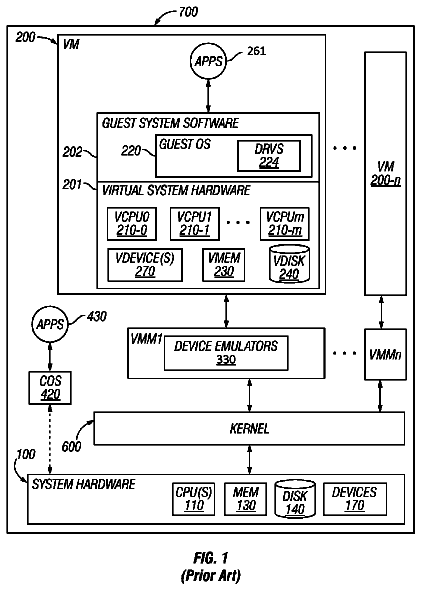
FIG. 1 is an illustrative drawing showing one possible arrangement of a computer system that implements virtualization.
FIG. 2 is an illustrative drawing of a virtualized system including SR-IOV virtualization.
FIG. 3 is an illustrative drawing of a system that includes a host machine that hosts a virtualization intermediary and a virtual machine and that is coupled to access physical storage through an IOV adapter.
FIGS. 4A-4C are illustrative drawings that show a process to provision and instantiate the virtualized computer resources of the system of FIG. 3.
FIG. 5 is an illustrative flow diagram of a runtime process in which a virtual machine guest operating system and a multipathing process of the virtualization intermediary of the system of FIG. 3 collaborate in an IO dispatch.
FIG. 6 is an illustrative flow diagram of a runtime process in which the virtualization intermediary provides asynchronous notifications of active path state change events so as to update the values cached by the guest VF driver of the system of FIG. 3.
FIG. 7 is an illustrative drawing showing a first example scenario in which a first table is stored in the guest VF driver cache of the system of FIG. 3.
FIG. 8 is an illustrative drawing showing a second example scenario in which a second table is stored in the guest VF driver cache of the system of FIG. 3.
FIG. 9 is an illustrative drawing showing additional details of the second example scenario in which a third table is stored in the shared memory of the system of FIG. 3.
FIG. 10 is an illustrative drawing showing a third example scenario in which a fourth table is stored in the guest VF driver cache of the system of FIG. 3.
FIG. 11 is an illustrative drawing showing additional details of the third example scenario in which a fifth table is stored in the shared memory of the system of FIG. 3.
Detailed description of the embodiments
The following description is presented to enable any person skilled in the art to create and use a computer system configured for use with an SR-IOV adapter in which a direct-access virtual machine and a virtualization intermediary collaborate in use of multipathing to select a SCSI path for access to a physical storage region. Various modifications to the preferred embodiments will be readily apparent to those skilled in the art, and the generic principles defined herein may be applied to other embodiments and applications without departing from the spirit and scope of the invention. Moreover, in the following description, numerous details are set forth for the purpose of explanation. However, one of ordinary skill in the art will realize that the invention might be practiced without the use of these specific details. In other instances, well-known structures and processes are shown in block diagram form in order not to obscure the description of the invention with unnecessary detail. Thus, the present invention is not intended to be limited to the embodiments shown, but is to be accorded the widest scope consistent with the principles and features disclosed herein.
In this description, reference is sometimes made to a virtual machine, a hypervisor kernel, virtual machine monitors (VMMs), a virtualization intermediary or some other virtualized component taking some action. Persons skilled in the art will appreciate that a hypervisor kernel, VMMs and a virtualization intermediary comprises one or more software layers that run on a host system, which comprises of hardware and software. In order to perform any given action, a virtual machine, virtualization intermediary or other virtualized component configures physical resources of the host machine to perform the given action. For example, a virtualization intermediary may configure one or more physical processors, according to machine readable program code stored in machine readable storage device.
Overview of Virtualization
FIG. 1 is an illustrative drawing showing one possible arrangement of a computer system 100 that implements virtualization. In the example system of FIG. 1, multiple virtual machines (VMs) or "guests" VM1 to VMn are installed on a "host platform," referred to as a "host," which includes system hardware, that is, hardware platform 104, and one or more layers of co-resident software components comprising a virtualization intermediary, e.g. a virtual machine monitor (VMM), hypervisor or some combination thereof. The system hardware typically includes one or more physical processors 106, physical memory 108, some form of mass storage 110, and various other physical devices 112, such as an IO storage adapter to perform protocol conversions required to access remote storage such as within a storage access network (SAN) 113 and to coordinate concurrent accesses to such storage.
Each virtual machine VM1 to VMn typically will have both and guest system software 115 and virtual system hardware, which typically includes one or more virtual CPUs (VCPUs) 116-1 to 116-m, virtual memory 118, at least one virtual disk 122, and one or more virtual devices 120. The virtual hardware components of the virtual machine may be implemented in software using known techniques to emulate the corresponding physical components. The guest system software includes guest operating system (OS) 124 and virtual drivers 126 as needed for the various virtual devices 120.
As is well known to persons skilled in the art, a typical device driver is a computer program based component that runs on (i.e. configures) a machine (e.g. host computer) and acts as a translator between a physical device and the applications or operating systems that use the device. A device driver typically accepts generic high-level commands and breaks them into a series of low-level device-specific commands as required by the device being driven. A virtual driver 126 is a computer program based component that that runs on a host computer and performs the same role as a physical driver except that it configures a machine (e.g. host computer) to provide translation between a virtual device 120 that provides hardware emulation and that runs within the VMM and the guest operating system 124. Furthermore, drivers (virtual or physical) can provide a level of security as they can run in kernel-mode, thereby protecting the operating system from applications running in user-mode.
In many cases, software applications 128 running on a virtual machine VM1 will function as they would if run on a "real" computer, even though the applications are running at least partially indirectly, that is via guest OS 124 and virtual processor(s). Executable files will be accessed by the guest OS from virtual disk 122 or virtual memory 118, which will correspond to portions of an actual physical disk 110 or storage on the SAN 113 or memory 108 allocated to that virtual machine.
A software component referred to herein as a `virtualization intermediary` serves as an interface between the guest software within a virtual machine and the various hardware components and devices in the underlying hardware platform. The virtualization intermediary may include VMMs, hypervisor (also referred to as a virtualization "kernel") or some combination thereof. Because virtualization terminology has evolved over time and has not yet become fully standardized, these three terms do not always provide clear distinctions between the software layers and components to which they refer. In some systems, some virtualization code is included in at least one "superior" virtual machine to facilitate the operations of other virtual machines. Furthermore, specific software support for virtual machines may be included in the host OS itself. For example, the term `hypervisor` often is used to describe both a VMM and a kernel together, either as separate but cooperating components or with one or more VMMs incorporated wholly or partially into the hypervisor itself to serve as a virtualization intermediary. However, the term hypervisor also is sometimes used instead to mean some variant of a VMM alone, which interfaces with some other software layer(s) or component(s) to support the virtualization.
One use of the term hypervisor signifies a software layer implemented to manage physical resources, process creation, I/O stacks, and that includes physical device drivers 133 (only one shown) that serve as an interface to host system devices such as such as an IO storage adapter. Under such an implementation, the hypervisor 132 would manage the selections of physical devices and their temporary assignment to virtual devices. For example, the hypervisor kernel 132 would manage the mapping between VM1-VMn and their virtual processors 116-1 to 116-m, virtual memory 118, and the physical hardware devices that are selected to implement these virtual devices. More particularly, when a virtual processor is dispatched by a VM, a physical processor, such as one of the physical processors 104, would be scheduled by the hypervisor 132 to perform the operations of that virtual processor. In contrast, in the context of such implementation, VMM1-VMMn might be responsible for actually executing commands on physical processors, performing binary translation (BT) or programming of virtual hardware, for example. Note that the VMM is `instanced` meaning that a separate instance of the VMM is created for each VM. Thus, although in this example, such a hypervisor and a VMM may be distinct, they would work together as a virtualization intermediary. Unless otherwise indicated, the term `virtualization intermediary` encompasses any combination of VMM and hypervisor (or hypervisor kernel) that provides a virtualization layer between a guest OS running on VMs and the host hardware.
In the system of FIG. 1, the virtual machine monitors VMM1 to VMMn are shown as separate entities from the hypervisor kernel software 132 that run within VM1 to VMn, respectively. The VMMs of the system of FIG. 1 emulate virtual system hardware. While the hypervisor kernel 132 is shown as a software layer located logically between all VMs and the underlying hardware platform and/or system-level host software, it would be possible to implement at least part of the hypervisor layer in specialized hardware. The illustrated embodiments are given only for the sake of simplicity and clarity and by way of illustration since as mentioned above, the distinctions are not always so clear-cut. Again, unless otherwise indicated or apparent from the description, it is to be assumed that one or more components of the virtualization intermediary can be implemented anywhere within the overall structure of such virtualization intermediary, and may even be implemented in part with specific hardware support for virtualization.
The various virtualized hardware components of the VM1, such as VCPU(s) 116-1 to 116-m, virtual memory 118, virtual disk 122, and virtual device(s) 120, are shown as being emulated within VMM1, which runs within virtual machine VM1. One advantage of such an arrangement is that the virtual machine monitors VMM1 to VMMn may be set up to expose "generic" devices, which facilitate VM migration and hardware platform-independence. For example, the VMM1 may be set up to emulate a standard Small Computer System Interface (SCSI) disk, so that the virtual disk 122 appears to the VM1 to be a conventional SCSI disk connected to a conventional SCSI adapter, whereas the underlying, actual, physical disk 110 may be something else. The term "disk" typically signifies persistently stored data addressed in sequence, typically from address zero to address max capacity-1. In that case, a conventional SCSI driver typically would be installed into the guest OS 124 as one of the virtual drivers 126. A virtual device 120 within the VMM then would provide an interface between VM1 and a physical device driver 133 that within the hypervisor kernel 132 that serves as an interface to a physical device (e.g., device 112) that is part of the host system and would handle disk operations for the VM1.
Different systems may implement virtualization to different degrees--"virtualization" generally relates to a spectrum of definitions rather than to a bright line, and often reflects a design choice with respect to a trade-off between speed and efficiency on the one hand and isolation and universality on the other hand. For example, "full virtualization" is sometimes used to denote a system in which no software components of any form are included in the guest OS other than those that would be found in a non-virtualized computer; thus, the guest OS 124 could be an off-the-shelf, commercially available OS with no components included specifically to support use in a virtualized environment.
In contrast, another term, which has yet to achieve a universally accepted definition, is that of "para-virtualization." As the term implies, a "para-virtualized" system is not "fully" virtualized, but rather the guest is configured in some way to provide certain features that facilitate virtualization. For example, the guest in some para-virtualized systems is designed to avoid hard-to-virtualize operations and configurations, such as by avoiding certain privileged instructions, certain memory address ranges, etc. As another example, some para-virtualized systems include an interface within the guest that enables explicit calls to other components of the virtualization software.
For some, the term para-virtualization implies that the guest OS (in particular, its kernel) is specifically designed to support such an interface. Others define the term para-virtualization more broadly to include any guest OS with any code that is specifically intended to provide information directly to any other component of the virtualization software. According to this view, loading a module such as a driver designed to communicate with other virtualization components renders the system para-virtualized, even if the guest OS as such is an off-the-shelf, commercially available OS not specifically designed to support a virtualized computer system. Unless otherwise indicated or apparent, embodiments are not restricted to use in systems with any particular "degree" of virtualization and are not to be limited to any particular notion of full or partial ("para-") virtualization.
In addition to the sometimes fuzzy distinction between full and partial (para-) virtualization, two arrangements of intermediate system-level software layer(s) are in general use--a "hosted" configuration and a non-hosted configuration. In a hosted virtualized computer system, an existing, general-purpose operating system forms a "host" OS that is used to perform certain input/output (I/O) operations, alongside and sometimes at the request of the VMM.
The system of FIG. 1 is an example of a non-hosted configuration in which VMMs are deployed on top of a software layer--hypervisor kernel 132--constructed specifically to provide an interface for the virtual machines. Kernel 132 also may handle any other applications running on it that can be separately scheduled, as well as a console operating system that, in some architectures, is used to boot the system and facilitate certain user interactions with the virtualization software.
Pci sr-iov
Many modern computing devices employ input/output (IO) adapters and buses that utilize some version or implementation of the Peripheral Component Interconnect (PCI) standard, which specifies a computer bus for attaching peripheral devices to a computer motherboard. PCI Express (PCIe) is an implementation of the PCI computer bus that uses existing PCI programming concepts, but bases the computer bus on a different and much faster serial physical-layer communications protocol. In addition to the PCI and PCIe specifications, the PCI-SIG has defined input/output virtualization (IOV) standards for defining how to design an IO adapter that can be shared by several virtual machines.
The term "function" is used in the PCI context to signify a device with access controlled by a PCI bus. A PCI function is identified within a single PCI root complex by its PCI or PCIe bus, device, and slot identifiers. A PCI function includes a configuration space, which includes both device dependent and device independent regions used by host software to support device relocation on the PCI bus, flexible device-to-interrupt binding, device identification, and device configuration. A function also includes memory space which is identified by Barrier Address Registers in configuration space and provides a memory mapped IO interface for host IO initiated from host to the device. A PCIe function also includes message space which is identified by MSI and MSI-X capabilities in configuration space and provides either or both MSI/MSI-X message based interrupt generation. Many network (e.g., Ethernet) and storage (e.g., disk) adapters are implemented as PCI or PCIe compliant adapters and are recognized by a machine's PCI sub-system as a single PCI function. Multi-port PCI or PCIe adapters simply appear to a host PCI sub-system as multiple PCI functions.
FIG. 2 is an illustrative drawing of a virtualized system 200 including SR-IOV virtualization. Techniques specified in the PCI SR-IOV specification can be used to reduce the CPU impact of high throughput workloads by bypassing the virtualization intermediary. The term `single root` refers to a single root complex as contrasted with a multiple root complex. In a PCI Express system, a root complex device couples the processor and memory subsystem to a PCI Express switch fabric comprised of one or more switch devices. The root complex generates transaction requests on behalf of the processor, which is interconnected through a local bus.
The illustrative system includes VMs 202 and 204, each independently running a separate (and possibly different) guest operating system. A virtualization intermediary layer 218 runs between the virtual machines 202-206 and a host machine 216. Device driver 208 of VM 202 and device driver 210 of VM 204 each drive a physical function (PF) 222, with intervention by the virtualization intermediary 218. Device driver 212 of VM 206 drives the virtual function (VF) 228, without intervention by the virtualization intermediary 218. The device driver 212 communicates with IO MMU logic 224 disposed on the host machine 216 in the course of data access to data with mass storage (not shown). A device manager 220 within virtualization intermediary 218 manages the allocation and de-allocation of VFs for the SR-IOV adapter 214. The IOV adapter 214 provides a memory-mapped input/output interface for IO and provides an interface for controlling VFs.
A typical IOV adapter includes processor, memory and network interface resources (not shown) to implement the PF and one or more virtual functions VFs. A PF is a PCIe function that supports the SR-IOV capabilities defined in the PCI SR-IOV specification. A PF is used to control the physical services of the device and to manage individual VFs.
A VF is a PCIe function which is associated with a particular physical function and shares physical PCI adapter resources (e.g., ports, memory) with that physical function and other virtual functions located on the same physical adapter. A virtual function has its own PCI configuration space, memory space, and message space separate from other physical or virtual functions on that same adapter. A physical function, such as PF 222 in this example that is associated with a virtual function 228 is responsible for allocating, resetting, and de-allocating that virtual function and the PCI resources required by that virtual function. In general, a VF can either be accessed via a virtualization intermediary or bypass the virtualization intermediary to be directly accessed by a guest OS. In the example system 200, VMs 202, 204 respectively access PF 222 via the virtualization intermediary 218, and VM 206 accesses VF 214 directly, i.e. without the virtualization intermediary 218. Thus, a VF can be a direct sink for I/O and memory operations of a VM, i.e., without run-time intervention by a virtualization intermediary. The VF also can be a source of Direct Memory Access (DMA), completion, and interrupt operations to a VM.
SCSI Command Protocol
The International Technology Standards (INCITS) T10 Technical Committee has adopted a layered approach that divides the Small Computer System Interface (SCSI) into multiple layers of standards. The lowest layer refers to physical interfaces sometimes referred to as physical transports. The next layer up pertains to transport protocols usually directly associated with one physical transport standard. The top layer consists of command sets associated with specific devices such as disk drives or tape drives, for example. See, J. Lohmeyer, SCSI Standards Architecture, Business Briefing: Data Management & Storage Technology 2003. A result of this layered approach to the SCSI standard is that there are over 30 SCSI standards. In general, only a few of these standards apply to a given product. As used herein, the term `SCSI` signifies compliance with one or more of these SCSI standards.
A SCSI command is a request describing a unit of work to be performed by a device server. A SCSI command descriptor block (CDB) is a structure used to communicate commands from an application client to a device server. The SCSI command set assumes an underlying request-response protocol. The fundamental properties of the request-response protocol are defined in SCSI Architecture Model (SAM)-3, Revision 14. Action on SCSI commands is not be deemed completed until a response is received. The response ordinarily includes a status that indicates the final disposition of the command. See, SCSI Primary Commands-3 (SPC-3), Revision 23, Section 4.2, The request-response model, May 4, 2005, American National Standards for Information Systems--InterNational Committee for Information Technology Standards. (hereinafter "SPC-3, Revision 23")
A SCSI device is a device that contains one or more SCSI ports that are connected to a service delivery subsystem and supports a SCSI application protocol. An application client is an object that is the source of SCSI commands. A SCSI initiator device is a SCSI device that contains application clients and SCSI initiator ports that originate device service and task management requests to be processed by a SCSI target device and receive device service and task management responses from SCSI target devices. A SCSI initiator port is a SCSI initiator device object that acts as the connection between application clients and the service delivery subsystem through which requests and responses are routed. A SCSI target device is a SCSI device containing logical units and SCSI target ports that receive device service and task management requests for processing and sends device service and task management responses to SCSI initiator devices. A SCSI target port is a SCSI target device object that acts as the connection between device servers and task managers and the service delivery subsystem through which requests and responses are routed. A logical unit is an externally addressable entity within a SCSI target device that implements a SCSI device model and contains a device server. See, SPC-3, Section 3.1 Definitions.
For the purpose of the following description, it is assumed that the IO storage adapter described herein employs a port based SCSI transport protocol, such as Fiber Channel, iSCSI or SAS, to transfer data between a host system IO bus and SCSI storage. In accordance with the iSCSI transport protocol, for example, a SCSI initiator is responsible for packaging a SCSI CDB perhaps with the aid of a machine's operating system and sending the CDB over an IP network. An iSCSI target receives the CDB and sends it to an iSCSI logical unit, which may be a disk, CD-ROM, tape drive, printer, scanner or any type of device, managed by a SCSI target. The SCSI target sends back a response to the CDB that include a status that indicates the final disposition of the command.
A SCSI target may manage numerous SCSI logical units. In some embodiments, a SCSI target identifier in combination with a SCSI LUN (logical unit number) and a Logical Block Address (LBA) constitutes a storage address. A separate parameter indicates the size of the storage region located at the specified storage address in terms of the number of contiguous blocks associated with the address. A SCSI LUN, serves as an instance identifier for a SCSI logical unit that uniquely identifies a SCSI logical unit within the scope of a given SCSI target at a given time. A SCSI LBA is the value used to reference a logical block within a SCSI logical unit.
IOV with Virtual Storage on Fast Access Data Path
FIG. 3 is an illustrative drawing of a system 300 that includes a host machine 302 that hosts a virtual machine 304 and that is coupled to an IOV storage adapter 306 that adapts IO communications over a PCI bus protocol of the host machine 302 to SCSI storage access protocols used to access persistent physical storage 308. The system 300 of FIG. 3 is an implementation that in general possesses much the same general type of configuration and component structures explained with reference to FIG. 1 except that VM 304 is configured for direct-access to physical storage via the IOV storage adapter 306 in accordance with the PCI SR-IOV specification. However, details are omitted from FIG. 3 so as to not obscure IOV features.
In some embodiments the PCI bus protocol is compliant both the PCI specification and the PCIe SR-IOV extension specification, and SCSI commands are used with one or more SCSI transport protocols such as iSCSI, SAS or Fibre Channel to directly communicate IO access requests (Read/Write) with persistent physical storage 308 such as SAN storage, for example. More particularly, the system 300 is configured to allow a virtual machine 304 to access physical storage 308 via IOV direct access for certain SCSI Read/Write CDBs and to allow access to physical storage 308 via a virtualization intermediary 310 for other SCSI CDBs. Specifically, certain frequently occurring Read and Write SCSI commands are directed over a direct IOV data path coupling between the virtual machine 304 and a virtual function 316 substantially without involvement of the virtualization intermediary 310.
The storage adapter 306 includes adapter resources 339 such as processor and memory resources and network protocol translation and interface resources, which will be readily understood by persons skilled in the art, to implement a physical function (PF) 314 and the virtual function (VF) 316. In the illustrated embodiment, the VF 316 is associated with virtual machine 304. A guest VF driver 321 communicates information with both the VF 316 and a hybrid storage adapter (HSA) 320 instantiated within the virtual machine 304. Although only one VM 304 and one corresponding VF 316 are shown and described herein, it will be appreciated that the host system 302 may host multiple VMs and the adapter 306 may implement multiple corresponding VFs, and the description herein would apply to each such combination of VM and VF. Multiple VFs (only one shown) may be instantiated within the adapter 306, and each respective virtual machine (only one shown) may be associated with a different respective VF to create respective IOV data paths for certain frequently occurring Read and Write SCSI commands.
The HSA 320 `appears` to be a physical PCI device (i.e. a storage adapter) from the perspective of the virtual machine 304. The HSA 320 acts as the virtual machine's interface to the physical storage world, i.e. to the physical storage adapter 306. The hybrid storage adapter is an emulated PCI storage adapter within the VM 304, which encapsulates a PCI SR-IOV virtual function of an SR-IOV compliant physical storage adapter presented by the virtualization intermediary 310 within a protected memory space of the virtual machine. A PCI configuration space 309 of the virtual function 316 is copied to the HSA's PCI configuration space, so as to provide a memory mapped interface to the first HSA PCI memory space 311 that supports direct access to physical memory. The HSA 320, through the first PCI memory space, provides a direct access path to the guest OS 307 of the virtual machine 304 with the capability to issue IO requests directly to the physical adapter virtual function (VF) 316 without intervention by the virtualization intermediary 310. In addition, the HSA's PCI configuration space maps to the second HSA PCI memory mapped interface 313 that supports fully emulated processing of certain SCSI commands using the virtualization intermediary 310. Although the HSA 320 is shown resident within a protected memory space of the virtual machine 304, it will be appreciated that it could instead reside within the virtualization intermediary 310.
The guest VF driver 321 is savvy as to the hybrid nature of the HSA 320, and as such is a `para-virtual` device driver. The guest VF driver 321 directs certain SCSI I/O operations to the first HSA PCI memory space 311 for direct access to physical storage 308 via the VF. The guest VF driver 321 directs other SCSI operations to the second HSA PCI memory space 313 for fully emulated processing by the virtualization intermediary 310.
Furthermore, for each physical SCSI disk exposed to the VF 316 on the physical SAN 208, there may be multiple physical SCSI paths existing to the physical SCSI disk of which only a subset may be active at any point in time. A path management layer in the storage stack 328 within the virtualization intermediary collapses or coalesces the multiple paths into a single logical device (not shown). For each respective logical device, a virtual disk (e.g., V.sub.D1, V.sub.D2, . . . V.sub.Dk) is provisioned to the VM 304 as being attached to the HSA 320 at a respective virtual SCSI address. While issuing IO requests to the physical SCSI disk via the VF 316 it is this virtual SCSI address that needs to be mapped to the actual physical SCSI address represented by a currently active path.
The storage stack 328 within the virtualization intermediary 310 provides IO services. A file system 328-1 issues an IO request for a virtual disk to a virtualization layer 328-2, which converts the request to an equivalent request for physical disks or LUNs. Typically, a path management layer 328-3 receives the request from the virtualization layer 328-2 and determines which path should handle the request and issues a request to a SCSI system driver 328-4 on the determined path. The SCSI system driver (which may be the PF driver 318, for example) converts IO request to a SCSI CDB and sends and receives CDBs and data on a storage network or IO bus.
The multipathing layer 328-3 in the storage stack 328 performs several functions. These include discovery of the physical paths to SCSI devices, collapsing multiple physical paths to a SCSI device, keeping track of the active path to a SCSI device, ensuring that IO coming from the software layers above it is routed to the correct path for a SCSI device, and changing the active path based on certain path selection and/or load balancing policies, for example.
The description continues in the full USPTO document.
 Lapsed, fee not paid21 drawings