Lapsed, fee not paid35 drawings
Hardware & Electronics · US 8,718,250 B2
Billing data interface for conferencing customers
A billing data interface provides billing data to customers in an accurate and efficient manner.
US 8,718,258 B2 · Assignee: Sprint Communication Company L.P. · Inventors: Cope; Warren B. et al.
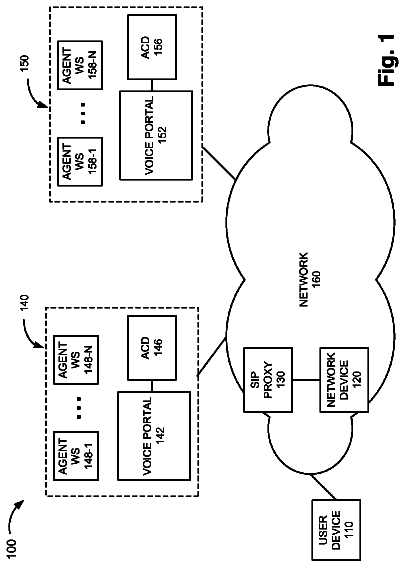
Sheet 1 of 4 from the published document. All sheets in the USPTO PDF
A system and method for routing calls based on the different fee structure between voice and data is disclosed. The origination type for an incoming call is determined. When the incoming call is a VoIP call then the call is routed based, in part, on selecting the minimum fee required to terminate the call.
Communication networks can have different types of incoming calls. For example, calls may originate as time division multiple (TDM) calls or as Voice over Internet Protocol (VoIP) calls. The TDM calls are analog calls that may be converted into packets by the communication network and then routed, or may be routed as an analog signals. The VoIP calls have already been converted into a stream of packets before entering the communications network. Currently, VoIP calls are typically routed in the same way that TDM calls are routed. Many government bodies have established different fee structures for voice communications than for data communications. The fee structures may also be based on if the call originates and terminates within the same government jurisdiction. Because the VoIP calls have already been converted into a stream of data packets before entering the communications network,
1 of 4 drawing sheets so far from the published document, cropped to the drawing. Every sheet is in the USPTO PDF.
What the patent claimed, word for word. All of it is now free to use.
Not applicable
Not applicable
Not applicable
The invention is related to the field of communications, and in particular, to communication network architectures and services.
Communication networks can have different types of incoming calls. For example, calls may originate as time division multiple (TDM) calls or as Voice over Internet Protocol (VoIP) calls. The TDM calls are analog calls that may be converted into packets by the communication network and then routed, or may be routed as an analog signals. The VoIP calls have already been converted into a stream of packets before entering the communications network. Currently, VoIP calls are typically routed in the same way that TDM calls are routed. Many government bodies have established different fee structures for voice communications than for data communications. The fee structures may also be based on if the call originates and terminates within the same government jurisdiction. Because the VoIP calls have already been converted into a stream of data packets before entering the communications network, the communications network may be able to route the VoIP calls differently than the TDM calls to take advantage of the different fee structure between voice and data communications.
Therefore there is a need for a system and method for routing calls based on the different fee structure between voice and data.
A system and method for routing calls based on the different fee structure between voice and data is disclosed. The origination type for an incoming call is determined. When the incoming call is a VoIP call then the call is routed based, in part, on selecting the minimum fee required to terminate the call.
FIG. 1 is a flow chart for a method of routing a 1+ call based on the call origination type in one example embodiment of the current invention.
FIG. 2 is a flow chart for a method of routing a call based on the call origination type in one example embodiment of the current invention.
FIG. 3 is a flow chart for a method of routing a call based on the lowest termination fee in one example embodiment of the current invention.
FIG. 4 is a block diagram of an apparatus for routing calls based on the call origination type in one example embodiment of the current invention.
FIGS. 1-4 and the following description depict specific examples to teach those skilled in the art how to make and use the best mode of the invention. For the purpose of teaching inventive principles, some conventional aspects have been simplified or omitted. Those skilled in the art will appreciate variations from these examples that fall within the scope of the invention. Those skilled in the art will appreciate that the features described below can be combined in various ways to form multiple variations of the invention. As a result, the invention is not limited to the specific examples described below, but only by the claims and their equivalents.
FIG. 1 is a flow chart for a method of routing a 1+ call based on the call origination type in one example embodiment of the current invention. At step 100 a check is made to determine if an incoming call is a 1+ call. 1+ calls are also known as long distance calls. When the incoming call is not a 1+ call then the call is routed normally at step 106. When the incoming call is a 1+ call then the origination type of the call is determined at step 102. At step 104 a check is made to determine if the origination type of the call is VoIP. When the origination type of the call is not VoIP then the call is routed normally at step 106. When the call origination type is VoIP then the destination numbering plan area (NPA) is determined at step 110. NPA is also known as the area code. At step 110 the NPA is checked to determine if the NPA is a predetermined NPA. When the NPA is a predetermined NPA then the call is routed using a Competitive Local Exchange Carrier (CLEC) at step 112. When the NPA is not a predetermined NPA then the call is routed using a Local Exchange Carrier (LEC) at step 114. There may be any number of predetermined NPAs ranging from zero up to the total number of NPAs in the US.
The predetermined NPAs correspond to NPAs that reduce the access cost for termination. There are at least two components to the access cost for termination. The first component is the technical or equipment cost for termination. The second component is the legal cost or regulatory fee structure for terminating a call. The legal cost or regulatory fee structure may be different depending on if the call is a TDM call or if the call is VoIP and can be treated as a data transfer. One example of a data transfer is information accessed through the Internet. In one example embodiment of the current invention the equipment cost for termination is neglected and the VoIP calls are routed based on the legal costs for termination. In another example embodiment the legal costs and the equipment costs are both used to select the total minimum termination cost. The predetermined NPAs may correspond to NPAs that result in an intra-state call.
Some jurisdictional areas may only have one NPA for the entire region, for example a state with low population may only have one area code for the entire state. Even with only one area code there may be differences in the regulatory fee structure for terminating a data call vs. terminating a TDM call within the jurisdictional area. FIG. 2 is a flow chart for a method of routing a call based on the call origination type in one example embodiment of the current invention. When an incoming call is detected then the origination type of the call is determined at step 200. At step 202 a check is made to determine if the origination type of the call is TDM. When the origination type of the call is TDM then the call is routed normally at step 206. When the call origination type is not TDM then the destination number is determined at step 204. At step 208 the destination number is checked to determine if the destination number is a predetermined destination number. When the destination number is a predetermined destination number then the call is routed using a Competitive Local Exchange Carrier (CLEC) at step 210. When the destination number is not a predetermined destination number then the call is routed using a Local Exchange Carrier (LEC) at step 212. In one example embodiment of the current invention, at step 208 the prefix of the destination number may be used to determine if the destination number is a predetermined destination number. In another example embodiment of the current invention, at step 208 the full destination number may be used to determine if the destination number is a predetermined destination number. The method shown in FIG. 2 may also be used when the incoming call is a 1+ number. When using the method shown in FIG. 2 with an incoming 1+ number, part or all of the ten digit destination number may be used to determine when the destination number is a predetermined destination number.
FIG. 3 is a flow chart for a method of routing a call based on the lowest termination fee in one example embodiment of the current invention. At step 300 the origination type for an incoming call is determined. At step 302 a check is made to determine if the origination type is TDM. When the incoming call is TDM then the call is routed normally at step 306. When the call origination type is not TDM then the call is routed based on the lowest termination fee in step 304. In one example embodiment of the current invention the equipment cost for termination is neglected and the non-TDM calls are routed based on the lowest legal costs for termination. In another example embodiment the legal costs and the equipment costs are both used to select the total minimum termination cost.
FIG. 4 is a block diagram of an apparatus for routing calls based on the call origination type in one example embodiment of the current invention. System 400 comprises switches 404, 408, and 410 and service control point (SCP) 406. Switch 404 is connected to SCP 406 and to switches 410 and 408. Switches 404 and 410 may be soft switches. Connected to system 400 through switch 404 is VoIP system 402 and telephone 412. Local exchange carrier (LEC) is connected to system 400 through switch 408 and switch 410. Competitive local exchange carrier (CLEC) is connected to system 400 through switch 410. CLEC is connected to LEC. Phone 414 is connected to LEC and phone 401 is connected to VoIP 402.
In one example embodiment of the current invention, switch 404 detects incoming calls. The incoming calls may be from VoIP 402 or phone 412. When the incoming call is a 1+ call, switch 404 queries SCP 406 for the routing for the call. When the incoming call is from VoIP 402, SCP compares the destination numbering plan area (NPA) to determine if the destination NPA is a predetermined NPA. When the destination NPA is a predetermined NPA then SCP routes the call through switch 410 to CLEC. CLEC will route the call through LEC and the LEC will terminate the call. When the destination NPA is not a predetermined NPA then SCP routes the call through switch 410 to LEC and the LEC will terminate the call.
In another example embodiment of the current invention, switch 404 detects incoming calls. The incoming calls may be from VoIP 402 or phone 412. When the incoming call is from VoIP then the destination number is checked to determine when the destination number is a predetermined destination number. The check on the destination number typically occurs in SCP 406. When switch 404 is a soft switch the check on the destination number may occur at switch 404. When the destination number is a predetermined destination number then the call is routed through switch 410 to CLEC. CLEC will route the call through LEC and the LEC will terminate the call. When the destination number is not a predetermined destination number then the call is routed through switch 410 to LEC and the LEC will terminate the call. In one example embodiment of the current invention, the prefix of the destination number may be used to determine if the destination number is a predetermined destination number. In another example embodiment of the current invention, the full destination number may be used to determine if the destination number is a predetermined destination number. When the incoming call is a 1+ call, part or all of the ten digit destination number may be used to determine when the destination number is a predetermined destination number.
About 1,869 words. The USPTO PDF has it with every drawing.
Fees are due 3.5, 7.5 and 11.5 years after grant. This patent expired on May 6, 2026, so the fee marked "not paid" was the one that went unpaid.
System and method for jurisdictional routing
Filed Jan 2005 · published Aug 2006System and method for jurisdictional routing
Filed Jan 2005 · granted May 2014Earlier publications, parents and continuations. None of them can still be enforced, or this patent would not be listed.
Prior art cited by the examiner or applicant. Useful when you check your own idea for novelty.
Everything on this page comes from the documents linked above.