 Lapsed, fee not paid6 drawings
Telecom & Networks · US 8,712,356 B2
Apparatus and method for phase synchronization in radio frequency transmitters
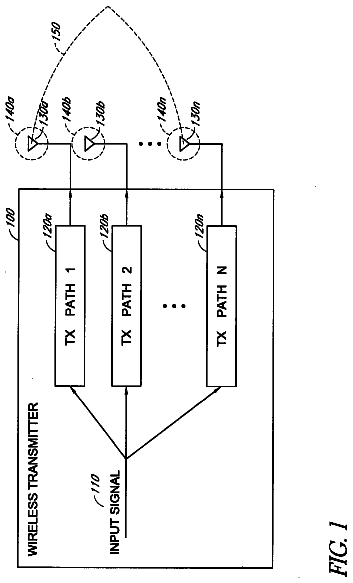
Apparatus and methods are disclosed related to phase synchronization in transmitters.
US 8,712,372 B2 · Assignee: Accenture Global Services Limited · Inventors: Cesarini; Andrea
Sheet 1 of 10 from the published document. All sheets in the USPTO PDF
A telecommunications service provider architecture integrates multiple architectures which include prepaid and post-paid processing systems. The convergent enhanced architecture provides performance, scalability, and efficiency consistent with a prepaid architecture and flexibility and configurability consistent with a post-paid system. The convergent architecture provides messaging interfaces between a telecommunications support architecture and a prepaid architecture or a combined rating and billing architecture. The messaging interfaces support message transfer between the processing systems in the architectures to provide information exchange including billing exchanges, rating exchanges, and customer management exchanges.
Rapid advances in data processing and telecommunications technology have lead to a vast array of communication services available to the consumer. Such telecommunication services include Internet service, cable television service, cellular phone service, paging service, combined voice and data delivery service, and many other services. Furthermore, most services may be wireless or wireline based. With the increase in available services has also come increased flexibility in paying for those services. Traditionally, most customer accounts were post-paid accounts. For post-paid accounts, the service provider tracked all of the time a customer spent using a service, determined the applicable cost, and billed the customer (e.g., monthly). In other words, the customer paid only after using the service. More recently, prepaid accounts have become a viable option for paying for telecommunicatio
1 of 10 drawing sheets so far from the published document, cropped to the drawing. Every sheet is in the USPTO PDF.
What the patent claimed, word for word. All of it is now free to use.
This application claims the priority benefit of EPO Application NO. 05425611.0 filed Aug. 31, 2005 and Italian Application No. MI2005A001618 filed Aug. 31, 2005, both of which are incorporated herein by reference in their entirety.
This invention relates to telecommunications processing systems. In particular, this invention relates to an efficient and flexible architecture which integrates prepaid account processing systems and post-paid account processing systems.
Rapid advances in data processing and telecommunications technology have lead to a vast array of communication services available to the consumer. Such telecommunication services include Internet service, cable television service, cellular phone service, paging service, combined voice and data delivery service, and many other services. Furthermore, most services may be wireless or wireline based.
With the increase in available services has also come increased flexibility in paying for those services. Traditionally, most customer accounts were post-paid accounts. For post-paid accounts, the service provider tracked all of the time a customer spent using a service, determined the applicable cost, and billed the customer (e.g., monthly). In other words, the customer paid only after using the service.
More recently, prepaid accounts have become a viable option for paying for telecommunications services. For a prepaid account, a customer makes an initial payment to the service provider which establishes a credit balance with the service provider. The customer may then use a telecommunications service until the credit balance is exhausted, with accounting performed during or after the termination of each service use transaction.
In the past, service providers implemented processing architectures in which independent systems supported prepaid and post-paid customers and performed customer management. The post-paid systems provided support for payment collection, invoicing, billing, discount and loyalty management, as well as other post-paid support functions. The prepaid systems provided support for credit refills, usage statements, balance management, and other prepaid support functions. However, architectures with independent prepaid, post-paid, and customer management processing systems significantly increased the complexity of providing both prepaid and post-paid services, resulted in a greater number of architectural impacts when rolling out new products, and increased both operational expenditures and capital expenditures to support products and services across both types of payment plans.
In addition, the lack of interaction between systems limited the products, services, discounts, billing flexibility, incentives, rewards, and other telecommunication service aspects which the service provider could provide for its customers. For example, a post-paid account generally had no interaction with a prepaid account, even when the accounts were for a common customer. Thus, the telecommunications service provider could not readily offer cross-product discounts, incentives, or billing options.
One aspect of the invention is a convergent telecommunications system architecture. The convergent architecture unites traditionally independent telecommunications architectures which perform a wide variety of functions. For example, the convergent architecture may unite a self care system, customer care system, billing system, and other support systems which exist in a telecommunications support architecture with a prepaid account balance manager and real time rating system which exist in a prepaid architecture. Efficient and flexible messaging interfaces unite the architectures. In an alternate convergent architecture, a telecommunications support architecture is integrated with a combined rating and billing architecture. As a result, the architectures may efficiently communicate data between the traditionally independent architectures and may support additional products and services and may offer enhanced billing options, such as cross product discounts.
In one implementation, the telecommunications support architecture maintains prepaid rating balances (e.g., in a billing system) and post-paid account balances for service customers. In other words, any given service customer may establish either or both types of payment plans for any one or more types of telecommunications products and services. The telecommunications support architecture may maintain create, update, and/or delete control over the balances in order to establish itself as the primary authority for maintaining the customer balance data.
The prepaid architecture tracks service usage for prepaid services. The rating system may receive telecommunication network mediation requests for service for a customer. In response, the rating system tracks usage of the prepaid service, determines the cost of the usage, and synchronizes usage data with the billing system in the telecommunications support architecture.
In one implementation, the convergent architecture connects the telecommunications support architecture and the prepaid architecture with a bi-directional messaging interface. The messaging interface establishes information flow from the telecommunications support architecture to the rating system and from the rating system to the telecommunications support architecture. The telecommunications support architecture and the rating system are thereby integrated into a single telecommunications architecture.
The messaging interface, for example, includes customer account management interface and a service usage interface. The customer account management interface defines message flows from the telecommunications support architecture to the prepaid architecture. The service usage interface defines message flows from the prepaid architecture to the telecommunications support architecture.
As one example, the customer account management interface defines a refill interface establishing a refill message which the telecommunications support architecture sends to the prepaid architecture. In response, the prepaid architecture credits a prepaid account balance as specified in the refill message. An adapter may translate the refill event message as specified by a refill message mapping into a form for refill messages supported by the prepaid architecture.
As additional examples of the customer account management interfaces, the messaging interface may include a balance adjustment interface and a subscriber account interface. The balance adjustment interface defines a balance adjustment message sent from the customer care system to the rating system. The subscriber account interface defines messages for customer and customer account creation and modification.
In addition, the messaging interface supports information flow from the rating system to the telecommunications support architecture. The information flow may be a batch file or message flow which runs on a periodic schedule, in real time, or according to any other schedule. More specifically, the messaging interface defines a service usage interface from the prepaid rating system to the telecommunications support architecture.
The service usage interface allows the rating system to communicate service usage information for prepaid service use to the telecommunications support architecture where centralized management of the customer balances occurs. To that end, the service usage interface may establish a messaging protocol which constructs messages and/or files based on a service use event record. The service use event record provides an efficient and flexible message transport mechanism which delivers a wide variety of information from the rating system to the telecommunications support architecture using a consistent message format.
The service use event record may include an event header and an event attribute list. The service usage interface may then define multiple event type definitions. Each definition may include an event attribute definition which specifies event attributes for insertion into the event attribute list in the service use event record. As examples, the event type definitions may specify rating information for services including voice traffic, short message service (SMS), Internet traffic, voice over Internet protocol service, Internet protocol television service, or any other telecommunications service.
The service use event record need not change to support additional event types. Instead, a new event type definition may be provided which fits within the service use event record. Accordingly, the telecommunications architecture efficiently and flexibly supports the integration of prepaid and post-paid processing systems over a wide range of telecommunications products and services.
Other systems, methods, features and advantages of the invention will be, or will become, apparent to one with skill in the art upon examination of the following figures and detailed description. It is intended that all such additional systems, methods, features and advantages be included within this description and be protected by the following claims.
The invention can be better understood with reference to the following drawings and description. The components in the figures are not necessarily to scale, emphasis instead being placed upon illustrating the principles of the invention. Moreover, in the figures, like referenced numerals designate corresponding parts or elements throughout the different views.
FIG. 1 shows a convergent telecommunications architecture which integrates a telecommunications support architecture and a prepaid architecture.
FIG. 2 shows a second implementation of a convergent telecommunications architecture which integrates a telecommunications support architecture and a combined rating and billing architecture.
FIG. 3 shows a portion of a convergent telecommunications architecture including a customer care system, a message publication system, and a rating system.
FIG. 4 shows a refill message definition established in a customer account management interface between the telecommunications support architecture and the prepaid architecture.
FIG. 5 shows a balance adjustment message definition established in a customer account management interface between the telecommunications support architecture and the prepaid architecture.
FIG. 6 shows subscriber account message definitions established as part of a subscriber account interface between the telecommunications support architecture and the prepaid architecture.
FIG. 7 shows a service use event record definition established in a service usage interface from the prepaid rating system to the telecommunications support architecture.
FIG. 8 shows an event type definition which may be used in conjunction with the service use event record definition.
FIG. 9 shows the acts that may be taken to establish a convergent telecommunications architecture.
FIG. 10 shows a message flow for communicating a refill message from a customer care system to a prepaid architecture.
The elements illustrated in the Figures interoperate as explained in more detail below. Before setting forth the detailed explanation, however, it is noted that all of the discussion below, regardless of the particular implementation being described, is exemplary in nature, rather than limiting. For example, although selected aspects, features, or components of the implementations are depicted as being stored in memories, all or part of systems and methods consistent with the reverse rating systems and method may be stored on, distributed across, or read from other machine-readable media, for example, secondary storage devices such as hard disks, floppy disks, and CD-ROMs; a signal received from a network; or other forms of ROM or RAM either currently known or later developed.
Furthermore, although specific components of the convergent architecture will be described, methods, systems, and articles of manufacture consistent with the convergent architecture may include additional or different components. For example, a processor may be implemented as a microprocessor, microcontroller, application specific integrated circuit (ASIC), discrete logic, or a combination of other type of circuits or logic. Similarly, memories may be DRAM, SRAM, Flash or any other type of memory. Flags, data, databases, tables, and other data structures may be separately stored and managed, may be incorporated into a single memory or database, may be distributed, or may be logically and physically organized in many different ways. Programs may be parts of a single program, separate programs, or distributed across several memories and processors.
FIG. 1 shows a convergent telecommunications architecture 100 which integrates a telecommunications support architecture 102 and a prepaid architecture 104. The support architecture 102 generally includes systems which implement or support telecommunications products or services. The support architecture 102 may be a Business Support System (BSS) for telecommunications, including billing, customer care, and other support systems traditionally included in a BSS. It is not necessary that the support architecture 102 adhere to any traditional implementation of a BSS, however. Instead the support architecture 102 may vary widely in implementation and functionality. The prepaid architecture 104 generally includes systems which implement or support prepaid customer accounts and may be implemented as an external adjunct rating system. Each architecture 102 and 104 may vary widely in implementation and functionality, however, and examples are given below. The convergent architecture 100 interacts with a mediation system 106, which in turn communicates with the network infrastructure 108.
The convergent architecture 100 connects the support architecture 102 with the prepaid architecture 104 through messaging interfaces. FIG. 1 shows a customer account management interface 138 which supports message communication from systems in the support architecture 102 to systems in the prepaid architecture 104. In one implementation, the interface 138 includes an account refill interface 142 which communicates refill messages from the self care system 114 or customer care system 112 to the prepaid balance manager 130. The interface 138 may also include a balance adjustment interface 144 which communicates refill or other balance adjustment messages from the customer care system 112 to the prepaid balance manager 130. A subscriber account interface 146 communicates customer management messages from the customer care system 112 to the prepaid balance manager 130.
FIG. 1 also shows a service usage interface 140 which supports message communication from systems in the prepaid architecture 104 to systems in the support architecture 102. In one implementation, the interface 140 includes a detailed rated usage interface 148 which communicates detailed usage data for telecommunications products and services from the real time rating system 126 to the billing system 110. The interface 140 also includes an aggregated usage interface 150 which communicates accumulated usage data for telecommunications products and services from the real time rating system 126 to the billing system 110. The customer account management interface 138, the service usage interface 140, and the messages are described in more detail below.
The telecommunications support architecture 102 may be implemented in many different ways and may provide a wide range of functionality. As one example, FIG. 1 shows a telecommunications support architecture 102 which includes a billing system 110, a customer care system 112, a self care system 114, and a revenue management system 116. Additional or alternative functionality may be established in the telecommunications support architecture 102. The prepaid architecture 104 includes a real-time rating system 126, prepaid account data 128, and the prepaid balance manager 130. The prepaid architecture 104 thereby supports prepaid accounts, but may also include, as described below, additional or different systems, such as a billing system.
The billing system 110 generates usage statements and/or invoices 118 for the telecommunication service provider customers. In handling both prepaid and post-paid customer accounts, the billing system 110 may maintain both rating balances and account balances for the service provider customers and may exercise centralized control over the rating balances and account balances. In other words, the billing system 110 has mastership (e.g., has exclusive create, update, and delete access) of the rating balances and account balances in the architecture 100. However, in other implementations, the customer care system 112 or other system may establish mastership of the rating balances and account balances.
The rating balances are associated with services for which a customer prepays. On the other hand, account balances are generally associated with services for which a customer pay after the service is used. As will be described in more detail below, as the customer uses the prepaid service, the billing system 110 decrements the rating balance. As the customer uses the postpaid service, the billing system 110 increments the account balance. The telecommunications support architecture 102, for any given customer, may maintain and track one or more rating balances and account balances.
The self care system 114 may process prepaid account refill actions. As will be explained in more detail below, the self care system 114 may communicate refill messages to the prepaid architecture 104. The prepaid architecture 104 will accordingly update rating balance information stored locally in the prepaid architecture 104.
The revenue management system 116 may provide information which allows the communications service provider to make informed decisions concerning demand for products and services so that the communications service provider may take steps to maximize revenue. The revenue management system 116, for example, may review and analyze historical data, current demand levels, and product and service usage forecasts, and output suggested rates for the telecommunications products and services.
The telecommunications support architecture 102 receives inputs from external sources. As one example, the telecommunications support architecture 102 receives postpaid account payment messages 120. The payment messages 120 may arrive from, for example, financial institutions such as banks and may indicate payment of invoices to the telecommunications support architecture 102. In response to the payment messages 120, the telecommunications support architecture 102 may update customer account balances maintained by the billing system 110.
As another example, the telecommunications support architecture 102 may receive prepaid payment messages 122. The prepaid payment messages 122 may arrive in response to customers funding their prepaid accounts, for example by making a credit card or bank account payment. In response to the prepaid payment messages 122, the telecommunications support architecture 102 may update customer rating balances maintained by the billing system 110. Similarly, the telecommunications support architecture 102 may receive and process voucher refill actions 124. The voucher refill actions 124 may also replenish prepaid account balances. Thus, in response to a voucher refill action 124, the telecommunications support architecture may also update customer rating balances maintained by the billing system 110.
All of the functionality within the telecommunications support architecture 102 may communicate to enhance the service provided to the customer. For example, the customer care system 112 and the revenue management system 116 may communicate balance adjustment messages, dispute resolution messages, or other messages to one another. Accordingly, all of the functionality within the telecommunications support architecture 102 has access to and may report a consistent view of customer data.
In one implementation, the systems 110-116 are implemented with Accenture Communications Solutions.TM. components available from Accenture S.a.P of Rome, Italy. In other implementations, the Geneva.TM. platform available from Convergys of Chicago Ill. and/or the Siebel 7.7 CME.TM. platform available from Siebel Systems, Inc. of San Mateo, Calif., may implement one or more of the systems 110-116. The systems 110-116 may run under the Unix.TM., Windows 2000 .TM., Linux.TM., or other operating system. Underlying databases may be implemented with an Oracle.TM. SQL database platform available from Oracle of Redwood Shores, Calif., Microsoft.TM. SQL database platform available from Microsoft Corporation of Redmond, Wash., and/or Siebel.TM. SQL database platform. The systems 110-116 may be implemented in other manners, however.
The telecommunications support architecture 102 connects to the prepaid architecture 104. The prepaid architecture 104 includes a real-time rating system 126, prepaid account data 128, and the prepaid balance manager 130. The prepaid architecture 104 communicates with the mediation system 106 through a messaging interface 132.
The messaging interface 132 receives messages from, and communicates messages to, the mediation system 106. For example a messaging interface 132 may receive a service use authorization request from the mediation system 106. In response, the prepaid architecture 104 may verify that the prepaid account has a balance which supports the requested service. The prepaid architecture 104 may then respond with a service use authorization or denial message to the mediation system 106. In addition, the mediation system 106 and the prepaid architecture 104 exchange messages concerning the type or amount charges to be incurred for the use of a particular product or service.
Furthermore, the mediation system 106 may provide postpaid service usage accounting messages to the prepaid architecture 104. For example, the postpaid service usage messages may report the type and duration of a postpaid telecommunications service usage, such as the duration of a cellular phone call. As will be described in more detail below, the prepaid architecture may provide postpaid service usage account messages to the telecommunications support architecture 102. The telecommunications support architecture 102 may then appropriately update postpaid account balances for the applicable customer.
The prepaid architecture 104 monitors and tracks ongoing usage of prepaid telecommunications services. To that end, the real-time rating system 126 continuously rates the ongoing service. For example, when a customer has prepaid for cellular phone service, the real-time rating system 126 monitors the duration of ongoing cellular phone calls and provides consistent cost updates to the prepaid balance manager 130. In response, the prepaid balance manager 130 continuously decrements the prepaid account balance in the prepaid account data 128. Accordingly, the prepaid balance manager 130 may determine when the prepaid customer account balance is exhausted and may then take steps to terminate the prepaid service.
Like the telecommunications support architecture 102, the prepaid architecture 104 may receive input from external sources. For example the prepaid architecture 104 may receive prepaid account refill messages 134. The refill messages 134 may arrive from many different refill channels.
As examples, point-of-sale terminals, automated teller machines, and/or interactive voice response systems may communicate refill messages directly to the prepaid architecture 104. Because the prepaid architecture 104 is integrated with the telecommunications support architecture 102 in the convergent architecture 100, the prepaid architecture 104 will communicate the refill information received in the refill messages 134 to the telecommunications support architecture 102. As noted above, the telecommunications support architecture 102 maintains centralized control over the rating balances and account balances for the telecommunications systems customers.
The prepaid architecture 104 may be implemented in many technologies. In one implementation, the Am-Beo nCharge.TM. and/or nRate.TM. platform may implement the real time rating system 126 and prepaid balance manager 130, and may maintain the prepaid account data 128. However, the prepaid architecture 104 does not maintain the prepaid account data 128 in isolation. Instead, the telecommunications support architecture 102 provides centralized management of the prepaid account data (e.g., the rating balances), as well as postpaid account data, thereby integrating the prepaid architecture 104 and the telecommunications support architecture 102 in one architecture.
The synchronization between the prepaid architecture 104 and the telecommunications support architecture 102 may be implemented by an efficient and flexible messaging interface. In particular, the architecture 100 includes a bidirectional messaging interface 136 which connects the telecommunications support architecture 102 and the prepaid architecture 104. Message flow from the telecommunications support architecture 102 to the prepaid architecture 104 may be governed by a customer account management interface 138. Similarly, message flow from the prepaid architecture 104 to the telecommunications support architecture 102 may be governed by a service usage interface 140.
The customer account management interface 138 may define interfaces, including messages and/or communication protocols, for information flow to the prepaid architecture 104. As examples, the customer account management interface 138 may define a prepaid account refill interface 142, a balance adjustment interface 144, and a subscriber account interface 146. Similarly, the service usage interface 140 may define interfaces, including messages, file structures, and/or communication protocols, for information flow from the prepaid architecture 104 to the telecommunications support architecture 102. As examples, the service usage interface 140 may establish a detailed rated usage interface 148 as well as an aggregated usage interface 150. The customer account management interface 138 and the service usage interface 140 are described in more detail below.
FIG. 1 also shows an adapter interface 152. The adapter interface may be provided between the telecommunications support architecture 102 and the prepaid architecture 104. The adapter interface 152 provides message translation, mapping, and/or transformation services which adapt messages and message content to conform to data expectations of the prepaid architecture 104 and/or telecommunications support architecture 102. In the example shown in FIG. 1, the adapter interface 152 includes account management adapters 154 and usage adapters 156.
The account management adapters 154 implement message and message content conversion from the message format in place in the telecommunications support architecture 102 to the message format in place in the prepaid architecture 104. For example, the account management adapters 154 may provide a refill message adapter which translates the refill message sent from the telecommunications support architecture 102 to a form expected by the prepaid architecture 104. Similarly, the account management adapters 154 may also provide a balance adjustment message adapter and subscriber account message adapters for customer and customer account creation and modification messages.
FIG. 1 shows that the adapter interface 152 also includes the usage adaptor 156. Like the account management adaptor 154, the usage adaptor 156 provides message and message content translation, mapping and/or transformation services for the data flowing from the prepaid architecture 104 to the telecommunications support architecture 102. The telecommunications support architecture 102 thereby receives detailed and aggregate usage data in the expected format. Alternatively, the architecture 100 may omit the adapter interface 152. In such implementations, the telecommunications support architecture 102 and/or prepaid architecture 104 prepare messages in the form expected by the receiving system, rather than in a format which is native to either system.
FIG. 2 presents an alternate convergent telecommunications system architecture 200. The architecture 200 also integrates centralized customer account management in a telecommunications support architecture 202 with an existing rating and billing architecture 204. Thus, in the architecture 200, the telecommunications support architecture 202 does not include a billing system. Instead, the rating and billing architecture 204 implements a billing system 206.
As a result, the rating and billing architecture 204 need not report detailed or aggregate usage information back to the telecommunications support architecture 202. Instead, the rating and billing architecture 204 processes the service usage data internally and establishes and maintains the rating balances and account balances for the telecommunications system customers locally. Nevertheless, the telecommunications support architecture 202 exercises control over customer creation and modification, customer account creation and modification, as well as other aspects of customer accounts.
The telecommunications support architecture 202 and the rating and billing architecture 204 are integrated through a messaging interface 208. As described above, the messaging interface 208 establishes the customer account management interface 138. The customer account management interface 138 communicates customer and customer account creation and modification messages from the telecommunications support architecture 202 to the rating and billing architecture 204.
The architecture 200 may be implemented in many ways. For example, the account and billing system 204 may include Convergys Geneva.TM. platform components which implement a rating engine, a billing engine, and account management. As another example, the account and billing system 204 may include SingleView.TM. platform components available from Intec Telecom Systems PLC of Surrey England. The Singl.eView.TM. components may implement a commerce engine, event normalization and rating processes, a balance and reservations management system, billing and invoicing generation processes, an accounting system, or other systems.
FIG. 3 shows a portion of a convergent telecommunications architecture including the telecommunications support architecture 102, the prepaid architecture 104, and a message publication system 302 which connects the systems 102 and 104. The message publication system 302 provides an enterprise application integration (EAI) mechanism by which messages may reach the prepaid architecture 104 (and/or the rating and billing architecture 204). In particular, the message publication system 302 may implement a publish/subscribe messaging interface between the telecommunications support architecture 102 and the prepaid architecture 104.
To that end, the message publication system 302 may establish subscriber records 304 and subscriber topics 306. The message publication system 302 may then send each subscriber to a given topic a copy of each message sent to that topic when the message is received at the message publication system 302. For example, the prepaid architecture 104 may subscribe to customer account management messages, such as refill messages 308, balance adjustment messages 310, customer and customer account creation and modification messages 312, and other messages. As the message publication system 302 receives such messages from the telecommunications support architecture 102, the message publication system 302 provides a copy of each message to the prepaid architecture 104.
The message publication system 302 may also provide one or more adapters 314 in the adapter interface 152. FIG. 3 shows a refill adapter 316 which performs data translation, mapping, and transformation in accordance with a refill mapping 318. Adapters may also be provided for balance adjustment messages, customer management messages, or any other messages.
The refill adapter 316 performs message and message data translation, mapping, and transformation from the refill messages 308 to a format expected by a subscriber, such as the prepaid architecture 104. The refill mapping 318 specifies the message and message data translations, mappings, and transformations which produce a refill message for processing by the prepaid architecture 104 starting with the known format of the refill messages 308. In other words, the adapter mappings support transformation of messages and/or message content from a format defined by one schema (e.g., a schema for messages to adhere to in the telecommunications support architecture 102) to another format defined by another schema (e.g., a schema for messages to adhere to in the prepaid architecture 104 and/or the account and billing system 204).
The message publication system 302 and adapter interfaces 152 may be implemented, for example, with TIBCO Adapters.sup.SM and TIBCO Rendezvous.TM. messaging, available from TIBCO Software Inc. of Palo Alto, Calif. In one implementation, the messages communicated are eXtensible Markup Language (XML) messages and the adapters perform transformation according to extensible Stylesheet Language for Transformations (XSLT) stylesheets. The transformations may transform data between schemas for any of XML, Hypertext Transport Protocol (HTTP), Simple Object Access Protocol (SOAP), Web Service Definition Language (WSDL), extensible Scheme Diagram (XSD), Java Database Connectivity/Open Database Connectivity (JDBC/ODBC) or other message format, content standards, or communication protocols in place in the architectures 100 and 200.
FIG. 3 also shows additional detail of information prepared by the prepaid architecture 104 for processing by the telecommunications support architecture 102. In particular, the prepaid architecture 104 prepares detailed usage data 320 and aggregate usage data 322. The data 320 and 322 may represent prepaid and postpaid service use data for telecommunications services tracked by the prepaid architecture 104 or received from the mediation system 106. The detailed usage data 320 may be specified by a control file 324 and a detailed event file 326. Similarly, the aggregate usage data 322 may be specified by an aggregate event file 328. In one implementation, the control file 324, the detailed event file 326, and the aggregate event file 328 share a format which includes headers 330, 332, and 334, a data section 336, 338, and 340, and footers 342, 344, and 346.
The prepaid architecture 104 may communicate the detailed usage data 320 (e.g., through the detailed rated usage interface 148) and aggregate usage data 322 (e.g., through the aggregated usage interface 150) to the telecommunications support architecture 102 as streams of messages, as batches of files, and/or in other manners. For example, the prepaid architecture 104 may stream the detailed usage data 322 to the telecommunications support architecture 102 as soon as the detailed usage data 320 is available. Accordingly, the detailed usage data 320 arrives in the input data directory 348 of the telecommunications support architecture 102 as a detailed usage data stream 348.
As another example, the aggregate usage data 322 may arrive in the input data directory 348 of the telecommunications support architecture 102 as an aggregate batch file 352 for processing by the telecommunications support architecture 102. Any of the detailed usage data 320 and aggregate usage data 322 may be delivered to the telecommunications support architecture 102 via an FTP interface, or other communication mechanism.
The detailed usage data 320 may provide a record of each telecommunications service event for which the prepaid architecture 104 is configured to provide detailed usage data. The detailed event files 326 contain records specific to any given type of event, any number of which may be accompanied by a control file 324 when the detailed usage data 320 is delivered to the telecommunications support architecture 102.
The control file header 330, the detailed event file header 332, and the aggregate file header 334 may share a common format. Specifically, the headers 330 and 332 may be built as follows. Line 1 may identify the file as being a prepaid architecture file and may specify a file format (e.g., a text based data file). The second line may identify a pre-defined format from one or more possible pre-defined file formats for the file. Lines 3, 4, and 5 may define the character set, the type of the file, and the sub-type of the file. For example, the character set may be ASCII-8. As examples, the file type may specify a control file or an event file, and each type may have a subtype which identifies a specific type of service (e.g., wireline, SMS, or GSM service).
Lines 6, 7 and 8 may include information which confirms the identification of the file within a group of multiple files transferred to the telecommunications support architecture 102. Lines 9 and 10 provide two general purpose fields. In some implementations, lines 9 and 10 include distinguishing identifiers so that multiple concurrent processes may process at one time files which have different sources. Table 1, below, provides additional detail concerning the headers 330-334.
TABLE-US-00001 TABLE 1 Line Line Name Length Type Null Description 1 File ID Text No File identifier, e.g., "text_data_transfer_file" 2 Format Int No File format specifier, e.g., "1". 3 Character set Text No Character set specifier, e.g., "ASCII8". 4 File type Text No File type specifier, e.g., "control_file" for control files "events_file" for event files 5 File Text No File sub-type specifier. subtype For control files, the sub-type may be a pre-determined value, e.g., "Generated Events" For event files, the sub-type may identify any event type, such as GSM, Internet, IPTV, or other service. 6 File group number 10 Int No Sequential number of the import file group stream. For control files this may be the sequence number of the group of files referenced by the control file. It typically matches the sequence number that is present in the name of the Control file (for example 0000001). For event files, the value of this field may be set to "1". 7 File in 10 Int No In control files this field may be set group to "0". number For event files, this field may provide a progressive number of the file contained within the group. For example, if there are 2 Event files to send and this is the first Event file header, then the header the value is "1". 8 Total files 10 Int No The total number of event files in the in group file group. For example if the Control file is related to 2 Event files the value is "2") 9 Source ID 120 Text Yes An optional identifier for the source of the file. Its value may vary from one implementation to another. This field may contain information that can be used to partition processing of the file in a multi-process environment. 10 Tag 120 Text Yes May provide a version number for the event file and is optional for control files.
Table 2 provides an example of a control file header.
TABLE-US-00002 TABLE 2 ID: text_data_transfer_file Format: 1 Character_set: ASCII8 File_type: control_file File_subtype: GENERATED_EVENTS File_group_number: 0000001 File_in_group_number: 0 Total_files_in_group: 2 Source_ID: rating system Tag: rating system
Table 3 provides an example of an event file header.
The description continues in the full USPTO document.
About 5,771 words. The USPTO PDF has it with every drawing.
Fees are due 3.5, 7.5 and 11.5 years after grant. This patent expired on April 29, 2026, so the fee marked "not paid" was the one that went unpaid.
Pre and post-paid real time billing convergence system
Filed Nov 2005 · published May 2007Pre and post-paid real time billing convergence system
Filed Nov 2005 · granted Apr 2014Earlier publications, parents and continuations. None of them can still be enforced, or this patent would not be listed.
Prior art cited by the examiner or applicant. Useful when you check your own idea for novelty.
Everything on this page comes from the documents linked above.


