 Lapsed, fee not paid7 drawings
Software & Apps · US 8,708,228 B2
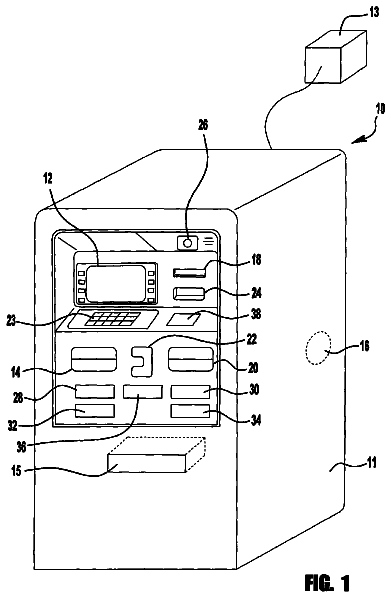
Financial kiosk
According to an embodiment of the present invention, a system and method for cashing checks is disclosed.
US 8,708,704 B2 · Assignee: Accenture Global Services Limited · Inventors: Bielenberg; Daniel R. et al.
Sheet 1 of 16 from the published document. All sheets in the USPTO PDF
A system is described for providing roadmaps for building proficiencies in skill areas. The system may include a memory, interface, and processor. The memory may store skill area and skill level identifiers, and associated job experience data items describing tasks of a user within the skill area and skill level, formal learning data items describing learning activities of a user within the skill area and skill level, and collaborative data items describing collaborative roles of a user within the skill area and skill level. The processor may receive the skill area and skill level identifiers. The processor may retrieve the job experience, formal learning and collaborative data items associated with the skill area and the skill level identifiers. The processor may transform the data items into a roadmap describing the job experience, formal learning and collaborative data items recommended to reach the skill level, and provide the roadmap to the user.
Organizations often implement learning systems to assist their employees with building proficiencies in skill areas. Learning systems may provide employees with guidance on formal learning activities relevant to building a proficiency in a skill area, such as lists of training courses or other training activities. However, formal learning may be one of many methods for building proficiencies in skill areas. Employees may also build proficiencies in skill areas through informal learning activities, such as job experience, methodologies and collaboration. Guidance on informal learning activities relevant to a skill area may not be included in the learning systems, and/or may not be available at all. Thus, it may be difficult for an organization to provide consistent, quality direction to their employees to build proficiencies in skill areas relevant to the organization's business model. Li
1 of 16 drawing sheets so far from the published document, cropped to the drawing. Every sheet is in the USPTO PDF.
What the patent claimed, word for word. All of it is now free to use.
The present description relates generally to a system and method, generally referred to as a system, for providing roadmaps for building proficiencies in skill areas, and more particularly, but not exclusively, to providing a repeatable process for developing and delivering targeted guides for building specialized proficiency in skills by combining critical and specific job experiences, the supporting collaboration activities, and formal learning.
Organizations often implement learning systems to assist their employees with building proficiencies in skill areas. Learning systems may provide employees with guidance on formal learning activities relevant to building a proficiency in a skill area, such as lists of training courses or other training activities. However, formal learning may be one of many methods for building proficiencies in skill areas. Employees may also build proficiencies in skill areas through informal learning activities, such as job experience, methodologies and collaboration. Guidance on informal learning activities relevant to a skill area may not be included in the learning systems, and/or may not be available at all. Thus, it may be difficult for an organization to provide consistent, quality direction to their employees to build proficiencies in skill areas relevant to the organization's business model. Likewise, it may be difficult for employees to determine how to build proficiencies in skill areas relevant to the organization's business model.
A system for providing roadmaps for building proficiencies in skill areas may include a memory, an interface, and a processor. The memory may be connected to the processor and the interface and may store job experience data items, formal learning data items and collaborative data items associated with a skill area identifier identifying a skill area of a plurality of skill areas within an organization and a skill level identifier identifying a skill level of a plurality of skill levels within the skill area. The job experience data items may describe tasks which are performed by a user within the skill area having the skill level. The formal learning data items may describe learning activities performed by the user within the skill area having the skill level. The collaborative data items may describe roles in a collaborative forum of a user within the skill area having the skill level. The interface may be operative to communicate with a device of a user. The processor may receive, from the device of the user via the interface, the skill area identifier and the skill level identifier. The processor may retrieve the job experience data items, formal learning data items and collaborative data items associated with the skill area identifier and the skill level identifier. The processor may transform the data items into a roadmap. The roadmap may describe the job experience data items, formal learning data items and collaborative data items recommended to reach the skill level identified by the skill level identifier. The processor may provide, to the device of the user via the interface, the skill area identifier, skill level identifier and the roadmap
Other systems, methods, features and advantages will be, or will become, apparent to one with skill in the art upon examination of the following figures and detailed description. It is intended that all such additional systems, methods, features and advantages be included within this description, be within the scope of the embodiments, and be protected by the following claims and be defined by the following claims. Further aspects and advantages are discussed below in conjunction with the description.
The system and/or method may be better understood with reference to the following drawings and description. Non-limiting and non-exhaustive descriptions are described with reference to the following drawings. The components in the figures are not necessarily to scale, emphasis instead being placed upon illustrating principles. In the figures, like referenced numerals may refer to like parts throughout the different figures unless otherwise specified.
FIG. 1 is a block diagram of a general overview of a system for providing roadmaps for building proficiencies in skill areas.
FIG. 2 is a block diagram of a network environment implementing the system of FIG. 1 or other systems for providing roadmaps for building proficiencies in skill areas.
FIG. 3 is a flowchart illustrating the steps of assembling a roadmap for building proficiency in a skill area in the system of FIG. 1 or other systems for providing roadmaps for building proficiencies in skill areas.
FIG. 4 is a flowchart illustrating the steps of assembling an aggregate roadmap for building proficiencies across multiple skill areas in the system of FIG. 1, or other systems for providing roadmaps for building proficiencies in skill areas.
FIG. 5 is a screenshot of a user interface displaying a roadmap for building proficiency in a skill area in the system of FIG. 1, or other systems for providing roadmaps for building proficiencies in skill areas.
FIG. 5A is a screenshot of a user interface for displaying job experience, formal learning and collaborative data items for building proficiencies across all skill areas of an individual in the system of FIG. 1, or other systems for providing roadmaps for building proficiencies in skill areas.
FIG. 6 is a graph displaying exemplary skill level descriptions in the system of FIG. 1, or other systems for providing roadmaps for building proficiencies in skill areas.
FIG. 7 is a graph displaying behavioral characteristics and growth enablers associated with exemplary skill levels in the system of FIG. 1, or other systems for providing roadmaps for building proficiencies in skill areas.
FIG. 8 is a graph displaying job experiences associated with exemplary skill levels in the system of FIG. 1, or other systems for providing roadmaps for building proficiencies in skill areas.
FIG. 9 is a graph displaying job experiences associated with exemplary skill levels in a skill area in the system of FIG. 1, or other systems for providing roadmaps for building proficiencies in skill areas.
FIG. 10 is a framework of an exemplary job experience roadmap in the system of FIG. 1, or other systems for providing roadmaps for building proficiencies in skill areas.
FIG. 11 is a graph displaying formal learning activities associated with exemplary skill levels in the system of FIG. 1, or other systems for providing roadmaps for building proficiencies in skill areas.
FIG. 12 is a framework of an exemplary formal learning roadmap in the system of FIG. 1, or other systems for providing roadmaps for building proficiencies in skill areas.
FIG. 13 is a graph displaying collaborative roles associated with exemplary skill levels in the system of FIG. 1, or other systems for providing roadmaps for building proficiencies in skill areas.
FIG. 14 is a framework of an exemplary collaboration roadmap in the system of FIG. 1, or other systems for providing roadmaps for building proficiencies in skill areas.
FIG. 15 is an illustration of a general computer system that may be used in the systems of FIG. 2, or other systems for providing roadmaps for building proficiencies in skill areas.
A system and method, generally referred to as a system, may relate to providing roadmaps for building proficiencies in skill areas, and more particularly, but not exclusively, providing a repeatable process for developing and delivering targeted guides for building specialized proficiency in skills by combining critical and specific job experiences, the supporting collaboration activities, and formal learning. The principles described herein may be embodied in many different forms.
FIG. 1 provides a general overview of a system 100 for providing roadmaps for building proficiencies in skill areas. Not all of the depicted components may be required, however, and some implementations may include additional components. Variations in the arrangement and type of the components may be made without departing from the spirit or scope of the claims as set forth herein. Additional, different or fewer components may be provided.
The system 100 may include one or more users 120A-N, a service provider 140, and an administrator 110. The users 120A-N may be employees of an organization who are skilled professionals specializing in a variety of skill areas, such as collaboration/communication solutions, workplace technology solutions, and operations/managed infrastructure services. The organization may provide services, such as consulting services, and may be located in several geographic regions across the world. The users 120A-N may specialize in one or more of the skill areas and may have an identifiable skill level within each skill area. For example, the users 120A-N may have a skill level of trained, novice, proficient, advanced, and expert. The skills associated with these exemplary skill levels are discussed in more detail in FIGS. 6-7 below.
The service provider 140 may identify the formal learning activities, such as training courses, and informal learning activities, such as job experiences and collaborative roles, associated with each of the skill levels within each of the skill areas. For example, the job experiences associated with each of the exemplary skill levels are discussed in FIG. 9 below, the formal learning activities associated with each of the exemplary skill levels are discussed in FIG. 11 below, and the collaborative roles associated with each of the exemplary skill levels are discussed in FIG. 13 below.
The service provider 140 may use the formal and informal learning activities associated with each skill area and skill level to provide the users 120A-N with roadmaps for building proficiencies in the skill areas. The users 120A-N may use the roadmaps to effectively build deep functional, technical, and industry skills relevant to the organization's business model. The roadmaps may provide the users 120A-N with both the formal and informal learning activities relevant to building a proficiencies in the skill areas.
For example, a user A 120A may request a roadmap for a skill area the user A 120A participates in, and the skill level the user A 120A has within the skill area. The service provider 140 may retrieve data describing formal and informal learning activities relevant to the skill area and skill level from disparate data sources. The service provider 140 may assemble the data describing the formal and informal learning activities into a roadmap, and may provide the roadmap to the user A 120A, such as through a web page. The roadmap may include one or more of the formal learning activities, such as training activities, recommended for a user A 120A in the skill area having the skill level. The roadmap may also include one or more informal learning activities, such as collaborative roles recommended for a user A 120A in the skill area having the skill level, and job experiences recommended for a user A 120A in the skill area having the skill level. The steps of assembling a roadmap for building proficiency in a skill area are discussed in more detail in FIG. 3 below.
Alternatively or in addition, the user A 120A may participate in multiple skill areas and may have different skill levels within each skill area. In this case, the service provider 140 may receive a list of the skill areas and skill levels of the user A 120A. For example, an external system may assess the skill level of the user A 120A within the skill areas and may provide the skill areas and skill levels to the service provider 140. The service provider 140 may retrieve data describing formal and informal learning activities relevant to each skill area and each skill level from disparate data sources and may assemble the data into an aggregate roadmap. The service provider 140 may provide the roadmap to the user A 120A. The user A 120A may use the roadmap to identify the formal and informal learning activities relevant to each skill area and skill level of the user A 120A. The steps of assembling an aggregate roadmap for building proficiencies across multiple skill areas are discussed in more detail in FIG. 4 below.
The service provider 140 may display the roadmap to the user A 120A in a format that is clear and concise, such as through a graphical user interface. The graphical user interface may include individual roadmaps for the recommended formal learning activities, job experiences, and collaborative roles. The individual roadmaps may be derived from frameworks associated with the formal learning activities, the job experiences and the collaborative roles. For example, an exemplary framework of a job experience roadmap is shown and discussed in FIG. 10 below, an exemplary framework of a formal learning roadmap is shown and discussed in FIG. 12 below, and an exemplary framework of a collaborative roadmap is shown and discussed in FIG. 14 below. The job experience, formal learning, and collaborative roadmaps may be transformed into the graphical user interface shown and discussed in FIG. 5 below.
The administrator 110 may be a person or an automated process, and may be responsible for maintaining a database storing the formal learning, job experience and collaborative role data associated with each skill area and skill level. The database may be manually compiled by the administrator 110 by aggregating disparate skill area data located throughout the organization. The information may be aggregated across both geographic locations of the organization and/or departments of the organization. Alternatively or in addition, the administrator 110 may use an automated process to retrieve the data from various data sources within the organization. For example, the administrator 110 may configure one or more data feeds from relevant data sources within the organization. The data feeds may provide updated data to the system 100 whenever the data sources are modified.
Alternatively or in addition, in the case of an organization that provides consulting services, the administrator 110 may be a consultant who provides consulting services to one or more clients of the organization. The administrator 110 may maintain the skill levels, skill areas, and associated formal and informal learning activities for each client of the organization. The administrator 110 may work with various departments of each client to identify and retrieve the relevant data required by the system 100. The administrator 110 may configure one or more data feeds to provide updated data from the clients to the system 100 whenever the client data is modified.
FIG. 2 provides a simplified view of a network environment 200 implementing the system of FIG. 1 or other systems for providing roadmaps for building proficiencies in skill areas. Not all of the depicted components may be required, however, and some implementations may include additional components not shown in the figure. Variations in the arrangement and type of the components may be made without departing from the spirit or scope of the claims as set forth herein. Additional, different or fewer components may be provided.
The network environment 200 may include one or more users 120A-N, an administrator 110, a service provider server 240, a third party server 250, a data store 245, networks 230, 235, and one or more web applications, standalone applications, mobile applications 220A-N, which may collectively be referred to as client applications.
Some or all of the service provider server 240 and the third party server 250 may be in communication with each other by way of network 235. The administrator 110 may use a web application 220A to interface with the service provider server 240 and maintain the database of skill areas, skill levels, and associated formal and informal learning data stored in the data store 245. Alternatively or in addition, the administrator 110 may use a mobile application 220N or a standalone application 220B to interface with the service provider server 240.
The networks 230, 235 may include wide area networks (WAN), such as the Internet, local area networks (LAN), campus area networks, metropolitan area networks, or any other networks that may allow for data communication. The network 230 may include the Internet and may include all or part of network 235; network 235 may include all or part of network 230. The networks 230, 235 may be divided into sub-networks. The sub-networks may allow access to all of the other components connected to the networks 230, 235 in the system 200, or the sub-networks may restrict access between the components connected to the networks 230, 235. The network 235 may be regarded as a public or private network connection and may include, for example, a virtual private network or an encryption or other security mechanism employed over the public Internet, or the like.
The web applications, standalone applications and mobile applications 220A-N may be connected to the network 230 in any configuration that supports data transfer. This may include a data connection to the network 230 that may be wired or wireless. Any of the web applications, standalone applications and mobile applications 220A-N may individually be referred to as a client application. The web application 220A may run on any platform that supports web content, such as a web browser or a computer, a mobile phone, personal digital assistant (PDA), pager, network-enabled television, digital video recorder, such as TIVO.RTM., automobile and/or any appliance or platform capable of data communications. The web application 220A may support a rich internet application implemented with the ADOBE FLEX.RTM. technologies. Alternatively or in addition the web application 220A may be developed using one or more of the following technologies: ADOBE FLEXBUILDER 3.RTM., ADOBE FLEX SUBCLIPSE.RTM., or generally any web development technologies.
The standalone application 220B may run on a machine that may have a processor, memory, a display, a user interface and a communication interface. The processor may be operatively connected to the memory, display and the interfaces and may perform tasks at the request of the standalone application 220B or the underlying operating system. The memory may be capable of storing data. The display may be operatively connected to the memory and the processor and may be capable of displaying information to the user B 120B. The user interface may be operatively connected to the memory, the processor, and the display and may be capable of interacting with a user B 120B. The communication interface may be operatively connected to the memory, and the processor, and may be capable of communicating through the networks 230, 235 with the service provider server 240. The standalone application 220B may be programmed in any programming language that supports communication protocols. These languages may include: SUN JAVA.RTM., C++, C#, ASP, SUN JAVASCRIPT.RTM., asynchronous SUN JAVASCRIPT.RTM., or ADOBE FLASH ACTIONSCRIPT.RTM., ADOBE FLEX.RTM., amongst others.
The mobile application 220N may run on any mobile device that may have a data connection. The data connection may be a cellular connection, a wireless data connection, an internet connection, an infra-red connection, a Bluetooth connection, or any other connection capable of transmitting data. For example, the mobile application 220N may be an application running on an APPLE IPHONE.RTM..
The service provider server 240 may include one or more of the following: an application server, a mobile application server, a data store, a database server, and a middleware server. The service provider server 240 may exist on one machine or may be running in a distributed configuration on one or more machines.
The service provider server 240 and client applications 220A-N may be one or more computing devices of various kinds, such as the computing device in FIG. 15. Such computing devices may generally include any device that may be configured to perform computation and that may be capable of sending and receiving data communications by way of one or more wired and/or wireless communication interfaces. Such devices may be configured to communicate in accordance with any of a variety of network protocols, including but not limited to protocols within the Transmission Control Protocol/Internet Protocol (TCP/IP) protocol suite. For example, the web application 220A may employ the Hypertext Transfer Protocol ("HTTP") to request information, such as a web page, from a web server, which may be a process executing on the service provider server 240.
There may be several configurations of database servers, application servers, mobile application servers, and middleware applications included in the service provider server 240. The data store 245 may be part of the service provider server 240 and may be a database server, such as MICROSOFT SQL SERVER.RTM., ORACLE.RTM., IBM DB2.RTM., SQLITE.RTM., or any other database software, relational or otherwise. The application server may be APACHE TOMCAT.RTM., MICROSOFT IIS.RTM., ADOBE COLDFUSION.RTM., or any other application server that supports communication protocols. The skill areas, skill levels and associated job experience data items, formal learning data items and collaborative role data items may be stored in the data store 245.
The networks 230, 235 may be configured to couple one computing device to another computing device to enable communication of data between the devices. The networks 230, 235 may generally be enabled to employ any form of machine-readable media for communicating information from one device to another. Each of networks 230, 235 may include one or more of a wireless network, a wired network, a local area network (LAN), a wide area network (WAN), a direct connection such as through a Universal Serial Bus (USB) port, and the like, and may include the set of interconnected networks that make up the Internet. The networks 230, 235 may include any communication method by which information may travel between computing devices.
In operation, the user A 120A may access the service provided by the service provider server 240 through the web application 220A and the network 230. The user A 120A may interact with the service provider server 240 through the web application 220A. The data may be passed between the web application 220A and the database 245. The majority of the calculations may be performed on the service provider server 240, although some calculations may be completed on the web application 220A in order to speed up response times.
FIG. 3 is a flowchart illustrating the steps of assembling a roadmap for building proficiency in a skill area in the system of FIG. 1 or other systems for providing roadmaps for building proficiencies in skill areas. The steps of FIG. 3 are described as being performed by the service provider server 240. However, the steps may be performed by the processor of the service provider server 240, or by any other hardware component of the service provider server 240. Alternatively the steps may be performed by an external hardware component.
At step 310, the service provider server 240 may receive a skill area identifier and a skill level identifier. For example, a user A 120A may select a skill area identifier and a skill level identifier from a drop down box on a web page. The user A 120A may then click on a submit button to communicate the selected skill area identifier and skill level identifier to the service provider server 240. At step 320, the service provider server 240 may retrieve job experience data items associated with the skill area identifier and skill level identifier selected by the user A 120A. The job experience data items may describe job experiences recommended for a user A 120A in the skill area having the skill level. The job experience data items associated with each exemplary skill level are discussed in more detail in FIGS. 8-10 below.
At step 330, the service provider server 240 may retrieve the formal learning data items associated with the skill area identifier and skill level identifier selected by the user A 120A. The formal learning data items may describe learning activities recommended for a user A 120A in the skill area having the skill level. The formal learning data items associated with each exemplary skill level are discussed in more detail in FIGS. 11-12 below. At step 340, the service provider server 240 may retrieve the collaborative data items associated with the skill area identifier and skill level identifier selected by the user A 120A. The collaborative data items may describe collaborative roles recommended for a user A 120A within the skill area having the skill level. The collaborative data items associated with each exemplary skill level are discussed in more detail in FIGS. 13-14 below.
At step 350, the service provider server 240 may transform the job experience data items, the formal learning data items and the collaborative data items into a roadmap. The service provider server 240 may utilize frameworks to transforming the job experience data items, the formal learning data items and the collaborative date items into a roadmap. For example, the service provider server 240 may utilize the job experience framework 1000 of FIG. 10, the formal learning framework 1200 of FIG. 12, and the collaborative framework 1400 of FIG. 14.
At step 360, the service provider server 240 may provide the roadmap to the user A 120A. For example, the service provider server 240 may communicate the roadmap to a computing device of the user A 120A. The roadmap may be in the format of a graphical user interface, such as the user interface 500, which displays an exemplary roadmap.
FIG. 4 is a flowchart illustrating the steps of assembling an aggregate roadmap for building proficiencies across multiple skill areas in the system of FIG. 1, or other systems for providing roadmaps for building proficiencies in skill areas. The steps of FIG. 4 are described as being performed by the service provider server 240. However, the steps may be performed by the processor of the service provider server 240, or by any other hardware component of the service provider server 240. Alternatively the steps may be performed by an external hardware component.
At step 405, the service provider server 240 may receive multiple skill area identifiers and skill level identifiers for a user A 120A. Each skill area identifier may be associated with a skill level identifier identifying the skill level of the user A 120A within the skill area. The service provider server 240 may receive the skill area identifiers and skill level identifiers from an external source, such as the third party server 250. Alternatively or in addition, the user A 120A may provide the skill area identifiers and skill level identifiers to the service provider server 240.
At step 410, the service provider server 240 may select the first skill area identifier and associated skill level identifier. At step 420, the service provider server 240 may determine the next skill level achievable by the user A 120A in the skill area identified by the skill area identifier. At step 420, the service provider server 240 may retrieve the job experience data items associated with the skill area and the next skill level. At step 425, the service provider server 240 retrieves the formal learning data items associated with the skill area and the next skill level. At step 430, the service provider server 240 retrieves the collaborative data items associated with the skill area and the next skill level. At step 435, the service provider server 240 stores the job experience data items, formal learning data items and collaborative data item associated with the skill area and the next skill level, such as in the data store 245.
At step 440, the service provider server 240 determines whether additional skill areas were received for the user A 120A. If, at step 440, the service provider server 240 determines that additional skill areas were received for the user A 120A, the service provider server 240 moves to step 445. At step 445, the service provider server 240 selects the next received skill area and repeats step 415-440 for the next received skill level. Once the service provider server 240 has repeated steps 415-440 for each of the received skill areas, the service provider server 240 moves to step 450.
At step 450, the service provider server 240 retrieves the data items stored for each skill area and associated skill level, such as from the data store 245. At step 455, the service provider server 240 transforms the data items into an aggregated roadmap. The aggregated roadmap may display the job experience data items, formal learning data items and collaborative data items recommended for the user A 120A for each of the skill areas and associated skill levels. The service provider server 240 may use one or more frameworks to transform the data items into the roadmap. For example, the service provider server 240 may utilize the job experience framework 1000 of FIG. 10, the formal learning framework 1200 of FIG. 12, and the collaborative framework 1400 of FIG. 14.
At step 460, the service provider server 240 may provide the aggregated roadmap to the user A 120A, such as to a computing device of the user A 120A. For example, the service provider server 240 may provide a web page displaying the aggregated roadmap to a computing device of the user A 120A.
FIG. 5 is a screenshot of a user interface 500 displaying a roadmap for building proficiency in a skill area in the system of FIG. 1, or other systems for providing roadmaps for building proficiencies in skill areas. The user interface 500 may include a skill level tabset 505, a formal learning subsection 510, a collaboration subsection 520, and a job experience subsection 530. The formal learning subsection 510 may display the formal learning data items to the user A 120A, the collaboration subsection 520 may display the collaborative data items to the user A 120A, and the job experience subsection 530 may display the job experience data items to the user A 120A.
The user A 120A may use the skill level tabset 505 to view a roadmap associated with a different skill level within the skill area. When the user A 120A selects a different skill level tab from the skill level tabset 505, the user interface 500 may update the subsections 510, 520, 530 to display the data items associated with the selected skill level.
FIG. 5A is a screenshot of a user interface 500A for displaying job experience, formal learning and collaborative data items for building proficiencies across all skill areas of an individual in the system of FIG. 1, or other systems for providing roadmaps for building proficiencies in skill areas. The user interface 500A may include a recommendations subsection 540, a detailed description subsection 550, and a list subsection 560. The list subsection 560 may display the job experience, formal learning, and collaborative data items suggested to a user A 120A for building proficiencies across all of the skill areas relevant to the user A 120A. The user A 120A may use the recommendations subsection 540 to filter the job experience, formal learning and collaborative data items displayed in the list subsection 560, such as by selecting one or more skill areas to view recommendations for. The details subsection 560 may display details of a job experience, formal learning, or collaborative data item selected by the user A 120A from the list subsection 560. The steps of assembling the job experience, formal learning and collaborative data items for building proficiencies across multiple skill areas are discussed in more detail in FIG. 4 above.
FIG. 6 is a graph 600 displaying exemplary skill level descriptions in the system of FIG. 1, or other systems for providing roadmaps for building proficiencies in skill areas. The graph 600 may include a trained description 605, a novice description 610, a proficient description 620, an advanced description 630, and an expert description. The descriptions 605, 610, 620, 630, 640 may be exemplary descriptions of skill levels of a user A 120A in an organization.
For example, a user A 120A with a skill level of 0, or trained, in a skill area may have attended a training course or may have started performing basic tasks in the skill area with direct oversight. A user A 120A with a skill level of trained often has at least three months of experience in the skill area. A user A 120A with a skill level of 1, or novice, in a skill area may have foundational skills in the skill area and may perform standard tasks in the skill area with regular feedback/supervision. A user A 120A with a skill level of novice often has at least one year of experience in the skill area. A user with a skill level of 2, or proficient, in a skill area may work independently on standard tasks in the skill area and may receive input on more complicated tasks or exceptions. In addition, a user with a skill level of proficient may coach or supervise users 120A-N with a skill level of novice in the skill area. A user A 120A with a skill level of proficient often has at least two years of experience in the skill area.
A user A 120A with a skill level of 3, or advanced, in a skill level may work independently on complex tasks in the skill area and may resolve problems and exceptions. Also, a user A 120A with a skill level of advanced may coach or supervise others in the skill area. A user A 120A with a skill level of advanced may often have at least four years of experience in multiple roles or contexts in the skill area. A user with a skill level of 4, or expert, in a skill area, may shape, defend and deliver complex solutions in the skill area. A user A 120A with a skill level of expert may often be asked to be a subject matter expert and may be externally recognized. A user A 120A with a skill level of expert may have built expertise in other people. A user A 120A with a skill level of expert may often have at least five years of experience in the skill area.
FIG. 7 is a graph 700 displaying behavioral characteristics and growth enablers associated with exemplary skill levels in the system of FIG. 1, or other systems for providing roadmaps for building proficiencies in skill areas. The graph 700 may include a trained skill level 705, a novice skill level 710, a proficient skill level 720, an advanced skill level 730, and an expert skill level 740.
The skill levels 705, 710, 720, 730, 740 may each be associated with behavioral characteristics and enablers. The behavioral characteristics may describe behavior often associated with a user A 120A having the skill level, while the enablers may describe formal training, collaborative learning, and job experience data items recommended for a user A 120A having each skill level. For example, a user A 120A having the trained skill level 705 may exhibit behavioral characteristics of often needing help starting and often making mistakes. The user A 120A having the trained skill level 705 may improve their skills by participating in online learning, researching knowledge assets, performing practice activities, and receiving feedback. A user A 120A having the novice skill level 710 may exhibit behavioral characteristics of starting to recognize steps, but being inefficient and having limited flexibility in the skill area. The user A 120A having the novice skill level 710 may improve their skills by participating in hands-on classroom learning and performing realistic work tasks with feedback.
A user A 120A having the proficient skill level 720 may exhibit behavioral characteristics of working on their own, solving routine problems and seeking input when needed. The user A 120A having the proficient skill level 720 may improve their skills by participating in on the job training practice with increased complexity, and collaborating with practitioners. A user A 120A having the advanced skill level 730 may exhibit behavioral characteristics of having fluent execution in complex situations, being able to explain their behaviors to others and being able to explain/defend variances in their behaviors. The user A 120A having the advanced skill level 730 may improve their skills by performing assignments in varied contexts and teaching and mentoring others. A user A 120A having the expert skill level 740 may exhibit behavioral characteristics of creating new approaches to respond to high levels of complexity and contributing significant intellectual property to the organization. A user having the expert skill level 740 may also improve their skills by having a subject matter expert role in collaborative forums and advising in varied contexts.
The graph 700 demonstrates that formal learning may be most impactful for users 120A-N having the exemplary skill levels of trained or novice, while collaboration and on the job experience may be most impactful for users 120A-N having the exemplary skill levels of proficient, advanced, or expert.
FIG. 8 is a graph 800 displaying job experiences associated with exemplary skill levels in the system of FIG. 1, or other systems for providing roadmaps for building proficiencies in skill areas. The graph 800 may include a trained skill level 805, a novice skill level 810, a proficient skill level 820, an advanced skill level 830, and an expert skill level 840. The skill levels 805, 810, 820, 830, 840 may provide descriptions of job experiences associated with a user A 120A having each of the skill levels 805, 810, 820, 830, 840.
For example, a user A 120A having the trained skill level 805, may have job experiences of achieving initial exposure to a specific tool. The initial focus may be on the software products of a particular vendor, such as MICROSOFT.RTM.. A user A 120A having the novice skill level 810 may have a job experience of building deep skills with a specific tool. A user A 120A having the proficient skill level 820 may have job experiences of broadening their experience with vendor products, such as focusing on server-side products of the vendor. The user A 120A having the proficient skill level may also broaden their experience to include other vendors which provide counterpart tools, such as CISCO.RTM. or IBM.RTM.. A user A 120 having the advanced skill level 830 may have job experiences of articulating differences in products and the appropriate fit/usage of the products. A user A 120A having the expert skill level 840 may have job experiences of articulating differences between extensive scope of products and the appropriate fit/usage of the products.
FIG. 9 is a graph 900 displaying job experiences associated with exemplary skill levels in a skill area in the system of FIG. 1, or other systems for providing roadmaps for building proficiencies in skill areas. The graph 900 may include a trained skill level 905, a novice skill level 910, a proficient skill level 920, an advanced skill level 930, and an expert skill level 940. The skill levels 905, 910, 920, 930, 940 may provide job tasks associated with a user A 120A in the skill area of Workplace Technology and Collaboration (WT&C) for each of the skill levels 905, 910, 920, 930, 940.
The description continues in the full USPTO document.
About 6,438 words. The USPTO PDF has it with every drawing.
Fees are due 3.5, 7.5 and 11.5 years after grant. This patent expired on April 29, 2026, so the fee marked "not paid" was the one that went unpaid.
SYSTEM FOR PROVIDING ROADMAPS FOR BUILDING PROFICIENCIES IN SKILL AREAS
Filed Aug 2009 · published Mar 2011System for providing roadmaps for building proficiencies in skill areas
Filed Aug 2009 · granted Apr 2014Earlier publications, parents and continuations. None of them can still be enforced, or this patent would not be listed.
Prior art cited by the examiner or applicant. Useful when you check your own idea for novelty.
Everything on this page comes from the documents linked above.


