Lapsed, fee not paid2 drawings
Consumer Products · US 8,696,439 B1
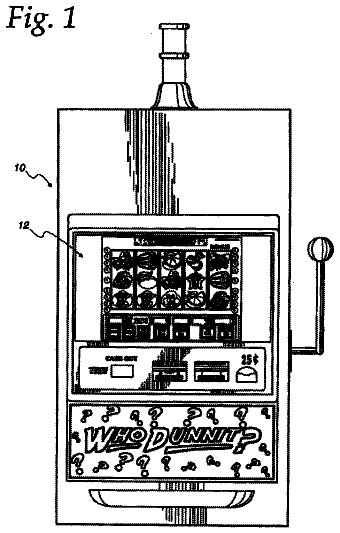
Slot machine with synchronized spinning reels
A slot machine that can spin two or more of the reels in unison.
US 8,696,444 B2 · Assignee: IGT · Inventors: Jorasch; James A. et al.
Sheet 1 of 23 from the published document. All sheets in the USPTO PDF
A system installed in a casino allows gambling chips in the casino to have variable values. Each chip has an electronic circuit installed in it to store a chip identifier and data indicative of a value currently associated with the chip. Slot machines and other devices are arranged to interact with the gambling chips to read and write data from and into the chips. A central controller is connected to the slot machines and other devices that interact with the chips. The chips carry a display and/or an audio device to apprise players of the value currently associated with the chip.
The profitability of a casino is directly related to such factors as the statistical house advantage provided by games offered by the casino, and the amount of money wagered by players. In general, profits are increased in casinos by increasing the amount of money wagered. It is therefore in the interest of casinos to attract as many players as possible, and to encourage them to continue playing as long as possible and to wager as much as possible. One technique used by casinos to attract and retain players is the granting complimentaries or "comps". Comps are benefits such as free or discounted food, lodging, entertainment or transportation given to players in recognition of amounts wagered and/or periods of time spent playing. U.S. Pat. No. 5,967,896, entitled "Method and Apparatus for Controlling a Gaming Device Having a Plurality of Balances," and commonly assigned with this applicat
1 of 23 drawing sheets so far from the published document, cropped to the drawing. Every sheet is in the USPTO PDF.
What the patent claimed, word for word. All of it is now free to use.
The present invention relates to equipment used in gaming casinos, and is also concerned with betting chips and tokens employed in casinos.
The profitability of a casino is directly related to such factors as the statistical house advantage provided by games offered by the casino, and the amount of money wagered by players. In general, profits are increased in casinos by increasing the amount of money wagered. It is therefore in the interest of casinos to attract as many players as possible, and to encourage them to continue playing as long as possible and to wager as much as possible.
One technique used by casinos to attract and retain players is the granting complimentaries or "comps". Comps are benefits such as free or discounted food, lodging, entertainment or transportation given to players in recognition of amounts wagered and/or periods of time spent playing.
U.S. Pat. No. 5,967,896, entitled "Method and Apparatus for Controlling a Gaming Device Having a Plurality of Balances," and commonly assigned with this application, discloses a slot machine that employs multiple credit meters so that players are given incentives to pay relatively large credit balances into the slot machine instead of merely inserting enough of a payment for the next play cycle.
It would be desirable to add new features to existing games to provide incentives for further play. It would also be desirable to add features that enhance the interest and entertainment value of existing games.
An aspect of the invention provides a method of changing a value of a gaming token, where the method includes associating a first non-zero value with a gaming token, detecting an event, and, in response to detection of the event, associating a second non-zero value with the gaming token, the second non-zero value being different from the first non-zero value.
The gaming token may include a memory, in which case the associating steps may respectively include storing the first and second values in the memory. Alternatively, the associating steps may respectively include storing the first and second values in a database entry that corresponds to the gaming token.
The detected event may be insertion of the gaming token in a gaming device such as a slot machine. The detected event may, alternatively, be discharging of the gaming token from a gaming device. As an alternative, the detected event may be a period of time that a player has played a gaming device, or a number of times that a player has played a gaming device. As still another alternative, the detected event may be placing the gaming token in proximity to a value-changing device, such as a read/write device that may be actuated by a dealer to change the value of the gaming token. Such a device may include a mechanism for changing a magnetic state of a component of the gaming token.
According to a further aspect of the invention, the value associated from time to time with the gaming token may be displayed, for example, by a display device mounted on the gaming token.
According to another aspect of the invention, a gaming token includes a token body, and a display device mounted in the token body and being switchable between a first display status and a second display status different from the first display status. The display device may be arranged to display a first color in the first display status and a second color, different from the first color, in the second display status. Alternatively, the display device may be blank in the first status and may display an alphanumeric readout in the second display status. As still another alternative, the display device may display a first alphanumeric readout in the first display status and a second alphanumeric readout, different from the first readout, in the second display status. The display device may include a light-emitting diode or a liquid crystal display. One purpose of the display device is to display to a person the currently applicable value of the token.
According to yet another embodiment of the invention, a gaming token includes a token body, and a sound emitting device, mounted in the token body, for emitting at least one sound indicative of a status of the gaming token.
According to a further aspect of the invention, a method of using a gaming token includes providing a gaming token that includes a memory and a display device, storing in the memory value data indicative of a value of a gaming token, and displaying information on the display device, where the displayed information represents the value data stored in the memory. The method according to this aspect of the invention may also include detecting an event, updating the value data stored in the memory in response to detection of the event, and displaying on the display device updated information that represents the updated value data. Still further, the method may include redeeming the gaming token, and, in response to redemption of the gaming token, updating the value data stored in the memory. The redeeming step may include inserting the gaming token into a gaming device, such as a slot machine.
According to yet another aspect of the invention, a method of redeeming a gaming token includes providing a gaming token that includes a memory, storing in the memory value data indicative of a value of the gaming token, inserting the gaming token into a gaming device, and in response to insertion of the gaming token into the gaming device, updating the value data stored in the memory.
Yet another aspect of the invention provides a memory device storing a database, the database including a plurality of entries, each entry including a first field for storing a token identifier that identifies a particular gaming token, and a second field for storing value data that represents a value associated with the gaming token identified by the token identifier stored in the first field.
In accordance with still a further aspect of the invention, a method of administering a game of chance includes inserting a gaming token into a gaming device, and after the inserting step reading from the gaming token a token identifier. Further steps of this method include determining on the basis of the read token identifier whether a prize has been won, and displaying a result of the determining step. The reading step may include receiving a signal transmitted from the gaming token or optically scanning the gaming token. The determination as to whether a prize has been won may be based on two or more token identifiers read from two or more gaming tokens that have been inserted in the gaming device.
Still another aspect of the invention provides a gaming device, which includes structure for receiving a gaming token, and circuitry for reading a token identifier from a gaming token that has been received by the token-receiving structure. The gaming device according to this aspect of the invention may also include communication circuitry for exchanging data signals from a host computer, and determining circuitry, connected to the reading circuitry and the communication circuitry, for determining whether a prize has been won, and also including a display responsive to the determining circuitry, for displaying an indication that a prize has been won.
According to still another aspect of the invention, a method of administering a game includes providing a gaming token that includes a display, using the display to display information, and determining a game outcome on the basis of the displayed information. The displayed information may be alphanumeric information, and the game may be bingo or a drawing.
According to still a further aspect of the invention, a method of operating a game device includes receiving a payment from a player, generating a credit corresponding to the received payment, representing the credit as a displayed set of at least one virtual token, associating a use number with each virtual token, identifying at least one virtual token for betting, determining a play outcome, and, on the basis of the play outcome, updating the displayed set of at least one virtual token. The receiving step may include receiving currency and/or tokens inserted in the game device or receiving a transfer from a payment card such as a credit card. The play outcome may be a result of spinning slot machine reels or virtual slot machine reels or by a result of generating a random number, which is used to determine a position of reels or virtual reels. The updating step may include adding at least one virtual token and incrementing the use number associated with the identified virtual token, if the play outcome indicates a win. The updating step may include removing the identified virtual token if the play outcome indicates a loss.
The use number associated with a virtual token that has not been identified for betting may be zero, and the use number associated with a virtual token may be equal to a number of times the virtual token has been identified for betting without being lost. A benefit may be provided to the player for each virtual token having a use number equal to a predetermined threshold. The benefit may be, for example, provision of one or more additional virtual tokens.
With the methods and devices provided in accordance with the invention, secondary games may be implemented to add interest to existing slot machines and other gaming devices. Moreover, tokens may be provided that are capable of supporting multiple statuses, with preferred statuses giving rise to benefits for the player. Consequently, players are given an incentive to continue playing to obtain special-status tokens and the entertainment value of existing gaming devices is enhanced. Tokens provided in accordance with the invention include display and/or sound-emitting devices so that the token can display and/or announce its status to the player.
FIG. 1 is a flowchart that provides an overview of a method of using a gaming token provided in accordance with an aspect of the invention;
FIG. 2 is a schematic block diagram of a system of devices provided in accordance with the invention;
FIG. 3 is a schematic perspective view of a gaming token provided in accordance with the invention;
FIG. 4 is a block diagram showing electronic components of the gaming token of FIG. 3;
FIG. 5 is a block diagram illustration of a slot machine provided in accordance with the invention and included in the system of FIG. 2;
FIG. 6 is a block diagram illustration of a central controller that is part of the system of FIG. 2;
FIG. 7 is a block diagram illustration of an event device that is part of the system of FIG. 2;
FIG. 8 is a tabular representation of a token database stored in the central controller of FIG. 6;
FIG. 9 is a tabular representation of a value database stored in the central controller;
FIG. 9A is a tabular representation of a token status database that may be stored in the central controller in addition to or instead of the databases shown in FIG. 6.
FIG. 10 is a tabular representation of an event database stored in the central controller;
FIG. 11 is a flowchart that illustrates a process carried out in accordance with the invention;
FIG. 12 is a schematic front view of another embodiment of a slot machine provided in accordance with the invention; and
FIGS. 13-22 are screen displays provided by the slot machine of FIG. 12 as virtual tokens are used, won or lost during a sequence of play cycles of the slot machine.
The following definitions shall apply in this specification and in the appended claims. "alphanumeric": including letters or numerals, or both letters and numerals. "client device": includes a personal computer, portable computer, palm top device, cellular telephone, personal digital assistant or any other device programmed with a browser program or other program to interact as a client relative to a host computer. "gaming device": includes slot machines, video poker machines, and other machines, devices or combinations or networks of devices used to play games of chance. "gaming token": includes a casino chip or other object issued by a casino for betting in a table game of chance or in a gaming device, or a token issued by a game arcade for use in a video game or other amusement game. "payment card": includes a credit card, a debit card, or a value card. "reel": may include either an actual mechanical reel of a slot machine or a field in a video display representative of a slot machine reel. "slot machine": may include a slot machine having mechanical reels controlled by a processing device, a video slot machine, a computer programmed to simulate a slot machine, and a web server that interacts with a client device to display a slot machine simulation on the client device.
FIG. 1 is a flowchart that provides an overview illustration of a method 100 provided in accordance with the present invention. According to a first step 102 in FIG. 1, a value is associated with a gaming token. This value may be, for example, the face value of the token. If the token is provided with a memory, as in certain embodiments of the invention, then the association of the value with the token may be performed by storing the value in the memory. As another alternative, a database, to be discussed below, may be maintained for all of the tokens in the casino. For this purpose, a unique token identifier may be associated with each token. Such an identifier may be stored in a machine-readable memory installed in the token and/or may be printed or otherwise marked on the token. By using such a unique token identifier, the database may have an entry for each token, including a field corresponding to the token identifier and another field that indicates a value currently associated with the token.
Following step 102 is step 104. At step 104 an event occurs which, as will be seen, is to have an effect upon the value of the token. Such an event may take many forms, as will be described below. To give just a few examples, the event of step 104 may involve interaction between a gaming token and a gaming device. Such an interaction may include the token being inserted in the gaming device. Another event may be the token being discharged or paid out from the gaming device. Other events may be related to a player who has the token in his or her possession or may soon come into possession of the token. Such events may include a period of time that the player has played a particular table game or gaming device (e.g., the player has played at a particular blackjack table for an hour, or has played a particular slot machine for 45 minutes); or an event may be deemed to have occurred upon a player playing a particular game a certain number of times (e.g., the player has played 30 play cycles of a slot machine or 40 hands of blackjack). As another alternative, events may simply be the expiration of a pre-determined period of time or the occurrence of a pre-determined point in time. As still another alternative, an event may be initiated by a casino employee, for example, the casino employee may bring a token into proximity with a device, to be discussed below, which allows the value of the token to be adjusted.
Step 106 follows step 104. At step 106a new, updated value is associated with the token. From previous discussion it will be understood that the new value may be stored in a memory provided in the token, or the new value may be stored in a token database, and more particularly in a database entry that corresponds to the token.
The present invention, by providing a token with a varying value, or a token that in some other way changes in status from time to time, makes it possible to add additional playable aspects to existing games and to provide incentives for players to continue playing games, and allows for enhancements in the entertainment value of casino games.
More detailed descriptions of embodiments of the invention will now be provided.
FIG. 2 is a simplified block diagram of a system that may be installed in a casino to implement one or more embodiments of the invention. In FIG. 2, reference numeral 200 generally indicates the system of the invention. Included in the system 200 is a central controller 202. The central controller 202 may be made up of multiple controllers.
The system 200 also includes a slot machine 204 and an event device 206, both connected for data communication with the central controller 202. Although only one slot machine is explicitly shown in FIG. 2, it is contemplated to include a large number of slot machines in the system 200 and connected to the central controller 202. Similarly, although only one event device is shown in FIG. 2, it is contemplated that a large number of event devices may be included in the system 200.
The slot machine 204 may include all of the hardware and software features of a conventional networkable slot machine. Details of the slot machine 204 will be discussed below. In addition, the slot machine 204 may include software and hardware features added in accordance with the invention to implement detection of events and to perform changes in value and/or status of gaming tokens that interact with the slot machine. An event device may also be a component of a slot machine.
The event device 206 may be an item provided in accordance with the invention. Details of the event device will be discussed below. From subsequent discussion it will be understood that slot machines may also function as event devices. The purpose of an event device is to detect events and to communicate with gaming tokens to cause the gaming tokens to undergo changes in value or status as a result of the detected events. An event device may also be a component of a slot machine.
Also shown in FIG. 2 are tokens 208-1 and 208-2, respectively interacting with the slot machine 204 and the event device 206. Features of the tokens 208 will be discussed below. Although only two tokens 208 are shown in FIG. 2, it is contemplated that a very large number of tokens may be included in the system 200, perhaps on the order of tens of thousands, or hundreds of thousands, or even a million or more tokens in a large casino. It is also contemplated to employ more than one type of token in a casino. For example, relatively large denomination tokens may be provided with the data storage, processing, token identification and/or display features to be described below, whereas some or all of these features may be omitted from low denomination tokens.
FIG. 3 is a schematic perspective view of one of the tokens 208. The token includes a body 210 which may be formed of molded plastic, clay, metal or the like. Mounted in the body 210 is a display 212. Housed within the body 210 and not shown in FIG. 3, are electronics for driving the display 212 and for performing other functions of the token 208. Also mounted in the token body 210 is an audio device 214 which provides an audio output to indicate the status of the token 208. Also to be noted in FIG. 3 is information 216 visually displayed by the display 212 to indicate the status and/or value of the token 208.
The display 212 may take many forms, including a liquid crystal display (LCD) and/or a light-emitting diode (LED). The display 212 may be segmented to display letters and/or numerals. The display 212 may be arranged to change colors, say from brown or bronze to gold, to indicate a change in status or an increased or decreased value of the token 208.
The audio device 214 may be a simple miniature audio transducer such as the Panasonic model EAF-8RM08EF. The audio device 214 may be driven to generate various coded beep sequences to indicate respective statuses and/or values of the token 208. Alternatively, the audio device 214 may be driven to beep intermittently or on occasion to indicate one value or status of the token 208, and may be maintained in silence to indicate another value or status. The display 212 and the audio device 214 may be driven in combination to indicate statuses and/or values of the token 208.
FIG. 4 is a block diagram of electronic components 400 of the token 208. The electronic components include a processor 402 which is connected to a clock 404, Read Only Memory (ROM) 406 and Random Access Memory (RAM) 408. The processor performs functions normally carried out by a programmable CPU in a microprocessor-based system. The clock 404 controls the timing of program execution cycles of the processor 402. The ROM 406 and RAM 408 together provide working memory space and program storage for the processor 402. Connected to the processor 402 is a communication port 410, by means of which processor 402 is enabled to engage in data communication with external devices.
Although the electronic components 402-410 may be embodied as discrete components mounted on a suitably sized circuit board, it may be desirable in the interest of miniaturization to implement these components by means of one or more application specific integrated circuits (ASICs). As another alternative, many or all of the components 402-410 may be implemented by means of hardware used in conventional miniature transponders of the types used for article identification applications such as RFID (radio frequency identification) applications.
Also connected to the processor 402 are input and/or output devices 412, which may include the display 212 and the audio device 214 referred to above. It is to be noted that either or both of the display 212 and the audio device 214 may be omitted from the token 208, and indeed the token 208 may be totally without input/output devices other than the communication port 410. Furthermore, the input/output 412 may include one or more pressure sensitive devices whereby a player, by squeezing or tapping the token or the like, may provide input signals to the processor 402.
FIG. 4 also shows a program 414 that controls the processor 402 and may be stored in one or both of the ROM 406 and the RAM 408. Also shown are data storage facility 416 for storing a token identifier that uniquely identifies the token 208, and data storage facility 418 for storing data indicative of a currently applicable value or status of the token 208.
Not explicitly shown in FIG. 4 is a power source such as a battery which provides power for the processor 402 and other components of the token 208, and which may also back up the RAM 408. The identifier storage facility 416 may be maintained in either the ROM 406 or the RAM 408, but the value storage 418 is preferably in the RAM 408 or in another memory device which is re-writable but permanent.
The present invention also contemplates variable-value gaming tokens that have a considerably simpler construction than that illustrated in FIGS. 3 and 4. For example, the token identifier and storage therefore may be eliminated. Moreover, the token may store its value in a simple "one-bit" arrangement such as a magnetic element that is placed in one magnetic state to indicate a first value and is placed in another magnetic state to indicate a second value. A simple display to indicate the magnetic state of the magnetic element may also be provided.
The present invention contemplates providing gaming tokens that store a currently associated value and/or a token identifier but do not include either a display device or an audio device. In such cases, one or more other components of the system are arranged to read the currently associated value and/or the token identifier and to display the information read from the token or corresponding information retrieved from the central controller.
FIG. 5 is a block diagram representation of a slot machine provided in accordance with at least one embodiment of the invention. Slot machine 204 may be a conventional slot machine modified in accordance with the invention. The slot machine 204 includes known hardware components, such as a processor 502 which may be any commonly available microprocessing chip such as the microprocessors manufactured by Intel, and marketed under the trademark "Pentium". Processor 502 is shown in communication with each of a data storage device 510, a Read Only Memory (ROM) 506, a Random Access Memory (RAM) 504, a clock 508 and a communications port 540. Processor 502 can be in communication with the data storage device 510, the ROM 506, the RAM 504, the clock 508 and the communications port 540, either by means of a shared data bus or by dedicated connections, as is well known in the art. Furthermore, processor 502 may be embodied as a single processor or a number of processors.
Processor 502 runs at a clock speed determined by clock 508. Clock 508 sends timing signals to processor 502 for controlling the processor speed and for synchronizing data and processing instructions among the components of slot machine 204. Clock 508 may further be used to measure the passage of time.
RAM 504 and ROM 506 may be standard memory components that operate in a conventional manner.
The data storage device 510 and/or ROM 506 are operable to store one or more instructions and data, which the processor 502 is operable to retrieve, interpret and execute. The data storage device 510 may be, for example, any one of the following, a hard drive, a floppy disk drive, a DVD drive, a ZIP drive, or a tape drive. Data storage device 510 is operative to store a program 512, a probability table 514, and a payout table 516. In accordance with a preferred embodiment of the present invention, the program 512 contains processing instructions for directing processor 502 to retrieve and perform process steps as are described below. Data storage device 510 is preferably also operative to store an operating system for operating the processor 502 as will be apparent to one of ordinary skill in the art.
Communications port 540 may be any input/output port commonly used for computer communications, such as a modem or other data transfer device. The communications port 540 connects the slot machine 204 for communication with the central controller 202 referred to above. It is also contemplated that the slot machine 204 may be in communication with other devices via the communications port 540. Among other functions, the communications port 540, under the control of the processor 502, may transmit data such as player tracking information received through the card reader/writer 526, discussed below. The communications port 540 may also receive and/or transmit data relevant to detection, or updating of the status and/or value of tokens 208 that interact with the slot machine 204. The communications port 540 may include multiple communication channels for simultaneous connections with a plurality of external devices.
Processor 502 is further operatively connected to hopper controller 546. Hopper controller 546 controls the dispensing of tokens and/or currency by slot machine 204 to hopper 548. The hopper controller 546 is connected to the hopper 548 for the purpose of dispensing tokens and/or coins. For example, a player can cash out credits to receive tokens in a conventional manner by pushing a cash out button (not shown) on the slot machine 204. The processor 502 then checks data stored in RAM 504 or data storage device 510 to determine if the player has any available credits and, if so, signals the hopper controller 546 to release an appropriate number of coins and/or tokens into a hopper 548, where the coins and/or tokens may be collected by the player.
Processor 502 is further operatively connected to token and currency acceptor 544. A player may deposit gaming tokens and/or currency (coins and/or bills) with the slot machine 204 via the token acceptor 544 (which also may include a paper currency receiving and validating device). It is also contemplated that the slot machine 204 may be equipped to receive payment in electronic form from a payment card such as a credit card, debit card, or value card. In any event, the token acceptor 544 determines the number of tokens or currency deposited and transmits such information to processor 502 which stores credit information in an appropriate register (not shown) in RAM 504 and/or data storage device 510.
Processor 502 is preferably in communication with a starting controller 528. The starting controller 528 is an input device, such as a button, handle, touch-screen or other known input device, and is used by the player to initiate a play cycle of the slot machine 204.
A player tracking device 520 is also in communication with the processor 502. The player tracking device 520 includes a card reader/writer 526 for reading player identification information stored on a player tracking card (not shown), which is preferably encoded with information to identify the player, in a known manner. The player tracking device 520 also preferably includes a display 522, having an associated player interface, such as a numeric keypad 524 for entry of player information. The player tracking device 520 may be embodied, for example, as the Mastercom device, commercially available from Bally Manufacturing. Tracking individual players may be useful in rewarding players for participating in or causing particular events and/or in motivating players to participate in or cause such events.
Processor 502 is further operatively connected to a random number generator 530 and a reel controller 532. Random number generator 530 may be an electronic pseudo-random number generator, as known to those who are skilled in the art, which determines a random number from a random electrical event or combination of events. The reel controller 532 is an electromechanical device, likewise known to those who are skilled in the art, which controls, monitors and records the position of slot reels 534, 536 and 538.
As noted above, a player may initiate a play cycle on the slot machine 204 by actuating starting controller 528. Thereafter, processor 502 initiates the random number generator 530 to generate a random number and transmit such number to processor 502. The processor 502 looks up the generated random number in an appropriate field of the probability table 514, and retrieves the corresponding reel combination, or an individual game result. The processor 502 then directs the reel controller 532 to spin reels 534, 536 and 538 and to stop at a point when a combination of symbols corresponding to the retrieved individual game result is displayed. The processor 502 then consults payout tables 516 to determine what, if any, payout is due in respect of the game results. If a payout is due, then a corresponding credit is added to whatever credits are already stored for the player in the slot machine 204. The processes described in this paragraph are such as are conventionally performed in slot machines.
The slot machine 204 also includes token read/write devices 550 which are connected to the processor 502. The token read/write devices 550 are provided for the purpose of communicating with intelligent tokens of the type described in connection with FIGS. 3 and 4. The token read/write devices 550 may be devices of the type used to communicate with article identification and tracking transponders, and may be placed at the token intake 552 (FIG. 2) and/or at the hopper 548. As will be seen, the token read/write devices 550 may operate to detect the presence of a token, and thereby detect an event such as insertion of a token into the slot machine 204 and/or discharging of a token from the slot machine 204. The token read/write devices 550 may cooperate with the token acceptor 544 and/or hopper controller 546, under supervision of processor 502, to determine the face denomination and/or value of the tokens inserted into and discharged from the slot machine 204. The token read/write devices 550 may also send instructions to the tokens or to the controller 202 to change the value and/or status of the tokens.
FIG. 6 is a block diagram illustration of the central controller 202. The central controller 202 may be implemented by conventional computer hardware such as a personal computer, mini computer, mainframe computer or server computer. Preferably the central controller 202 includes conventional computer components such as processor 602, connected with clock 604, ROM 606, RAM 608, communications port 609, input/output devices 610 and data storage device 612. All of the components shown as being connected to processor 602 may also be conventional items. The communication port 609 may include, for example, one or more modems to support data communications between the processor 602 and the slot machines and event devices that constitute other components of the system 200. The data storage device 612 may be a hard disk or other suitable storage device.
The data storage device 612 stores a program 614, a token database 616, a value database 618, and an event database 620. The program 614 controls the processor 602 in accordance with the invention such that the central controller 202 manages and oversees operations of the system 200. The processes performed and managed by the central controller 202 will be described in further detail below. The program 614 may also include instructions for carrying out other functions, including operating system and device drivers as well as communications software. Furthermore, the central controller 202 may perform functions in addition to token management. These functions may include, for example, player tracking and player information storage functions. The token database 616, value database 618 and event database 620 will be described below.
FIG. 7 is a block diagram illustration of an event device 206 that is provided to detect and/or register events related to the tokens 208. As seen from FIG. 7 the overall architecture of the event device 206 may be that of a conventional microprocessor-based system, including conventional components such as a processor 702, clock 704, ROM 706, RAM 708, communications port 710, input/output devices 712 and data storage device 714. Stored in the data storage device 714 is a program 716 for controlling the processor 702 and hence the event device 206. The communication port 710 handles data communication between the processor 702 and the central controller 202 (FIG. 2). Continuing to refer to FIG. 7, the input/output devices 712 include one or more devices for providing wireless communication with tokens 208 brought into proximity of the event device 206. Such devices for communicating with the tokens may include conventional devices used to interact with article identification and tracking transponders. For example, the event device 206 (as well as the slot machine 204) may utilize conventional RFID technology with a suitable transponder being included in each of the tokens 208.
Where a "one-bit" variable-value gaming token is used, as discussed above, the event device may be replaced with a much simpler device for changing the value of a token. Depending on the make-up of the gaming token, a simple permanent magnet, or an operator-actuated electro-magnet, may be used by a dealer or a cashier employee to change the status of a gaming token so as to indicate an enhanced value. A suitable degaussing device may be used to reverse the status of the gaming token.
FIG. 8 shows a table 800 that illustrates the token database 616 stored in the central controller 202. The table 800 has columns 802 and 804, which respectively correspond to token identifier entries and value number entries. In each row of the table 800, there is a first field under column 802 which contains a token identifier that uniquely identifies a particular one of the tokens 208. Also in the row is a second field in which there is a number that corresponds to the value currently associated with the token identified in the first field of the row. Although five-digit numbers are shown in column 802, it is contemplated to use numbers having a larger number of digits, so that a larger number of tokens may be uniquely identified. The meaning of the value numbers stored under column 804 will be explained in connection with the value database to be described immediately below. Although only three entries are shown in the Table 800 of FIG. 8, it is contemplated to include a much larger number of entries, and particularly one entry for each of the tokens 208 employed in a particular casino. As noted before the number of tokens may be in the thousands or even upwards of one million.
FIG. 9 shows a table 900 that is an illustration of the value database 618 of FIG. 6. Continuing to refer to FIG. 9, the table 900 includes columns 902 and 904, which respectively store value numbers and corresponding values. That is, in each entry in the table 900 the first field, under column 902, stores a number by which a respective token value is indexed, and in the second field for the entry the currently applicable value for the corresponding token is stored. Thus, value number 1 corresponds simply to a token value of $5.00. Similarly, value number 2 corresponds to a token value of $7.00. Value number 3 indicates that each token assigned this value number is to be accorded a value equal to the face value of the token plus $3.00. Value number 4 indicates that tokens assigned this value number are to be accorded a value that declines over a period of time from an initial value of $5.00 down to a final value of $3.00. It is noted that the time period begins with the occurrence of an event such as the payment of the token to a particular player.
Although not indicated in the particular examples of values recited in FIG. 9, it is also contemplated that tokens may be accorded different values for different purposes. Thus, a token may be accorded its face value for the purpose of redeeming the token for cash, but may be accorded a higher value if inserted into a slot machine. Such an arrangement would tend to give the player an incentive to use the token for slot machine play. The higher value accorded the token for slot machine play may decrease over time, to give the player an incentive to begin playing the slot machine promptly after the event which caused the token to acquire the higher value.
Although only four different values are listed in the table of FIG. 9, it is contemplated that a smaller or much larger number of different values may be assigned to various ones of the tokens 208 to be used in a given casino.
Moreover, although token database 616 and value database 618 have been separately illustrated, it will be recognized that these two databases can be combined in one, by substituting for the value number entries in the table of FIG. 8, the corresponding value entries from the table of FIG. 9.
FIG. 9A shows a table 950 that illustrates a token status database that may be stored in the central controller in addition to or instead of the databases shown in FIG. 6. Continuing to refer to FIG. 9A, the table 950 has a column 952 for storing token identifiers for respective tokens, a column 954 for storing indications of the status of the respective tokens, and a column 956 for storing information as to the benefits associated with the status of each token. The various statuses shown in column 954 may be represented by respective displays provided by the tokens, such as displays of colors that conform to the statuses. Alternatively, the display on the respective token may include an alphanumeric indication of the token status, such as "bronze", "silver", "gold", "platinum".
The description continues in the full USPTO document.
About 6,683 words. The USPTO PDF has it with every drawing.
Fees are due 3.5, 7.5 and 11.5 years after grant. This patent expired on April 15, 2026, so the fee marked "not paid" was the one that went unpaid.
Gaming token having a variable value
Filed Jun 2000 · granted Sep 2007Gaming token having a variable value
Filed Dec 2005 · published Sep 2006Gaming token having a variable value
Filed Dec 2005 · granted Feb 2011Gaming token having a variable value
Filed Jan 2006 · published Jun 2006Gaming token having a variable value
Filed Jan 2006 · granted May 2012Gaming token having a variable value
Filed Jan 2006 · published May 2006Gaming token having a variable value
Filed Jan 2006 · granted Oct 2011Gaming token having a variable value
Filed Feb 2006 · published Jun 2006Gaming token having a variable value
Filed Feb 2006 · granted Jun 2009GAMING TOKEN HAVING A VARIABLE VALUE
Filed Aug 2007 · published Dec 2007Gaming token having a variable value
Filed Aug 2007 · granted Apr 2014Earlier publications, parents and continuations. None of them can still be enforced, or this patent would not be listed.
Prior art cited by the examiner or applicant. Useful when you check your own idea for novelty.
Everything on this page comes from the documents linked above.