 Lapsed, fee not paid5 drawings
Software & Apps · US 8,689,289 B2
Global object access auditing
Global object access auditing techniques are described.
US 8,689,335 B2 · Assignee: Microsoft Corporation · Inventors: Helman; Yair et al.
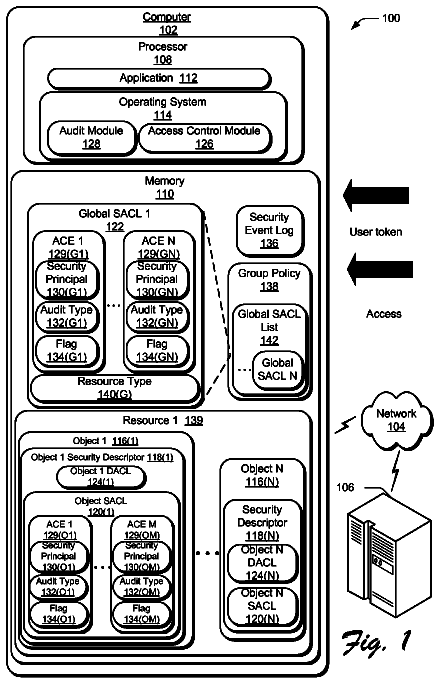
Sheet 1 of 22 from the published document. All sheets in the USPTO PDF
Mapping between object types in an enterprise security assessment sharing ("ESAS") system enables attacks on an enterprise network and security incidents to be better detected and capabilities to respond to be improved. The ESAS system is distributed among endpoints incorporating different security products in the enterprise network that share a commonly-utilized communications channel. An endpoint publishes a security assessment when a potential security incident is detected. The security assessment identifies the object of interest, the type of security incident and its severity. A level of confidence in the detection is also provided which is expressed by an attribute called the "fidelity". ESAS is configured with the capabilities to map between objects, including users and machines in the enterprise network, so that security assessments applicable to one object domain can be used to generate security assessments in another object domain.
In an enterprise computing environment, for example, an office of a business, a number of personal computers, workstations, servers and the like, along with other devices such as mass storage subsystems, internal network interfaces, and external network interfaces, are typically interconnected to provide an integrated environment in which information may be generated, accessed from external sources, and shared among various users. Commonly, users perform a variety of operations including order receipt, manufacturing, shipping, billing, inventory control, document preparation and management, e-mail, web browsing, and other operations in which creation, access, and sharing of data is beneficial. Currently, security against malicious attacks and malicious software (termed "malware") is typically provided for an enterprise using a variety of different security products that are each normally
1 of 22 drawing sheets so far from the published document, cropped to the drawing. Every sheet is in the USPTO PDF.
What the patent claimed, word for word. All of it is now free to use.
In an enterprise computing environment, for example, an office of a business, a number of personal computers, workstations, servers and the like, along with other devices such as mass storage subsystems, internal network interfaces, and external network interfaces, are typically interconnected to provide an integrated environment in which information may be generated, accessed from external sources, and shared among various users. Commonly, users perform a variety of operations including order receipt, manufacturing, shipping, billing, inventory control, document preparation and management, e-mail, web browsing, and other operations in which creation, access, and sharing of data is beneficial.
Currently, security against malicious attacks and malicious software (termed "malware") is typically provided for an enterprise using a variety of different security products that are each normally arranged to monitor only a portion of enterprise-wide data. That is, security products are arranged as separate local "islands" where each product monitors, assesses, and takes action with respect to different parts of the data within the enterprise. For example, an enterprise may utilize a combination of security products such as a product that protects host computers in the enterprise, an edge firewall product, a network intrusion detection system ("NIDS") product, a network access protection ("NAP") product, and other discrete security products in order to provide security for the various different parts of the enterprise.
While these security products often perform satisfactorily in many applications, detection of security incidents often suffers from undesirably high levels of false-positive and false-negative occurrences as a result of the monitoring of only partial enterprise security data. It has also been difficult to provide effective common management across all the enterprise security product islands. Current attempts to correlate enterprise-wide security data have high management and maintenance costs and have problems in scaling. More effective enterprise security management would be desirable to enable a single enterprise-wide view to enable security administrators to define and enforce clear, simple, and unified enterprise-wide policies for automatic responses to security incidents.
This Background is provided to introduce a brief context for the Summary and Detailed Description that follow. This Background is not intended to be an aid in determining the scope of the claimed subject matter nor be viewed as limiting the claimed subject matter to implementations that solve any or all of the disadvantages or problems presented above.
Mapping between object types in an enterprise security assessment sharing ("ESAS") system enables attacks on an enterprise network and security incidents to be better detected and capabilities to respond to such attacks and incidents to be improved. The ESAS system is distributed among endpoints incorporating different security products in the enterprise network that share a commonly-utilized communications channel. An endpoint will generate a tentative assignment of contextual meaning called a security assessment that is published into the channel when a potential security incident is detected by the endpoint. The security assessment identifies the object of interest, the type of security incident, and its severity. A level of confidence in the detection is also provided which is expressed by an attribute called the "fidelity" of the security assessment. Receiving endpoints may use the information contained in a security assessment to trigger responses and local actions to deal with the detected security incident in accordance with a set of response policies that are defined in the enterprise.
ESAS is configured with the capabilities to map between objects, including users and machines in the enterprise network, so that security assessments applicable to one object domain can be used to generate security assessments in another object domain. Accordingly, a security assessment may trigger a receiving endpoint to generate new security assessment about the object of interest as well as generate a new security assessment across object types. As endpoints can typically only detect security incidents occurring in one object domain, such cross-mapping capability can help identify the source of security incident by broadening the scope of detection to encompass both common vectors of attack (i.e., attacks against users and attacks against machines).
In various illustrative examples, cross-mapping between different object types may be performed by a specialized host security endpoint that is configured with knowledge of both users and machines in the enterprise network. When the host security endpoint receives a security assessment published by one of the other endpoints, it will generate one or more additional security assessments pertaining to cross-mapped objects. For example, if another endpoint publishes a security assessment about a user who is suspected of being compromised in some way, the host security endpoint will map that user to machines on which the user was recently logged on. Compromised users can easily cause the security to be compromised on these machines, so security assessments identifying the machines are generated and published into the ESAS channel. The reverse may also occur where a compromised machine may be mapped to one or more users and security assessments generated to cover them.
To avoid a situation where the mapping of users to machines generates additional security assessments about machines which are then mapped to additional users, and so on until the entire organization is covered, the fidelity of security assessments is reduced for each round of object cross-mapping. In this way, the fidelity of a security assessment will be reduced after several rounds to a low enough point that it becomes insufficient to trigger the generation of additional security assessments by the endpoints. In addition, different security assessments pertaining to a cross-mapped object may be generated or the severity or fidelity of an assessment may be adjusted depending on the access privileges under which a compromised user has logged on.
This Summary is provided to introduce a selection of concepts in a simplified form that are further described below in the Detailed Description. This Summary is not intended to identify key features or essential features of the claimed subject matter, nor is it intended to be used as an aid in determining the scope of the claimed subject matter.
FIG. 1 shows an illustrative enterprise security environment in which the present enterprise security assessment sharing may be implemented;
FIG. 2 shows an illustrative enterprise security assessment sharing arrangement in which a channel is provided to enable a security assessment to be shared among multiple endpoints;
FIG. 3 shows an illustrative terminology hierarchy that underlies a security assessment;
FIG. 4 shows two illustrative endpoints and the complexity reduction enabled by the utilization of the present security assessment arrangement;
FIG. 5 shows an illustrative example of functionality disposed in an endpoint that enables sharing of security assessments;
FIG. 6 is a diagram of a first illustrative scenario in which a plurality of ESAS-enabled endpoints are coupled to a security assessment channel and a detected incident at one endpoint triggers responses at multiple other endpoints;
FIG. 7 is a diagram of a second illustrative scenario in which a low fidelity security assessment is sent over the security assessment channel that triggers the generation of a new high fidelity assessment by a receiving ESAS-enabled endpoint which also performs cross-object mapping;
FIG. 8 is a diagram of a third illustrative scenario in which a host security endpoint is specifically configured to perform cross-object mapping;
FIG. 8A shows an example in which the host security endpoint generates security assessments about several host machines in response to receiving a security assessment that deals with a compromised user;
FIG. 9 shows how cross-object mapping between users and host machines could generate security assessments covering the entire enterprise if not kept in check;
FIG. 9A shows an illustrative arrangement in which security assessments are provided with decreasing fidelity with each subsequent round of cross-object mapping;
FIG. 10 is a diagram of a fourth illustrative scenario that shows the targeted use of remediation techniques;
FIG. 11 shows an illustrative screen shot that is provided by a graphical user interface ("GUI") which enables a user, such as an administrator, to manage and define the response policies of ESAS-enabled endpoints in the enterprise;
FIG. 12 shows an illustrative screen shot that is provided by a GUI that is arranged to supplement, or be used as an alternative, to the GUI shown in FIG. 11;
FIG. 13 shows a screen shot of an illustrative GUI that supports a rule editor that an administrator may use to configure rules supporting manual operations that are applicable to ESAS-enabled endpoints;
FIG. 14 shows a second screen shot of the illustrative rule editor;
FIG. 15 shows a third screen shot of the illustrative rule editor;
FIG. 16 shows a screen shot of a GUI that an administrator may use to manually cancel a security assessment;
FIG. 17 shows an illustrative scenario in which a security assessment is manually cancelled and generation of new security assessments by an endpoint is suppressed;
FIG. 18 shows a screen shot of an illustrative GUI that supports manual injection of a security assessment into the security assessment channel by an administrator;
FIG. 19 is a diagram of an illustrative scenario in which a plurality of ESAS-enabled endpoints are coupled to a security assessment channel and a manually injected security assessment triggers responses at multiple endpoints; and
FIG. 20 shows an illustrative enterprise security arrangement in which the present ESAS feature set provides an enterprise security management layer functionality.
Like reference numerals indicate like elements in the drawings.
In the present arrangement for performing cross-object mapping, an enterprise-wide sharing arrangement called "ESAS"--Enterprise Security Assessment Sharing is utilized in which a semantic abstraction, called a security assessment, is created to enable sharing of security-related information among different security products, called endpoints, in an enterprise security environment. A security assessment is defined as a tentative assignment by an endpoint of broader contextual meaning to information (i.e., data in some context) that is collected about an object of interest in the environment such as a computer, user, service (e.g., one that is accessed via a website), data, or the enterprise as a whole. The security assessment utilizes a concise vocabulary for an endpoint to declare that an object in the environment falls into a particular assessment category such as "compromised" or "under attack" along with the severity (e.g., low, medium, high, critical) of the detected incident.
A security assessment is tentative because it is subject to some uncertainty and is valid for a limited period of time. The tentative nature of a security assessment is reflected in two of its components: a fidelity field which expresses the level of confidence the endpoint has in its assignment of contextual meaning, and a time-to-live ("TTL") field which reflects the endpoint's estimate of the time period for which the security assessment is expected to be valid. Thus, for example, a security assessment may be used by an endpoint to declare, in light of that endpoint's current understanding of one or more security incidents, that a particular machine is compromised, with a critical level of severity, with medium fidelity, and having a TTL of 30 minutes. A variety of security assessment types may be used in a given enterprise security environment using various combinations of assessment category and object type.
Endpoints are enabled with functionality to publish security assessments onto a security assessment channel operating in the environment, as well as subscribe to a subset of available security assessments published by other endpoints. The security assessments existing in the environment that are active (i.e., those having a TTL which indicates the assessments are still valid) function to provide a security context that gives such an ESAS-enabled endpoint with a new way to look at its own locally-available information. That is, the security context enables the ESAS-enabled endpoint to combine or correlate evidence from security assessments received from a variety of different sources, and across object types, in order to significantly enhance the quality of its detection of potential security incidents.
The ESAS-enabled endpoint can then make a decision as to what local action or response is appropriate for each type of security assessment (whether received from another endpoint or internally generated by the endpoint itself) in accordance with a set of response policies. Incident detection is both efficient and cost-effective because the security context enables distributed processing of enterprise-wide information, in the form of security assessments, without the burden of sharing large amounts of raw data throughout the enterprise (most of which is completely irrelevant due to the lack of any context). ESAS-enabled endpoints are further arranged to roll-back the local action upon expiration of the security assessment that prompted the local action (i.e., when the security assessment exceeds the time-to-live specified in the TTL field), or when a security assessment is manually cancelled (as discussed below).
In various illustrative examples that are described in detail below, a specialized endpoint called an ESAS central server is coupled to the security assessment channel that performs as a centralized audit point by subscribing to all security assessments, logging the security assessments, and also logging the local actions taken by endpoints in response to security incidents in the environment. The ESAS central server provides administrators with a comprehensive view of the history and current status of the enterprise as a whole and of each ESAS-enabled endpoint. The utilization of the security assessments enables an administrator to compactly and efficiently configure response policies to incidents that are detected across the entire enterprise. The security assessments function as natural anchors, or starting points, to define enterprise-wide security response policies. A streamlined and consistent management interface is thus enabled to define the desired responses for each type of security assessment across the entire enterprise.
The ESAS central server, or a separate ESAS administrator ("admin") console, may also be arranged to support a variety of manual operations that can be performed by the administrator when dealing with security assessments. These manual operations include the ability of the administrator to set the response policies so that selected responses (i.e., local actions taken by an ESAS-enabled endpoint) are set to be triggered automatically in response to receipt of a given security assessment, while other responses are set to require manual approval by the administrator before they are implemented by an endpoint.
The administrator may also be provided with an ability to manually cancel a security assessment that has been published into the channel by an ESAS-enabled endpoint. The administrator may cancel a security assessment, for example, when it is determined to be incorrect (e.g., it relates to a false positive detection of a security incident), or the underlying security incident or problem which triggered the security assessment has been resolved which makes the security assessment no longer relevant. A cancellation message from the ESAS central server is then sent through the security assessment channel which, when received by the ESAS-enabled endpoints, causes any local action taken as a result of the published security assessment to be rolled-back in response to the cancellation. When the ESAS-enabled endpoint that originally published the security assessment (that was later manually cancelled) receives the cancellation message, the issuance of any new security assessments about the same object for the same reason is suppressed even though the endpoint may continue to detect the same pattern that triggered the original security assessment. Such suppression typically occurs over a period of time that equals the TTL of the original security assessment.
In addition to being able to set response policies to accommodate manual approval, and having the ability to manually cancel a security assessment, the administrator may also be provided with a facility to create new security assessments that can be manually injected into the security assessment channel. Such manually injected security assessments use the same compact and precise vocabulary as assessments generated by the ESAS-enabled endpoints, including assessment category (e.g., "compromised," "vulnerable"), severity, fidelity, and TTL, for example. A security assessment can be generated and then manually injected when an administrator learns of a security incident or issue from external information that the ESAS system cannot access on its own, or would not know how to look at such information.
For example, the administrator may manually inject a security assessment into the ESAS channel based on an investigation of a possible security incident, or after receiving a report by telephone from a user regarding unusual behavior of a local host machine or an external URL. The ESAS-enabled endpoints will treat a manually injected security assessment as they do other assessments and will take actions in accordance with the response policies. The administrator can thus manually inject a security assessment as a way to educate the ESAS system and take advantage of the system's largely automated responses to effectively and efficiently deal with security incidents that the administrator learns of or discovers.
In ESAS, machines and users are the basic objects of security assessments (although as described below, a variety of objects may be dealt with by security assessments) in many implementations. There is usually a tight connection between users and machines so that a user who is logged onto a compromised machine, for example, may himself become compromised and then go on to infect other machines with malware on which he later logs on. By configuring one or more endpoints in the enterprise with knowledge of both users and machines, an object covered by a security assessment may be cross-mapped by the endpoint to other objects that are potentially compromised. Thus, users may be cross-mapped to machines that they have used or to which they have logged on, and machines may be cross-mapped to users. The cross-mapping may be extended to cover future events as well. For example, a presently compromised machine may be used to generate security assessments about the future users of the machine. Likewise, a presently compromised user may be used to generate security assessments about the machines to which the user logs on in the future.
The present ESAS sharing arrangement provides a number of advantages. By employing a security assessment having a concise vocabulary, overall data complexity in the enterprise is drastically reduced and only meaningful information is shared between endpoints. Use of the security assessment also eliminates the need to collect large amounts of raw data in a central storage location, and thereby enables highly scalable enterprise security solutions to be built on a very cost effective basis. In addition, a new endpoint may be readily deployed with on-demand extensibility. Security assessments may be shared between the new endpoint and existing endpoints without the need to reconfigure any of the response policies within existing endpoints. The new endpoint simply functions as a new source of security assessments using a semantic abstraction that the existing endpoints already understand. The utilization of security assessments also enables enterprise-wide security policies to be established using a very compact and clear methodology, without needing to understand all of the possible security events that every endpoint may generate in the enterprise, and then try to describe the responsive action for each event.
The manual operations capabilities provide further benefits by enabling administrators to exercise more control over responses taken by the ESAS system. Such control can be important when first deploying an ESAS system where the administrator may wish to gain confidence that the response policies are appropriately set before allowing fully automatic responses to take place. Or, there may be situations even after an ESAS system is fully deployed and tested where critical assets are at issue and the administrator would prefer to have the opportunity to review and approve responses before they are implemented. With assets such as domain controllers or web servers that support financial transactions, administrators may want to double check that a security incident has in fact occurred that is serious enough to justify the planned response. This may be the case particularly if the planned response is "harsh" and involves, for example, the asset being shut down or having access to it restricted which could possibly have a large business impact by affecting productivity, revenue, or costs.
Analysis of current enterprise security solutions indicates that there are still significant opportunities for addressing customer needs. For example, each separate security product tends to have high rates of false positive and false negative detection of security incidents such as those produced through actions of malware or malicious users. Such low fidelity detection occurs because data from a single type of source (i.e., a subset of the enterprise-wide data) does not normally provide the context needed to make an accurate assessment of the security incident.
The use of automatic actions or responses is very infrequent as a result of the low fidelity detection since confidence in the validity of the detected incident is low. In addition, the typical response to a detected incident tends to be very harsh, for example, a user or machine may be disconnected from the network. Since such harsh actions generally impose significant costs to business activity in the enterprise, automation of such actions based on low fidelity detection is not generally performed.
Upon detection of an incident of interest, current security products typically perform investigation to determine the validity of the detection (i.e., whether the incident is true or false) and what action to take in response. Significant resources are expended on investigation to review the detailed data that is collected which may be relevant to the detected incident. Because it is not feasible to collect all data at all times, a security product collects only a subset of the available data through application of policies defined by an administrator. Such policies are often static and are commonly defined based on the storage capacity of the collection system, and not necessarily by the relevance of the incident data or the data source.
When an incident is detected, application of the policies typically results in a review of the data which triggered the detection. When this data is deemed insufficient to generate a high fidelity response, typically even more data is collected. For example, all of the data traffic into and out of a suspected compromised machine may be monitored. In many cases, a large amount of data is collected but is never used and has statistical significance only as noise. Consequently, many present security products collect an often overwhelming amount of noise, but not enough relevant data is collected.
Another area for improvement is the management and coordination of responses throughout the enterprise. Current enterprise security products inherently provide localized responses to incidents detected in the each separate island. Since the security products are isolated, the possible response options are limited to that part of the enterprise in which the particular security product operates. That is, actions and responses are capable of being defined in one security product island for separate incidents that are detected, but there is no ability to describe a desired action which may be more effective when it is applied in another part of the enterprise, or on a global basis. There is currently no single management point to enable enterprise-wide definition and enforcement of response policies to security incidents. Nor does a unified response channel and language/protocol exist by which each island can communicate to thereby notify the others that something has occurred or an action needs to be taken. The lack of management and coordinated responses results in significant costs being incurred for manual integration and correlation of data across the islands in the enterprise.
Turning now to the drawings, FIG. 1 shows an illustrative enterprise security environment 100 in which a variety of security products 105.sub.1, 2 . . . N, called endpoints, are deployed. It is emphasized that the number and type of endpoints 105 shown in FIG. 1 are merely illustrative and the specific number of endpoints can be scaled up or down, and different types of security products/endpoints can be utilized, depending on the requirements of a specific application of enterprise security assessment sharing. For example, in addition to those shown in FIG. 1 and described below, web application protection products, SEM/SIM (Security Event Management/Security Incident Management) products, operational heath monitoring and configuration management products (e.g., Microsoft Windows.RTM. Software Update Services, Microsoft Operations Manager), or identity management products (e.g., Microsoft Active Directory) are also usable in some applications.
In enterprise security environment 100, a host security endpoint 105.sub.1 is deployed to protect, assess, and monitor a plurality of host computers 108 in the enterprise environment 100. A commercial example of the host security endpoint 105.sub.1 is Microsoft Forefront Client Security.RTM. ("FCS") which provides unified malware protection for the enterprise's desktops, laptops, and server operating systems.
An edge firewall 105.sub.2 is a security product that is arranged to protect the enterprise environment 100 from Internet-based threats while providing users with remote access to applications and data through a perimeter network 112. Edge firewall 105.sub.2 may be embodied by, for example, a Microsoft Internet Security and Acceleration.RTM. ("ISA") server.
A NAP security endpoint 105.sub.3 performs computer health policy validation by ensuring ongoing compliance with health policies defined by an administrator. Typically, access is restricted for computers (e.g., desktops and roaming laptops 115) monitored by the NAP security endpoint 105.sub.3 that do not comply with system health requirements.
A NIDS security endpoint 105.sub.4 analyzes traffic inside the enterprise 100 over an internal network 119. The NIDS security endpoint 105.sub.4 operates to detect malicious activity such as denial of service attacks port scans by monitoring network traffic on the internal network 119.
A line-of-business security endpoint 105.sub.N protects various line-of-business applications 122. Line-of-business applications 122 include, for example, an e-mail application such as Microsoft Exchange.RTM. that is used in the enterprise 100. Security endpoint 105.sub.N typically monitors e-mail to provide anti-virus and anti-spam protection.
Each of the security endpoints 105 in the enterprise 100 are normally arranged as individual islands, as indicated by the dashed rectangles in FIG. 1. Accordingly, each security endpoint 105 is arranged for monitoring a subset of the available data in the enterprise 100 and for performing localized actions in response to a detected incident. In addition, each endpoint typically includes a local management function 135.sub.1, 2 . . . N. As noted above, the individual local management functions are not generally integrated to provide a single point of management.
FIG. 2 shows an illustrative ESAS system 200 in which a channel 205 is provided to enable a semantic abstraction called a "security assessment" to be shared among multiple endpoints using a language/protocol that is commonly-utilized at each endpoint. The security assessment channel 205 facilitates a publish/subscribe model used by the endpoints for connecting the sources of security assessments (publishers) to the consumers of the security assessments (subscribers). As shown, both the publishers and subscribers on the security assessment channel 205 are endpoints 105.
The endpoints 105 are isolated from the mechanics of the actual transport and management of the publish/subscribe model through a semantic abstraction layer that is arranged to simplify interactions with the security assessment channel 205. The abstraction layer comprises tables describing the security assessment types to which the endpoints subscribe, and tables describing the security assessment types that endpoints publish (as described below, not all endpoints generally subscribe to all security assessment types). In addition, the abstraction layer provides an API (application programming interface) for reading received security assessments, and an API for generating security assessments.
A specialized endpoint, ESAS central server 216, is coupled to the security assessment channel 205 and performs as a centralized audit point for the ESAS system 200. Accordingly, the ESAS central server 216 subscribes to all security assessments and permanently logs them. ESAS central server 216 also receives and logs messages from the endpoints that indicate the local actions that are taken by an endpoint. The ESAS central server 216 thus provides administrators with security assessment monitoring functionality that gives a comprehensive view of the history and current status of the enterprise as a whole, and each ESAS-enabled endpoint.
FIG. 3 shows an illustrative terminology hierarchy 300 that underlies a security assessment. A security assessment is defined as a tentative assignment of security meaning, or category, to information. Information, as used here, is defined as data with some context. Data is defined as discrete items devoid of context. These definitions may be further described by way of an example. As shown in FIG. 3, a piece of data 305 is an event in an event log such as a failed login. Information 310 is data provided with context which, in this example, is that the failed login was the sixth such failure within 10 minutes on the same machine, a laptop named Laptop2. The security assessment 316, in this example, indicates that Laptop2 is categorized in a particular way, namely that it is assessed with a category of "Compromised," with high "severity," and where such assessment has low "fidelity" (these terms are defined and discussed below in more detail).
A security assessment may be performed on any object of interest in an enterprise security environment, such as a user or a device. In this illustrative example, assessments include four main object types: 1) Host--assessments about computers in an enterprise; 2) User--assessments about users or accounts in enterprise; 3) Service--assessments about a service provided to the enterprise such as a URL (Uniform Resource Locator) of a web site that has a reputation as being malicious; 4) Enterprise--assessments about the enterprise as a whole or a well-defined subset of the enterprise such as a department, subnet, site, or branch; and 5) Data--assessments about business-related data (e.g., as found in documents, e-mail, business data in a database etc.) that is present or accessed by objects in the enterprise.
It is emphasized that these object types are merely illustrative, and other object types may be used as required by specific scenarios. In most applications of enterprise security assessment sharing, endpoints only publish, and subscribe to, a subset of all of the available security assessment types since particular endpoints are generally going to have interest in particular objects in the enterprise environment. In addition, while some endpoints will be both publishers and subscribers, there is no requirement for every endpoint to support both functionalities. For these reasons, the publish/subscribe model used herein is said to be loosely-coupled.
Table 1 below shows an illustrative set of assessment categories (i.e., types), and their mapping to specific object types that may be contained in a typical security assessment:
TABLE-US-00001 TABLE 1 Object Assessment Type category Description Host/ Vulnerable machine Machine had vulnerable machine configuration or is missing some patches. Compromised An endpoint detected some evidence machine that the machine might be compromised by a malicious software/user. Machine under An attack attempt was detected attack without an evidence for success Machine of interest An endpoint has a general suspicion about a machine without the ability to pin point what is wrong. User Compromised user An endpoint detects some evidence that the user/account might be compromised. User under attack An attack attempt was detected without an evidence for success Malicious user An endpoint or an administrator detects that a user is a malicious one and actively (i.e., on purpose) performs illegal actions. User of interest An endpoint has a general suspicion about a user/account without the ability to pin point what is wrong. Enterprise Enterprise under An endpoint detects that an attack enterprise is under attack without evidence that a significant part of the enterprise is compromised. Compromised An endpoint detects that significant enterprise part of the enterprise is compromised (machines/users). Service (e.g., Malicious A URL (Uniform Resource Locator) a website) has a malicious reputation. Data Compromised An endpoint detects some evidence that some business-related data in the enterprise is compromised. Corrupted An endpoint detects some evidence that some business-related data in the enterprise is corrupted.
In the present illustrative ESAS arrangement, four levels of severity are typically utilized: low, medium, high, and critical. Three levels of fidelity are typically utilized: low medium, and high. Note that the number of levels for both severity and fidelity can be arranged to be different depending on the assessment category. For example, it is possible to use the three severity levels for the assessment category of "vulnerable machine" while using four severity levels for the assessment category of "compromised machine." The particular choice of number of levels to be utilized will depend on the requirements of a specific application of the present enterprise security assessment sharing.
A security assessment uses information that is available at the time the assessment is made and relies on the particular security expertise and knowledge that is resident in the endpoint that produces it. A security assessment is tentative because confidence in any particular event can never be absolute, and also because the assessment is temporary in nature as it relies on information that is present at the time it was produced. At some future time, other information will be available, so the security assessment may change.
The tentative nature of a security assessment is reflected in two fields included in each assessment--fidelity and time-to-live ("TTL"). The fidelity field provides a way for endpoints to express their confidence level in an assignment of a broader contextual meaning to information being analyzed. The TTL field enables endpoints to reflect the best estimate of the time period for which the security assessment is expected to be valid. Or alternatively, the TTL field provides the best estimate for a future security assessment update. When a TTL expires, an endpoint that takes actions based on a security assessment to which it subscribes is expected to roll-back such actions when the TTL of that assessment expires. Thus, the TTL provides a safety valve functionality to prevent a user or a machine from getting inappropriately trapped with restricted access due to a false positive, or the loss of a message somewhere in the enterprise. However, if such restricted access is indeed appropriate, then either a new security assessment may be generated to continue the restriction, or the TTL extended.
The security assessment is designed to enable precise semantics (i.e., the meaning imparted by the categorization used in the security assessment) using a compact vocabulary. As shown in FIG. 4, two of the endpoints 105 in the enterprise log data about events that occur in their respective areas of interest. The host event logs 405 and firewall event logs 412 thus contain very large amounts of data. Typically, the data is processed in the respective endpoints using correlation rules 420 and 425 in order to identify events of interest. The correlation rules, which are often numerous, define the localized sponsors or actions taken responsibly to a detected event.
By comparison, the security assessments, indicated by reference numeral 432, contain only a relatively small amount of data. As security assessments are utilized to assign broad context to information, they provide answers to the questions: Who created the assessment? When? Why? For how long? And, on which object does the assessment apply? Thus, in order to make use of a security assessment, an endpoint need only understand the few assessment types of interest as compared with the unbounded number of information messages that result from application of the correlation rules. Accordingly, the complexity of the data collected by each endpoint is reduced by mapping information into one or more of the assessment types. Using security assessments thus enables relevant information to be provided to subscribing endpoints without requiring that large amounts of data or information be shared across the enterprise.
Table 2 below provides an illustrative set of fields that may be included in a typical security assessment.
The description continues in the full USPTO document.
About 5,900 words. The USPTO PDF has it with every drawing.
Fees are due 3.5, 7.5 and 11.5 years after grant. This patent expired on April 1, 2026, so the fee marked "not paid" was the one that went unpaid.
MAPPING BETWEEN USERS AND MACHINES IN AN ENTERPRISE SECURITY ASSESSMENT SHARING SYSTEM
Filed Jun 2008 · published Dec 2009Mapping between users and machines in an enterprise security assessment sharing system
Filed Jun 2008 · granted Apr 2014Earlier publications, parents and continuations. None of them can still be enforced, or this patent would not be listed.
Prior art cited by the examiner or applicant. Useful when you check your own idea for novelty.
Everything on this page comes from the documents linked above.