Lapsed, fee not paid11 drawings
Sports & Fitness · US 8,672,756 B2
Analog-signal controller for mobile electronic devices
A system and method are provided for interfacing with a mobile device.
US 8,672,775 B2 · Assignee: Bridgestone Sports Co., Ltd. · Inventors: Higuchi; Hiroshi et al.
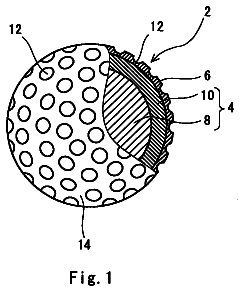
Sheet 1 of 2 from the published document. All sheets in the USPTO PDF
The invention provides a multi-piece solid golf ball composed of a solid core, a cover, at least one intermediate layer situated therebetween, and a plurality of dimples on a surface of the ball. The diameter of the solid core, the deflection of the core when compressed under a final load of 130 kgf from an initial load of 10 kgf, the hardness at the center of the core, the hardness in a region 5 mm to 10 mm from the center of the core, the hardness 15 mm from the center of the core, and the surface hardness are set within specific ranges. The intermediate layer is composed primarily of a material obtained by mixing under applied heat a specific resin composition and the cover is formed primarily of polyurethane. And, the number of dimples and the trajectory volume TVT are set within specific ranges. The golf ball of the invention has an excellent flight performance, feel, controllability and scuff resistance.
The present invention relates to a multi-piece solid golf ball of three or more layers which is composed of a solid core, an intermediate layer and a cover, and is endowed with excellent properties such as flight performance, feel on impact and controllability. In recent years, the number of layers in solid golf balls has been increased from the conventional two-piece ball construction composed of a solid core and a cover by additionally providing an intermediate layer between the solid core and the cover, and efforts are being made to optimize each of the layers. Various three-piece golf balls have been disclosed in which a good flight performance and an excellent durability, feel and controllability are achieved by giving the core itself an optimized hardness profile and by providing the ball as a whole--including the core, the intermediate layer and the cover--with an optimized hardne
All 2 drawing sheets from the published document, cropped to the drawing.
What the patent claimed, word for word. All of it is now free to use.
The present invention relates to a multi-piece solid golf ball of three or more layers which is composed of a solid core, an intermediate layer and a cover, and is endowed with excellent properties such as flight performance, feel on impact and controllability.
In recent years, the number of layers in solid golf balls has been increased from the conventional two-piece ball construction composed of a solid core and a cover by additionally providing an intermediate layer between the solid core and the cover, and efforts are being made to optimize each of the layers. Various three-piece golf balls have been disclosed in which a good flight performance and an excellent durability, feel and controllability are achieved by giving the core itself an optimized hardness profile and by providing the ball as a whole--including the core, the intermediate layer and the cover--with an optimized hardness profile.
For example, JP No. 3505922 (and the corresponding specification of U.S. Pat. No. 5,830,085) discloses a three-piece solid golf ball having a core, an intermediate layer and a cover, which ball satisfies the following relationship: core center hardness<core surface hardness<intermediate layer hardness<cover hardness. However, this golf ball has a low rebound.
JP No. 3772252 (and the corresponding specification of U.S. Pat. No. 6,565,455) discloses the use of the specific resin mixture mentioned in paragraph
as the intermediate layer and/or cover material. Although using such an intermediate layer and/or cover material does enable a high rebound to be achieved in the golf ball, improving the durability remains a problem.
U.S. Pat. Nos. 6,409,614, 6,277,035 and 7,160,211 disclose multi-piece solid golf balls having a core, a soft inner cover and a hard outer cover, which outer cover is an ionomer cover having a high Shore D hardness. However, because the cover is too hard, these golf balls have a low spin performance on approach shots.
In the golf ball of U.S. Pat. No. 6,561,928, the total thickness of the cover encasing the core is too large, resulting in a decrease in flight performance. Other prior art includes the multi-piece solid golf ball disclosed in JP-A 2004-49913 (and the corresponding specification of U.S. Pat. No. 6,663,507).
U.S. Pat. No. 6,991,562 discloses a multi-piece solid golf ball having an inner cover layer formed of an ordinary ionomeric resin and an outer cover layer formed of a urethane resin. However, because this ball has a low rebound, achieving both a good flight performance and a good spin performance on approach shots is difficult.
Because the many multi-piece solid golf balls which have been disclosed to date fail to satisfy all the desired attributes--namely, flight performance, feel on impact, controllability/spin performance and durability, a need has been felt for further improvement.
It is therefore an object of the present invention to provide a multi-piece golf ball of at least three layers which has a solid core, an intermediate layer and a cover, and which is endowed with an excellent flight performance, feel, controllability and durability.
The inventors have conducted extensive investigations in order to achieve the above object. As a result, they have discovered that, in a multi-piece solid golf ball having a core, an intermediate layer and a cover, by optimizing the core hardness profile and by optimizing also the relationship between the intermediate layer, cover and core surface hardnesses, the ball can be imparted with an excellent feel on impact and an excellent spin performance on approach shots, in addition to which the ball can be conferred with a low spin rate on full shots, enabling an improved distance to be achieved. Moreover, the inventors have found that by using a highly neutralized ionomer in the intermediate layer and using a polyurethane in the cover material, it is possible to achieve in the same ball a lower spin rate on shots with a driver, an enhanced spin performance on approach shots and an improved scuff resistance.
Accordingly, the invention provides the following multi-piece solid golf balls.
[1] A multi-piece solid golf ball comprising a solid core, a cover, at least one intermediate layer situated therebetween, and a plurality of dimples on a surface of the ball, wherein the solid core has a diameter of from 34 to 38.7 mm, a deflection when compressed under a final load of 130 kgf from an initial load of 10 kgf of from 3.5 to 6.0 mm, a Shore D hardness at a center of the core of from 20 to 38, a Shore D hardness in a region 5 mm to 10 mm from the core center of from 23 to 41, a Shore D hardness 15 mm from the core center of from 28 to 46, and a Shore D hardness at a surface of the core of from 37 to 62; the intermediate layer is composed primarily of a material obtained by mixing under applied heat:
100 parts by weight of a resin component of (a) from 95 to 50 wt % of an olefin-unsaturated carboxylic acid-unsaturated carboxylic acid ester random copolymer so and/or a metal salt thereof, (b) from 0 to 20 wt % of an olefin-unsaturated carboxylic acid random copolymer and/or a metal salt thereof, and (c) from 5 to 50 wt % of a thermoplastic block copolymer composed of a crystalline polyolefin block and a polyethylene/butylene random copolymer,
(d) from 5 to 170 parts by weight of a fatty acid or fatty acid derivative having a molecular weight of from 280 to 1500, and
(e) from 0.1 to 10 parts by weight of a basic inorganic metal compound capable of neutralizing acid groups within components (a) and (d);
the intermediate layer material has a Shore D hardness of from 35 to 60 and has a Shore D hardness difference with the surface of the solid core of within .+-.10; the cover is formed primarily of polyurethane, has a thickness of from 0.5 to 1.5 mm, and has a Shore D hardness of from 53 to 65 which is higher than the intermediate layer hardness, the Shore D hardness difference therebetween being from 6 to 15; the overall ball has a deflection, when compressed under a final load of 130 kgf from an initial load of 10 kgf, of from 2.9 to 5.0 mm; and the number of dimples is from 250 to 400 and the sum of the dimple trajectory volumes VT (total dimple trajectory volume TVT) obtained by multiplying the volume of each dimple by the square root of the dimple diameter is from 640 to 800. [2] A multi-piece solid golf ball comprising a solid core, a cover, at least one intermediate layer situated therebetween, and a plurality of dimples on a surface of the ball, wherein the solid core has a diameter of from 34 to 38.7 mm, a deflection when compressed under a final load of 130 kgf from an initial load of 10 kgf of from 3.5 to 6.0 mm, a Shore D hardness at a center of the core of from 20 to 38, a Shore D hardness in a region 5 mm to 10 mm from the core center of from 23 to 41, a Shore D hardness 15 mm from the core center of from 28 to 46, and a Shore D hardness at a surface of the core of from 37 to 62; the intermediate layer is composed primarily of a material obtained by mixing under applied heat:
100 parts by weight of a resin component of (a) from 95 to 50 wt % of an olefin-unsaturated carboxylic acid-unsaturated carboxylic acid ester random copolymer and/or a metal salt thereof, (b) from 0 to 20 wt % of an olefin-unsaturated carboxylic acid random copolymer and/or a metal salt thereof, and (c) from 5 to 50 wt % of a thermoplastic block copolymer composed of a crystalline polyolefin block and a polyethylene/butylene random copolymer,
(d) from 5 to 170 parts by weight of a fatty acid or fatty acid derivative having a molecular weight of from 280 to 1500, and
(e) from 0.1 to 10 parts by weight of a basic inorganic metal compound capable of neutralizing acid groups within components (a) and (d);
the intermediate layer has a thickness of from 1.0 to 2.5 mm; the intermediate layer material a Shore D hardness difference with the surface of the solid core of within .+-.10; the cover is formed primarily of polyurethane, has a thickness of from 0.5 to 1.5 mm, and has a Shore D hardness higher than the intermediate layer hardness, the Shore D hardness difference therebetween being from 6 to 15; the cover and the intermediate layer have a combined thickness of from 1.5 to 3.5 mm; and the overall ball has a deflection, when compressed under a final load of 130 kgf from an initial load of 10 kgf, of from 2.9 to 5.0 mm; and the number of dimples is from 250 to 400 and the sum of the dimple trajectory volumes VT (total dimple trajectory volume TVT) obtained by multiplying the volume of each dimple by the square root of the dimple diameter is from 640 to 800. [3] A multi-piece solid golf ball comprising a solid core, a cover, at least one intermediate layer situated therebetween, and a plurality of dimples on a surface of the ball, wherein the solid core has a diameter of from 34 to 38.7 mm, a deflection when compressed under a final load of 130 kgf from an initial load of 10 kgf of from 3.5 to 6.0 mm, a Shore D hardness at a center of the core of from 20 to 38, a Shore D hardness in a region 5 mm to 10 mm from the core center of from 23 to 41, a Shore D hardness 15 mm from the core center of from 28 to 46, and a Shore D hardness at a surface of the core of from 37 to 62; the intermediate layer is composed primarily of a material obtained by mixing under applied heat:
100 parts by weight of a resin component of (a) from 95 to 50 wt % of an olefin-unsaturated carboxylic acid-unsaturated carboxylic acid ester random copolymer and/or a metal salt thereof, (b) from 0 to 20 wt % of an olefin-unsaturated carboxylic acid random copolymer and/or a metal salt thereof, and (c) from 5 to 50 wt of a thermoplastic block copolymer composed of a crystalline polyolefin block and a polyethylene/butylene random copolymer,
(d) from 5 to 170 parts by weight of a fatty acid or fatty acid derivative having a molecular weight of from 280 to 1500, and
(e) from 0.1 to 10 parts by weight of a basic inorganic metal compound capable of neutralizing acid groups within components (a) and (d);
the intermediate layer has a thickness of from 1.0 to 2.5 mm; the intermediate layer material has a Shore D hardness of from 35 to 60; the cover is formed primarily of polyurethane, has a thickness of from 0.5 to 1.5 mm, and has a Shore D hardness of from 53 to 65; the cover and the intermediate layer have a combined thickness of from 1.5 to 3.5 mm; and the overall ball has a deflection, when compressed under a final load of 130 kgf from an initial load of 10 kgf, of from 2.9 to 5.0 mm; and the number of dimples is from 250 to 400 and the sum of the dimple trajectory volumes VT (total dimple trajectory volume TVT) obtained by multiplying the volume of each dimple by the square root of the dimple diameter is from 640 to 800. [4] A multi-piece solid golf ball comprising a solid core, a cover, at least one intermediate layer situated therebetween, and a plurality of dimples on a surface of the ball, wherein the solid core has a diameter of from 34 to 38.7 mm, a deflection when compressed under a final load of 130 kgf from an initial load of 10 kgf of from 3.5 to 6.0 mm, a Shore D hardness at a center of the core of from 20 to 38, a Shore D hardness in a region 5 mm to 10 mm from the core center of from 23 to 41, a Shore D hardness 15 mm from the core center of from 28 to 46, a Shore D hardness at a surface of the core of from 37 to 62 and a Shore D hardness difference of 5 to 30 between the surface and the center; the intermediate layer is composed primarily of a material obtained by mixing under applied heat:
100 parts by weight of a resin component of (a) from 95 to 50 wt % of an olefin-unsaturated carboxylic acid-unsaturated carboxylic acid ester random copolymer and/or a metal salt thereof, (b) from 0 to 20 wt % of an olefin-unsaturated carboxylic acid random copolymer and/or a metal salt thereof, and (c) from 5 to 50 wt % of a thermoplastic block copolymer composed of a crystalline polyolefin block and a polyethylene/butylene random copolymer,
(d) from 5 to 170 parts by weight of a fatty acid or fatty acid derivative having a molecular weight of from 280 to 1500, and
(e) from 0.1 to 10 parts by weight of a basic inorganic metal compound capable of neutralizing acid groups within components (a) and (d);
the intermediate layer has a thickness of from 1.0 to 2.5 mm; the intermediate layer material has a Shore D hardness difference with the surface of the solid core of within .+-.10; the cover is formed primarily of polyurethane, has a thickness of from 0.5 to 1.5 mm, and has a Shore D hardness higher than the intermediate layer hardness, the Shore D hardness difference therebetween being from 6 to 15; the cover and the intermediate layer have a combined thickness of from 1.5 to 3.5 mm; and the overall ball has a deflection, when compressed under a final load of 130 kgf from an initial load of 10 kgf, of from 2.9 to 5.0 mm; and the number of dimples is from 250 to 400 and the sum of the dimple trajectory volumes VT (total dimple trajectory volume TVT) obtained by multiplying the volume of each dimple by the square root of the dimple diameter is from 640 to 800.
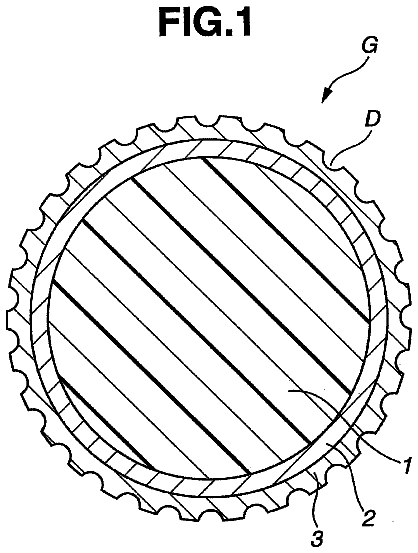
FIG. 1 is a cross-sectional view showing a multi-piece solid golf ball according to one embodiment of the invention.
FIG. 2 is a plan view of the surface of the golf balls in the examples (Dimples I to III).
Describing the invention more fully below in conjunction with the attached diagrams, the multi-piece golf ball of the invention has at least a three-layer construction composed of a solid core 1, an intermediate layer 2 encasing the solid core 1, and a cover 3 encasing the intermediate layer 2. A plurality of dimples D are formed on the surface of the cover 3. FIG. 1 shows a construction in which the solid core 1, the intermediate layer 2, and the cover 3 are each composed of one layer, although any of these parts may be composed of two or more layers. If necessary, the solid core 1, the intermediate layer 2 and the cover 3 may each have a multilayer construction. When the solid core, intermediate layer or cover described below has a multilayer construction, the multiple layers together should be configured in such a way as to collectively satisfy the conditions which pertain to that part of the golf ball.
First, the solid core is described. The solid core is molded under the application of heat from a rubber composition containing polybutadiene as the base rubber.
Here, the polybutadiene has a cis-1,4 bond content of at least 60%, preferably at least 80%, more preferably at least 90%, and most preferably at least 95%.
It is recommended that the polybutadiene have a Mooney viscosity (ML.sub.1+4 (100.degree. C.)) of at least 30, preferably at least 35, more preferably at least 40, even more preferably at least 50, and most preferably at least 52, but not more than 100, preferably not more than 80, more preferably not more than 70, and most preferably not more than 60.
The term "Mooney viscosity" used herein refers to an industrial indicator of viscosity as measured with a Mooney viscometer, which is a type of rotary plastometer (JIS-K6300). The unit symbol used is ML.sub.1+4 (100.degree. C.), where "M" stands for Mooney viscosity, "L" stands for large rotor (L-type), "1+4" denotes a pre-heating time of 1 minute and a rotor rotation time of 4 minutes, and "100.degree. C." indicates that measurement was carried out at a temperature of 100.degree. C.
The molecular weight distribution Mw/Mn (where Mw stands for the weight-average molecular weight, and Mn stands for the number-average molecular weight) of the above polybutadiene is at least 2.0, preferably at least 2.2, more preferably at least 2.4, and even more preferably at least 2.6, but not more than 6.0, preferably not more than 5.0, more preferably not more than 4.0, and even more preferably not more than 3.4. If Mw/Mn is too small, the workability may worsen. On the other hand, if it is too large, the rebound may decrease.
The polybutadiene may be synthesized using a nickel or cobalt catalyst, or may be synthesized using a rare-earth catalyst. Synthesis with a rare-earth catalyst is especially preferred. A known rare-earth catalyst may be used for this purpose.
Examples include catalysts obtained by combining a lanthanum series rare-earth compound, an organoaluminum compound, an alumoxane, a halogen-bearing compound and, if necessary, a Lewis base.
In the present invention, the use of a neodymium catalyst containing a neodymium compound as the lanthanum series rare-earth compound is advantageous because it enables a polybutadiene rubber having a high 1,4-cis bond content and a low 1,2-vinyl bond content to be obtained at an excellent polymerization activity. Preferred examples of such rare-earth catalysts include those mentioned in JP-A 11-35633.
When butadiene is polymerized in the presence of a rare-earth catalyst, bulk polymerization or vapor-phase polymerization may be carried out, with or without the use of a solvent. The polymerization temperature may be set to generally between -30.degree. C. and 150.degree. C., and preferably between 10 and 100.degree. C.
Alternatively, the polybutadiene may be obtained by polymerization using the rare-earth catalyst, followed by the reaction of an active end on the polymer with a terminal modifier.
Examples of terminal modifiers and methods for carrying out such a reaction include those described in, for example, JP-A 11-35633, JP-A 7-268132 and JP-A 2002-293996.
The polybutadiene is included in the rubber base in an amount of at least 60 wt %, preferably at least 70 wt %, more preferably at least 80 wt %, and most preferably at least 90 wt %. The upper limit in the amount of polybutadiene included is 100 wt % or less, preferably 98 wt % or less, and more preferably 95 wt % or less. When too little polybutadiene is included in the rubber base, it is difficult to obtain a golf ball having a good rebound.
Rubbers other than the above-described polybutadiene may be included and used together with the polybutadiene insofar as the objects of the invention are attainable. Illustrative examples include polybutadiene rubbers (BR), is styrene-butadiene rubbers (SBR), natural rubbers, polyisoprene rubbers, and ethylene-propylene-diene rubbers (EPDM). These may be used singly or as combinations of two or more thereof.
The hot-molded solid core is formed using a rubber composition prepared by blending, as essential ingredients, specific amounts of an unsaturated carboxylic acid or a metal salt thereof, an organosulfur compound, an inorganic filler and an antioxidant with 100 parts by weight of the above-described base rubber.
The unsaturated carboxylic acid is exemplified by acrylic acid, methacrylic acid, maleic acid and fumaric acid. Acrylic acid and methacrylic acid are especially preferred.
Metal salts of unsaturated carboxylic acids that may be used include the zinc and magnesium salts of unsaturated fatty acids, such as zinc methacrylate and zinc acrylate. The use of zinc acrylate is especially preferred.
The amount of unsaturated carboxylic acid and/or metal salt thereof included per 100 parts by weight of the base rubber is preferably at least 20 parts by weight, more preferably at least 22 parts by weight, even more preferably at least 24 parts by weight, and most preferably at least 26 parts by weight, but preferably not more than 45 parts by weight, more preferably not more than 40 parts by weight, even more preferably not more than 35 parts by weight, and most preferably not more than 30 parts by weight. Including too much will result in excessive hardness, giving the ball an unpleasant feel when played. On the other hand, including too little will result in a decrease in the rebound.
An organosulfur compound may optionally be included. The organosulfur compound can be advantageously used to impart an excellent rebound. Thiophenols, thionaphthols, halogenated thiophenols, and metal salts thereof are recommended for this purpose. Illustrative examples include pentachlorothiophenol, pentafluorothiophenol, pentabromothiophenol, p-chlorothiophenol, and the zinc salt of pentachlorothiophenol; and diphenylpolysulfides, dibenzylpolysulfides, dibenzoylpolysulfides, dibenzothiazoylpolysulfides and dithiobenzoylpolysulfides having 2 to 4 sulfurs. Diphenyldisulfide and the zinc salt of pentachlorothiophenol are especially preferred.
The amount of the organosulfur compound included per 100 parts by weight of the base rubber is preferably at least 0 part by weight, more preferably at least 0.1 part by weight, even more preferably at least 0.2 part by weight, and most preferably at least 0.4 part by weight, but preferably not more than 5 parts by weight, more preferably not more than 4 parts by weight, even more preferably not more than 3 parts by weight, and most preferably not more than 2 parts by weight. Including too much organosulfur compound may excessively lower the hardness, whereas including too little is unlikely to improve the rebound.
The inorganic filler is exemplified by zinc oxide, barium sulfate and calcium carbonate. The amount of the inorganic filler included per 100 parts by weight of the base rubber is preferably at least 5 parts by weight, more preferably at least 6 parts by weight, even more preferably at least 7 parts by weight, and most preferably at least 8 parts by weight, but preferably not more than 80 parts by weight, more preferably not more than 60 parts by weight, even more preferably not more than 40 parts by weight, and most preferably not more than 20 parts by weight. Too much or too little inorganic filler may make it impossible to achieve a suitable weight and a good rebound.
The organic peroxide may be a commercial product, examples of which include those available under the trade names Percumyl D (produced by NOF Corporation), Perhexa 3M (NOF Corporation), Perhexa C(NOF Corporation), and Luperco 231XL (Atochem Co.). The use of Perhexa 3M or Perhexa C is preferred.
A single organic peroxide may be used alone or two or more different organic peroxides may be mixed and used together. Mixing two or more different organic peroxides is preferred from the standpoint of further enhancing rebound.
The amount of the organic peroxide included per 100 parts of the base rubber is preferably at least 0.1 part by weight, more preferably at least 0.2 part by weight, and even more preferably at least 0.3 part by weight, but preferably not more than 2 parts by weight, more preferably not more than 1.5 parts by weight, and even more preferably not more than 1 part by weight. Including too much or too little organic peroxide may prevent the desired hardness profile from being achieved, making it impossible, in turn, to achieve the desired feel, durability and rebound.
In the present invention, an antioxidant may be included if necessary. Illustrative examples of the antioxidant include commercial products such as Nocrac NS-6 and Nocrac NS-30 (both produced by Ouchi Shinko Chemical Industry Co., Ltd.), and Yoshinox 425 (Yoshitomi Pharmaceutical Industries, Ltd.).
To achieve a good rebound and durability, it is recommended that the amount of the antioxidant included per 100 parts by weight of the base rubber be preferably at least 0 part by weight, more preferably at least 0.03 part by weight, and even more preferably at least 0.05 part by weight, but preferably not more than 0.4 part by weight, more preferably not more than 0.3 part by weight, and even more preferably not more than 0.2 part by weight.
Sulfur may also be added if necessary. Such sulfur is exemplified by the product manufactured by Tsurumi Chemical Industry Co., Ltd. under the trade name "Sulfur Z." The amount of sulfur included per 100 parts by weight of the base rubber is preferably at least 0 part by weight, more preferably at least 0.005 part by weight, and more preferably at least 0.01 part by weight, but preferably not more than 0.5 part by weight, more preferably not more than 0.4 part by weight, and even more preferably not more than 0.1 part by weight. By adding sulfur, the core hardness profile can be increased. Adding too much sulfur may result in undesirable effects during hot molding, such as explosion of the rubber composition, or may considerably lower the rebound.
To achieve the subsequently described specific core hardness profile and core deflection, the foregoing rubber composition is suitably selected and fabrication of the solid core (hot-molded piece) is carried out by vulcanization and curing according to a method similar to that used for conventional golf ball rubber compositions. Suitable vulcanization conditions include, for example, a vulcanization temperature of between 100.degree. C. and 200.degree. C., and a vulcanization time of between 10 and 40 minutes. To obtain the desired rubber crosslinked body for use as the core in the present invention, the vulcanizing temperature is preferably at least 150.degree. C., and especially at least 155.degree. C., but preferably not above 200.degree. C., more preferably not above 190.degree. C., even more preferably not above 180.degree. C., and most preferably not above 170.degree. C.
It is critical for the solid core of the invention to have a diameter between 34.0 and 38.7 mm. It is recommended that the solid core have a diameter of preferably at least 34.5 mm, more preferably at least 35.0 mm, even more preferably at least 35.5 mm, and most preferably at least 36.0 mm, but preferably not more than 38.2 mm, more preferably not more than 37.7 mm, even more preferably not more than 37.0 mm, and most preferably not more than 36.5 mm. At too small a diameter, the soft core becomes smaller, which may lower the ball rebound and result in a harder feel. On the other hand, at too large a diameter, the intermediate layer and cover necessarily become thinner, which may result in a poor durability.
The solid core has a center hardness, expressed as the Shore D hardness, of at least 20, preferably at least 25, more preferably at least 30, and even more preferably at least 33, but not more than 38, preferably not more than 37, even more preferably not more than 36, and most preferably not more than 35.
The solid core has a hardness in the region 5 mm to 10 mm from the center thereof, expressed as the Shore D hardness, of at least 23, preferably at least 28, more preferably at least 32, and even more preferably at least 35, but not more than 41, preferably not more than 40, even more preferably not more than 39, and most preferably not more than 38.
The region of the solid core 15 mm from the center has a hardness, expressed as the Shore D hardness, of at least 28, preferably at least 33, more preferably at least 36, and even more preferably at least 39, but not more than 46, preferably not more than 45, and even more preferably not more than 44.
The surface of the solid core has a hardness, expressed as the Shore D hardness, of at least 37, preferably at least 39, more preferably at least 41, and even more preferably at least 42, but not more than 62, preferably not more than 57, even more preferably not more than 52, and most preferably not more than 48.
The hardness difference between the surface and center of the solid core as expressed in Shore D hardness units, while not subject to any particular limitation, is preferably at least 5, and more preferably at least 6, but preferably not more than 30, more preferably not more than 25, and even more preferably not more than 20. At a hardness difference smaller than the above range, the spin rate on shots with a driver may rise, lowering the distance traveled by the ball. On the other hand, at a hardness difference larger than the above range, the rebound and durability of the ball may decrease.
The solid core has a deflection, when compressed under a final load of 130 kgf from an initial load of 10 kgf, of at least 3.5 mm, preferably at least 3.8 mm, and more preferably at least 4.1 mm, but not more than 6.0 mm, preferably not more than 5.5 mm, more preferably not more than 5.0 mm, and most preferably not more than 4.8 mm. Too small a deflection by the solid core may worsen the feel of the ball on impact and, particularly on long shots such as with a driver in which the ball incurs a large deformation, may subject the ball to an excessive rise in the spin rate, shortening the distance traveled by the ball. On the other hand, a solid core which is too soft may deaden the feel of the ball when played and result in a less than adequate rebound, shortening the distance traveled by the ball, and moreover may give the ball a poor durability to cracking on repeated impact.
Next, in the present invention, it is preferable to use as the intermediate layer material a resin mixture containing:
(a) from 95 to 50 wt % of an olefin-unsaturated carboxylic acid-unsaturated carboxylic acid ester random copolymer and/or a metal salt thereof,
(b) from 0 to 20 wt % of an olefin-unsaturated carboxylic acid random copolymer and/or a metal salt thereof, and
(c) from 5 to 50 wt % of a thermoplastic block copolymer composed of a crystalline polyolefin block and a polyethylene/butylene random copolymer.
The olefin-unsaturated carboxylic acid-unsaturated carboxylic acid ester random copolymer and/or a metal salt thereof serving as component (a) has a weight-average molecular weight (Mw) of preferably at least 100,000, more preferably at least 110,000, and even more preferably at least 120,000, but preferably not more than 200,000, more preferably not more than 190,000, and even more preferably not more than 170,000. The weight-average molecular weight (Mw) to number-average molecular weight (Mn) ratio for the copolymer is preferably at least 3, and more preferably at least 4, but preferably not more than 7, and more preferably not more than 6.5.
Above component (a) is an olefin-containing copolymer. The olefin in component (a) is exemplified by olefins in which the number of carbons is at least 2 but not more than 8, and preferably not more than 6. Illustrative examples of such olefins include ethylene, propylene, butene, pentene, hexene, heptene and octene. The use of ethylene is especially preferred.
Illustrative examples of the unsaturated carboxylic acid in component (a) include acrylic acid, methacrylic acid, maleic acid and fumaric acid. Acrylic acid and methacrylic acid are especially preferred.
The unsaturated carboxylic acid ester in component (a) may be, for example, a lower alkyl ester of an unsaturated carboxylic acid. Illustrative examples include methyl methacrylate, ethyl methacrylate, propyl methacrylate, butyl methacrylate, methyl acrylate, ethyl acrylate, propyl acrylate and butyl acrylate. The use of butyl acrylate (n-butyl acrylate, isobutyl acrylate) is especially preferred.
The random copolymer serving as component (a) in the invention may be obtained by the random copolymerization of the above ingredients in accordance with a known method. It is recommended that the unsaturated carboxylic acid content (acid content) within the random copolymer be generally at least 2 wt %, preferably at least 6 wt %, and more preferably at least 8 wt %, but not more than 25 wt %, preferably not more than 20 wt %, and more preferably not more than 15 wt %. At a low acid content, the rebound may decrease, whereas at a high acid content, the material processability may decrease.
The copolymer of component (a) accounts for a proportion of the overall resin component which is from 95 to 50 wt %, preferably at least 60 wt %, more preferably at least 70 wt %, and even more preferably at least 75 wt %, but preferably not more than 92 wt %, more preferably not more than 89 wt %, and most preferably not more than 86 wt %.
The metal salt of the copolymer of component (a) may be obtained by neutralizing some of the acid groups in the random copolymer of component (a) with metal ions.
Examples of the metal ions which neutralize the acid groups include Na.sup.+, W.sup.+, Li.sup.+, Zn.sup.++, Cu.sup.++, Mg.sup.++, Ca.sup.++, Co.sup.++, Ni.sup.++ and Pb.sup.++. Of these, Na.sup.+, Li.sup.+, Zn.sup.++, Mg.sup.++ or Ca.sup.++ are preferred, and Zn.sup.++ is especially preferred. The degree of neutralization of the random copolymer by these metal ions, while not subject to any particular limitation, is generally at least 5 mol %, preferably at least 10 mol %, and especially at least 20 mol %, but not more than 95 mol %, preferably not more than 90 mol %, and especially not more than 80 mol %. At a degree of neutralization in excess of 95 mol %, the moldability may decrease. On the other hand, at less than 5 mol %, there arises a need to increase the amount in which the inorganic metal compound serving as component (c) is added, which may present a drawback in terms of cost. Such a neutralization product may be obtained by a known method. For example, the neutralization product may be obtained by introducing a metal ion compound, such as a formate, acetate, nitrate, carbonate, bicarbonate, oxide, hydroxide or alkoxide, into the random copolymer.
Illustrative examples of the olefin-unsaturated carboxylic acid-unsaturated carboxylic acid ester random copolymer serving as component (a) include those available under the trade names Nucrel AN4318, Nucrel AN4319, and Nucrel AN4311 (DuPont-Mitsui Polychemicals Co., Ltd.). Illustrative examples of the metal salts of olefin-unsaturated carboxylic acid-unsaturated carboxylic acid ester random copolymer include those available under the trade names Himilan AM7316, Himilan AM7331, Himilan 1855 and Himilan 1856 (DuPont-Mitsui Polychemicals Co., Ltd.), and those available under the trade names Surlyn 6320 and Surlyn 8120 (E.I. DuPont de Nemours and Co., Ltd.).
In cases where component (b) is blended with the resin of the above component (a), the olefin-unsaturated carboxylic acid random copolymer and/or metal salt thereof serving as component (b) has a weight-average molecular weight (Mw) of preferably at least 100,000, more preferably at least 110,000, and even more preferably at least 120,000, but preferably not more than 200,000, more preferably not more than 190,000, and even more preferably not more than 170,000. The weight-average molecular weight (Mw) to number-average molecular weight (Mn) ratio for the copolymer is preferably at least 3, and more preferably at least 4, but preferably not more than 7, and more preferably not more than 6.5.
Above component (b) is an olefin-containing copolymer. The olefin in component (b) is exemplified by olefins in which the number of carbons is at least 2 but not more than 8, and preferably not more than 6. Illustrative examples of such olefins include ethylene, propylene, butene, pentene, hexene, heptene and octene. The use of ethylene is especially preferred.
Illustrative examples of the unsaturated carboxylic acid in component (b) include acrylic acid, methacrylic acid, maleic acid and fumaric acid. Acrylic acid and methacrylic acid are especially preferred.
The random copolymer serving as component (b) in the invention may be obtained by the random copolymerization of the above ingredients in accordance with a known method. It is recommended here that the unsaturated carboxylic acid content (acid content) within the random copolymer be generally at least 2 wt %, preferably at least 6 wt %, and more preferably at least 8 wt %, but not more than 25 wt %, preferably not more than 20 wt %, and more preferably not more than 15 wt %. At a low acid content, the rebound may decrease, whereas at a high acid content, the material processability may decrease.
In the above case, the copolymer of component (b) accounts for a proportion of the overall base resin which is 0 wt % or more, and preferably at least 1 wt %, but not more than 20 wt %, preferably not more than 17 wt %, more preferably not more than 10 wt %, even more preferably not more than 8 wt %, and most preferably not more than 5 wt %.
The metal salt of the copolymer of component (b) may be obtained by neutralizing some of the acid groups in the random copolymer of component (b) with metal ions.
Examples of the metal ions which neutralize the acid groups include Na.sup.+, K.sup.+, Li.sup.+, Zn.sup.++, Cu.sup.++, Mg.sup.++, Ca.sup.++, Co.sup.++, Ni.sup.++ and Pb.sup.++. Of these, Na.sup.+, Zn.sup.++, Mg.sup.++ or Ca.sup.++ are preferred, and Zn.sup.++ is especially preferred. The degree of neutralization of the random copolymer by these metal ions, while not subject to any particular limitation, is generally at least 5 mol %, preferably at least 10 mol %, and especially at least 20 mol %, but not more than 95 mol %, preferably not more than 90 mol %, and especially not more than 80 mol %. At a degree of neutralization in excess of 95 mol %, the moldability may decrease. On the other hand, at less than 5 mol %, there arises a need to increase the amount in which the inorganic metal compound serving as component (c) is added, which may present a drawback in terms of cost. Such a neutralization product may be obtained by a known method. For example, the neutralization product may be obtained by introducing a metal ion compound, such as a formate, acetate, nitrate, carbonate, bicarbonate, oxide, hydroxide or alkoxide, into the random copolymer.
Illustrative examples of the olefin-unsaturated carboxylic acid random copolymer serving as component (b) include those available under the trade names Nucrel 1560, Nucrel 1525 and Nucrel 1035 (DuPont-Mitsui Polychemicals Co., Ltd.). Illustrative examples of the metal salts of the olefin-unsaturated carboxylic acid random copolymer include those available under the trade names Himilan 1605, Himilan 1601, Himilan 1557, Himilan 1705 and Himilan 1706 (DuPont-Mitsui Polychemicals Co., Ltd.), those available under the trade names Surlyn 7930 and Surlyn 7920 (E.I. DuPont de Nemours and Co., Ltd.), and those available under the trade names Escor 5100 and Escor 5200 (ExxonMobil Chemical).
When component (c) is used, the thermoplastic block copolymer composed of a crystalline polyolefin block and a polyethylene/butylene random copolymer which serves as component (c) is exemplified by thermoplastic block copolymers composed of a crystalline polyethylene block (E) as a hard segment and a block of a relatively random copolymer of ethylene and butylene (EB) as a soft segment. Preferred use may be made of block copolymers having a molecular structure with a hard segment at one or both ends, such as block copolymers having an E-EB or E-EB-E structure.
Such thermoplastic block copolymers composed of a crystalline polyolefin block and a polyethylene/butylene random copolymer which serve as component (c) may be obtained by hydrogenating polybutadiene.
A polybutadiene in which bonding within the butadiene structure is characterized by the presence of a block-like 1,4-polymer region having a 1,4-bond content of from 95 to 100 wt %, and in which the butadiene structure as a whole has a 1,4-bond content of from 50 to 100 wt %, and preferably from 80 to 100 wt %, may be advantageously used here as the polybutadiene subjected to hydrogenation. That is, preferred use may be made of a polybutadiene having a 1,4-bond content of 50 to 100 wt %, and preferably 80 to 100 wt %, and having a block-like 1,4-polymer region with a 1,4-bond content of 95 to 100 wt %.
The description continues in the full USPTO document.
About 6,714 words. The USPTO PDF has it with every drawing.
Fees are due 3.5, 7.5 and 11.5 years after grant. This patent expired on March 18, 2026, so the fee marked "not paid" was the one that went unpaid.
MULTI-PIECE SOLID GOLF BALL
Filed Dec 2010 · published Apr 2011Multi-piece solid golf ball
Filed Dec 2010 · granted Mar 2014Earlier publications, parents and continuations. None of them can still be enforced, or this patent would not be listed.
Prior art cited by the examiner or applicant. Useful when you check your own idea for novelty.
Everything on this page comes from the documents linked above.