Related applications
The present application is a National Phase entry of PCT Application No. PCT/FR2011/051384, filed Jun. 16, 2011, which claims priority from France Application No. 1002588, filed Jun. 18, 2010, the disclosures of which are hereby incorporated by reference in their entireties.
Technical field
The present invention notably relates to ulvan lyases, to nucleic acid coding sequences for these ulvan lyases, to vectors comprising these coding sequences, to a method of manufacturing these ulvan lyases, as well as to a method of degrading ulvans using these ulvan lyases.
The present invention notably finds applications in valorization of natural bioresources consisting of organisms and microorganisms comprising ulvans, notably green algae. In particular, it finds applications in the laboratory, for analysis of these ulvans, as well as in food processing, in the area of cosmetics and in the area of medicinal products and pharmaceutical formulations, where the products of degradation of ulvans can be utilized.
In the following description, references in square brackets [ ] refer to the list of references given at the end of the text.
Background of the invention
The green algae belonging to the order Ulvales (Ulva sp. and Enteromorpha sp.) are present everywhere on Earth and are very commonly encountered on coasts. These algae are frequently involved in algal blooms promoted by eutrophication of coastal waters, giving rise to "green tides".
Until now this undesirable biomass has been of very low added value and it is used essentially as compost.
The anionic complex polysaccharides present in the cell walls of the ulvales, called ulvans, possess unusual structures and represent a source of biopolymers whose functionalities have so far received little attention.
The ulvans are made up of various disaccharide repeating units constructed with rhamnose units, glucuronic acids, iduronic acids, xyloses and sulphates. The two main repeating units are called aldobiuronic acid, or ulvanobiuronic acids, or A (A.sub.3S) and B (B.sub.3S) respectively, which have the following formulae:
##str00001##
The A unit (A.sub.3S) is beta-D-1,4-glucuronic acid (1.fwdarw.4) alpha-L-1,4-rhamnose 3-sulphate. The B unit (B.sub.3S) is alpha-L-1,4-iduronic acid (1.fwdarw.4) alpha-L-1,4-rhamnose 3-sulphate.
The uronic acids are sometimes replaced with xylose residues sulphated to O-2.
The ulvans possess unique physicochemical properties that make them attractive candidates for new food-industry, pharmaceutical, and cosmetic applications. The ulvans possess very unusual structures composed of rare sugars or monosaccharides such as rhamnose and iduronic acid. Rhamnose is an important compound of the surface antigens of numerous microorganisms that are recognized specifically by mammalian lectins. It is also used for the synthesis of flavouring materials. Iduronic acid is used for the synthesis of glycosaminoglycans, for example heparin.
In addition to the monomers, the ulvans and oligo-ulvans have interesting biological properties. In fact, studies have shown, for example, that oligo-ulvans have antitumour, antiviral, notably anti-influenzal, and anticoagulant activities. A non-exhaustive list of potential applications of the ulvans was proposed by M. Lahaye and A. Robic in the document Structure and functional properties of ulvan, a polysaccharide from green seaweeds. Biomacromolecules 2007, 8, 1765-1774 [1].
In this context, better understanding of the structure of the ulvans and the development of methods for fragmenting the ulvans in oligomeric or monomeric form are of considerable interest.
At present, through lack of means for understanding them better and for degrading them efficiently, the algae, notably the green algae, are essentially composted, without any industrial utilization. This is all the more deplorable since it is an abundant source, which is sometimes troublesome in terms of pollution of our maritime coastlines. At present they are eliminated of by composting.
There is therefore a real need to find novel means of degradation of ulvans so as to be able to valorize this bioresource, obtained notably from green algae, producing "tailor-made" oligo-ulvan fragments in view of cosmetic, food-processing and medical applications.
Summary of the invention
The aim of the present invention is precisely to meet this need by supplying ulvan lyases that degrade ulvans very effectively by depolymerization. Investigation of the conditions for recognition of the enzymes of the present invention undertaken by the inventors demonstrates their glucuronic lyase activity.
The inventors have also demonstrated iduronic and glucuronic lyase activity.
The inventors supply, in particular, ulvan lyases extracted from the microorganism deposited under number I-4324 in the National Collection of Cultures of Microorganisms (CNCM) 25 rue du docteur Roux, 75724 Paris Cedex 15, France. This microorganism is also called "01-PN-2010" in the present text and in the CNCM deposition documents.
In other words, the inventors supply, in particular, ulvan lyases extracted from the microorganism of marine origin deposited under number I-4324 in the National Collection of Cultures of Microorganisms (CNCM) 25 rue du docteur Roux, 75724 Paris Cedex 15, France.
These ulvan lyases, also called ulvanolytic proteins, can be for example of 30 or 46 kD and can comprise the following four sequences in their peptide sequence:
TABLE-US-00001 (SEQ ID No. 9) PNDPNLK, (SEQ ID No. 10) LLEVGNTGTFGSTGS, (SEQ ID No. 11) DLANPDNV, and (SEQ ID No. 12) WNLPE.
In some aspects of the present invention, ulvan lyase of 30 or 46 kD are of sequence SEQ ID No. 1 in the appended sequence listing. This ulvan lyase may further comprise at its C-terminal end, the sequence SEQ ID No. 2 in the appended sequence listing. In some aspects the ulvan lyase further has a signal sequence at its N-terminal end. In some aspects, the signal sequence is the sequence SEQ ID No. 3 in the appended sequence listing.
The present invention also relates to nucleic acids coding for the ulvan lyases of the present invention, notably for the protein SEQ ID No. 1. It can be for example a nucleic acid comprising or consisting of the sequence SEQ ID No. 5 in the appended sequence listing. In some aspects, the nucleic acid comprises at its 3' end the sequence SEQ ID No. 6 in the appended sequence listing. In some aspects, the nucleic acid comprises at its 5' end the sequence SEQ ID No. 7 in the appended sequence listing.
The present invention also relates to a vector comprising a nucleic acid coding for one of the ulvan lyases of the present invention. In some aspects, the vector comprises a nucleic acid selected from the sequences SEQ ID No. 5 to 8 in the appended sequence listing.
The present invention also relates to a host cell comprising a nucleic acid sequence according to the present invention or a vector according to the present invention.
The present invention also relates to an isolated marine bacterium microorganism, which is named 01-PN-2010, which produces the ulvan lyases of the present invention, the isolated bacterium deposited on 17 Jun. 2010 under number I-4324 in the National Collection of Cultures of Microorganisms (CNCM) 25 rue du docteur Roux, 75724 Paris Cedex 15, France.
The present invention further relates to a method of manufacturing an ulvan lyase by genetic recombination using a nucleic acid of the present invention or a vector of the present invention.
In some aspects of the present invention, a method of degrading ulvans comprises a step of bringing the ulvans into contact with an ulvan lyase of the present invention or with a host cell of the present invention or with a microorganism of the present invention, in conditions permitting degradation of the ulvans by enzymatic digestion by said protein or said host or said microorganism.
Brief description of the drawings
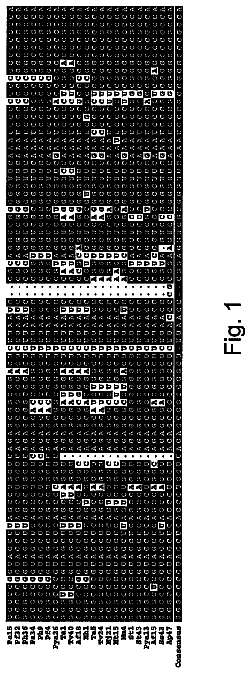
FIG. 1 is a gel from electrophoresis of the ulvanolytic proteins of 30 kD (Gel A) and of 46 kD (Gel B) of the present invention. The arrows indicate the bands that were excised and then used for sequencing the peptides by mass spectrometry.
FIG. 2 shows the protein sequence of ulvan lyase of 46 Dka (SEQ ID No. 4) of the present invention with, in bold, the signal peptide or sequence (SEQ ID No. 3). In normal text, the catalytic module, determined by mass spectrometry, SEQ ID No. 1. The non-catalytic part of the protein sequence (SEQ ID No. 2) of the 46 kD protein is underlined.
FIG. 3 shows the sequence of the gene coding for the ulvan lyase protein of 46 Dka. In bold, the gene coding for the signal peptide or sequence (SEQ ID No. 7). In normal text, the gene SEQ ID No. 5 coding for the catalytic module of SEQ ID No. 1, determined by mass spectrometry. Underlined, the sequence SEQ ID No. 6 coding for the non-catalytic part of the 46 kD protein (SEQ ID No. 2) present in the 46 kD peptide.
FIG. 4 shows the results obtained in ion exchange chromatography experiments conducted before or after incubation of a disaccharide (graph A) or of a tetrasaccharide (graph B) with the ulvan lyase of the present invention. On these graphs, the abscissa shows the elution time in minutes (min), and the ordinate shows the conductimetry in nano-coulomb (nC).
FIG. 5 is a photograph showing Petri dishes with ulvans labelled with an aqueous solution of ruthenium red at 0.05% showing the enzymatic degradation of the ulvans by the purified ulvan lyase of 30 kD (A), 46 kD (B) and the recombinant catalytic module (C). An extract comprising E. coli bacteria lacking an expression plasmid was also deposited on agar as control (D).
FIG. 6 shows the results obtained from experiments of high-performance anion exchange chromatography of purified oligosaccharides. (A) .DELTA.-R3S has not been degraded by the ulvan lyase. (B) The tetrasaccharide .DELTA.-R3S-Glc-R3S was converted solely to .DELTA.-R3S after incubation with the ulvan lyase. (C) The tetrasaccharide .DELTA.-R3S-Idu-R3S was converted solely to .DELTA.-R3S after incubation with the ulvan lyase, as also observed in (B). On these graphs, the abscissa shows the elution time in minutes (min), and the ordinate shows the conductometry in microsiemens (.mu.S).
Detailed description of the invention
The aim of the present invention is precisely to meet this need by supplying ulvan lyases that degrade ulvans very effectively by depolymerization. Investigation of the conditions for recognition of the enzymes of the present invention undertaken by the inventors demonstrates their glucuronic lyase activity.
The inventors have also demonstrated iduronic and glucuronic lyase activity.
The inventors supply, in particular, ulvan lyases extracted from the microorganism deposited under number I-4324 in the National Collection of Cultures of Microorganisms (CNCM) 25 rue du docteur Roux, 75724 Paris Cedex 15, France. This microorganism is also called "01-PN-2010" in the present text and in the CNCM deposition documents.
In other words, the inventors supply, in particular, ulvan lyases extracted from the microorganism of marine origin deposited under number I-4324 in the National Collection of Cultures of Microorganisms (CNCM) 25 rue du docteur Roux, 75724 Paris Cedex 15, France.
These ulvan lyases, also called ulvanolytic proteins, can be for example of 30 or 46 kD and can comprise the following four sequences in their peptide sequence:
TABLE-US-00002 (SEQ ID No. 9) PNDPNLK, (SEQ ID No. 10) LLEVGNTGTFGSTGS, (SEQ ID No. 11) DLANPDNV, and (SEQ ID No. 12) WNLPE.
The inventors have in fact notably isolated ulvan lyases of 30 kD or 46 kD having these sequences in common in their respective sequence. Although these proteins possess peptide fragments in common, their sequences have never been described in the prior art. These sequences of 30 or 46 kD are active for degrading the ulvans by depolymerization according to the present invention. They were extracted as indicated in the examples given below.
One of these sequences is the sequence SEQ ID No. 1 of 30 kD. The present invention therefore also relates to this sequence. This sequence is the catalytic moiety of an ulvan lyase isolated by the inventors and of 46 kD (SEQ ID No. 4). This ulvan lyase is shown in the accompanying FIG. 2.
The sequence ID No. 1 can therefore comprise, at its C-terminal end, the sequence SEQ ID No. 2 in the appended sequence listing.
According to the invention, these ulvan lyases, whatever their sequence, can further comprise, at their N-terminal end, a signal sequence or address sequence. This signal sequence can be one of the signal sequences known by a person skilled in the art so that the protein, when it is synthesized in a host cell, is directed to an organelle or a particular region of the host cell. It can be for example a signal sequence found in sites specializing in the prediction of signal peptides, for example the SignalP Server website [2] or the SIG-Pred: Signal Peptide Prediction website [3]. It can be for example the sequence SEQ ID No.3 in the appended sequence listing. This signal sequence can be cleaved after synthesis of the protein or otherwise. The methods of cleavage known by a person skilled in the art can be used, for example those involving proteases specific to a cleavage site. A signal sequence having such a site is then selected.
The present invention also relates to nucleic acids coding for the ulvan lyases of the present invention, notably for the protein SEQ ID No. 1. It can be for example a nucleic acid comprising or consisting of the sequence SEQ ID No. 5 in the appended sequence listing.
The present invention also relates to a nucleic acid coding for the protein of sequence SEQ ID No. 2 in the appended sequence listing. It can be for example the sequence SEQ ID No. 6 in the appended sequence listing.
The present invention also relates to a nucleic acid coding for the protein of sequence SEQ ID No. 3 in the appended sequence listing. It can be for example the sequence SEQ ID No. 7 in the appended sequence listing.
The present invention also relates to a nucleic acid coding for the protein of sequence SEQ ID No. 4 in the appended sequence listing. It can be for example the sequence SEQ ID No. 8 in the appended sequence listing.
These nucleic acid sequences or genes of the present invention are the first representatives of a new family of genes coding for polysaccharide lyases and also represent the first genes of enzymes according to the present invention for degradation of ulvan.
The present invention also relates to a vector comprising a nucleic acid coding for one of the ulvan lyases of the present invention, for example a nucleic acid selected from the sequences SEQ ID No.5 or 8. The vector can be one of the vectors known by a person skilled in the art for manufacturing proteins by genetic recombination. In general it is selected notably as a function of the cellular host selected. The vector can be for example selected from the vectors listed in the Promega catalogue [4] or the Qiagen catalogue [5], or the santa crus biotechnology, inc. catalogue [6]. It can be for example the expression vector described in the document WO 83/004261 [7].
The nucleic acids of the present invention or the vectors of the present invention are usable notably for manufacturing the ulvan lyases of the present invention by genetic recombination. Thus, the present invention also relates to a host cell comprising a nucleic acid sequence according to the invention or a vector according to the invention.
The host cell or cellular host can be any suitable host for manufacturing the ulvan lyases of the present invention from the nucleic acids or the vectors of the invention. It can be for example E. coli, Pischia pastoris, Saccharomyces cerevisiae, insect cells, for example an insect cells-baculovirus system (for example insect cells SF9 using a baculovirus expression system), mammals.
Thus, the present invention also relates to a method of manufacturing an ulvan lyase according to the invention by genetic recombination using a nucleic acid or a vector according to the invention. The methods of genetic recombination known by a person skilled in the art can be used. The marine or terrestrial origin has no influence on the possibility of recombination and of heterologous expression.
The present inventors are moreover the very first to have isolated a microorganism, which they named 01-PN-2010, which produces the ulvan lyases of the present invention. It is a marine bacterium. This marine bacterium is found for example in the faeces of Aplysia punctata (Mullusca, Gastropoda). They deposited this bacterium in accordance with the Budapest Treaty on the international recognition of the deposition of microorganisms for the purposes of patent procedure in the National Collection of Cultures of Microorganisms (CNCM) 25 rue du docteur Roux, 75724 Paris Cedex 15, France. The deposition number of this strain in the CNCM is I-4324.
The inventors purified, from this microorganism, the two ulvan lyases of 30 kD and 46 kD described in the present text.
Thus, the present invention also relates to the microorganism deposited under number I-4324 in the National Collection of Cultures of Microorganisms (CNCM) 25 rue du docteur Roux, 75724 Paris Cedex 15, France.
This microorganism can therefore be used notably for manufacturing ulvan lyases. The present invention therefore also relates to a method of manufacturing ulvan lyases comprising culturing the microorganism deposited under number I-4324 in the CNCM in France.
This culturing is preferably carried out in a culture medium permitting the growth of this marine microorganism. It can be for example ZoBell liquid culture medium, as described in the document ZoBell, CE 1941 Studies on marine bacteria. I. The cultural requirements of heterotrophic aerobes, J Mar Res 4, 41-75 [8]. Culture conditions usable for implementing the present invention are also described in this document. The culture pH is preferably between 7 and 9, preferably pH 8. The culture temperature is preferably between 15 and 30.degree. C., preferably 25.degree. C. Culture is preferably carried out with an NaCl concentration from 20 to 30 gL.sup.-1, preferably 25 gL.sup.-1.
This method of manufacturing ulvan lyases using the microorganism of the invention or any other host cell transformed for manufacture by genetic recombination according to the present invention, can further comprise a step of recovery of the ulvan lyases. This step of recovery or of isolation can be carried out by any means known by a person skilled in the art. It can be for example a technique selected from electrophoresis, molecular sieving, ultracentrifugation, differential precipitation, for example with ammonium sulphate, by ultrafiltration, membrane filtration or gel filtration, ion exchange, elution on hydroxyapatite, separation by hydrophobic interactions, or any other known means. An example of a method of isolating these ulvan lyases usable for carrying out the present invention is described below.
The aforementioned microorganism or any other host cell transformed for manufacture by genetic recombination according to the present invention can also be used directly for degrading ulvans, in their natural environment or in culture. When it is a culture, it can be a batch system or a continuous system. For example, a culture reactor can be used containing a culture medium suitable for the development of the microorganism.
The present invention therefore also relates to a method of degrading ulvans comprising a step of bringing the ulvans into contact with an ulvan lyase according to the invention or with a host cell according to the invention or with the microorganism deposited under number I-4324 in the CNCM in France, in conditions permitting degradation of the ulvans by enzymatic digestion by said ulvan lyase or said transformed host cell or said microorganism deposited under number I-4324 in the CNCM in France.
The conditions permitting degradation of the ulvans, when a host cell or microorganism is used, are those presented above, for the host cell or for the microorganism, respectively.
For enzymatic digestion, determination of the Michaelis Menten constants (Km and Vmax) easily enables a person skilled in the art to find optimum concentration conditions of the ulvan lyase used and concentration of the ulvans for degradation of the ulvans in the environment where they are located or in the medium in which they have been placed. The pH can also preferably be between 7 and 8, preferably between 9 and 9.5. It is in fact the optimum pH range. The (optimum) temperature is preferably between 30.degree. C. and 40.degree. C. The strength. The ionic strength above 300 mM NaCl for the protein of 46 kD and without salt with the protein of 30 kD, in another embodiment, the optimum ionic strength is 300 mM NaCl for the protein of 46 kD and 100 mM NaCl for the protein of 30 kD.
The invention advantageously allows mobilization of the very large resource of algae that is currently unexploited, notably of green algae. The invention makes it possible, moreover, to promote the biodegradation of the algae, notably of the green algae, to produce original molecules, which are fragments of ulvans or oligo-ulvans, for example oligosaccharides, for example also hydrocolloids, and to offer a new source of rare monosaccharides for cosmetic and food-processing applications, medicinal products or pharmaceutical and parapharmaceutical formulations.
The products of degradation of the ulvans give access to new products, which may be food-processing, cosmetic, pharmaceutical and parapharmaceutical active substances usable in the food-processing, cosmetic, pharmaceutical and parapharmaceutical fields. These new products may also be products that are not active, but display a neutrality and/or a stability that is very interesting for use in each of these fields.
The use of the ulvan lyases of the present invention moreover gives access to rare monosaccharides usable as synthons in glycochemistry. The degradation of ulvan with ulvan lyases combined with other enzymes can give access to iduronic acid (a rare sugar) used for the synthesis of synthetic glycoaminoglycans.
The present invention also opens up new perspectives for the use of these algae for applications in bioenergy and in chemistry. The production of oligosaccharide fragments can give base molecules for manufacturing other molecules. The depolymerization of ulvan should facilitate fermentation by microorganisms leading to the production of methane for example.
Other features and advantages will become clearer to a person skilled in the art on reading the following examples, given for purposes of illustration and non-limiting, referring to the appended drawings.
Examples
Example 1
Identification of the Microorganism of the Present Invention
Several individuals of Aplysia punctata (Mollusca, Gastropoda) were fed with green algae belonging to the genus Ulva (Ulva sp.), in particular Ulva armoricana. The faeces of the molluscs were collected and then frozen for storage at -80.degree. C.
A fraction of the faeces was collected and served as inoculum in a POPSO culture medium. In particular, this fraction of faeces was incubated with stirring, rotation at 200 rpm, in an incubator that controls temperature and rotation at 20.degree. C. for 72 hours in 5 mL of POPSO culture medium (piperazine-N,N'-bis[2-hydroxypropane-3-sulphonic] acid), which has the following composition: 25 mM of POPSO buffer pH 7.0, 50 mM NaCl, 0.4 g of casamino acid, 3 g of ulvan, 1 L of seawater.
The ulvan used here and in the examples given below was prepared by the method described in the document Lahaye M. et al., Method of extraction of ulvans,
Hydrobiologia, 326/327, 473 [9].
Another fraction of the faeces was incubated with stirring for 72 h in 5 mL of ZoBell 2216E culture medium (ZoBell, 1941) (see ZoBell et al. [8]). The ZoBell medium used comprises the following elements (for 1 L of ZoBell medium): 5 g of bactotryptone, 1 g of yeast extract, 200 mL of distilled water and 800 mL of seawater.
Each of the liquid cultures was then spread on agar dishes containing ZoBell culture medium enriched with ulvan or "agar-ZoBell-ulvan dishes". These solidified ZoBell media comprised, besides the above composition, 1.5 wt % of agar (15 g) and 0.4 wt % of ulvan. The ZoBell-agar dishes were maintained at 20.degree. C. for one week.
After culture for one week at 37.degree. C., colonies appeared possessing very different phenotypic characteristics (colour, size, shape, etc.). These colonies were isolated and subcultured several times on agar-ZoBell-ulvan dishes, each time with culture for a time enabling the colonies to be seen at a temperature of 20.degree. C. About twenty strains were isolated.
All the strains isolated were cultured for 24 hours at 20.degree. C. in ZoBell liquid culture medium enriched with 0.4 wt % of ulvan. After centrifugation at 1000.times.g, the bacterial pellets were lysed using a French press or with a chemical lysis buffer and then centrifuged at 1000.times.g.
The supernatants of bacterial cultures and the supernatants of the bacterial lysates were examined separately after being incubated in the presence of ulvan. For this, 50 .mu.L of bacterial culture supernatant or 5 .mu.L of bacterial lysate was added each time to 1 mL of reaction mixture comprising, in wt %: 1% of ulvan, 200 mM NaCl in 20 mM Tris-HCl, pH 7.7.
The double bond formation produced by the activities of the ulvan lyases optionally present in the extracts was monitored by spectrophotometry at 235 nm and the depolymerization of the polysaccharide was observed by electrophoresis (C-PAGE) and by gel filtration chromatography.
Four of the twenty strains isolated had a very strong ulvanolytic activity in the bacterial lysates and the culture supernatants.
The most active strain was referenced under the name 01-PN-2010 and was then used for purification of the ulvan lyases (examples 2 and 3). This strain was deposited in the National Collection of Cultures of Microorganisms (CNCM) 25 rue du docteur Roux, 75724 Paris Cedex 15, France, under number I-4324.
Example 2
Finding the Optimum Conditions for Culture of Strain 01-PN-2010 of the Present Invention and Characterization of the Strain
Various cultures of strain 01-PN-2010 were carried out in a ZoBell 2216E medium, as in example 1, at temperatures of 4, 10, 20, 30, 37 and 42.degree. C. for 24 h. The growth of 01-PN-2010 was observed by measuring the optical density at 600 nm, using a Shimadzu (trademark) spectrophotometer. Growth is observed from about 4.degree. C. to 35.degree. C., growth is optimum between 20 and 30, and especially around 25.degree. C.
The optimum culture pH was determined at 20.degree. C. on ZoBell medium, adding various buffers: 20 mM of MES buffer for pH 5.5, 6 and 6.5; 20 mM of MOPS buffer for pH 7; 20 mM of HEPES buffer for pH 7.5 20 mM of TRIS-HCl buffer for pH 8 and 8.5; 20 mM CHES buffer for pH 9, 9.5 and 10.
Growth of 01-PN-2010 was observed between pH 6.5 and 9 after incubation for 3 days, with optimum growth at pH 7.5 to 8.
The effect of NaCl on growth was also tested on ZoBell medium, at 20.degree. C. and pH 8, with different concentrations of NaCl: 0, 0.25, 0.5, 1.0, 2.0, 3.0, 4.0, 5.0, 6.0, 8.0, 10, 25, 30, 40, 50, 55, 60, 65, 70 and 80 gl.sup.-1. After incubation for 2 days, growth was observed in ZoBell media comprising 2.0 to 65 gl.sup.-1 of NaCl, with an optimum at around 25 gl.sup.-1 (2.5% w/v).
In the following optimum conditions identified: culture temperature from 15 to 30.degree. C., preferably 15 to 25.degree. C., preferably 25.degree. C.; pH between 7 and 10, between 7 and 9, preferably pH 8; 20 to 30 gL.sup.-1 of NaCl, preferably 25 gL.sup.-1 of NaCl, the doubling time of the strain is 3 hours.
The colonies on a ZoBell 2216E Agar medium in a Petri dish are circular, shiny, orange, with a diameter of 2 to 3 mm after incubation for 5 days at 20.degree. C. Culturing the strain on ZoBell-ulvan medium in a Petri dish for 24 hours at 20.degree. C. causes formation of a hole, which results from hydrolysis of the ulvan by the strain.
Example 3
Purification of an Ulvan Lyase According to the Invention of 30 kD
The purification was carried out starting from a culture of 1 L of ZoBell medium (see above for composition) with 0.4 wt % of ulvan inoculated with 50 mL of a fresh culture of 01-PN-2010 possessing an optical density at 600 nm.
The culture was conducted in a conical flask and maintained at 20.degree. C. for 96 hours with stirring at 230 rpm (apparatus, see above). Throughout bacterial growth, the ulvanolytic activity was monitored by spectrometry at 235 nm.
The bacteria were removed from the culture medium by centrifugation at 7500.times.g, for 30 min at 10.degree. C. The supernatant was concentrated to 120 mL by tangential flow ultrafiltration on a 10-kD filter (Prep/Scale (trademark)-TFF, Milipore).
A fraction of the proteins was precipitated by adding 1M (NH.sub.4).sub.2SO.sub.4 in small amounts with gentle stirring of the solution, maintained in ice.
The precipitate was removed after centrifugation at 20 000.times.g at 10.degree. C. and the supernatant possessing ulvanolytic activity was used for the rest of the purification.
The whole supernatant was injected on a HiTrap phenyl-sepharose high sub column (1 mL; GE Healthcare) equilibrated with buffer A [20 mM Tris-HCl pH 7.5, 1M (NH.sub.4).sub.2SO.sub.4] at a flow rate of 1 mL min.sup.-1 at room temperature, here 22.degree. C. The gel was washed with 2 column volumes of buffer A.
Elution of the proteins was performed by applying a linear gradient decreasing from 1 M to 0 M (NH.sub.4).sub.2SO.sub.4 [buffer A without (NH.sub.4).sub.2SO.sub.4 respectively] on 20 column volumes.
The active fractions (15 mL) were combined and then desalted on a HiPrep desalting column (2.6.times.30 cm; GE Healthcare) equilibrated in buffer B [20 mM Tris-HCL, pH 8.0]. The flow rate for loading and elution was 3 mL min.sup.-1.
The desalted sample was loaded on a HiTrap Q FF column (1 mL; GE Healthcare) equilibrated with buffer B. The gel was washed with 2 column volumes of buffer B before elution with a linear gradient of NaCl in buffer B from 0 M to 1 M on 20 column volumes.
The active fractions were combined and loaded on a HiTrap heparin HP column (1 mL; GE Healthcare) equilibrated with buffer C [phosphate buffer 10 mM, pH 7.0] at a flow rate of 1 mL min.sup.-1.
The gel was washed with 2 column volumes of buffer C before elution with a linear gradient of NaCl in buffer C from 0 M to 1 M on 20 column volumes.
The active fractions (5 mL) were combined and loaded on a column of Superdex 75 HiPrep (1.6.times.60 cm; GE Healthcare) equilibrated with buffer B with 100 mM NaCl.
The proteins were eluted with an isocratic gradient with the same buffer at 1 mL min.sup.-1.
The inventors thus isolated a protein of 30 kD. This protein is an active ulvan lyase. They observed slight contamination with two other less abundant proteins of very similar molecular weights.
The main 30 kD protein was digested with trypsin, then the peptides obtained were analysed by mass spectrometry on the R10 "Biopolymers" platform located at the NRA in Nantes. The results of analysis and of sequencing are presented in Table 1 of example 5 below.
Example 4
Purification of Another Ulvan Lyase According to the Invention
The purification of this other ulvan lyase was performed starting from a culture of 01-PN-2010 in a 5-L fermenter in the ZoBell medium described above with 0.4 wt % of ulvan, at 25.degree. C. and with a pH maintained at pH 7.8 for 48 hours.
The bacteria were removed by centrifugation at 8000 g, for 1 h at 10.degree. C. The supernatant was concentrated to 220 mL by tangential ultrafiltration on the millipore system (Prep/Scale (trademark)-TFF) with a 10-kD filter. As before, the proteins were precipitated by adding 1 M (NH.sub.4).sub.2SO.sub.4.
The pellet was removed after centrifugation at 20 000 g, for 30 min at 10.degree. C.
30 mL of 6 high sub phenylsepharose resin equilibrated with buffer B with 1M (NH.sub.4).sub.2SO.sub.4 was added to the supernatant and stirred gently for 30 min. The resin was separated from the medium by filtration on a glass frit. The resin was then washed with two volumes of 75 mL of buffer B with 1 M (NH.sub.4).sub.2SO.sub.4 and elution was carried out with buffer B in 25-mL aliquots on a glass frit.
The rest of the purification was carried out in the same way as for the 30 kD protein in the preceding example. The active fractions (100 mL) were loaded on a HiTrap phenyl-sepharose high sub column (1 mL; GE Healthcare) equilibrated in buffer B with 1 M (NH.sub.4).sub.2SO.sub.4 at a flow rate of 1 mL min.sup.-1 at room temperature, here 22 or 20.degree. C.
The active fractions (30 mL) were mixed and desalted on a HiPrep desalting column (2.6.times.30 cm; GE Healthcare) equilibrated in buffer D [20 mM Bis-Tris pH 6.0].
The desalted sample was loaded on a HiTrap DEAE column (1 mL; GE Healthcare) equilibrated with buffer D at 1 mL min.sup.-1. The gel was washed with 5 column volumes of buffer D before elution with a linear gradient of NaCl of up to 1 M in buffer D.
The active fractions were mixed (7 mL) and diluted to 50 mL in buffer B before loading on a HiTrap Q FF column (1 mL; GE Healthcare) equilibrated with buffer B. The gel was washed with 5 column volumes of buffer B before elution with a linear gradient of NaCl of up to 1 Min buffer B.
The active fractions (5 mL) were put and injected together on a Superdex 75 HiPrep column (1.6.times.60 cm; GE Healthcare) equilibrated with buffer B with 100 mM NaCl.
The proteins were eluted with an isocratic gradient with the same buffer at 1 mL min.sup.-1.
The active fractions (15 mL) were mixed and dialysed overnight against buffer C.
The desalted sample was loaded on a HiTrap heparin HP prepacked column (1 mL; GE Healthcare) equilibrated with buffer C [10 mM phosphate buffer pH 7.0] at a flow rate of 0.5 mL min.sup.-1. The gel was washed with 2 column volumes of buffer C before elution with a linear gradient of NaCl in buffer C from 0 M to 1 M on 20 column volumes.
At each step of the purification, the active fractions were analysed by SDS-PAGE according to the technique described in the document LaemmLi UK and Favre M 1973 Links maturation of the head of bacteriophage T4.I. DNA packaging events. J Mol Biol 80: 575-599 [10].
Protein quantitation was performed according to the technique described in the document Bradford M M 1976; A rapid and sensitive method for the quantitation of microgram quantities of protein using the principle of protein-dye binding. Anal Biochem 72: 248-254 [11] using the Biorad reagent [Biorad protein assay (trademark)] with bovine serum albumin as standard.
The activity of the ulvan lyase extracted was analysed by a spectrophotometric method: 25-50 .mu.L of extract is added to 1 mL of reaction mixture [20 mM Tris-HCL pH 7 or 8.5, 200 mM NaCl and 1 wt % of ulvan]. The increase in absorbance at 235 nanometers was monitored for 5 min.
For identification of the active fractions, the inventors used a method of detection in a Petri dish according to the method described in the document Gacesa P and Wusteman F S 1990 Plate assay for simultaneous detection of alginate lyases and determination of substrate specificity. Appl and Environ Microbiol 56: 2265-2267 [12].
Two-microliter aliquots of the protein fractions are deposited on agarose gels (1 wt % of agarose, 0.1 wt % of ulvans, 20 mM Tris-pH 7.7 or 8.5, 200 mM NaCl). The Petri dish was kept overnight at room temperature, here 20.degree. C., and the presence of enzymatic activity is detected by adding a solution of ruthenium red (0.5 wt % in water) for 10 minutes or for 10-to 30 minutes. The active fractions are identified by light (unstained) patches on a pink background.
The purified proteins migrated on electrophoresis gel and were then stained with colloidal blue. The protein bands were excised from the SDS-PAGE gels and were analysed by mass spectrometry on the RIO "Biopolymers" platform, INRA, in Nantes.
The inventors thus isolated a protein of 46 kD of sequence SEQ ID No. 4.
The sequences of the peptides obtained after incubation with trypsin had no significant homology with sequences of the prior art in the TrEMBL database despite the large size of the peptide fragments sequenced.
The proteins, called ulvanolytic proteins, of 30 kD isolated in example 3 and of 46 kD isolated in the present example were purified on electrophoresis gel as shown in the accompanying FIG. 1: electrophoresis gel of the 30 kD protein (Gel A) and of the 46 kD protein (Gel B). The arrows indicate the bands that were excised and then used for sequencing the peptides by mass spectrometry.
TABLE-US-00003 TABLE 1 Peptide sequences obtained from ulvanolytic proteins of 30 kD and 46 kD by sequencing de novo Molecular weight 30 kD 46 kD SEQ SEQ ID ID Sequences NO. Sequences NO. PNDPNLK 9 PNDPNLK 9 BLLEVGNTGTFGSTGSA 13 LLEVGNTGTFGSTGSYLMQAK 30 DLANPDNV 11 DLANPDNVGTVDDR 31 ALLGGQVFNWNLPES 14 QEMALLMQEVDWNLPE 32 BEQLNFR 15 ---------ADLYR 33 LELLDLELE 16 VVDNSTLPAADLYR 34 TGVGSYAR 17 ADLYR 35 BPVYG-NQVQVSFDLWR 18 YHDTNNMLTHSANLDDR 36 GGGGSNDPALCLYLAR 19 LYENGELVDEFL 37 ACPSSGVFQ 20 LLSGWG 21 BVYDNTLV 22 FGVTGPPT 23 DLLGNTLD 24 BDTDLPNPR 25 ATGAG 26 BSCYANYSESSLLGK 27 BDDPNNPGQTLHYAWK 28 BFWGLYNLTD 29
The sequences in bold correspond to the sequences common to the ulvan lyases of 30 and 46 kD of the present invention. The first four peptides are common to both proteins. These data, when compared with the TrEMBL database, did not allow a homologous sequence comprising these four sequences to be identified in a single protein.
The sequences underlined were used for constructing the degenerate primers used in the next example.
Example 5
Identification of a Coding Gene
5.1) Degenerate Primers
Six degenerate primers were synthesized based on the peptide sequences common to the proteins of 30 and 46 kD obtained from mass spectrometry in both directions (Forward: F and Reverse: R; Table 2).
PCR amplification was performed with all the possible combinations of the primers on 75 ng of genomic DNA of 01-PN-2010 in 25 .mu.L of reaction mixtures containing GoTaq PCR 1.times. buffer, 1 mM MgCl.sub.2, 0.2 mM of each dNTP, 2 .mu.M of the Forward and Reverse primers, and 1.25 U GoTaq (Promega). The amplification programme was 94.degree. C. for 2 minutes, thirty-five cycles of: 94.degree. C. for 30 s, 50.degree. C. for 30 s and 72.degree. C. for 1 min 30 s followed by a final step at 72.degree. C. for 7 minutes. Then the samples were maintained at 4.degree. C. before sequencing.
In this way the inventors obtained a 700 bp fragment of the ulvan lyase gene.
5.2) "Tail-pcr"
The TAIL-PCR method described in the document Liu Y G and Whittier R F 1995 Thermal Asymmetric Interlaced PCR: Automatable Amplification and Sequencing of Insert End Fragments from P1 and YAC Clones for Chromosome walking. Genomics 25: 674-681 [13] was used for obtaining the sequence of the ends of the ulvan lyase gene.
The "specific" primers are degenerate primers designed on the basis of the sequence fragments of the known gene (Table 2). Five different "arbitrary" degenerate primers were selected from those determined in the literature (Table 2 in the document Liu and Whittier et al. [6], and in the document Liu Y G, Mitsukawa N, Oosumi T and Whittier R F 1995 Efficient isolation and mapping of Arabidopsis thaliana T-DNA insert junctions by thermal asymmetric interlaced PCR. Plant J. 8: 457-463 [14]).
The amplification programmes were different for the different reactions of TAIL-PCR (Table 3) and are based on the programmes of Liu et al., 1995 [14] but adapted to the PCR machines available to the laboratory.
The description continues in the full USPTO document.