Lapsed, fee not paid31 drawings
Software & Apps · US 8,667,418 B2
Object stack
Stack elements corresponding to system object are associated with a stack item and aggregated in the stack item.
US 8,667,422 B2 · Assignee: Apple Inc. · Inventors: Anderson; Alexandrea et al.
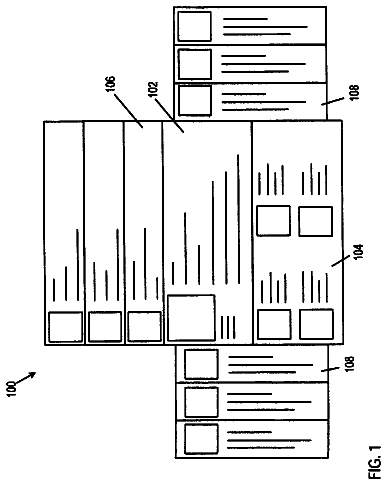
Sheet 1 of 33 from the published document. All sheets in the USPTO PDF
Improved approaches to allow a portable electronic device to dynamically present location-specific information while the portable electronic device is at a predetermined location are disclosed. In one embodiment, the portable electronic device has a display that can display the location-specific information and has wireless capabilities for use in receiving the location-specific information from the server. The location-specific information can, for example, augment other information that is to be presented on the display. In one embodiment, the location-specific information can be information pertaining to a media item being played in an establishment, such as a store, where the portable electronic device is located.
Businesses normally couple to the Internet by way of a leased line, such as a T1 line. Patrons (e.g., customers) to these businesses can also be permitted to access the Internet over the leased line by way of a router at the business location. In some cases, the router is a wireless router such that the patrons can gain access to the leased line by way of local wireless connections (e.g., WiFi). Some businesses, or independent network service providers that provide network access services at the businesses, charge patrons for Internet access, while other businesses offer network access free of charge. Regardless, once Internet access is provided, patrons are typically free to navigate the network. Businesses can also play music, movies or music videos at their establishments for the benefit of employees and patrons. When a patron hears a song being played at the store, the patron could (
1 of 33 drawing sheets so far from the published document, cropped to the drawing. Every sheet is in the USPTO PDF.
What the patent claimed, word for word. All of it is now free to use.
This application hereby references U.S. patent application Ser. No. 11/849,865, filed Sep. 4, 2007, entitled "DYNAMIC PRESENTATION OF LOCATION-SPECIFIC INFORMATION", which is herein incorporated by reference.
A portion of the disclosure of this patent document contains material that is subject to copyright protection. The copyright owner has no objection to the facsimile reproduction by anyone of the patent document or the patent disclosure as it appears in the U.S. Patent and Trademark Office patent file or records, but otherwise reserves all copyright rights whatsoever.
The present invention relates to providing location-specific data and, more particularly, to providing location-specific data to patrons of a store.
Businesses normally couple to the Internet by way of a leased line, such as a T1 line. Patrons (e.g., customers) to these businesses can also be permitted to access the Internet over the leased line by way of a router at the business location. In some cases, the router is a wireless router such that the patrons can gain access to the leased line by way of local wireless connections (e.g., WiFi). Some businesses, or independent network service providers that provide network access services at the businesses, charge patrons for Internet access, while other businesses offer network access free of charge. Regardless, once Internet access is provided, patrons are typically free to navigate the network.
Businesses can also play music, movies or music videos at their establishments for the benefit of employees and patrons. When a patron hears a song being played at the store, the patron could (while still at the establishment) attempt to remember the name of the song and then navigate to a portion of an online media store, e.g., iTunes.TM. media store, that offers the media content of the song for purchase. The navigation, however, can be cumbersome particularly when the patron does not know the exact name of the song. There can also be various versions (e.g., remixes, live version, acoustic version, clean version, explicit version) of some songs which can further complicate the navigation. These complications in navigation can frustrate a patron and cause them to fail to locate the desired song in the online media store. Electronic commerce (e-commerce) activity with respect to such songs, such as purchasing digital versions for download, can be frustrated given that locating of a particular song being played in an establishment on an online media store can be cumbersome.
Therefore, there is a need for improved approaches to assist patrons of businesses playing media items with the purchase or review of media items at an online media store.
The invention pertains to improved approaches to allow a portable electronic device to dynamically present location-specific information while the portable electronic device is at a predetermined location. In one embodiment, the portable electronic device has a display that can display the location-specific information and has wireless capabilities for use in receiving the location-specific information from the server. The location-specific information can, for example, augment other information that is to be presented on the display. In one embodiment, the location-specific information can be information pertaining to a media item being played in an establishment, such as a store, where the portable electronic device is located.
The invention can be implemented in numerous ways, including as a method, system, device, or apparatus (including computer readable medium or graphical user interface). Several embodiments of the invention are discussed below.
In one embodiment of the invention, a graphical user-interface for a portable electronic device is disclosed. The graphical user-interface contains location-specific or establishment-specific display panels, which display establishment-specific information such as an enhanced online media store. In addition, some establishment-specific display elements only appear when location specific or establishment-specific online media store content is available. Additionally, establishment-specific information can include media information about a media item that is currently playing, for instance over a media-play system, in a particular establishment. Another establishment specific display shows media information about media content that has been recently played in a particular establishment.
In another embodiment of the invention, a graphical user-interface for a portable electronic device is disclosed. In this embodiment, a display panel that displays location-specific information about a currently playing media asset and one or more device controls for purchasing at least the media asset being displayed are shown in the graphical user-interface
In another embodiment of the invention, graphical user-interface for a portable electronic device that displays a two-state `Buy` button for purchasing displayed media assets is disclosed. The two state button changes its appearance based on how many times the button has been operated. According to one embodiment of the invention, if the two-state `Buy` button has not been operated, then the two-state `Buy` button displays a price for one or more displayed media assets. If the button has been operated (i.e., tapped on or clicked on) twice, then the two-state `Buy` button displays a purchase confirmation for the purchase of that media item.
In one embodiment of the invention, a graphical user-interface for a portable electronic device that allows a user to display, preview, and obtain more information about a media asset is disclosed. In this embodiment, a single media asset is previewed by single-tapping a displayed media while double-tapping on that a single media asset displays a media asset collection associated with that single media asset, for example a double tapping on a displayed music single will display a music album associated with that music single.
In still another embodiment of the invention, a graphical user interface for a portable electronic device having an associated display is disclosed. In this embodiment, the graphical user interface includes at least a page of information displayed on the display, and a location-specific module that displays location-specific information on the page.
Other aspects and advantages of the invention will become apparent from the following detailed description taken in conjunction with the accompanying drawings which illustrate, by way of example, the principles of the invention.
The invention will be readily understood by the following detailed description in conjunction with the accompanying drawings, wherein like reference numerals designate like structural elements, and in which:
FIG. 1 is a block diagram of a media delivery system according to one embodiment of the invention.
FIG. 2 is a flow diagram of a page request process according to one environment of the invention.
FIG. 3 is a flow diagram of a data request process according to one embodiment of the invention.
FIGS. 4A and 4B are flow diagrams of a page request process according to another embodiment of the invention.
FIG. 5 is a flow diagram of a page response process according to still another embodiment of the invention.
FIG. 6 is a flow diagram of a page customization process according to one embodiment of the invention.
FIG. 7 is a diagram of a navigation arrangement according to one embodiment of the invention.
FIG. 8 is a diagram of an exemplary page according to one embodiment of the invention.
FIG. 9A is a diagram of a now playing module according to one embodiment of the invention.
FIG. 9B is a diagram of a now playing module according to another embodiment of the invention.
FIG. 10 is a screenshot of an exemplary media store home page according to one embodiment of the invention.
FIG. 11 is a screen shot of an exemplary recently played page according to one embodiment of the invention.
FIG. 12 is a screenshot of an exemplary media store internal page according to one embodiment of the invention.
FIG. 13 is a screenshot of an exemplary redeem page according to one embodiment of the invention.
FIG. 14(a) is a block diagram of a portable electronic media store graphical user interface according to one embodiment of the invention.
FIG. 14(b) is a block diagram of an exemplary media store navigation display panel according to one embodiment of the invention.
FIG. 14(c) is a block diagram of an exemplary featured artist display panel, according to one embodiment of the invention.
FIG. 14(d) a block diagram of an exemplary media browser display panel according to one embodiment of the invention.
FIG. 14(e) a block diagram of an exemplary device control panel, according to one embodiment of the invention.
FIG. 15(a) is a block diagram of a portable electronic media store graphical user interface according to one embodiment of the invention.
FIG. 15(b) is a block diagram of an exemplary media store navigation display panel according to one embodiment of the invention.
FIG. 15(c) is a block diagram of an exemplary featured artist display panel, according to one embodiment of the invention.
FIG. 15(d) is a block diagram of an exemplary media browser display panel according to one embodiment of the invention.
FIG. 15(e) is a block diagram of an exemplary device control panel, according to one embodiment of the invention.
FIG. 15(f) is a block diagram of an exemplary transition between a device control panel and a device control panel according to one embodiment of the invention.
FIG. 16(a) is a block diagram of an enhanced portable electronic media store user-interface according to one embodiment of the invention.
FIG. 16(b) is a block diagram of an exemplary `Now Playing` display panel, according to one embodiment of the invention
FIG. 16(c) is a block diagram of an exemplary `Recently Played Songs` display panel, according to one embodiment of the invention.
FIG. 16(d) is a block diagram of an exemplary device control panel, according to one embodiment of the invention.
FIG. 17 is a portable media device media store purchase interface, according to one embodiment of the invention
FIG. 18 is a portable media device media store browsing and previewing interface, according to one embodiment of the invention.
FIG. 19 is an exemplary portable media device graphical user interface tree, according to one embodiment of the invention.
FIGS. 20-27 are screenshots of various specific combinations of display panels and device control panels.
FIG. 28 is a block diagram of a mobile multi-function device according to one embodiment of the invention.
The invention pertains to improved approaches to allow a portable electronic device to dynamically present location-specific information while the portable electronic device is at a predetermined location. In one embodiment, the portable electronic device has a display that can display the location-specific information and has wireless capabilities for use in receiving the location-specific information from the server. The location-specific information can, for example, augment other information that is to be presented on the display. In one embodiment, the location-specific information can be information pertaining to a media item being played in an establishment, such as a store, where the portable electronic device is located.
Embodiments of the invention are discussed below with reference to FIGS. 1-28. However, those skilled in the art will readily appreciate that the detailed description given herein with respect to these figures is for explanatory purposes as the invention extends beyond these limited embodiments.
FIG. 1 is a block diagram of a media delivery system 100 according to one embodiment of the invention. The media delivery system 100 includes an online media store server 102 that couples to a data network 104. The online media store can offer digital media assets (e.g., media items) for purchase, rental, preview, etc. One example of an online media store is iTunes.TM. media store operated by Apple Inc. of Cupertino, Calif. The data network 104 can include one or more networks, which can be not only public or private but also wired or wireless. The media delivery system 100 also includes equipment at a store location 106, a central store server 108 and a regional cache server 110, each of which can also couple to the data network 104. Although the media delivery system 100 illustrates only a single store location, namely, the store location 106, it should be understood that the media delivery system 100 typically supports a plurality of different store locations in different geographical locations.
The online media store server 102 hosts an online media store from which digital media assets can be acquired (e.g., purchased). On acquisition of a digital media asset, media content for the purchased digital media asset can be delivered to the purchaser. More particularly, the media content can be delivered to an electronic device (media device) associated with the user. In one scenario, the purchaser has interacted with the online media store server 102 from the store location 106 using an electronic device, such as a portable electronic device. In such case, the media content for the digital media asset can be delivered to the electronic device associated with the purchaser while residing at the store location 106.
The store location 106 includes a wireless network 112 and a store cache server 114. The wireless network 112 and/or the store cache server 114 can couple to the data network 104. Additionally, at the store location 106, one or more media devices 116 and 118 can be coupled to the wireless network 112. The wireless access network 110 can, for example, by a local area wireless network generally associated with the first store 104. One specific example of a local area wireless network is a WiFi network. Accordingly, patrons to the store location 106 that have a portable electronic device that supports wireless communication are able to communicate with the online media store server 102 by way of the data network 108 and the wireless access network 112. In doing so, the patron may purchase or otherwise acquire media content pertaining to a media item that is offered for acquisition (e.g., purchase, rental, etc.) by the online media store server 102.
Typically, the media devices 116 and 118 are portable electronic devices that are associated with persons (patrons) visiting the store location 106. When the media devices 116 and 118 are within the store location 106, the electronic devices, assuming that they support wireless communications, are able to access the wireless network 112 associated with the store location 106. As such, the media devices 116 and 118 are able to communicate to the online media store server 102 by way of the wireless network 112 and the data network 104. In the event that a user of one of the media devices 116 and 118 purchases is a digital media asset from the online media store server 102, the media content associated with the purchased digital media asset can be delivered to the media device 116 or 118 associated with the user.
In one embodiment, the central store server 108 operates in advance to store to the store cache server 114 at the store location 106 the likely required media content. Consequently, media content for a purchased digital media asset can be delivered locally at the store location 106 from the store cache server 114 to the requesting media device 116 or 118 via the wireless network 112. As such, the delivery of the media content is not required to be requested and returned from a remote server by way of the data network 104 or a network access link thereto which can suffer from network traffic or congestion. In one embodiment, the purchased digital media asset can be delivered directly from the store cache server 114. In another embodiment, the purchased digital media asset can be delivered from the online media store 102 or other remote server.
The store location 106 can also support a media play system 120. The media play system 120 can also be coupled to the data network 104. By being coupled to the data network 104, the central store server 108 can operate to manage the operation of the media play system 120 at the store location 106. In one embodiment, the media play system 120 operates to play media items at the store location 106. For example, the media play system 120 can cause songs and/or videos to be played at the store location 106 for the benefit of employees and patrons. The central store server 108 can centrally manage the media items that are to be played at the store location 106. In one embodiment, the media items being played by the media play system 120 are media items that are also offered for purchase by the online media store server 102.
The networking components in the store location 106 can couple to the data network 104 via a network access link 122. The network access link 122 is a shared network access resource, such as a lease line (e.g., T1 line) to the data network 104. The wireless network 112, the store cache server 114 and the media play system 120 can access the data network 104 via the network access link 122.
As an example of one usage scenario, a user at the store location 106 could hear a media item being played by the media play system 120 and elect to interact with the online media store server 102 to purchase the media item. As such, should a user of the media device 116 request to purchase such a media item from the online media store server 102 while at the store location 106, the media content for the purchased media item can be delivered to the media device 116.
In one embodiment, the media content for the media items that are to be delivered and stored in the store cache server 114 can be made available from the regional cache server 110. The regional cache server 110 is remotely located from the store location 106 but within a similar regional or metropolitan area as is the store location 106. Hence, the delivery of the media content to the store cache server 114 can efficiently utilize the regional cache server 110 to offload or distribute server loads for media content delivery. The regional cache server 110 can also be referred to as an edge server.
Although the media delivery system 100 is illustrated in FIG. 1 as having one store at the store location 106, it should be understood that the media delivery system 100 is suitable for use with one or more stores. Typically, a particular retailer will have a plurality of retail stores in different geographical locations. With all of the stores coupled to the data network 104, such as a global public network, the central store server 108 can manage the media being played in any of the plurality of retail stores. Consequently, these various retails stores can allow its patrons to wirelessly access a remote online media store while at a store location.
In one embodiment, the network or the networking infrastructure (e.g., WiFi wireless network) at the store facilitates access to the global network and can also inform another device (e.g., the electronic device and/or server) as to whether or not the electronic device is within the store. Various other ways can be used to determine whether an electronic device is within a store, such as using location technology (e.g., GPS, triangle navigation, or localized beacons).
FIG. 2 is a flow diagram of a page request process 200 according to one environment of the invention. The page request process 200 is performed by a client device. The client device is an electronic device, namely, a portable electronic device. For example, the client device can be the media device A 116 or the media device B 116 illustrated in FIG. 1.
The page request process can begin with a decision 202. In the decision 202 can determine whether a page request is to be issued to a remote server. As an example, the remote server can pertain to the online media store server 102 illustrated in FIG. 1. When the decision 202 determines that a page request is not to be made to a remote server, other processing can be optionally performed 204. The other processing being performed 204 can be associated with various other features, applications or modules that are available on the client device. Following the block 204, the page request process 200 can return to repeat the decision 202.
When the decision 202 determines that a page request has been made to a remote server, a decision 206 can determine whether the client device is in a store. There are various different techniques that can be utilized to determine whether the client device is within a particular store. In one implementation, a local network available at the store can provide a store identifier to the client device when the client device accesses the local area network (e.g., wireless network 112), thereby signifying to the device that the client device is currently at the particular store identified by the store identifier. For example, the store cache server 114 can operate to attach a store identifier to a response header being sent to the client device.
When the decision 206 determines that the device is in a store, a request for a page with stored-based information can be sent 208. The request is sent 208 over one or more networks to the remote server. On the other hand, when the decision 206 determines that the client device is not in a store, a request for a page without store-based information can be sent 210. The request can be sent 210 over one or more networks to the remote server. Following the blocks 208 and 210, a decision 212 determines whether the requested page has been received. Here, in the page request process 200 is waiting to receive the requested page from the remote server. However, with reference to FIG. 1, it should be recognized that the requested page can be returned from not only the online media store server 102 but also a cache server, such as the store cache server 114 or the regional cache server 110. When the decision 212 determines that the requested page has been received, the requested page can be presented 214 on the client device. Typically, the client device includes a display and the requested page can be displayed on the display. The requested page can thus provide a graphical user interface (e.g., display screen).
Depending on whether or not the client device is within a store, the requested page being displayed may or may not display store-based information. Also, the store-based information when provided is typically only a portion of the requested page. Following the block 214, the page request process 200 can return to repeat the decision 202 and subsequent operations so that additional page requests can be similarly processed.
FIG. 3 is a flow diagram of a data request process 300 according to one embodiment of the invention. The data request process 300 is processing performed by a server. For example, the server can be an online media store server, such as the online media store server 102 illustrated in FIG. 1.
The data request process 300 can begin with a decision 302. The decision 302 determines whether a data request has been received. When the decision 302 determines that a data request has not been received, other processing can optionally be performed 304 by the server. The other processing 304 is, for example, various other different types of data or information requests, such as requests to browse, search, preview or purchase media items available on an online media store hosted by the online media store server. Following the block 304, the data request process 300 returns to repeat the decision 302.
When the decision 302 determines that a data request has been received, a store identifier associated with the location of the requesting electronic device (e.g., computing device) can be obtained 306. For example, in one implementation, the store identifier can be provided with the data request and thus obtained 306 from the data request. Next, store-based information associated with the store can be retrieved 308 based on the store identifier. In one implementation, the store-based information for the particular store associated with the store identifier can be retrieved 308 from a server that stores or manages information for various stores, such as the central store server 108 illustrated in FIG. 1. A data response including at least the store-based information can then be formed 310. The data response can then be sent 312 to the requesting electronic device. Following the block 312, the data request process 300 can return to repeat the decision 302 and subsequent blocks so that subsequent data requests can be similarly processed.
The store-based information being requested or received by the page request process 200 or the data request process 300 can vary with implementation. One example of store-based information is media playing information associated with a particular store. The store-based information can, for example, indicate a particular media item (e.g., song, movie, music video, etc.) that is playing at a store. The client device can present a graphical user interface relevant to the particular media item. The graphical user interface can display descriptive information concerning the particular media item. For example, in the case of a song, the descriptive information can include artist, album, and song name. The graphical user interface can also facilitate navigation to additional related information for review or purchase of media items.
FIGS. 4A and 4B are flow diagrams of a page request process 400 according to one embodiment of the invention. The page request process 400 is, for example, performed by a client device, such as a media device or other electronic device having wireless networking capability and a display screen. In one embodiment, the client device is a portable computing device (e.g., laptop computer) having wireless data capabilities. In another embodiment, the client device is a mobile phone having wireless voice and wireless data capabilities.
The page request process 400 can begin with a decision 402 that determines whether a wireless network is available. The wireless network is generally commensurate with the location of a store. Consequently, the availability of the wireless network to the client device can serve as an indication that the client device (and thus its user) is physically present at the store. On the other hand, when the wireless network is not available to the client device, it is can serve as an indication that the client device (and thus its user) is not physically at the store.
When the decision 402 determines that a wireless network is available to the client device, a decision 404 can determine whether a media management application has been launched. When the decision 404 determines that a media management application has not been launched, a decision 406 can determine whether the network browser has been launched. When the decision 406 determines that a network browser has not been launched, and then the page request process 400 returns to repeat the decision 402. Accordingly, further processing by the page request process 400 can require either launching of a media management application or a network browser. One example of media management application is the iTunes.TM. application program available from Apple Inc. of Cupertino Calif. One example of a network browser is Safari.TM. network browser available from Apple Inc. of Cupertino, Calif.
When the decision 406 determines that a network browser has launched, a decision 408 can determine whether to navigate to an online store (e.g., online media store). When the decision 408 determines that the network browser (or its user) is not attempting to navigate to an online store, navigation can be restricted 412 such that only certain approved network destinations are accessible. Here, according to one embodiment, the wireless network being utilized by the network browser can limit the ability for the network browser to access network destinations that are not approved. For example, the page request process 400 could permit the network browser to access only those network addresses that are listed in a set of approved network addresses. Attempts to access other non-approved network destinations could then be restricted 410. As an example, network access can be blocked for non-paying users but permitted for paying users.
On the other hand, when the decision 404 determines that a media management application has launched or when the decision 408 determines that the network browser has been utilized to navigate to an online store that is approved for access, the page request process 400 can continue. In particular, when the page request process 400 continues, an online store page request can be sent 412. Here, the online store page request can be sent 412 to a server, such as an online media store server that hosts an online store. The online store page request requests information available from the online store. In addition, a store identifier can be sent 414 with or associated to the online store page request.
A decision 416 determines whether the requested page has been received. When the decision 416 determines that the requested page has not been received, the page request process 400 can await the requested page. On the other hand, when the decision 416 determines that the requested page has been received, the requested page can be displayed 418.
Next, a decision 420 determines whether another online store page request has been received. When the decision 420 determines that another online store page request has been received, the page request process 400 can return to repeat the block 412 and subsequent blocks so that the other online store page request can be similarly processed. Here, it is assumed that the another online store page request is with respect to the same online store, and thus still an improved network destination. On the other hand, when the decision 420 determines that another online store page request has not been received, a decision 422 determines whether a purchase request has been received. When the decision 422 determines that a purchase request has not been received, then other processing can be optionally performed 424 prior to returning to repeat the decision 420. The other processing can be other actions that can be performed with respect to the requested page that is being displayed 418.
On the other hand, when the decision 422 determines that a purchase request has been received, the one or more items being purchased can be processed 428. The media content associated with the purchased item can then be downloaded 430 to the device. Depending on the type of client device being used, some items that can be purchased may or may not be useable on the client device. Hence, in one embodiment, items that have been purchased that are either too cumbersome to download or not useful on the client device are not delivered (e.g., downloaded) to the client device. In one embodiment, such items that are not delivered to the client device can be subsequently delivered to another device associated with the requestor (purchaser).
Next, a decision 434 determines whether the page request process 400 should stop. When the decision 434 determines that the page request process 400 should not stop, the page request process 400 can return to repeat the block 412 and subsequent blocks. On the other hand, when the decision 434 determines that the page request process 400 should stop, the page request process 400 can end.
FIG. 5 is a flow diagram of a page response process 500 according to one embodiment of the invention. The page response process 500 is, for example, performed by a server. For example, the server can be an online media store server, such as the online media store server 102 illustrated in FIG. 1.
The page response process 500 can begin with a decision 502 that determines whether a page request has been received from a requester. When the decision 502 determines that a page request has not been received, the page response process 500 can await such a request. Once the decision 502 determines that a page request has been received from a requester, a decision 504 it can determine whether a store identifier is associated with the request. In this regard, the page request itself can directly include the store identifier or the page request can indirectly reference the store identifier. The store identifier is an identification of a particular store from which the requestor (namely, a client device used by the requester) is located.
When the decision 504 determines that the page request has a store identifier associated with it, store-based information associated with a store using the store identifier can be requested 506. In one embodiment, the store-based information for a store is requested from a server, such as the central store server 108 illustrated in FIG. 1. Next, a decision 508 determines whether store-based information has been received. When the decision 508 determines that the stored-based information has been received, a requested page can be formed 510 with the requested page including or referencing at least the store-based information.
Alternatively, when the decision 508 determines that store-based information is not received, then the page response process 500 can assume that the store-based information is currently unavailable and thus form 512 the requested page without any store-based information. Also, when the decision 504 determines that the page request does not have a store identifier associated therewith, the page response process 500 can form 512 the requested page without any store-based information. Following the block 510 or the block 512, the page response process 500 can operate to send a 514 the requested page to the requester. After the requested page has been sent 514, the page response process 500 can return to repeat the decision 502 and subsequent blocks so that a subsequent page request can be similarly processed.
In the page response process 500, a page is returned to a requester. In one embodiment, the page returned to the requestor can be displayed on the client device used by the requester. If the requestor is at a particular store that supports monitoring of store-based information, the displayed page can include store-based information as well as other content. For example, the store-based information can pertain to one or more items being played at the store and the other content can be information about one or more media items available for purchase on an online media store. Alternatively, If the requester is not at a store that supports monitoring of store-based information, the displayed page can include the other content without the store-based information.
In an alternative embodiment, a server can evaluate whether the client device is in a store and form (e.g., select, generate) the appropriate page to be delivered to the client device. In contrast, in other embodiment such as discussed above, a client device understands that it is in a store and requests the appropriate pages (data) from the server. In either case, store-based information can be delivered to a client device which can present a graphical user interface (or display screen) using the store-based information.
FIG. 6 is a flow diagram of a page customization process 600 according to one embodiment of the invention. The page customization process 600 is, for example, performed by a server such as an online media store server that hosts an online media store.
The page customization process 600 can begin with a decision 602. The decision 602 can determine whether a page request has been received. When the decision 602 determines that a page request has not been received, the page customization process 600 can await such a request. However, once the decision 602 determines that a page request has been received, the page customization process 600 can perform further processing to service the page request. In this regard, once the decision 602 determines that a page request has been received, a decision 604 can determine whether the requestor for the page is in a store. Here, the requestor (user) operates an electronic device (client device), such as a portable electronic device. The portable electronic device can be carried by its user to various different locations. In some of those locations, the portable electronic device may be able to gain wireless access to a network, such as a WiFi network, which in turn enables access to a global network (e.g., the Internet). In such cases, the decision 604 of the page customization process 600 can determine whether the requester, namely, the electronic device used by the requester, is in a store. If the electronic device is in a store, it can be assumed that the portable computing device has wireless access to a local network within the store. In one embodiment, the network or the networking infrastructure (e.g., WiFi wireless network) at the store facilitates access to the global network and can also inform another device (e.g., the electronic device and/or server) as to whether or not the electronic device is within the store. Various other ways can be used to determine whether an electronic device is within a store, such as using location technology (e.g., GPS, triangle navigation, or localized beacons).
When the decision 604 determines that the requestor (electronic device) is within a store, a page can be formed 606 that includes store-based information. In one embodiment, the page has its ordinary content (default content) and the store-based information is additional content that is included in the page. Alternatively, when the decision 604 determines that the requestor (electronic device) is not in a store, the page can be formed 608 without including store-based information. In one embodiment, the page that is formed 608 thus includes only its ordinary content.
Following the blocks 606 and 608, the formed page can be sent 610 to the client device associated with the requestor. Following the block 610, a decision 612 can determine whether the page customization process 600 should stop. When the decision 612 determines that the page customization process 600 should not stop, then the page customization process 600 returns to repeat the decision 602 and subsequent blocks so that another page request could be similarly processed. Alternatively, when the decision 612 determines that the page customization process 600 should stop, then the page customization process 600 can end.
As used herein, a page can refer to a graphical user interface or a display screen that can be presented on a display device.
According to one aspect of the invention location-specific information, such as store-specific information, can be presented on a display associated with a computing device while resident at an establishment. The location-specific information can be presented as a graphical user interface, such as a screen or page presented on a display of the computing device. The portable computing device can, for example, be a portable electronic device having a display, such as a portable computer (e.g., notebook or laptop computer), personal digital assistant, or mobile communication device.
The description continues in the full USPTO document.
About 6,461 words. The USPTO PDF has it with every drawing.
Fees are due 3.5, 7.5 and 11.5 years after grant. This patent expired on March 4, 2026, so the fee marked "not paid" was the one that went unpaid.
Graphical User Interface with Location-Specific Interface Elements
Filed Sep 2007 · published Mar 2009Graphical user interface with location-specific interface elements
Filed Sep 2007 · granted Mar 2014Earlier publications, parents and continuations. None of them can still be enforced, or this patent would not be listed.
Prior art cited by the examiner or applicant. Useful when you check your own idea for novelty.
Everything on this page comes from the documents linked above.