Patent Yard Sign in
Lapsed, fee not paid

Extended noise mode

US 8,649,877 B2 · Assignee: Biotronik CRM Patent AG · Inventors: Doerr; Thomas et al.

USPTO PDF

Overview

Sheet 1 of 4 from the published document. All sheets in the USPTO PDF

Abstract From the patent

A device and a method for working in the presence of electromagnetic fields, in particular fields occurring in cautery applications. Also relates to a partially implanted medical device (IMD), having a unit for detecting electromagnetic interference fields, at least one control unit, a timer, and a detection unit for electrical measured variables and/or a stimulation unit, at least one electrode line having an electrode at one end which is brought into contact with bodily tissue, and which either extends inside the body and/or is situated on the surface of an implant, wherein when nonphysiological signals and/or electromagnetic interference fields are detected and the unit for electromagnetic interference fields evaluates the detected signals as nonphysiological signals for a first specifiable time period, and/or for a second specified time period the stimulation unit is placed in an asynchronous operating state in which the wearer of the IMD is asynchronously stimulated.

Why it's free to use

  • The USPTO Official Gazette of April 7, 2026 lists it as expired on February 11, 2026 for an unpaid maintenance fee.
  • It isn't on any reinstatement notice published since.
  • Its 1 US relative has also lapsed, expired or never issued.
  • We check US rights only. Check foreign counterparts before selling abroad.
FiledDecember 18, 2010
GrantedFebruary 11, 2014
Expired (fee)February 11, 2026
Application number12/972463
Classification (CPC)A61N1/37 +1 more
Length14 claims · 9 pages

Background From the patent

Although cautery applications are becoming increasingly important in medicine, particularly in surgical procedures and in conjunction with damaged vessels, such applications are contraindicated for some patients. Such contraindication may result from an at least partially implanted medical device (also referred to below as "implant" or "IMD"), in particular for so-called implanted cardiverter-defribillator (ICD) patients. Cautery applications in the prior art primarily involve electrical cautery, i.e., cautery that is carried out using an object, for example a thin wire, which is heated by current flow. Cautery is also referred to as "diathermy". Distinctions are made among electrical high-frequency diathermy, ultrasonic diathermy, and microwave diathermy. Ultrasonic diathermy is generally considered to be noncritical for IMD wearers, whereas high-frequency diathermy and microwave diathe

Drawings 4

1 of 4 drawing sheets so far from the published document, cropped to the drawing. Every sheet is in the USPTO PDF.

Figures as described

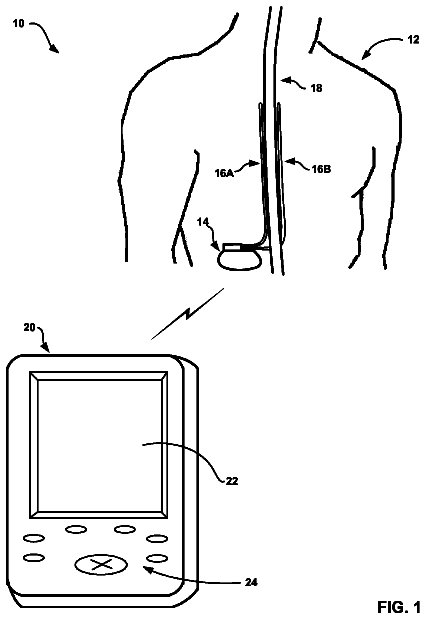
  • FIG. 1 shows a schematic illustration of the starting situation for pulsed interferences
  • FIG. 2 shows a block diagram of a cardiac stimulator according to the invention
  • FIG. 3 shows a schematic illustration of the control of the mode switcher illustrated in FIG. 2
  • FIG. 4 shows an example of a situation using the approach according to the invention

Claims 14 total, 3 independent

What the patent claimed, word for word. All of it is now free to use.

  1. 1
    Independent claimAt least partially implantable medical device comprising a unit configured to detect electromagnetic interference fields, wherein said unit comprises at least one sensor or indicator configured to detect electromagnetic interference fields and detect and identify nonphysiological signals; at least one control unit connected to the unit configured to detect electromagnetic interference fields, comprising a timer and a detection unit for electrical measured variables and a stimulation unit; at least one electrode line comprising a first end and a second end, wherein said at least one electrode line is connected at said first end to the at least one control unit and to the unit configured to detect electromagnetic interference fields, said second end opposite the first end comprises an electrode configured to be in contact with bodily tissue, and wherein said at least one electrode line is configured to extend inside a body and be situated on a surface of the least partially implantable medical device; wherein said unit configured to detect electromagnetic interference fields is further configured to evaluate the detected signals as nonphysiological signals for a first specifiable time period, and for a second specified time period, the stimulation unit is configured to be placed in an asynchronous operating state such that a wearer of the at least partially implantable medical device is asynchronously stimulated, when nonphysiological signals and electromagnetic interference fields are detected; wherein the asynchronous operating state is activated for the second specified time period whenever at least one stimulation pulse has been emitted, with simultaneous detection of nonphysiological signals, or with detection of electromagnetic interference fields or with both simultaneous detection of nonphysiological signals and with detection of electromagnetic interference fields.
  2. 2
    The at least partially implantable medical device according to claim 1, wherein the at least partially implantable medical device is an implantable or external stimulator.
  3. 3
    The at least partially implantable medical device according to claim 1, wherein the asynchronous operating state is activated for the second specified time period whenever a predeterminable minimum number of nonphysiological signals is detected in a predeterminable time window.
  4. 4
    The at least partially implantable medical device according to claim 1, wherein the asynchronous operating state is an A00, V00, or D00 operating state.
  5. 5
    The at least partially implantable medical device according to claim 1, wherein the asynchronous operating state includes biventricular stimulation.
  6. 6
    The at least partially implantable medical device according to claim 1, wherein the asynchronous operating state is associated with a change in stimulation frequency, wherein asynchronous stimulation frequency is calculated from a heart rate before a detected electromagnetic interference and detection of said nonphysiological signals.
  7. 7
    The at least partially implantable medical device according to claim 1, wherein the asynchronous operating state is associated with a change in a stimulation amplitude, change in a stimulation pulse width, or any combination thereof.
  8. 8
    The at least partially implantable medical device according to claim 1, wherein the detected signals are evaluated as said nonphysiological signals, and the asynchronous operating state is activated for only a specifiable time period by detection of nonphysiological signals and electromagnetic interference fields.
  9. 9
    The at least partially implantable medical device according to claim 8, wherein the specifiable first time period is in a range of hours, days, or any combination thereof.
  10. 10
    The at least partially implantable medical device according to claim 1, wherein the unit configured to detect electromagnetic interference fields includes at least one of the following sensors or indicators: GMR sensor, MagFET sensor, Hall sensor, electro-optical converter, battery voltage sensor configured to monitor voltage during capacitor charging, RF field detector, magnetic gradient field detector, current detector for currents induced by electromagnetic fields.
  11. 11
    The at least partially implantable medical device according to claim 6, wherein said asynchronous stimulation frequency calculated from a heart rate includes adding a predeterminable number of heartbeats per time unit to the heart rate.
  12. 12
    Independent claimA method comprising: detecting electromagnetic fields via an at least partially implantable medical device; wherein said at least partially implantable medical device continues to work in the presence of said electromagnetic fields; and wherein said partially implantable medical device comprises a unit configured to detect electromagnetic interference fields, wherein said unit comprises at least one sensor or indicator configured to detect electromagnetic interference fields and detect and identify nonphysiological signals; at least one control connected to the unit configured to detect electromagnetic interference fields, comprising a timer and a detection unit for electrical measured variables and a stimulation unit; at least one electrode line comprising a first end and a second end, wherein said at least one electrode line is connected at said first end to the at least one control unit and to the unit configured to detect electromagnetic interference fields, said second end opposite the first end comprises an electrode configured to be in contact with bodily tissue, and wherein said at least one electrode line is configured to extend inside a body and be situated on a surface of the least partially implantable medical device; wherein said unit configured to detect electromagnetic interference fields is further configured to evaluate the detected signals as nonphysiological signals for a first specifiable time period, and for a second specified time period, the stimulation unit is configured to be placed in an asynchronous operating state such that a wearer of the at least partially implantable medical device is asynchronously stimulated, when nonphysiological signals and electromagnetic interference fields are detected; wherein the asynchronous operating state is activated for the second specified time period whenever at least one stimulation pulse has been emitted, with simultaneous detection of nonphysiological signals, or with detection of electromagnetic interference fields or with both simultaneous detection of nonphysiological signals and with detection of electromagnetic interference fields.
  13. 13
    The method of claim 12, wherein the asynchronous operating state is associated with a change in stimulation frequency, wherein asynchronous stimulation frequency is calculated from a heart rate before a detected electromagnetic interference and detection of said nonphysiological signals.
  14. 14
    Independent claimAt least partially implantable medical device comprising a unit configured to detect electromagnetic interference fields, wherein said unit comprises at least one sensor or indicator configured to detect electromagnetic interference fields and detect and identify nonphysiological signals; at least one control unit connected to the unit configured to detect electromagnetic interference fields, comprising a timer and a detection unit for electrical measured variables and a stimulation unit; at least one electrode line comprising a first end and a second end, wherein said at least one electrode line is connected at said first end to the at least one control unit and to the unit configured to detect electromagnetic interference fields, said second end opposite the first end comprises an electrode configured to be in contact with bodily tissue, and wherein said at least one electrode line is configured to extend inside a body and be situated on a surface of the least partially implantable medical device; wherein said unit configured to detect electromagnetic interference fields is further configured to evaluate the detected signals as nonphysiological signals for a first specifiable time period, and for a second specified time period, the stimulation unit is configured to be placed in an asynchronous operating state such that a wearer of the at least partially implantable medical device is asynchronously stimulated, when nonphysiological signals and electromagnetic interference fields are detected; wherein the asynchronous operating state is activated for the second specified time period whenever at least one stimulation pulse has been emitted, with simultaneous detection of nonphysiological signals, or with detection of electromagnetic interference fields or with both simultaneous detection of nonphysiological signals and with detection of electromagnetic interference fields; and, wherein the asynchronous operating state is associated with a change in stimulation frequency, wherein asynchronous stimulation frequency is calculated from a heart rate before a detected electromagnetic interference and detection of said nonphysiological signals, wherein the asynchronous operating state is activated for the second specified time period whenever a predeterminable minimum number of nonphysiological signals is detected in a predeterminable time window, and wherein said asynchronous stimulation frequency calculated from a heart rate includes adding a predeterminable number of heatbeats per time unit to the heart rate.

Claim map

Independent claims stand on their own. The others add detail to the claim they name.

Claim 110 claims build on it
Claim 121 claim builds on it
Claim 14No claims build on it

Description

Background of the invention

1. Field of the invention

Embodiments of the invention relate to a device and a method for working in the presence of electromagnetic fields, in particular fields occurring in cautery applications.

2. Description of the related art

Although cautery applications are becoming increasingly important in medicine, particularly in surgical procedures and in conjunction with damaged vessels, such applications are contraindicated for some patients. Such contraindication may result from an at least partially implanted medical device (also referred to below as "implant" or "IMD"), in particular for so-called implanted cardiverter-defribillator (ICD) patients.

Cautery applications in the prior art primarily involve electrical cautery, i.e., cautery that is carried out using an object, for example a thin wire, which is heated by current flow. Cautery is also referred to as "diathermy". Distinctions are made among electrical high-frequency diathermy, ultrasonic diathermy, and microwave diathermy. Ultrasonic diathermy is generally considered to be noncritical for IMD wearers, whereas high-frequency diathermy and microwave diathermy may interfere with an IMD.

To still allow cautery applications, in particular using high-frequency diathermy and microwave diathermy, primarily asynchronous operating modes for pacemakers and ICD patients are known. These have the disadvantage that a considerable proarrhythmic risk results from asynchronous stimulation. Unnecessary asynchronous stimulation is contraindicated, especially for ICD patients.

Currently known interference detectors for all established pacemaker (IPG) and ICD systems cannot be used for this purpose, since such detectors depart from asynchronous interference mode immediately after onset of the interference. Thus, these detectors fail in the presence of pulsed interferences, which occur in cautery applications, among others.

Brief summary of the invention

The object of one or more embodiments of the invention is to provide a device and a method for medical devices and implantable medical devices which eliminate the disadvantages of the prior art and allow safe operation in the presence of electromagnetic interference fields, in particular based on cautery applications. The object is achieved by an at least partially implantable medical device (IMD) having the features as claimed herein.

The at least partially implantable medical device (IMD) comprises at least the following: a unit for detecting electromagnetic interference fields, the unit having at least one sensor and/or indicator for electromagnetic interference fields, and/or being designed for detecting and identifying nonphysiological signals, at least one control unit which may be connected to the unit for detecting electromagnetic interference fields, at least containing a timer and a detection unit for electrical measured variables and/or at least containing a stimulation unit, at least one electrode line which may be connected to the control unit and/or to the unit for detecting electromagnetic interference fields, and which at the other end has an electrode which in the at least partially implanted state may be brought into contact with bodily tissue, and which either extends inside the body or which may be situated on the surface of an implant, whereby when nonphysiological signals and/or electromagnetic interference fields are detected the unit for electromagnetic interference fields evaluates the detected signals as nonphysiological signals for a first specifiable time period, and/or for a second specified time period the stimulation unit is placed in an asynchronous operating state in which the wearer of the IMD is asynchronously stimulated.

The IMD is preferably an implantable or external stimulator.

An external stimulator is understood to mean, for example, without being limited thereto, an external cardiac stimulator, external defibrillator, and/or neurostimulator, wherein for external stimulators portions may be implanted or temporarily implanted.

It is also preferred that the IMD is an implant for monitoring bodily functions, but is not limited to an implantable cardiac monitor. Such an implant may have electrode lines together with at least one electrode which extend into the body, and/or may have least one electrode on the implant surface for detecting physiological signals.

It is also preferred that the asynchronous operating state is activated for the second specified time period whenever at least one stimulation pulse has been emitted, with simultaneous detection of nonphysiological signals and/or with detection of electromagnetic interference fields.

It is further preferred that the asynchronous operating state is activated for the second specified time period whenever a predeterminable minimum number of nonphysiological signals is detected in a predeterminable time window.

It is also preferred that the asynchronous operating state is an A00, V00, or D00 operating state.

It is likewise preferred that the asynchronous operating state includes biventricular stimulation.

It is also preferred that the asynchronous operating state is associated with a change in the stimulation frequency, the asynchronous stimulation frequency being calculated from the heart rate before a detected electromagnetic interference and/or the detection of nonphysiological signals.

One possible method for calculating the asynchronous stimulation frequency from the heart rate before a detected electromagnetic interference and/or the detection of nonphysiological signals is to add a predeterminable number of heartbeats per time unit, such as but not limited to the heart rate +10 bpm.

It is further preferred that the asynchronous operating state is associated with a change in the stimulation amplitude and/or the stimulation pulse width.

It is also preferred that detected signals are evaluated as nonphysiological signals, and/or the asynchronous operating state may be activated for only a specifiable first time period by the detection of nonphysiological signals and/or electromagnetic interference fields.

It is particularly preferred that the specifiable first time period is in a range of hours and/or days.

It is likewise preferred that the unit for detecting electromagnetic interference fields includes at least one of the following sensors or indicators: GMR sensor, MagFET sensor, Hall sensor, electro-optical converter as indicator, monitoring of battery voltages during capacitor charging processes as indicator, detection of RF fields as indicator, detection of magnetic gradient fields as indicator, and detection of currents induced by electromagnetic fields as indicator.

The object is achieved by use of a method for working in the presence of electromagnetic interference fields which are detectable by an IMD, whereby when nonphysiological signals and/or electromagnetic interference fields are detected, for a first specifiable time period the detected signals are evaluated as nonphysiological signals, and/or for a second specified time period the stimulation unit is placed in an asynchronous operating state in which the wearer of the IMD asynchronously stimulated. The method may be carried out using any of the above-referenced IMDs, for example.

Brief description of the drawings

Several aspects of the invention are illustrated in FIGS. 1 through 4.

FIG. 1 shows a schematic illustration of the starting situation for pulsed interferences;

FIG. 2 shows a block diagram of a cardiac stimulator according to the invention;

FIG. 3 shows a schematic illustration of the control of the mode switcher illustrated in FIG. 2; and

FIG. 4 shows an example of a situation using the approach according to the invention.

Detailed description of the invention

In one example the system according to the invention is implemented in a pacemaker. For the case of pulsed interference, it is possible that patients dependent on pacemakers may not be stimulated continuously, since conventional noise detection for ICD/IPG departs from interference mode immediately after the interference ends. However, to ensure stimulation during a cautery application, in this case an extended interference mode is implemented which includes an additional timer, thereby extending the time of an asynchronous stimulation after a one-time interference detection. By means of prior programming, this time is matched to the typical duration of the procedure. This interference mode may be restricted with respect to time, such as but not limited to hours, days, or weeks.

In another example the extended interference mode is implemented in a cardiac monitor, which during a pulsed interference possibly may not continuously record heart signals, and/or which labels the identified interferences to prevent misinterpretation of the recorded data. The interference mode is maintained until no further interferences have been detected after a presettable time period.

FIG. 1 illustrates a typical situation with the prior art. In this case the stimulation of a pacemaker is erroneously inhibited by the pulsed interference fields of magnetic resonance tomography (MRT), resulting in underprovision of the patient.

Illustrated here is the surface EKG 110 and the (optically transmitted) intracardial right ventricular electrogram 120 of a dual-chamber pacemaker for a patient with total AV block.

Before the onset of the MRT interference the patient receives synchronous atrial stimulation 130. However, these stimulation pulses are routinely inhibited by the pulsed interference 140. This repeated inhibition occurs because the interference is constantly interrupted, thus preventing the pacemaker from switching to an interference mode.

In this example the patient still has a very slow ventricular escape rhythm 150, indicating a minimal pump function of the ventricle. Without this escape rhythm, in the present case cardiac arrest would occur. Besides this possibility, also prior to a cautery application, for example, the stimulator may be placed in an asynchronous stimulation mode which, however, entails increased risk of tachycardia.

FIG. 2 shows the block diagram of an enhanced cardiac stimulator according to the invention. The IEGM signals are first amplified and digitized 210, and are then conditioned in a digital filter unit 220 for the subsequent signal processing. The sensed events are generated in an adaptive comparator stage 230 and then sent to the noise and refractory elements 240. The signals evaluated in this manner are sent to the stimulation timer 250, and the pacemaker stimulation is controlled using this information.

According to the invention, the block diagram includes an additional mode switcher 260 which is controlled via a connection of the noise evaluation unit 240, and which switches the stimulation timer 250 to an asynchronous stimulation mode (V00, D00) for a programmed period of time whenever noise events have occurred.

FIG. 3 shows an example of a timing diagram; i.e., FIG. 3 shows the control of the mode switcher shown in FIG. 2. The intracardial IEGM channel 310 and the marker channel 320 are illustrated. In this example, an interference 330 appears after a sensed R wave (S). The interference 330 is identifiable in the marker channel on the basis of the noise markers (N). If the duration of an uninterrupted noise state exceeds a settable time period 340, the mode switcher 260 signals the stimulation timer 250 to switch to asynchronous stimulation 350.

By the introduction of the required noise duration 340 a distinction may be made between multiple triggering of an R wave (which is also briefly evaluated as noise) and a relevant pulsed interference which makes mode switching necessary.

FIG. 4 shows the example illustrated in FIG. 1, this time with the interference switching according to the invention. Here as well, the ventricular stimulation is initially inhibited by the onset of MRT interference 410. However, the implant then automatically switches to a programmed interference mode, in this case a V00 stimulation 420, for six cycles. This is followed by automatic switching back to the original DDD operating mode. Since the interference is still present, further stimulation is inhibited 430, and a switch is once again made to V00 mode for six cycles.

It is thus possible to achieve reliable backup stimulation for pulsed interferences, which does not expose the patients to asynchronous stimulation for a long time period.

The number of cycles and/or the duration of the asynchronous stimulation may be correspondingly varied.

In principle, implants and methods according to the invention are selected independently of the detection and identification methods for the pulsed interference sources. For implants, however, on the one hand the most accurate detection methods possible and on the other hand the lowest possible energy requirements are preferred. This results in use of the following as advantageous detection and/or identification possibilities: GMR sensors, MagFET sensors, Hall sensors, electro-optical converters, monitoring of battery voltages during capacitor charging processes, detection of RF fields, detection of magnetic gradient fields, and detection of currents induced by electromagnetic fields. The technology is preferably implemented in conjunction with other technologies, such as but not limited to magnetic resonance tomography (MRT) detection and MRT-safe operation, to be able to make use of synergy effects. Thus, the methods and/or detection devices may be used for various applications.

It is thus possible to ensure reliable stimulation also for pulsed electromagnetic interferences, thereby allowing cautery applications to be used for pacemaker and ICD systems without having to program an asynchronous stimulation operating mode beforehand. Other applications using pulsed electromagnetic interferences are also possible which occur, for example, when electromagnetic radio frequency fields and/or gradient fields are used.

It will be apparent to those skilled in the art that numerous modifications and variations of the described examples and embodiments are possible in light of the above teaching. The disclosed examples and embodiments are presented for purposes of illustration only. Therefore, it is the intent to cover all such modifications and alternate embodiments as may come within the true scope of this invention.

Timeline & family

Timeline From USPTO dates

201020122014201620182020202220242026Earliest priority dateDec 22, 2009Application filedDec 18, 2010Application publishedJune 23, 2011Patent grantedFeb 11, 20143.5-year fee paidAug 11, 20177.5-year fee paidAug 11, 202111.5-year fee not paidAug 11, 2025Patent expiredFeb 11, 2026

Maintenance fees

Fees are due 3.5, 7.5 and 11.5 years after grant. This patent expired on February 11, 2026, so the fee marked "not paid" was the one that went unpaid.

3.5-year feeDue August 11, 2017Paid
7.5-year feeDue August 11, 2021Paid
11.5-year feeDue August 11, 2025Not paid

US family 2 documents, by filing date

Published applicationUS 2011/0152973 A1

EXTENDED NOISE MODE

Filed Dec 2010 · published Jun 2011
Published application
This documentUS 8,649,877 B2

Extended noise mode

Filed Dec 2010 · granted Feb 2014
Lapsed, fee not paid

Earlier publications, parents and continuations. None of them can still be enforced, or this patent would not be listed.

US patents it cites 5

Prior art cited by the examiner or applicant. Useful when you check your own idea for novelty.

Sources & verification

Verification

  • The USPTO Official Gazette of April 7, 2026 lists it as expired on February 11, 2026 for an unpaid maintenance fee.
  • It isn't on any reinstatement notice published since.
  • Its 1 US relative has also lapsed, expired or never issued.
  • Rechecked against USPTO records every day.
  • We check US rights only. Check foreign counterparts before selling abroad.

Confirm it yourself

  1. Open the file history on Patent Center.
  2. The status should read "Patent Expired Due to NonPayment of Maintenance Fees Under 37 CFR 1.362".
  3. Check the documents for any later petition to revive or reinstate.

Everything on this page comes from the documents linked above.

More in Medical Devices

All Medical Devices
Drawing from US 8,649,867 B2Lapsed, fee not paid2 drawings
Medical Devices · US 8,649,867 B2

Patient device for wireless data communication with an implant

A patient device (10) having a first interface (20) for the wireless transmission of data from and to an implant and having a second interface (22) for the remote data communication with a central service center and…

Filed2007
LapsedFeb 2026
OwnerBiotronik CRM Patent AG
Drawing from US 8,649,872 B2Lapsed, fee not paid10 drawings
Medical Devices · US 8,649,872 B2

Identifying combinations of electrodes for neurostimulation therapy

A programmer allows a clinician to identify combinations of electrodes from within an electrode set implanted in a patient that enable delivery of desirable neurostimulation therapy by an implantable medical device.

Filed2003
LapsedFeb 2026
OwnerMedtronic, Inc.
Drawing from US 8,649,881 B2Lapsed, fee not paid1 drawing
Medical Devices · US 8,649,881 B2

Suture sleeve and a method for manufacturing a suture sleeve

A suture sleeve for securing a medical implantable lead in position in relation to a human or animal body, has a tubular body of a resilient material defining a through bore in the longitudinal direction of the suture…

Filed2009
LapsedFeb 2026
OwnerSt. Jude Medical AB