 Lapsed, fee not paid5 drawings
Software & Apps · US 8,645,488 B2
Extensible file and path renaming during multimedia acquisition
A method and system to extending naming of captured multimedia data to secondary applications is provided.
US 8,645,490 B2 · Assignee: Microsoft Corporation · Inventors: Christensen; Erik Bo
Sheet 1 of 3 from the published document. All sheets in the USPTO PDF
Web sites are modeled using mappings from paths to expressions. A mapping data structure of expressions represents a web site's hierarchical structure, and an enumerator, an array of characters, or an array of bytes represents the web site's content. Expressions are written in a declarative programming language, and are lazily evaluated to provide results used in HTTP responses. A mapping may be recursive. An expression may contain a function call which returns contents of a file named in the HTTP request path, or the expression may evaluate to a text string, for example. Expressions may call functions which produce side-effects. An expression may recursively map a directory name to a mapping of a file name. Scalability is promoted by concurrently evaluating expression(s) on different machines in a stateless middle tier, and by streaming results. An arbitrarily large web site may be implemented in this manner.
A form of web site implementation occurs, for example, when a web application retrieves, creates, modifies, or otherwise provides web pages during execution. Web applications are sometimes created using a web application framework. Such frameworks may facilitate web application development by providing libraries for database access, providing templates, managing sessions, and promoting code reuse, for example. Web application frameworks may help programmers build dynamic web sites, web applications, and web services. Web sites can also be implemented using web-scripting tools. Scripts embedded into HTML source can be interpreted by a web server to generate a web page.
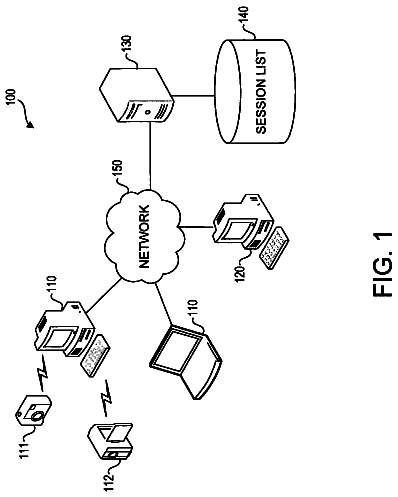
1 of 3 drawing sheets so far from the published document, cropped to the drawing. Every sheet is in the USPTO PDF.
What the patent claimed, word for word. All of it is now free to use.
A form of web site implementation occurs, for example, when a web application retrieves, creates, modifies, or otherwise provides web pages during execution. Web applications are sometimes created using a web application framework. Such frameworks may facilitate web application development by providing libraries for database access, providing templates, managing sessions, and promoting code reuse, for example. Web application frameworks may help programmers build dynamic web sites, web applications, and web services. Web sites can also be implemented using web-scripting tools. Scripts embedded into HTML source can be interpreted by a web server to generate a web page.
Developing scalable dynamic web applications can be a complex and challenging project. Some embodiments described herein provide approaches that can make web site implementation easier by allowing programmers to use declarative structures containing expressions whose evaluation generates web pages on demand.
For example, some embodiments receive an HTTP request which includes a path, and map from the path to an expression in a nestable mapping data structure; the mapping data structure can contain multiple expressions which collectively represent the web site. Evaluating the expression provides a result, without necessitating evaluation of other expressions of the mapping data structure. An HTTP response to the HTTP request, containing the evaluation result, is generated and provided, e.g., in the form of a dynamic web page, an image, a cascading style sheet, or another web resource. Responses to FTP requests, and to other network application layer requests utilizing a hierarchical naming scheme, may also be generated in some embodiments.
In some embodiments, the expression is written in a declarative (as opposed to imperative) programming language. Evaluation of the expression may include parsing or making a function call consistent with rules of the particular declarative programming language. Evaluation may also utilize a lazy evaluation mechanism of the declarative programming language. The expression may contain, for example, a call to a function which returns contents of a file named in the path, or a function which returns a text string, or the expression may evaluate to a text string. In some cases, the expression may call a function which produces a side-effect, e.g., DELETE, PUT, POST, or the like. Some embodiments recursively map a directory name to a mapping of a file name; some recursively map a dynamically constructable record which includes at least one field-value pair. In some embodiments, the expression occurs in a mapping data structure which is declared in a version of an M programming language.
Some embodiments promote scalability. For example, some receive multiple HTTP requests at different machines in a network, concurrently evaluate expression(s) of the same mapping data structure on the different machines, concurrently generate respective HTTP responses, and transmit the respective HTTP responses toward the multiple sources of the requests. In particular, HTTP responses containing streams of web site content can be generated. In some embodiments, copies of a lazy expression evaluator evaluate the same expression and reside on multiple machines in a stateless middle tier in a network, thereby promoting scalability.
Some embodiments electronically declare a computer data structure which maps portions of a Uniform Resource Identifier (URI) path to respective expressions. The mapping may be recursive. Digital web site content is made electronically accessible to a fully automatic evaluation mechanism which is operable to perform lazy evaluation of the expressions, based on automatically located dependencies that have been made declaratively. Some embodiments implement an arbitrarily large web site, namely, a web site which has no fixed upper bound on storage size in the absence of lazy evaluation of the expressions. Some model a web site by providing the mapping data structure of expressions to represent the web site's hierarchical structure, and by providing an enumerator, an array of characters, and/or an array of bytes to represent the web site's content.
The examples given are merely illustrative. This Summary is not intended to identify key features or essential features of the claimed subject matter, nor is it intended to be used to limit the scope of the claimed subject matter. Rather, this Summary is provided to introduce--in a simplified form--some concepts that are further described below in the Detailed Description. The innovation is defined with claims, and to the extent this Summary conflicts with the claims, the claims should prevail.
A more particular description will be given with reference to the attached drawings. These drawings only illustrate selected aspects and thus do not fully determine coverage or scope.
FIG. 1 is a block diagram illustrating a client having at least one processor, at least one memory, and one or more applications which make requests to a server, and other items in an operating environment which may be present on multiple network nodes, and also illustrating configured storage medium embodiments;
FIG. 2 is a data flow diagram illustrating aspects of web site implementation using lazily evaluated expressions of a declarative mapping in an example architecture; and
FIGS. 3 and 4 collectively are a flow chart illustrating steps of some process and configured storage medium embodiments.
Overview
One widely used web application framework is the ASP.NET.TM. framework available from Microsoft.RTM. Corporation. ASP.NET technology helps programmers build dynamic web sites, web applications, and web services; it followed Microsoft's Active Server Pages (ASP) technology. The ASP.NET environment utilizes the Microsoft.RTM. Common Language Runtime (CLR), allowing programmers to write ASP.NET code using a variety of supported programming languages. Web sites can also be implemented using web-scripting tools such as ASP and PHP scripts. PHP, also known as Hypertext Preprocessor, is a widely used general-purpose scripting language originally designed for web development of dynamic web pages. PHP code can be embedded into HTML source, and can be interpreted by a web server PHP processor which generates a web page using the PHP.
Although ASP.NET technology and other familiar technologies can be helpful, developing scalable dynamic web applications can nonetheless be quite difficult. Some embodiments described herein can make the authoring of scalable dynamic web applications easier by allowing developers to use lazily evaluated declarative mapping data structures. Some embodiments provide mechanisms for implementing a web site using lazily evaluated declarative mapping data structures in which the contents of the web site are calculated by expressions that make up the mapping data structures. A mapping specifies how an HTTP response corresponds to a part of the mapping data structure. Only the part of the mapping data structure that is requested for a given HTTP request need be calculated, thereby promoting both efficiency and flexibility.
Reference will now be made to exemplary embodiments such as those illustrated in the drawings, and specific language will be used herein to describe the same. But alterations and further modifications of the features illustrated herein, and additional applications of the principles illustrated herein, which would occur to one skilled in the relevant art(s) and having possession of this disclosure, should be considered within the scope of the claims.
The meaning of terms is clarified in this disclosure, so the claims should be read with careful attention to these clarifications. Specific examples are given, but those of skill in the relevant art(s) will understand that other examples may also fall within the meaning of the terms used, and within the scope of one or more claims. Terms do not necessarily have the same meaning here that they have in general usage, in the usage of a particular industry, or in a particular dictionary or set of dictionaries. Reference numerals may be used with various phrasings, to help show the breadth of a term. Omission of a reference numeral from a given piece of text does not necessarily mean that the content of a Figure is not being discussed by the text. The inventor asserts and exercises his right to his own lexicography. Terms may be defined, either explicitly or implicitly, here in the Detailed Description and/or elsewhere in the application file.
As used herein, a "computer system" may include, for example, one or more servers, motherboards, processing nodes, personal computers (portable or not), personal digital assistants, cell or mobile phones, and/or device(s) providing one or more processors controlled at least in part by instructions. The instructions may be in the form of software in memory and/or specialized circuitry. In particular, although it may occur that many embodiments run on workstation or laptop computers, other embodiments may run on other computing devices, and any one or more such devices may be part of a given embodiment.
A "multithreaded" computer system is a computer system which supports multiple execution threads. The term "thread" should be understood to include any code capable of or subject to synchronization, and may also be known by another name, such as "task," "process," or "coroutine," for example. The threads may run in parallel, in sequence, or in a combination of parallel execution (e.g., multiprocessing) and sequential execution (e.g., time-sliced). Multithreaded environments have been designed in various configurations. Execution threads may run in parallel, or threads may be organized for parallel execution but actually take turns executing in sequence. Multithreading may be implemented, for example, by running different threads on different cores in a multiprocessing environment, by time-slicing different threads on a single processor core, or by some combination of time-sliced and multi-processor threading. Thread context switches may be initiated, for example, by a kernel's thread scheduler, by user-space signals, or by a combination of user-space and kernel operations. Threads may take turns operating on shared data, or each thread may operate on its own data, for example.
A "logical processor" or "processor" is a single independent hardware thread-processing unit. For example a hyperthreaded quad core chip running two threads per core has eight logical processors. Processors may be general purpose, or they may be tailored for specific uses such as graphics processing, signal processing, floating-point arithmetic processing, encryption, I/O processing, and so on.
A "multiprocessor" computer system is a computer system which has multiple logical processors. Multiprocessor environments occur in various configurations. In a given configuration, all of the processors may be functionally equal, whereas in another configuration some processors may differ from other processors by virtue of having different hardware capabilities, different software assignments, or both. Depending on the configuration, processors may be tightly coupled to each other on a single bus, or they may be loosely coupled. In some configurations the processors share a central memory, in some they each have their own local memory, and in some configurations both shared and local memories are present.
"Kernels" include operating systems, hypervisors, virtual machines, and similar hardware interface software.
"Code" means processor instructions, data (which includes constants, variables, and data structures), or both instructions and data.
"Automatically" means by use of automation (e.g., general purpose computing hardware configured by software for specific operations discussed herein), as opposed to without automation. In particular, steps performed "automatically" are not performed by hand on paper or in a person's mind; they are performed with a machine.
Throughout this document, use of the optional plural "(s)" means that one or more of the indicated feature is present. For example, "request(s)" means "one or more requests" or equivalently "at least one request".
Throughout this document, unless expressly stated otherwise any reference to a step in a process presumes that the step may be performed directly by a party of interest and/or performed indirectly by the party through intervening mechanisms and/or intervening entities, and still lie within the scope of the step. That is, direct performance of the step by the party of interest is not required unless direct performance is an expressly stated requirement. For example, a step involving action by a party of interest such as "transmitting to", "sending toward", or "communicating to" a destination may involve intervening action such as forwarding, copying, uploading, downloading, encoding, decoding, compressing, decompressing, encrypting, decrypting and so on by some other party, yet still be understood as being performed directly by the party of interest.
Whenever reference is made to data or instructions, it is understood that these items configure a computer-readable memory thereby transforming it to a particular article, as opposed to simply existing on paper, in a person's mind, or as a transitory signal on a wire, for example.
Operating Environments
With reference to FIG. 1, an operating environment 100 for an embodiment may include client 101 device(s) and server 103 device(s), each of which may include a computer system 102. Each of the computer systems 102 may be a multiprocessor computer system, or not. An operating environment may include one or more machines in a given computer system, which may be clustered, client-server networked, and/or peer-to-peer networked.
Human users 104 may interact with the computer systems 102 by using displays, keyboards, and other peripherals 106. System administrators, developers, engineers, and end-users are each a particular type of user 104. Automated agents acting on behalf of one or more people may also be users 104. Storage devices and/or networking devices may be considered peripheral equipment in some embodiments. Other computer systems not shown in FIG. 1 may interact with the computer system 102 or with another system embodiment using one or more connections to a network 108 via network interface equipment, for example.
Each computer system 102 includes at least one logical processor 110. Each illustrated computer system 102, like other suitable systems, also includes one or more computer-readable storage media 112. Storage media 112 may be of different physical types. The storage media 112 may be volatile memory, non-volatile memory, fixed in place media, removable media, magnetic media, and/or optical media, as opposed to propagated signal media. In particular, a configured medium 114 such as a CD, DVD, memory stick, or other removable non-volatile memory medium may become functionally part of the computer system when inserted or otherwise installed, making its content accessible for use by processor 110. The removable configured medium 114 is an example of a computer-readable storage medium 112. Some other examples of computer-readable storage media 112 include built-in RAM, ROM, hard disks, and other storage devices which are not readily removable by users 104.
The medium 114 is configured with instructions 116 that are executable by a processor 110; "executable" is used in a broad sense herein to include machine code, interpretable code, and code that runs on a virtual machine, for example. The medium 114 is also configured with data 118 which is created, modified, referenced, and/or otherwise used by execution of the instructions 116. The instructions 116 and the data 118 configure the medium 114 in which they reside; when that memory is a functional part of a given computer system, the instructions 116 and data 118 also configure that computer system. In some embodiments, a portion of the data 118 is representative of real-world items such as product characteristics, inventories, physical measurements, settings, images, readings, targets, volumes, and so forth. Such data is also transformed by as discussed herein, e.g., requests are transformed into responses by locating, mapping, lazily evaluating, declaring, generating, calling, binding, deployment, execution, modification, display, creation, loading, and/or other operations.
Applications 120 such as web browsers, media players, email managers, and/or game managers, for example, make requests 122 (generally by way of protocol stacks or other network layers 124) to obtain web site 126 content 128 such as files 130 over a network 108, to update a display 132, for example. Applications 120, other software, requests 122, and other items shown in the Figures may reside partially or entirely within one or more media 112, thereby configuring those media. An operating environment may also include other hardware 134, such as buses, power supplies, and graphics accelerators, for instance.
Items are shown in outline form in FIG. 1 to emphasize that they are not necessarily part of the illustrated operating environment, but may interoperate with items in the operating environment as discussed herein. It does not follow that items not in outline form are necessarily required, in any Figure or any embodiment.
Systems
FIG. 2 illustrates an architecture which is suitable for use with some embodiments. System embodiments may be seen as supporting process embodiments, and vice versa. Assume a client 101 sends requests 122 over a network 108 toward a server 103. The requests 122 can be created using a familiar web browser or other familiar application 120. In some embodiments, no special syntax or semantics is required in the requests 122; in that sense, the presence of an embodiment in the server is transparent to the clients.
The requests 122 have various portions 202. For example, an HTTP request has a prefix such as "http://" or "https://", a method or verb such as GET, and a path 204, such as a Uniform Resource Identifier (URI) or another path 204. In requests 122 to get a file 130, the path 204 generally includes a directory name 206 and a file name 208.
Some embodiments process requests 122 at a server 103 using a mapping data structure 210 which includes a mapping 212 of request portion(s) 202 to expressions 214 which, upon evaluation, produce a response to the request. A lazy expression evaluator 216 evaluates the expression(s) 214 that correspond under the mapping 212 to the particular request 122. The expressions may be written in a declarative programming language 218, such as a version of the M programming language, or another programming language equipped with a lazy expression evaluator 216 for evaluating expressions which describe what result 220 should be provided, rather than describing how to compute the result. The result 220 of the expression evaluation, such as file content 222, 128, is sent back to the client 101 in a response 224. In some embodiments, no special syntax or semantics is required in the responses 224, in that the presence of an embodiment in the server is transparent to the clients.
With reference to FIGS. 1 and 2, some embodiments provide a computer system 102 with a logical processor 110 and a memory medium 112 configured by circuitry, firmware, and/or software to transform requests 122 into responses 224 by mapping request portions to lazily evaluated expressions as described herein. For example, some embodiments include a computer system 102 having at least one logical processor 110, and a memory 112 in operable communication with the logical processor(s). The memory is located in at least one machine; in some embodiments, memory is located in multiple servers 103.
A mapping 212 resides in the memory and maps portions 202 of a network application layer 124 requests to respective expressions 214. A lazy expression evaluator 216 also resides in the memory. The evaluator 216 is operable to evaluate an expression in response to a request, and more specifically, to evaluate an expression E in response to a portion P of a request that seeks access to content 128. The request portion P is mapped to the expression E by the mapping data structure 210. The mapping data structure 210 includes one or more expressions, and associated mapping 212 code that is operable to select portions 202 and map them to the expression(s).
As used herein, a "server" 103 may be a single destination machine, or it may be an intermediary machine, or a collection of machines. For example, the response result 220 may be calculated on a different server machine than the server machine that sends the response 224 to the client.
In some embodiments, the system includes an HTTP request 122 and/or an FTP request 122 configuring a medium 112. In some, the system includes a network application layer request 122 utilizing some other hierarchical naming scheme. The lazy expression evaluator 216 is operable to evaluate an expression in response to the request 122. Although HTTP is used as a frequent example herein, in some embodiments the mapping data structure 210 maps FTP requests to expressions. Like HTTP, FTP has a hierarchical naming schema suitable for such mappings.
In some embodiments, copies of the lazy expression evaluator 216 reside (configure memory and/or other media 112) on multiple server machines in a stateless middle tier in a network 108. In some cases those multiple evaluators (or a subset of them) evaluate the same expression 214. It will be appreciated that the ability to place stateless copies of a computation on multiple machines tends to promote scalability.
In some embodiments, in some cases an expression 214 in the mapping can be directly evaluated, while in other cases the expression calls a function whose return value is part of the calculation of the expression value. In some embodiments, the function(s) called in an expression 214 can include any function supported in the declarative programming language environment. Functions may be general purpose, such as database accesses or email notice generators, or functions may be tailored to particular dynamic web sites. In one embodiment, for example, an expression 214 in the mapping includes a call to a File-Contents function which is operable to return contents of a file as binary data. In a key-value pair implementation of a mapping data structure 210, for instance, a value of a key "b.gif" is the result of calling a function File:Contents with the path "c:\b.gif", which will return the contents of the file as binary data.
In some embodiments, the system contains in memory a network application layer request 122 identifying a file 130, an expression 214 to which the request is mapped, and a result 220 of a lazy evaluation of the expression. In some cases, the result 220 includes metadata which specifies a content type for the file. File content type may be determined, for example, by the extension within a file name 208.
In some embodiments, the mapping 212 is recursive. For example, one mapping data structure 210 is declared recursively as follows:
TABLE-US-00001 Map:From ( [ {Key ="b.gif", Value = File:Contents("c:\b.gif") }, {Key = "a.html", Value = "<html><body>" + "hello" + "</body></html>" }, {Key = "dir", Value = Map:From([ { Key = "c.txt", Value = "hello world" {circumflex over ( )}{circumflex over ( )} { Content:Type = "text/plain" } ]) } ] )
The foregoing can be viewed as two examples, one which shows a static mapping and one that shows a dynamic mapping example. Such a static recursive example is:
TABLE-US-00002 map { "b.gif" = File:AsBytes("c:\b.gif"), "a.html" = "<html><body>" + "hello" + "</body></html>" {circumflex over ( )}{circumflex over ( )} { Content:Type = "text/html" }, "dir" = map { "c.txt" = "hello world" {circumflex over ( )}{circumflex over ( )} { Content:Type = "text/plain" } } }
Such a dynamic example shows the contents of the "dir" key being generated based on the contents of a directory on the disk:
TABLE-US-00003 map { "b.gif" = File:AsBytes("c:\b.gif"), "a.html" = "<html><body>" + "hello" + "</body></html>" {circumflex over ( )}{circumflex over ( )} { Content:Type = "text/html" }, "dir" = Map:From( Path:Search("c:\dir") where item.Kind == "File" select { Key = item.Name, Value = File:AsBytes(item.Path) } ) }
In some embodiments, an expression 214 in the mapping 212 includes a call to a function which is operable to produce a side-effect. For example, in some cases an expression calls HTTP POST, PUT, and/or DELETE functions which produce side-effects.
In some embodiments peripherals 106 such as human user I/O devices (screen, keyboard, mouse, tablet, microphone, speaker, motion sensor, etc.) will be present in operable communication with one or more processors 110 and memory. However, an embodiment may also be deeply embedded in a system, such that no human user 104 interacts directly with the embodiment. Software processes may be users 104.
In some embodiments, the system includes multiple computers connected by a network. Networking interface equipment can provide access to networks 108, using components such as a packet-switched network interface card, a wireless transceiver, or a telephone network interface, for example, will be present in a computer system. However, an embodiment may also communicate through direct memory access, removable nonvolatile media, or other information storage-retrieval and/or transmission approaches, or an embodiment in a computer system may operate without communicating with other computer systems.
Some embodiments operate in a "cloud" computing environment and/or a "cloud" storage environment. For example, applications 120 may execute on multiple client devices/systems 102 in a networked cloud, mappings 212 may reside on yet other devices within the cloud, and the responses 224 may configure the displays 132 on yet other cloud device(s)/system(s) 102.
Processes
FIGS. 3 and 4 illustrate some process embodiments in connected flowcharts 300 and 400. Processes shown in the Figures may be performed in some embodiments automatically, e.g., by mappings 212 and evaluators 216 producing responses 224 for a testing tool or other client 101 that is making and sending requests 122 under control of a script requiring little or no user input. Processes may also be performed in part automatically and in part manually unless otherwise indicated. In a given embodiment zero or more illustrated steps of a process may be repeated, perhaps with different parameters or data to operate on. Steps in an embodiment may also be done in a different order than the top-to-bottom order that is laid out in FIGS. 3 and 4. Steps may be performed serially, in a partially overlapping manner, or fully in parallel. The order in which flowchart(s) 300 and/or 400 are traversed to indicate the steps performed during a process may vary from one performance of the process to another performance of the process. The flowchart traversal order may also vary from one process embodiment to another process embodiment. Steps may also be omitted, combined, renamed, regrouped, or otherwise depart from the illustrated flow, provided that the process performed is operable and conforms to at least one claim.
Examples are provided herein to help illustrate aspects of the technology, but the examples given within this document do not describe all possible embodiments. Embodiments are not limited to the specific implementations, arrangements, displays, features, approaches, or scenarios provided herein. A given embodiment may include additional or different features, mechanisms, and/or data structures, for instance, and may otherwise depart from the examples provided herein.
During a request receiving step 302, an embodiment receives an HTTP request 122, an FTP request 122, or another request 122. Step 302 may be accomplished using familiar network transmission software and hardware, or other mechanism, for example.
During a mapping step 304, an embodiment maps a portion of a request 122 to an expression 214. Mapping may be accomplished using substeps such as parsing the request to extract a mappable portion 202, comparing the extracted portion 202 with keys in a mapping data structure 210 to find a key-value pair to which the portion 202 is mapped, and locating 306 an expression 214 as a value in the key-value pair for the identified key. Step 304 may be accomplished using parsers, regular expressions and other string comparison tools, and other familiar mechanisms, adapted for mappings 212 as taught herein.
During an expression evaluating step 308, an embodiment evaluates an expression 214, thereby obtaining 310 an evaluation result 220. Step 308 may involve calling functions specified in expressions. Step 308 may be accomplished using familiar expression evaluators 216, such as expression evaluators in declarative languages 218. In particular, some embodiments evaluate 308 expressions 214 by lazily invoking an expression evaluator in an M programming language environment.
During a response generating step 312, an embodiment generates a response 224 which contains at least one evaluation result 220. Step 312 may be accomplished using familiar mechanisms for formatting content 128 and other data into HTTP, FTP, or other formats, adapted to utilize evaluation result(s) 220 as content 128 and/or other data in a response.
During an expression parsing step 314, an embodiment parses an expression 214 in the course of evaluating 308 the expression. Parsing may be accomplished using familiar parsers 316 which comply with syntactic and semantic rules 318 of the declarative programming language 218 in which the expression being parsed is written.
During a function executing step 320, an embodiment executes a function 322 called in an expression 214, in the course of evaluating 308 the expression. Execution of functions 322 may be accomplished using familiar mechanisms 324 for function invocation and execution which comply with syntactic and semantic rules 318 of the declarative programming language 218 (including its runtime environment) in which the expression containing the function is written.
During a lazy evaluation utilizing step 326, an embodiment utilizes a lazy evaluation mechanism 328 to lazily evaluate 308 an expression 214 of a mapping 212. Step 326 may be accomplished using familiar lazy evaluation mechanisms 328, such as some expression evaluators 216 in declarative languages 218. In particular, some embodiments evaluate 308 expressions 214 by utilizing an M programming language expression evaluator 216 as the lazy evaluation mechanism 328.
In some embodiments, the evaluation mechanism 328 is lazy in the sense that other expressions of the mapping 212, which the current request 122 did not map to, are not evaluated. Only the expression to which the request 122 was mapped 304 gets evaluated to generate a response. In some embodiments, evaluation of part of the mapped expression is also avoided when not needed to generate the desired result 220, that is, "short-circuit" lazy evaluation is used.
During a file name to expression file contents function mapping step 330, which is an example of mapping step 304, an embodiment maps a file name 208 portion of a path to an expression 214 containing a call to a function 322, 332 which, on being invoked, will return 334 contents 128 of the file 130 that is named by the file name 208.
During a file name to expression string function mapping step 336, which is an example of mapping step 304, an embodiment maps a file name 208 portion of a path to an expression 214 containing a call to a function 322 which, on being invoked, will return 334 a text string 338.
During a file name to expression string mapping step 340, which is an example of mapping step 304, an embodiment maps a file name 208 portion of a path to an expression 214 which, on being evaluated 308, will result in a text string 338.
During a recursive directory name mapping step 342, which is an example of mapping step 304, an embodiment recursively maps a directory name 206 portion of a path to a mapping of a file name 208. The file name mapping may in turn may involve file name mapping steps, such as steps 340, 336, 330.
During a recursive record mapping step 344, which is an example of mapping step 304, an embodiment recursively maps a dynamically constructable record 346 as a map. In the case of an empty directory being mapped with such a record 346, the record will contain no key-value pairs, but in other cases the record 346 will contain one or more key-value pairs 348. Key-value pairs are sometimes referred to as field-value pairs. Mapping data structures 210 provide some examples of record 346 syntax and semantics, but mapping data structures 210 are not necessarily dynamically constructed. Step 344 may be viewed as a generalization of recursive directory name mapping step 342, to handle a set of path 204 elements that include not only directory names 206 and a terminal file name but also other elements used in a given application layer request hierarchical naming scheme, e.g., subnet names, company names, node identifiers, date ranges, and so forth.
During a minimal portion evaluating step 350, which is an example of evaluating step 308, an embodiment evaluates at most a minimal portion 352 of a mapping data structure 210. That is, the embodiment evaluates the portion of the mapping data structure 210 whose evaluation is a logical precondition for generating the response 224 to a given request 122. Preconditions are logical conclusions based on dependencies 354 declared in the mapping data structure 210. Examples of dependencies 354 include, but are not necessarily limited to, recursive mappings, and invocations of functions.
During a mapping to M expression step 356, which is an example of mapping step 304, an embodiment maps a portion 202 of a path 204 to an expression 214 which is declared 358 in a version of the M programming language.
During a distributed request receiving step 360, an embodiment receives requests 122 at different machines (e.g., servers 103) from multiple sources 366 (e.g., clients 101). Step 360 may be viewed at a high level as an example of receiving step 302 that happens to include multiple clients and servers. Step 360 may also be viewed at a more detailed level as a step that includes multiple receiving steps 302.
During a concurrent evaluation step 362, an embodiment evaluates expression(s) 214 of a particular mapping data structure 210 at different machines, e.g., on several servers 103. Step 362 may be viewed at a high level as an example of evaluating step 308 that happens to include multiple servers. Step 362 may also be viewed at a more detailed level as a step that includes multiple evaluating steps 308.
During a response transmitting step 364, an embodiment transmits one or more response(s) 224 to request(s) 122. In some cases, a single response to a single request is transmitted to a single source 366. In other cases, at least in some embodiments, multiple responses to respective requests are transmitted to respective sources 366, namely, clients 101. Step 364 may be accomplished using familiar network transmission mechanisms, for example.
During a stream response generating step 312, an embodiment generates 312 a response 224 which contains a data stream 368 as at least part of the evaluation result 220.
During a URI mapping step 304, an embodiment maps a Uniform Resource Identifier 370 to an expression 214.
During a making step 372, an embodiment makes content 128 electronically accessible to an evaluator 216, such as a lazy evaluation mechanism 328. Step 372 may be accomplished using buffers, file systems, and/or other familiar mechanisms for making data available to an evaluator 216, for example.
During a dependency locating step 376, an embodiment automatically locates dependencies 354 that have been declared 378 in a mapping data structure 210. Step 376 may be accomplished by familiar parsing techniques adapted for use with mapping data structures 210, for example.
During an implementing step 380, an embodiment implements a web site 126. Step 380 may be accomplished with request receiving step 302, mapping step 304, evaluating step 308, and response generating step 312, for example. In some embodiments, implementing 380 only includes mapping step 304, evaluating step 308, and response generating step 312. The use of lazy evaluation by a given embodiment during evaluating step 308 facilitates implementing 380 an arbitrarily large web site 374, 126, because storage space need not be allocated up from for all of a sites structurally distinct web pages. Such a web site 374 may be arbitrarily large in the sense that it provides an arbitrarily large set of computable content, e.g., by supporting an arbitrarily large set of URLs, as opposed to having an arbitrarily large amount of stored content.
During a modeling step 382, an embodiment models a web site in at least one of two aspects. An embodiment may model the site by providing 384 a mapping data structure 210 to represent 386 the web site's hierarchical structure 388, e.g., like the directory hierarchy in which a developer organizes web site content 128. An embodiment may also model 382 the site by providing 390 a content stream or other content producer, e.g., by providing 390 an enumerator 392, character array 394, and/or byte array 396 to represent 398 web site content 128. Modeling step 382 may be accomplished by providing 384 a mapping 212 and evaluator 216, for example. Modeling step 382 may also be accomplished by providing 390 content while transmitting 364 a response 224, for example.
During a residing step 402, multiple copies of an expression evaluator 216 reside in a stateless middle tier 404 in a network, e.g., by configuring memory or other media 112 in middle tier machines. The middle tier is stateless in the sense that the expression evaluator 216 need not remember the result of a previous evaluation 308 to perform a current evaluation 308, except as needed within a recursive evaluation.
During a file-contents calling step 406, which is an example of executing step 320, an embodiment calls and hence executes a file-contents function 322, 408 to return contents 222 of a file 130, e.g., as a stream of characters or as binary data.
During a metadata including step 410, an embodiment includes in an evaluation 308 result 220 a metadata 412 value which specifies 414 a content type 416 for a file 130. For example metadata may be included 410 in a response for a file 130 named in the corresponding request 122. Content types 416 may be identified by familiar mechanisms such as file extensions, file headers, and file signatures.
During a side-effect function calling step 418, an embodiment calls (and thus executes 320) a function 322, 422 which causes a side-effect 420. For example, an embodiment may call a HTTP POST, PUT, and/or DELETE functions 422.
The foregoing steps and their interrelationships are discussed in greater detail below, in connection with various embodiments.
The description continues in the full USPTO document.
About 6,203 words. The USPTO PDF has it with every drawing.
Fees are due 3.5, 7.5 and 11.5 years after grant. This patent expired on February 4, 2026, so the fee marked "not paid" was the one that went unpaid.
Web Site Implementation by Mapping Expression Evaluation
Filed Jun 2010 · published Dec 2011Web site implementation by mapping expression evaluation
Filed Jun 2010 · granted Feb 2014Earlier publications, parents and continuations. None of them can still be enforced, or this patent would not be listed.
Prior art cited by the examiner or applicant. Useful when you check your own idea for novelty.
Everything on this page comes from the documents linked above.


