 Lapsed, fee not paid7 drawings
Hardware & Electronics · US 8,644,458 B2
Method and system for routing calls based on a language preference
A method processes and conditionally routes a call.
US 8,644,473 B1 · Assignee: Ernst & Young U.S. LLP · Inventors: Bardwell; Robert et al.
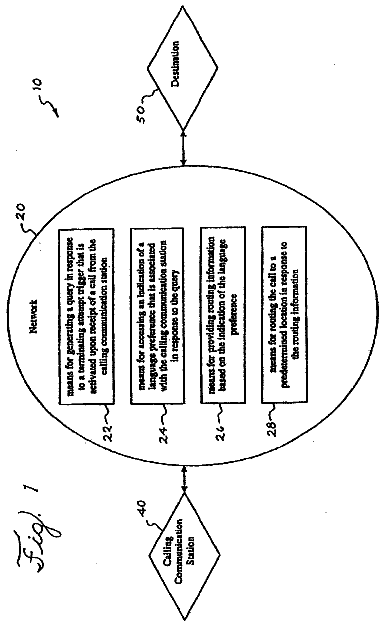
Sheet 1 of 7 from the published document. All sheets in the USPTO PDF
A method is provided for directing calls placed to a telephone number associated with a user according to a reservation identifying the user, a workspace, and a start time. The method includes acts of receiving a first message from a telephone device located at the workspace in response to a first input at the telephone device on or after the start time, retrieving the reservation from a reservation database in response to receiving the first message, sending a second message to the telephone device based at least in part on a portion of the reservation identifying the user, receiving a third message sent in response to a second input at the telephone device, the third message including an identifier of the telephone device, retrieving the telephone number associated with the user from a user database, and directing calls placed to the telephone number associated with the user to the telephone device.
1 of 7 drawing sheets so far from the published document, cropped to the drawing. Every sheet is in the USPTO PDF.
What the patent claimed, word for word. All of it is now free to use.
The present invention is directed to methods and systems for providing workspace mobility and hoteling. More particularly, methods and systems are provided for managing and providing telephony services to particular individuals whose workspace location can change from time to time.
2. Discussion of Related Art
There are a variety of tools and techniques for managing and providing telephony services in a workplace environment. Organizations have long used private branch exchanges (PBXs) to deploy and maintain telephone service to employees at a particular physical location, for example, a work site such as an office building. By connecting individual phones to the public switched telephone network via a trunk line, the organization could route an individual employee's extension to wherever the employee was located at the work site, and could reroute the extension as appropriate.
However, the PBX is of little use when a user needs telephony services in a location physically distant from the location of the PBX system. Furthermore, the PBX requires too much manual intervention to be efficient when a user frequently moves locations, or when a particular work location, for example, a cubicle, will host a number of different users in the course of a relatively short period of time.
"Hoteling" is a term given to the practice of providing unassigned workspaces that can be reserved or claimed by different users at different times. Specifically, a user may reserve a workspace, such as a cubicle or office, for a particular duration of time. During that time, she may be provided telephony or other custom services at that location. Hoteling thus allows mobile workers to have access to a shared workspace at one or more locations as needed without requiring a dedicated workspace for each mobile worker at each location.
As noted above, automated methods for managing telephony services and other workplace assets have been developed. Specifically, systems have been developed that allow users to make advance reservations that will cause their telephony services to be activated at a particular workspace at a particular time. However, these systems may be limited in that they carry out the activation or termination of telephony services regardless of the user's actual location. Thus, there is a need for telephony management methods and systems that accepts reservations for telephony services for a particular user at a particular workspace and time, and that activate those telephony services only upon confirmation that the user is physically present at that workspace.
The present invention is directed to methods and systems configured to accept reservations for telephony services for a particular user at a particular workspace and time, and to activate those telephony services only upon confirmation that the user is physically present at that workspace. These telephony services may include directing all calls for the user to a telephone in that workspace, and providing outgoing telephone service on the telephone. Additional personalized telephony features may be deployed to the phone at the workspace as well, including the user's speed dial settings, personalized greeting, custom ringer settings, or other options.
According to one aspect of the present invention, a method is provided for directing calls placed to a telephone number associated with a user according to a reservation identifying the user, a workspace, and a start time. The method includes acts of receiving a first message from a telephone device located at the workspace in response to a first input at the telephone device on or after the start time, retrieving the reservation from a reservation database in response to receiving the first message, sending a second message to the telephone device based at least in part on a portion of the reservation identifying the user, receiving a third message sent in response to a second input at the telephone device, the third message including an identifier of the telephone device, retrieving the telephone number associated with the user from a user database, and directing calls placed to the telephone number associated with the user to the telephone device.
According to one embodiment, the act of receiving the first message may include an act of receiving a URL request on a web server. In another embodiment, the second message may include a portion identifying the user. In a further embodiment, the second message may include a name of the user.
According to another embodiment, the identifier of the telephone device may include a MAC address of the telephone device. In yet another embodiment, the act of directing may include sending a fourth message to a switching server requesting that the switching server route to the telephone device telephone calls placed to the number associated with the user. In another embodiment, the act of retrieving the reservation may include determining that calls placed to the telephone number associated with the user are not already directed to a second telephone device other than the telephone device.
In still another embodiment, the act of retrieving the reservation may include determining that calls placed to the telephone number associated with the user are already directed to a second telephone device other than the telephone device, and ceasing to direct to the second telephone device calls placed to the telephone number associated with the user. In this embodiment, the act of ceasing to direct may include sending a fourth message to a switching server requesting that the switching server not route to the second telephone device telephone calls placed to the number associated with the user.
In another embodiment, the method may further comprise an act of validating at least one parameter of the reservation prior to receiving the first message, the act of validating the at least one parameter of the reservation including at least one of determining that a portion of the reservation identifying the workspace identifies a valid workspace, and determining that a portion of the reservation identifying the user identifies a valid user. In yet another embodiment, the reservation may further identify an end time, and the method further comprises an act of ceasing, on or after the end time, to direct to the telephone device calls placed to the telephone number associated with the user.
In another embodiment, the act of retrieving the telephone number may include an act of retrieving a user profile uniquely corresponding to the user, the user profile including the telephone number associated with the user and a set of telephone device configuration parameters uniquely corresponding to the user, and wherein the act of directing further comprises providing the set of telephone device configuration parameters to the telephone device. In this embodiment, the telephone device may include at least one configurable function button, and the set of telephone device configuration parameters may include a mapping of the at least one configurable function button to at least one telephone function. In yet a further aspect of this embodiment, the at least one telephone function includes at least one of speed-dialing a specified telephone number and connecting to a voice mailbox of the user.
According to another aspect of the present invention, a computer readable medium is provided. The computer readable medium comprises computer executable instructions that, when executed, perform a method of directing calls placed to a telephone number associated with a user according to a reservation that identifies the user, a workspace, and a start time. The method comprises acts of receiving a first message from a telephone device located at the workspace in response to a first input at the telephone device on or after the start time, retrieving the reservation from a reservation database in response to receiving the first message, sending a second message to the telephone device based at least in part on a portion of the reservation identifying the user, receiving a third message sent in response to a second input at the telephone device, the third message including an identifier of the telephone device, retrieving the telephone number associated with the user from a user database, and directing calls placed to the telephone number associated with the user to the telephone device.
In one embodiment, the act of directing may include receiving a fourth message, at a switching server, requesting that the switching server route to the telephone device telephone calls placed to the number associated with the user. In another embodiment, the act of retrieving the reservation includes determining that calls placed to the telephone number associated with the user are not already directed to a second telephone device other than the telephone device.
In yet another embodiment, the act of retrieving the reservation includes determining that calls placed to the telephone number associated with the user are already directed to a second telephone device other than the telephone device, and ceasing to direct to the second telephone device calls placed to the telephone number associated with the user. In a further aspect of this embodiment, the act of ceasing to direct includes receiving a fourth message, at a switching server, requesting that the switching server not route to the second telephone device telephone calls placed to the number associated with the user.
In another embodiment, the method may further comprise an act of validating at least one parameter of the reservation prior to receiving the first message, the act of validating the at least one parameter of the reservation including at least one of determining that a portion of the reservation identifying the workspace identifies a valid workspace, and determining that a portion of the reservation identifying the user identifies a valid user.
In yet another embodiment, the reservation may further identify an end time, and the method may further comprise an act of ceasing, on or after the end time, to direct to the telephone device calls placed to the telephone number associated with the user.
In another embodiment, the act of retrieving the telephone number may include an act of retrieving a user profile uniquely corresponding to the user, the user profile including the telephone number associated with the user and at least one telephone device configuration parameter uniquely corresponding to the user, and the act of directing may further comprise providing the at least one telephone device configuration parameter to the telephone device. In a further aspect of this embodiment, the telephone device may include at least one configurable function button, and the at least one telephone device configuration parameter may include a mapping of the at least one configurable function button to at least one telephone function. In yet a further aspect of this embodiment, the at least one telephone function includes at least one of speed-dialing a specified telephone number and connecting to a voice mailbox of the user.
According to another aspect of the present invention, a system is provided. The system comprises a telephone device located at a specific location, the telephone device configured to send a first message in response to a first input, and a server configured to receive the first message, and responsive to a determination that a reservation exists associating a user with the specific location during a time interval, to request a switching server to direct to the telephone device calls placed to a telephone number associated with the user.
In one embodiment, the server may be further configured to validate at least one parameter of the reservation by determining that a first portion of the reservation identifying the specific location identifies a valid specific location and by determining that second portion of the reservation identifying the user identifies a valid user.
In another embodiment, the server may be further configured to retrieve a user profile uniquely corresponding to the user, the user profile including the telephone number associated with the user and a set of telephone device configuration parameters uniquely corresponding to the user, wherein the server is further configured to provide the set of telephone device configuration parameters to the telephone device. In a further aspect of this embodiment, the telephone device may include at least one configurable function button, and the telephone device may be configured to map the at least one configurable function button to at least one telephone function based upon the set of telephone device configuration parameters uniquely corresponding to the user.
According to another aspect of the present invention, a method is provided for directing calls placed to a telephone number associated with a user according to a reservation identifying the user, a workspace, and a start time. The method includes acts of receiving a first message sent on or after the start time from a telephone device located at the workspace, retrieving the reservation from a reservation database, determining that the reservation associates the user, the workspace, and the start time, and directing to the telephone device calls placed to the telephone number associated with the user.
In one embodiment, the act of determining may further include receiving a second message from the telephone device, the second message confirming an identity of the user. In another embodiment, the act of directing may include receiving a second message, at a switching server, requesting that the switching server route to the telephone device telephone calls placed to the telephone number associated with the user. In another embodiment, the method may further comprise an act of determining that calls placed to the telephone number associated with the user are not already directed to a second telephone device other than the telephone device.
In yet another embodiment, the method may further comprise acts of determining that calls placed to the telephone number associated with the user are already directed to a second telephone device other than the telephone device, and ceasing to direct to the second telephone device calls placed to the telephone number associated with the user. In a further aspect of this embodiment, the act of ceasing to direct may include an act of receiving a second message, at a switching server, requesting that the switching server not route to the second telephone device telephone calls placed to the number associated with the user.
According to another aspect of the present invention, a method of directing calls to a telephone device located at a workspace is provided. The method includes the acts of receiving a first message at a current time from the telephone device located at the workspace, retrieving a reservation from a reservation database, the reservation associating the workspace and a time interval with a user, determining that the current time is within the time interval, and directing to the telephone device calls placed to a telephone number associated with the user.
According to yet another aspect of the present invention, a method of associating a telephone device at a workspace with a telephone number associated with a user is provided. The method includes the acts of receiving an input at the telephone device on or after a reservation start time, sending a first message in response to the input, receiving a second message at the telephone device comprising a portion identifying the user, receiving, at the telephone device, a second input confirming the identity of the user, sending a third message in response to receiving the second input, and receiving at the telephone device telephone calls placed to the telephone number associated with the user.
In one embodiment, the method may further include an act of displaying, in response to receiving the second message, a request for the second input, the request being displayed on a display of the telephone device. In another embodiment, the first message may include a portion identifying the workspace and the third message may include an identifier of the telephone device.
In yet another embodiment, the method may further include the act of receiving, at the telephone device, a fourth message including at least one configuration parameter uniquely corresponding to the user. In a further embodiment, the method may include the act of configuring at least one function of the telephone device based upon the at least one configuration parameter.
According to another aspect of the present invention, a method is provided for associating a telephone device at a workspace with a telephone number associated with a user. The method comprises receiving an input at the telephone device on or after a reservation start time, sending a first message indicating the presence of the user at the workspace in response to the input, and receiving at the telephone device telephone calls placed to the telephone number associated with the user.
In one embodiment, the method includes an act of displaying, on a display of the telephone device, a request for a second input confirming the presence of the user at the workspace, wherein the act of sending the first message is performed in response to receiving the second input. In another embodiment, the method further includes an act of receiving, at the telephone device, a second message including at least one configuration parameter uniquely corresponding to the user, and configuring at least one function of the telephone device based upon the at least one configuration parameter.
Still other aspects, embodiments, and advantages of these exemplary aspects and embodiments, are discussed in detail below. Moreover, it is to be understood that both the foregoing information and the following detailed description are merely illustrative examples of various aspects and embodiments, and are intended to provide an overview or framework for understanding the nature and character of the claimed aspects and embodiments. The accompanying drawings are included to provide illustration and a further understanding of the various aspects and embodiments, and are incorporated in and constitute a part of this specification. The drawings, together with the remainder of the specification, serve to explain principles and operations of the described and claimed aspects and embodiments.
The accompanying drawings are not intended to be drawn to scale. In the drawings, each identical or nearly identical component that is illustrated in various figures is represented by a like numeral. For purposes of clarity, not every component may be labeled in every drawing. In the drawings:
FIG. 1 illustrates an example computer system upon which various aspects in accord with the present invention may be implemented;
FIG. 2 depicts an example architecture of a system providing telephony services in the context of a distributed system according to an embodiment of the present invention;
FIG. 3 depicts one aspect of the architecture of the system of FIG. 2 in more detail;
FIG. 4 depicts some aspects of an alternative example architecture of a system providing telephony services in the context of a distributed system according to an embodiment of the present invention;
FIG. 5A depicts a graphical interface of a telephone in accordance with an embodiment of the present invention in which the telephone is in a ready state;
FIG. 5B depicts the graphical interface of FIG. 5A in an error state;
FIG. 5C depicts the graphical interface of FIG. 5A in a confirmation state;
FIG. 5D depicts the graphical interface of FIG. 5A in a checked-in state;
FIG. 6 depicts a check-in process according to one embodiment of the present invention; and
FIG. 7 depicts a check-out process according to another embodiment of the present invention.
At least one embodiment in accord with the present invention relates to a system with facilities, i.e. executable code and data structures, configured to accept reservations for telephony services for a particular user at a particular workspace and time, and to activate those telephony services only upon confirmation that the user is physically present at that particular workspace.
The aspects disclosed herein, which are in accord with the present invention, are not limited in their application to the details of construction and the arrangement of components set forth in the following description or illustrated in the drawings. These aspects are capable of assuming other embodiments and of being practiced or of being carried out in various ways. Examples of specific implementations are provided herein for illustrative purposes only and are not intended to be limiting. In particular, acts, elements and features discussed in connection with any one or more embodiments are not intended to be excluded from a similar role in any other embodiments.
For example, according to various embodiments of the present invention, a computer system is configured to perform any of the functions described herein, including but not limited to accepting reservations for telephony services, as well as to activating and deactivating those services. However, such a system may also perform other functions. Moreover, the systems described herein may be configured to include or exclude any of the functions discussed herein. Thus, the invention is not limited to a specific function or set of functions. Also, the phraseology and terminology used herein is for the purpose of description and should not be regarded as limiting. The use herein of "including," "comprising," "having," "containing," "involving," and variations thereof is meant to encompass the items listed thereafter and equivalents thereof as well as additional items.
In various embodiments of the present invention, a user is provided an opportunity at a user terminal to reserve a workspace for a future or present time, and to request custom telephony services at that workspace for that time. "Custom telephony services" as used hereinafter may include, among others, directing all telephone calls to a telephone number associated with the user to a telephone in the workspace, providing outgoing telephone service, and configuring the telephone with such customizations as the user's speed dial settings, personalized greeting, custom ringer settings, or other options.
At one or more times after the reservation is made but before its start time, the reservation may be validated by the system. That is, the system may ensure that a valid user, workspace, and telephone are associated with the reservation. The system may further confirm that it can communicate with the telephone, and that the telephone is operational and capable of receiving and carrying out instructions from other components of the system.
When the user arrives at the workspace at or near the reservation start time, he signals his physical presence at the workspace by "checking in" to the reservation system through use of a touch screen on the telephone in the workspace. Upon confirming the user's identity, the system provides custom telephony services at the telephone.
Though the user is variously described herein as "checking into," being "checked into," and being in a "checked in" state on any of the reservation system, a reservation, a workspace, and a telephone, the use of a certain one of these terms in relation to different systems is for conceptual and grammatical ease only. It will be understood that these terms interchangeably describe the same state or act of the system providing telephony services for a user holding a reservation at a particular telephone in a particular workspace.
Computer System
Various aspects and functions described herein in accord with the present invention may be implemented as hardware, software, or a combination of hardware and software on one or more computer systems. There are many examples of computer systems currently in use. Some examples include, among others, network appliances, personal computers, workstations, mainframes, networked clients, servers, media servers, application servers, database servers and web servers. Other examples of computer systems may include mobile computing devices, such as cellular phones and personal digital assistants, and network equipment, such as load balancers, routers and switches. Additionally, aspects in accord with the present invention may be located on a single computer system or may be distributed among a plurality of computer systems connected to one or more communication networks.
For example, various aspects and functions may be distributed among one or more computer systems configured to provide a service to one or more client computers, or to perform an overall task as part of a distributed system. Additionally, aspects may be performed on a client-server or multi-tier system that includes components distributed among one or more server systems that perform various functions. Thus, the invention is not limited to executing on any particular system or group of systems. Further, aspects may be implemented in software, hardware or firmware, or any combination thereof. Thus, aspects in accord with the present invention may be implemented within methods, acts, systems, system elements and components using a variety of hardware and software configurations, and the invention is not limited to any particular distributed architecture, network, or communication protocol.
FIG. 1 shows a block diagram of a distributed computer system 100, in which various aspects and functions in accord with the present invention may be practiced. The distributed computer system 100 may include one more computer systems. For example, as illustrated, the distributed computer system 100 includes three computer systems 102, 104 and 106. As shown, the computer systems 102, 104 and 106 are interconnected by, and may exchange data through, a communication network 108. The network 108 may include any communication network through which computer systems may exchange data. To exchange data via the network 108, the computer systems 102, 104 and 106 and the network 108 may use various methods, protocols and standards including, among others, token ring, Ethernet, Wireless Ethernet, Bluetooth, TCP/IP, UDP, HTTP, FTP, SNMP, SMS, MMS, SS7, JSON, XML, REST, SOAP, CORBA BOP, RMI, DCOM and Web Services. To ensure data transfer is secure, the computer systems 102, 104 and 106 may transmit data via the network 108 using a variety of security measures including TSL, SSL or VPN, among other security techniques. While the distributed computer system 100 illustrates three networked computer systems, the distributed computer system 100 may include any number of computer systems, networked using any medium and communication protocol.
Various aspects and functions in accord with the present invention may be implemented as specialized hardware or software executing in one or more computer systems including the computer system 102 shown in FIG. 1. As depicted, the computer system 102 includes a processor 110, a memory 112, a bus 114, an interface 116 and a storage system 118. The processor 110, which may include one or more microprocessors or other types of controllers, can perform a series of instructions that manipulate data. The processor 110 may be a well-known, commercially available processor such as an Intel Pentium, Motorola PowerPC, SGI MIPS, Sun UltraSPARC, or Hewlett-Packard PA-RISC processor, or may be any other type of processor or controller as many other processors and controllers are available. As shown, the processor 110 is connected to other system elements, including a memory 112, by the bus 114.
The memory 112 may be used for storing programs and data during operation of the computer system 102. Thus, the memory 112 may be a relatively high performance, volatile, random access memory such as a dynamic random access memory (DRAM) or static memory (SRAM). However, the memory 112 may include any device for storing data, such as a disk drive or other non-volatile storage device. Various embodiments in accord with the present invention can organize the memory 112 into particularized and, in some cases, unique structures to perform the aspects and functions disclosed herein.
Components of the computer system 102 may be coupled by an interconnection element such as the bus 114. The bus 114 may include one or more physical busses (for example, busses between components that are integrated within a same machine), and may include any communication coupling between system elements including specialized or standard computing bus technologies such as IDE, SCSI, PCI and InfiniB and. Thus, the bus 114 enables communications (for example, data and instructions) to be exchanged between system components of the computer system 102.
The computer system 102 also includes one or more interface devices 116 such as input devices, output devices and combination input/output devices. The interface devices 116 may receive input, provide output, or both. For example, output devices may render information for external presentation. Input devices may accept information from external sources. Examples of interface devices include, among others, keyboards, mouse devices, trackballs, microphones, touch screens, printing devices, display screens, speakers, network interface cards, etc. The interface devices 116 allow the computer system 102 to exchange information and communicate with external entities, such as users and other systems.
The storage system 118 may include a computer readable and writeable nonvolatile storage medium in which instructions are stored that define a program to be executed by the processor. The storage system 118 also may include information that is recorded, on or in, the medium, and this information may be processed by the program. More specifically, the information may be stored in one or more data structures specifically configured to conserve storage space or increase data exchange performance. The instructions may be persistently stored as encoded signals, and the instructions may cause a processor to perform any of the functions described herein. The medium may, for example, be optical disk, magnetic disk or flash memory, among others. In operation, the processor 110 or some other controller may cause data to be read from the nonvolatile recording medium into another memory, such as the memory 112, that allows for faster access to the information by the processor 110 than does the storage medium included in the storage system 118. The memory may be located in the storage system 118 or in the memory 112. The processor 110 may manipulate the data within the memory 112, and then copy the data to the medium associated with the storage system 118 after processing is completed. A variety of components may manage data movement between the medium and the memory 112, and the invention is not limited thereto. Further, the invention is not limited to a particular memory system or storage system.
Although the computer system 102 is shown by way of example as one type of computer system upon which various aspects and functions in accord with the present invention may be practiced, aspects of the invention are not limited to being implemented on the computer system, shown in FIG. 1. Various aspects and functions in accord with the present invention may be practiced on one or more computers having a different architectures or components than that shown in FIG. 1. For instance, the computer system 102 may include specially-programmed, special-purpose hardware, such as for example, an application-specific integrated circuit (ASIC) tailored to perform a particular operation disclosed herein. While another embodiment may perform the same function using several general-purpose computing devices running MAC OS System X with Motorola PowerPC processors and several specialized computing devices running proprietary hardware and operating systems.
The computer system 102 may include an operating system that manages at least a portion of the hardware elements included in computer system 102. A processor or controller, such as processor 110, may execute an operating system which may be, among others, a Windows-based operating system (for example, Windows NT, Windows 2000/ME, Windows XP, or Windows Vista) available from the Microsoft Corporation, a MAC OS System X operating system available from Apple Computer, one of many Linux-based operating system distributions (for example, the Enterprise Linux operating system available from Red Hat Inc.), a Solaris operating system available from Sun Microsystems, or a UNIX operating systems available from various sources. Many other operating systems may be used, and embodiments are not limited to any particular operating system.
The processor and operating system together define a computing platform for which application programs in high-level programming languages may be written. These component applications may be executable, intermediate (for example, C# or JAVA bytecode) or interpreted code which communicate over a communication network (for example, the Internet) using a communication protocol (for example, TCP/IP). Similarly, aspects in accord with the present invention may be implemented using an object-oriented programming language, such as SmallTalk, JAVA, C++, Ada, or C# (C-Sharp). Other object-oriented programming languages may also be used. Alternatively, procedural, scripting, or logical programming languages may be used.
Additionally, various aspects and functions in accord with the present invention may be implemented in a non-programmed environment (for example, documents created in HTML, XML or other format that, when viewed in a window of a browser program, render aspects of a graphical-user interface or perform other functions). Further, various embodiments in accord with the present invention may be implemented as programmed or non-programmed elements, or any combination thereof. For example, a web page may be implemented using HTML while a data object called from within the web page may be written in C++. Thus, the invention is not limited to a specific programming language and any suitable programming language could also be used.
A computer system included within an embodiment may perform functions outside the scope of the invention. For instance, aspects of the system may be implemented using an existing commercial product, such as, for example, Database Management Systems such as SQL Server available from Microsoft of Seattle, Wash.; Oracle Database from Oracle of Redwood Shores, Calif.; and MySQL from Sun Microsystems of Santa Clara, Calif.; or integration software such as WebSphere middleware from IBM of Armonk, N.Y. However, a computer system running, for example, SQL Server may be able to support both aspects in accord with the present invention and databases for sundry applications not within the scope of the invention.
At least one telephony device allowing for voice communication may also be provided with the system. The telephony device may be located in a workspace such as an office or cubicle at a work location or in a home office. The telephony device may comprise a computer system 102 as described above and seen in FIG. 1. It may be connected to a traditional switched PBX phone system as known in the art, or it may be enabled to operate as a voice-over-internet-protocol (VOIP) phone. The telephony device may be connected to and capable of exchanging data with a server through a communication network. The network may include any communication network through which computer systems may exchange data. To exchange data via the network, the server, the network, and the telephony device may use various methods, protocols and standards including, among others, token ring, Ethernet, Wireless Ethernet, Bluetooth, TCP/IP, UDP, HTTP, FTP, SNMP, SMS, MMS, SS7, JSON, XML, REST, SOAP, CORBA BOP, RMI, DCOM and Web Services. To ensure data transfer is secure, the server, the network, and the telephony device computer systems 102, 104 and 106 may transmit data via the network 108 using a variety of security measures including TSL, SSL or VPN, among other security techniques. In one embodiment, the telephony device may be a CISCO voice or unified IP phone, however it will be understood that many telephony devices capable of carrying out the methods described herein may be used, including any video phone, unified phone, or voice-over-internet-protocol (VOIP) phone. The telephony device preferably has a touch screen or non-touch display and provides a mechanism for responding to simple confirmation questions, for example, soft keys on a touch screen display or physical buttons. However, it will be understood that a traditional phone could be used with an automated voice prompt to confirm the user's identity prior to activating telephony services at that workspace. Therefore, though the telephony device may be referred to hereinafter as a "telephone" or "phone," embodiments are not limited to any particular telephony device.
Example System Architecture
FIG. 2 shows a block diagram of a reservation system 200 according to an embodiment of the present invention. Referring to FIG. 2, the system 200 includes a server 210, a telephone 212, a workspace 214, a reservation database 218, a switching server 220, a user terminal 222, and a profile database 224. The reservation database 218, the telephone 212, the switching server 220, and the profile database 224 are interconnected and able to interact as described below through their connection with the server 210. A user 230 is able to interact with the system 200 through the telephone 212 and the user terminal 222, which interacts with the reservation database 218, and in some embodiments with the server 210. In response to various events related to a reservation stored in the reservation database 218, the server 210 interacts with the user 230 via the telephone 212 and directs the switching server 220 to provide the user 230 with incoming and outgoing telephone service on the telephone 212. The switching server 220 accesses user preferences stored in the profile database 224 and sends them to the telephone 212, which configures itself according to those preferences.
As discussed above in regard to FIG. 1, the server 210, the telephone 212, the reservation database 218, the switching server 220, the user terminal 222, and the profile database 224 may be interconnected via any communication network or method through which member computer systems may exchange data. For example, the communication network may be a public network, such as the internet, and may include other public or private networks such as LANs, WANs, extranets and intranets.
The description continues in the full USPTO document.
About 6,140 words. The USPTO PDF has it with every drawing.
Fees are due 3.5, 7.5 and 11.5 years after grant. This patent expired on February 4, 2026, so the fee marked "not paid" was the one that went unpaid.
Method and system for providing telephony services
Filed Apr 2009 · granted Feb 2014Earlier publications, parents and continuations. None of them can still be enforced, or this patent would not be listed.
Prior art cited by the examiner or applicant. Useful when you check your own idea for novelty.
Everything on this page comes from the documents linked above.


