 Lapsed, fee not paid3 drawings
Software & Apps · US 8,639,602 B2
Agent-assisted mobile banking
Mobile deposits, withdrawals and transfers done through local agents who hand over or take cash.
US 8,639,629 B1 · Assignee: Nexus Payments, LLC · Inventors: Hoffman; Ned
Sheet 1 of 107 from the published document. All sheets in the USPTO PDF
The invention is a system and method for accessing an online user account registry, comprising: a) Approving access to an online user account registry via a verification platform comparing a bid verification data, comprising a unique user code provided from a nexus access token, with a registered verification data; b) Accessing the online user account registry via a rule-module invoked from a rule-module nexus, said online user account registry comprising a plurality of financial accounts of the user; Whereby an online account registry, comprising a plurality of financial accounts, is accessed via a unique user code provided from a nexus access token.
Electronic financial transaction systems have become a popular part of merchant point of sale and internet commerce. Currently, over $6 trillion in commercial exchanges occur in the United States annually using electronic financial transaction systems, including transactions involving credit, debit, stored value, electronic check, electronic benefits transfer, scrip, and reward incentives.
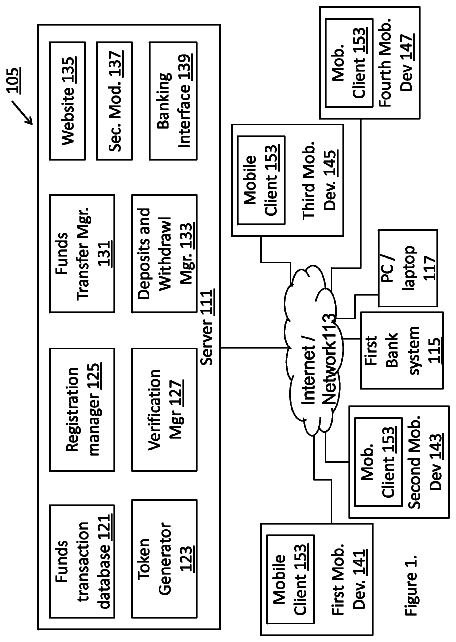
1 of 107 drawing sheets so far from the published document, cropped to the drawing. Every sheet is in the USPTO PDF.
What the patent claimed, word for word. All of it is now free to use.
The invention relates generally to computer methods and systems to process electronic financial transactions. More specifically, this invention relates to processing financial transactions, in an illustrative embodiment, using: a portable "thin-client" Nexus Access Token, a Rule-Module Nexus, and a User Account Registry stored apart from the Nexus Access Token.
Electronic financial transaction systems have become a popular part of merchant point of sale and internet commerce. Currently, over $6 trillion in commercial exchanges occur in the United States annually using electronic financial transaction systems, including transactions involving credit, debit, stored value, electronic check, electronic benefits transfer, scrip, and reward incentives.
The present invention satisfies these needs by providing an improved system and method for real-time processing of financial transactions using a nexus access token and a remotely located rule-module nexus.
The invention describes a method for financial transactions, comprising the steps of: a) registering a user, wherein a rule-module is registered to a user within a rule-module nexus, said registered rule-module further comprising a pattern data associated with an execution command; b) data-storing in a nexus access token, wherein a unique user code of the user is stored in a portable nexus access token; c) processing a financial transaction, using a nexus access token and a user interface apparatus located remotely from the rule-module nexus, comprising: (i) verifying a user, wherein a user's authority to access the rule-module nexus is verified online by a verification platform using verification data provided via the user interface apparatus, said verification data comprising a bid unique user code provided directly from the nexus access token, and; (ii) accessing financial accounts, wherein upon the verification platform verifying the user is authorized to access the rule-module nexus, the rule-module nexus enables access to a plurality of proprietary financial accounts of the user for completing the financial transaction; whereby, a nexus access token and a rule-module nexus provide an authorized user access to a plurality of proprietary financial accounts for processing a financial transaction.
In an illustrative embodiment of the method of the invention, the unique user code comprises: no data which uniquely and directly identifies a specific financial account of the user; no live financial account data; no payment enabling data; a rule-module nexus routing code; an electronic positioning system code, and; a network routing instruction for processing the financial transaction via the rule-module nexus.
In an illustrative embodiment of the method of the invention, the pattern data comprises: a registration personal verification code; a registration secondary personal verification code; a registration unique user code, and; a plurality of proprietary financial accounts.
In an illustrative embodiment of the method of the invention, the user interface apparatus comprises: being conjoined with a transaction terminal; being conjoined with the nexus access token, and; being fully integrated with a transaction terminal.
In an illustrative embodiment of the method of the invention, completing the financial transaction comprises the rule-module nexus preserving a processing preference of a party registered with the rule-module nexus, said party comprising: an account issuer; a user, and; a payee.
In an illustrative embodiment of the method of the invention, selecting the financial account further comprises: data-entering by the user via a touch-screen; data-entering by the user via a key pad; data-entering by the user via an audio receiver.
In an illustrative embodiment of the method of the invention, preserving the processing preference of a party registered with the rule-module nexus, said preference comprising: invoking criteria predetermined by the party for declining the financial transaction; invoking criteria predetermined by the party for approving the financial transaction, and; invoking criteria predetermined by the party for settlement of the financial transaction.
In an illustrative embodiment of the method of the invention, criteria predetermined by the party for settlement of the financial transaction comprises: invoking a proprietary network; invoking a discount rate; invoking an interchange fee; invoking a settlement protocol; invoking a surcharge; invoking a processing partner; enabling a payee to electronically store and batch the financial transaction with at least one other financial transaction for later settlement, and; invoking a time period for settlement.
In an illustrative embodiment of the method of the invention, processing a financial transaction further comprises: precluding a global execution command from requiring all financial transactions of all users to bypass a processing preference of a party; precluding a global execution command from requiring all financial transactions of all users to invoke a specific processing preference of a specific party; precluding a global execution command from requiring all financial transactions of all users to use a specific merchant service, and; precluding a global execution command from requiring all financial transactions of all users to use a specific merchant product.
In an illustrative embodiment of the method of the invention, a code is identified as compromised based on an occurance comprising: unusual usage of the code; loss of the code; inaccessibility of the code due to nexus access token damage; fraudulent duplication of the code; unauthorized access to the code, and; coersion of the user.
In an illustrative embodiment of the method of the invention, the compromised code comprises: a unique user code; a personal verification code; a verification approval code; a user account registry code; a payee account registry code; a unique payee code; an account issuer verification code; a payee verification code, and; a user interface apparatus hardware verification code.
In an illustrative embodiment of the method of the invention, resolving the compromised code comprises: deactivating the compromised code and activating a replacement code, and; verifying the user further comprising providing dual personal verification codes.
In an illustrative embodiment of the method of the invention, activating the replacement code comprises: data-storing a replacement unique user code in the nexus access token of the user to replace a compromised unique user code stored therein, and; data-storing a replacement unique user code in a new nexus access token of the user, the new nexus access token replacing a nexus access token of the user storing a compromised unique user code.
In an illustrative embodiment of the method of the invention, the plurality comprises two or more.
In an illustrative embodiment of the method of the invention, a proprietary financial account comprises: a financial account having an account issuer which is distinct from an account issuer of another financial account; a financial account having a unique financial account identifier; a financial account having a code identifying an account issuer, as approved by the International Organization for Standardization [(Bank Identification Code, or BIC Code) or (Bank Identification Number, or BIN)]; a financial account having a code identifying an account issuer, as approved by the Society for Worldwide Interbank Financial Telecommunications (SWIFT Address or SWIFT Code), and; a financial account having a code identifying an account issuer, as approved by the American Banker's Association (ABA Routing Code).
In an illustrative embodiment of the method of the invention, the verification platform electronically compares the user's bid unique user code with a user's registration unique user code, and makes a matching determination for verifying the user's authority to access the rule-module nexus, said matching determination comprising: making a positive matching determination verifying that the user is authorized to access the rule-module nexus, and; failing to make a positive matching determination, wherein making a negative matching determination is automatic, verifying that the user is not authorized to access the rule-module nexus.
In an illustrative embodiment of the method of the invention, upon a positive matching determination, the verification platform issues a verification approval code invoking a rule-module of the user in the rule-module nexus.
In an illustrative embodiment of the method of the invention, the verification approval code invokes a user account registry code identifying a user account registry, said user account registry code comprising: no data directly identifying a specific financial account of the user, and; no data identifying a primary financial account of the user for all financial transactions of the user.
In an illustrative embodiment of the method of the invention, the user account registry comprises a plurality of proprietary financial accounts of the user.
In an illustrative embodiment of the method of the invention, the verification approval code comprises: a static code identifying the user account registry; a dynamic code comprising a unique code for storage and retrieval of data relating to processing of the financial transaction, and; a static code and a dynamic code.
In an illustrative embodiment of the method of the invention, a rule-module of the user is modified by parties authorized by the rule-module nexus, said parties comprising: the user; the rule-module nexus; a payee; an account issuer, and; a third-party with predetermined authorization.
In an illustrative embodiment of the method of the invention, modifying a rule-module further comprises: registering, deleting, adding pattern data; registering, deleting, adding execution commands, and; registering, deleting, adding associations between pattern data and execution commands.
In an illustrative embodiment of the method of the invention, the pattern data comprises: personal legal name; a private code; a driver's license number; a unique user code; a physical POS unique user code; a virtual POS unique user code; a personal verification code; a secondary personal verification code; an emergency code; a plurality of proprietary financial accounts; demographic information; an email address; social security number; a mother's maiden name; a biometric sample; a facial photograph; an Internet browsing pattern; a telephone number; a mailing address; a purchasing pattern; an authorized subordinated user; electronic data usage patterns; employee status; job title; data on user behavior patterns; a credit score; a digital certificate; a network credential; an Internet protocol address; a digital signature; an encryption key; an instant messaging address; personal medical records; an electronic audible signature, and; an electronic visible signature.
In an illustrative embodiment of the method of the invention, the execution command comprises invoking at least one of the following: accessing the rule-module nexus; accessing a user account registry; accessing a financial account; authorizing a subordinated user to access a financial account of the user; presenting a financial account of the user; completing the financial transaction; authorizing settlement of the online transaction; presenting the pattern data; presenting the execution command; presenting the rule-module; notifying an emergency authority upon rule-module nexus receiving an emergency code of the user; accessing a third-party database; accessing an account issuer database, and; accessing a payee database.
In an illustrative embodiment of the method of the invention, invoking the rule-module comprises: accessing a plurality of rule-modules in the rule-module nexus; accessing a plurality of proprietary financial accounts; authorizing a subordinated account user authority; accessing a third-party computer via the rule-module nexus.
In an illustrative embodiment of the method of the invention, the unique user code comprises: a dynamic code which changes periodically based on predetermined criteria synchronized with the verification platform, and; a static code which remains constant based on a predetermined code synchronized with the verification platform.
In an illustrative embodiment of the method of the invention, the personal verification code comprises: an alpha-numeric sequence selected by the user; an alpha-numeric sequence selected by the rule-module nexus; an alpha-numeric sequence selected by an account issuer; a visible image; an audible sound.
In an illustrative embodiment of the method of the invention, verifying the user further comprises detecting rule-module nexus fraud, wherein criteria predetermined by a fraud prevention platform are invoked for detecting fraud by the user involving the rule-module nexus, said criteria comprising: unusual usage of bid verification data; unusual modifying of a rule-module, and; unusual accessing of a financial account.
In an illustrative embodiment of the method of the invention, upon a determination by the rule-module nexus that the user has committed fraud involving the rule-module nexus, data of the user is registered with a fraud prevention platform, said data comprising: a pattern data; an execution command, and; a rule-module.
In an illustrative embodiment of the method of the invention, the private code, registered to the user, distinct from a personal verification code and not used in verifying the user, is presented to the user via the rule-module nexus for verifying to the user that the authentic rule-module nexus has been accessed.
In an illustrative embodiment of the method of the invention, the private code is registered to the user in the rule-module nexus by a party, said party comprising: the user; the rule-module nexus, and; an account issuer.
In an illustrative embodiment of the method of the invention, during the financial transaction processing, the emergency code, distinct from a personal verification code and not used in verifying the user, is provided by the user to the user interface apparatus for sending an alert via the rule-module nexus of an emergency comprising: the bid verification data being compromised; the nexus access token being compromised, and; the user being coerced.
In an illustrative embodiment of the method of the invention, the emergency code comprises: an alternate personal verification code; an alpha-numeric code; a visible image, and; an audible signal.
In an illustrative embodiment of the method of the invention, alerting of emergency invokes an execution command via the rule-module nexus, comprising: presenting a visible display of predetermined emergency data to the user; presenting an audible signal of predetermined emergency data to the user; alerting an emergency authority, and; identifying a compromised code.
In an illustrative embodiment of the method of the invention, the visible display comprises: a false financial account; a false financial data with in a financial account, and; confirming an emergency authority has been contacted.
In an illustrative embodiment of the method of the invention, the audible signal comprises: a false financial account; a false financial data within a financial account, and; confirming an emergency authority has been contacted.
In an illustrative embodiment of the method of the invention, resolving the compromised code further comprises deactivating the unique user code and activating a secondary personal verification code.
In an illustrative embodiment of the method of the invention, providing dual personal verification codes, further comprises the rule-module nexus enabling the user on a limited basis to provide a bid secondary personal verification code in replacement of the user's unique user code.
An illustrative embodiment of the method of the invention further comprises: a) calling by the user from a predetermined first phone number to a predetermined second phone number; b) data-entering by the user of the personal verification code of the user; c) invoking by the user of a secondary personal verification code, and; d) notifying the user that the secondary personal verification code has been activated for providing dual personal verification codes when verifying the user.
In an illustrative embodiment of the method of the invention, invoking by the user further comprises: activating a registration secondary personal verification code of the user; creating by the user of a secondary personal verification code, and; accepting by the user of an offered secondary personal verification code.
An illustrative embodiment of the method of the invention further comprises: a) emailing by the user from a predetermined internet protocol address to a predetermined web site; b) data-entering by the user of the personal verification code of the user; c) invoking by the user of a secondary personal verification code, and; d) notifying the user that the secondary personal verification code has been activated for providing dual personal verification codes when verifying the user.
In an illustrative embodiment of the method of the invention, invoking by the user further comprises: activating a registration secondary personal verification code of the user; creating by the user of a secondary personal verification code, and; accepting by the user of an offered secondary personal verification code.
In an illustrative embodiment of the method of the invention, providing dual personal verification codes further comprises the bid personal verification code and the bid secondary personal verification code, both provided directly by the user to the user interface apparatus, being electronically compared by the verification platform with a registration personal verification code and a registration secondary personal verification code, to make a matching determination for verifying the user's authority to access the rule-module nexus.
In an illustrative embodiment of the method of the invention, the limited basis comprises: a predetermined time period; predetermined financial account access when using the secondary personal verification code; predetermined frequency for usage for using the secondary personal verification code, and; predetermined geographic area for using the secondary personal verification code.
In an illustrative embodiment of the method of the invention, the secondary personal verification code comprises: an alpha-numeric sequence selected by the user; an alpha-numeric sequence selected by the rule-module nexus; an alpha-numeric sequence selected by an account issuer; a visible image; an audible sound.
In an illustrative embodiment of the method of the invention, processing the financial transaction further comprises: a credit transaction; a debit transaction; a scrip transaction; a rewards transaction; an electronic check transaction; a private label transaction; a stored value transaction; an electronic benefits transfer transaction; a brokerage trade transaction; invoking a surcharge to a transaction based on predetermined criteria; a buyer-seller exchange wherein a user's financial account balance is adjusted and a payee's financial account is correspondingly adjusted; an intra-account transfer transaction between financial accounts of the user without a buyer-seller exchange; redeeming a pre-paid ticket transaction for venue admittance without a buyer-seller exchange, and; redeeming a pre-paid membership benefit transaction for venue admittance without a buyer-seller exchange.
In an illustrative embodiment of the method of the invention, the venue comprises: a concert hall; a sports stadium; a movie theatre; a live-action theatre; an airplane; a train; a bus; a boat; a dance club; a restaurant; a garage; an office building; a health club; an apartment building; a medical facility; a toll booth, and; a dining club.
In an illustrative embodiment of the method of the invention, venue admittance comprises displaying a facial photograph of the user, wherein upon the verification platform making a positive matching determination that the user is authorized to access the rule-module nexus, the rule-module nexus transmits the user's registered facial photograph for display to a third-party present during the financial transaction for visually verifying that the user's actual face is sufficiently similar to the user's displayed facial photograph to permit venue admittance.
In an illustrative embodiment of the method of the invention, accessing a financial account comprises: accessing a rule-module associated with a financial account; querying data associated with a financial account; retrieving data from a financial account; querying data of a financial account via accessing a third-party computer; accessing a third-party computer to retrieve data from a financial account; presenting a visible electronic image of a financial account; presenting visible electronic text communication of a financial account; presenting a visible J2ME-enabled communication; presenting an audible signal of a financial account; adjusting the balance in a financial account by making a credit to a financial account; transmitting an electronic positioning system communication; transmitting an electronic navigating system communication; transmitting an electronic mapping communication; an electronic guiding system communication; transmitting an electronic text message of a financial account, and; adjusting the balance in a financial account by making a debit from a financial account.
In an illustrative embodiment of the method of the invention, the data-storing in the nexus access token comprises: storing no data which uniquely and directly identifies a specific financial account of the user; storing no live financial account data, and; storing no payment-enabling data.
An illustrative embodiment of the method of the invention further comprises verifying the user, further comprising displaying a facial photograph of the user, wherein upon the verification platform making a positive matching determination that the user is authorized to access the rule-module nexus, the rule-module nexus transmits the registered facial photograph of the user for display to a third-party present during the financial transaction, for visually verifying that the user's actual face is sufficiently similar to the user's displayed facial photograph to permit the financial transaction.
An illustrative embodiment of the method of the invention, further comprises data-storing in a user interface apparatus, wherein a hardware verification code, registered with the rule-module nexus and unique to the user interface apparatus, is stored in the user interface apparatus.
In an illustrative embodiment of the method of the invention, a rule-module is registered to a payee, said registered rule-module comprising a pattern data associated with an execution command.
In an illustrative embodiment of the method of the invention, a pattern data comprises: the payee's legal name; a user interface apparatus hardware verification code; an employer identification number; financial account access authorization fields; a payee account registry; a unique payee code; a payee verification code; a a transaction terminal identification code; a user interface apparatus identification code; an emergency code; a financial account; an email address; a telephone number; a mailing address; authority of at least one employee of the payee; a digital certificate; a network credential; an Internet protocol address; a digital signature; an encryption key; electronic audible signature, and; an electronic visible signature.
In an illustrative embodiment of the method of the invention, the execution command comprises: accessing a user's financial account; processing a user's financial transaction; presenting selected data from user's rule-module data, and; alerting an emergency authority.
In an illustrative embodiment of the method of the invention, processing the financial transaction further comprises verifying the payee, wherein the verification platform electronically compares bid verification data of the payee with registered verification data of a payee, and makes a matching determination for verifying the payee's authority to access the rule-module nexus, said matching determination comprising: making a positive matching determination verifying that the payee is authorized to access the rule-module nexus, and; failing to make a positive matching determination, wherein making a negative matching determination is automatic, verifying that the payee is not authorized to access the rule-module nexus.
In an illustrative embodiment of the method of the invention, the bid verification data comprises any registered pattern data of the payee enabling the verification platform to verify that the payee is authorized to access the rule-module nexus.
In an illustrative embodiment of the method of the invention, upon the verification platform making a positive matching determination of the payee's authority to access the rule-module nexus, an execution command of the payee is invoked, comprising: authorizing a field for accessing rule-modules in the rule-module nexus; accepting a subordinated payee; authorizing a field for accessing a third-party computer being accessed by the rule-module nexus, and; invoking a processing preference of the payee.
In an illustrative embodiment of the method of the invention, upon a determination by the rule-module nexus that the payee has committed fraud involving the rule-module nexus, data of the payee data is registered with a fraud prevention platform, said data comprising: a pattern data; an execution command, and; a rule-module.
In an illustrative embodiment of the method of the invention, a platform is a computer-based set of related data subject to electronic processing with software using predetermined criteria associated with the rule-module nexus, said processing comprising: data storage; data queries; data retrieval, and; data modification.
In an illustrative embodiment of the method of the invention, the rule-module nexus is remotely located from the user, the user interface apparatus, and the nexus access token.
In an illustrative embodiment of the method of the invention, processing the financial transaction further comprises accessing the remotely located rule-module nexus via a network comprising: a cable network; a wireless network; a land-line phone network; the Internet; an intranet; a local area network, a wide area network; an electronic positioning network; a satellite network, and; an X.25 network.
In an illustrative embodiment of the method of the invention, processing the financial transaction further comprises transmitting transaction data via the rule-module nexus, said transaction data comprising: pricing information; a list of goods and services; a verification data of the user; a verification data of a payee; a date or time; a location of the user interface apparatus; a location of the nexus access token; an electronic positioning code; a unique payee code; a hardware verification code of the user interface apparatus; the name of a payee; an invoice number, and; transaction settlement instruction.
In an illustrative embodiment of the method of the invention, the payee and the account issuer are identical.
In an illustrative embodiment of the method of the invention, the predetermined time period for settlement comprises: an immediate adjustment of a balance in the user's financial account; a delayed adjustment of a balance in the user's financial account, and; a time interval for repeated adjustment of a balance in the user's financial account.
In an illustrative embodiment of the method of the invention, an account issuer of a financial account comprises: an owner, comprising a party that owns the financial account; a servicer, comprising a party that services the financial account on behalf of an account owner; an agent, comprising a party that acts on behalf of another party associated with the financial account, and; a fiduciary, comprising a party with the fiduciary duty to the financial account.
In an illustrative embodiment of the method of the invention, the account issuer comprises: a bank; a merchant; a scrips provider; credit account organization; the rule-module nexus; a government agency; an insurance company; a brokerage firm; a reward incentives provider; a services provider; a product provider, and; an internet payment provider.
In an illustrative embodiment of the method of the invention, the financial account is a computerized set of related financial data having a predetermined legal monetary value for usage comprising: purchasing a product; purchasing of a service; exchanging a product; exchanging a service, and; exchanging for other financial data of equivalent monetary value.
In an illustrative embodiment of the method of the invention, the financial account comprises any: checking account; credit account comprising Visa.RTM., MasterCard.RTM. and American Express.RTM.; reward incentives account; insurance account; brokerage account; savings account; scrip incentives account; pre-paid account; pre-paid ticket; membership benefits account; private label credit account; services barter account; product barter account, and; internet payment account.
In an illustrative embodiment of the method of the invention, an incentives account comprises financial data, comprising: gift certificate units; stored-value units; electronic coupon units having a predetermined monetary value; minutes of telephone calling time; miles towards earning a free airplane flight; accruing units of a predetermined monetary value exchangeable for a product, and; accruing units of a predetermined monetary value exchangeable for a service.
In an illustrative embodiment of the method of the invention, accessing financial accounts further comprises presenting a financial account to the user, comprising: a visible display of an electronic visible signature; a visible text message, and; an audible signal of an electronic audible signature.
An illustrative embodiment of the method of the invention, further comprises ranking the plurality of proprietary financial accounts within a user account registry, wherein predetermined criteria is used for tagging and ranking the plurality of proprietary financial accounts in a certain order.
In an illustrative embodiment of the method of the invention, the predetermined criteria for the ranking further comprises: improving a transaction benefit for an account issuer, and; improving a transaction benefit for the user, and; improving a transaction benefit for a payee.
In an illustrative embodiment of the method of the invention, improving a transaction benefit further comprises: increasing efficiency; increasing speed; increasing profit; increasing security; decreasing cost; increasing reward incentives, and; invoking a surcharge predetermined by the user.
In an illustrative embodiment of the method of the invention, the ranking further comprises presenting to the user a display comprising: a default financial account; a plurality of financial accounts, with visibly distinct indicators for the respective rankings of the financial accounts, and; a plurality of financial accounts displayed in sequence as a function of their respective rankings.
In an illustrative embodiment of the method of the invention, the electronic visible signature is an electronic visible image comprising: streaming media; a video clip; a moving image; a holographic display; a static display; a dynamic display; an alpha-numeric display, and; a textual display.
In an illustrative embodiment of the method of the invention, ranking proprietary financial accounts further comprises presenting: a plurality of financial accounts, with audibly distinct indicators for the respective rankings of the financial accounts.
In an illustrative embodiment of the method of the invention, the electronic audible signature is an audible signal comprising: a musical fragment; speech; phonation, and; a song.
In an illustrative embodiment of the method of the invention, the surcharge comprises: an additional financial amount debited from the financial account selected by the user, and credited to a different financial account.
In an illustrative embodiment of the method of the invention, the surcharge comprises: a fixed financial amount, and; a variable financial amount.
In an illustrative embodiment of the method of the invention, the variable financial amount comprises a formula for calculating the surcharge as a function of a predetermined factor comprising: income of the user; a credit score of the user; a financial amount of the transaction; time; a purchasing frequency of the user; a balance in a financial account of the user; an economic indicator, and; a financial objective of the user.
In an illustrative embodiment of the method of the invention, processing the financial transaction further comprises the rule-module nexus accessing a third-party computer, comprising: verifying a user; detecting a rule-module nexus fraud; registering a user fraud; registering an account issuer fraud; registering a payee fraud; alerting of an emergency; resolving a compromised code; accessing a financial account; settlement of the financial transaction, and; completing the financial transaction.
In an illustrative embodiment of the method of the invention, accessing financial accounts further comprises verifying resources, wherein upon a selection of a financial account by the user, an electronic determination is made if the selected financial account of the user has sufficient resources for settlement of the financial transaction.
An illustrative embodiment of the method of the invention further comprises settlement of the financial transaction, comprising: invoking a debit of financial data within the selected financial account of the user, and; invoking a credit of financial data within the selected financial account of the user.
In an illustrative embodiment of the method of the invention, the data-storing in the nexus access token further comprises storing the unique user code in the nexus access token in memory comprising: read only memory, and; read and write memory.
In an illustrative embodiment of the method of the invention, processing the financial transaction further comprises: the rule-module nexus accessing a third-party computer; the rule-module nexus accessing the user interface apparatus, and; the rule-module nexus accessing a transaction terminal, and; the rule-module nexus accessing the user interface apparatus.
In an illustrative embodiment of the method of the invention, accessing financial accounts invokes an execution command comprising: querying the user's financial account balance; invoking an authorization a field within the rule-module nexus; invoking a user's rewards program; invoking a micro-merchandising advertising and upsell program; invoking an intelligent tracking and extrapolating agent, and; invoking an automated User notification program.
In an illustrative embodiment of the method of the invention, the automated User notification program invokes an outgoing communication comprising: sending a wireless phone text message; mailing a paper notice; sending a fax; a phone number dialing, and; sending a page.
In an illustrative embodiment of the method of the invention, the transaction terminal comprises: a wireless telephone; a wireless pager; a personal computer; a merchant point of sale register; a vending machine; a venue admittance device; a personal digital assistant; an internet kiosk; a land line telephone; a television, and; a digital music player.
In an illustrative embodiment of the method of the invention, the transaction terminal further comprises: a data-entering touch screen; a data-entering key pad; a visible display screen; an audible signal speaker, and; an audio receiver.
In an illustrative embodiment of the method of the invention, the user interface apparatus comprises: a contactless proximity communications interrogator; an electronic positioning system communications element; an electronic navigating system communications element; an electronic mapping system communications element; an electronic guiding system communications element; a contactless proximity communications data-reader and data-writer; a magnetic stripe reader; a magnetic ink character reader; a bar code reader; a data-entering touch screen; a data-entering key pad; a visible display screen; an audible signal speaker; an audio receiver, and; a biometric scanning sensor.
In an illustrative embodiment of the method of the invention, the nexus access token further comprises communicating capability, comprising: electronically readable bar-code imprint; electronically readable alpha-numeric code; radio signal; infrared signal; digital signal; cellular signal; visible display; and vibrational signal; acoustic sound signal; microwave signal; satellite signal; X-ray signal; pulsar signal; television signal; electronically readable magnetic stripe, and; photo signal.
In an illustrative embodiment of the method of the invention, the nexus access token is conjoined with a device comprising: wireless telephone, key fob; wireless pager; personal digital assistant; wearable ornament; digital media player; refillable container; removeably implantable computer chip; a user interface apparatus, and; door key.
In an illustrative embodiment of the method of the invention, the wearable ornament comprises any of the following: jewelry, and; clothing.
In an illustrative embodiment of the method of the invention, the refillable container comprises any of the following: a beverage container, and; a gasoline container.
In an illustrative embodiment of the method of the invention, processing the financial transaction further comprises the real-time elapsed in which the transaction terminal remains online communicating with the remotely located rule-module nexus as measured from verifying the user to selecting the financial account.
In an illustrative embodiment of the method of the invention, completing the financial transaction comprises: declining the financial transaction, and; settlement of the financial transaction.
In an illustrative embodiment of the method of the invention, declining the financial transaction is invoked by a party comprising: the user; an account issuer; a payee, and; the rule-module nexus.
In an illustrative embodiment of the method of the invention, declining the financial transaction is invoked based upon predetermined criteria comprising: insufficient financial data within the financial account; a credit score of the user; geography; usage frequency; usage recency; demographics of the user; financial amount of the financial transaction; a user fraud; a payee fraud; an account issuer fraud, and; a compromised code.
In an illustrative embodiment of the method of the invention, accessing the financial account further comprises determining resources via an account issuer, comprising: a positive determination wherein the selected financial account has sufficient resources, outputting an approval of the financial account for settlement of the financial transaction; a negative determination wherein the selected financial account has insufficient resources, outputting a decline of the financial account for settlement, whereupon at least one other financial account of the user is automatically displayed to the user by the transaction terminal based upon predetermined criteria.
The description continues in the full USPTO document.
About 5,767 words. The USPTO PDF has it with every drawing.
Fees are due 3.5, 7.5 and 11.5 years after grant. This patent expired on January 28, 2026, so the fee marked "not paid" was the one that went unpaid.
System and method for accessing an online user account registry via a thin-client unique user code
Filed Oct 2007 · granted Jan 2014Earlier publications, parents and continuations. None of them can still be enforced, or this patent would not be listed.
Prior art cited by the examiner or applicant. Useful when you check your own idea for novelty.
Everything on this page comes from the documents linked above.


