Background
Cardiac contraction in a healthy human heart is initiated by spontaneous excitation of the sinoatrial ("SA") node, which is located in the right atrium. The electric impulse generated by the SA node travels to the atrioventricular ("AV") node where it is transmitted to the bundle of His and to the Purkinje network. The fibers in the Purkinje network branch out in many directions to facilitate coordinated contraction of the left and right ventricles, thus providing natural pacing. In some disease states, the heart loses some of its natural capacity to pace properly. Such dysfunction is commonly treated by implanting a pacemaking device that generates an electronic pulse.
While effectively improving the lives of many patients, such implantable pacemakers have certain technical limitations. For example, implantable pacemakers rely on a self-contained power source such as a battery and consequently have a limited lifetime before the power source is in need of replacement. Hence, an otherwise healthy patient may require multiple surgeries to replace the power source or the entire implantable pacemaker. In addition, implantable pacemaker batteries are large and are usually the bulkiest pacemaker component. A pacemaker's size and capability for implantation in different body regions are typically dictated by the battery size. Also, implantable pacemakers have very limited or no capacity for directly responding to the body's endogenous signaling the way the SA node responds to such signaling, i.e. by a modulation of the heart rate relative to the physiological and emotional state (e.g. sleep, rest, stress, exercise).
Recently, biological methods of influencing a patient's cardiac cells have been developed, some of which include administering biopharmaceutical compositions that affect cardiac pacing. Developments in genetic engineering have produced methods for genetically modifying cardiac cells to modify non-pacemaking cardiac cells to acquire pacemaking capabilities or supply stem cells to regenerate the pacing capabilities of cells in the conduction system of the heart. For example, U.S. Pat. No. 6,214,620 describes a method for modulating the excitability of ventricular cells by controlling the regulation of the expression of certain ion channels (for example, K.sup.+ channels), and PCT Publication No. WO 02/087419 and WO 05/062890A3 describe methods and systems for modulating electronic behavior of cardiac cells by genetic modification of inwardly rectifying K.sup.+ channels (I.sub.K1) in quiescent ventricular cells.
Other biological approaches for moderating cardiac pacing involve implanting into the SA node, or other suitable heart regions, cells having particular ion channels that are commonly referred to as hyperpolarization-activated and cyclic nucleotide-gated (HCN) channels. Physiologically originating in the SA node, the HCN channels play a prominent role in the control of rhythmic electrical heart, activity. Cyclic nucleotides modulate HCN channel activity, and channel activation occurs upon hyperpolarization rather than depolarization. There are four isoforms of HCN channels (HCN1-4), and each has greater or lesser prevalence in different heart regions. Because the HCN isoforms are directly involved in pacemaker current modulation and activation, implantation of HCN-expressing cells into cardiac tissue that is diseased or experiencing conduction blockage is a viable method for regulating cardiac pacemaker function. See, for example, PCT Publication Nos. WO 02/098286 and WO 05/062958A2 and U.S. Published Application 20090099611.
Biological pacemakers, implemented using gene or cell based therapies, present great potential and promise as therapeutic alternatives to implantable electronic pacemakers for the treatment of cardiac disorders. However, there is a need for effective methods, systems, and apparatus for monitoring the functional maturation over time of the gene therapy or cell therapy approaches involved in establishing a biological pacemaker and for assessing the success or failure of such biological interventions.
Summary of the invention
The present invention includes a method of monitoring the functional effect of an intervention effecting cardiac pacing, the method including halting artificial pacing provided by an implantable electronic pulse generator to a heart subject to an intervention effecting cardiac pacing at predetermined data collection intervals and obtaining data on one or more intrinsic physiological parameters of cardiac pacing in the heart subject to an intervention effecting cardiac pacing during the predetermined data collection intervals.
The present invention includes a method of monitoring the functional effect of an intervention effecting cardiac pacing, the method including providing artificial pacing to a heart with an implantable pulse generator; providing one or more interventions that effect cardiac pacing; halting at predetermined data collection intervals the artificial pacing provided by the implantable electronic pulse generator; and obtaining data on one or more intrinsic physiological parameters of cardiac pacing during the predetermined data collection intervals.
In some aspects of the methods of the present invention, obtaining data on one or more intrinsic physiological parameters of cardiac pacing may be initiated after a predefined interval after the halting of the artificial pacing provided by the implantable electronic pulse generator.
In some aspects of the methods of the present invention, the intervention effecting cardiac pacing includes gene therapy, cell therapy, ablation, and/or drug delivery. In some aspects, the drug is a pharmaceutical drug. In some aspects, the drug is a biological agent, such as for example, a polypeptide, including, but not limited to, a receptor polypeptide or an antibody. In some aspects, gene therapy includes providing a hyperpolarization-activated cyclic nucleotide-gated (HCN) channel gene construct. In some aspects, an intervention effecting cardiac pacing includes cell therapy. In some aspects, cell therapy includes stem cell therapy or genetically modified cell therapy.
In some aspects of the methods of the present invention, an implantable electronic pulse generator includes a pacemaker, ICD, CRT, CRT-D, SubQ ICD, intravascular pacemaker/ICD, and/or miniaturized leadless pacemaker.
In some aspects, a method of the present invention includes monitoring a response of the intervention effecting cardiac pacing to cardiac autonomic function.
In some aspects of the methods of the present invention, providing artificial pacing, halting artificial pacing at predetermined data collection intervals, and/or obtaining data on one or more intrinsic physiological parameters of cardiac pacing during the predetermined data collection intervals may be implemented using programmed instructions. In some aspects, programmed instructions may be executed on a processing circuit included within the implantable electronic pulse generator. In some aspects, programmed instructions may be executed on a processing circuit included external to the implantable electronic pulse generator.
In some aspects of the present invention, the methods further include storing the data on one or more intrinsic physiological parameters of cardiac pacing in memory of the implantable electronic pulse generator. Some aspects further include transmission of stored data to an external device. In some aspects, transmission of the stored data includes uplink telemetry.
In some aspects of the present invention, the methods further include presenting data on one or more intrinsic physiological parameters of cardiac pacing to a user.
In some aspects of the methods of the present invention, an intrinsic physiological parameter of cardiac pacing may be indicative of the establishment of an exogenous biopacing intervention.
In some aspects of the methods of the present invention, an intrinsic physiological parameter of cardiac pacing includes an electrogram (EGM), pressure, cardiac contractability.
In some aspects of the methods of the present invention, artificial pacing may be halted for a period of about 30 seconds to about 180 seconds. In some aspects, data on one or more intrinsic physiological parameters of cardiac pacing may be obtained after a predefined interval after halting artificial pacing.
The present invention includes systems for monitoring the functional effect of an intervention effecting cardiac pacing, the system including an implantable electronic pulse generator delivering artificial cardiac pacing; a means for halting the electronic pulse generator delivering artificial cardiac pacing at predetermined data collection intervals; and a sensor for obtaining data on one or more intrinsic physiological parameters of cardiac pacing during the predetermined data collection intervals.
In some aspects of the systems of the present invention, the system further includes a computer readable medium programmed with instructions, the instructions including instructions for halting the electronic pulse generator delivering artificial cardiac pacing at predetermined data collection intervals; and instructions for obtaining data on one or more intrinsic physiological parameters of cardiac pacing during the predetermined data collection intervals.
In some aspects of the systems of the present invention, the system further includes an external device that provides instructions for halting the electronic pulse generator delivering artificial cardiac pacing at predetermined data collection intervals; and instructions for obtaining data on one or more intrinsic physiological parameters of cardiac pacing during the predetermined data collection intervals.
In some aspects of the systems of the present invention, the system further includes an external device that receives data on the one or more intrinsic physiological parameters of cardiac pacing and presents the data to a user.
The present invention includes a system for monitoring the functional effect of an intervention effecting cardiac pacing, the system including an implantable medical device (IMD) including an electronic pulse generator delivering artificial cardiac pacing, a means of halting the electronic pulse generator delivering artificial cardiac pacing at predetermined data collection intervals, and one or more sensors for obtaining data on one or more intrinsic physiological parameters of cardiac pacing during the predetermined data collection intervals; and a computer readable medium programmed with instructions including halting for a period of time artificial pacing provided the IMD, recording the data on one or more intrinsic physiological parameters of cardiac pacing, and resuming artificial pacing provided by the IMD. In some aspects, the system further includes an external device that provides instruction to the IMD for turning on or off the electronic pulse generator delivering artificial cardiac pacing halting and for obtaining data. In some aspects, the system further includes an external device that receives data on the one or more intrinsic physiological parameters of cardiac pacing and presents the data to a user.
In some aspects of the systems of the present invention, obtaining data on one or more intrinsic physiological parameters of cardiac pacing may be initiated after a predefined interval after the halting of the artificial pacing provided by the implantable electronic pulse generator.
In some aspects of the systems of the present invention, the intervention effecting cardiac pacing includes gene therapy, cell therapy, ablation, and/or drug delivery. In some aspects, the drug is a pharmaceutical drug. In some aspects, the drug is a biological agent, such as for example, a polypeptide, including, but not limited to, a receptor polypeptide or an antibody. In some aspects, gene therapy includes providing a hyperpolarization-activated cyclic nucleotide-gated (HCN) channel gene construct. In some aspects, the intervention effecting cardiac pacing includes cell therapy. In some aspects, cell therapy includes stem cell therapy or genetically modified cell therapy.
In some aspects of the systems of the present invention, the implantable electronic pulse generator includes a pacemaker, ICD, CRT, CRT-D, SubQ ICD, intravascular pacemaker/ICD, and/or miniaturized leadless pacemaker.
In some aspects, a system of the present invention includes monitoring a response of the intervention effecting cardiac pacing to cardiac autonomic function.
In some aspects of the systems of the present invention, the system further includes programmed instructions for providing artificial pacing; halting artificial pacing at predetermined data collection intervals; and/or obtaining data on one or more intrinsic physiological parameters of cardiac pacing during the predetermined data collection intervals. In some aspects, the programmed instructions may be executed on a processing circuit included within the implantable electronic pulse generator. In some aspects, the programmed instructions may be executed on a processing circuit included external to the implantable electronic pulse generator.
In some aspects of the systems of the present invention, the system further includes a means for storing the data on one or more intrinsic physiological parameters of cardiac pacing in memory of the implantable electronic pulse generator. In some aspects, the system further includes a means for the transmission of stored data to an external device. In some aspects, transmission of the stored data includes uplink telemetry.
In some aspects of the systems of the present invention, the system further includes a means for presenting data on one or more intrinsic physiological parameters of cardiac pacing to a user.
In some aspects of the systems of the present invention, an intrinsic physiological parameter of cardiac pacing may be indicative of the establishment of an exogenous biopacing intervention.
In some aspects of the systems of the present invention, an intrinsic physiological parameter of cardiac pacing includes an electrogram (EGM), pressure, cardiac contractability.
In some aspects of the systems of the present invention, artificial pacing may be halted for a period of about 30 seconds to about 180 seconds. In some aspects, data on one or more intrinsic physiological parameters of cardiac pacing may be obtained after a predefined interval after halting artificial pacing.
The present invention includes a computer program product in a computer readable recordable-type medium, the medium including instructions for accomplishing any of the methods or systems of the present invention.
The present invention includes a computer program product in computer readable recordable type medium, the computer program product including instructions for an electronic pulse generator to deliver artificial cardiac pacing; instructions for halting the electronic pulse generator delivering artificial cardiac pacing at predetermined data collection intervals; and instructions for obtaining data on one or more intrinsic physiological parameters of cardiac pacing during the predetermined data collection intervals.
In some aspects of the present invention, a computer program product in a computer readable recordable-type medium further includes instructions for communicating with an external device that receives data on the one or more intrinsic physiological parameters of cardiac pacing and presents the data to a user.
In some aspects of a computer program product of the present invention, obtaining data on one or more intrinsic physiological parameters of cardiac pacing may be initiated after a predefined interval after the halting of the artificial pacing provided by the implantable electronic pulse generator.
In some aspects of a computer program product of the present invention, the intervention effecting cardiac pacing includes gene therapy, cell therapy, ablation, and/or drug delivery. In some aspects, the drug is a pharmaceutical drug. In some aspects, the drug is a biological agent, such as for example, a polypeptide, including, but not limited to, a receptor polypeptide or an antibody. In some aspects, gene therapy includes providing a hyperpolarization-activated cyclic nucleotide-gated (HCN) channel gene construct. In some aspects, the intervention effecting cardiac pacing includes cell therapy. In some aspects, cell therapy includes stem cell therapy or genetically modified cell therapy.
In some aspects of a computer program product of the present invention, the implantable electronic pulse generator includes a pacemaker, ICD, CRT, CRT-D, SubQ ICD, intravascular pacemaker/ICD, and/or miniaturized leadless pacemaker.
In some aspects, a computer program product of the present invention includes monitoring a response of the intervention effecting cardiac pacing to cardiac autonomic function.
In some aspects of a computer program product of the present invention, instructions for providing artificial pacing; halting artificial pacing at predetermined data collection intervals; and/or obtaining data on one or more intrinsic physiological parameters of cardiac pacing during the predetermined data collection intervals may be implemented using programmed instructions. In some aspects, programmed instructions may be executed on a processing circuit included within the implantable electronic pulse generator. In some aspects, programmed instructions may be executed on a processing circuit included external to the implantable electronic pulse generator.
In some aspects, a computer program product of the present invention further includes instructions for storing the data on one or more intrinsic physiological parameters of cardiac pacing in memory of the implantable electronic pulse generator. In some aspects, a computer program product further includes instructions for transmission of stored data to an external device. In some aspects, transmission of the stored data includes uplink telemetry.
In some aspects, a computer program product of the present invention further includes instructions for presenting data on one or more intrinsic physiological parameters of cardiac pacing to a user.
In some aspects of a computer program product of the present invention, an intrinsic physiological parameter of cardiac pacing may be indicative of the establishment of an exogenous biopacing intervention.
In some aspects of a computer program product of the present invention, an intrinsic physiological parameter of cardiac pacing includes an electrogram (EGM), pressure, cardiac contractability.
In some aspects of a computer program product of the present invention, artificial pacing may be halted for a period of about 30 seconds to about 180 seconds. In some aspects, data on one or more intrinsic physiological parameters of cardiac pacing may be obtained after a predefined interval after halting artificial pacing.
The term "and/or" means one or all of the listed elements or a combination of any two or more of the listed elements.
Unless otherwise specified, "a," "an," "the," and "at least one" are used interchangeably and mean one or more than one.
The words "preferred" and "preferably" refer to embodiments of the invention that may afford certain benefits, under certain circumstances. However, other embodiments may also be preferred, under the same or other circumstances. Furthermore, the recitation of one or more preferred embodiments does not imply that other embodiments are not useful, and is not intended to exclude other embodiments from the scope of the invention.
The terms "comprises" and variations thereof do not have a limiting meaning where these terms appear in the description and claims.
Also herein, the recitations of numerical ranges by endpoints include all numbers subsumed within that range (e.g., 1 to 5 includes 1, 1.5, 2, 2.75, 3, 3.80, 4, 5, etc.).
For any method disclosed herein that includes discrete steps, the steps may be conducted in any feasible order. And, as appropriate, any combination of two or more steps may be conducted simultaneously.
The above summary of the present invention is not intended to describe each disclosed embodiment or every implementation of the present invention. The description that follows more particularly exemplifies illustrative embodiments. In several places throughout the application, guidance is provided through lists of examples, which examples can be used in various combinations. In each instance, the recited list serves only as a representative group and should not be interpreted as an exclusive list.
Brief description of the figures
FIG. 1 is an overview of the chronology of one embodiment of the BioEGM of the present invention. Artificial pacing provided by an implantable electronic pulse generator is halted at a predetermined interval (one minute for the present embodiment) during which cardiac electrogram (EGM) data is collected for a predetermined data collection interval (fifteen seconds for the present embodiment).
FIG. 2. Screen shot of the Session Summary Indicators. FIG. 2A is a general overview of User Interface Indicators. FIG. 2B and FIG. 2C are more detailed screen shots.
FIG. 3. Screen shot of the Parameters tab in BioEGM.
FIG. 4. Screen shot of the EGM Controls tab in BioEGM.
FIG. 5. Screen shot of the Reference EGM tab in BioEGM.
FIG. 6. Screen shot of the Data View tab in BioEGM.
FIG. 7. Screen shot of the General Information tab in BioEGM.
FIG. 8. Screen shot of the EGM Controls tab in BioEGM showing channel vector selection, gain, and compression mode.
FIG. 9. Screen shot of the Reference EGM tab of the BioEGM Data Translation Tool showing pacing rate, channel selection, and vector.
FIG. 10. Screen shot of Parameters tab from BioEGM which includes settings for periodic data collection and back-up pacing.
FIG. 11. Electrograms recorded from the RAtip-RVring vector. FIG. 11A is a Data View Screen shot for Reference 2 and periodic EGM on Day 2. FIG. 11B is a Data View Screen shot for Reference 1 and periodic EGM one hour later. FIG. 11C presents a single beat from each reference and periodic in FIG. 11A and FIG. 11B.
FIG. 12. Ventricular heart rate calculated from periodic BioEGM data. Standard deviation reflects heart rate variability within each 15-second epoch of data. Missing data is a result of the device memory capacity being exceeded.
FIG. 13. Heart rate averages (FIG. 13A) and variability (FIG. 13B) over a 12-hour period for Dog 1 (diamond) and Dog 2 (square) calculated from BioEGM.
FIG. 14. The location of leads and injections showing ventricular leads connecting to one implantable pulse generator (IPG) and atrial leads to another (FIG. 14A) and reference and periodic electrogram recordings from modified software within the IPGs (FIG. 14B).
FIG. 15. Screen shots of EGM Controls and Parameters tabs showing programmed options for data collection with the ventricular device.
FIG. 16. Screen shot of the Reference EGM tab of the BioEGM Data Translation Tool showing programmed options for collection of reference EGMs with the ventricular device. The Translation Tool allows the user to display the reference electrogram, while the Acquisition Tool allows the additional functionality of recording reference EGMs.
FIG. 17. Ventricular heart rate calculated from periodic BioEGM data. Error bars (standard deviation) reflect heart rate variability within each 15-second epoch of data.
FIG. 18. Channel 1 recordings from the RV lead showing reference electrograms on Day 0 and periodic electrograms on Day 2 at 10:23. Dotted line represents the transition from ventricular escape rhythm to biological pacing from the LV. In FIG. 18A, Reference 2 shows electrograms of a ventricular escape rhythm (top panel), similar in morphology to the first two beats in the periodic recording (bottom panel). In FIG. 18B, Reference 3 shows electrograms during pacing from the left ventricular injection site (top panel), similar in morphology to the last 3 beats of the periodic recording (bottom panel).
FIG. 19. Channel 2 recordings from the LV lead showing reference electrograms on Day 0 and periodic electrograms from Day 2 at 10:23. Dotted line represents the transition from ventricular escape rhythm to biological pacing from the LV. In FIG. 19A, Reference 1 shows electrograms of a ventricular escape rhythm (top panel), similar in morphology to the first two beats in the periodic recording (bottom panel). In FIG. 19B, Reference 4 shows electrograms during pacing from the left ventricular injection site (top panel), similar in morphology to the last 3 beats of the periodic recording (bottom panel).
FIG. 20. Periodic electrograms recorded on Day 2 at 10:23 from Channel 1 (RV, top) and Channel 2 (LV, bottom) showing transition from ventricular escape rhythm to biological pacing from the LV. In addition to morphological changes in the EGMs, the LV EGMs precede the RV EGMs from the third beat and beyond in this 15-second epoch of data.
FIG. 21. Periodic atrial electrograms show a representative isolated LA beat on Day 1.
FIG. 21A shows Reference 2 (top panel) shows LA electrograms of pacing from the LA injection site, similar in morphology to the circled beat in the periodic recording (bottom panel), similar in morphology to the circled beat in the periodic recording (bottom panel). FIG. 21B shows Reference 4 (top) shows RA electrograms during pacing from the LA injection site. Similar to the paced reference, the circled beat in the periodic electrogram in the bottom panel has an initial negative downward deflection indicative of LV activation. As shown in FIG. 21C, plotting simultaneous LA and RA recordings demonstrates LA activation in the third beat, which corresponds to the circled beat in FIG. 21A and FIG. 21B.
Detailed description of illustrative embodiments of the present invention
The following detailed description of the invention is merely exemplary in nature and is not intended to limit the invention or the application and uses of the invention. Furthermore, there is no intention to be bound by any theory presented in the preceding background of the invention or the following detailed description of the invention.
Biological interventions for the treatment of cardiac disorders present great potential and promise. The present invention includes systems, devices, methods, and apparatus relating to the monitoring of the functional maturation of biological interventions influencing cardiac pacing. The present invention may be used with any of a wide variety of interventions that influence cardiac pacing, such as, for example, ablation, and/or drug delivery. In some aspects, the drug is a pharmaceutical drug. In some aspects, the drug is a biological agent, such as for example, a polypeptide, including, but not limited to, a receptor polypeptide or an antibody. It is particularly useful in monitoring the maturation of biological interventions affecting cardiac pacing, such as, for example, gene therapy or cell therapy. Such biological interventions may also be referred to herein as a "biological pacemaker," "biologic pacemaker," "biopacemaker," "biopacer," or "biopacing." The ability to monitor the functional maturation and effect of a biological pacemaker after its instillation into the heart will assist the physician in assessing the success or failure of the intervention and resolve potential complications. Depending on the type of biological pacemaker administered and the heart condition being treated, it may take days or weeks before a biological pacemaker expresses pacing functions. The present invention allows for monitoring the maturation of a biological pacemaker after its instillation and until a functional biopacemaker is obtained.
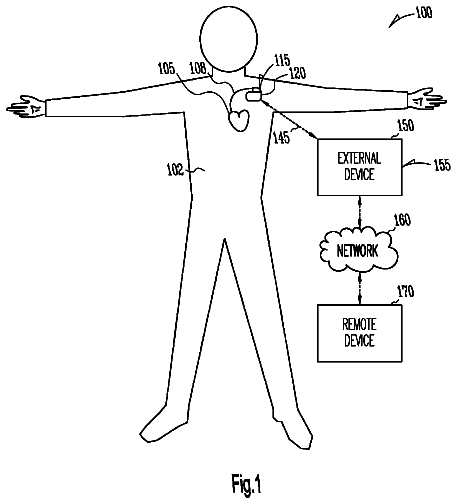
The present invention allows for monitoring the functional effect of an intervention effecting cardiac pacing by halting, at predetermined intervals, the artificial cardiac pacing being provided by an implantable electronic pulse generator and obtaining data on one or more intrinsic physiological parameters of intrinsic cardiac pacing during these data collection intervals. This is shown in FIG. 1. The present invention may also be referred to herein as a "Bio-pacemaker EGM system," "BioEGM," "BioEGM tool," or "Bio-pacemaker EGM download system."
With the present invention, artificial electronic pacing may be provided to the heart with any of a variety of medical devices that sense data, provide diagnostic information, and/or deliver therapy. When such a device is implantable (in whole or in part), it is referred to as an implantable medical device (IMD). An IMD may be, for example, an implantable pulse generator (IPG) that delivers electronic pacing therapy. Any of a wide variety of implantable electronic pulse generators may be used, including, but not limited to, pacemaker, implantable cardioverter defibrillator (ICD), cardiac resynchronization therapy (CRT), cardiac resynchronization therapy defibrillation device (CRT-D), subcutaneous ICD (SubQ ICD), intravascular pacemaker/ICD, and/or miniaturized leadless pacemaker. A pacemaker may include, but is not limited to, EnRhythm.RTM. pacemaker, Adapta.RTM. pacemaker, Versa.TM. pacemaker, Sensia.TM. pacemaker, Thera.RTM. pacemaker, Prodigy.RTM. pacemaker, Priva.RTM. pacemaker, and Minuet.RTM. pacemaker, all available from Medtronic Inc., Minneapolis, Minn.
An implantable electronic pulse generator (IPG) delivers cardiac pacing therapy to the heart in the faun of one or more electrical stimulation signals via one or more electrodes of an implantable lead connected to the IPG. The IPG may be configured to generate and deliver pacing therapy according to a variety of electrical stimulation parameters, which may include amplitude, pulse width, pulse rate, electrode combination, electrode polarity, and the like. The specific values for these parameters influence the effectiveness of the pacing therapy in achieving adequate capture of the heart. Capture generally refers to the pacing therapy causing sufficient depolarization of the myocardium that a propagating wave of excitation and contraction results, which may be considered a heartbeat. An implantable electronic pulse generator may also provide cardiac monitoring capabilities, alternate cardiac therapies, non-cardiac monitoring and/or non-cardiac therapies.
With the present invention, artificial electronic pacemaking provided by an IPG is halted at various intervals, so that data on intrinsic physiological parameters of cardiac pacing may be collected and recorded. Intrinsic physiological parameters of cardiac pacing include, but are not limited to, cardiac electrogram (EGM), cardiac contractability, intracardiac blood pressure, intravascular blood pressure, blood flow, blood oxygen, and electrocardiogram (ECG). The BioEGM tool of the present invention may gather specialized data on physiological parameters of cardiac pacing. For example, data on the morphology of ectopic beats may be gathered to assist in a determination of whether such an ectopic beat is coming from the injection site at which a biological pacemaker therapy was delivered. The BioEGM tool may record VT episodes in case biologic intervention is proarrhythmic.
The Bio-pacemaker EGM may perform any of a variety of calculations using data collected on physiological parameters of cardiac function, including, but not limited to, heart rate variability analysis, night and day heart rate calculations, and other assessments of the responsiveness of the biological pacemaker to cardiac autonomic function.
The Bio-pacemaker EGM allows for device-based EGM data collection on a periodic basis. Thus, the Bio-pacemaker EGM download program will enable the device to perform periodic storage of intrinsic physiological parameters of cardiac function, including, but not limited to, normal sinus/intrinsic rhythm (NSR). EGM. The program will help in the bio-pacemaker experiments by helping to elucidate time course for expression of exogenously delivered genes. Thus, the Bio-pacemaker EGM study is particularly useful for investigational use in animal studies.
In addition to periodically collecting data at predetermined intervals, the Bio-pacemaker EGM may include a means for data collection that is triggered by an event. Inhibition of pacing and data collection may be triggered, for example, when a programmed heart rate, average heart rate, or heart rate condition is met, a specified time interval has elapsed, or when an observer or the patient initiates a recording interval. Such data collection may be periodic or may be continuous long duration capture.
In some aspects, the Bio-pacemaker EGM may include a means for changing from the periodic capture of data to the continuous long duration capture of data. In some aspects, such a change may be triggered, for example, when a programmed heart rate, average heart rate, or heart rate condition is met, a specified time interval has elapsed, or at the initiation of an observer or the patient.
Pacing may be halted at predetermined intervals during pacing. The time between such intervals may be, for example, about fifteen minutes, about thirty minutes, about an hour, about one and a half hours, about two hours, about three hours, about four hours, about six hours, about eight hours, about twelve hours, about twenty-four hours, or any interval of the above referenced times.
Artificial electronic pacemaking is halted for an interval of time sufficient to allow for the collection and recordation of data on intrinsic physiological parameters of cardiac pacing. Such an interval of time may be, for example, about 1 second, about 2 seconds, about 5 seconds, about 10 seconds, about 20 seconds, about 30 seconds, about 40 seconds, about 45 seconds, about 50 seconds, about 60 seconds, about 90 seconds, about 100 seconds, about 120 seconds, about 150 seconds, about 180 seconds, about 200 seconds, about 240 seconds, about 300 seconds, about 360 seconds, or any interval of the above referenced times.
Data on one or more intrinsic physiological parameters of cardiac pacing may be collected and recorded for a length of time, also referred to herein as a recording interval. For example, data may be collected and recorded for about 1 second, about 2 seconds, about 5 seconds, about 10 seconds, about 15 seconds, about 20 seconds, about 30 seconds, about 40 seconds, about 45 seconds, about 50 seconds, about 60 seconds, about 75 seconds, about 90 seconds, about 120 seconds, about 150 seconds, about 180 seconds, or any interval of the times referenced above. The IPG may include a sensing module that collects and records the data obtained on parameters of cardiac pacing.
Data on one or more intrinsic physiological parameters of cardiac pacing may be collected and recorded during the entire time period in which artificial pacing is halted, or for any a portion of the time that artificial pacing is halted. For example, in some embodiments, obtaining data on intrinsic physiological parameters of cardiac pacing is initiated after a defined interval of time after the halting of the artificial pacing. Such a pause before the collection and recording of intrinsic data on cardiac pacing may be, for example, about 1 second, about 2 seconds, about 5 seconds, about 10 seconds, about 15 seconds, about 20 seconds, about 30 seconds, about 40 seconds, about 45 seconds, about 50 seconds, about 60 seconds, about 75 seconds, about 90 seconds, about 100 seconds, about 120 seconds, about 150 seconds, about 180 seconds, about 200 seconds, about 240 seconds, about 300 seconds, about 360 seconds, or any interval of the above referenced times. In some embodiments, the BioEGM provides instructions for an interval of halted pacing followed immediately by instructions for an interval of halted pacing and data collection and recording.
In preferred embodiments providing artificial pacing, halting artificial pacing at data collection intervals; and/or obtaining data on one or more intrinsic physiological parameters of cardiac pacing is implemented using programmed instructions. Such programmed instructions may be executed on a processing circuit included within the IPG or on a processing circuit external to the IPG. The IPG may interact with a programmer to allow a user to view and manage data and information stored on the IPG and/or to change the operation parameters of the IPG. Data on cardiac physiological parameters may be stored in memory of the IPG. Stored data may be transmitted to an external device, including, for example, by uplink telemetry.
The present invention and/or one or more portions thereof may be implemented in hardware or software, or a combination of both. For example, the functions described herein may be designed in conformance with the principles set forth herein and implemented as one or more integrated circuits using a suitable processing technology, e.g., CMOS. As another example, the present invention may be implemented using one or more computer programs executing on programmable computers, such as computers that include, for example, processing capabilities, data storage (e.g., volatile and nonvolatile memory and/or storage elements), input devices, and output devices. Program code and/or logic described herein are applied to input data to perform functionality described herein and generate desired output information. The output information may be applied as an input to one or more other devices and/or processes, in a known fashion. Any program used to implement the present invention may be provided in a high level procedural and/or object orientated programming language to communicate with a computer system. Further, programs may be implemented in assembly or machine language. In any case, the language may be a compiled or interpreted language. Any such computer programs may preferably be stored on a storage media or device (e.g., ROM or magnetic disk) readable by a general or special purpose program, computer, or a processor apparatus for configuring and operating the computer when the storage media or device is read by the computer to perform the procedures described herein. The system may also be considered to be implemented as a computer readable storage medium, configured with a computer program, where the storage medium so configured causes the computer to operate in a specific and predefined manner to perform functions described herein. Such a computer readable medium may include only forms of non-transitory tangible media, excluding transitory propagating signals per se.
The present invention and/or one or more portions thereof include circuitry that may include a computer system operable to execute software to provide for periodic halting artificial electronic pacing.
The present invention and/or one or more portions thereof include circuitry that may include a computer system operable to execute software to provide for the determination of one or more physiological parameters of cardiac function.
The description continues in the full USPTO document.
 Lapsed, fee not paid11 drawings

