Lapsed, fee not paid4 drawings
Software & Apps · US 8,621,591 B2
Software signing certificate reputation model
A request from a software developer is received to digitally sign software included in the request.
US 8,621,607 B2 · Assignee: VMware, Inc. · Inventors: Pike; Geoffrey
Sheet 1 of 9 from the published document. All sheets in the USPTO PDF
Mechanisms have been developed for securing computational systems against certain forms of attack. Taint status for data accessible by processes is selectively maintained and propagated in correspondence with information flows of instructions executed by a computing system, so that a security (or other appropriate) response can be provided if and when a control transfer (or other restricted use) is attempted based on tainted data. One response that may be triggered is a change in the privilege level (root and guest) that is used to process code executing in a virtual environment, so as to allow remediation to be performed. The triggering events may be specified in a control block.
Vulnerability of computer systems, configurations, software, and protocols to unauthorized access or use is recognized. Vulnerabilities can lead to minor annoyances and even pose critical national security risks. Automated tools have made it easier for hackers and other unauthorized users to probe systems and discover vulnerabilities. Once vulnerabilities are discovered, exploits, which are a sequence of commands or a block of data that take advantage of vulnerabilities, are disseminated and deployed. Today, given the ubiquitous nature of internet communications and the value of information and transactions hosted on the internet, discovery and exploitation of vulnerabilities have become widespread. Often, exploits seek to compromise security by introducing into a target system, data that can be interpreted by the target system in a way that facilitates the attack. One classic form of at
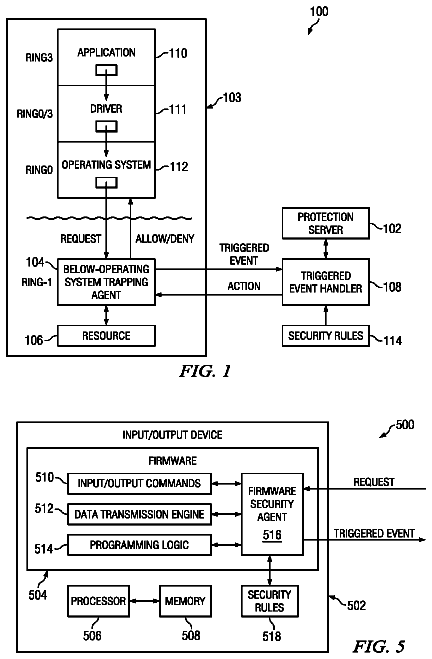
1 of 9 drawing sheets so far from the published document, cropped to the drawing. Every sheet is in the USPTO PDF.
What the patent claimed, word for word. All of it is now free to use.
Vulnerability of computer systems, configurations, software, and protocols to unauthorized access or use is recognized. Vulnerabilities can lead to minor annoyances and even pose critical national security risks. Automated tools have made it easier for hackers and other unauthorized users to probe systems and discover vulnerabilities. Once vulnerabilities are discovered, exploits, which are a sequence of commands or a block of data that take advantage of vulnerabilities, are disseminated and deployed. Today, given the ubiquitous nature of internet communications and the value of information and transactions hosted on the internet, discovery and exploitation of vulnerabilities have become widespread.
Often, exploits seek to compromise security by introducing into a target system, data that can be interpreted by the target system in a way that facilitates the attack. One classic form of attack is the so-called buffer overflow attack, in which an exploit causes vulnerable code to write data to memory in such a way that locations beyond the ostensible write target are updated. Typically, the data written takes the form of an input string that includes data which, if successfully introduced into memory in a precise location, will be interpreted by executing code (typically privileged code) in a way that facilitates the exploit. For example, if a write operation improperly writes 2 KBytes of data to a 128 Byte data structure, memory locations may be updated beyond the data structure intended by the original programmer. If those memory locations include the stack or a pointer used by privileged code, an attacker may successfully alter an execution path of privileged code. Other exploits may modify data upon which privileged code relies. In any case, a precisely crafted input string can be used to compromise a computer system.
Vulnerability to such attacks generally results from poor programming practices and/or bugs. However, such vulnerabilities are surprisingly widespread in commercial, off-the-shelf software. A majority of the most damaging internet "worms" have employed techniques that resulted in direct corruption of function-pointers. Two notable examples are the 1988 Morris Internet worm which exploited (amongst other vulnerabilities) an unchecked buffer write in the UNIX fingered program and the 2003 Slammer worm which exploited a buffer overflow vulnerability in computers running Microsoft's SQL Server.
In general, the strategy of such attacks is reasonably well understood and a variety of security techniques have been developed to detect and/or defeat some such attacks. Techniques employed have typically required a binary-rewriting pass or worse, source code analysis. Another security technique that has been proposed involves
modifications to processor hardware and related structures of a memory hierarchy to store and manage security tags and
modifications to operating system implementations to mark spurious input data.
Mechanisms have been developed for securing computational systems against certain forms of attack. Taint status for storage locations is selectively maintained and propagated in correspondence with information flows of instructions executed by a computing system, so that a security (or other appropriate) response can be provided if and when a control transfer (or other restricted use) is attempted based on tainted data. One response that may be triggered is changes in the privilege level (root mode and non-root or guest mode) that is used to process code executing in a virtual environment, so as to allow remediation to be performed. The events that trigger root mode and guest mode processing may be specified in a control block. In some embodiments, labels may be employed to code source designation or classification, aging, popularity/frequency of access or taint. Persons of skill in the art will appreciate that a wide variety of additional techniques may be used to track and change the privilege level that is used to process code based on the description herein.
A method according to an embodiment of the invention is implemented in a computational system and runs processes in a first privilege mode and a second privilege mode that has a lower privilege level than the first privilege mode. The method includes executing a first process in the second privilege mode, associating taint information with data accessible by the first process during execution of the first process to produce tainted locations, determining a taint state of the first process based on an evaluation of defined conditions and the tainted locations, and determining whether the first process is to transition from the second privilege mode to the first privilege mode based on the taint state.
A computational system according to an embodiment of the invention runs processes in a first privilege mode and a second privilege mode that has a lower privilege level than the first privilege mode. The system includes a processor and a memory. The processor is configured to: (i) execute a first process in the second privilege mode; and (ii) determine whether the first process is to transition from the second privilege mode to the first privilege mode. The memory is configured to store a control block that defines one or more conditions under which the first process transitions from execution in the second privilege mode to the first privilege mode.
FIG. 1 depicts a network of computer systems in which one or more embodiments of the present invention may be employed.
FIG. 2 illustrates the flow of input data that may constitute or contribute to an intrusion attempt, together with mechanisms that may be employed to propagate and operate on taint status.
FIG. 3 illustrates the flow of input data that may constitute or contribute to an intrusion attempt, together with mechanisms that may be employed to propagate and operate on taint status.
FIG. 4 is a functional block diagram of a virtualization system in which security techniques in accordance with one or more embodiments of the present invention may be employed.
FIG. 5 includes flowcharts illustrating operation of certain security techniques.
FIGS. 6 and 7 depict functional block diagrams of virtualization system configurations in which one or more embodiments of the present invention may be employed.
FIG. 8A includes a flowchart illustrating operation of taint triggered transitions between root and guest privilege modes in accordance with one or more embodiments of the present invention.
FIG. 8B illustrates the flow of input data that may constitute or contribute to an intrusion attempt, together with mechanisms in accordance with one or more embodiments of the present invention that may be employed to trigger a taint exit event.
In the following description, numerous specific details are set forth to provide an understanding of embodiments of the invention. However, it will be apparent to one of skill in the art that one or more embodiments of the invention may be practiced without one or more of these specific details. In other instances, well-known features have not been described to avoid obscuring the description.
Mechanisms have been developed for configuring an intrusion detection system or other computer security mechanism to facilitate identification of possible exploitations of data introduced from untrusted sources. In particular, techniques have been developed for propagating a taint status for storage locations in correspondence with information flows of instructions executed by a computing system. In general, the method(s) by which an attack is discovered can differ significantly from most conventional intrusion detection methods, which typically scan for signatures or require examination of source or binary code prior to execution. Instead, input data from untrusted sources is identified and steps are taken to track its propagation through storage to a point at which a restricted use of the data (or of derived data) may be consistent with an exploit attempt.
For example, in a secure (or security conscious) computational system, the target of a control transfer instruction (e.g., a branch target, interrupt service routine, return address, etc.) would not typically be introduced into a computation as input data. In particular, it would be particularly suspicious if input data received via a network communication from an untrusted remote system found its way into a memory location (or register) used by privileged code as a branch target or return address. Some techniques described herein build on this insight to provide efficient mechanisms to propagate auxiliary information (typically a taint-status label) in correspondence with information flows of instructions executed in the computational system.
By propagating such auxiliary information or taint-status labels, appropriate action may be taken when potentially suspect data is used in a way that (for a given security policy) is or could be restricted. Use as the target of a control transfer is a good illustrative example of such a restricted use. There are a wide variety of other possible restricted uses, however, which may be characterized more generally as restricted information flows or restricted data transfers. Thus, a control transfer may be considered a special case of a data transfer, such as a transfer of data into the instruction pointer of a CPU. Of course, based on the description herein, persons of ordinary skill in the art will appreciate a broad range of restricted use scenarios that may be appropriate for a particular implementation, deployment or security policy. For example, it may be appropriate or desirable to restrict use of information having an associated taint status by an instruction or operation sequence that introduces information into an operating system data structure, a portion of virtual/physical memory space, or a file system or software component that, consistent with a particular security posture or policy, could or should be protected. Use of tainted information as a format string by code that may be susceptible to "format string vulnerabilities" can constitute a restricted use. Similarly, the passing of tainted information to a compiler, interpreter, or execution environment as code, script, command or as any identifier for any of the forgoing can constitute a restricted use.
Some security measures may interdict or prevent completion of a particular restricted use. For some uses and/or security postures or policies, other less dramatic responses may be appropriate. For example, logging of the restricted use, escalation of a security posture, initiation of resource, process, user or other monitoring, and/or deployment of a honeypot may be appropriate with (or without) interdiction of a particular restricted use.
Additionally, in systems that support virtualization features, such as execution of code in a root privilege mode or a non-root (guest) privilege mode, taint events may be defined that trigger changes in the privilege mode that is used to process code executing in a virtual environment. The events that trigger guest privilege mode to root privilege mode transition may be specified in a control block. A typical default condition is to execute the code in guest privilege mode until a taint trigger event causes the processing to transition from the guest privilege mode to root privilege mode. When the taint trigger event is removed, the code may revert to being processed in guest privilege mode.
The implementations described herein are based on facilities, terminology and exploits typical of certain processor architectures and systems, and are based on terminology and exploits typical of certain operating systems, virtualization systems and network protocols and/or services. That said, the techniques are general to a wide variety of processor and system architectures (including both single- and multi-processor architectures based on any of a variety of instruction set architectures), to numerous operating system implementations and to systems in which hardware may or may not be virtualized. In general, the techniques may be implemented in an operating system, in a virtual machine layer, using device firmware or drivers or combinations of the foregoing. For implementations in a virtualization system (with or without hardware support), existing operating systems and applications may run unmodified. For implementations in an operating system (with or without virtualization system and/or hardware support), existing applications may run unmodified. In general, the taint tracking techniques do not require modification or recompilation of existing code deployments that are vulnerable to an exploit; however, certain implementations may employ runtime binary translation or dynamic recompilation of selected portions of existing code deployments as an efficient instrumented mode execution mechanism.
Accordingly, in view of the foregoing and without limitation on the range of underlying processor, hardware or system architectures; operating systems; or virtualization techniques that may be employed in one or more embodiments of the invention, we describe the techniques primarily in the context of certain exemplary implementations. Based on these embodiments, and on the claims that follow, persons of ordinary skill in the art will appreciate a broad range of suitable implementations and exploitations.
Exploits, Generally
In general, taint tracking techniques address many of the unwelcome side-effects of buggy or poorly-coded software that handles inputs. These side-effects, which can often be exploited in an attack, include: function-pointer corruption; data-pointer corruption; and indirect data retrieval, corruption, or transmission via the introduction of misinterpreted data. The term "function pointer" refers to any pointer to code. In this sense, a branch target or return address is a type of function pointer. The term "corruption" is used to mean that a part or all of the information in an input is copied (possibly, after several intermediate copies) or otherwise written into a register, memory cell, or other storage, that was not intended to store any part of the input at that time. This definition encompasses "buffer overrun" attacks, amongst others. Function-Pointer Corruption
Historically, the majority of the most damaging "worms" have exploited this form of attack. The Morris Internet worm from 1988 and the more recent Slammer worm are two examples, and other similar exploits will be understood by persons of ordinary skill in the art. The techniques of tracking and executing code with taint can be employed to detect function-pointer corruption attacks.
Data-Pointer Corruption
It is also undesirable to allow attackers to corrupt data pointers. Examples of exploits in which a data pointer is directly corrupted to later gain control of an application are well known, and will be understood by persons of ordinary skill in the art. One notable example was published as Bypassing StackGuard and StackShield, by Bulba and Kil3r, in Phrack Magazine, Volume 10 [0xa] Issue 56 [0x38] (May 2000), archived on the World Wide Web at phrack.org/phrack/56/p56-0x05. The techniques of tracking and executing code with taint can be used to detect such attacks.
Indirect Data Retrieval/Corruption/Transmission
The classes of attacks summarized above generally build upon an input that is misinterpreted because, contrary to a programmer's intent, a part or all of it is copied to an inappropriate place in the computer. For example, a return address on the stack can be overwritten by an input and a later machine instruction might then interpret part of that data as a code address. Of course, while such a sequence may be contrary to the intent of the operating system or application programmer, it can be exactly what a hacker intends.
It is also possible for bugs to allow data to be "misinterpreted" even when the data are in an expected place in the computer. For example, some programs sloppily interpret a string as a set of formatting instructions when it is unsafe to do so; this class of vulnerabilities is sometimes called "format string vulnerability." Other programs may be exploited to execute a script, command or code specified by an input, typically at an inappropriate level of privilege.
Computational Systems, Generally
FIG. 1 depicts a network in which one or more embodiments of the invention may be employed to secure any of a variety of computational systems against exploits such as described above. In particular, FIG. 1 illustrates a networked system 100 in which a collection of computational systems 110 interfaces with external and potentially untrusted computers 121, 122 and 123. In the illustrated configuration, an important source of inputs that may contribute to an exploit is the set of untrusted computers 121, 122 and 123 and users. However, more generally, exploits may come from other sources including computational systems, storage and devices inside a corporate firewall or local to a targeted machine. In general, computers 121, 122 and 123 and network(s) 130 are representative of any of a variety of systems and networks (and combinations thereof), local or globally distributed, that may supply information to a computational system via any of a variety of communication channels and/or protocols, including (but not limited to) those generally associated with the Internet. Eventually, such information is presented to one or more of the illustrated computational systems 110 as an input.
We refer generally to such information as an input and the data thereof need not be coded in any particular format. Indeed, we use the term input merely to identify a sequence of codes, symbols, characters, or numbers supplied (or received) as an input to a computational system. Persons of ordinary skill in the art will understand that information is often supplied (or received) encapsulated in packets or other information bearing units and coded/modulated/stored/represented in forms suitable to a particular transmission medium, storage form, etc. and is routinely decoded, transcoded, assembled, packetized, quantized, etc. in the course of manipulation and/or transfer. Therefore, the term input is meant to represent information content as eventually presented to a computational system without regard to any particular information coding, modulation, storage form, data representation etc. In particular, the information content of an "input" may at times span multiple packets, coding units, buffers, etc., particularly en-route to memory of a targeted computational system.
While many attack vectors originate from outside a local (and potentially trusted) network such as the network of computational systems 110, it is important to note that local systems, devices, storage and users may also constitute sources of input strings that constitute or contribute to an exploit. As a result, one or more embodiments of the present invention may be concerned with inputs that are sourced from a local device (e.g., keyboard 132, network interface 133, modem or other communication device 134, etc.), local stores (e.g., local storage 131 or shared memory), networked devices (e.g., network attached storage 135 or storage area networks), and other computational systems, including those down the hall and across the globe.
Techniques of the present invention will be understood in the context of conventional hardware-oriented embodiments of these and similar systems and devices. However, in addition, we note that computational systems may be embodied as virtual computers 113 presented or emulated within a virtualization system such as virtualization system 112 executing on underlying hardware facilities. Virtualization systems are well known in the art and include commercial implementations, such as VMware.RTM. ESX Server.TM., VMware.RTM. Server and VMware.RTM. Workstation, available from VMware, Inc., Palo Alto, Calif. and operating systems with virtualization support, such as Microsoft.RTM. Virtual Server 2005, and open-source implementations such as available from XenSource, Inc. Computers 114 and/or 116 may be configured to support Intel Corporation's (of Santa Clara, Calif.) virtualization technologies, such as VT-x (for the IA-32 architecture) and VT-I (for the Itanium architecture). Alternatively, computers 114 and/or 116 may be configured to support AMD Corporation's (of Sunnyvale, Calif.) virtualization technologies, such as AMD-V (for the Opteron architecture).
Virtual machine technology can provide certain advantages. Amongst these advantages is the ability to run multiple virtual machines on an underlying hardware platform. Server consolidation exploits this advantage in an attempt to make better use of the capacity of the underlying hardware, while still ensuring that each user enjoys the features of a "complete" and apparently isolated computer. Depending on how a particular virtualization system is implemented, it can also provide greater security since the individual virtual machines can isolate potentially unstable or unsafe software so that it cannot adversely affect the hardware state or system files required for running the physical (as opposed to virtual) hardware. Although certain virtualization strategies/designs are described herein, virtualization system 112 is representative of a wide variety of designs and implementations in which underlying hardware resources are presented to software (typically to operating system software and/or applications) as virtualized instances of computational systems that may or may not precisely correspond to the underlying physical hardware.
Thus, computational systems in (or for) which one or more embodiments of the present invention may be employed include traditional hardware systems (such as computers 114 and 116), virtualized systems (such as virtualization system 112 and presented virtual computers and/or virtual machines 113) and/or combinations of the foregoing. In addition, functionality described herein may be distributed across devices or systems. For example, an initial labeling of tainted data may be performed upstream (in a data transfer sense) of a targeted system, e.g., at a gateway such as gateway 115 or computer 116. In some implementations, a virtualization system can be employed to provision a virtual computer as a "host" for a gateway device or virtual appliance.
These and other implementations will be understood with reference to the description that follows. We now turn to certain exemplary scanning and exception handling techniques.
Taint Tracking Facilities
Computational systems such as illustrated above typically receive inputs that are eventually stored in memory and/or presented to programs (including operating system software and/or application programs) executing within the computational system. In general, such inputs may be received via any of a variety of communication channels, device interfaces or data transfers. For example, some inputs may be received at a network interface card (NIC) and eventually transferred into memory of a computational system using techniques such as DMA. Other inputs may be received or accessed from data storage devices (such as disk, tape or other media) or from other storage (such as shared memory or device memory) or other I/O (Input/Output) devices such as keyboard devices, modems, USB (Universal Serial Bus) devices, etc.
Inputs may arrive from nearly any source and via nearly any path. Those inputs may contain (or encode) data suitable for use in an exploit. Of course, inputs usually encode legitimate data that is not part of any attack or exploit and which will never be misused or misinterpreted. In general, for at least some of the kinds of exploits of interest, it will not be possible to distinguish a priori between innocuous data and data that will later be employed in an exploit. For this reason, the strategy includes identifying data of potential interest, tracking its propagation and instrumenting a computational system to at least detect inappropriate use. A few scenarios are illustrated in the context of FIGS. 2 and 3.
At least one suitable point is selected for initially labeling information as "tainted." By "tainted," we mean untrusted, suspect, potentially dangerous, malicious or otherwise of interest given a particular implementation, deployment, or security posture or policy. In general, appropriate taint criteria will be implementation dependent. For example, in some implementations, information may be considered tainted simply if it is not known to be completely trusted or if it is sourced from or transported via resources that are not completely trusted. In some implementations, information may be considered tainted based on some affirmative indicia of malice or based on information regarding compromised systems/networks or vulnerable protocols, services or interfaces. In some implementations, analysis of the data itself may contribute to taint characterization. In many implementations, taintedness can correspond to a multi-characteristic risk assessment, and may be based on fixed or variable criteria and/or single- or multi-level thresholds.
Handler-Based Facilities
In some embodiments, handler-based facilities are employed to aid in the implementation of some of the taint propagation and restricted use detection mechanisms described herein. FIG. 2 illustrates at least one such embodiment. A suitable point (e.g., labeling point 211) is identified for initially labeling information as tainted. Often, the suitable labeling point resides in device driver or DMA handler software or in the implementation of a protocol stack or in a virtualization layer corresponding to any of the foregoing. In operating system or application software realizations, labeling points may be provided using input processing facilities of the operating system or application itself. However, because it is typically the operating system and applications that we seek to protect from exploits, it will often be preferable to label using facilities independent of the operating system or application itself. For this reason, virtualization layer facilities provide an attractive implementation site for performing initial labeling, for propagating taint information and for triggering responsive actions (if desired).
For simplicity of description, a single labeling point in FIG. 2 is illustrated, although multiple points may be appropriate or desirable in some implementations. Labeling point 211 is representative of any suitable point along a data path via which data 201 (e.g., data received via a network or I/O interface or read from a file system) is transported to memory 213 accessible to a vulnerable program. Since, in general, data may be used and interpreted in a variety of ways and any given data may turn out to be innocuous, we typically do not interfere with normal information flows. Instead, taint labels are propagated in correspondence with information flows and the computational system is configured to recognize a potentially inappropriate use.
In some embodiments, when information destined for a location (e.g., location 294) in memory 213 is initially characterized as tainted, a store 222 of tainted locations is updated and memory subsystems associated with memory 213 are configured to trigger an action in circumstances consistent with use or propagation of the tainted information. Typically, store 222 includes an identification of locations that are considered to be tainted. Often, store 222 will associate some characterization of the taint (e.g., level, type, source, confidence and/or aging information) with a given identification. In the illustrated case, we configure
subsystems associated with memory 213 to trigger an action if and when a tainted memory location is accessed. In general, we use any of a variety of techniques, including unmapping a corresponding memory page, marking a page as non-readable and/or non-writable, truncating a data segment or setting a breakpoint or watch point.
In some cases, the triggering mechanism we employ may be somewhat imprecise. Accordingly, we may use the appropriate handler mechanism, e.g., an exception, fault, trap, interrupt, breakpoint or other handler (shown generally as exception handler 221 or 221A) to evaluate the possibility that a particular exception 291, 292, 293 (i.e., a particular exception, fault, trap, interrupt, breakpoint or other event) was triggered by access to or use
of a location that we are tracking as tainted. In this way, a mechanism with relatively coarse-grain resolution, e.g., page-based memory management, can be used to trigger a finer-grained evaluation of whether a particular access or use involves tainted information. If a particular access or use involves an untainted location that resides on the same memory page as a tainted location, the handler may return and execution flow may continue normally.
In the illustrated case, exception handler 221 also evaluates whether a particular triggering access or use (e.g., 231) propagates taint. In general, rules regarding taint propagation are implementation dependent. Nonetheless, the following partial set is illustrative of a suitable rule set: Instructions that copy data unmodified taint their destination if any source is tainted, and untaint their destination if all sources are untainted. Instructions that write fixed results or results that are modified forms of their source operands always untaint their destination, even if one of their source operands is tainted. Of course, more sophisticated propagation rules may be employed in some embodiments. For example, propagation decisions may take level, type or source of taint into account as well as confidence and/or aging information. Similarly, a more complex decision tree for evaluating instructions that generate results that are modified forms of their source operands can be employed. For example, instructions that perform simple arithmetic transformations (e.g., incrementing by a unit typical of pointer or indexing arithmetic) may be viewed as tainting their destination if a source operand is tainted.
In situations where propagation of taint is appropriate based on particulars (e.g., operand taint status and opcode) of a triggering instruction and based on dictates of an implemented rule set, exception handler 221 updates store 222 to reflect taint of the destination and configures/reconfigures
subsystems associated with memory 213 to trigger an appropriate action based on access to an updated set of tainted memory locations. Similarly, in situations where clearing of taint is appropriate, exception handler 221 updates store 222 and may reconfigure
subsystems associated with memory 213 to no longer trigger an action. Of course, an action triggering configuration (e.g., an unmapped page) may remain appropriate if another memory location (e.g., one residing on the same page) remains tainted.
FIG. 2 illustrates exception handler 221 completing an operation consistent with semantics of triggering use 231, thereby updating memory location 296. In general, completion of the triggering action (e.g., use 231) can be performed by the handler itself, although some embodiments may update taint tracking facilities and return control to the triggering use, which may itself perform the underlying operation (shown illustratively as an update of memory location 295). In general, clearing of taint, e.g., by overwriting previously tainted contents of a memory location with data that is untainted should be handled as well. Accordingly, exception handler 221 (or a similar handler) can also be triggered (see exception 292) based on taint of a destination (such as memory location 297) rather than a source. As before, completion of the triggering action (e.g., use 232) can be performed by the handler itself or by the underlying operation. In some embodiments, handler 221 may be implemented as multiple specialized handlers.
Certain uses of tainted information may constitute a "restricted use." As previously described, use of tainted data to specify the target of a control transfer may be restricted in some exploitations. Other restrictable uses may include use of tainted information by an instruction or operation sequence that introduces information into an operating system data structure, portion of virtual/physical memory space, file system or software component that, consistent with a particular security posture or policy, should be protected. For clarity of description, we illustrate in FIG. 2 the use of tainted information to specify the target of branch 233; however, based on the description herein, persons of ordinary skill in the art will appreciate a broad range of restricted use scenarios that may be appropriate for a particular implementation, deployment or security policy.
In the illustration of FIG. 2, subsystems associated with memory 213 are configured (based on taint propagation mechanisms described herein) to trigger an action if and when tainted memory location 299 is accessed. As before, triggering mechanisms employed in some configurations may not discriminate on a location-by-location basis, and we use a handler, e.g., an exception, fault, trap, interrupt, breakpoint or other handler 221A, to evaluate the possibility that exception 293 was triggered by use (in this case, use as a branch target specifier by branch 233) of a memory location that is tainted. Handler 221A consults store 222 for this purpose. As before, rules regarding taint can (in general) be implementation dependent. Nonetheless, an illustrative rule for handling certain control flows is: Control flow instructions that read the new program counter from a tainted location result in an exception. For example, an undefined opcode exception could be overloaded. In some embodiments, alternate rule sets may be deployed and other actions may be triggered, including logging of the restricted use, escalation of a security posture, initiation of resource, process, user or other monitoring, with (or without) interdiction. Of course, rules that are more sophisticated may be employed in some embodiments. For example, decisions may take level, type or source of taint into account as well as confidence and/or aging information. Additional or other uses of tainted information may be restricted in some embodiments. In some embodiments, handlers 221 and 221A are implemented as a single handler.
When guest and root privilege levels are available for processing the code, the privilege level may be changed when taint is detected. Specific events that cause execution of the code to exit guest privilege mode execution and transition to root privilege mode execution may be defined by rules in a control block. Similarly, the privilege level of execution may transition from the root privilege mode execution to the guest privilege mode execution when the taint state changes. Typically, resuming execution of the code in the guest privilege mode improves the processing performance of a virtual system. Allowing definition of the rules in the control block permits customization of privilege level of code execution based on the taint state.
Instrumented Execution Mode for Taint Tracking Through Register Storage
While the preceding description has focused on handler-based mechanisms for propagating taint and restricting use of tainted information, it should be noted that in many computational systems not all storage accesses are conveniently mediated using handler mechanisms. For example, while many conventional memory subsystems may be configured in ways that support our techniques to provide coverage for tainted memory locations, these mechanisms do not provide coverage for accesses that involve register storage. Since tainted data may propagate through registers and since restrictable uses (including branches) may source operands from tainted registers, we employ additional techniques to provide register coverage. These additional techniques may be employed to cover other forms of storage, including some or all of the memory storage, if desired.
Some of the instructions that use tainted data and which trigger handler 221 may propagate taint to register storage of computational system 210 (illustrated in FIG. 2 as registers 214). In such cases, handler 221 initiates an instrumented execution mode 223 that facilitates taint tracking at least while register storage contains tainted data. In general, instrumented execution modes dynamically augment the functionality of executable/executing code and may be supported using a variety of techniques including a binary translation (or rewriting) mode, just-in-time (JIT) compilation/re-compilation, interpreted mode execution, etc. For register coverage, instrumented execution modes provide a mechanism for augmenting instruction sequences to test conditions related to taint status of register operands and to propagate taint status (as appropriate) for information transferred to register and non-register storage.
As with the handler-based mechanisms described above, a set of taint propagation and use restriction rules are implemented. For purposes of illustration, rules similar to those described above are assumed. Therefore, in an illustrative embodiment, a sequence that includes a first instruction that copies data without modification is augmented with additional instructions (or other functionality) to propagate taint status from the source to the destination of the first instruction. Similarly, a sequence that includes a second instruction that modifies data is augmented with additional instructions (or other functionality) to untaint the destination of the second instruction regardless of the taintedness of its source(s). Thus, the additional instructions operate to update store 222 and, if the destination of the first or second instruction is memory 213, may reconfigure
subsystems associated therewith to trigger (or no longer trigger) an action consistent with taint status updates.
As with the handler-based mechanisms described above, certain instructions (e.g., control transfer instructions that use tainted data as a branch target or return address) may be subject to use restrictions. Therefore, a sequence that includes a control transfer instruction is augmented with additional instructions (or other functionality) to check taint status for the memory location or register that contains a branch target or return address for the control transfer instruction. If tainted data is used as a branch target or return address, an appropriate action is triggered. As before, a variety of actions may be triggered including logging of the restricted use, escalation of a security posture, initiation of resource, process, user or other monitoring, with (or without) interdiction.
In general, computational system 210 remains in instrumented mode (and the original instruction sequences of deployed code are augmented) for at least so long as registers 214 contain tainted data. In some embodiments, it may be desirable to disable handler-based mechanisms while operating in instrumented mode. Once all registers 214 are free of taint, computational system 210 may revert to handler-based facilities for taint tracking.
Comprehensive Taint Tracking Using Instrumented Execution
The description continues in the full USPTO document.
About 5,965 words. The USPTO PDF has it with every drawing.
Fees are due 3.5, 7.5 and 11.5 years after grant. This patent expired on December 31, 2025, so the fee marked "not paid" was the one that went unpaid.
COMPUTATIONAL SYSTEM INCLUDING MECHANISMS FOR TRACKING TAINT
Filed Apr 2008 · published Sep 2008Computational system including mechanisms for tracking taint
Filed Apr 2008 · granted Dec 2013Earlier publications, parents and continuations. None of them can still be enforced, or this patent would not be listed.
Prior art cited by the examiner or applicant. Useful when you check your own idea for novelty.
Everything on this page comes from the documents linked above.