 Lapsed, fee not paid5 drawings
Materials & Chemistry · US 8,617,668 B2
Method of using nitrogen based compounds to reduce contamination in beam-induced thin film deposition
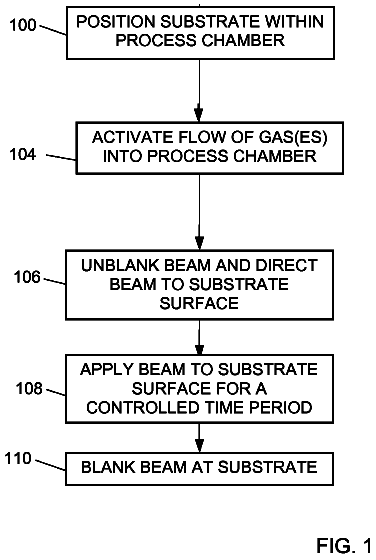
A method of depositing a material on a work piece surface.
US 8,617,700 B2 · Assignee: Sabic Innovative Plastics IP B.V. · Inventors: Pai-Paranjape; Vandita et al.
Sheet 1 of 2 from the published document. All sheets in the USPTO PDF
Disclosed herein is an article and thermoplastic composition comprising a polysiloxane-polycarbonate, optionally, a polycarbonate, and an X-ray contrast agent comprising X-ray scattering atoms having an atomic number of greater than or equal to 22, wherein a 3.2 mm thick article molded from the thermoplastic composition has a notched Izod impact strength of greater than or equal to about 620 J/m, when measured at a temperature of 0.degree. C. according to ASTM D256-04, and has an Equivalent Al Thickness of greater than 0.51 mm, when irradiated with 50 kV X-ray radiation, and wherein melt volume rates determined under a load of 1.2 kg at 300.degree. C. (ASTM D1238-04), a melt volume rate measured at a dwell time of 18 minutes increases relative to that measured at 6 minutes by less than or equal to 31%. A method of improving contrast in a polycarbonate composition, and specific articles are also disclosed.
This invention is directed to thermoplastic compositions having improved X-ray contrast, and in particular thermoplastic compositions comprising polysiloxane-polycarbonate and X-ray contrast agents, methods of making and of improving X-ray contrast in thermoplastics, and articles prepared therefrom. Polycarbonate molds are commonly used in chocolate production. Such molds are generally made by plastic injection mold-making which involves high pressure injection of a polycarbonate resin around a metal master. Such polycarbonate molds have a long useful life and are very strong, and are desirable for both ease of use and for making high gloss chocolates. Other types of molds such as those made of silicone rubber or thermoformed plastic are also used for a limited set of applications. Polysiloxane-polycarbonate copolymers are also used in chocolate molds, primarily because of their exceptio
All 2 drawing sheets from the published document, cropped to the drawing.
What the patent claimed, word for word. All of it is now free to use.
This invention is directed to thermoplastic compositions having improved X-ray contrast, and in particular thermoplastic compositions comprising polysiloxane-polycarbonate and X-ray contrast agents, methods of making and of improving X-ray contrast in thermoplastics, and articles prepared therefrom.
Polycarbonate molds are commonly used in chocolate production. Such molds are generally made by plastic injection mold-making which involves high pressure injection of a polycarbonate resin around a metal master. Such polycarbonate molds have a long useful life and are very strong, and are desirable for both ease of use and for making high gloss chocolates. Other types of molds such as those made of silicone rubber or thermoformed plastic are also used for a limited set of applications. Polysiloxane-polycarbonate copolymers are also used in chocolate molds, primarily because of their exceptional release characteristics and chemical and thermal stability, as well as their ability to provide high gloss surfaces.
Metal detectors are generally used in the manufacturing process to detect metallic contaminants which typically arise from wear and tear of machines resulting from routine use, to ensure that chocolates prepared from them are of the highest quality. However, they are not capable of detecting any contaminants coming from plastic components (such as a chocolate mold) in the manufacturing process. X-ray detectors can be used to detect plastics; however, polycarbonate and typical compositions, such as for example those useful for preparing chocolate molds, are transparent to X-rays. Elements having higher atomic numbers than carbon have to be introduced into polycarbonate, either in the form of additives (e.g., glass, pigments, etc.) or incorporated into the polymer chain, to enable articles prepared from the polycarbonate to show any level of X-ray contrast. Typically addition of glass or other inorganic fillers leads to loss of gloss and low transparency as well as reduction in flow and impact properties of polycarbonate. This is not acceptable in the case of polysiloxane-polycarbonate matrices where low temperature ductility in combination with good flow is important.
The above-described and other drawbacks are alleviated by, in an embodiment, an article comprising a thermoplastic composition comprising: a polysiloxane-polycarbonate; optionally, a polycarbonate; and an X-ray contrast agent comprising X-ray scattering atoms having an atomic number of greater than or equal to 22; wherein an article molded from the thermoplastic composition and having a thickness of 3.2 mm has a notched Izod impact (NII) strength of greater than or equal to about 620 J/m, when measured at a temperature of 0.degree. C. according to ASTM D256-04, or a notched Izod impact strength of greater than or equal to about 409 J/m, when measured at a temperature of -30.degree. C. according to ASTM D256-04, wherein an article molded from the thermoplastic composition and having a thickness of 3.2 mm has an Equivalent Al Thickness of greater than 0.51 mm, when irradiated with 50 kV X-ray radiation, and wherein for melt volume rates of the thermoplastic composition determined under a load of 1.2 kg at a temperature of 300.degree. C. according to ASTM D1238-04, a melt volume rate measured at a dwell time of 18 minutes increases relative to a melt volume rate measured at a dwell time of 6 minutes by less than or equal to 31%.
In another embodiment, a thermoplastic composition comprises: 5 to 100 parts by weight of a polysiloxane-polycarbonate; 0 to 95 parts by weight of a polycarbonate; and 0.01 to 10 parts by weight of a contrast agent comprising rutile titanate having a median particle size of less than or equal to about 5 micrometers (.mu.m), magnetite having a median particle size of less than about 1 micrometer, or a combination comprising at least one of the foregoing contrast agents; wherein each of the polysiloxane-polycarbonate, polycarbonate, and X-ray contrast agent are present based on a combined 100 parts by weight of polysiloxane-polycarbonate and polycarbonate; wherein an article molded from the thermoplastic composition and having a thickness of 3.2 mm has a notched Izod impact (NII) strength of greater than or equal to about 620 J/m, when measured at a temperature of 0.degree. C. according to ASTM D256-04, or a notched Izod impact strength of greater than or equal to about 409 J/m, when measured at a temperature of -30.degree. C. according to ASTM D256-04, wherein an article molded from the thermoplastic composition and having a thickness of 3.2 mm has an Equivalent Al Thickness of greater than 0.51 mm, when irradiated with 50 kV X-ray radiation, and wherein for melt volume rates of the thermoplastic composition determined under a load of 1.2 kg at a temperature of 300.degree. C. according to ASTM D1238-04, a melt volume rate measured at a dwell time of 18 minutes increases relative to a melt volume rate measured at a dwell time of 6 minutes by less than or equal to 31%.
In another embodiment, a method for increasing the x-ray contrast in an article comprises a thermoplastic composition, comprising combining an X-ray contrast agent having a median particle size of less than or equal to 5 micrometers, with a polysiloxane-polycarbonate, and optionally a polycarbonate, wherein the X-ray contrast agent comprises an element having an atomic number of greater than or equal to 22; and forming the article from the thermoplastic composition, wherein an article molded from the thermoplastic composition and having a thickness of 3.2 mm has a notched Izod impact (NII) strength of greater than or equal to about 620 J/m, when measured at a temperature of 0.degree. C. according to ASTM D256-04, or a notched Izod impact strength of greater than or equal to about 409 J/m, when measured at a temperature of -30.degree. C. according to ASTM D256-04, wherein an article molded from the thermoplastic composition and having a thickness of 3.2 mm has an Equivalent Al Thickness of greater than 0.51 mm, when irradiated with 50 kV X-ray radiation, and wherein for melt volume rates of the thermoplastic composition determined under a load of 1.2 kg at a temperature of 300.degree. C. according to ASTM D1238-04, a melt volume rate measured at a dwell time of 18 minutes increases relative to a melt volume rate measured at a dwell time of 6 minutes by less than or equal to 31%.
In another embodiment, a mold for manufacturing chocolate comprises a thermoplastic composition comprising: 5 to 99 parts by weight of a polysiloxane-polycarbonate, 1 to 95 parts by weight of a polycarbonate, and 0.01 to 10 parts by weight of an X-ray contrast agent comprising rutile titanate having a median particle size of less than or equal to about 5 micrometers, magnetite having a median particle size of less than or equal to about 0.5 micrometers, or a combination comprising at least one of the foregoing X-ray contrast agents, wherein each of the polysiloxane-polycarbonate, polycarbonate, and X-ray contrast agent are present based on a combined 100 parts by weight of polysiloxane-polycarbonate and polycarbonate, wherein an article molded from the thermoplastic composition and having a thickness of 3.2 mm has a notched Izod impact (NII) strength of greater than or equal to about 620 J/m, when measured at a temperature of 0.degree. C. according to ASTM D256-04, or a notched Izod impact strength of greater than or equal to about 409 J/m, when measured at a temperature of -30.degree. C. according to ASTM D256-04, wherein an article molded from the thermoplastic composition and having a thickness of 3.2 mm has an Equivalent Al Thickness of greater than 0.51 mm, when irradiated with 50 kV X-ray radiation, and wherein for melt volume rates of the thermoplastic composition determined under a load of 1.2 kg at a temperature of 300.degree. C. according to ASTM D1238-04, a melt volume rate measured at a dwell time of 18 minutes increases relative to a melt volume rate measured at a dwell time of 6 minutes by less than or equal to 31%.
A description of the figures, which are meant to be exemplary and not limiting, is provided below.
FIG. 1 is an X-ray image of a chocolate bar taken at (A) 70 kV using a filter, and (B) 50 kV taken without a filter;
FIG. 2 is an X-ray image of a chocolate bar with pellets of an exemplary thermoplastic composition having X-ray contrast, scattered over the surface of the chocolate bar, taken at (A) 70 kV using a filter, and (B) 50 kV taken without a filter;
FIG. 3 shows X-ray images of a chocolate bar and an article (circular in A and B, oblong in C and D) placed on the chocolate bar, in which the articles are molded from the composition of (A) Example 4, (B) Example 5, (C) Example 7, and (D) Example 8; and
FIG. 4 shows a plot of ejection pressure versus cycle time to demonstrate mold release properties for articles molded from a polycarbonate control, Example 9, and Comparative Examples 13 and 14.
The above described and other features are exemplified by the following detailed description.
This disclosure provides a thermoplastic composition that is detectable by X-rays, prepared from a polysiloxane-polycarbonate copolymer, optionally, a polycarbonate, and an X-ray contrast agent. Articles made from the thermoplastic composition, and a method of improving X-ray contrast in an article comprising the thermoplastic composition, are also disclosed.
It has surprisingly been found that certain inorganic compounds are useful as X-ray contrast agents for formulating the X-ray detectable thermoplastic composition. Specifically useful inorganic compounds include rutile titanates and inorganic fillers such as magnetite selected from within an optimal particle size range, are useful in formulating such X-ray detectable compositions having the aforementioned properties. Common inorganic compounds useful as X-ray contrast agents such as barium sulfate, bismuth oxide and bismuth carbonate may also potentially be used. The particle size of the X-ray contrast agent is desirably less than 5 micrometers so that properties of flow, low temperature impact, and gloss of the X-ray detectable composition are maintained.
The thermoplastic composition includes a polysiloxane-polycarbonate, and may also include a polycarbonate. As used herein, the terms "polycarbonate" and "polycarbonate resin" mean compositions having repeating structural carbonate units of the formula (1):
##STR00001## in which at least 60 percent of the total number of R.sup.1 groups are aromatic organic radicals and the balance thereof are aliphatic, alicyclic, or aromatic radicals. In one embodiment, each R.sup.1 is an aromatic organic radical, for example a radical of the formula (2): -A.sup.1-Y.sup.1-A.sup.2-
wherein each of A.sup.1 and A.sup.2 is a monocyclic divalent aryl radical and Y.sup.1 is a bridging radical having one or two atoms that separate A.sup.1 from A.sup.2. In an exemplary embodiment, one atom separates A.sup.1 from A.sup.2. Illustrative non-limiting examples of radicals of this type are --O--, --S--, --S(O)--, --S(O).sub.2--, --C(O)--, methylene, cyclohexyl-methylene, 2-[2.2.1]-bicycloheptylidene, ethylidene, isopropylidene, neopentylidene, cyclohexylidene, cyclopentadecylidene, cyclododecylidene, and adamantylidene. The bridging radical Y.sup.1 may be a hydrocarbon group or a saturated hydrocarbon group such as methylene, cyclohexylidene, or isopropylidene.
Polycarbonates may be produced by the reaction of dihydroxy compounds having the formula HO--R.sup.1--OH, which includes dihydroxy compounds of formula (3): HO-A.sup.1-Y.sub.1-A.sub.2-OH
wherein Y.sup.1, A.sup.1 and A.sup.2 are as described above. Also included are bisphenol compounds of general formula (4):
##STR00002## wherein R.sup.a and R.sup.b each represent a halogen atom or a monovalent hydrocarbon group and may be the same or different; p and q are each independently integers of 0 to 4; and X.sup.a represents one of the groups of formula (5):
##STR00003## wherein R.sup.c and R.sup.d each independently represent a hydrogen atom or a monovalent linear or cyclic hydrocarbon group and R.sup.e is a divalent hydrocarbon group.
In an embodiment, a heteroatom-containing cyclic alkylidene group comprises at least one heteroatom with a valency of 2 or greater, and at least two carbon atoms. Heteroatoms for use in the heteroatom-containing cyclic alkylidene group include --O--, --S--, and --N(Z)--, where Z is a substituent group selected from hydrogen, hydroxy, C.sub.1-12 alkyl, C.sub.1-12 alkoxy, or C.sub.1-12 acyl. Where present, the cyclic alkylidene group or heteroatom-containing cyclic alkylidene group may have 3 to 20 atoms, and may be a single saturated or unsaturated ring, or fused polycyclic ring system wherein the fused rings are saturated, unsaturated, or aromatic.
Other bisphenols containing substituted or unsubstituted cyclohexane units can be used, for example bisphenols of formula (6):
##STR00004## wherein each R.sup.f is independently hydrogen, C.sub.1-12 alkyl, or halogen; and each R.sup.g is independently hydrogen or C.sub.1-12 alkyl. The substituents may be aliphatic or aromatic, straight chain, cyclic, bicyclic, branched, saturated, or unsaturated. Such cyclohexane-containing bisphenols, for example the reaction product of two moles of a phenol with one mole of a hydrogenated isophorone, are useful for making polycarbonate polymers with high glass transition temperatures and high heat distortion temperatures. Cyclohexyl bisphenol containing polycarbonates, or a combination comprising at least one of the foregoing with other bisphenol polycarbonates, are supplied by Bayer Co. under the APEC.RTM. trade name.
Other useful dihydroxy compounds having the formula HO--R.sup.1--OH include aromatic dihydroxy compounds of formula (7):
##STR00005## wherein each R.sup.h is independently a halogen atom, a C.sub.1-10 hydrocarbyl such as a C.sub.1-10 alkyl group, a halogen substituted C.sub.1-10 hydrocarbyl such as a halogen-substituted C.sub.1-10 alkyl group, and n is 0 to 4. The halogen is usually bromine.
Exemplary dihydroxy compounds include the following: 4,4'-dihydroxybiphenyl, 1,6-dihydroxynaphthalene, 2,6-dihydroxynaphthalene, bis(4-hydroxyphenyl)methane, bis(4-hydroxyphenyl)diphenylmethane, bis(4-hydroxyphenyl)-1-naphthylmethane, 1,2-bis(4-hydroxyphenyl)ethane, 1,1-bis(4-hydroxyphenyl)-1-phenylethane, 2-(4-hydroxyphenyl)-2-(3-hydroxyphenyl)propane, bis(4-hydroxyphenyl)phenylmethane, 2,2-bis(4-hydroxy-3-bromophenyl)propane, 1,1-bis(hydroxyphenyl)cyclopentane, 1,1-bis(4-hydroxyphenyl)cyclohexane, 1,1-bis(4-hydroxyphenyl)isobutene, 1,1-bis(4-hydroxyphenyl)cyclododecane, trans-2,3-bis(4-hydroxyphenyl)-2-butene, 2,2-bis(4-hydroxyphenyl)adamantine, (alpha,alpha'-bis(4-hydroxyphenyl)toluene, bis(4-hydroxyphenyl)acetonitrile, 2,2-bis(3-methyl-4-hydroxyphenyl)propane, 2,2-bis(3-ethyl-4-hydroxyphenyl)propane, 2,2-bis(3-n-propyl-4-hydroxyphenyl)propane, 2,2-bis(3-isopropyl-4-hydroxyphenyl)propane, 2,2-bis(3-sec-butyl-4-hydroxyphenyl)propane, 2,2-bis(3-t-butyl-4-hydroxyphenyl)propane, 2,2-bis(3-cyclohexyl-4-hydroxyphenyl)propane, 2,2-bis(3-allyl-4-hydroxyphenyl)propane, 2,2-bis(3-methoxy-4-hydroxyphenyl)propane, 2,2-bis(4-hydroxyphenyl)hexafluoropropane, 1,1-dichloro-2,2-bis(4-hydroxyphenyl)ethylene, 1,1-dibromo-2,2-bis(4-hydroxyphenyl)ethylene, 1,1-dichloro-2,2-bis(5-phenoxy-4-hydroxyphenyl)ethylene, 4,4'-dihydroxybenzophenone, 3,3-bis(4-hydroxyphenyl)-2-butanone, 1,6-bis(4-hydroxyphenyl)-1,6-hexanedione, ethylene glycol bis(4-hydroxyphenyl)ether, bis(4-hydroxyphenyl)ether, bis(4-hydroxyphenyl)sulfide, bis(4-hydroxyphenyl)sulfoxide, bis(4-hydroxyphenyl)sulfone, 9,9-bis(4-hydroxyphenyl)fluorine, 2,7-dihydroxypyrene, 6,6'-dihydroxy-3,3,3',3'-tetramethylspiro(bis)indane ("spirobiindane bisphenol"), 3,3-bis(4-hydroxyphenyl)phthalide, 2,6-dihydroxydibenzo-p-dioxin, 2,6-dihydroxythianthrene, 2,7-dihydroxyphenoxathin, 2,7-dihydroxy-9,10-dimethylphenazine, 3,6-dihydroxydibenzofuran, 3,6-dihydroxydibenzothiophene, and 2,7-dihydroxycarbazole, resorcinol, substituted resorcinol compounds such as 5-methyl resorcinol, 5-ethyl resorcinol, 5-propyl resorcinol, 5-butyl resorcinol, 5-t-butyl resorcinol, 5-phenyl resorcinol, 5-cumyl resorcinol, 2,4,5,6-tetrafluoro resorcinol, 2,4,5,6-tetrabromo resorcinol, or the like; catechol; hydroquinone; substituted hydroquinones such as 2-methyl hydroquinone, 2-ethyl hydroquinone, 2-propyl hydroquinone, 2-butyl hydroquinone, 2-t-butyl hydroquinone, 2-phenyl hydroquinone, 2-cumyl hydroquinone, 2,3,5,6-tetramethyl hydroquinone, 2,3,5,6-tetra-t-butyl hydroquinone, 2,3,5,6-tetrafluoro hydroquinone, 2,3,5,6-tetrabromo hydroquinone, and the like, as well as combinations comprising at least one of the foregoing dihydroxy compounds.
Specific examples of bisphenol compounds that may be represented by formula
include 1,1-bis(4-hydroxyphenyl) methane, 1,1-bis(4-hydroxyphenyl)ethane, 2,2-bis(4-hydroxyphenyl) propane (hereinafter "bisphenol A" or "BPA"), 2,2-bis(4-hydroxyphenyl) butane, 2,2-bis(4-hydroxyphenyl) octane, 1,1-bis(4-hydroxyphenyl) propane, 1,1-bis(4-hydroxyphenyl) n-butane, 2,2-bis(4-hydroxy-1-methylphenyl) propane, 1,1-bis(4-hydroxy-t-butylphenyl) propane, 3,3-bis(4-hydroxyphenyl) phthalimidine, 2-phenyl-3,3-bis(4-hydroxyphenyl) phthalimidine (PPPBP), and 1,1-bis(4-hydroxy-3-methylphenyl)cyclohexane (DMBPC). Combinations comprising at least one of the foregoing dihydroxy compounds may also be used.
In a specific embodiment, the polycarbonate may be a linear homopolymer derived from bisphenol A, in which each of A.sup.1 and A.sup.2 is p-phenylene and Y.sup.1 is isopropylidene. The polycarbonates may have an intrinsic viscosity, as determined in chloroform at 25.degree. C., of 0.3 to 1.5 deciliters per gram (dl/g), specifically 0.45 to 1.0 dl/g. The polycarbonates may have a weight average molecular weight (Mw) of 10,000 to 100,000 g/mol, as measured by gel permeation chromatography (GPC) using a crosslinked styrene-divinyl benzene column, at a sample concentration of 1 milligram per milliliter, and as calibrated with polycarbonate standards.
In an embodiment, the polycarbonate may have a melt volume flow rate (often abbreviated MVR) measures the rate of extrusion of a thermoplastics through an orifice at a prescribed temperature and load. Polycarbonates useful for the formation of articles may have an MVR, measured at 300.degree. C. under a load of 1.2 kg according to ASTM D1238-04 or ISO 1133, of 0.5 to 80 cubic centimeters per 10 minutes (cc/10 min). In a specific embodiment, a useful polycarbonate or combination of polycarbonates (i.e., a polycarbonate composition) has an MVR measured at 300.degree. C. under a load of 1.2 kg according to ASTM D1238-04 or ISO 1133, of 0.5 to 20 cc/10 min, specifically 0.5 to 18 cc/10 min, and more specifically 1 to 15 cc/10 min.
"Polycarbonates" and "polycarbonate resins" as used herein further include homopolycarbonates, copolymers comprising different R.sup.1 moieties in the carbonate (referred to herein as "copolycarbonates"), copolymers comprising carbonate units and other types of polymer units, such as ester units, polysiloxane units, and combinations comprising at least one of homopolycarbonates and copolycarbonates. As used herein, "combination" is inclusive of blends, mixtures, alloys, reaction products, and the like. A specific type of copolymer is a polyester carbonate, also known as a polyester-polycarbonate. Such copolymers further contain, in addition to recurring carbonate chain units of the formula (1), repeating units of formula (8):
##STR00006## wherein R.sup.2 is a divalent group derived from a dihydroxy compound, and may be, for example, a C.sub.2-10 alkylene group, a C.sub.6-20 alicyclic group, a C.sub.6-20 aromatic group or a polyoxyalkylene group in which the alkylene groups contain 2 to about 6 carbon atoms, specifically 2, 3, or 4 carbon atoms; and T divalent group derived from a dicarboxylic acid, and may be, for example, a C.sub.2-10 alkylene group, a C.sub.6-20 alicyclic group, a C.sub.6-20 alkyl aromatic group, or a C.sub.6-20 aromatic group.
In an embodiment, R.sup.2 is a C.sub.2-30 alkylene group having a straight chain, branched chain, or cyclic (including polycyclic) structure. In another embodiment, R.sup.2 is derived from an aromatic dihydroxy compound of formula
above. In another embodiment, R is derived from an aromatic dihydroxy compound of formula
above.
Examples of aromatic dicarboxylic acids that may be used to prepare the polyester units include isophthalic or terephthalic acid, 1,2-di(p-carboxyphenyl)ethane, 4,4'-dicarboxydiphenyl ether, 4,4'-bisbenzoic acid, and combinations comprising at least one of the foregoing acids. Acids containing fused rings can also be present, such as in 1,4-, 1,5-, or 2,6-naphthalenedicarboxylic acids. Specific dicarboxylic acids are terephthalic acid, isophthalic acid, naphthalene dicarboxylic acid, cyclohexane dicarboxylic acid, or combinations thereof. A specific dicarboxylic acid comprises a combination of isophthalic acid and terephthalic acid wherein the weight ratio of isophthalic acid to terephthalic acid is about 91:9 to about 2:98. In another specific embodiment, R.sup.2 is a C.sub.2-6 alkylene group and T is p-phenylene, m-phenylene, naphthalene, a divalent cycloaliphatic group, or a combination thereof. This class of polyester includes the poly(alkylene terephthalates).
The molar ratio of ester units to carbonate units in the copolymers may vary broadly, for example 1:99 to 99:1, specifically 10:90 to 90:10, more specifically 25:75 to 75:25, depending on the desired properties of the final composition.
In a specific embodiment, the polyester unit of a polyester-polycarbonate may be derived from the reaction of a combination of isophthalic and terephthalic diacids (or derivatives thereof) with resorcinol. In another specific embodiment, the polyester unit of a polyester-polycarbonate is derived from the reaction of a combination of isophthalic acid and terephthalic acid with bisphenol A. In a specific embodiment, the polycarbonate units are derived from bisphenol A. In another specific embodiment, the polycarbonate units are derived from resorcinol and bisphenol A in a molar ratio of resorcinol carbonate units to bisphenol A carbonate units of 1:99 to 99:1.
Polycarbonates can be manufactured by processes such as interfacial polymerization and melt polymerization. Although the reaction conditions for interfacial polymerization may vary, an exemplary process generally involves dissolving or dispersing a dihydric phenol reactant in aqueous caustic soda or potash, adding the resulting mixture to a suitable water-immiscible solvent medium, and contacting the reactants with a carbonate precursor in the presence of a catalyst such as triethylamine or a phase transfer catalyst, under controlled pH conditions, e.g., about 8 to about 10. The most commonly used water immiscible solvents include methylene chloride, 1,2-dichloroethane, chlorobenzene, toluene, and the like.
Carbonate precursors include, for example, a carbonyl halide such as carbonyl bromide or carbonyl chloride, or a haloformate such as a bishaloformates of a dihydric phenol (e.g., the bischloroformates of bisphenol A, hydroquinone, or the like) or a glycol (e.g., the bishaloformate of ethylene glycol, neopentyl glycol, polyethylene glycol, or the like). Combinations comprising at least one of the foregoing types of carbonate precursors may also be used. In an exemplary embodiment, an interfacial polymerization reaction to form carbonate linkages uses phosgene as a carbonate precursor, and is referred to as a phosgenation reaction.
Among the phase transfer catalysts that may be used are catalysts of the formula (R.sup.3).sub.4Q.sup.+X, wherein each R.sup.3 is the same or different, and is a C.sub.1-10 alkyl group; Q is a nitrogen or phosphorus atom; and X is a halogen atom or a C.sub.1-8 alkoxy group or C.sub.6-18 aryloxy group. Useful phase transfer catalysts include, for example, [CH.sub.3(CH.sub.2).sub.3].sub.4NX, [CH.sub.3(CH.sub.2).sub.3].sub.4PX, [CH.sub.3(CH.sub.2).sub.5].sub.4NX, [CH.sub.3(CH.sub.2).sub.6].sub.4NX, [CH.sub.3(CH.sub.2).sub.4].sub.4NX, CH.sub.3[CH.sub.3(CH.sub.2).sub.3].sub.3NX, and CH.sub.3[CH.sub.3(CH.sub.2).sub.2].sub.3NX, wherein X is Cl.sup.-, Br.sup.-, a C.sub.1-8 alkoxy group or a C.sub.6-18 aryloxy group. An effective amount of a phase transfer catalyst may be about 0.1 to about 10 wt % based on the weight of bisphenol in the phosgenation mixture. In another embodiment an effective amount of phase transfer catalyst may be about 0.5 to about 2 wt % based on the weight of bisphenol in the phosgenation mixture.
All types of polycarbonate end groups are contemplated as being useful in the polycarbonate composition, provided that such end groups do not significantly adversely affect desired properties of the compositions.
Branched polycarbonate blocks may be prepared by adding a branching agent during polymerization. These branching agents include polyfunctional organic compounds containing at least three functional groups selected from hydroxyl, carboxyl, carboxylic anhydride, haloformyl, and mixtures of the foregoing functional groups. Specific examples include trimellitic acid, trimellitic anhydride, trimellitic trichloride, tris-p-hydroxy phenyl ethane, isatin-bis-phenol, tris-phenol TC (1,3,5-tris((p-hydroxyphenyl)isopropyl)benzene), tris-phenol PA (4(4(1,1-bis(p-hydroxyphenyl)-ethyl) alpha, alpha-dimethyl benzyl)phenol), 4-chloroformyl phthalic anhydride, trimesic acid, and benzophenone tetracarboxylic acid. The branching agents may be added at a level of about 0.05 to about 2.0 wt %. Mixtures comprising linear polycarbonates and branched polycarbonates may be used.
A chain stopper (also referred to as a capping agent) may be included during polymerization. The chain stopper limits molecular weight growth rate, and so controls molecular weight in the polycarbonate. Exemplary chain stoppers include certain mono-phenolic compounds, mono-carboxylic acid chlorides, and/or mono-chloroformates. Mono-phenolic chain stoppers are exemplified by monocyclic phenols such as phenol and C.sub.1-C.sub.22 alkyl-substituted phenols such as p-cumyl-phenol, resorcinol monobenzoate, and p- and tertiary-butyl phenol; and monoethers of diphenols, such as p-methoxyphenol. Alkyl-substituted phenols with branched chain alkyl substituents having 8 to 9 carbon atom may be specifically mentioned. Certain mono-phenolic UV absorbers may also be used as a capping agent, for example 4-substituted-2-hydroxybenzophenones and their derivatives, aryl salicylates, monoesters of diphenols such as resorcinol monobenzoate, 2-(2-hydroxyaryl)-benzotriazoles and their derivatives, 2-(2-hydroxyaryl)-1,3,5-triazines and their derivatives, and the like.
Mono-carboxylic acid chlorides may also be used as chain stoppers. These include monocyclic, mono-carboxylic acid chlorides such as benzoyl chloride, C.sub.1-C.sub.22 alkyl-substituted benzoyl chloride, toluoyl chloride, halogen-substituted benzoyl chloride, bromobenzoyl chloride, cinnamoyl chloride, 4-nadimidobenzoyl chloride, and combinations thereof; polycyclic, mono-carboxylic acid chlorides such as trimellitic anhydride chloride, and naphthoyl chloride; and combinations of monocyclic and polycyclic mono-carboxylic acid chlorides. Chlorides of aliphatic monocarboxylic acids with less than or equal to about 22 carbon atoms are useful. Functionalized chlorides of aliphatic monocarboxylic acids, such as acryloyl chloride and methacryoyl chloride, are also useful. Also useful are mono-chloroformates including monocyclic, mono-chloroformates, such as phenyl chloroformate, alkyl-substituted phenyl chloroformate, p-cumyl phenyl chloroformate, toluene chloroformate, and combinations thereof.
Alternatively, melt processes may be used to make the polycarbonates. Generally, in the melt polymerization process, polycarbonates may be prepared by co-reacting, in a molten state, the dihydroxy reactant(s) and a diaryl carbonate ester, such as diphenyl carbonate, in the presence of a transesterification catalyst in a BANBURY.RTM. mixer, twin screw extruder, or the like to form a uniform dispersion. Volatile monohydric phenol is removed from the molten reactants by distillation and the polymer is isolated as a molten residue. A specifically useful melt process for making polycarbonates uses a diaryl carbonate ester having electron-withdrawing substituents on the aryls. Examples of specifically useful diaryl carbonate esters with electron withdrawing substituents include bis(4-nitrophenyl)carbonate, bis(2-chlorophenyl)carbonate, bis(4-chlorophenyl)carbonate, bis(methyl salicyl)carbonate, bis(4-methylcarboxylphenyl)carbonate, bis(2-acetylphenyl)carboxylate, bis(4-acetylphenyl)carboxylate, or a combination comprising at least one of the foregoing. In addition, transesterification catalysts for use may include phase transfer catalysts of formula (R.sup.3).sub.4Q.sup.+X above, wherein each R.sup.3, Q, and X are as defined above. Examples of transesterification catalysts include tetrabutylammonium hydroxide, methyltributylammonium hydroxide, tetrabutylammonium acetate, tetrabutylphosphonium hydroxide, tetrabutylphosphonium acetate, tetrabutylphosphonium phenolate, or a combination comprising at least one of the foregoing.
The polyester-polycarbonates may also be prepared by interfacial polymerization. Rather than utilizing the dicarboxylic acid per se, it is possible, and sometimes even preferred, to employ the reactive derivatives of the acid, such as the corresponding acid halides, in particular the acid dichlorides and the acid dibromides. Thus, for example instead of using isophthalic acid, terephthalic acid, or a combination comprising at least one of the foregoing, it is possible to employ isophthaloyl dichloride, terephthaloyl dichloride, and a combination comprising at least one of the foregoing.
In addition to the polycarbonates described above, combinations of the polycarbonate with other thermoplastic polymers, for example combinations of homopolycarbonates and/or polycarbonate copolymers with polyesters, may be used. Useful polyesters may include, for example, polyesters having repeating units of formula (8), which include poly(alkylene dicarboxylates), liquid crystalline polyesters, and polyester copolymers. The polyesters described herein are generally completely miscible with the polycarbonates when blended.
The polyesters may be obtained by interfacial polymerization or melt-process condensation as described above, by solution phase condensation, or by transesterification polymerization wherein, for example, a dialkyl ester such as dimethyl terephthalate may be transesterified with ethylene glycol using acid catalysis, to generate poly(ethylene terephthalate). It is possible to use a branched polyester in which a branching agent, for example, a glycol having three or more hydroxyl groups or a trifunctional or multifunctional carboxylic acid has been incorporated. Furthermore, it is sometime desirable to have various concentrations of acid and hydroxyl end groups on the polyester, depending on the ultimate end use of the composition.
Useful polyesters may include aromatic polyesters, poly(alkylene esters) including poly(alkylene arylates), and poly(cycloalkylene diesters). Aromatic polyesters may have a polyester structure according to formula (8), wherein D and T are each aromatic groups as described hereinabove. In an embodiment, useful aromatic polyesters may include, for example, poly(isophthalate-terephthalate-resorcinol) esters, poly(isophthalate-terephthalate-bisphenol-A) esters, poly[(isophthalate-terephthalate-resorcinol) ester-co-(isophthalate-terephthalate-bisphenol-A)]ester, or a combination comprising at least one of these. Also contemplated are aromatic polyesters with a minor amount, e.g., about 0.5 to about 10 wt %, based on the total weight of the polyester, of units derived from an aliphatic diacid and/or an aliphatic polyol to make copolyesters. Poly(alkylene arylates) may have a polyester structure according to formula (8), wherein T comprises groups derived from aromatic dicarboxylates, cycloaliphatic dicarboxylic acids, or derivatives thereof. Examples of specifically useful T groups include 1,2-, 1,3-, and 1,4-phenylene; 1,4- and 1,5-naphthylenes; cis- or trans-1,4-cyclohexylene; and the like. Specifically, where T is 1,4-phenylene, the poly(alkylene arylate) is a poly(alkylene terephthalate). In addition, for poly(alkylene arylate), specifically useful alkylene groups D include, for example, ethylene, 1,4-butylene, and bis-(alkylene-disubstituted cyclohexane) including cis- and/or trans-1,4-(cyclohexylene)dimethylene. Examples of poly(alkylene terephthalates) include poly(ethylene terephthalate) (PET), poly(1,4-butylene terephthalate) (PBT), and poly(propylene terephthalate) (PPT). Also useful are poly(alkylene naphthoates), such as poly(ethylene naphthanoate) (PEN), and poly(butylene naphthanoate) (PBN). A useful poly(cycloalkylene diester) is poly(cyclohexanedimethylene terephthalate) (PCT). Combinations comprising at least one of the foregoing polyesters may also be used.
Copolymers comprising alkylene terephthalate repeating ester units with other ester groups may also be useful. Useful ester units may include different alkylene terephthalate units, which can be present in the polymer chain as individual units, or as blocks of poly(alkylene terephthalates). Specific examples of such copolymers include poly(cyclohexanedimethylene terephthalate)-co-poly(ethylene terephthalate), abbreviated as PETG where the polymer comprises greater than or equal to 50 mol % of poly(ethylene terephthalate), and abbreviated as PCTG where the polymer comprises greater than 50 mol % of poly(1,4-cyclohexanedimethylene terephthalate).
Poly(cycloalkylene diester)s may also include poly(alkylene cyclohexanedicarboxylate)s. Of these, a specific example is poly(1,4-cyclohexane-dimethanol-1,4-cyclohexanedicarboxylate) (PCCD), having recurring units of formula (9):
##STR00007## wherein, as described using formula (8), R.sup.2 is a 1,4-cyclohexanedimethylene group derived from 1,4-cyclohexanedimethanol, and T is a cyclohexane ring derived from cyclohexanedicarboxylate or a chemical equivalent thereof, and may comprise the cis-isomer, the trans-isomer, or a combination comprising at least one of the foregoing isomers.
The polycarbonate and polyester and/or polyester-polycarbonate may be used in a weight ratio of 1:99 to 99:1, specifically 10:90 to 90:10, and more specifically 30:70 to 70:30, depending on the function and properties desired.
The polyester-polycarbonates may have a weight average molecular weight (M.sub.w) of 1,500 to 100,000 g/mol, specifically 1,700 to 50,000 g/mol, more specifically 2,000 to 40,000 g/mol, and still more specifically 5,000 to 30,000 g/mol. Molecular weight determinations are performed using gel permeation chromatography (GPC), using a crosslinked styrene-divinylbenzene column and calibrated to polycarbonate references. Samples are prepared at a concentration of about 1 mg/ml, and are eluted at a flow rate of about 1.0 ml/min.
Where used, it is desirable for a polyester-polycarbonate to have an MVR of about 5 to about 150 cc/10 min., specifically about 7 to about 125 cc/10 min, more specifically about 9 to about 110 cc/10 min, and still more specifically about 10 to about 100 cc/10 min., measured at 300.degree. C. and a load of 1.2 kilograms according to ASTM D1238-04. Commercial polyester blends with polycarbonate are marketed under the trade name XYLEX.RTM., including for example XYLEX.RTM. X7300, and commercial polyester-polycarbonates are marketed under the tradename LEXAN.RTM. SLX polymers, including for example LEXAN.RTM. SLX-9000, and are available from SABIC Innovative Plastics (formerly GE Plastics).
In an embodiment, the thermoplastic composition comprises polycarbonate in an amount of 0 to 95 parts by weight, specifically 1 to 95 parts by weight, based on a combined 100 parts by weight of polysiloxane-polycarbonate and any added polycarbonate. In a specific embodiment, the thermoplastic composition comprises polycarbonate in an amount of 1 to 50 parts by weight, specifically 1 to 45 parts by weight, more specifically 5 to 40 parts by weight, and still more specifically 10 to 35 parts by weight, based on a combined 100 parts by weight of polysiloxane-polycarbonate and any added polycarbonate. In another specific embodiment, the thermoplastic composition comprises polycarbonate in an amount of 70 to 95 parts by weight, specifically 75 to 95 parts by weight, more specifically 80 to 95 parts by weight, based on a combined 100 parts by weight of polysiloxane-polycarbonate and any added polycarbonate.
The thermoplastic composition comprises a polysiloxane-polycarbonate copolymer, also referred to as a polysiloxane-polycarbonate. The polysiloxane (also referred to herein as "polydiorganosiloxane") blocks of the copolymer comprise repeating siloxane units (also referred to herein as "diorganosiloxane units") of formula (10):
##STR00008## wherein each occurrence of R is same or different, and is a C.sub.1-13 monovalent organic radical. For example, R may independently be a C.sub.1-C.sub.13 alkyl group, C.sub.1-C.sub.13 alkoxy group, C.sub.2-C.sub.13 alkenyl group, C.sub.2-C.sub.13 alkenyloxy group, C.sub.3-C.sub.6 cycloalkyl group, C.sub.3-C.sub.6 cycloalkoxy group, C.sub.6-C.sub.14 aryl group, C.sub.6-C.sub.10 aryloxy group, C.sub.7-C.sub.13 arylalkyl group, C.sub.7-C.sub.13 arylalkoxy group, C.sub.7-C.sub.13 alkylaryl group, or C.sub.7-C.sub.13 alkylaryloxy group. The foregoing groups may be fully or partially halogenated with fluorine, chlorine, bromine, or iodine, or a combination thereof. Combinations of the foregoing R groups may be used in the same copolymer.
The value of D in formula
may vary widely depending on the type and relative amount of each component in the thermoplastic composition, the desired properties of the composition, and like considerations. Generally, D may have an average value of 2 to 1,000, specifically 2 to 500, more specifically 5 to 100, and still more specifically 5 to 50. In a specific embodiment, D has an average value of 40 to 50. In an exemplary embodiment, D has an average value of 45. In another specific embodiment, D has an average value of 20 to 40. In another exemplary embodiment, D has an average value of 30.
Where D is of a lower value, e.g., less than 40, it may be desirable to use a relatively larger amount of the polycarbonate-polysiloxane copolymer. Conversely, where D is of a higher value, e.g., greater than 40, it may be necessary to use a relatively lower amount of the polycarbonate-polysiloxane copolymer.
A combination of a first and a second (or more) polysiloxane-polycarbonate copolymer may be used, wherein the average value of D of the first copolymer is less than the average value of D of the second copolymer.
In one embodiment, the polydiorganosiloxane blocks are provided by repeating structural units of formula (11):
##STR00009## wherein D is as defined above; each R may independently be the same or different, and is as defined above; and each Ar may independently be the same or different, and is a substituted or unsubstituted C.sub.6-C.sub.30 arylene radical, wherein the bonds are directly connected to an aromatic moiety. Useful Ar groups in formula
may be derived from a C.sub.6-C.sub.30 dihydroxyarylene compound, for example a dihydroxyarylene compound of formula (3), (4), or
The description continues in the full USPTO document.
About 5,398 words. The USPTO PDF has it with every drawing.
Fees are due 3.5, 7.5 and 11.5 years after grant. This patent expired on December 31, 2025, so the fee marked "not paid" was the one that went unpaid.
THERMOPLASTIC COMPOSITION HAVING IMPROVED X-RAY CONTRAST, METHOD OF MAKING, AND ARTICLES PREPARED THEREFROM
Filed Sep 2008 · published Apr 2010Thermoplastic composition having improved X-ray contrast, method of making, and articles prepared therefrom
Filed Sep 2008 · granted Dec 2013Earlier publications, parents and continuations. None of them can still be enforced, or this patent would not be listed.
Prior art cited by the examiner or applicant. Useful when you check your own idea for novelty.
Everything on this page comes from the documents linked above.
