Lapsed, fee not paid7 drawings
Software & Apps · US 8,615,464 B2
Credit management system and method
Systems and methods are provided for managing credit information relating to customers and the credit process.
US 8,615,471 B2 · Assignee: Digimarc Corporation · Inventors: Hannigan; Brett T et al.
Sheet 1 of 5 from the published document. All sheets in the USPTO PDF
The presently claimed invention relates generally to toys and games that are enhanced with encoded information. One claim recites a method of playing a computerized game including: receiving image or video representing a physical object, the physical object comprising information steganographically encoded therein, the information is carried by the physical object through alterations to data representing at least some features carried by the physical object; utilizing a multi-purpose processor configured to: analyze received image or video to decode information steganographically encoded therein; interrogate a database or storage location with at least some of the information to obtain at least one game attribute associated with information; and modify the at least one game attribute to reflect activity during play of the computerized game. Of course, other claims and combinations are provided as well.
Digital watermarking is a process for modifying physical or electronic media to embed a machine-readable code into the media. The media may be modified such that the embedded code is imperceptible or nearly imperceptible to the user, yet may be detected through an automated detection process. Most commonly, digital watermarking is applied to media signals such as images, audio signals, and video signals. However, it may also be applied to other types of media objects, including documents (e.g., through line, word or character shifting), software, multi-dimensional graphics models, and surface textures of objects. Digital watermarking systems typically have two primary components: an encoder that embeds the watermark in a host media signal, and a decoder that detects and reads the embedded watermark from a signal suspected of containing a watermark (a suspect signal). The encoder embeds a
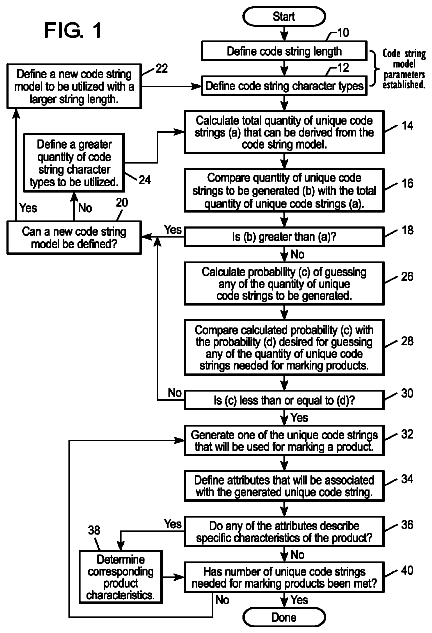
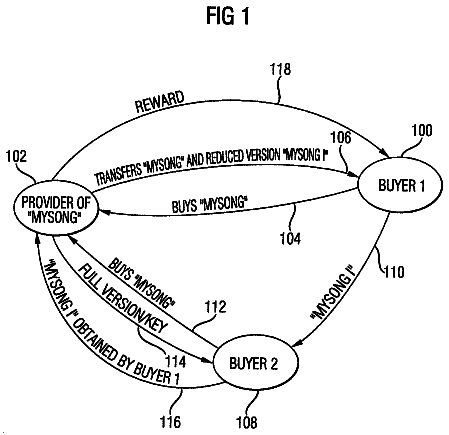
1 of 5 drawing sheets so far from the published document, cropped to the drawing. Every sheet is in the USPTO PDF.
What the patent claimed, word for word. All of it is now free to use.
The invention generally relates to steganography and data hiding. More particularly, the present invention relates to enhancing toys and games with steganography.
Digital watermarking is a process for modifying physical or electronic media to embed a machine-readable code into the media. The media may be modified such that the embedded code is imperceptible or nearly imperceptible to the user, yet may be detected through an automated detection process. Most commonly, digital watermarking is applied to media signals such as images, audio signals, and video signals. However, it may also be applied to other types of media objects, including documents (e.g., through line, word or character shifting), software, multi-dimensional graphics models, and surface textures of objects.
Digital watermarking systems typically have two primary components: an encoder that embeds the watermark in a host media signal, and a decoder that detects and reads the embedded watermark from a signal suspected of containing a watermark (a suspect signal). The encoder embeds a watermark by altering the host media signal. The reading component analyzes a suspect signal to detect whether a watermark is present. In applications where the watermark encodes information, the reader extracts this information from the detected watermark.
Several particular watermarking techniques have been developed. The reader is presumed to be familiar with the literature in this field. Particular techniques for embedding and detecting imperceptible watermarks in media signals are detailed in the assignee's co-pending U.S. application Ser. No. 09/503,881 and U.S. Pat. No. 6,122,403, which are herein incorporated by reference.
As computing power increases, and transmission and storage of digital information becomes more inexpensive, the amount of digital content will continue to exponentially increase. Digital watermarking provides a way to embed an imperceptible watermark into digital content. In addition, digital watermarks can also be embedded into traditional media such as printed material. Watermarks provide a way to communicate additional information about the watermarked medium (also called cover medium) and therefore enhance the value of the embedded medium. This additional information can be used for a variety of applications--security, content protection, authentication, data hiding, content tracking, enabling a link between content and provider, to name just a few. Digital watermarking offers a unique advantage since this information is imperceptibly bound to the cover medium and travels with it.
The present invention enhances games, books and toys through digital watermarking.
Further features will become apparent with reference to the following detailed description and accompanying drawings.
FIG. 1 is a diagram illustrating trade-offs in execution speed, robustness, and false positives in a digital watermark system.
FIG. 2 is a block diagram illustrating a multi-player computer game environment.
FIG. 3 is a block diagram illustrating a data retrieval according to one aspect of the present invention.
FIG. 4 is a block diagram illustrating an alternative communications path of the FIG. 3 embodiment.
FIG. 5 is a diagram of an interactive game environment.
Each digital watermarking application has its own set of requirements. These requirements determine which attributes of a watermarking system are essential for the application and drive the choice of techniques and algorithms used for embedding and detection. We briefly describe some important attributes (e.g., as discussed under headings A-J) for watermarking applications. It is important to note that not all attributes are required for every watermarking application. As we will see later, most applications need only a subset of attributes to satisfy the application requirements. Below, we describe attributes of watermarking systems in general. And in section K, we provide an example toy implementation. We note that the specific details and attributes discussed in section K are not needed for every toy or game application. A digital watermarking system is composed of two parts--a watermark embedder for inserting the watermark in a cover media file and a watermark detector for detecting the embedded watermark. As we will see, some attributes are specific to the embedder while others refer to the detector.
A. Robustness
Robustness refers to the ability of the watermark detector to detect the watermark under degradations. Robustness is measured in terms of detection rates (e.g., percentage of watermarked images successfully detected). Note that the need for robustness is also application-specific. For example fragile authentication watermarks are intended not to be robust. Robustness can be classified according to the type of degradations caused to the watermarked content.
1) Robustness to Common Manipulations
Most digital content has to be manipulated in some way for it to be consumed. Common manipulations of image content include brightness and contrast modifications, sharpening, blurring etc. For example, an image may be contrast enhanced before adding it to a web page. Sometimes content may have to be compressed for storage or transmission. Many watermarking applications require robustness to these manipulations.
2) Robustness to Geometric Distortions
Use of media content such as images often involves a change in geometry such as scaling (enlarging or reducing) the image, rotation, cropping, translation, mirroring, skew, etc. These operations are geometric transformations that distort the image. Robustness to geometric distortions means the ability to recover the watermark signal in the presence of geometric distortions. Some applications may require robustness against a limited set of geometric distortions or no robustness to geometric distortions at all. Video watermarks may need to be robust to other geometric transformations such as aspect ratio changes or frame-rate changes.
3) Robustness to D-A and A-D Conversions
With the advent of inexpensive printers and scanners, it is becoming easier to print digital images (digital to analog or D-A conversion) and to scan printed material to store in a digital form (analog to digital or A-D conversion). Some applications require that the watermark signal be robust to one or more print and scan operations. D-A and A-D conversions involve re-sampling, a potential loss in signal quality, and distortions of the power spectrum of the image.
4) Robustness to Malicious Attacks
This refers to the ability of the watermark to resist hostile attacks that are intended specifically to remove the watermark. It is important to distinguish between intentional attacks and common manipulations. Most users of a watermarking application are not likely to apply hostile attacks. Such attacks require special skills (e.g., signal processing and software engineering knowledge) to implement. Intentional attacks have been the topic of a significant body of research on digital watermarking. Not all watermarking applications are prone to intentional attacks.
B. Perceptibility
Regardless of the watermarking scheme employed, embedding a watermark in digital media such as an image or audio clip implies altering signal samples in some way. This alteration introduces distortions in the form of artifacts that may sometimes be perceptible to the user. Most watermarking applications require the watermark to be imperceptible. Visibility refers to the perceptibility of the watermark in image content. Visibility is affected by factors such as watermark strength, desired robustness and characteristics of the image. Visibility often competes with robustness and false positives. Greater robustness or fewer false positives require higher watermark strength and therefore greater visibility. Image watermarking systems often utilize properties of the human visual system (HVS) for reducing visibility.
The degree to which the watermark may acceptably distort the image is dependent upon many factors. The intended use has a major impact. An image designed to sell high-end cosmetics will tolerate much less distortion than one of a busy city scene. A highly textured graphical image will be more tolerant of distortion than will one full of specular reflections. Further, in the case of a printed image, the quality of the substrate and the printing process employed will set limits on the acceptable distortion of the host image.
C. Capacity
The watermark signal contains the payload that includes the bits to be communicated. Capacity refers to the size of the payload, measured in bits. As in any communication channel, an increase in capacity reduces the robustness. To explain this we first define a few terms. The payload is encoded using error correction coding schemes. This coded payload is further processed using spread spectrum techniques to generate the spread spectrum payload. Assume that the number of pixels available for embedding the spread spectrum payload is fixed. As capacity increases either the amount of coding or the spread has to decrease to accommodate the watermark. Reduction in the amount of error correction or the amount of spread usually results in decreased robustness.
D. Capacity Vs. Robustness
The amount of data the watermark carries is frequently in tension with the degree to which the watermark resists both normal and malicious attacks. For example, a large capacity can be achieved by replacing the least significant bits (LSB) of the cover medium with a watermark signal. However, LSB coding lacks robustness against operations such as printing and scanning, filtering and noisy transmission.
As with every signal detection scheme, the watermark detector will occasionally falsely detect the presence of a watermark when there is none. This false detection is termed a false positive. False positives can be measured by a false positive rate, which is the frequency of occurrence of detection in an unmarked cover media, e.g., 1 in 105. Most watermarking applications require the false positive rate to be low.
E. Speed and Computational Complexity
The speed of watermark embedding and detection is closely coupled with the computational complexity of the system. In an application with strict visibility constraints, the watermark embedder may employ computationally intensive HVS models to modulate watermark strength. This will increase embedding time. At the detector, there is a tradeoff between speed and robustness. A detector having lower speed requirements (and therefore more time) can employ additional signal processing operations (such as filtering) to increase robustness. Similarly there is a tradeoff between speed and false positives. Given more time for detection more processing may be performed to reduce the false positive rate.
F. Security
The security of the watermarking system becomes a key design parameter when the payload itself has intrinsic value as in the case of identity or financial information. Code security for the application, encryption of the data, or trusted third parties may be required as part of an overall system design. If the owner of the cover media wants the user to have embedded imperceptible digital data for the owner's or the customer's advantage, few security precautions will be required.
G. Trade-Offs Between Application Requirements
There is an inherent tradeoff between some of the attributes of digital watermarks discussed earlier. Watermark attributes such as robustness or false positive rate and speed often compete with each other. For example, if robustness to geometric distortions is desired, the speed of detection will decrease. The lower the speed requirement, more time can be spent in signal processing operations that provide increased robustness. Tradeoffs can be conceptually divided into two categories.
1) Embedder Trade-Offs
On the embedder side, the main tradeoffs are between perceptibility, capacity and speed. Visibility can be measured either subjectively or quantitatively. Subjective evaluation requires human intervention and is both expensive and time consuming. The degree to which human intervention in the embedding process is permitted, impacts both speed of embedding and visibility. Ideally, one would like to quantitatively measure how the change in visibility relates to robustness, so that the embedding software can select an optimum operating point automatically. Simple quantitative measures are based on mean squared error, more sophisticated measures may use perceptual metrics based on the HVS.
As described above, capacity is in tension with robustness. An increase in capacity usually comes at the cost of decreased robustness. Watermark strength (energy of the embedded signal) also affects both perceptibility and robustness. The effect of change in strength on visibility depends largely on the media characteristics. The watermark in a textured image may not be as visible when the strength is increased as in a relatively flat image. This is where HVS models will likely play a key role. The ability to automatically adapt visibility according to media characteristics without sacrificing robustness (or some other set of attributes) is a goal in embedder design.
2) Detector Trade-Offs
At the detector, robustness and false positives are competing attributes whose properties must be selected with speed of the system in mind. FIG. 1 illustrates the tension between these three attributes. The arrows on the three axes indicate increased robustness, increased speed and high false positive rejection (lower false positive rate). Ideally, we would like the detector to operate at the vertex of the cube marked by the circle so as to achieve the most robustness at the highest speed and maximum false positive rejection. However, due to the tension between the attributes the detector often has to work within the volume beneath the shaded triangle. If the required operating point on two axes are fixed then the value of the third axis is determined. Within this region, attempts to increase robustness come at the cost of speed and false positives and trade-offs have to be made to arrive at the operating point.
In systems where the image fed to the detector is always watermarked, the false positive requirement may not be critical and more emphasis could be given to robustness. For some systems a large majority of the images fed to the detector may be unmarked. In this case, false positive rates may be as critical as detection rates. Robustness and false positives are both competing with speed. Speed is often the most important factor. If the input to the detector is from a video camera, maintaining the frame-rate may sometimes be more important than high detection rates. In systems where speed is critical, fast detection comes at the cost of trade-offs in robustness and false positives.
H. Data Acquisition
Data acquisition is one of the basic aspects of a watermarking application that is often ignored in watermarking literature. The requirements will influence the mode of data acquisition. For example, is the input to the detector from an existing digital file or an analog source? Will the data be available once or will there be multiple opportunities to extract the payload? The choice of the data acquisition device, to a large extent, determines the choice of the watermarking technology and its capabilities. Two types of data acquisition devices that are becoming increasingly prevalent are low-cost PC cameras and low-cost PC scanners.
A low-cost PC camera provides an easy to use interface to capture an image or video sequence where the user just holds a printed version of the image or textured object up to a camera. However, given a camera input, the detector has to deal with issues such as lens distortion, lower resolution, focus issues, compression, image size, frame rate etc. In addition geometric distortions are introduced because the mechanism of holding the image up to the camera is not controlled.
A low-cost scanner provides a more controlled environment for the image to be captured. On the other hand, the interface is less flexible, less intuitive and cumbersome for repeated use. Since most scanners allow a whole range of capture resolution, the detector must be robust to re-sampling issues.
I. Choice of Synchronization Scheme
If the application requires robustness to geometric distortions, a scheme must be employed to register the acquired image with the watermark detector. To correctly read the embedded message, all message bits must be interpreted correctly. Thus, geometric distortions should be reversed or circumvented in the application. In the choice of a synchronization scheme, the degree of geometric robustness required, the presence or absence of mirrored or inverted images, and the expected degree of perspective distortions or differential scale, will all be key in determining the particular registration scheme employed.
J. Choice of Payload and Error Correction Scheme
Preferably the payload should be extendable and robust to errors. The payload is extendable by reserving payload bits for future use. Also, the error correction coding scheme allows a trade-off between robustness and bit capacity such that more bits can be carried in a given signal size at the expense of robustness to errors.
K. Toy Applications
The following discussion details novel toy and game applications of digital watermarking.
One aspect of this patent document is aimed at providing an interactive link between children's toys (or other objects including cards and documentation) and a computer (including computing devices like a video game console, personal digital assistant (PDA), set top box, Internet appliance, etc., etc.). The child's toy carries hidden digital information in a digital watermark that can inform the computer as to the nature of the object and its location and orientation (via scale and rotation parameters derived from detection). The digital watermark is embedded in an image imprinted on the toy (or in a sticker on the toy or surface texture of the toy) and can be supplemented with watermarked cards or objects that are supplied along with the packaging for the toy. The toy is based on a local database of actions and on information available on the Internet. A child is able to hold her or his toy in front of a tethered PC camera or wireless camera. The camera transmits the image data to the computer. Software on the PC performs watermark detection. On detection, a number of different actions are initiated as determined by the toy (or as intended by the toy manufacturer) or even as determined by the child's parents. These include: Playing a video or audio clip to enhance the play value of the toy, or even playing the child's favorite video or audio. Taking some action on the N.sup.th instance of detecting the toy. Educating the child about something. Registering the toy for warranty and support through an Internet connection. Finding out about usage, features and accessories from the manufacturer's web site. The software allows the actions to be programmable. There are a variety of toys that can be based on this system architecture, including digitally watermarked flash cards, each bearing watermark messages associated with game or learning actions. Another example is a free-standing robot-like device with image and audio sensors for capturing digitally watermarked images and audio and a processor for detecting the digital watermark and identifying and manipulating objects based on actions associated with messages extracted from the watermark payloads.
As an example, we will describe the requirements for a toy with the following characteristics:
Age range: 3 to 7 years.
Play action: The toy includes an expandable set of vehicles, houses, stores, and other familiar neighborhood locales. Each toy component is watermarked. On first showing the toy to the PC Camera, the computer retrieves a short video and sound clip from either the local data base or the internet. For example, the sounds of a fire engine and a short clip about firefighting are played if the fire engine is shown to the computer via the PC camera. A different clip can be optionally played the second time the same object is shown.
The toy includes a starter kit with software and one or two digitally watermarked vehicles. An add-on kit includes additional watermarked vehicles and buildings.
The toy system uses the payload of the digital watermark on each toy to distinguish around 100 toys, each from about 50 manufacturers and to carry information about the age group for which it is intended.
The detection process is fast enough to preferably allow a frame-rate of about 10 frames per second (fps) when no digital watermarked object is held up to the camera. When a watermarked object is held up to the camera, the watermark payload is obtained in, e.g., less than two seconds.
If the game is running, and no watermarked image is held up to the camera, the action of the toy is unaffected for the length of time it takes to play a session of the game. For a frame rate of 10 frames per second and a play session of one hour, less than one false positive in 10^4 is preferred for this example application.
The probability of wrongly detecting one toy as another is preferably less than 1 in 10.sup.4.
Detector software is customized to allow user-defined actions.
Camera and PC requirements already exist in the home.
Based on the requirements listed above, we can begin to define the attributes and understand the trade offs between them. Now we describe how these requirements drive various design considerations.
Visibility of Watermark
In the toy application, the watermark should not affect the artistic value the toy. As a watermark will be on a toy, this is an appropriate application where the cover medium can be adapted to suit the watermark. Toy vehicles and houses could be textured or stylized to maximize the ability to carry a watermark signal with minimum impact on visibility. Or a decorative sticker or artwork on the toy can include an embedded digital watermark.
Data Acquisition
In one implementation, a game is played by a child holding an object up to a PC camera. The toy software controls camera settings such as frame rate, compression, exposure and white balance as required. Given characteristics of the currently installed base of PC cameras, the watermark detection scheme and the play action of the toy are preferably designed to be not limited by a frame rate as slow as five frames per second for uncompressed data. The data acquisition does not impose physical manipulations in terms of requiring a precise presentation to the camera that are beyond the physical limitations of a three-year-old child. This requirement may be met via the intrinsic robustness of the capture system or via mechanical aids provided with the game to assist in positioning the watermarked image, such as an object or cardholder into which the child places the toy in front of the camera. A typical PC camera has a 480.times.640 pixel image size. Lower resolutions may typically be selected down to 120.times.160 pixels. Typical imagers have pixels about 9 um on a side. At a typical focal length of 5 mm the pixels each subtend an angular distance of .about.2.times.10.sup.-3 radians. This angular resolution sets the minimum meaningful size for a watermarking feature. At a working distance for the game of 20 cm, the minimum spatial extent of a watermarking feature is 4.times.10^2 cm. For robustness reasons, it may be advisable to over-sample the watermarking information leading to a larger watermarking feature.
Robustness
The watermark preferably withstands common image manipulations that result from holding the image in front of a camera, such as rotation, scaling, cropping, brightness adjustment and contrast enhancement. Detection is adaptive to camera-image distance. The watermarking technique works on small watermarked areas on the toy (say of size 1 inch by 1 inch). The watermark is detectable under conditions that include the soiling or distortion of the object to be presented to the camera. At a 15 fps rate the watermark detection is tolerant of image compression levels as high as a 50% reduction in file size. Since the digital watermark exists in printed form (on the toy or sticker), the watermarking technique is robust to D-A and A-D conversions.
Synchronization
Before the payload information can be extracted from the acquired image, the detector synchronizes the image with respect to rotation, scale and translation. The synchronization scheme is geared to recover affine transformations and small projective transformations. In particular, the payload is extractable from an image acquired at any angle of rotation about the camera's optic axis, for any distance within the focal zone of the camera, and with projective rotations of small pitch and yaw deviations from normality to the optic axis. A strong synchronization component may be necessary in the watermark signal, such as carrier signal or calibration signal that enables recovery from geometric distortion, or a watermark signal that is invariant to certain types of geometric distortions (e.g., rotationally symmetric patterns), as described in assignee's co-pending application Ser. No. 09/503,881 and U.S. Pat. No. 6,122,403, each incorporated by reference above.
Payload
Our preferred digital watermark payload includes plural-bit information. Based on toy, game or manufacturer requirements, our payload can even include various fields. In one implementation a payload includes three
fields--a toy ID that identifies the toy and the action, a manufacturer ID, and the intended minimum age. In this implementation, payload includes sufficient bits to carry the required fields. The payload size and importance of the individual fields determine the error correction scheme and the amount of spread employed. Some payload fields can have higher importance and could be encoded more robustly than the others.
In one implementation, the payload includes the following fields--toy ID (7 bits) that identifies the toy and the action, manufacturer ID (6 bits), intended minimum age (3 bits) and an open field (6 bits) for future use, giving a total of 22 bits. The payload size and importance of the individual fields determine the error correction scheme and the amount of spread employed. Some payload fields can have higher importance and could be encoded more robustly than the others. Here we assume all fields equally important. For fast detection, a simple repetition code (each bit repeated 14 times) can be used for error correction. Each coded bit is further coded into 30 chips to give a total of 9240 bits. To these we append 760 bits reference PN sequence derived from a key, to obtain a total of 10000 spread-spectrum bits. If the minimum camera resolvable feature has an extent of 4.times.10-2 cm the watermarked area should be of order 4 cm on a side for maximum robustness.
Table 1 shows a list of fields and the number of bits they include for another implementation. Here, we have introduced a field of 10 known bits and a field of 6 bits that is kept open for future use by extensions of this application. In all there are 32 payload bits. The term "ECC" in the table refers to error correction coding.
TABLE-US-00001 TABLE 1 Field Bits ECC Repetition Toy ID 7 Yes 4 times Manufacturer ID 6 Yes 4 times Minimum age 3 Yes 4 times Known bits 10 Yes 4 times Open 6 Yes 2 times
False Positives
The known bits in the payload are used to achieve the desired false positive rate. The values of these bits are fixed for this application. During detection, the estimated known bits are matched with the known bits. A perfect match is often necessary for detection. This ensures that the false positive rate is 1 in 2.sup.10 (or less than 1 in 10.sup.3) for a randomly occurring bit pattern that matches the known bits. An additional factor of 1 in 100 false positives is achieved by including a classification decision at the synchronization stage. This decision involves a classifier that determines whether the acquired image is watermarked or not.
Error Detection and Correction
In one toy implementation, we assume that all the bits are equally important. Error correction may be achieved by means of error correction techniques such as BCH coding or convolutional coding. We select a rate 1/3 convolutional code as a compromise between efficiency of decoding and robustness of error correction. A similar calculation to that for false positives can be performed for the probability of a false read. That is, an object is held up and miss identified. The object should fail to read in preference to misreading. As an example let's say a level of one misread is permitted in 1000 hours of play and that one object is identified each second. (Very active play). This gives a misread probability of less than 1.times.10^7 For a given identifier payload size, this will determine the bits that must be allocated to error correction and the type of error correction codes to be employed.
To reduce false reads, we partition the chips for the coded bits of toy ID and manufacturer ID into two equal sets. These chips are despread independently and then decoded independently. A read is declared valid only when the decoded sets of ID fields from both sets match bit for bit.
Watermark Signal
A watermarked image I' is obtained by embedding the watermark W in the original image I, I'=f(I, g(I,W)), where f(.) is a function denoting the embedding operation, and g(.) is a gain function that depends upon W and local and global image properties. These functions can either be linear or non-linear. Embedding can be done either in a transform domain (e.g., frequency domain) or the spatial domain. The choice of the embedding domain also influences the amount of error correction and spread used. For the above-described toy application, we choose f(.) to be an additive operation in the spatial domain. Though additive, the watermark may be computed as a non-linear function of the host signal and the embedded message to optimize imperceptibility and robustness of the signal. We could also choose to embed data using non-linear quantization embedding functions, where samples in the spatial or some transform domain are quantized to levels corresponding to symbols to be encoded.
The watermark signal W includes the spread spectrum bits combined with a synchronization signal, which can be a pattern robust to rotation/scale and/or carrier signal for the message payload. The spread spectrum bits can be designed to serve the dual purpose of a synchronization signal and message carrier by selecting a watermark carrier signal that forms a pattern in transform domain, such as a frequency domain or autocorrelation domain. The watermark signal is repeated in every M.times.N block of the image. A key determines the arrangement of the spread-spectrum and reference bits within the block.
In one implementation, the watermarked image is obtained by embedding the watermark signal, I'(x,y)=I(x,y)+.alpha.(x,y)W(x,y), where I' is the watermarked image, I is the original image, W is the watermark signal and .alpha. is the gain. The gain a is derived using HVS models, and depends on both local and global image characteristics as described in application Ser. No. 09/503,881 and U.S. Pat. No. 6,122,403. The watermark signal is of size M.times.N and is defined as W(x,y)=D(x,y)+S(x,y), where D is the watermark component containing the spread spectrum payload and S is the watermark component comprising the synchronization signal. S is a known pattern, preferably with localization properties in the frequency domain. The use of a separate synchronization signal is optional. The spread spectrum payload can be designed such that it serves the dual purpose of a synchronization signal. For example, the properties of the carrier signal can be designed to create a pattern of signal peaks in the Fourier domain, the autocorrelation domain, or some other transform domain. Transforming the suspect signal to this domain and correlating the synchronization pattern with the transformed data achieve synchronization. Again, see application Ser. No. 09/503,881 and U.S. Pat. No. 6,122,403.
The spread spectrum payload can be broken down into its components
.function..times..times..function. ##EQU00001## Ci refers to the ith coded bit and Ki is a pseudorandom key signal used for spread spectrum coding of the coded bit Ci. The signal Ki serves two purposes--spread the coded payload and spatially scatter the chips so that they are not localized. The coded bits Ci are obtained from the payload bits Bi using error detection and correction coding, (C.sub.1,C.sub.2,.LAMBDA.,Cq)=f(B.sub.1,B.sub.2,.LAMBDA.,Bp),q.gtoreq.p, where the function f refers to error detection and correction.
The watermark W is repeatedly embedded in each M.times.N block of the image.
Detection
During detection, detector software reverses the steps taken during embedding. The detector has no knowledge of the original image. It obtains an estimate, , of the watermark signal from the watermarked image. The detector applies prediction techniques to estimate the original image from the watermarked one. is then obtained by comparing the predicted image with the watermarked image--it contains an estimate of the synchronization signal, an estimate of the spread spectrum payload and remnants of the cover image. The detector then uses and a knowledge of the synchronization signal to recover the geometry (rotation, scale, etc.) of the watermark. A classifier at the synchronization stage discriminates the presence or absence of the synchronization signal. Before recovering the synchronization signal, the detector may apply pre-processing to suppress the unwanted components due to the image and the spread spectrum signal. Using the recovered synchronization, the detector proceeds to extract the reference bits and spread-spectrum payload. The extracted spread-spectrum data is first de-spread and then decoded to obtain the payload bits. Again, at the payload extraction stage, the detector may pre-process to further suppress components due to the image and the synchronization signal. In one implementation, the difference between the original and the predicted image is the prediction residual. The prediction residual is the estimate of the watermark signal. Let I'' be the image presented to the detector. Then the estimated watermark signal is (x, y)=I''(x, y)-g(I''(x, y))
where g is a function representing the prediction operation. The estimated watermark contains an estimate of the synchronization signal, S, an estimate of the spread spectrum payload, {circumflex over (D)}, and remnants of the original cover image, I. (x,y)=S(x,y)+{circumflex over (D)}(x,y)+I(x,y)
The detector then uses to recover the rotation, scale, and origin of the watermark. Note that both {circumflex over (D)} and I act as noise during this process. Before recovering the synchronization signal, the detector may employ additional pre-processing to suppress the unwanted components {circumflex over (D)} and I. Using the recovered synchronization, the detector proceeds to recover the coded payload. An estimate of the coded payload bits Ci is obtained by a de-spread and de-scattering operation, C.sub.i= (x,y),K.sub.i(x,y)
Again, the estimated watermark signal can be pre-processed to suppress the components and I before this step. Finally, the estimated coded payload is error corrected using the appropriate decoder to obtain the payload bits.
At each step during the detection process, a decision is made as to whether the recovered signal at that step is actually a watermark signal. The decision process at each step can be tuned to achieve specific false positive rates. This ensures that the overall false positive rate of the system can meet the required goal.
The operating point of the classifier at the synchronization stage is derived from ROC curves that ensure a false positive rate of 1 in 10.sup.2. We then estimate the reference bits and correlate with the reference sequence. The correlation threshold is chosen to give a false positive rate of less than 1 in 10.sup.3, to give an overall false positive rate of 1 in 10.sup.5.
To reduce false reads, the detector partitions the chips for the coded payload bits into two equal sets. These chips are de-spread and decoded independently. A read is declared valid only when the decoded sets of ID fields from both sets match bit for bit. Assuming that the probability of chip error is 0.4, this gives an approximate false read rate of less than 1 in 10.sup.-4.
Detection Speed
Our assumed requirements suggest that when the capture device is a camera, the frame-rate should be at least 10 fps when no watermarked object is held up to the camera. At this desired frame-rate the detector gets a maximum of 100 ms to reject a frame that does not contain a watermark. When the frame contains a watermark, the detector can take up to 200 ms to read the watermark, based on the 5 fps requirement. These bounds imply that a fast decision must be made about the presence or absence of the watermark. When a watermark is present, more time is available
Back End and Internet Connectivity Considerations
In one implementation of our present invention, a game or toy is playable using a stored video clip that is packaged and initially sold or distributed with the toy or game. Internet connectivity is not required in such a case. Should it be available, however, the utility of the game is enhanced by allowing connection to the internet for the download of additional sound and video clips, for registration of the toy or game, and for an update of game or watermark detection software. For a description of indexing information or programmatic actions from a digital watermark, see U.S. Pat. No. 6,122,403 and application Ser. No. 09/571,422.
L. Enhancing and Modifying Games with Digital Watermarks
As noted previously, the above game system can be adapted to a variety of toy and game applications. Some example categories of game applications include: 1. Card Games; 2. Interactive or automated books; 3. Collectible and Role-playing games; 4. Multi-player games; e.g., games over a computer network such as the Internet; 5. Toy component recognizers; 6. Puzzles; 7. Scavenger hunts; and 8. Game devices and consoles (e.g., Gameboy, Xbox.TM., PlayStation 2.TM., GameCube.TM., etc.).
Card Games
Some examples of card games include flash cards for learning math or reading, or playing cards. For flash cards, the user shows the digitally watermarked flash card to the PC camera, which captures a digital image of the card and passes it to a computer. The computer, executing watermark decoder software, extracts a watermark identifier (or payload) identifying the card and plays audio and/or video helping a child solve a math problem, or helping the child spell or read a word on the card.
In a playing card game, at least one side of each card is digitally watermarked identifying the type of card (such as the suit and card type--King through Ace). The player shows the card being played to the computer, which in turn, extracts the type of the card, and makes a play based on that card. The computer is programmed to play any of a variety of card games, like poker, black jack, bridge, etc.
Interactive or Automated Books
The description continues in the full USPTO document.
About 6,244 words. The USPTO PDF has it with every drawing.
Fees are due 3.5, 7.5 and 11.5 years after grant. This patent expired on December 24, 2025, so the fee marked "not paid" was the one that went unpaid.
Digital watermarking methods and related toy and game applications
Filed May 2002 · published Feb 2003Digital watermarking methods and related toy and game applications
Filed May 2002 · granted Mar 2009Methods and Related Toy and Game Applications Using Encoded Information
Filed Mar 2009 · published Mar 2010Methods and related toy and game applications using encoded information
Filed Mar 2009 · granted Dec 2013Earlier publications, parents and continuations. None of them can still be enforced, or this patent would not be listed.
Prior art cited by the examiner or applicant. Useful when you check your own idea for novelty.
Everything on this page comes from the documents linked above.