Lapsed, fee not paid3 drawings
Telecom & Networks · US 8,612,753 B2
Method and apparatus for protected code execution on clients
In one embodiment of the invention, a server may send encrypted material to a client.
US 8,612,762 B2 · Assignee: Ricoh Company, Ltd. · Inventors: Imai; Tatsuya
Sheet 1 of 20 from the published document. All sheets in the USPTO PDF
An apparatus in a system which includes at least a high-level apparatus and a plurality of low-level apparatuses, said apparatus being one of the low-level apparatuses. The apparatus includes a storage unit configured to store an individual certificate set and a common certificate set and a communication unit configured to transmit own authentication information to the high level apparatus to allow the high level apparatus to perform decryption to authenticate the validity of the apparatus.
Up to now, connecting multiple communications apparatuses, each of which is provided with a communications function, to enable communicating via a network and building various systems have been carried out. As an example, there is a so-called electronic commerce system such that orders for products are transmitted from a computer such as a PC which functions as a client apparatus and those orders are received in a server apparatus enabled to communicate with this client apparatus over the Internet. Moreover, a system is being proposed such that each of the various electronic apparatuses is made to have a function of the client apparatus or the server apparatus so as to be connected via a network, and remote control of the electronic apparatuses is performed by means of mutual communications. In building such a system, it is important to confirm when communicating, for instance, whether t
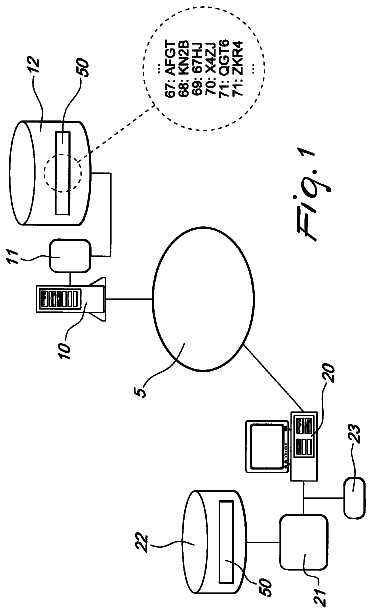
1 of 20 drawing sheets so far from the published document, cropped to the drawing. Every sheet is in the USPTO PDF.
What the patent claimed, word for word. All of it is now free to use.
Independent claims stand on their own. The others add detail to the claim they name.
The present invention generally relates to a technology for communicating and more specifically relates to a communications apparatus provided with communicating means and enabled to communicate with a communications counterparty with the communicating means, a communications system provided with a low-level apparatus as such a communications apparatus and a high-level apparatus to be the communications counterparty, and a method of setting a certificate into such a communications apparatus.
Up to now, connecting multiple communications apparatuses, each of which is provided with a communications function, to enable communicating via a network and building various systems have been carried out. As an example, there is a so-called electronic commerce system such that orders for products are transmitted from a computer such as a PC which functions as a client apparatus and those orders are received in a server apparatus enabled to communicate with this client apparatus over the Internet. Moreover, a system is being proposed such that each of the various electronic apparatuses is made to have a function of the client apparatus or the server apparatus so as to be connected via a network, and remote control of the electronic apparatuses is performed by means of mutual communications.
In building such a system, it is important to confirm when communicating, for instance, whether the communications counterparty is appropriate, or whether information having been transmitted is being manipulated. Moreover, especially when communicating over the Internet, there is also a demand for making sure that, when transmitting confidential information, the contents are not viewed stealthily, as the information often passes through unrelated computers before reaching the communications counterparty. Then, as a communication protocol that responds to such a demand, for example a protocol called SSL (Secure Socket Layer) has been developed and is being widely used. Communicating using this protocol enables combining a public-key encrypting method and a common-key encrypting method, authenticating the communications counterparty, as well as preventing manipulating and eavesdropping by means of encrypting the information. Moreover, also at the communications-counterparty side, authenticating an apparatus of a communications source having requested communications is enabled.
As technologies related to such authentication using the SSL and the public-key encrypting, there are, for example, those as described in the Patent Documents 1 and 2.
Patent Document 1 JP 2002-353959A
Patent Document 2 JP 2002-251492A
Herein, a procedure for communicating when performing mutual authentication according to this SSL is described, focusing on an authentication process. FIG. 18 is a flowchart of a process for each apparatus when a communications apparatus A and a communications apparatus B are performing mutual authentication according to the SSL, together with information used in the process.
As illustrated in FIG. 18, when performing mutual authentication according to the SSL, it is necessary to have stored in both communications apparatuses a root-key certificate, a private key and a public-key certificate. This private key is a private key that is issued to each apparatus by a CA (Certificate Authority), and the public-key certificate is one which the CA has provided as a digital certificate as the CA affixes a digital signature to a public key corresponding to the private key so as to be made a digital certificate. Moreover, the root-key certificate is one which the CA has provided as a digital certificate with a root key corresponding to a private root-key that the CA has used for the digital signature so as to be made a digital certificate.
FIGS. 19A and 19B illustrate a relationship among these keys.
As illustrated in FIG. 19A, a public key A is configured with a key main-body for decrypting a document encrypted using a private key A, and bibliographical information including information on a source (CA) of the public key and an expiry date, etc. Then, the CA, in order to indicate that the key main-body and the bibliographical information are not manipulated, has a hash value obtained by hashing the public key A encrypted using the private root-key for providing to a client public-key as a digital signature. Moreover at this time, identifying information identifying the private root-key is added as signing-key information to bibliographical information on the public key A. Then, the public-key certificate being provided this digital signature is a public-key certificate A.
When using this public-key certificate A for an authentication process, the digital signature included therein is decrypted using a key main-body of the root key as a public key corresponding to the private root-key. When this decrypting is performed successfully, it is known that the digital signature surely has been provided by the CA. Moreover, when the hash value obtained by hashing a part of the public key A, and the hash value obtained by decrypting match, it is known that the key main-body also has not been damaged or manipulated. Furthermore, when the received data can be decrypted successfully using this public key A, it is known that the data are those transmitted from a holder of the private key A.
Herein, in order to perform an authentication, while it is necessary to store a root key in advance, this root key, as illustrated in FIG. 19B, is also made to be stored as a root-key certificate with the CA having provided the digital signature. This root-key certificate is in a form of a self-signature such that decrypting of a digital signature with a public key contained in the certificate itself is enabled. Then, when using the root key, the digital signature is decrypted by using the key main-body included in the root-key certificate for comparing with the hash value obtained by hashing the root key. When these are matched, it is confirmed that the root key is not damaged, etc.
The flowchart in FIG. 18 is now described. It is noted that, in FIG. 18, with arrows between two flowcharts denoting data transfer, the transmitting side performs a transfer process in a step originating the arrow, and the receiving side, once receiving the information, performs a process in a step to which the arrow points. Moreover, when the process in each step is not successfully completed, a response indicating an unsuccessful authentication is returned at that time so as to suspend the process. The same applies when the response indicating the unsuccessful authentication is received from the communications counterparty, or when a timeout of the process is reached, etc.
Herein, assuming that a communications apparatus A requests communications with a communications apparatus B, when performing the request, a CPU of the communications apparatus A executing required control programs starts the process in the flowchart illustrated at the left in FIG. 18. Then, in Step S11, a connection request is transmitted to the communications apparatus B.
On the other hand, a CPU of the communications terminal B, once receiving the connection request, executing required control programs, starts the process in the flowchart illustrated at the right in FIG. 18. Then, in Step S21 a first random number is generated for encrypting using a private key B. Then, in Step S22 the encrypted first random number and a public-key certificate B are transmitted to the communications apparatus A.
At the communications apparatus A side, once receiving this, Step S12 confirms the validity of the public-key certificate B using a root-key certificate.
Then once having confirmed validity, in Step S13, the first random number is decrypted using a public key B included in the received public-key certificate B. When the decrypting is successful, confirming that the first random number has surely been received from a subject of issuance of the public-key certificate B is enabled.
Subsequently, in Step S14 further a second random number and a common-key seed are generated. The common-key seed may be generated, for example, based on data transacted in prior communications. Then, in Step S15 the second random number is encrypted using a private key A, and the common-key seed is encrypted using the public key B, for transmitting these along with a public-key certificate A to a server apparatus. The encrypting of the common-key seed is performed in order to make sure that the common-key seed is not known to an apparatus other then the communications counterparty.
Moreover, in the next Step S17, a common key for use in encrypting subsequent communications is generated from the common-key seed generated in Step S14.
At the communications apparatus B side, once receiving data having been transmitted in Step S16 from the communications apparatus A, in Step S23 the validity of the public-key certificate A is confirmed using a root-key certificate. Then once confirmed, in Step S24, the second random number is decrypted using the public key A included in the received public-key certificate A. When the decrypting is successful herein, confirming that the second random number is surely received from a subject of issuance of the public-key certificate A is enabled.
Subsequently, in Step S25 the common-key seed is decrypted using a private key B. In the processes thus far, the common-key seed has been shared at the communications apparatus A side and at the communications apparatus B side. Then, the common-key seed does not become known to an apparatus other than the communications apparatus A having generated the seed and the communications apparatus B having the private key B. When the processes thus far are successful, also at the communications apparatus B side in Step S26, a common key for use in encrypting subsequent communications is generated from the common-key seed obtained in the decrypting.
Then, once the processes of Step S17 at the communications apparatus A side and Step S26 at the communications apparatus B side are completed, a success of authentication and an encrypting method for use in subsequent communications are mutually confirmed and the process regarding the authentication is terminated assuming that subsequent communications are performed with the encrypting method using the common key generated. It is noted that, in this confirmation, a response from the communications apparatus B that an authentication has succeeded is also included. The processes as described above enable mutual establishing of communications, and, subsequently, encrypting of data by means of a common-key encrypting method, using the common key generated in Step S17 or S26 so as to perform the communications.
Performing such processes enables the communications apparatuses A and B to securely share a common key and to establish a route for communicating securely.
It is to be noted that, in the processes as described above, it is not mandatory to encrypt the second random number with the public key A, and to transmit the public-key certificate A to the communications apparatus B. In this case, the processes of Steps S23 and S24 at the communications apparatus B side are not needed so that the process becomes as illustrated in FIG. 20. In such a way, while the communications apparatus B cannot authenticate the communications apparatus A, this process is sufficient when only the communications apparatus A authenticating the communications apparatus B suffices. Then in this case, it is necessary to have only the root-key certificate, and not the private key A and the public-key certificate A, stored in the communications apparatus A. Moreover, it is not necessary to have the root-key certificate stored in the communications apparatus B.
Now, when performing the authentication process as described above, two levels are possible for the authentication criteria. A first level determines whether equipment of a communications counterparty fulfills certain criteria such as whether it is supplied from the same vendor, or whether it has passed a certain test, whereas a second level specifies an individual equipment unit of the communications counterparty.
Then, when performing the first-level authentication, it suffices to have a common set of a public-key certificate and a private key stored in equipment fulfilling certain criteria, to use the stored common set to perform the authentication at the time of SSL communications and for the communications counterparty to be able to confirm as surely that it is an apparatus of issuance of the public-key certificate. Therefore, there is no need to replace equipment-specific identifying information (ID), etc.
Moreover, even when performing the second level authentication, it is possible that, after establishing a secure communications route using, for example, the same key as in the case of the first-level authentication as described above, an ID is made to be transmitted in order to specify a communications counterparty, for use in the authentication.
Herein, when operating a communications system for having communications conducted between communications apparatuses, in case it is envisioned that there is to be no operator near the apparatuses, there is a demand such that specifying of an apparatus is performed with the communications. Then, in order to fulfill such a demand, a mechanism for guaranteeing that the apparatus specified with the communications is surely the apparatus is needed. In other words, the second-level authentication as described above is needed.
However, in the method as described above such that after the secure communications route is established the ID is made to be transmitted so as to specify the communications counterparty, a need arises to separately manage the ID with an application from the authentication process according to the SSL.
Moreover, when the common public-key certificate and the private key are leaked, a third party having obtained the leaked information may disguise itself as any equipment having a detectable ID, seriously compromising the security of the communications. Then in this case, the security of the communications cannot be recovered unless keys of all equipment units are updated, the task requiring a great deal of effort.
Then, in order to solve this issue, a public-key certificate and a private key are issued per apparatus, and information identifying the apparatus is provided in bibliographical information of the public-key certificate, such that when confirming the validity of the public-key certificate the identifying information having been included in the bibliographical information is referred to so as to confirm that a counterparty having transmitted the certificate (a subject apparatus of issuance of the certificate) is an appropriate communications counterparty. In such a case, as a different pair of the public-key certificate and the private key is made to be stored for each apparatus, even when a key of one equipment unit is leaked, the third party disguising is possible only as the one equipment unit, and when the key of the one equipment unit is updated, maintaining the communications again in a secure state is enabled.
Now, when authenticating an apparatus, as a matter of course an authentication that specifies the apparatus is needed, which is different from authentication that specifies an operator of a Web browser, etc. Thus, while there is a need to have a digital certificate stored in advance in the apparatus, when a component storing the digital certificate is replaced, the digital certificate ends up being dropped with the component. Thus, the authentication of the apparatus cannot be performed. Therefore, when using a public-key certificate provided with information identifying an apparatus, a problem would occur when a need arises to replace a component storing the digital certificate due to damage or a failure, etc.
Although there is no problem when the digital certificate is still being stored in a replaced component, it is not desirable that identifying information for use in the replacing component be changed, in order to specify an equipment unit or a user. However, in order to have a public-key certificate provided in the replacing component with the same identifying information as the replaced component, information identifying an apparatus to be receiving the replacing component at the time of manufacturing is needed, making it impossible to have in advance a component ready to be the replacing component having recorded a new public-key certificate. Therefore, there is a problem such that manufacturing is done as needed only after the apparatus requiring the replacing component becomes known, which imposes an extremely inefficient production system.
Moreover, there is a problem such that as components cannot be supplied speedily, the apparatus needs to be kept for a certain period in a state of not being able to successfully perform an authentication process according to the SSL, making it impossible to maintain, during the period of replacing a component, a secure communications channel for the apparatus.
While it is possible to have separately stored the public-key certificate and the private key after replacing the component, in a state without such stored information, successful performing of the authentication process according to the SSL cannot be done, making impossible the maintaining of a secure communications route for the apparatus having replaced a component. Thus, in order to securely distribute a new public-key certificate, etc., there is a need to store it in a recording medium so as to be sent by post to an installation site of the apparatus or brought by a representative servicing the replacing of the component. However, even in having this recording medium ready, there is a problem that is the same as in the case of component manufacturing as described above.
Furthermore, in order to prevent a disguising, etc. of an apparatus, for the digital certificate, there is a need to prevent a malicious user replacing, reading or registering, and a need to prevent a general user from updating a digital certificate, making difficult the confirming of privileges when manually setting the digital certificate.
Accordingly, it is a general object of the present invention to provide a technology for communicating that substantially obviates one or more problems caused by the limitations and disadvantages of the related art.
It is a more particular object of the present invention to provide a communications apparatus, a communications system, and a method of setting a certificate that enable, while maintaining security, even when there arises a need to replace a component for storing a certificate needed for an authentication, recovering to the state of being able to perform a successful authentication easily and speedily.
According to the invention, an apparatus for communicating includes communicating means that is enabled to communicate with communications counterparties via the communicating means, wherein the communicating means, including means for providing an individual certificate that is a digital certificate being provided with information identifying the apparatus for communicating in order to receive an authentication by the communications counterparty when communicating, is means for communicating when having been authenticated with the individual certificate by the communications counterparty, and the apparatus for communicating further includes a storage area for storing the individual certificate and a common certificate that is a digital certificate not being provided with apparatus-identifying information, in a replacement component as a minimum unit enabled for replacement.
The apparatus for communicating in an embodiment of the invention enables, while maintaining security, even when there arises a need to replace a component for storing a certificate needed for an authentication, recovering to the state of being able to perform a successful authentication easily and speedily.
According to another aspect of the invention, a system for communicating includes a high-level apparatus and low-level apparatuses to be communications counterparties of the high-level apparatus, wherein the low-level apparatus includes means for providing an individual certificate that is a digital certificate being provided with information identifying the low-level apparatus in order to receive an authentication by the communications counterparty when communicating, and includes communicating means for communicating when having been authenticated with the individual certificate by the communications counterparty, and the low-level apparatus further includes a storage area for storing the individual certificate and a storage area for storing a common certificate that is a digital certificate not being provided with apparatus-identifying information in a replacement component as a minimum unit enabled for replacement.
The system for communicating in an embodiment of the invention enables, while maintaining security, even when there arises a need to replace a component for storing a certificate needed for an authentication, recovering to the state of being able to perform a successful authentication easily and speedily.
According to yet another aspect of the invention, a method of setting a certificate for setting, in an apparatus for communicating including communicating means enabled to communicate with communications counterparties via the communicating means, an individual certificate that is a digital certificate being provided with information identifying the apparatus for communicating, includes the steps of installing in the apparatus for communicating a replacement component as a minimum unit enabled for replacement having been provided with a storage area for storing the individual certificate and a storage area for storing a common certificate that is a digital certificate not being provided with apparatus-identifying information, in the state of having the common certificate to be stored and not having the individual certificate to be stored, and having the apparatus for communicating, to provide the common certificate in order to receive an authentication by the communications counterparties when communicating and to obtain via the communicating means the individual certificate from the communications counterparty so as to have the obtained individual certificate stored in the storage area for storing the individual certificate when having been authenticated with the common certificate by the communications counterparty.
The method of setting a certificate in an embodiment of the invention enables, while maintaining security, even when there arises a need to replace a component for storing a certificate needed for an authentication, recovering to the state of being able to perform a successful authentication easily and speedily.
Other objects, features, and advantages of the present invention will become more apparent from the following detailed description when read in conjunction with the accompanying drawings, in which:
FIG. 1 is a block diagram illustrating a configuration of an embodiment of a communications system according to this invention;
FIG. 2 is a block diagram illustrating hardware configurations of a high-level apparatus and a low-level apparatus as illustrated in FIG. 1;
FIG. 3 is a functional block diagram illustrating a functional composition of a portion related to remote control and setting of a certificate of the high-level apparatus and low-level apparatus in FIG. 2;
FIG. 4 is a table illustrating determining criteria on whether to execute an operation in a request manager as illustrated in FIG. 3;
FIG. 5 is a schematic diagram for describing an overview of a method of communicating between the high-level apparatus and the low-level apparatus in the communications system as illustrated in FIG. 1;
FIG. 6A is a diagram for describing authentication information which is stored by the low-level apparatus as illustrated in FIG. 1;
FIG. 6B is a diagram for describing authentication information which is stored by the high-level apparatus as illustrated in FIG. 1;
FIG. 7 is a diagram illustrating an example of information included in an individual public-key certificate for a low-level apparatus as illustrated in FIG. 6;
FIG. 8 is a sequence diagram for describing a configuration for the high-level apparatus and the low-level apparatus as illustrated in FIG. 1 making proper use of the individual public-key certificate and a common public-key certificate;
FIG. 9A is a diagram for describing a configuration of replacement components providing storage areas for certificates and its problem, in a comparative example of the embodiment as illustrated in FIG. 1, etc.;
FIG. 9B is another diagram for describing the configuration of the replacement components providing the storage areas for the certificates and its problem, in another comparative example of the embodiment as illustrated in FIG. 1, etc.;
FIG. 9C is yet another diagram for describing the configuration of the replacement components providing the storage areas for the certificates and its problem, in yet another comparative example of the embodiment as illustrated in FIG. 1, etc.;
FIG. 10A is a diagram for describing a configuration of a replacement component providing storage areas for certificates and its advantages, in the low-level apparatus as described in FIG. 1;
FIG. 10B is another diagram for describing the configuration of the replacement component providing the storage areas for the certificates and its advantages, in the low-level apparatus as described in FIG. 1;
FIG. 10C is yet another diagram for describing the configuration of the replacement component providing the storage areas for the certificates and its advantages, in the low-level apparatus as described in FIG. 1;
FIG. 11 is a diagram illustrating an overview of a component A as illustrated in FIG. 10 and a manufacturing process of the lower-level apparatus being equipped with the component A;
FIG. 12 is a diagram for describing steps of having each certificate set to be stored in the component A;
FIG. 13 is a flowchart illustrating a process of executing at the low-level apparatus side when writing an individual certificate set into the low-level apparatus in the steps as illustrated in FIG. 12;
FIG. 14 is a diagram illustrating an overview of a facility for use in setting into the low-level apparatus the individual certificate set in a product assembly step as illustrated in FIGS. 11 and 12.
FIG. 15 is a diagram illustrating an overview of the state of the surroundings of a communications terminal and a certificate write-in apparatus as illustrated in FIG. 14, in a production plant;
FIG. 16 is a diagram illustrating an example of a rating plate for mounting when assigning an identification number to an apparatus having passed a functional test;
FIG. 17 is a diagram for describing a configuration when multiple low-level apparatuses are provided, for the communications system as illustrated in FIG. 1;
FIG. 18 is a diagram illustrating a flowchart of a process for executing in each apparatus when two communications apparatuses perform a mutual authentication according to the SSL, together with information for use in the process;
FIG. 19A is a diagram for describing a relationship among a root key, a private root-key, and a public-key certificate in the authentication process illustrated in FIG. 18;
FIG. 19B is another diagram for describing a relationship among the private root-key, the root key, and a root-key certificate in the authentication process illustrated in FIG. 18; and
FIG. 20 is a diagram corresponding to FIG. 18, illustrating a process for executing in each apparatus when two apparatuses perform a one-way authentication according to the SSL.
Descriptions are given next, with reference to the accompanying drawings, of a preferred embodiment of the present invention.
First, a configuration of an embodiment of a communications apparatus according to the invention and an embodiment of a communications system of the invention that is configured using the communications apparatus is described.
FIG. 1 is a block diagram illustrating a configuration of the communications system.
The communications system, as illustrated in FIG. 1, is configured with a high-level apparatus 10 and a low-level apparatus 20, each of which is provided with communicating means, that are connected via a network 30. Then, the low-level apparatus 20 is the embodiment of the communications apparatus of the invention. Moreover, the high-level apparatus 10 is also a communications apparatus provided with a communications function and becomes a communications counterparty of the low-level apparatus 20.
As for the network 30, which may be wired or wireless, various communications circuits (communications routes), enabling building of the network, may be adopted. Moreover, herein while only one low-level apparatus 20 is illustrated, it is possible to provide multiple low-level apparatuses 20 within the communications system as illustrated in FIG. 17.
For such a communications system, first hardware configurations of the high-level apparatus 10 and the low-level apparatus 20 are described. A simplified illustration of the hardware configurations of the high-level apparatus 10 and the low-level apparatus 20 is such as illustrated in FIG. 2.
As illustrated in FIG. 2, the high-level apparatus 10 is provided with a CPU 11, a ROM 12, a RAM 13, a HDD 14, and a communications interface (I/F) 15, which are connected with a system bus 16. Then, the CPU 11 executing various control programs being stored in the ROM 12 and the HDD 14 controls an operation of the high-level apparatus 10, and implements functions of authenticating the communications counterparty and updating of a digital certificate of the low-level apparatus 20, etc. It is noted in the description that the digital certificate denotes digital data having been provided with a signature in order to prevent counterfeiting.
The low-level apparatus 20, in the same manner as the high-level apparatus 10, is provided with a CPU 21, a ROM 22, a RAM 23, a HDD 24, and a communications interface (I/F) 25, which are connected with a system bus 26. The CPU 21 executing as needed various control programs being stored in the ROM 22 and the HDD 24, and performing control of the apparatuses, enables implementing of functions as various means such as communicating means, individual certificate setting means, etc.
It is noted that, in the communications system, it is a matter of course that various configurations may be adopted depending on objectives of remote control or electronic commerce, etc. Then, as hardware for the high-level apparatus 10 and the low-level apparatus 20, a known computer model as appropriate may be adopted. It is a matter of course that other hardware may be added as needed so that it is not necessary for the high-level apparatus 10 and the low-level apparatus 20 to have the same configuration.
Next, as a portion related to the features of the embodiment out of the communications system, a functional configuration of a portion related to setting of a certificate of the high-level apparatus 10 and low-level apparatus 20 is illustrated in FIG. 3. The functions in the high-level apparatus 10 are implemented by the CPU 11 of the high-level apparatus 10 executing required control programs being stored in the ROM 12 and the HDD 14, while the functions in the low-level apparatus 20 are implemented by the CPU 21 of the low-level apparatus 20 executing required control programs being stored in the ROM 22 and the HDD 24, etc.
As illustrated in FIG. 3, the high-level apparatus 10 is provided with a HTTPS (Hyper Text Transfer Protocol Security) client-function unit 31, a HTTPS server-function unit 32, an authentication processor 33, a certificate-update requesting unit 34, and a certificate storage unit 35.
The HTTPS client-function unit 31 has a function of using a HTTPS protocol including authentication and encrypting processes according to the SSL to request communications with another apparatus, having a HTTPS server function, such as the low-level apparatus 20, etc., and transmitting to a communications counterparty a request (a command) and data so as to have an operation depending on the request and the data executed.
On the other hand, the HTTPS server-function unit 32 has a function of accepting a communications request using the HTTPS protocol from the other apparatus having the HTTPS client function, receiving from the other apparatus the request and the data so as to have each unit of the apparatus execute depending on the received request and data, and returning the executed outcome as a response to the requestor.
The authentication processor 33 has a function of authentication means for performing authentication process using the digital certificate received from the communications counterparty when the HTTPS client-function unit 31 and the HTTPS server-function unit 32 authenticate the communications counterparty, and various certificates and private keys, etc., being stored in the certificate storage unit 35. Moreover, it has also a function of transmitting to the communications counterparty via the HTTPS client-function unit 31 and the HTTPS server-function unit 32 the digital certificate being stored in the certificate storage unit 35 for requesting authentication with the communications counterparty.
The certificate-update requesting unit 34 as described below has a function of transmitting an individual certificate to the communications counterparty of the low-level apparatus 20, etc., in predetermined cases so as to request that the transmitted certificate be stored. It is noted that information needed for a certificate-managing apparatus (CA) external to the communications system is transmitted so as to have the certificate transmitted herein issued.
The certificate-storage unit 35 has a function of storing authentication information such as various certificates and private keys, etc., and making the information available for the authentication process in the authentication processor 33. Types of these various certificates and private keys, and their uses and methods of being generated are described in detail below.
On the other hand, in the low-level apparatus 20, a HTTPS client-function unit 41, a HTTPS server-function unit 42, an authentication processor 43, a request manager 44, a certificate-storage unit 45, a state reporter 46, a log reporter 47, a certificate setting unit 48, and a command receiver 49 are provided.
The HTTPS client-function unit 41 in the same manner as the HTTPS client-function unit 31 of the high-level apparatus 10 has a function of requesting communications with another apparatus, having the HTTPS server-function, such as the high-level apparatus 10, etc., using the HTTPS protocol, and having an operation depending on the request and the data transmitted executed.
The HTTPS server-function unit 42 also in the same manner as the HTTPS server-function unit 32 of the high-level apparatus 10 has a function of accepting a communications request from another apparatus having a HTTPS client function, having each unit of the apparatus execute an operation depending on the received request and data, and returning a response to the requestor.
The function of the authentication processor 43 is also the same as that of the authentication processor 33 of the high-level apparatus 10, while the certificate, etc., for use in the authentication process is one being stored in the certificate storage section 45.
The request manager 44 has a function of determining, for a request received from a high-level apparatus, whether to execute an operation based on the request. Then, it also has a function of passing on an operating request to the functional units 46 through 49 for executing an operation based on the request, when allowing the execution.
FIG. 4 illustrates the determining criteria on whether to execute as described above, the determining criteria being the types of requests and the types of digital certificates used in the authentication process in the authentication processor 43. As described in detail below, the digital certificate being stored in the high-level apparatus 10 and the low-level apparatus 20 may be one of an individual public-key certificate that is an individual certificate and that is a public-key certificate being provided with information identifying the apparatus (the own apparatus), and a common public-key certificate that is a common certificate and a public-key certificate not being provided with information identifying the apparatus, such that the request manager 44, as illustrated in FIG. 3, allows all operations when having performed an authentication process with the individual certificate, while it allows only an operation of setting a certificate when having performed an authentication process with the common certificate. Thus, the common certificate is a certificate for use only when having a new individual certificate to be stored in the low-level apparatus 20.
The certificate storage unit 45 in the same manner as the certificate storage section 35 of the high-level apparatus has a function of certificate-storing means for storing authentication information such as various certificates and private keys, etc., and making the stored information available to the authentication process in the authentication processor 33. It is noted that the certificates, etc., being stored are different from those in the authentication manager 33 as described below.
The state reporter 46 has a function of performing a call for reporting the state of the low-level apparatus 20 to the high-level apparatus 10 when an error is detected or when there is a user instruction. The report may be transmitted as a response to an inquiry from the high-level apparatus 10 or communications may be requested from the HTTPS client-function unit 41 to the high-level apparatus 10 so as to transmit the report.
The log reporter 47 has a function of reporting a log from the low-level apparatus 20 to the high-level apparatus 10. The contents of the reporting may be an operations log of the low-level apparatus 20, as well as for example, the counted value in a image-forming sheet counter for an image-forming apparatus, and for a measuring system, the measured value, etc. As the reporting is not required urgently, it may be transmitted as a response to an inquiry from the high-level apparatus 10.
The certificate-setting unit 48 has a function of individual certificate setting means for setting and updating the certificate, etc., being stored in the certificate storage unit 45 with an individual public-key certificate as described below received from the high-level apparatus 10.
The command receiver 49 has a function of executing an operation corresponding to a request related to a function other than the functions of each of the functional units 46 through 48 as described above. The operation includes, for example, transmitting data being stored in the low-level apparatus 20, and controlling an operation of an engine unit as needed. It is noted that the state reporter 46 and the log reporter 47 are illustrated as specific examples of functions being provided by the command receiver 49, so that providing such functions is not mandatory.
Next, a method of communicating between the high-level apparatus 10 and the low-level apparatus 20 in the communications system is described. FIG. 5 is a diagram for describing an overview of the method of the communicating.
The description continues in the full USPTO document.
About 6,213 words. The USPTO PDF has it with every drawing.
Fees are due 3.5, 7.5 and 11.5 years after grant. This patent expired on December 17, 2025, so the fee marked "not paid" was the one that went unpaid.
Communications apparatus, communications system, and method of setting certificate
Filed Sep 2004 · published May 2005Communications apparatus, communications system, and method of setting certificate
Filed Sep 2004 · granted Jan 2010COMMUNICATIONS APPARATUS, COMMUNICATIONS SYSTEM, AND METHOD OF SETTING CERTIFICATE
Filed Dec 2009 · published Mar 2010Communications apparatus, communications system, and method of setting certificate
Filed Dec 2009 · granted Oct 2012COMMUNICATIONS APPARATUS, COMMUNICATIONS SYSTEM, AND METHOD OF SETTING CERTIFICATE
Filed Sep 2012 · published Dec 2012Communications apparatus, communications system, and method of setting certificate
Filed Sep 2012 · granted Dec 2013Earlier publications, parents and continuations. None of them can still be enforced, or this patent would not be listed.
Prior art cited by the examiner or applicant. Useful when you check your own idea for novelty.
Everything on this page comes from the documents linked above.