This application claims priority from Chinese Patent Application No. 200510007156.3, filed Jan. 23, 2005.
Technical field
The present invention relates to a codec used for data transmission error-correcting in a digital communication system, and more specifically to a codec based on low density parity check code in error-correcting technology in the field of digital communication and a generation method thereof, and the basic matrix used for creating the parity check matrix.
Background art
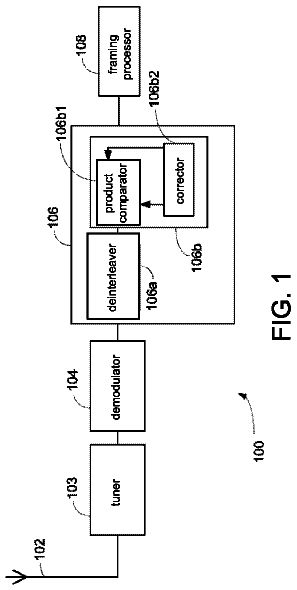
Data transmission between computes as well as internal operation and storage system of all digital communication systems, such as communication, radar, telecontrol and telemetering, and digital computer can be summarized as the model shown in FIG. 1. The source encoder is used to improve validity of transmission; channel encoder is used to resist various noise and interference during transmission. By increasing artificially redundant information, the system is made to be capable of correcting error automatically so as to ensure the reliability of digital transmission. With the development of the wireless digital communication and the advent of all kinds of services with high speed and burst, there is increased demand for error-correction coding technology.
The initial research of error-correction code is mainly focused on the linear block code based on algebraic theory, followed by a series of good codes such as hamming code, cyclic code, BCH code and RS code. In convolutional code appeared in the 50s, register is introduced in the process of encoding to increase the correlation between code elements, thus higher coding gain than that of the block code can be obtained with the same order of complexity. With the appearance of decoding algorithms of the convolutional code (Viterbi algorithm), it gained intensive research and application. In 1993, C. Berrou and etc. in France offers Turbo code, striding forward to the limitation of encoding performance. Under the inspiration of successful Turbo code, another kind of encoding with similar characteristic and capability regains people's attention, that is, the low density parity check codes (which can be referred to as LDPC code). LDPC code is a kind of linear block code which can be defined by sparse parity check matrix or bipartite graph. It was originally discovered by Gallager, so it is called Gallager code. Through decades' dreariness, with the development of computer hardware and associated theories, MacKay and Neal rediscovered LDPC code and proved that it has performance of approximating Shannon limit. Latest research indicates that LDPC code has the following characteristics: low complexity of decoding, linear time encoding, the performance of approximating Shannon limit, parallel decoding, and better performance than Turbo code under the condition of long code.
LDPC code is a linear block code based on sparse parity check matrix, and it is the sparse characteristic of LDPC that make it possible to realize encoding/decoding with low complexity and make LDPC code move toward practical application. The above-mentioned Gallager code is a regular LDPC code (regular ldpcc), but Luby and Mitzenmacher generalized Gallager code and offered irregular LDPC code (irregular ldpcc). The original code offered by Gallager has regular code structure whose parity check matrix is a sparse matrix with the same number of 1 at each row or each column. M. G. Luby thought that if the number of non-zero elements in each row or column in the check matrix is allowed to change, with the sparse characteristic of the matrix being guaranteed, the decoding algorithm of the code would still be applicable; moreover, the performance of the code can be largely improved, reaching, or even surpassing that of Turbo code. This is because that if the corresponding left node and right node of the bipartite graph have appropriate degree distribution in the code structure, a waveform effect, which will greatly improve the decoding performance, will exist in decoding. Irregular code is such a code that allows the same nodes have different orders of low density coding, yet the original code offered by Gallager is correspondingly called regular code.
Based on unit matrix and its cyclic shift matrix, LDPC code has become research emphasis in current academic circles because of its randomly variable length, simple implementation, and the guaranteed invariable degree distribution and girth (referred to the shortest length of a circle) distribution in expanding. But, the currently constructed LDPC code based on unit matrix and its cyclic shift matrix does not fully take into account the influence of girth and the relationship between code length and girth, so the method for building a LDPC code with as small girth as possible and as few number of girth as possible is far from comprehensive. Therefore, the drop of BER curve dramatically slows down at high signal to noise ratio, and phenomenon of error floor often happens, resulting in decreased code performance. How to eliminate the error-floor phenomenon of LDPC code, accelerate the dropping speed of BER curve, and improve the performance of the LDPC code at high SNR, are the urgent problems to be solved.
The research object of the present invention is mainly irregular codes. Irregular codes are low-density parity-check codes with totally different row weight and column weight of parity check matrix, and column weight of the information bits of the parity check matrix is also different. Regular codes are low density parity check codes with the same row weight and column weight of the parity check matrix, or low density parity check codes with the same row weight and column weight of the information bits when the corresponding check bits maintain constant structure. In relevant literatures, the second case of regular code, the low-density parity-check codes are also called semi-regular codes. The degree distribution of the basic matrix is consistent with that of the parity check matrix.
For irregular codes, since there are many non-zero elements in the parity check matrix, it is hard to ensure that the girth of the parity check matrix can reach 8, but it is easy to ensure that the girth of the parity check matrix can reach 6. It is desirable in the present invention to eliminate the cycles with length of 8 as far as possible under the basic condition that the girth of the parity check matrix reaches 6, thus error floors will be eliminated further; for low density parity check codes with specific code rate and multiple code lengths, the method can ensure FER curves with different code length will not intersect when FER is larger than 10-4, therefore, good irregular low density parity check codes can be designed.
Summary of the invention
The present invention resolves the technical problem by offering a basic matrix of irregular low density parity check codes and generation method thereof, to make the generated parity check matrix effectively eliminate the phenomenon of error floors and accelerate the falling speed of BER curve.
In order to solve the foregoing technical problem, the present invention offers a basic matrix of irregular low density parity check codes, and the basic matrix Hb consists of M.times.(N-M) block A (corresponding to the information bits) and M.times.M block B corresponding to the check bits, which is characterized in that, the matrix also meets the following condition: for all cycles with length of 4 in the basic matrix Hb, any element of i, j, k and l constituting the cycle in anti-clockwise or clockwise always satisfies the inequality: (i-j+k-1) mod z.noteq.0, wherein mod is modular operation, z is the extension factor.
Furthermore, the above-mentioned basic matrix may also have the following characteristic: said block B corresponding to the check bits applies quasi lower triangular structure.
Furthermore, the above-mentioned basic matrix may also have the following characteristic: the matrix also meets the following condition: suppose the number of the columns with largest weight in the basic matrix Hb is r, in each new basic matrix formed by deleting random r-1 columns herein, for all cycles with length of 4, any element of i, j, k or l constituting the cycle in anti-clockwise or clockwise always satisfies the inequality: (i-j+k-1) mod z.noteq.0; moreover, for all cycles with length of 6, any element of i, j, k, l, m or n constituting the cycle in anti-clockwise or clockwise always satisfies the inequality: (i-j+k-1+m-n) mod z.noteq.0.
Furthermore, the above-mentioned basic matrix may also have the following characteristic: the matrix also meets the following condition: suppose the number of the columns with the largest weight in the basic matrix Hb is r, in each new basic matrix formed by deleting any r-1 columns herein and all columns with weight of 3, for all cycles with length of 4, any element of i, j, k or l constituting the cycle in anti-clockwise or clockwise always satisfies the inequality: (i-j+k-1) mod z.noteq.0; moreover, for all cycles with length of 6, any element of i, j, k, l, m or n constituting the cycle in anti-clockwise or clockwise always satisfies the inequality: (i-j+k-1+m-n) mod z.noteq.0.
Furthermore, the above-mentioned basic matrix may also have the following characteristic: said basic matrix Hb is the unique basic matrix of the low density parity check codes with specific code rate and multiple code lengths, and the value of the elements are corrected according to length of each code, each basic matrix obtained satisfies all inequalities satisfied by the basic matrix before correcting.
In order to solve the foregoing technical problem, the present invention further offers a generation method of the basic matrix of irregular low density parity check codes, which includes the following steps:
(a) the number of rows M and the number of columns N of the basic matrix Hb are determined according to the requirement of code rate and code length; the row weight vector and the column weight vector of the basic matrix Hb are determined according to the requirement of degree distribution;
(b) Construct an original irregular basic matrix Hb' which consists of M.times.(N-M) block A corresponding to the information bits and M.times.M block B corresponding to the check bits;
(c) fill positions corresponding to element `1` of the original basic matrix Hb' with values selected from set {0, 1, 2, . . . , z-1} to obtain the basic matrix Hb, and for all cycles in Hb with length of 4, any element of i, j, k and l constituting the cycle in anti-clockwise or clockwise always satisfies the inequality: (i-j+k-1) mod z.noteq.0, where mod is modular operation, and z is the extension factor;
Furthermore, the above-mentioned generation method of the basic matrix may also have the following characteristic: said step (c) further divides into the following steps:
(c1) Suppose there are r heaviest columns in the original basic matrix, firstly, delete all the r heaviest columns from the original basic matrix Hb', then fill positions corresponding to element `1` of the original basic matrix Hb' with values selected from set {0, 1, 2, . . . , z-1} leaving the unfilled positions blank; when filling a position, select the value according to the requirement that girth of the corresponding parity check matrix is no less than 10 (girth.gtoreq.10); if there is no value meeting the requirement, then select the value according to the requirement that girth of the corresponding parity check matrix is no less than 8 (girth.gtoreq.8);
The requirement that girth of the corresponding parity check matrix is no less than 10 (girth.gtoreq.10) is: after a position is filled, for each cycle with length of 4 passing this position, any element of i, j, k and l constituting the cycle in anti-clockwise or clockwise always satisfies the inequality: (i-j+k-1) mod z.noteq.0; for each cycle with length of 6 passing this position, any element of i, j, k, l, m and n constituting the cycle in anti-clockwise or clockwise always satisfies the inequality: (i-j+k-1+m-n) mod z.noteq.0; for each cycle with length of 8 passing this position, any element of i, j, k, l, m, n, s and t constituting the cycle in anti-clockwise or clockwise always satisfies the inequality: (i-j+k-1+m-n+s-t) mod z.noteq.0;
The requirement that girth of the corresponding parity check matrix no less than 8 (girth.gtoreq.8) is: after a position is filled, for each cycle with length of 4 passing this position, any element of i, j, k and l constituting the cycle in anti-clockwise or clockwise always satisfies the inequality: (i-j+k-1) mod z.noteq.0; for each cycle with length of 6 passing this position, any element of i, j, k, l, m and n constituting the cycle in anti-clockwise or clockwise always satisfies the inequality: (i-j+k-1+m-n) mod z.noteq.0;
(c2) After filling the matrix removed heaviest column, add the n.sup.th heaviest column and remove the residual r-1 heaviest columns (n=1, 2, . . . , r) to construct a new basic matrix; select values to fill positions according to element `1` of the heaviest column according to the same method as step (c1), and whenever a required value selected, add the foregoing r-1 heaviest columns to construct another new basic matrix; check whether the girth of the corresponding parity check matrix meets the requirement: girth is .gtoreq.6 or not; if yes, fill the next position, otherwise, reselect value for the position and check;
The requirement that girth of the parity check matrix corresponding to the matrix .gtoreq.6 is: after a position is filled with selected value, for each cycle with length of 4 passing this position, any element of i, j, k and l constituting the cycle in anti-clockwise or clockwise always satisfies the inequality: (i-j+k-1) mod z.noteq.0;
(c3) After one of the heaviest columns is filled, fill the next heaviest column according to the method of step (c2) until all the r heaviest columns are filled, then the desired basic matrix Hb is obtained.
Furthermore, the above-mentioned generation method of the basic matrix may also have the following characteristic: in said step (c2), if all the selectable values do not meet the requirements, then execute step (c2)': all columns with weight of 3 are deleted to construct a new basic matrix, select values to fill positions according to element `1` of the n.sup.th heaviest column according to the same method as step (c1), and whenever a required value selected, add the foregoing r-1 heaviest columns to construct another basic matrix; check whether the girth of the corresponding parity check matrix meets the requirement: girth is .gtoreq.6 or not; if yes, fill the next position, otherwise, reselect value for the position and check;
Furthermore, the above-mentioned generation method of the basic matrix may also have the following characteristic: in said step (c1), after a value satisfying the requirement that the corresponding parity check matrix girth .gtoreq.10 or girth .gtoreq.8 is selected, modify the basic matrix to basic matrices with all other code lengths corresponding to the code rate; for each basic matrix obtained by modification, determine whether the girth of its corresponding parity check matrix is .gtoreq.8, if yes, then execute step (c2), otherwise, reselect a value. In said steps (c2) and (c2)', after selected values meeting the corresponding inequalities, the present basic matrix is modified according to each code length, and check whether each obtained basic matrix satisfies the inequality; if yes, the selection is successful, otherwise, another value should be selected.
Furthermore, the above-mentioned generation method of the basic matrix may also have the following characteristic: the size of the basic matrix with code rate of 1/2 is set to be 12.times.24, the maximum weight of the columns of the basic matrix is selected to be 12; the size of the basic matrix with code rate of 2/3 is set to be 8.times.24, the maximum weight of the columns of the basic matrix is selected to be 8; the size of the basic matrix with code rate of 3/4 is set to be 6.times.24, the maximum weight of the columns of the basic matrix is selected to be 6.
Furthermore, the above-mentioned generation method of the basic matrix may also have the following characteristic: said block B applies quasi lower triangular structure.
Furthermore, the above-mentioned generation method of the basic matrix may also have the following characteristic: said original basic matrix is constructed by the bit-filling method, and the number of the shortest cycles during construction is summarized. Preferably the filling value that makes the fewer number of the shortest cycles is selected.
Furthermore, the above-mentioned generation method of the basic matrix may also have the following characteristic: modification of said basic matrix to a basic matrix with other code length is done by acquiring modulus, integrating, or rounding of the non-zero elements of the original basic matrix according to the length of the original basic matrix and the basic matrix to be generated.
The present invention solves another technical problem by offering an encoder and decoder based on irregular low density parity check codes to effectively eliminate error-floor phenomenon of the LDPC codes and accelerate the falling speed of the BER curve. The present invention also provides a method for generating such an encoder/decoder.
In order to solve the foregoing technical problem, the present invention offers an encoder based on irregular low density parity check codes, which includes an encoding operation module, and is characterized in that it also includes basic matrix storage module, wherein:
Said basic matrix storage module is used to store the M.times.(N-M) block A corresponding to the information bit and the M.times.M block B corresponding to the basic bit. In said basic matrix, for all cycles with length of 4 in the basic matrix Hb, any element of i, j, k and I constituting the cycle in anti-clockwise or clockwise always satisfies the inequality: (i-j+k-1) mod z.noteq.0, where mod is modular operation, and z is the extension factor.
Said encoding operation module is used to perform the encoding operation of obtaining N.times.z bit code from the (N-M).times.z bit original source data based on said basic matrix.
Furthermore, the above-mentioned encoder may also have the following characteristic: it still includes the extension module to extend said basic matrix according to the extension factor and the basic permutation matrix to obtain (M.times.z).times.(N.times.z) parity check matrix of the low density parity check codes, and said encoding operation module perform encoding based on the parity check matrix obtained from the extension of said basic matrix.
Furthermore, the above-mentioned encoder may also have the following characteristic: said basic matrix storage module stores several basic matrices, and each of them corresponds to the low density parity check codes required by specific bit rate with certain code length; alternatively, said stored basic matrix is the unique basic matrix of the low density parity check codes of specific bit rate and several code lengths, and the encoder also includes a modification module to read the basic matrices according to the code length of the present data stream, modify their non-negative values and forward them to the subsequent processing module.
Furthermore, the above-mentioned encoder may apply the above-mentioned basic matrix of the present invention, therefore bears all characteristics of the basic matrix.
In order to solve the foregoing technical problem, the present invention offers a decoder based on irregular low density parity check codes, which includes a decoding operation module, and is characterized in that it also includes basic matrix storage module, wherein:
Said basic matrix storage module is used to store the M.times.(N-M) block A corresponding to the information bit and the M.times.M block B corresponding to the check bit. In said basic matrix, for all cycles with length of 4 in the basic matrix Hb, any element of i, j, k and l constituting the cycle in anti-clockwise or clockwise always satisfies the inequality: (i-j+k-1) mod z.noteq.0, where mod is modular operation, and z is the extension factor.
Said decoding operation module is used to correct and output the input interfered codeword bits based on said basic matrix.
Furthermore, the above-mentioned decoder may also have the following characteristic: it still includes the extension module to extend said basic matrix based on the extension factor and the basic permutation matrix to obtain (M.times.z).times.(N.times.z) parity check matrix of the low density parity check codes, and said decoding operation module performs decoding based on the parity check matrix obtained from the extension of said basic matrix.
Furthermore, the above-mentioned encoder may also have the following characteristic: said basic matrix storage module stores several basic matrices, and each of them corresponds to the low density parity check codes required by specific code rate with certain code length; alternatively, said stored basic matrix is the unique basic matrix of the low density parity check codes of specific code rate and several code lengths, and the encoder also includes a modification module to read the basic matrices according to the code length of the present data stream, modify their non-negative values and forward them to the subsequent processing module.
Furthermore, the above-mentioned decoder may apply the above-mentioned basic matrices of the present invention, therefore bears all characteristics of the basic matrices.
In order to solve the foregoing technical problem, the present invention offers a generation method of encoder/decoder based on irregular low density parity check codes, which includes the following steps:
(a) According to the requirement of code rate and code length, the number of rows M and the number of columns N of the basic matrix to be constructed is determined, and, the row weight vector and column weight vector of the basic matrix Hb is determined according to the requirement of degree distribution;
(b) An irregular original basic matrix Hb' which consists of M.times.(N-M) block A corresponding to the information bits and M.times.M block B corresponding to the check bits is constructed;
(c) Positions corresponding to element `1` of the original basic matrix Hb' are filled with values selected from set {0, 1, 2, . . . , z-1} i to obtain the basic matrix Hb, and for all cycles in Hb with length of 4, any element of i, j, k and l constituting the cycle in anti-clockwise or clockwise always satisfies the inequality: (i-j+k-1) mod z.noteq.0, where mod is modular operation, and z is the extension factor;
(d) Said basic matrix obtained according to steps (a) to steps (c) is stored and an encoding/decoding module for encoding/decoding operation is constructed to form encoder/decoder.
Furthermore, said steps (a) to (c) may apply the generation method of the above-mentioned basic matrix of the present invention, therefore having all characteristics of the above generation method.
Furthermore, the above-mentioned generation method of the above-mentioned encoder/decoder may also have the following characteristic: based on each code length of specific code rate, the method constructs a corresponding basic matrix respectively by the method of step (a) to (c), and stores it in said basic matrix storage module.
Furthermore, the above-mentioned generation method of the encoder/decoder may also have the following characteristic: in said step (d), what is stored in said basic matrix storage module is the unique basic matrix of the low density parity check codes of specific code rate with several code lengths, and the basic matrix is constructed from the extension factor corresponding to the maximum code length, and a modification module is configured to the encoder/decoder to modify the non-negative values of the basic matrix according to the code length of the present data stream and forward them to the subsequent processing module.
The method of the present invention lays stress on girth of LDPC codes to design good encoder and decoder of LDPC codes. But the possible combination patterns of the basic matrix is huge, and no feasible method for constructing a parity check matrix with girth as large as possible and the number of shortest cycles as few as possible is offered, no basic matrix meeting the above requirements can be obtained by prior art. The present invention offers a generation method of basic matrix to create such basic matrix meeting the above requirements, namely, LDPC parity check matrix created by the basic matrix has higher girth and the fewest number of the shortest cycles on the lighter node as possible, effectively eliminates error-floor phenomenon of the LDPC codes and accelerates the falling speed of the BER curve. Furthermore, the basic matrix of the present invention has the foregoing characteristics for variable code length under the condition of specific code rate, therefore, dramatically decreases the storage space and is quite universal.
Brief description of drawings
FIG. 1 is a block diagram of the digital communication system;
FIG. 2 is an illustration of the cycle with length of 4 in the bipartite graph;
FIG. 3 is an illustration of the cycle with length of 6 in the bipartite graph;
FIG. 4 is an illustration of the cycle with length of 4 in the check matrix;
FIG. 5 is an illustration of the cycle with length of 6 in the check matrix;
FIG. 6 is a flow chart of the generation method of the encoder according to an embodiment of the present invention;
FIG. 7 is the structure illustration of the basic matrix defined by the present invention;
FIG. 8 is the structure block diagram of the codec according to an embodiment of the present invention;
FIG. 9 is the frame error ratio of the low density parity check codes with 19 kinds of code lengths created by an embodiment of a basic matrix with 1/2 code rate according to the present invention;
FIG. 10 is the frame error ratio of the low density parity check codes with 19 kinds of code lengths created by an embodiment of a basic matrix with 3/4 code rate according to the present invention;
FIG. 11 is the frame error ratio of the low density parity check codes with 19 kinds of code lengths created by an embodiment of a totally irregular code basic matrix with 3/4 code rate according to the present invention.
Embodiment of the present invention
LDPC code is a special kind of linear block codes. In communication, M check bits are needed for each sent code word with block length of N bits to guarantee certain correction capability, each code word needs to meet the requirement of Hx.sup.T=0.sup.T, wherein H is an M.times.N dimensional parity check matrix in binary field. All operations are performed in binary field GF(2), and addition and subtraction herein are XOR operation, and multiplication AND operation.
Direct encoding method of the system block code is: a code word x is divided into N-M information bit s and M check bit c, correspondingly, the M.times.N parity check matrix H is divided into two blocks with sizes of M.times.(N-M) and M.times.M corresponding to the information bit and the check bit respectively, namely H=[A|B]. According to H.times.x=0, we have:
.times. ##EQU00001##
Then we have A.times.s+B.times.c=0, and further c=B-1As is obtained. When block B applies a special matrix structure, such as strictly lower triangular structure (half random matrix), double lower triangular structure, etc., B-1 has a very simple form, the check bit part c in the code word can be directly calculated according to the above formula, and the encoder can be guaranteed to have linear complexity.
Richardson linear-time encoding algorithm can also be applied: the parity check matrix H has quasi lower triangular structure, suppose H has the following form:
##equ00002##
The encoded code word is supposed x=(s, p.sub.1, p.sub.2), wherein s is the system bit part of the encoded code word, p.sub.1 and p.sub.2 are the check bit part of the code word, the length of p.sub.1 is g and the length of p.sub.2 is (m-g). In the above formula, the dimension of A is (m-g).times.(n-m), B (m-g).times.g, T (m-g).times.(m-g), C g.times.(n-m), D g.times.g, and E g-(m-g). All these matrices are sparse matrices, and T is lower triangular matrix with all the diagonal elements being 1. The check bit part can be obtained from the following formula: p.sub.1.sup.T=-.phi..sup.-1(-ET.sup.-1A+C)s.sup.T p.sub.2.sup.T=-T.sup.-1(As.sup.T+Bp.sub.1.sup.T) wherein .phi.=-ET.sup.-1B+D.
Therefore, the encoder of LDPC codes designed by the present invention can be uniquely created by LDPC parity check matrix H, which actually determines not only the performance of the LDPC code decoder but also the complexity, storage space and processing delay of the encoder and decoder of LDPC code. So it is the most important to search for the appropriate parity check matrix structure of LDPC codes.
In the concrete implementation, the encoding from the (N-M).times.z bits row data to the N.times.z-bit code word can be performed by the foregoing direct method, Richardson method or other operation method. In fact, the encoder uses software or hardware to implement the multiplication and addition operations of the sparse matrix in the formula. For LDPC code based on the unit matrix and its cyclic shift matrix, the multiplication operation of the sparse matrix may be performed by several cyclic shift registers with z bits (z is the extension factor) and several adders with z bits, and the addition operation of the sparse matrix may be performed by the foregoing several adders with z bits, and the cyclic shift registers with several z bits and adders with several z bits constitute a LDPC encoder implemented by a hardware circuit.
The graph presentation of the LDPC parity check matrix is a bipartite graph, which has one-to-one correspondence with the check matrix, a M*N parity check matrix H defines the restriction for each code word with N bits meeting M parity check sets. A bipartite graph includes N variable nodes and M parity check nodes. When the m.sup.th check relates to the n.sup.th bit, namely the m.sup.th row and the n.sup.th column element in H equals 1 (Hm,n=1), there is a connecting line connects the check node m and the variable node n. There is no connection between nodes of any same kind in the bipartite graph, and the number of edges in the bipartite graph equals to the number of non-zero elements in the check matrix.
The concept of girth is used to quantitatively describe short cycles in bipartite graphs. In graph theory, girth of a bipartite graph indicates the length of the shortest cycle in the graph, for instance, some bipartite graph has cycles with length of 6, 8, 10, 12 and more, then the girth of the bipartite graph is 6; girth of a node is the length of the shortest cycle passing the node. For example, the solid line in thickened black in FIG. 2 is a cycle with length of 4 composed by the information bits x1 and x2 and the check bits c1 and c2, which means x1 and x2 relate with each other via the cycle with length of 4. The solid line in thickened black in FIG. 3 is a cycle with length of 6 composed by the information bits x1, x2 and x3 and the check bits c1, c2 and c3, which means x1, x2 and x3 relate with each other via the cycle with length of 6. FIG. 4 and FIG. 5 offers the general forms of cycles with length of 4 and 6 respectively in the LDPC parity check matrix.
Information transmission decoding algorithm of LDPC codes assumes the variable nodes are independent with each other, yet the existence of the cycle inevitably breaks the assumption, which will obviously decrease the decoding performance. In fact, the longer the shortest cycle of the bipartite graph corresponding to LDPC parity check matrix is, namely, the larger the girth value, the less positive feedback information of the information sent from the variable node is transferred to the node itself and the better is the decoding performance. Therefore, the principle of constructing LDPC parity check matrix in the present invention is as follows: firstly, the length of the shortest cycle (girth) of the selected check matrix should be as large as possible; secondly, for the check matrix with the same girth, the number of shortest cycles of the selected check matrix should be as few as possible.
The parity check matrix of LDPC codes is assumed to be a (M.times.z).times.(N.times.z) matrix composed of M.times.N block matrices, each block matrix is a z.times.z basic permutation matrix with a different power number, and when the basic permutation matrices are the unit matrices, they are cyclic shift matrices of the unit matrices (the default is right shift in this document). Each block matrix can be uniquely identified via the power number j, the power number of the unit matrix can be represented as 0, and null matrix is generally represented as -1. Therefore, if each block matrix of H is replaced by its power number, a M.times.N power matrix Hb can be obtained. Here, Hb is defined as the basic matrix of H, and H is called the extension matrix of Hb. In practical encoding, z=length of code/the number of rows N in the basic matrix, called the extension factor.
For example, matrix
##EQU00003## can be obtained by extending the following parameter z and a 2.times.4 basic matrix Hb:
.times..times..times. ##EQU00004##
Therefore, the LDPC code encoder of the present invention can be thought to be uniquely created by the basic matrix Hb, the extension factor z and the selected basic permutation matrix. According to the definition of the foregoing basic matrix, it can be seen that the basic matrix and the parity check matrix are essentially the same if the extension factor (an integer z larger than 1) is given.
When constructing the basic matrix Hb, firstly an original basic matrix Hb' is constructed, and elements of the original basic matrix are only made up of 0 and 1, and the matrix reflects important characteristics such as the degree distribution, code rate of LDPC codes to be constructed. Appropriate values are selected from set {0, 1, 2, . . . , z-1} to fill all positions corresponding to element `1` in the original basic matrix, and elements `0` are replaced by `-1`, then the corresponding basic matrix can be obtained, wherein z is the extension factor for the corresponding code length.
There is relationship between girth of the check matrix H and the basic matrix Hb, and the following conclusions can be obtained by validation of mathematical reasoning and computational simulation (referred to the relative content of Chinese patent application 200410009746.5 by the same inventor for detailed analyzing process):
The sufficient and necessary condition for girth of LDPC parity check matrix .gtoreq.6 is: in its basic matrix, for all cycles with length of 4, any element of i, j, k and l constituting the cycle in anti-clockwise or clockwise (the effect is equivalent for clockwise order and anti-clockwise order) always satisfies: (i-j+k-1) mod z.noteq.0, wherein mod is modular operation, and z is the extension factor, an even number;
The sufficient and necessary condition for girth of LDPC parity check matrix .gtoreq.8 is: in its basic matrix, for all cycles with length of 4, any element of i, j, k and l constituting the cycle in anti-clockwise or clockwise always satisfies: (i-j+k-1) mod z.noteq.0; and for all cycles with length of 6, any element of i, j, k, l, m and n constituting the cycle in anti-clockwise or clockwise always satisfies: (i-j+k-1+m-n) mod z.noteq.0.
The sufficient and necessary condition for girth of LDPC parity check matrix .gtoreq.10 is: in its basic matrix, for all cycles with length of 4, any element of i, j, k and l constituting the cycle in anti-clockwise or clockwise always satisfies: (i-j+k-1) mod z.noteq.0; for all cycles with length of 6, any element of i, j, k, l, m and n constituting the cycle in anti-clockwise or clockwise always satisfies: (i-j+k-1+m-n) mod z.noteq.0; and for all cycles with length of 8, any element of i, j, k, I, m, n, s and t constituting the cycle in anti-clockwise or clockwise always satisfies: (i-j+k-1+m-n+s-t) mod z.noteq.0.
The performance of the encoder can be hardly improved by increasing girth when girth.gtoreq.10, therefore only elimination of short cycles with length of 4, 6 and 8 will be considered in the present invention.
Based on the foregoing conclusions, when constructing the basic matrix of LDPC parity check matrix, the foregoing inequality can be used as the constraint condition for selecting element value to make the parity check matrix obtained by extending the basic matrix have the expected girth value. It also can be used to check the created basic matrix to tell whether the parity check matrix obtained by the extension has the expected girth value.
If one basic matrix does not applies to different extension factors, said LDPC code encoder/decoder need to store one basic matrix for every different code length, then a large number of basic matrices need to be stored when there are plenty of code lengths, which will occupy a huge storage space or complicate the hardware circuit. Therefore, from practicability, for several different code lengths with the same code rate, the embodiment uses the same basic matrix, which is usually created corresponding to the longest code and modified at specific code length to make the created codec suitable for variable code length. Not being limited to this characteristic, the present invention also applies to the case that each code length applies a basic matrix.
The correction uses the extension factor of other bit length to correct the non-negative elements in the basic matrix Hb, and the corrected element value should be less than the value of the extension factor under the code length. The correction algorithm can be mod, scale+floor or scale+round. Suppose Pi, j is the non-negative element on the i.sup.th row and the j.sup.th column of the basic matrix, and P'i, j is the corrected elements, there is:
For mod algorithm:
'.ident..times..times..times..times..times. ##EQU00005##
For scale+floor algorithm:
'.times. ##EQU00006##
For scale+round algorithm:
'.function..times. ##EQU00007##
Wherein N is the number of columns of the basic matrix, and n is the code length of the low density parity check codes for the parity check matrix. Mod is mod operation, [ ] is floor operation, and Round is round-off operation. Here, the biggest length of code is supposed to be 2304.
For example, for LDPC codes with code length 1152, suppose some non-negative element of the basic matrix is 93, then the corrected result is:
For mod algorithm:
.times..times..times..times..times..times..times..times..times. ##EQU00008##
For scale+floor algorithm:
.times. ##EQU00009##
For scale+round algorithm:
.function..times..function. ##EQU00010##
Based on the above analysis, as shown in FIG. 6, the generation method of the basic matrix of the LDPC codes with variable code length and its encoder/decoder offered by the embodiment is as follows:
In step 110, according to the requirement of code rate and code length, the number of rows M and the number of columns N of the LDPC codes to be constructed are determined;
The description continues in the full USPTO document.
 Lapsed, fee not paid7 drawings