Background
Reference to co-pending applications for patent
The present Application for Patent is related to the following co-pending U.S. Patent Applications:
"METHODS AND APPARATUS FOR DISTRIBUTING CONTENT TO SUPPORT MULTIPLE CUSTOMER SERVICE ENTITIES AND CONTENT PACKAGERS", having U.S. patent application Ser. No. 11/270,199, filed Nov. 8, 2005, assigned to the assignee hereof, and expressly incorporated by reference herein, "APPARATUS AND METHODS OF OPEN AND CLOSED PACKAGE SUBSCRIPTION", having U.S. patent application Ser. No. 11/270,372, filed Nov. 8, 2005, assigned to the assignee hereof, and expressly incorporated by reference herein, "METHOD AND APPARATUS FOR DELIVERING CONTENT BASED ON RECEIVERS CHARACTERISTICS", having U.S. patent application Ser. No. 11/270,413, filed Nov. 8, 2005, assigned to the assignee hereof, and expressly incorporated by reference herein, "APPARATUS AND METHODS FOR PROVIDING AND PRESENTING CUSTOMIZED CHANNEL INFORMATION", having U.S. patent application Ser. No. 11/270,166, filed Nov. 8, 2005, assigned to the assignee hereof, and expressly incorporated by reference herein, "APPARATUS AND METHODS FOR DELIVERING AND PRESENTING AUXILIARY SERVICES FOR CUSTOMIZING A CHANNEL", having U.S. patent application Ser. No. 11/270,370, filed Nov. 8, 2005, assigned to the assignee hereof, and expressly incorporated by reference herein, "METHODS AND APPARATUS FOR DELIVERING REGIONAL PARAMETERS", having U.S. patent application Ser. No. 11/270,210, filed Nov. 8, 2005, assigned to the assignee hereof, and expressly incorporated by reference herein, "METHODS AND APPARATUS FOR FRAGMENTING SYSTEM INFORMATION MESSAGES IN WIRELESS NETWORKS", having U.S. patent application Ser. No. 11/270,168, filed Nov. 8, 2005, assigned to the assignee hereof, and expressly incorporated by reference herein, "FLEXIBLE SYSTEM FOR DISTRIBUTING CONTENT TO A DEVICE", having U.S. patent application Ser. No. 11/270,165, filed Nov. 8, 2005, assigned to the assignee hereof, and expressly incorporated by reference herein; and
"METHODS AND APPARATUS FOR PROVIDING SYSTEM INFORMATION TO A WIRELESS DEVICE", having U.S. Provisional Patent Application Ser. No. 60/735,044, filed Nov. 8, 2005, assigned to the assignee hereof, and expressly incorporated by reference herein.
Field
The present Application for Patent relates generally to content distribution systems, and more particularly, to a system for distributing content to a device.
Background
In current content delivery/media distribution systems, providers make services available over proprietary networks, so that devices operating on their networks will have the ability to receive those services. Some providers may be billing and customer service (BCS) providers.
For a typical portable device, the entire relationship between the customer and the network may be managed by a BCS provider exclusively. Oftentimes, the device has a subsidy associated with the user's agreement relating to the primary or initiating network service agreement. This results in the customer buying all services via the primary network's BCS provider. This situation may be acceptable, when the voice, data, and media networks have a single ownership. However, as devices gain access to multiple networks, there is an increasing need to support multiple content packagers and BCS providers. In addition, BCS providers may decide to change packages and the content of those packages.
Therefore, what is needed is a system to distribute content to a device on a data network that supports multiple content packagers and customer service entities in a flexible manner.
Summary
In one or more embodiments, is distribution system is provided that operates to distribute services on a data network while supporting multiple content packagers and customer service entities.
In an aspect, a method of organizing packages and channels in a device comprises receiving a plurality of packages, at least one package having an associated weight, wherein each package has a set of associated channels, and ordering the plurality of packages based on associated package weight.
In an aspect, a method of organizing packages and channels in a device comprises receiving a plurality of ordered packages, wherein at least one package is ordered according to an associated package weight, and displaying each package according to the order of each package.
In an aspect, a wireless device comprises a transceiver configured to receive a plurality of ordered packages, wherein at least one package is ordered according to an associated weight, a processor configured to process the plurality of ordered packages for display, a user interface configured to select a package from the plurality of ordered packages, a memory coupled to the processor configured to store the plurality of ordered packages, and a display coupled to the processor configured to display the stored plurality of ordered packages according to their order.
In an aspect, a wireless device comprises means for receiving a plurality of ordered packages, wherein at least one package is ordered according to an associated weight, and means for displaying each package according to the order of each package.
In an aspect, a server comprises a transceiver configured to receive a plurality of packages, wherein at least one package is ordered according to an associated weight, and a processor configured to order each package of the plurality of package according to an associated package weight, and a memory coupled to the processor configured to store ordered plurality of packages.
In an aspect, a server, comprising means for receiving a plurality of packages, at least one package having an associated weight, wherein each package has a set of associated channels, and means for ordering the plurality of packages based on their associated weight.
Other aspects of the embodiments will become apparent after review of the hereinafter set forth Brief Description of the Drawings, Description, and the Claims.
Brief description of the drawings
The foregoing aspects of the embodiments described herein will become more readily apparent by reference to the following detailed description when taken in conjunction with the accompanying drawings wherein:
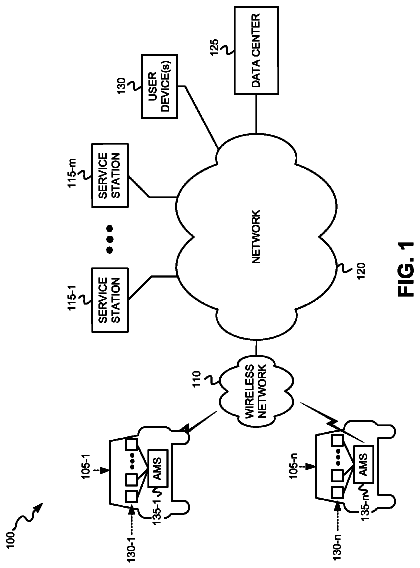
FIG. 1 shows a network that comprises an embodiment of a distribution system;
FIG. 2 shows a diagram of an embodiment of a distribution server suitable for use in one or more embodiments of a distribution system;
FIG. 3 shows an example of a flexible relationship between packages, tiers, channels and services in accordance with an embodiment;
FIG. 4 shows a diagram of an embodiment of a device suitable for use in an embodiment of a distribution system;
FIG. 5 shows an embodiment of a method for operating a device in an embodiment of a distribution system;
FIG. 6 shows an embodiment of an SI structure for use in an embodiment of a distribution system;
FIG. 7 shows an embodiment of a Marketplace Common message schema for use in an embodiment of a distribution system;
FIG. 8 shows an embodiment of a Marketplace Content Packager message 800 schema for use in an embodiment of a distribution system;
FIG. 9 shows a detailed diagram of an embodiment of a package record schema for use in a Marketplace Content Packager message in an embodiment of a distribution system;
FIG. 10 shows an embodiment of a service definition message schema for use in an embodiment of a distribution system; and
FIG. 11 shows an embodiment of a service record schema for use in an embodiment of a distribution system.
Description
The description describes embodiments of a flexible distribution system that supports multiple content packagers and customer service entities on a data network. The system is especially well suited for distributing content to portable devices having limited resources, but may be used with any type of device. The system may also be used in any type of network environment, including but not limited to, communication networks, public networks, such as the Internet, private networks, such as virtual private networks (VPN), local area networks, wide area networks, long haul networks, or any other type of data or communication network.
Definitions
The following definitions apply:
TABLE-US-00001 Term Definition Activation The placement of a Device into a state that causes it acquires SI and Services. Add-on Package A Package that may be subscribed to after a Parent Package is subscribed to. Auto-Subscribed Package A Package that the Device will subscribe to without the user explicitly selecting it, typically as a result of subscription to a different Package. Auxiliary Presentation A Presentation on an Auxiliary Service, typically presented at a defined time in relation to a Presentation on the Base Service. Auxiliary Service A Service used to customize or provide enhancements to a Base Service. It is not displayed in the MPG. Barker A Presentation advertising a Channel or Package that a user is not subscribed to. Base Service The primary Service represented by a Channel. BCS Service Provider Business entity that provides end user billing and customer support services on behalf of one or more Content Packagers. Each Device is associated with a BCS Provider. Blackout A set of LOIs and WOIs in which access to a Presentation is forbidden. Channel A view of a Base Service that may be customized through replacement of certain attributes of the Base Service and/or association with one or more Auxiliary Services. Channel Weight The Weight to be assigned to MPG Titles of Presentations delivered via the Channel. Classification Scheme A set of language-independent terms that defines the vocabulary for a particular application or domain. Classification Scheme Alias A string that may be used as short form representation of a Classification Scheme namespace Classification Scheme Table An XML Table formatted according to MPEG-7 specifications which defines a set of Classification Schemes and Classification Scheme Aliases. Closed Package A Package that is not accepting new subscriptions Contact Window An interval of time in which a Non Real Time Presentation is being transmitted. Content Packager Business entity that defines Packages and offers them for subscription through one or more associated BCS Service Providers. Also called a Content Retailer. Content Provider Business entity that supplies content delivered to the user through Services Controlled Term A token that is resolved to an entry in a Classification Scheme Table. Default Language The language in which information is to be delivered to a user if the user has not selected some other language in which the information available. Device Customer Equipment that can be activated to access Service. EULA End User Licence Agreement - a contract between the User and the BCS Provider that specifies the default terms of subscription. It may be superseded by a Terms of Use Agreement for a particular Content Packager. Excluded Package A member of a set of Packages which a user is not permitted to subscribe to if it subscribes to a specified Package Excluded Service A Subscribed Service that is not downloaded to or stored on the device, typically as a result of a user action to exclude access to the Service. See also Included Service, Non-excludable Service Flow Logical stream within a Multiplex, typically used to deliver a single Media component of a Realtime Presentation, or a file containing a Non Real Time Presentation, or SI Messages. Icon A still image that may be overlaid on part of the main image of a Device display screen. Included Service A Subscribed Service delivered to the device. See also Excluded Service, Non-excludable Service. Intro An Auxiliary Presentation that is delivered to the user before the associated Presentation on the Base Service. IP Datacast Presentation A Presentation consisting of IP-formatted content addressed to a defined set of IP multicast addresses. IP Datacast Service A Service delivering IP Datacast Presentations. Local Operations See LOI Infrastructure LOI Logical grouping of infrastructure deployed to provide Network coverage of a specific local-area. Marketplace Common Message An SI Message used to deliver information about the BCS Providers associated with the Network and certain Classification Scheme Tables used in the Network. Marketplace Content Retailer An SI Message used to deliver information about Content Retailers and Message the Packages, Tiers and Channels available through the Content Retailers. Marketplace Definition The protocol managing transmission and acquisition of MSI. Protocol Marketplace Information Information describing the BCS Providers, Content Packagers, Packages, Tiers and Channels. Marketplace & Service Marketplace Common Message, Marketplace Content Packager Information Messages and Service Definition Message. Media Formats for representing information, such as moving or still images, sound, or text, possibly associated with metadata used to assist in interpretation of the media content. Media Presentation Guide The schedule of MPG Titles available in the Network, delivered to the Device as a sequence of MPG Blocks. MIME Type A media type delivered in a Non Real Time or IP Datacast Presentation and the associated metadata identifying it according to the conventions of RFCs 2045-2049 (Error! Reference source not found. - Error! Reference source not found.). MPG See Media Presentation Guide MPG Block An SI Message delivering the set of MPG Titles and Contact Windows available in a Multiplex for a defined time window, the MPG Block Duration. MPG Delivery Protocol The protocol managing transmission and acquisition of MPG Blocks. MPG Title The description of an instance of a Presentation that is available for viewing at a specified time. MSI See Marketplace and Service Information Multiplex The set of Flows available in a given LOI or WOI. Network A multicast network using the Physical Layer. Non-Excludable Service A Subscribed Service that the Device is not allowed declining delivery of. See also Included Service, Excluded Service. Non Real Time Presentation A Presentation that is stored for later retrieval and presentation to the user. Non Real Time Service A Service delivering content consisting entirely of Non Real Time Presentations Outro An Auxiliary Presentation that is delivered to the user after the associated Presentation on the Base Service. Package A Package is a set of Tiers and associated Auxiliary Services. Packages are offered for purchase on the System. Package Weight The Weight of a Package. Parent Package A Package for which a prior subscription must exist before the user may subscribe to an Add-on Package. Per MPG Title Service A Service delivering both Real Time Presentations and Non Real Time Presentations. The type of a particular Presentation is determined from the MPG Title for the Presentation. Presentation A set of media segments which may be presented to the user concurrently and/or consecutively and which can be described by a single MPG Title. Presentation Window An interval of time in which a user may view a Presentation. Primary Flow A Flow delivering, inter alia, a list of the current Versions of the various types of SI Message. Private Content Retailer A Content Retailer which requires that users establish access right to it by means not specified in the SI. Private Package A Package offered by a Private Content Retailer. Private Channel A Channel offered through a Private Package. Private Service A Service to which access may only be offered as a Private Channel. Rating A classification of a Service or Presentation content that provides guidance on the suitability of the content. A Rating is usually a level in a single scale, but may have several dimensions. Real Time Presentation A Presentation consisting of Media that is presented to the user as it is received and processed, and need not be stored for later retrieval. Real Time Service A Service delivering content consisting entirely of Real Time Presentations. Service Definition Message An SI Message delivering information about the Services available in the Network Service Schedule The temporal order in which Presentations are available for presentation to the user. Service A sequence of Presentations offered under a single label and delivered using a defined set of Flows. SI See System Information SI Flow A Flow used to deliver SI Messages SI Framing Protocol The protocol for transmitting an SI Message SI Message A message containing all the elements of an SI Message schema. SI Message Fragment A message containing a copy of the root element and a subset the other elements of an SI Message Instance Subscribed Service A Service that a user can access, having subscribed to a Package that includes the right to access the Service. System Information The set of information that enables a Device to locate Services or subscribe to Packages on behalf of the user, and to describe Marketplace Information, Services and MPG Titles to the user. Terms of Use Agreement A contract between the user and the Content Retailer that controls the terms of subscription to a Package. See also EULA. Tier A set of Channels grouped together for subscription purposes. Tiers are combined to create Packages. Version An attribute of an SI Message that identifies the particular set of attributes and element values transported by the SI Message, allowing it to be identified as a copy of another SI Message. Weight An attribute whose value controls the order in which information about an element is presented to the user in a list of elements of the same type. Wide Area Operations See WOI Infrastructure WOI Logical grouping of infrastructure deployed to provide Network coverage of a specific wide-area.
FIG. 1 shows a network 100 that comprises an embodiment of a distribution system. The network 100 comprises portable devices (102, 104 and 106), BCS providers 110, content packagers 118, and content providers 124 all coupled to a distribution network 108.
The devices (102, 104 and 106) are portable devices that communicate with the distribution network 108 to allow device users to access the distribution network 108 to subscribe to receive available packages.
The BCS providers 110 accept and maintain user subscriptions to packages that are received from the distribution network 108. In an embodiment, each of the devices (102, 104 and 106) is associated with a single BCS provider. For example, the device 102 is associated with BCS 112, device 104 is associated with BCS 114, and device 106 is associated with BCS 116. In another embodiment, a device (102, 104 or 106) may be associated with more than one BCS provider. For clarity, the operation of BCS provider 112 is described in detail; however, the BCS providers 114 and 116 operate in a similar fashion.
The BCS provider 112 establishes relationships with one or more content packagers 118 through subscription agreements, as illustrated at 120. These agreements define which content packagers 118 offer packages that a device associated with a BCS provider 112 may subscribe to receive. In an embodiment, the BCS provider 112 notifies the distribution network 108 of its association with one or more content packagers 118, as shown at 122.
The content packagers 118 define and maintain packages. A package ultimately is a set of services available on the distribution network 108 which may be offered to devices. The device user obtains access to the services by subscribing to the package. The content packagers 118 obtain the right to offer access to services from the content providers 124 through content retail agreements, as shown at 126. The content packagers 118 notify the distribution network 108 of the definition of the packages created by the content packagers 118, as shown at 128.
The content providers 124 supply the content of the services to the distribution network 108, as shown at 130. They also provide descriptions of the content that allows the distribution network 108 to maintain a media presentation guide (MPG) which provides a description to the device users of the services available through the distribution network 108 at any given time.
In an embodiment, the MPG allows a subscriber to select and play content, but not subscribe. In an alternative embodiment, the MPG may allow a user to subscribe in addition to allowing a user to select and play content.
The distribution network 108 is responsible for the delivery of the services to the devices (102, 104 and 106). It is also responsible for the creation and delivery of accompanying system information (SI) parameters. In an embodiment, the communications between the distribution network 108 and the devices (102, 104 and 106) are organized into a set of flows, e.g. to carry different media components of a real time service, or IP streams addressed to different IP ports in an IP Datacast service. All flows which are to be made available in a particular local or wide area are grouped into a corresponding multiplex.
The distribution network 108 comprises any combination of wired and wireless network technologies. For example, the distribution network 108 may be a wireless multicast network. In an embodiment, the distribution network 108 comprises servers (132, 134 and 136). For clarity, the operation of server 132 is described in detail; however, servers 134 and 136 operate in a similar fashion.
Server 132 operates to receive subscription parameters, as shown at 122, from one more of the BCS providers 110. The server 132 also receives package parameters 128 from the content packagers 118, and programming parameters 130 from the content providers 124. The server 132 processes the received parameters to generate the system information (SI) parameters 138 and a media presentation guide (MPG) 140.
The SI parameters 138 comprise a set of information that enables a device to locate services or subscribe to packages, and to describe subscription information, services, and MPG titles to a device user. The MPG 140 comprises a schedule of available titles that is delivered to a device as a sequence of MPG blocks.
During operation of an embodiment of the distribution system, the distribution network 108 activates the devices (102, 104 and 106) and transmits the SI 138 and MPG 140. The devices (102, 104 and 106) then operate to process the SI 138 and MPG 140 to render information to the device users to allow the device users to subscribe to one or more packages. For example, the user of the device 102 selects a package for subscription from the rendered information. The device 102 then transmits a subscription request to the distribution network 108 to subscribe to receive the selected package.
In one or more embodiments, the distribution server 132 operates in an embodiment of the distribution system by performing one or more of the following functions. 1. Obtain subscription, package, and presentation guide parameters associated with selected BCS providers, content packagers and content providers. 2. Generate SI and MPG parameters. 3. Activate a device to subscribe to packages over the distribution network. 4. Transmit the SI and MPG to the activated device. 5. Receive one or more subscription requests from the device.
Thus, embodiments of the distribution system operate to support multiple content packagers and BCS providers on a data network to allow devices associated with different BCS providers to subscribe to receive available packages. It should be noted that the network 100 illustrates just one network configuration, and that other network configurations or arrangements are possible within the scope of the described embodiments.
FIG. 2 shows a diagram of an embodiment of a distribution server 200 suitable for use in one or more embodiments of a distribution system. For example, the distribution server 200 may be used as the distribution server 132 in FIG. 1. The distribution server 200 comprises processing logic 202, SI generation logic 204, MPG generation logic 206, transceiver logic 208, and activation logic 210 all coupled to an internal data bus 212. The server 200 also comprises subscription parameter storage 214, content package parameter storage 216, and programming parameter storage 218, which are all also coupled to the data bus 212.
In one or more embodiments, the processing logic 202 comprises a CPU, processor, gate array, hardware logic, memory elements, virtual machine, software, and/or any combination of hardware and software. Thus, the processing logic 202 generally comprises logic to execute machine-readable instructions and to control one or more other functional elements of the server 200 via the internal data bus 212.
The transceiver logic 208 comprises hardware and/or software that operates to allow the server 200 to transmit and receive data and/or other information with remote devices or systems via communication channel 220. For example, in an embodiment, the communication channel 220 comprises any suitable type of communication link to allow the server 200 to communicate with one or more data networks and/or devices coupled to those data networks.
The storage logic (214, 216, and 218) comprises any suitable type of storage devices or elements that allow the server 200 to store information parameters. For example, in an embodiment the storage logic (214, 216, and 218) comprises any type of RAM, Flash memory, hard disk, or any other type of storage device.
In an embodiment, the processing logic 202 operates to communicate with one or more BCS providers through the transceiver logic 208 and channel 220. The BCS providers provide subscription parameters that are received by the processing logic 202 and stored in the subscription parameter storage 214. The processing logic 202 also operates to communicate with one or more content packagers through the transceiver logic 208 and channel 220. The content packagers provide package parameters that are receive by the processing logic 202 and stored in the package parameter storage 216. The processing logic 202 also operates to communicate with one or more content providers. The content providers provide programming parameters that are received by the processing logic 202 and stored in the programming parameters storage 218. A more detailed description of the subscription, package, and programming parameters is provided in another section of the document.
In one or more embodiments, the SI generation logic 204 comprises a CPU, processor, gate array, hardware logic, memory elements, virtual machine, software, and/or any combination of hardware and software. The SI generation logic 204 operates to retrieve parameters from the storage (214, 216, and 218) to generate SI parameters 224. For example, the SI logic 204 retrieves subscription parameters from the storage 214 that are associated with one or more BCS providers. The SI logic also operates to retrieves package parameters from the storage 216 and programming parameters from the storage 218 that are associated with each BCS provider. Thus, the SI generation logic 204 operates to generate SI parameters 224 that are associated with each BCS provider. A more detailed description and format of the SI parameters 224 is provided in another section of this document.
The MPG generation logic 206 comprises a CPU, processor, gate array, hardware logic, memory elements, virtual machine, software, and/or any combination of hardware and software. The MPG generation logic 206 operates to retrieve parameters from the programming parameters storage 218 to generate a MPG 222 that is associated with one or more BCS providers. A more detailed description and format of the MPG 222 is provided in another section of this document.
The activation logic 210 comprises a CPU, processor, gate array, hardware logic, memory elements, virtual machine, software, and/or any combination of hardware and software. The activation logic 210 operates to activate a device to allow the device to subscribe to available packages. The activation process need only occur once for each device that desires to subscribe to packages. For example, in an embodiment, the activation logic 210 comprises a client application 226 that is downloaded to the device during the activation process. For example, the client 226 is downloaded to the device using the transceiver logic 208. Once a device is activated by the activation logic 210, the client 226 runs on the device and operates to receive and display information about available packages and other related information to the device user. Thus, the activation logic 210 operates to allow the server 200 to identify and authenticate a device, thereby allowing the device to subscribe to one or more available packages.
During the activation process, the SI parameters 224 and MPG 222 are transmitted to a device being activated. The client executing on the device operates to render information from the SI parameters 224 and the MPG 222 so that the device may subscribe to receive available packages.
In an embodiment, the distribution system comprises program instructions stored on a computer-readable media, which when executed a processor, for instance, the processing logic 202, provides the functions of the server 200 described herein. For example, instructions may be loaded into the server 200 from a computer-readable media, such as a floppy disk, CDROM, memory card, FLASH memory device, RAM, ROM, or any other type of memory device or computer-readable media that interfaces to the server 200. In another embodiment, the instructions may be downloaded into the server 200 from an external device or network resource that interfaces to the sever 200 via the transceiver logic 208. The instructions, when executed by the processing logic 202, provide one or more embodiments of a distribution system as described herein.
In an embodiment, SI services fall into three classes:
1. Marketplace Definition services, providing information that allows users to subscribe to Packages.
2. Service Definition services, providing information that allows the Device to locate and interpret a Service.
3. Media Presentation Guide services, providing information about the content available on the services.
In an embodiment, Marketplace Definition SI informs a device of Classification Scheme Tables, the capabilities of the BCS Providers, and the packages offered by the Content Providers. The principal function is to communicate information about the packages.
Marketplace Definition SI defines the Classification Scheme Tables in use in the Network. A Classification Scheme Table is an infrastructural element that defines a set of common terms as used for a specified function in a particular Network, but which may vary between Networks, or which may exist in multiple forms, e.g. differentiated by language. Examples of such terms include Rating Schemes and Genres.
Classification Scheme Tables allow SI Messages to refer to the terms succinctly and in a controlled fashion.
Marketplace Definition SI defines the characteristics and capabilities of the BCS Providers related to subscription services. In an embodiment, the Marketplace Definition SI may define: The set of Content Packagers associated with the BCS Provider. In an embodiment, a device can only subscribe to Packages which are provided by Content Packagers associated with the BCS Provider. The Billing Policies available through the BCS Provider and the types of account ID that may be used, such as Credit Card subscriptions through PayPal. Contact details for placing subscriptions to the BCS Provider, such as a telephone number, email address or webpage URL. The Terms of Use agreement for the BCS Provider.
Marketplace Definition SI defines the characteristics and capabilities of the Content Packager related to subscription services. In an embodiment, it may define: The Name of the Content Packager Whether the Content Packager is Private or not. Currencies in which Packages may be offered by the Content Packager The End User License Agreement for the Content Packager
Additionally, the SI may define in an embodiment, a set of Auxiliary Services associated with a Content Packager. These services may provide supplemental information related to any channel offered through the Content Packager. They are monitored by a device so long as the device is subscribed to any package offered by the Content Packager.
In an embodiment, the principal information delivered by the Marketplace SI is the definition of the packages offered by the Content Packagers.
In principle, a package is a set of services, together with some affiliated characteristics such as the name of the package and its price. However, the package definition is not directly constructed as a list of Services. Instead, the package is defined as a set of tiers. In turn, each Tier is a set of Channels, where a channel is a view of a service.
An example of the relationship between packages, tiers, channels and services in accordance with an embodiment is shown in FIG. 3. FIG. 3 shows a hierarchal system 300 of packages 302, tiers 304, channels 306, and services 308 in accordance with an embodiment.
In this example, a Content Packager is creating packages 302 which will be branded for certain operators (here, Verizon 310 and Sprint 312), while also creating packages targeted at particular groups which may be offered by both operators (here, the "UK Expat Package" 314, targeted at a small but presumably high-end demographic). These packages 302 provide access to a number of Real Time Services which carry sports video and continuous reruns of popular television series, reformatted for the devices.
The tiers 304 shown include a Verizon sports tier 316, a Sprint sports tier 318, a tennis tier 320, a rerun tier 322, a Verizon rerun tier 324, and a UK tier 326. The channels 306 shown include ESPN-Verizon 328, ESPN-Sprint 330, tennis 332, Days of Our Lives 334, Eastenders 336, and Python 338. The services 308 include ESPN 340, Wimbledon TV 342, Days of Our Lives 344, Eastenders 346, and Python 348.
For the premium sports service ESPN, two channels 328, 330, are created, which provide different views of the service 340 that serve to brand it in a way that advertises a particular mobile network operator (Verizon and Sprint respectively in this example); otherwise, the channels are direct reflections of the services. The tiers 304 are defined, in this example, to provide logical groupings of channels according to the type of content offered.
The packages 302 then offer the users the opportunity to subscribe to combinations of tiers than provide access to services 308 likely to be of interest. Thus, the "UK Expat Package" 314 includes access to the "EastEnders" service 346 and to "Wimbledon Tennis" 342, but no access to general American sports channels, while the Verizon 310 and Sprint 312 packages include access to all sports of interest to their American subscribers, as well as access to reruns that have appeared in the US.
The Content Packager may choose to restrict access to packages by BCS Provider ID.
As well as providing access to a set of services 308, a package may be associated with one or more auxiliary services. These services may provide supplemental information related to any channel offered through the package. They are monitored by the device so long as it is subscribed to the package.
A tier is a set of channels which is treated as a logical group. A channel offered by a Content Packager shall appear in at least one tier, and may appear in more than one tier.
A tier has no meaning outside the context of a package. It is provided to allow compact representation of groups of services, and to provide flexibility in service management. For example, if a service which is accessible through multiple packages becomes unavailable, it can be removed from the packages by redefining the tier(s) that include the service rather than redefining the packages themselves.
A channel is a view of a service presented to the user that is appropriate for a particular Package or Content Packager. It is the smallest unit of content which a user can subscribe to.
Subscription to a package automatically provides access to all channels in the package. However, a user may not wish to access certain channels, and a device can include a capability that allows a user to exclude access to such channels. The Content Packager may indicate that certain channels in the package are not excludable.
The concept of a channel allows the Content Packager to customize the service's appearance to the user. For example, the Content Packager can replace the default name of the service with a channel name, or it can override the service description with different text. Since a service may be offered through more than one package, it is possible to define several channels which resolve to the same service. The service underlying a channel is known as the Base Service.
As well as providing access to a Base Service, a channel may be associated with one or more Auxiliary services. These services provide supplemental information related to the channel. They are monitored by the device so long as it is accessing the channel.
In an embodiment, packages and channels are each assigned a weight. The weight is a resource used to manage the ordering of packages and channels within a device. It defines the default position of the package or channel relative to other packages or channels when they are presented to the user in a list. Thus, if packages from all Content Packagers are presented to the user in a single list, the order of presentation, in the absence of other considerations such as a user preference, is determined by the package weight. Similarly, MPG Titles from the MPG are, by default, presented to the user in order of channel weight.
In an embodiment, a user subscribes to a package via a subscription user interface on the device display. In an embodiment, the default ordering of the packages on the device display is determined according to package weights. Similarly, the default order of channels within a package is determined according to channel weights.
The values of the weights are agreed between all the Content Packagers and BCS Providers using the network. The means by which this is done is a policy decision. For example, blocks of weights may be assigned to different Content Packagers, allowing each Content Packager to assign weights freely.
In an embodiment, the weights may be used to differentiate between different packages and to differentiate between different channels such that specific functions may apply to particular packages and channels based on the weights. Thus, the weights may play a differential function role. In an embodiment, the weights may be encoded with conditions such that the package or channel has associated conditions for a given weight. For example, a weight of "101" may be a binary encoding representing that the associated package or channel has an associated first and third condition. It would be apparent to those skilled in the art that any encoding known in the art may be used to encode information in the form of weights.
An example of a function encoded in a weight is an embodiment, wherein a weight encodes a not-display function such that an associated package or channel is not displayed on a device. It would be apparent to those skilled in the art that any function known in the art may be encoded in a weight.
Each Package is assigned one or more prices. The price is associated with a subscription method (e.g. flat fee, weekly, monthly) that is charged to the user when the user subscribed to the package.
The description continues in the full USPTO document.
 Lapsed, fee not paid13 drawings

