Background of the invention
This invention relates to game playing methods for gaming machines such as video slot machines, video poker machines, bingo machines, etc. More particularly, the present invention relates to methods and apparatus for providing additional capabilities, e.g., downloading and gaming capabilities, to a gaming machine.
There are a wide variety of associated devices that can be connected to a gaming machine such as a slot machine or video poker machine. Some examples of these devices are player tracking units, lights, ticket printers, card readers, speakers, bill validators, ticket readers, coin acceptors, display panels, key pads, coin hoppers and button pads. Many of these devices are built into the gaming machine or components associated with the gaming machine, such as a top box that usually sits on top of the gaming machine.
Typically, utilizing a master gaming controller, the gaming machine controls various combinations of devices that allow a player to play a game on the gaming machine and also encourage game play on the gaming machine. For example, a game played on a gaming machine usually requires a player to input money or indicia of credit into the gaming machine, indicate a wager amount, and initiate a game play. These steps require the gaming machine to control input devices, including bill validators and coin acceptors, to accept money into the gaming machine and recognize user inputs from devices, including touch screens and button pads, to determine the wager amount and initiate game play.
After game play has been initiated, the gaming machine determines a game outcome, presents the game outcome to the player and may dispense an award of some type depending on the outcome of the game. A game outcome presentation may utilize many different visual and audio components such as flashing lights, music, sounds and graphics. The visual and audio components of the game outcome presentation may be used to draw a player's attention to various game features and to heighten the player's interest in additional game play. Maintaining a game player's interest in game play, such as on a gaming machine or during other gaming activities, is an important consideration for an operator of a gaming establishment.
One method of maintaining a player's interest in game play is to provide new data, such as new or updated games, new content, etc., for gaming machines. As used herein, the term "data" will encompass software and content. In addition, it may be desirable to download data (e.g., new or updated software) for an associated device, such as a player tracking system and/or for a peripheral device. However, many installed gaming machines are not configured for downloading data from a network. In some instances, the gaming machine itself may not be configured for networking with a game server. In other instances, a gaming establishment may choose not to configure its gaming machines for communication with such network devices, e.g., because the gaming establishment does not have enough gaming machines to justify the cost of such a network. It would be desirable to provide devices and methods for overcoming at least some of the foregoing drawbacks.
Summary of the invention
The present invention provides various modules for use with gaming machines. The gaming machine may be, for example, a class 2 or a class 3 gaming machine. One such module is configured to receive data from a portable memory device and/or from a network device, e.g., from a game server. In some embodiments, the module includes, or is disposed within, a player tracking unit. Some embodiments of the module include a central processing unit ("CPU") and a memory device such as a dual-ported random access memory ("DPRAM"). Data, such as software or content, may be downloaded to the module's CPU and written to the module's memory. According to some embodiments, data are written to a DPRAM in the module and simultaneously written from the DPRAM to the gaming machine via a high-speed digital bus. In some implementations, a memory in the module is configured to emulate a memory of the gaming machine. This allows a CPU of the gaming machine to execute software stored in the memory in the module. In alternative implementations, a CPU in the module can execute software stored in the memory in the module.
Some embodiments of the invention provide a module for a gaming machine, including: a first module port configured for downloading first data from a server; a first random access memory ("RAM") having a first port and a second port. The second port is configured for communication with a digital communication bus. The module also includes a first processor configured to read downloaded data and write the downloaded data to the first RAM via the first port. The module is configured to emulate a second RAM of a gaming machine, the second RAM being configured for storing software for games of chance for execution on a second CPU of the gaming machine. The software for the games of chance is designed to control an input of cash or indicia of credit for wagers on the games of chance and to control an output of cash or indicia of credit from the gaming machine. Some such embodiments of the invention provide a player tracking unit that includes the module.
As used herein, the term "RAM" includes both read-only memory and read/write memory. Accordingly, the second RAM may include at least one electrically programmable read-only memory ("EPROM"). The module may have an in-circuit EPROM emulator for connecting the module and the EPROM. The module may include a second module port configured for downloading second data from a portable memory device.
Some modules of the present invention include the following elements: a first module port configured for downloading first data from a portable memory device; a DPRAM having a first port and a second port. The second port is configured for communication with a digital communication bus and the DPRAM is configured to be simultaneously accessible by both the module's CPU and the game machine's CPU. The module also includes a central processor configured to read downloaded data and write the downloaded data to the DPRAM via the first port. The DPRAM is further configured to transfer the downloaded data to a gaming machine via a digital bus connection. The gaming machine is operable to receive an input of cash or indicia of credit for wagers on games of chance and to control an output of cash or indicia of credit from the gaming machine.
The module may include a second module port configured for downloading second data from a server. Some such modules include a digital communication bus configured for communication between the second port and the digital bus connection. Moreover, some such modules are part of a player tracking unit.
Alternative gaming machine modules according to the invention include the following: a first module port configured for downloading first data from a server; a DPRAM having a first port and a second port, the second port configured for communication with a digital communication bus. The DPRAM is configured to be simultaneously accessible by both the module's CPU and the game machine's CPU to read and write from the first port and the second port. The module includes a first central processor configured to read downloaded data and write the downloaded data to the DPRAM via the first port. The module is further configured to emulate a gaming machine memory configured for storing software for games of chance. The software is designed to control an input of cash or indicia of credit for wagers on the games of chance and to control an output of cash or indicia of credit from the gaming machine.
The module may include a second module port configured for downloading second data from a portable memory device and/or an in-circuit memory emulator for connecting the module and the gaming machine memory.
Some embodiments of the invention provide a player tracking unit that includes the following elements: a first port; a first CPU configured for enabling player tracking functionality and for communication with a game server via the first port; a first RAM configured for communication with the first CPU and for communication with a second CPU of a gaming machine. The first RAM is configured to receive downloaded games of chance from the first CPU and to emulate a second RAM of the gaming machine. The second RAM is configured for storing software for games of chance for execution on a second CPU of the gaming machine. The software is designed to control an input of cash or indicia of credit for wagers on the games of chance and to control an output of cash or indicia of credit from the gaming machine. The second RAM may include an EPROM.
The player tracking unit may include a second port configured for communication with a portable memory device. A gaming machine may include the player tracking unit.
Alternative player tracking units of the invention include: a first port; a first CPU configured for enabling player tracking functionality and for downloading games of chance from a game server via the first port; and a first RAM configured for communication with the first CPU. The first RAM is also configured to store downloaded games of chance from the first CPU. The first CPU is further configured for executing the downloaded games of chance, thereby bypassing a second CPU of a gaming machine. The gaming machine is configured to control an input of cash or indicia of credit for wagers on the games of chance and to control an output of cash or indicia of credit.
Some implementations of the invention provide a gaming method including the following steps: writing data from a portable memory device to a first CPU of a player tracking device; writing the data from the first central processing unit to a first memory of the player tracking device while simultaneously reading the data by a second CPU of a gaming machine; and writing the data from the second CPU of the gaming machine to a second memory of the gaming machine, wherein the gaming machine is operable to receive an input of cash or indicia of credit for wagers on games of chance and to control an output of cash or indicia of credit from the gaming machine. The step of writing the data to the first CPU may involve writing data from a portable memory device.
Some implementations of the invention provide a gaming system including a module, a gaming machine and a digital communication bus. The module includes a first module port configured for downloading first data from a server and a DPRAM having a first port and a second port, the second port configured for communication with a digital communication bus. The DPRAM is configured to be simultaneously read/write accessible from the first port and from the second port. The module also includes a central processor configured to read downloaded data and write the downloaded data to the DPRAM via the first port. The gaming machine includes apparatus for receiving an input of cash or indicia of credit for wagers on games of chance; devices for playing the games of chance; and a logic device for controlling an output of cash or indicia of credit from the gaming machine according to outcomes of the games of chance. The digital communication bus connects the second port with the gaming machine. The gaming machine is further configured to read the downloaded data via second port and the digital communication bus.
In some such gaming systems, the module is further configured to provide the functionality of a player tracking unit. The gaming system may include a second module port configured for downloading second data from a portable memory device. The second module port may be a USB port.
These and other features and advantages of the invention will be described in more detail below with reference to the associated drawings.
Brief description of the drawings
FIG. 1 is a block diagram of a number of gaming machines with player tracking units connected to servers providing player tracking services.
FIGS. 2A and 2B are perspective diagrams of two embodiments of modules according to the present invention.
FIG. 3A is a block diagram of the components of a module according to some embodiments of the present invention.
FIG. 3B is a block diagram of the components of a module according to alternative embodiments of the present invention.
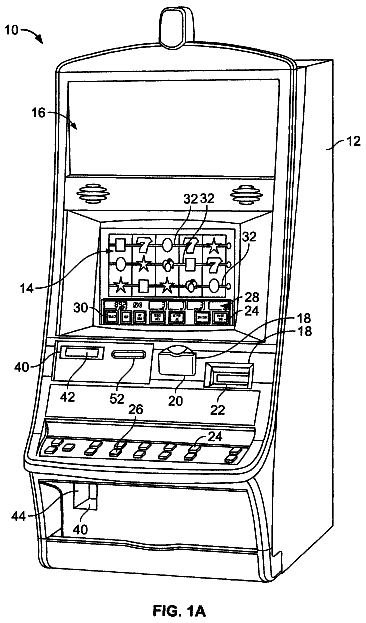
FIG. 4 is a perspective drawing of a video gaming machine of the present invention.
FIG. 5 is a block diagram depicting exemplary software architecture according to some implementations of the invention.
FIG. 6 is a flow chart that outlines a method of downloading and installing data according to some implementations of the invention.
FIG. 7 illustrates one type of portable memory device that may be used in accordance with the present invention.
FIG. 8 illustrates one type of portable memory device that may be used in accordance with the present invention.
Description of the preferred embodiments
Although the present invention may be manifested in a variety of ways, some implementations of the present invention provide a module for providing enhanced functionality for existing gaming machines. Preferably, few (or no) modifications are made to the main gaming machine itself, so that the module may simply be added to an existing gaming machine. The module may be configured to receive data from a portable memory device and/or from a network device, e.g., from a game server, a content server, etc.
In some embodiments, the module includes, or is disposed within, a player tracking unit. U.S. patent application Ser. Nos. 10/246,373 and 10/241,398, respectively entitled "Player Tracking Communication Mechanisms In A Gaming Machine" and "Method and Apparatus for Managing Gaming Machine Code Downloads," are hereby incorporated by reference. Application Ser. Nos. 10/246,373 and 10/241,398 describe, inter alia, some player tracking units that may be modified to perform some of the method of the present invention.
FIG. 1 is a block diagram of an illustrative conventional player tracking system. Although the player tracking system shown in FIG. 1 is described as "conventional" herein, it may be the basis for novel player tracking systems, including those provided by the present invention. FIG. 1 illustrates a number of gaming machines with player tracking units connected to servers providing player tracking services. In gaming establishment 150, gaming machines 100, 101, 102 and 103 are connected, via the data collection unit (DCU) 106 to the player tracking/accounting server 120. The DCU 106, which may be connected to up to 32 player tracking units as part of a local network in a particular example, consolidates the information gathered from player tracking units in gaming machines 100, 101, 102 and 103 and forwards the information to the player tracking account server 120. The player tracking account server is designed 1) to store player tracking account information, such as information regarding a player's previous game play, and 2) to calculate player tracking points based on a player's game play that may be used as basis for providing rewards to the player.
In gaming machine 100 of gaming establishment 150, a player tracking unit 107 and slot machine interface board (SMIB) 105 are mounted within a main cabinet 8 of the gaming machine. A top box 6 is mounted on top of the main cabinet 8 of the gaming machine. In many types of gaming machines, the player tracking unit is mounted within the top box 6. Usually, player tracking units, such as 107, and SMIBs, such as 105, are manufactured as separate modules before installation into a gaming machine, such as 100. Accordingly, some embodiments of the present invention are combined with a preexisting module, such as a player tracking unit, for easy integration with existing gaming machines. Such embodiments include specialized features for performing the types of enhancements that they provide to the gaming machine. These features will be described in detail below.
The player tracking unit 107 includes three player tracking devices, a card reader 24, a key pad 22, and a display 16, all mounted within the unit. The player tracking devices are used to input player tracking information that is needed to implement the player tracking program. The player tracking devices may be mounted in many different arrangements depending upon design constraints such as accessibility to the player, packaging constraints of a gaming machine and a configuration of a gaming machine. For instance, the player tracking devices may be mounted flush with a vertical surface in an upright gaming machine and may be mounted flush or at a slight angle upward with a horizontal in a flat top gaming machine.
The player tracking unit 107 communicates with the player tracking server via the SMIB 105, a main communication board 110 and the data collection unit 106. The SMIB 105 allows the player tracking unit 107 to gather information from the gaming machine 100 such as an amount a player has wagered during a game play session. This information may be used by the player tracking server 120 to calculate player tracking points for the player. In the example shown in FIG. 1, the player tracking unit 107 is connected to the master gaming controller 104 via a serial connection using a wire serial connector and communicates with the master gaming controller 104 using a serial communication protocol. However, as described below (e.g., with reference to FIG. 3A), some preferred implementations of the invention communicate with the gaming machine across a digital bus. Some implementations include both a serial bus and a digital bus.
The serial connection between the SMIB 105 and the master gaming controller 104 may be through the main communication board 110, through another intermediate device or through a direct connection to the master gaming controller 104. In general, communication between the various gaming devices is provided using wire connectors with proprietary communication protocols. As an example of a proprietary serial communication protocol, the master gaming controller 104 may employ a subset of the Slot Accounting System (SAS protocol) developed by International Game Technology of Reno, Nev. to communicate with the player tracking unit 107.
In this example, when a game player wants to play a game on a gaming machine and utilize the player tracking services available through the player tracking unit, a game player inserts a player tracking card, such as a magnetic striped card, into the card reader 24. Co-pending U.S. patent application Ser. No. 10/214,936, filed Aug. 6, 2002 and entitled "Flexible Loyalty Points Programs," is hereby incorporated by reference for all purposes. As described in application Ser. No. 10/214,936, various other types of player tracking cards, devices and readers may be used. Here, after the magnetic striped card has been so inserted, the player tracking unit 107 may detect this event and receive certain identification information contained on the card. For example, a player's name, address, and player tracking account number encoded on the magnetic striped card, may be received by the player tracking unit 107. In general, a player must provide identification information of some type to utilize player tracking services available on a gaming machine. For current player tracking programs, the most common approach for providing identification information is to issue a magnetic-striped card storing the necessary identification information to each player that wishes to participate in a given player tracking program.
After a player has inserted her or his player tracking card into the card reader 24, the player tracking unit 107 may command the display 16 to display the game player's name on the display 16 and also, may optionally display a message requesting the game player to validate their identity by entering an identification code using the key pad 22. Once the game player's identity has been validated, the player tracking information is relayed to the player tracking server 120. Typically, the player tracking server 120 stores player tracking account records including the number of player tracking points previously accumulated by the player.
During game play on the gaming machine, the player tracking unit 107 may poll the master gaming controller 104 for game play information such as how much money the player has wagered on each game, the time when each game was initiated and the location of the gaming machine. The game play information is sent by the player tracking unit 107 to the player tracking server 120. While a player tracking card is inserted in the card reader 24, the player tracking server 120 may use the game play information provided by the player tracking unit 107 to generate player tracking points and add the points to a player tracking account identified by the player tracking card. The player tracking points generated by the player tracking server 120 are stored in a memory of some type on the player tracking server.
Some embodiments of the invention allow data to be downloaded from a portable memory device to a module such as a player tracking device. The data may include software or content, such as advertisements, video clips, etc. In some such embodiments, the data are downloaded from a "smart card" or similar card, using a card reader of a player tracking unit. U.S. patent application Ser. No. 09/718,974, entitled "EZ Pay Smart Card and Ticket System," which describes relevant methods and devices for downloading software from smart cards, is hereby incorporated by reference.
In other embodiments, the data are downloaded from a memory stick into a port of the module, such as a USB port. U.S. Pat. No. 6,439,996, entitled "Key for a Gaming Machine and Method of Use Thereof," which describes relevant methods and devices for downloading information from a portable memory device to a communication port of a gaming machine, is hereby incorporated by reference. Modules suitable for downloading will be described below with reference to FIGS. 2A and 2B.
FIGS. 2A and 2B are perspective diagrams of different embodiments of modules of the present invention. In these examples, the modules also provide the functionality of player tracking units. Details of FIGS. 2A 2B not described herein are set forth with reference to FIGS. 2A and 2C of U.S. patent application Ser. No. 10/246,373, entitled "Player Tracking Communication Mechanisms In A Gaming Machine," which has been incorporated herein by reference for all purposes.
FIG. 2A is a front diagram for a housing or chassis 200 enclosing a number of interface peripherals. The interface peripherals may be used to provide input and output (I/O) to one or more network devices, to various types of portable storage devices, or to other gaming systems such as a gaming machine. The device housing 200 may enclose a logic device (not shown) and other electronics configured to execute the methods of the present invention or the logic device may be enclosed in a logic device housing separate from the device housing 200.
Using the interface devices enclosed in the housing 200, data may be downloaded and information, such as gaming and player tracking information, may be input to the module. Information may be visually and aurally communicated to various individuals that may use the module, such as game players, casino service representatives and maintenance technicians. Illumination devices, such as back lit key pad buttons (e.g. 221, 222 and 223), light 211 and light 216 and sound projection devices, such as speaker 209, can visually and/or aurally communicate game information, display content, etc. The function buttons, F1, F2, F3 and F4 (i.e. 221) may be used to provide various services through the module.
The device housing 200 encloses a display 215, a key pad 220, a microphone 207, a speaker 209, a card reader 225, a light 216 adjacent to the card reader 225 and a light 216 adjacent to the display 215. The modules shown in FIGS. 2A and 2B include card readers 225 that can read data from a portable storage device such as a "smart card." Moreover, the modules shown in FIGS. 2A and 2B include ports 233 for downloading data from other types of portable storage devices, such as memory sticks. These ports may be accessible, as shown, but are preferably located in a protected area, e.g., in a locked box.
The dimensions of the device housing 200, (e.g. 205, 208 and 210) are shown in FIGS. 2A and 2B. The device housing 200 is shown as a rectangular box for illustrative purposes only. A shape of the device housing 200 is variable and is not strictly limited to rectangular shapes. Further, dimensions of the cut-outs on the face plate 230 for the player tracking interface devices may vary depending the manufacturer of a particular interface peripheral device which may be used in a player tracking device.
FIG. 2B is a front diagram for a housing or chassis 200 enclosing a number of interface peripherals according to another embodiment of the present invention. The front plate 230 is covered with a decorative skin 265 with a silk-screen logo 266.
In addition to the player tracking interface devices described with respect to FIG. 2A, the player tracking housing 200 includes a wireless interface 264, a camera 262 and a finger-print reader with platen 260. A description of a finger print reader as an identification device is provided in co-pending U.S. patent application Ser. No. 09/172,787, filed Oct. 14, 1998, by Wells, et al., entitled "Gaming Device Identification method and Apparatus," which is incorporated herein in its entirety and for all purposes.
In this example, display 215 is a color LCD. Other display technologies (such as organic electro-luminescent devices) may be used with the display 215. Display 215 and speaker 209 may be used for any convenient purpose, e.g., to reproduce downloaded content such as video clips or advertisements, to communicate game information, to display information regarding the status of a data download, of software installation, etc. For instance, when a portable memory device such as a card has been inserted incorrectly in the card reader 225, a message (e.g., "card not inserted correctly") may be projected from the speaker. Many different types of information may be visually or aurally communicated using the present invention and such information is not limited to the examples provided above.
User preferences, such as the language preferred by the person using the machine may be stored on a portable memory device. According to some implementations, such information may be stored on a smart card, memory stick, player tracking card, etc. Alternatively, a user of the module may be able to specify a language using one of the input devices on the module. For example, such preferences may be based on a user profile previously established by the person using the module.
FIG. 3A is a block diagram of an embodiment of a module 300 of the present invention connected to a gaming machine and two exemplary network devices. The module 300 includes a logic device 310 enclosed in a logic device housing and a number of interface devices including a card reader 225, a display 215, a key pad 220, a light panel 216, a microphone 207, a speaker 209, a wireless interface and other interface devices 356 enclosed in a device housing 311. The logic device 310 for the module and the interface devices may be enclosed in a single housing (see FIGS. 2A and 2B) or in separate housings.
The logic device 310 may include one or more processors for executing software allowing the module 300 to perform various functions such as communicating with servers 120 and 333 and one or more components of a gaming machine. In this example, module 300 is networked for communication with player tracking server 120 and game server 333. In other implementations, a module may be configured for communication with other network devices, such as servers for downloading content such as audio, video, advertisements, etc. Alternatively, a module could be configured for communication with a messaging server, a cashless system server, or other network devices. As noted above, it is desirable to provide a module that requires few or no modifications of the gaming machine.
Module 300 preferably performs data authentication and verification functions for downloaded data. In some embodiments, the verification may be performed by processor 302. Alternatively, the gaming machine (e.g., master gaming controller 104 could authenticate and verify downloaded data. The former option is preferable, so that the gaming machine does not need to be reconfigured for authentication and verification purposes.
In this example, logic device 310 allows module 300 to communicate with master gaming controller 104 and to operate various peripheral devices, such as card reader 225, display 215, key pad 220 and light panel 216. For instance, the logic device 310 may send messages containing player tracking information to the display 215. As another example, the logic device 310 may send commands to the light panel 216 to display a particular light pattern and to the speaker 209 to project a sound to visually and aurally convey game information. The logic device 310 may utilize a microprocessor and/or microcontrollers. For instance, the light panel 216 may include a microcontroller that converts signals from the processor 302 to voltage levels for one or more illumination devices. U.S. Pat. No. 6,368,216, entitled "Gaming Machine Having Secondary Display for Providing Video Content," is hereby incorporated by reference.
In one embodiment, application software for module 300 and configuration information for the player tracking unit may be stored in a memory device such as an EPROM 308, a non-volatile memory, hard drive or a flash memory. Here, module 300 also includes memory 316. In this example, memory 316 is configured to store: 1) player tracking software 314 such as data collection software, 2) communication protocols (e.g. 320) allowing module 300 to communicate with different types of network devices, 3) device drivers for many types of interface devices (e.g. 330), 4) voice recognition software for receiving voice commands from the microphone 207, 5) a secondary memory storage device such as a non-volatile memory device, configured to store gaming software related information (the gaming software related information and memory may be used in a game download process or other software download process), and 6) communication transport protocols [(e.g. 340) such as TCP/IP, USB, IEEE1394, Bluetooth, IEEE 802.11a, IEEE 802.11b, IEEE 802.11x (e.g. other IEEE 802.11 standards), hiperlan/2, and HomeRF allowing module 300 to communicate with devices using these protocols or communication protocols allowing the logic device to communicate with different types of master gaming controllers (e.g. master gaming controllers using different types of communication protocols), such as 104.
In the embodiment shown in FIG. 3A, module 300 communicates with the gaming machine using 2 different interfaces. Interface 325 is a relatively low speed serial bus that is suitable for, e.g., communicating player tracking information. Accordingly, the master gaming controller, such as 104, communicates over bus 325 using a serial communication protocol. A few examples of serial communication protocols that may be used to communicate with the master gaming controller include but are not limited to USB, RS-232 and Netplex (a proprietary protocol developed by IGT, Reno, Nev.). Interface 325 is primarily used to bridge to legacy machines.
Interface 303 is a high speed digital bus that is suitable for rapidly transferring data between module 300 and the gaming machine. The digital bus may be any convenient width, for example, a 32-bit width. In that case, there would be 32 digital I/O lines.
In the example shown, interface 301 is also a high-speed interface. This configuration allows data downloaded from a network device or a portable memory device to be stored in memory 316 temporarily, then downloaded to master gaming controller 104 via the dual ported random access memory ("DPRAM") interface either immediately, or at some later time. Data can be simultaneously read from and written to a DPRAM module. Therefore, in implementations that include a DPRAM module, e.g., in logic device 310 or on the Communication Board 304, downloaded data can be simultaneously written to the DPRAM module from a processor (e.g. processor 302 or a processor of network interface board 306) and written to the gaming machine (here, to master gaming controller 104). Master gaming controller 104 can store the data in a memory device of the gaming machine.
Depending on the embodiment of module 300, logic device 310 may enable module 300 to bypass master gaming controller 104 and communicate directly with other components of a gaming machine. These components may include memory 305 and/or gaming peripherals 334. For example, in some embodiments of the invention, this direct communication allows a memory of module 300 to emulate memory 305 of the gaming machine. Memory 305 may be, for example, a random access memory such as an EPROM that contains gaming software that is intended to be executed by master gaming controller 104. As used herein, a "random access memory" includes both read-only memory ("ROM") and read/write memory such as DRAM and SRAM. A connection such as a jumper (e.g., an EPROM emulator) could connect module 300 to memory 305, e.g., to an EPROM socket. Such a connection should be pin-to-pin compatible with memory 305. When the master gaming controller 104 seeks to execute a program stored in memory 305, the game codes are actually coming from module 300 (e.g., previous downloaded to the EPROM emulator from memory 316). This configuration allows master gaming controller 104 to execute software directly from module 300. Such a configuration is particularly advantageous because it eliminates the need for, e.g., replacing an EPROM of the gaming machine or reconfiguring a CPU of a legacy machine to process and store downloaded data.
In alternative embodiments of the invention, a processor of module 300 is configured to perform gaming machine functions. For example, processor 302 may execute gaming software that has been downloaded and stored in a memory of module 300 (e.g., in memory 316), thereby bypassing (at least in part) the functionality of master gaming controller 104. Alternatively, one or more processors are dedicated to gaming and one or more other processors perform the other functions of module 300 (e.g., player tracking functions). In implementations wherein module 300 is executing gaming software, module 300 preferably controls at least some of gaming peripherals 334 for implementation of a game (e.g., a game of chance).
Some preferred embodiments of module 300 (e.g., wherein one or more processors of module 300 are configured to perform gaming machine functions) are implemented with special features and/or additional circuitry that differentiates gaming machines of the present assignee from general-purpose computers (e.g., desktop PC's and laptops). Gaming machines are highly regulated to ensure fairness and, in many cases, gaming machines are operable to dispense monetary awards of multiple millions of dollars. Therefore, to satisfy security and regulatory requirements in a gaming environment, hardware and software architectures may be implemented in gaming machines that differ significantly from those of general-purpose computers. A description of gaming machines relative to general-purpose computing machines and some examples of the additional (or different) components and features found in gaming machines are described below.
At first glance, one might think that adapting PC technologies to the gaming industry would be a simple proposition because both PCs and gaming machines employ microprocessors that control a variety of devices. However, because of such reasons as 1) the regulatory requirements that are placed upon gaming machines, 2) the harsh environment in which gaming machines operate, 3) security requirements and 4) fault tolerance requirements, adapting PC technologies to a gaming machine can be quite difficult. Further, techniques and methods for solving a problem in the PC industry, such as device compatibility and connectivity issues, might not be adequate in the gaming environment. For instance, a fault or a weakness tolerated in a PC, such as security holes in software or frequent crashes, may not be tolerated in a gaming machine because in a gaming machine these faults can lead to a direct loss of funds from the gaming machine, such as stolen cash or loss of revenue when the gaming machine is not operating properly.
For the purposes of illustration, a few differences between PC systems and gaming systems will be described. A first difference between gaming machines and common PC based computers systems is that gaming machines are designed to be state-based systems. In a state-based system, the system stores and maintains its current state in a non-volatile memory, such that, in the event of a power failure or other malfunction the gaming machine will return to its current state when the power is restored. For instance, if a player was shown an award for a game of chance and, before the award could be provided to the player the power failed, the gaming machine, upon the restoration of power, would return to the state where the award is indicated. As anyone who has used a PC, knows, PCs are not state machines and a majority of data is usually lost when a malfunction occurs. This requirement affects the software and hardware design on a gaming machine.
A second important difference between gaming machines and common PC based computer systems is that for regulation purposes, the software on the gaming machine used to generate the game of chance and operate the gaming machine has been designed to be static and monolithic to prevent cheating by the operator of gaming machine. For instance, one solution that has been employed in the gaming industry to prevent cheating and satisfy regulatory requirements has been to manufacture a gaming machine that can use a proprietary processor running instructions to generate the game of chance from an EPROM or other form of non-volatile memory. The coding instructions on the EPROM are static (non-changeable) and must be approved by a gaming regulators in a particular jurisdiction and installed in the presence of a person representing the gaming jurisdiction. Any changes to any part of the software required to generate the game of chance, such as adding a new device driver used by the master gaming controller to operate a device during generation of the game of chance can require a new EPROM to be burnt, approved by the gaming jurisdiction and reinstalled on the gaming machine in the presence of a gaming regulator. Regardless of whether the EPROM solution is used, to gain approval in most gaming jurisdictions, a gaming machine must demonstrate sufficient safeguards that prevent an operator of a gaming machine from manipulating hardware and software in a manner that gives them an unfair and some cases an illegal advantage. The code validation requirements in the gaming industry affect both hardware and software designs on gaming machines.
The description continues in the full USPTO document.
 Lapsed, fee not paid3 drawings