Lapsed, fee not paid6 drawings
Software & Apps · US 8,549,266 B2
System and method of instruction modification
A method and system of instruction modification.
US 8,549,276 B2 · Assignee: IGT · Inventors: Chen; Xuedong et al.
Sheet 1 of 10 from the published document. All sheets in the USPTO PDF
Gaming machines and systems having a universal interface layer linking a gaming platform to a hardware platform are disclosed. In particular, the universal interface layer is configured such that the gaming platform is hardware platform independent and such that the hardware platform is gaming platform independent. Platform independence can facilitate the interchangeability of one platform without a corresponding need to modify the other platform. The gaming platform can include various gaming modules and an operating system, while the universal interface layer can include firmware, various additional gaming modules, hardware specific drivers and various APIs to facilitate communication between the gaming platform and other universal interface layer components. A safe storage manager can be included to utilize a non-volatile storage component to store data regarding a gaming machine state, with the state being recoverable after a substantial interruption to the machine.
Modern scientific progress and technological advances have resulted in a growing variety of increasingly sophisticated and complex devices and machines. Many recently developed hardware items and components have resulted in electronic devices and machines with faster processing capabilities, increased storage capacities, better video presentations, higher quality audio systems and other improved features, often in more compact devices and at lower costs with respect to previous generation items and components. One unfortunate side-effect of continuing advancements in chips, boards and other electronic items is that software programs and architectures for computing units and systems can sometimes lag behind in development, and thus may not fully optimize or even make use of many capabilities of various emerging and recently developed electronics technologies. Devices with software structu
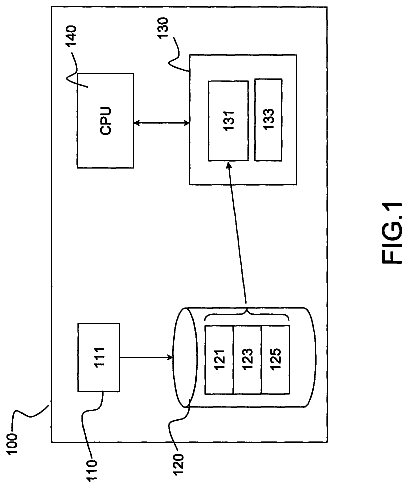
1 of 10 drawing sheets so far from the published document, cropped to the drawing. Every sheet is in the USPTO PDF.
What the patent claimed, word for word. All of it is now free to use.
The present invention relates generally to gaming machines and systems, and more specifically to gaming software architectures and related components for electronic gaming machines and systems.
2.
Modern scientific progress and technological advances have resulted in a growing variety of increasingly sophisticated and complex devices and machines. Many recently developed hardware items and components have resulted in electronic devices and machines with faster processing capabilities, increased storage capacities, better video presentations, higher quality audio systems and other improved features, often in more compact devices and at lower costs with respect to previous generation items and components. One unfortunate side-effect of continuing advancements in chips, boards and other electronic items is that software programs and architectures for computing units and systems can sometimes lag behind in development, and thus may not fully optimize or even make use of many capabilities of various emerging and recently developed electronics technologies. Devices with software structures and programs that might lag behind in this manner can include, for example, general-purpose computers such as a laptop or desktop personal computer ("PC"), among others. Software structures or routines that can be archaic in many PCs can include, for example, diagnostics, boot and initialization routines, among others.
To alleviate such problems, various organizations and industry leaders have begun to devise examples of and standards for improved software structures and programs that move away from those that tend to be relatively outdated and restrictive. One example of such a movement is the Extensible Firmware Interface ("EFI") and associated standards that have been recently promulgated by Intel Corporation of Santa Clara, Calif. for use in various newer generation electronics products. As is known, this EFI provides options and guidelines for using programs and running routines in a pre-boot environment of a PC based system, and examples of such can be found on the Intel web site at http://www.intel.com/technology/efi.
Another example of a class of electronic devices that have experienced a relative lag in software and hardware architecture development with respect to recent advances in electronic technologies is that of gaming machines. In a typical gaming machine, such as, for example, a video poker machine, blackjack machine, keno machine, or slot machine, among others, a game play is first initiated through a player wager of money or credit, whereupon the gaming machine determines a game outcome, presents the game outcome to the player and then potentially dispenses an award of some type, including a monetary award, depending on the game outcome. Although this process is generally true for both mechanical and electronic gaming machines, electronic machines tend to be more popular with players and thus more lucrative for casinos for a number of reasons, such as increased game varieties, more attractive and dynamic presentations and the ability to award larger jackpots.
Electronic gaming machines can include various hardware and software components to provide a wide variety of game types and game playing capabilities, with such hardware and software components being generally well known in the art. A typical electronic gaming machine can include hardware devices and peripheral such as bill validators, coin acceptors, card readers, keypads, buttons, levers, touch screens, coin hoppers, ticket printers, player tracking units and the like. In addition, each gaming machine can have various audio and visual display components that can include, for example, speakers, display panels, belly and top glasses, exterior cabinet artwork, lights, and top box dioramas, as well as any number of video displays of various types to show game play and other assorted information, with such video display types including, for example, a cathode ray tube ("CRT"), a liquid crystal display ("LCD"), a light emitting diode ("LED"), a flat panel display and a plasma display, among others. Software components can include, for example, boot and initialization routines, various game play programs and subroutines, credit and payout routines, image and audio generation programs, various component modules and a random number generator, among others. In addition, a typical electronic gaming machine comprises a central processing unit ("CPU") or master gaming controller ("MGC") that generally controls various combinations of hardware and software devices and components that encourage game play, allow a player to play a game on the gaming machine and control payouts and other awards.
It is well known that gaming machines are becoming more sophisticated, such that current software and hardware architectures are becoming too slow and inadequate to optimize the capabilities of newer technologies. Newer machines, such as those having "Wheel of Fortune," "Star Wars" or other similar themes, can require increasingly complex and demanding processing routines, as well as many different presentations, video and sound. Such requirements tend to result in a need for better processing capabilities and massive amounts of data storage, as well as improved communication and data transfer speeds. Because the costs and logistics of providing such capabilities become more prohibitive within the restrictive architectures of most electronic gaming machines, the overall qualities and functionalities of such gaming machines continue to lag behind those of other electronic devices and machines.
Many examples of current legacy architectures that can hinder the overall performance of a gaming machine involve the operating system ("OS") and many associated boot and initialization processes. As one particular example, the operating system on an electronic gaming machine usually requires knowledge of the specific hardware platform installed on that gaming machine in order to boot up. This can be particularly disadvantageous in that many gaming specific software modules are or can be designed to be completely hardware independent. Such software modules can include, for example, diagnostics, encryption and/or authenticator modules, among others. While the use of such modules in a pre-boot environment might be desirable for various reasons, implementations in this manner are rarely practical in current architectures where booting up an operating system must typically be done first or very early in a gaming machine start up or reset process.
In addition, the specific firmware linking the operating system and hardware platform in a given gaming machine usually has a number of limitations as well. Using the basic input/output system ("BIOS") of a gaming machine as one specific example, a typical gaming machine BIOS is written in assembler language and contains a number of legacy features that do not enhance the functionality of an advanced gaming machine, but rather detract from it in a number of ways. For example, a typical gaming machine BIOS contains disadvantages with respect to scalability, complexity, maintenance and compatibility, among others, as will be readily appreciated. For at least these reasons, it can be very difficult and tedious to write any customized application that runs before the operating system is started.
Furthermore, the very nature of many gaming machine architectures tends to render whole platforms in these devices as non-interchangeable. Current electronic gaming machine architectures generally include a specific game application, a general gaming platform, and a general hardware platform. The general gaming platform typically contains a base operating system, such as Windows CE or QNX, and a variety of gaming specific software modules, while the hardware platform generally contains the hardware and associated firmware of the gaming machine. Typically, too many components of a given gaming platform on an electronic gaming machine must be customized with respect to the actual hardware platform used on that gaming machine, with the consequence being that much of the gaming platform software for different gaming machines must be rewritten or redesigned for each different gaming machine. Of course, such customization can be very inefficient, particularly where the use and functions of many software modules and even portions of platforms are repeated, albeit in different forms as a result of the variances in hardware platforms. In addition, it is nearly impossible to replace or even substantially alter a hardware platform in a given gaming machine without replacing or making significant changes to the respective gaming platform in place.
In light of the foregoing issues, it would be quite advantageous to abstract the gaming platform from the hardware platform in a gaming machine as much as possible, such that the gaming platform would not need to be concerned with various hardware details in order to boot up the operating system. Not only would platform interchangeability then be a possibility, but a pre-boot execution environment could also be established to allow for the use of programs that would be compatible with more systems and that could be readily scaled. Accordingly, it is generally desirable to provide an electronic gaming machine hardware and software architecture that allows for better optimization of current electronic technologies, and in particular that such an architecture abstract the gaming platform from the hardware platform such that platform interchangeability and effective pre-boot environments are created.
It is an advantage of the present invention to provide a gaming machine software and hardware architecture that creates a substantial level of independence between the gaming platform and hardware platform of the gaming machine. Such an architecture results in a general interchangeability of gaming and hardware platforms, as well as an effective pre-boot environment for the use of generic pre-boot modules and routines. Additional benefits include self-diagnostic, remote configuration and other pre-boot capabilities, a faster and more streamlined boot process, improved download capabilities, authentication, firmware updates and other processes that are gaming platform independent, virtual test device capabilities, and hardware specific encryption features, among others. Other advantages and benefits will become apparent upon examination of the following figures and detailed description.
The foregoing is accomplished in many embodiments of the present invention by providing within an electronic gaming machine a software structure that includes a universal interface layer linking the gaming platform and the hardware platform. According to several embodiments, the disclosed systems and methods involve the use or creation of a gaming machine adapted for accepting a wager, playing a game based on the wager and granting a payout based on the result of the game. Such a gaming machine can include various hardware components that collectively form a hardware platform, an exterior housing arranged to contain one or more hardware components, a variety of memory or storage components, and an MGC adapted to control various game aspects and to execute computer code from at least one of the storage components, some of which can be non-volatile in nature. Some of these storage components can contain computer code forming a software structure that includes a gaming platform and a universal interface layer that facilitates communication between the gaming platform and the hardware platform. In particular, the gaming platform can include at least some gaming modules and an operating system, and is also preferably hardware platform independent.
In one particular embodiment, at least one non-volatile storage component is adapted to store data regarding an overall state of the electronic gaming machine, with this data being recoverable after a substantial interruption to the operation of the gaming machine. This overall state can includes a variety of items, such as the amount of credits and the state of any game being played on the electronic gaming machine at the time of the interruption. In addition, the software structure can include a safe storage manager module that is configured to update the overall state of the gaming machine to the non-volatile storage component or components, preferably on a recurring basis. This safe storage manager can also be configured to restore the gaming machine to a part or all of the overall state stored at a non-volatile storage component. Such a substantial interruption to the gaming machine can include a power outage, a gaming machine reset, a critical hardware malfunction, a critical software malfunction and a gaming machine functional tilt, among other items.
In the foregoing embodiment, as well as others, the universal interface layer can include various software modules and at least one application program interface ("API"). Various APIs within the universal interface layer can form a universal interface to be used to facilitate communication between the gaming platform and various software modules also within the universal interface layer, as needed. Some of these software modules within the universal interface layer can be "universal function modules" that are essentially gaming platform independent, in that they are operable with virtually any gaming platform, such as a second gaming platform that is substantially disparate from the gaming platform that is actually used. Of course, such a second gaming platform is typically not simultaneously present with the original gaming platform in a given gaming machine, but the ability of the various universal function modules to be gaming platform independent can aid in the swapping of gaming platforms in an existing gaming machine, if desired. Such a universal nature for these particular modules generally results in no substantial changes to a module being necessary as a result of the specific gaming platform used.
In more specific embodiments, some of these universal function modules within the universal interface layer can also be essentially hardware platform independent, such that the foregoing properties also apply with respect to whatever hardware platform is used in a given gaming machine. It will be readily appreciated that various minor changes might be desirable in a given universal function module depending upon the actual gaming or hardware platform used, such as specific name and address designations. In more detailed embodiments, these universal function modules can include an application downloader module, an authentication module, a configuration module and/or a diagnostics module, among others.
In other embodiments, various storage components might not be included in the gaming machine, particularly where remote management or downloading abilities are included. Accordingly, such a gaming machine might then not include any storage components containing the foregoing software structures, but would at least include a master gaming controller that is configured to execute a software structure including a gaming platform and a universal interface layer linking the gaming platform to a hardware platform, where the gaming platform is again hardware platform independent. Various features and abilities of the universal interface layer as disclosed above and below may be included as well. For example, firmware specific to the hardware platform being used may reside on the universal interface layer itself. In addition, one or more of the universal function modules can be written in a high level computer language, such as C, for example, in addition to being gaming platform and/or hardware platform independent.
In other embodiments, a gaming system adapted for accepting wagers, playing games based on the wagers and granting payouts based on the results of the games is provided. Such embodiments can include any of the foregoing gaming machines within a larger gaming system or network. Alternatively, actual self-contained gaming machines may not be necessary, so long as various input and output devices forming at least a portion of a hardware platform are provided, as well as a master gaming controller that is in communication with at least one of the input and output devices, is adapted to control one or more aspects of the games, and is configured to execute a software structure including a gaming platform and a universal interface layer linking the gaming platform to the hardware platform, where the gaming platform is hardware platform independent. Additional components of such a gaming system can include a server in communication with the master gaming controller and configured to receive data regarding the play of one or more of the games controlled by the master gaming controller, a database adapted to store such data, and/or a cashier station adapted to authorize the payment of an award to a player based on the play of a game controlled by the master gaming controller.
Further embodiments can include a computer readable memory adapted to direct an electronic gaming machine to function in a specified manner, with such a computer readable memory including at least a game application software layer, a gaming platform software layer and a universal interface software layer. The game application software layer can include instructions for running a specific game involving a player wager and a potential payout based on the game result, while the gaming platform software layer can include an operating system and a first set of gaming modules adapted to perform various gaming machine functions. With this gaming platform software layer being hardware platform independent. The universal interface software layer is preferably adapted to facilitate communication between the gaming platform software layer and a specific hardware platform designed for use on the gaming machine. This universal interface software layer can include custom firmware adapted to run the specific hardware platform being used, a second set of gaming modules adapted to perform various gaming machine functions, one or more drivers, and one or more APIs adapted to facilitate communication between the gaming platform software layer and one or more items in the universal interface layer.
Similar to the foregoing embodiments, a safe storage manager can be included as a gaming module, preferably in the first set of gaming modules here. Also, the second set of gaming modules here can include one or more universal function modules operable in conjunction with a non-included second gaming platform without any substantial change to the universal function module. The second set of gaming modules can include an application downloader module, an authentication module, a configuration module, a diagnostics module, an initialization module, a resource allocation module and a resource detection module, among others, with one or more of these modules being written in a high level computer language, being gaming platform independent, and/or being hardware platform independent.
In still further embodiments, methods of manufacturing or converting gaming machines are provided. One method can include creating a standardized gaming platform, forming first and second hardware platforms, designing first and second universal interface layers, constructing first and second gaming machines, and installing the standardized gaming platform to both of the gaming machines. Another method involves converting a hardware platform of an existing gaming machine, which can include retaining on the gaming machine a standardized gaming platform, converting a first hardware platform residing on the gaming machine into a second hardware platform, and replacing a first universal interface layer on the gaming machine with a second universal interface layer. As in the foregoing embodiments, the standardized gaming platform is preferably hardware platform independent, and can include an operating system and one or more gaming modules adapted to perform various gaming machine functions. The first and second hardware platforms can be substantially disparate, with the first universal interface layer being adapted to facilitate communication between the standardized gaming platform and the first hardware platform and the second universal interface layer being adapted to facilitate communication between the standardized gaming platform and the second hardware platform. In the manufacturing method, the first gaming machine is constructed to contain the first hardware platform and first universal interface layer, while the second gaming machine is constructed to contain the second hardware platform and second universal interface layer.
In yet other particular embodiments, various apparatuses and methods involving a pre-boot environment in a gaming machine are provided. In addition to one or more elements or features from the foregoing embodiments being included in these particular embodiments, the master gaming controller is also adapted to execute one or more gaming software modules in a pre-boot environment. Such a pre-boot environment includes that which occurs during the period after an electronic gaming machine start or reset condition and before a base operating system is loaded. Such gaming software modules are preferably those contained within a universal interface layer, although alternative locations are also possible. These gaming software modules can include a boot manager module, an authentication module, a diagnostics module, an application downloader and a configuration module, among others.
In some variations on any of the foregoing specific embodiments, the master gaming controller is further configured to load and execute an operating system based on instructions from a boot manager module. Also, an authentication module may be used to authenticate this operating system prior to loading and executing the operating system. Further, an application downloader module can be used to download computer code to the gaming machine, with this computer code including one or more of a first game application, a first operating system, a second game application, and a second operating system. Yet another gaming software module can be used to monitor for an attachment of a new hardware component and/or a detachment of an existing hardware component. Any combination of these and other gaming software modules can be adapted for use in a pre-boot environment of the gaming machine, prior to boot and/or execution of an operating system.
In still further embodiments, various methods for starting an electronic gaming machine are provided. These methods can include various steps, such as those for activating a boot manager adapted to operate within a pre-boot system environment, reading a pre-boot system configuration for information regarding one or more pre-boot procedures, loading and executing one or more gaming software modules to the master gaming controller, and loading and executing a base operating system to the master gaming controller. In particular, some or all of the former steps may be performed prior to executing the base operating system. Additional steps that can be performed before executing the base operating system can include establishing communications between a hardware component and the master gaming controller, reading metadata for the hardware component from that hardware component, authenticating the base operating system and performing a self-diagnostics routine, among others. Of course, such steps are preferably performed by one or more of the preloaded gaming software modules prior to executing the base operating system.
Other methods, features and advantages of the invention will be or will become apparent to one with skill in the art upon examination of the following figures and detailed description. It is intended that all such additional methods, features and advantages be included within this description, be within the scope of the invention, and be protected by the accompanying claims.
The included drawings are for illustrative purposes and serve only to provide examples of possible structures and process steps for the disclosed inventive systems and methods involving a universal interface layer and/or universal interface within a gaming machine or gaming system. These drawings in no way limit any changes in form and detail that may be made to the invention by one skilled in the art without departing from the spirit and scope of the invention.
FIG. 1 illustrates in perspective view an exemplary electronic gaming machine.
FIG. 2A illustrates a block diagram of an exemplary software and hardware architecture for the electronic gaming machine of FIG. 1.
FIG. 2B illustrates further details for an isolated portion of the gaming machine architecture shown in the block diagram of FIG. 2A.
FIG. 3A illustrates in block diagram format one exemplary result of converting the hardware platform in an electronic gaming machine.
FIG. 3B illustrates in block diagram format one exemplary result of creating electronic gaming machines having disparate hardware platforms.
FIG. 4 illustrates a block diagram of an exemplary software and hardware architecture for a specialized gaming machine having a universal interface layer according to one embodiment of the present invention.
FIG. 5 illustrates further details for an isolated portion of the gaming machine architecture shown in the block diagram of FIG. 4 according to one embodiment of the present invention.
FIG. 6A illustrates in block diagram format one exemplary result of converting the hardware platform in a specialized gaming machine having the software and hardware architecture shown in FIG. 4 according to one embodiment of the present invention.
FIG. 6B illustrates in block diagram format one exemplary result of converting the gaming platform in a specialized gaming machine having the software and hardware architecture shown in FIG. 4 according to one embodiment of the present invention.
FIG. 7 illustrates in block diagram format one exemplary result of creating specialized gaming machines with disparate hardware platforms while also having the software and hardware architecture shown in FIG. 4 according to one embodiment of the present invention.
FIG. 8 illustrates a flowchart of an exemplary initialization process of a specialized gaming machine having the software and hardware architecture shown in FIG. 4 according to one embodiment of the present invention.
FIG. 9 illustrates a block diagram of an exemplary network infrastructure for providing a gaming system having one or more specialized gaming machines having the software and hardware architecture shown in FIG. 4 according to one embodiment of the present invention.
FIGS. 10A and 10B illustrate flowcharts of exemplary processes for manufacturing and converting specialized gaming machines having the software and hardware architecture shown in FIG. 4 according to various embodiments of the present invention.
Exemplary applications of systems and methods according to the present invention are described in this section. These examples are being provided solely to add context and aid in the understanding of the invention. It will thus be apparent to one skilled in the art that the present invention may be practiced without some or all of these specific details. In other instances, well known process steps have not been described in detail in order to avoid unnecessarily obscuring the present invention. Other applications are possible, such that the following example should not be taken as definitive or limiting either in scope or setting. In the detailed description that follows, references are made to the accompanying drawings, which form a part of the description and in which are shown, by way of illustration, specific embodiments of the present invention. Although these embodiments are described in sufficient detail to enable one skilled in the art to practice the invention, it is understood that these examples are not limiting, such that other embodiments may be used and changes may be made without departing from the spirit and scope of the invention.
One advantage of the present invention is the introduction of a gaming machine architecture having a universal interface layer between the gaming platform and hardware platform of the gaming machine, such that these platforms can be relatively independent of each other. Such a structure can result in a general interchangeability of gaming and hardware platforms, and also create an effective pre-boot environment to enable the use of pre-boot modules and routines. A variety of benefits and added features can be realized with such an arrangement, as noted above, such that the more advanced electronics technologies can be better implemented and optimized within electronic gaming machines. In addition to faster and improved functionality within a gaming machine, modularity of gaming and hardware platforms can also be realized.
Although the present invention is directed primarily to gaming machines and systems, it is worth noting that some of the apparatuses, systems and methods disclosed herein might be adaptable for use in other types of devices or environments, such that their use is not restricted exclusively to gaming machines and systems. In fact, it will be readily appreciated that a wide variety of machines and devices can be used in conjunction with the inventive apparatuses, systems and methods disclosed herein. Such other devices can be specialized gaming devices that do not amount to actual gaming machines, as well as any other device that can be implemented with the inventive hardware and software architectures disclosed and detailed herein. Such other adaptations may become readily apparent upon review of the following detailed description. Although it will be understood that such other applications can be used with the inventive systems and methods disclosed herein, the discussion here shall focus on examples involving actual gaming machines for purposes of clarity.
The remainder of the detailed description herein first provides general discussions of gaming machines and of typical hardware and software architectures for electronic gaming machines in particular. Following that, specific embodiments of specialized gaming machines having better hardware and software architectures are provided. Next, discussion of the initialization process and pre-boot environment in a specialized gaming machine is provided, after which exemplary network and system configurations are given. Finally, methods of manufacturing or converting gaming machines that have the inventive architectures disclosed herein are given.
Gaming Machines
Referring first to FIG. 1, an exemplary gaming machine is illustrated in perspective view. Gaming machine 10 includes a top box 11 and a main cabinet 12, which generally surrounds the machine interior (not shown) and is viewable by users. This top box and/or main cabinet can together or separately form an exterior housing adapted to contain a plurality of internal gaming machine components therein. Main cabinet 12 includes a main door 20 on the front of the gaming machine, which preferably opens to provide access to the gaming machine interior. Attached to the main door are typically one or more player-input switches or buttons 21, one or more money or credit acceptors, such as a coin acceptor 22 and a bill or ticket validator 23, a coin tray 24, and a belly glass 25. Viewable through main door 20 is a primary video display monitor 26 and one or more information panels 27. The primary video display monitor 26 will typically be a cathode ray tube, high resolution flat-panel LCD, plasma/LED display or other conventional or other type of appropriate video monitor. Alternatively, a plurality of gaming reels can be used as a primary gaming machine display in place of display monitor 26, with such gaming reels preferably being electronically controlled, as will be readily appreciated by one skilled in the art.
Top box 11, which typically rests atop of the main cabinet 12, may contain a ticket printer 28, a key pad 29, one or more additional displays 30, a card reader 31, one or more speakers 32, a top glass 33, one or more cameras 34, and a secondary video display monitor 35, which can similarly be a cathode ray tube, a high resolution flat-panel LCD, a plasma/LED display or any other conventional or other type of appropriate video monitor. Alternatively, secondary display monitor 35 might also be foregone in place of other displays, such as gaming reels or physical dioramas that might include other moving components, such as, for example, one or more movable dice, a spinning wheel or a rotating display. It will be understood that many makes, models, types and varieties of gaming machines exist, that not every such gaming machine will include all or any of the foregoing items, and that many gaming machines will include other items not described above.
With respect to the basic gaming abilities provided, it will be readily understood that gaming machine 10 can be adapted for presenting and playing any of a number of gaming events, particularly games of chance involving a player wager and potential monetary payout, such as, for example, a wager on a sporting event or general play as a slot machine game, a keno game, a video poker game, a video blackjack game, and/or any other video table game, among others. While gaming machine 10 can typically be adapted for live game play with a physically present player, it is also contemplated that such a gaming machine may also be adapted for game play with a player at a remote gaming terminal. Other features and functions may also be used in association with gaming machine 10, and it is specifically contemplated that the present invention can be used in conjunction with such a gaming machine or device that might encompass any or all such additional types of features and functions. Gaming machines such as these and other variations and types are made by many manufacturers, such as, for example, IGT of Reno, Nev.
With respect to electronic gaming machines in particular, the electronic gaming machines made by IGT are provided with special features and additional circuitry that differentiate them from general-purpose computers, such as a laptop or desktop personal computer. Because gaming machines are highly regulated to ensure fairness, and in many cases are operable to dispense monetary awards of millions of dollars, hardware and software architectures that differ significantly from those of general-purpose computers may be implemented into a typical electronic gaming machine in order to satisfy security concerns and the many strict regulatory requirements that apply to a gaming environment. Descriptions and examples of current gaming machine architectures can be found in a variety of references, and various discussions of hardware and software structures for an electronic gaming machine are disclosed in, for example, commonly assigned U.S. Pat. No. 6,804,763 by Stockdale, et al., entitled "High Performance Battery Backed RAM Interface;" as well as commonly assigned and co-pending U.S. patent application Ser. No. 10/040,239, by LeMay, et al., entitled "Game Development Architecture That Decouples The Game Logic From The Graphics Logic;" and Ser. No. 10/041,242, by Breckner, et al., entitled "Decoupling Of The Graphical Presentation Of A Game From The Presentation Logic," each of which is incorporated herein in its entirety and for all purposes. A general description of many specializations in electronic gaming machines relative to general-purpose computing machines and specific examples of additional or different components and features found in such electronic gaming machines now follows.
At first glance, one might think that adapting PC technologies to the gaming industry would be a simple proposition, since both PCs and gaming machines employ microprocessors that control a variety of devices. However, because of such reasons as 1) the regulatory requirements that are placed upon gaming machines, 2) the harsh environment in which gaming machines operate, 3) security requirements and 4) fault tolerance requirements, adapting PC technologies to a gaming machine can be quite difficult. Further, techniques and methods for solving a problem in the PC industry, such as device compatibility and connectivity issues, might not be adequate in the gaming environment. For instance, a fault or a weakness tolerated in a PC, such as security holes in software or frequent crashes, may not be tolerated in a gaming machine because in a gaming machine these faults can lead to a direct loss of funds from the gaming machine, such as stolen cash or loss of revenue when the gaming machine is not operating properly.
Accordingly, one difference between gaming machines and common PC based computers or systems is that gaming machines are designed to be state-based systems. In a state-based system, the system stores and maintains its current state in a non-volatile memory, such that in the event of a power failure or other malfunction the gaming machine will return to its current state when the power is restored. For instance, if a player were shown an award for a game of chance and the power failed before the award was provided, the gaming machine, upon the restoration of power, would return to the state where the award was indicated. As anyone who has used a PC knows, PCs are not state machines, and a majority of data is usually lost when a malfunction occurs. This basic requirement affects the software and hardware design of a gaming machine in many ways.
A second important difference between gaming machines and common PC based computer systems is that for regulation purposes, the software on the gaming machine used to generate the game of chance and operate the gaming machine must be designed as static and monolithic to prevent cheating by the operator of gaming machine. For instance, one solution that has been employed in the gaming industry to prevent cheating and satisfy regulatory requirements has been to manufacture a gaming machine that can use a proprietary processor running instructions to generate the game of chance from an EPROM or other form of non-volatile memory. The coding instructions on the EPROM are static (non-changeable) and must be approved by a gaming regulator in a particular jurisdiction and installed in the presence of a person representing the gaming jurisdiction. Any change to any part of the software required to generate the game of chance, such as, for example, adding a new device driver used by the master gaming controller to operate a device during generation of the game of chance, can require a new EPROM to be burnt, approved by the gaming jurisdiction, and reinstalled on the gaming machine in the presence of a gaming regulator. Regardless of whether the EPROM solution is used, to gain approval in most gaming jurisdictions, a gaming machine must demonstrate sufficient safeguards that prevent an operator of the gaming machine from manipulating hardware and software in a manner that gives the operator an unfair or even illegal advantage over a player. The code validation requirements in the gaming industry affect both hardware and software designs on gaming machines.
The description continues in the full USPTO document.
About 6,085 words. The USPTO PDF has it with every drawing.
Fees are due 3.5, 7.5 and 11.5 years after grant. This patent expired on October 1, 2025, so the fee marked "not paid" was the one that went unpaid.
Universal operating system to hardware platform interface for gaming machines
Filed Dec 2004 · published Jun 2006Universal operating system to hardware platform interface for gaming machines
Filed Dec 2004 · granted Jun 2011UNIVERSAL OPERATING SYSTEM TO HARDWARE PLATFORM INTERFACE FOR GAMING MACHINES
Filed Mar 2011 · published Jul 2011Universal operating system to hardware platform interface for gaming machines
Filed Mar 2011 · granted Oct 2012UNIVERSAL OPERATING SYSTEM TO HARDWARE PLATFORM INTERFACE FOR GAMING MACHINES
Filed Aug 2012 · published Dec 2012Universal operating system to hardware platform interface for gaming machines
Filed Aug 2012 · granted Oct 2013Earlier publications, parents and continuations. None of them can still be enforced, or this patent would not be listed.
Prior art cited by the examiner or applicant. Useful when you check your own idea for novelty.
Everything on this page comes from the documents linked above.