Background of the invention
1. Field of the invention
The invention relates generally to handheld electronic devices and, more particularly, to a handheld electronic device having a reduced keyboard and an input disambiguation function, and also relates to an associated method.
2.
Background
Information
Numerous types of handheld electronic devices are known. Examples of such handheld electronic devices include, for instance, personal data assistants (PDAs), handheld computers, two-way pagers, cellular telephones, and the like. Many handheld electronic devices also feature wireless communication capability, although many such handheld electronic devices are stand-alone devices that are functional without communication with other devices.
Such handheld electronic devices are generally intended to be portable, and thus are of a relatively compact configuration in which keys and other input structures often perform multiple functions under certain circumstances or may otherwise have multiple aspects or features assigned thereto. With advances in technology, handheld electronic devices are built to have progressively smaller form factors yet have progressively greater numbers of applications and features resident thereon. As a practical matter, the keys of a keypad can only be reduced to a certain small size before the keys become relatively unusable. In order to enable text entry, however, a keypad must be capable of entering all twenty-six letters of the Roman alphabet, for instance, as well as appropriate punctuation and other symbols.
One way of providing numerous letters in a small space has been to provide a "reduced keyboard" in which multiple letters, symbols, and/or digits, and the like, are assigned to any given key. For example, a touch-tone telephone includes a reduced keypad by providing twelve keys, of which ten have digits thereon, and of these ten keys eight have Roman letters assigned thereto. For instance, one of the keys includes the digit "2" as well as the letters "A", "B", and "C". Other known reduced keyboards have included other arrangements of keys, letters, symbols, digits, and the like. Since a single actuation of such a key potentially could be intended by the user to refer to any of the letters "A", "B", and "C", and potentially could also be intended to refer to the digit "2", the input generally is an ambiguous input and is in need of some type of disambiguation in order to be useful for text entry purposes.
In order to enable a user to make use of the multiple letters, digits, and the like on any given key, numerous keystroke interpretation systems have been provided. For instance, a "multi-tap" system allows a user to substantially unambiguously specify a particular character on a key by pressing the same key a number of times equivalent to the position of the desired character on the key. For example, on the aforementioned telephone key that includes the letters "ABC", and the user desires to specify the letter "C", the user will press the key three times. While such multi-tap systems have been generally effective for their intended purposes, they nevertheless can require a relatively large number of key inputs compared with the number of characters that ultimately are output.
Another exemplary keystroke interpretation system would include key chording, of which various types exist. For instance, a particular character can be entered by pressing two keys in succession or by pressing and holding first key while pressing a second key. Still another exemplary keystroke interpretation system would be a "press-and-hold/press-and-release" interpretation function in which a given key provides a first result if the key is pressed and immediately released, and provides a second result if the key is pressed and held for a short period of time. While they systems have likewise been generally effective for their intended purposes, such systems also have their own unique drawbacks.
Another keystroke interpretation system that has been employed is a software-based text disambiguation function. In such a system, a user typically presses keys to which one or more characters have been assigned, generally pressing each key one time for each desired letter, and the disambiguation software attempt to predict the intended input. Numerous such systems have been proposed, and while many have been generally effective for their intended purposes, shortcomings still exist.
It would be desirable to provide an improved handheld electronic device with a reduced keyboard that seeks to mimic a QWERTY keyboard experience or other particular keyboard experience. Such an improved handheld electronic device might also desirably be configured with enough features to enable text entry and other tasks with relative ease.
Summary of the invention
In view of the foregoing, an improved handheld electronic device includes a keypad in the form of a reduced QWERTY keyboard and is enabled with disambiguation software. As a user enters keystrokes, the device provides output in the form of a default output and a number of variants from which a user can choose. The output is based largely upon the frequency, i.e., the likelihood that a user intended a particular output, but various features of the device provide additional variants that are not based solely on frequency and rather are provided by various logic structures resident on the device. The device enables editing during text entry and also provides a learning function that allows the disambiguation function to adapt to provide a customized experience for the user. In certain predefined circumstances, the disambiguation function can be selectively disabled and an alternate keystroke interpretation system provided. Additionally, the device can facilitate the selection of variants by displaying a graphic of a special <NEXT> key of the keypad that enables a user to progressively select variants generally without changing the position of the user's hands on the device.
Accordingly, an aspect of the invention is to provide an improved handheld electronic device and an associated method, with the handheld electronic device including a reduced keyboard that seeks to simulate a QWERTY keyboard experience or another particular keyboard experience.
Another aspect of the invention is to provide an improved handheld electronic devices and an associated method that provide a text input disambiguation function.
Another aspect of the invention is to provide an improved handheld electronic device and an associated method that employ a disambiguation function that, responsive to an ambiguous input, provides a number of proposed outputs according to relative frequency.
Another aspect of the invention is to provide an improved handheld electronic device and an associated method that provide a number of proposed outputs that can be based upon relative frequency and/or can result from various logic structures resident on the device.
Another aspect of the invention is to provide an improved handheld electronic device and an associated method that enable a custom experience by a user based upon various learning features and other features.
Another aspect of the invention is to provide an improved handheld electronic device and an associated method that employ a disambiguation function that can be selectively disabled in certain predefined circumstances.
Another aspect of the invention is to provide an improved handheld electronic device and an associated method, wherein the handheld electronic device includes an input apparatus which facilitates the selection of variants with relative ease.
Another aspect of the invention is to provide an improved handheld electronic device and an associated method that employ a disambiguation function to disambiguate text input from a reduced QWERTY keyboard or other keyboard and that allow editing of the text input.
Accordingly, an aspect of the invention is to provide an improved method of disambiguating an input into a handheld electronic device including an input apparatus, an output apparatus, and a memory having a plurality of objects stored therein. The plurality of objects include a plurality of language objects and a plurality of frequency objects, with each of at least a portion of the language objects of the plurality of language objects being associated with an associated frequency object of the plurality of frequency objects. The plurality of language objects include a plurality of word objects and a plurality of n-gram objects, with substantially each n-gram object of the plurality of n-gram objects including at least a first character. The input apparatus includes a plurality of input members, with each of at least a portion of the input members of the plurality of input members having a plurality of characters assigned thereto. The general nature of the method can be stated as including detecting an ambiguous input including a number of input member actuations of a number of the input members of the plurality of input members, with each of at least a portion of the input members of the number of input members including a number of characters assigned thereto, and with at least one of the input members of the number of input members having a plurality of characters assigned thereto. The method further includes generating a number of prefix objects corresponding with the ambiguous input, with each prefix object of the number of prefix objects including a number of the characters of the number of the input members of the ambiguous input. The method further includes, for each prefix object of at least a portion of the number of prefix objects, seeking a corresponding language object of the plurality of language objects that corresponds with the prefix object. The method further includes generating a result by, for each prefix object of at least a portion of the number of prefix objects, the at least a portion being a quantity of one of zero and greater than zero, identifying a word object of the plurality of word objects, with the identified word object corresponding with the prefix object, obtaining an associated frequency object of the plurality of frequency objects, with the associated frequency object being associated with the identified word object and having a frequency value, and associating the frequency value of the associated frequency object with the prefix object. The method further includes, for at least a portion of the prefix objects of the result, generating an output set of the prefix objects sorted according to the frequency values associated therewith. The method further includes outputting an output including the prefix objects of at least a portion of the output set organized in descending order of frequency value. The method further includes detecting another input member actuation of an input member of the plurality of input members, generating a number of other prefix objects corresponding with the ambiguous input plus the another input member actuation, and determining that substantially each other prefix object of the number of other prefix objects is an orphan prefix object for which a corresponding word object of the plurality of word objects was not identified. The method further includes determining that the another input member actuation corresponds with a symbol from among a number of predetermined symbols, and employing the another input member actuation as a delimiter input representative of a delimiter symbol to delimit the ambiguous input from the another input member actuation.
Another aspect of the invention is to provide an improved handheld electronic device, the general nature of which can be stated as including a processor unit including a processor, an input apparatus, an output apparatus, and a memory having a plurality of objects and a routine stored therein. The plurality of objects include a plurality of language objects and a plurality of frequency objects, with each of at least a portion of the language objects of the plurality of language objects being associated with an associated frequency object of the plurality of frequency objects. The plurality of language objects include a plurality of word objects and a plurality of n-gram objects, with substantially each n-gram object of the plurality of n-gram objects including at least a first character. The input apparatus includes a plurality of input members, each of at least a portion of the input members of the plurality of input members having a plurality of characters assigned thereto. The routine is adapted to detect an ambiguous input including a number of input member actuations of a number of the input members of the plurality of input members, with each of at least a portion of the input members of the number of input members including a number of characters assigned thereto, and with at least one of the input members of the number of input members having a plurality of characters assigned thereto. The routine is adapted to generate a number of prefix objects corresponding with the ambiguous input, with each prefix object of the number of prefix objects including a number of the characters of the number of the input members of the ambiguous input For each prefix object of at least a portion of the number of prefix objects, the routine is adapted to seek a corresponding language object of the plurality of language objects that corresponds with the prefix object. The routine is adapted to generate a result by, for each prefix object of at least a portion of the number of prefix objects, the at least a portion being a quantity of one of zero and greater than zero, identifying a word object of the plurality of word objects, with the identified word object corresponding with the prefix object, obtaining an associated frequency object of the plurality of frequency objects, with the associated frequency object being associated with the identified word object and having a frequency value, and associating the frequency value of the associated frequency object with the prefix object. For at least a portion of the prefix objects of the result, the routine is adapted to generate an output set of the prefix objects sorted according to the frequency values associated therewith. The routine is adapted to output an output including the prefix objects of at least a portion of the output set organized in descending order of frequency value. The routine is adapted to detect another input member actuation of an input member of the plurality of input members, to generate a number of other prefix objects corresponding with the ambiguous input plus the another input member actuation, to determine that substantially each other prefix object of the number of other prefix objects is an orphan prefix object for which a corresponding word object of the plurality of word objects was not identified, and to determine that the another input member actuation corresponds with a symbol from among a number of predetermined symbols. The routine is adapted to employ the another input member actuation as a delimiter input representative of a delimiter symbol to delimit the ambiguous input from the another input member actuation.
Brief description of the drawings
A full understanding of the invention can be gained from the following Description of the Preferred Embodiment when read in conjunction with the accompanying drawings in which:
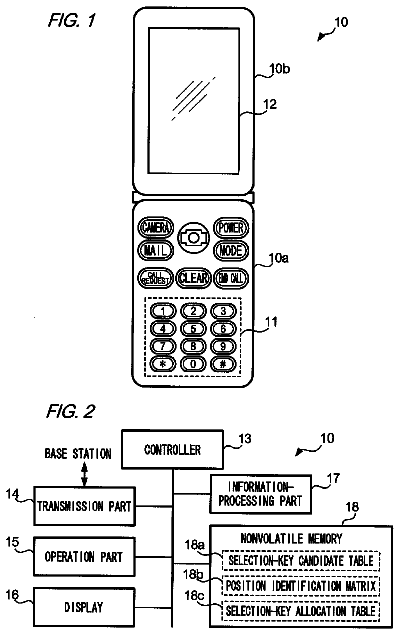
FIG. 1 is a top plan view of an improved handheld electronic device in accordance with the invention;
FIG. 2 is a schematic depiction of the improved handheld electronic device of FIG. 1;
FIG. 2a is a schematic depiction of a portion of the handheld electronic device of FIG. 2;
FIGS. 3a and 3b are an exemplary flowchart depicting certain aspects of a disambiguation function that can be executed on the handheld electronic device of FIG. 1;
FIG. 4 is another exemplary flowchart depicting certain aspects of a disambiguation function that can be executed on the handheld electronic device by which certain output variants can be provided to the user;
FIGS. 5a and 5b are another exemplary flowchart depicting certain aspects of the learning method that can be executed on the handheld electronic device;
FIG. 6 is another exemplary flowchart depicting certain aspects of a method by which various display formats that can be provided on the handheld electronic device;
FIG. 7 is an exemplary output during a text entry operation;
FIG. 8 is another exemplary output during another part of the text entry operation;
FIG. 9 is another exemplary output during another part of the text entry operation;
FIG. 10 is another exemplary output during another part of the text entry operation;
FIG. 11 is an exemplary output on the handheld electronic device during another text entry operation; and
FIG. 12 is an exemplary output that can be provided in an instance when the disambiguation function of the handheld electronic device has been disabled.
Similar numerals refer to similar parts throughout the specification.
Description of the preferred embodiment
An improved handheld electronic device 4 is indicated generally in FIG. 1 and is depicted schematically in FIG. 2. The exemplary handheld electronic device 4 includes a housing 6 upon which are disposed a processor unit that includes an input apparatus 8, an output apparatus 12, a processor 16, a memory 20, and at least a first routine. The processor 16 may be, for instance, and without limitation, a microprocessor (.mu.P) and is responsive to inputs from the input apparatus 8 and provides output signals to the output apparatus 12. The processor 16 also interfaces with the memory 20. Examples of handheld electronic devices are included in U.S. Pat. Nos. 6,452,588 and 6,489,950, which are incorporated by record herein.
As can be understood from FIG. 1, the input apparatus 8 includes a keypad 24 and a thumbwheel 32. As will be described in greater detail below, the keypad 24 is in the exemplary form of a reduced QWERTY keyboard including a plurality of keys 28 that serve as input members. It is noted, however, that the keypad 24 may be of other configurations, such as an AZERTY keyboard, a QWERTZ keyboard, or other keyboard arrangement, whether presently known or unknown, and either reduced or not reduced. In this regard, the expression "reduced" and variations thereof, in the context of a keyboard, a keypad, or other arrangement of input members, shall refer broadly to an arrangement in which at least one of the input members has assigned thereto a plurality of characters within a given set, such as a plurality of letters, for example, in the set of Roman letters, for example, thereby rendering ambiguous an intended result of an actuation of the at least one of the input members.
In this regard, and as will be set forth below in greater detail, the system architecture of the handheld electronic device 4 advantageously is organized to be operable independent of the specific layout of the keypad 24. Accordingly, the system architecture of the handheld electronic device 4 can be employed in conjunction with virtually any keypad layout substantially without requiring any meaningful change in the system architecture. It is further noted that certain of the features set forth herein are usable on either or both of a reduced keyboard and a non-reduced keyboard.
The keys 28 are disposed on a front face of the housing 6, and the thumbwheel 32 is disposed at a side of the housing 6. The thumbwheel 34 can serve as another input member and is both rotatable, as is indicated by the arrow 34, to provide selection inputs to the processor 16, and also can be pressed in a direction generally toward the housing 6, as is indicated by the arrow 38, to provide another selection input to the processor 16.
Among the keys 28 of the keypad 24 are a <NEXT> key 40 and an <ENTER> key 44. The <NEXT> key 40 can be pressed to provide a selection input to the processor 16 and provides substantially the same selection input as is provided by a rotational input of the thumbwheel 32. Since the <NEXT> key 40 is provided adjacent a number of the other keys 28 of the keypad 24, the user can provide a selection input to the processor 16 substantially without moving the user's hands away from the keypad 24 during a text entry operation. As will be described in greater detail below, the <NEXT> key 40 additionally and advantageously includes a graphic 42 disposed thereon, and in certain circumstances the output apparatus 12 also displays a displayed graphic 46 thereon to identify the <NEXT> key 40 as being able to provide a selection input to the processor 16. In this regard, the displayed graphic 46 of the output apparatus 12 is substantially similar to the graphic 42 on the <NEXT> key and thus identifies the <NEXT> key 40 as being capable of providing a desirable selection input to the processor 16.
As can further be seen in FIG. 1, many of the keys 28 include a number of characters 48 disposed thereon. As employed herein, the expression "a number of" and variations thereof shall refer broadly to any quantity, including a quantity of one, and in certain circumstances herein can also refer to a quantity of zero. In the exemplary depiction of the keypad 24, many of the keys 28 include two characters, such as including a first character 52 and a second character 56 assigned thereto. It is understood that the expression "characters" shall broadly be construed to include letters, digits, symbols and the like and can additionally include ideographic characters, components thereof, and the like.
One of the keys 28 of the keypad 24 includes as the characters 48 thereof the letters "Q" and "W", and an adjacent key 28 includes as the characters 48 thereof the letters "E" and "R". It can be seen that the arrangement of the characters 48 on the keys 28 of the keypad 24 is generally of a QWERTY arrangement, albeit with many of the keys 28 including two of the characters 28.
The output apparatus 12 includes a display 60 upon which can be provided an output 64. An exemplary output 64 is depicted on the display 60 in FIG. 1. The output 64 includes a text component 68 and a variant component 72. The variant component 72 includes a default portion 76 and a variant portion 80. The display also includes a caret 84 that depicts generally where the next input from the input apparatus 8 will be received.
The text component 68 of the output 64 provides a depiction of the default portion 76 of the output 64 at a location on the display 60 where the text is being input. The variant component 72 is disposed generally in the vicinity of the text component 68 and provides, in addition to the default proposed output 76, a depiction of the various alternate text choices, i.e., alternates to the default proposed output 76, that are proposed by an input disambiguation function in response to an input sequence of key actuations of the keys 28.
As will be described in greater detail below, the default portion 76 is proposed by the disambiguation function as being the most likely disambiguated interpretation of the ambiguous input provided by the user. The variant portion 80 includes a predetermined quantity of alternate proposed interpretations of the same ambiguous input from which the user can select, if desired. The displayed graphic 46 typically is provided in the variant component 72 in the vicinity of the variant portion 80, although it is understood that the displayed graphic 46 could be provided in other locations and in other fashions without departing from the concept of the invention. It is also noted that the exemplary variant portion 80 is depicted herein as extending vertically below the default portion 76, but it is understood that numerous other arrangements could be provided without departing from the concept of the invention.
Among the keys 28 of the keypad 24 additionally is a <DELETE> key 86 that can be provided to delete a text entry. As will be described in greater detail below, the <DELETE> key 86 can also be employed in providing an alternation input to the processor 16 for use by the disambiguation function.
The memory 20 is depicted schematically in FIG. 2A. The memory 20 can be any of a variety of types of internal and/or external storage media such as, without limitation, RAM, ROM, EPROM(s), EEPROM(s), and the like that provide a storage register for data storage such as in the fashion of an internal storage area of a computer, and can be volatile memory or nonvolatile memory. The memory 20 additionally includes a number of routines depicted generally with the numeral 22 for the processing of data. The routines 22 can be in any of a variety of forms such as, without limitation, software, firmware, and the like. As will be explained in greater detail below, the routines 22 include the aforementioned disambiguation function as an application, as well as other routines.
As can be understood from FIG. 2A, the memory 20 additionally includes data stored and/or organized in a number of tables, sets, lists, and/or otherwise. Specifically, the memory 20 includes a generic word list 88, a new words database 92, and a frequency learning database 96. Stored within the various areas of the memory 20 are a number of language objects 100 and frequency objects 104. The language objects 100 generally are each associated with an associated frequency object 104. The language objects 100 include a plurality of word objects 108 and a plurality of N-gram objects 112. The word objects 108 are generally representative of complete words within the language or custom words stored in the memory 22. For instance, if the language stored in the memory is, for example, English, generally each word object 108 would represent a word in the English language or would represent a custom word.
Associated with substantially each word object 108 is a frequency object 104 having frequency value that is indicative of the relative frequency within the relevant language of the given word represented by the word object 108. In this regard, the generic word list 88 includes a corpus of word objects 108 and associated frequency objects 104 that together are representative of a wide variety of words and their relative frequency within a given vernacular of, for instance, a given language. The generic word list 88 can be derived in any of a wide variety of fashions, such as by analyzing numerous texts and other language sources to determine the various words within the language sources as well as their relative probabilities, i.e., relative frequencies, of occurrences of the various words within the language sources.
The N-gram objects 112 stored within the generic word list 88 are short strings of characters within the relevant language typically, for example, one to three characters in length, and typically represent word fragments within the relevant language, although certain of the N-gram objects 112 additionally can themselves be words. However, to the extent that an N-gram object 112 also is a word within the relevant language, the same word likely would be separately stored as a word object 108 within the generic word list 88. As employed herein, the expression "string" and variations thereof shall refer broadly to an object having one or more characters or components, and can refer to any of a complete word, a fragment of a word, a custom word or expression, and the like.
In the present exemplary embodiment of the handheld electronic device 4, the N-gram objects 112 include 1-gram objects, i.e., string objects that are one character in length, 2-gram objects, i.e., string objects that are two characters in length, and 3-gram objects, i.e., string objects that are three characters in length, all of which are collectively referred to as N-grams 112. Substantially each N-gram object 112 in the generic word list 88 is similarly associated with an associated frequency object 104 stored within the generic word list 88, but the frequency object 104 associated with a given N-gram object 112 has a frequency value that indicates the relative probability that the character string represented by the particular N-gram object 112 exists at any location within any word of the relevant language. The N-gram objects 112 and the associated frequency objects 104 are a part of the corpus of the generic word list 88 and are obtained in a fashion similar to the way in which the word object 108 and the associated frequency objects 104 are obtained, although the analysis performed in obtaining the N-gram objects 112 will be slightly different because it will involve analysis of the various character strings within the various words instead of relying primarily on the relative occurrence of a given word.
The present exemplary embodiment of the handheld electronic device 4, with its exemplary language being the English language, includes twenty-six 1-gram N-gram objects 112, i.e., one 1-gram object for each of the twenty-six letters in the Roman alphabet upon which the English language is based, and further includes 676 2-gram N-gram objects 112, i.e., twenty-six squared, representing each two-letter permutation of the twenty-six letters within the Roman alphabet
The N-gram objects 112 also include a certain quantity of 3-gram N-gram objects 112, primarily those that have a relatively high frequency within the relevant language. The exemplary embodiment of the handheld electronic device 4 includes fewer than all of the three-letter permutations of the twenty-six letters of the Roman alphabet due to considerations of data storage size, and also because the 2-gram N-gram objects 112 can already provide a meaningful amount of information regarding the relevant language. As will be set forth in greater detail below, the N-gram objects 112 and their associated frequency objects 104 provide frequency data that can be attributed to character strings for which a corresponding word object 108 cannot be identified or has not been identified, and typically is employed as a fallback data source, although this need not be exclusively the case.
In the present exemplary embodiment, the language objects 100 and the frequency objects 104 are maintained substantially inviolate in the generic word list 88, meaning that the basic language corpus remains substantially unaltered within the generic word list 88, and the learning functions that are provided by the handheld electronic device 4 and that are described below operate in conjunction with other object that are generally stored elsewhere in memory 20, such as, for example, in the new words database 92 and the frequency learning database 96.
The new words database 92 and the frequency learning database 96 store additional word objects 108 and associated frequency objects 104 in order to provide to a user a customized experience in which words and the like that are used relatively more frequently by a user will be associated with relatively higher frequency values than might otherwise be reflected in the generic word list 88. More particularly, the new words database 92 includes word objects 108 that are user-defined and that generally are not found among the word objects 108 of the generic word list 88. Each word object 108 in the new words database 92 has associated therewith an associated frequency object 104 that is also stored in the new words database 92. The frequency learning database 96 stores word objects 108 and associated frequency objects 104 that are indicative of relatively more frequent usage of such words by a user than would be reflected in the generic word list 88. As such, the new words database 92 and the frequency learning database 96 provide two learning functions, that is, they together provide the ability to learn new words as well the ability to learn altered frequency values for known words.
FIGS. 3a and 3b depicts in an exemplary fashion the general operation of certain aspects of the disambiguation function of the handheld electronic device 4. Additional features, functions, and the like are depicted and described elsewhere.
An input is detected, as at 204, and the input can be any type of actuation or other operation as to any portion of the input apparatus 8. A typical input would include, for instance, an actuation of a key 28 having a number of characters 48 thereon, or any other type of actuation or manipulation of the input apparatus 8.
Upon detection at 204 of an input, a timer is reset at 208. The use of the timer will be described in greater detail below.
The disambiguation function then determines, as at 212, whether the current input is an operational input, such as a selection input, a delimiter input, a movement input, an alternation input, or, for instance, any other input that does not constitute an actuation of a key 28 having a number of characters 48 thereon. If the input is determined at 212 to not be an operational input, processing continues at 216 by adding the input to the current input sequence which may or may not already include an input.
Many of the inputs detected at 204 are employed in generating input sequences as to which the disambiguation function will be executed. An input sequence is build up in each "session" with each actuation of a key 28 having a number of characters 48 thereon, Since an input sequence typically will be made up of at least one actuation of a key 28 having a plurality of characters 48 thereon, the input sequence will be ambiguous. When a word, for example, is completed the current session is ended an a new session is initiated.
An input sequence is gradually built up on the handheld electronic device 4 with each successive actuation of a key 28 during any given session. Specifically, once a delimiter input is detected during any given session, the session is terminated and a new session is initiated. Each input resulting from an actuation of one of the keys 28 having a number of the characters 48 associated therewith is sequentially added to the current input sequence. As the input sequence grows during a given session, the disambiguation function generally is executed with each actuation of a key 28, i.e., and input, and as to the entire input sequence. Stated otherwise, within a given session, the growing input sequence is attempted to be disambiguated as a unit by the disambiguation function with each successive actuation of the various keys 28.
Once a current input representing a most recent actuation of the one of the keys 28 having a number of the characters 48 assigned thereto has been added to the current input sequence within the current session, as at 216 in FIG. 3a, the disambiguation function generates, as at 220, substantially all of the permutations of the characters 48 assigned to the various keys 28 that were actuated in generating the input sequence. In this regard, the "permutations" refer to the various strings that can result from the characters 48 of each actuated key 28 limited by the order in which the keys 28 were actuated. The various permutations of the characters in the input sequence are employed as prefix objects.
For instance, if the current input sequence within the current session is the ambiguous input of the keys "AS" and "OP", the various permutations of the first character 52 and the second character 56 of each of the two keys 28, when considered in the sequence in which the keys 28 were actuated, would be "SO", "SP", "AP", and "AO", and each of these is a prefix object that is generated, as at 220, with respect to the current input sequence. As will be explained in greater detail below, the disambiguation function seeks to identify for each prefix object one of the word objects 108 for which the prefix object would be a prefix.
For, each generated prefix object, the memory 20 is consulted, as at 224, to identify, if possible, for each prefix object one of the word objects 108 in the memory 20 that corresponds with the prefix object, meaning that the sequence of letters represented by the prefix object would be either a prefix of the identified word object 108 or would be substantially identical to the entirety of the word object 108. Further in this regard, the word object 108 that is sought to be identified is the highest frequency word object 108. That is, the disambiguation function seeks to identify the word object 108 that corresponds with the prefix object and that also is associated with a frequency object 104 having a relatively higher frequency value than any of the other frequency objects 104 associated with the other word objects 108 that correspond with the prefix object.
It is noted in this regard that the word objects 108 in the generic word list 88 are generally organized in data tables that correspond with the first two letters of various words. For instance, the data table associated with the prefix "CO" would include all of the words such as "CODE", "COIN", "COMMUNICATION", and the like. Depending upon the quantity of word objects 108 within any given data table, the data table may additionally include sub-data tables within which word objects 108 are organized by prefixes that are three characters or more in length. Continuing onward with the foregoing example, if the "CO" data table included, for instance, more than 256 word objects 108, the "CO" data table would additionally include one or more sub-data tables of word objects 108 corresponding with the most frequently appearing three-letter prefixes. By way of example, therefore, the "CO" data table may also include a "COM" sub-data table and a "CON" sub-data table. If a sub-data table includes more than the predetermined number of word objects 108, for example a quantity of 256, the sub-data table may include further sub-data tables, such as might be organized according to a four letter prefixes. It is noted that the aforementioned quantity of 256 of the word objects 108 corresponds with the greatest numerical value that can be stored within one byte of the memory 20.
Accordingly, when, at 224, each prefix object is sought to be used to identify a corresponding word object 108, and for instance the instant prefix object is "AP", the "AP" data table will be consulted. Since all of the word objects 108 in the "AP" data table will correspond with the prefix object "AP", the word object 108 in the "AP" data table with which is associated a frequency object 104 having a frequency value relatively higher than any of the other frequency objects 104 in the "AP" data table is identified. The identified word object 108 and the associated frequency object 104 are then stored in a result register that serves as a result of the various comparisons of the generated prefix objects with the contents of the memory 20.
It is noted that one or more, or possibly all, of the prefix objects will be prefix objects for which a corresponding word object 108 is not identified in the memory 20. Such prefix objects are considered to be orphan prefix objects and are separately stored or are otherwise retained for possible future use. In this regard, it is noted that many or all of the prefix objects can become orphan object if, for instance, the user is trying to enter a new word or, for example, if the user has mis-keyed and no word corresponds with the mis-keyed input.
The description continues in the full USPTO document.
 Lapsed, fee not paid5 drawings