Cross-reference to related application
This application is a National Stage of PCT international application Ser. No. PCT/JP2010/060899 filed on Jun. 25, 2010 which is based upon and claims the benefit of priority from Japanese Patent Application No. 2009-152947, filed on Jun. 26, 2009.
Field
The present invention relates to a mobile electronic device that performs communications with another terminal and has a heat generation unit that generates heat.
Background
In recent years, there has been proposed mobile electronic devices, such as a projector function-equipped mobile phone having a projector function and a communication function and a fuel cell-mounted mobile electronic device. When there is an incoming call during the use of the projector function or during the generation of electric power by the fuel cell, some of those devices notify an operator of the incoming call.
For example, Patent Literature 1 discloses a projector-equipped mobile phone which includes projection means for projecting an optical image, communication means for performing communications with an external device, and projection control means for causing the projection means to start performing a projection operation to notify the reception of an incoming call when an incoming call is received by the communication means while the projection by the projection means is being performed. Moreover, Patent Literature 1 discloses a method in which a ringing tone is used for notification.
Patent Literature 2 and Patent Literature 3 disclose a method in which, when information is received through a communication network, a reception notification image to notify the user of the reception of the information is projected on a user-viewable projection surface using a projector, regardless of the device being used as a projector.
Citation list
Patent Literature
Patent Literature 1: Japanese Patent Application Laid-open No. 2007-74652
Patent Literature 2: Japanese Patent Application Laid-open No. 2004-289401
Patent Literature 3: Japanese Patent Application Laid-open No. 2005-94496
Technical problem
As disclosed in Patent Literature 1 to Patent Literature 3, the notification of a reception allows the operator to recognize the reception. However, when the projector is used or the electric power generation by the fuel cell is performed, the mobile electronic device may become hot from the generated heat. If a call is placed with the mobile electronic device during the hot state, the hand which holds the mobile electronic device or the ear grows warm, so that the user may not be comfortable during the call (communication) period.
For the foregoing reasons, there is a need for a mobile electronic device capable of an appropriate communication operation when communicating with another terminal.
Summary of the invention
According to the an aspect, a mobile electronic device includes a heat source unit that generates heat, a housing for holding the heat source unit; a temperature detection unit for detecting the temperature of the housing, a communication unit for performing communications, a sound output unit for outputting sound relating to the communications, and a control unit for controlling the heat source unit and the communication unit. The control unit changes sound output from the sound output unit depending on the temperature detected by the temperature detection unit and a set temperature.
According to another aspect, the control unit has a plurality of output modes in which settings for outputting sound relating to the communication differ, and performs control while switching the output modes between when the temperature detected by the temperature detection unit is equal to or higher than the set temperature and when the temperature by the temperature detection unit is lower than the set temperature.
According to another aspect, the control unit increases the volume level of the sound output from the sound output unit when the temperature detected by the temperature detection unit is equal to or higher than the set temperature compared to when the temperature detected by the temperature detection unit is lower than the set temperature.
According to another aspect, the sound output unit includes a receiver for outputting sound, and a speaker for outputting sound louder than that from the receiver. The control unit outputs sound using the speaker when the temperature detected by the temperature detection unit is equal to or higher than the set temperature.
According to another aspect, the control unit performs an inhibition control by which a call by the communication unit is not performed when the temperature detected by the temperature detection unit is equal to or higher than the set temperature.
According to another aspect, the inhibition control is a control including at least one of inhibiting an outgoing call, stopping a call, and rejecting an incoming call by the communication unit.
According to another aspect, when the temperature detected by the temperature detection unit is equal to or higher than the set temperature, the control unit estimates the time which will be taken until the temperature detected by the temperature detection unit is lower than the set temperature, and notifies that time estimated to be taken until the temperature detected by the temperature detection unit is lower than the set temperature.
According to another aspect, the mobile electronic device further includes a storage unit for storing the correspondence relationship between the temperature detected by the temperature detection unit and a sound output pattern output from the sound output unit. The control unit outputs the sound output pattern specified on the basis of the temperature detected by the temperature detection unit and the correspondence relationship when an incoming call is detected by the communication unit.
According to another aspect, a mobile electronic device includes a heat source unit that generates heat, a housing for holding the heat source unit, a temperature detection unit for detecting the temperature of the housing, a communication unit for performing communications, a receiver for outputting sound relating to the communication, a speaker for outputting a louder sound than the receiver, a storage unit for storing the correspondence between the temperature detected by the temperature detection unit and a sound output pattern and a control unit for controlling the operation of the heat source unit and the operation of the communication unit. The control unit reads the correspondence relationship from the storage unit, specifies the sound output pattern on the basis of the temperature detected by the temperature detection unit and the correspondence relationship, and outputs the specified sound output pattern from the speaker, when an incoming call from another terminal is detected.
According to another aspect, the heat source unit is an image projection unit for projecting an image.
According to another aspect, the temperature detection unit includes a detection element for detecting the temperature at a measurement point of the housing, and a temperature correspondence table in which the relationship between the temperature at the measurement point of the housing and the temperature in the outer surface of the housing. The temperature detection unit detects the temperature in the outer surface of the housing based on the temperature detected by the detection element and the temperature correspondence table.
According to another aspect, a measurement point of the temperature detection unit is near the sound output unit in the outer surface of the housing.
Advantageous Effects of Invention
A mobile electronic device according to the present invention changes the volume level of sound output from the sound output unit depending on whether the temperature of the housing is higher than a predetermined temperature or lower than the predetermined temperature, such that the operator can intuitively determine whether the temperature of the housing is higher than the predetermined temperature. Therefore, it is possible to suppress a call of the operator when the operator feels that the device is hot or heated, and to perform an appropriate communication operation when communicating with another terminal.
Brief description of drawings
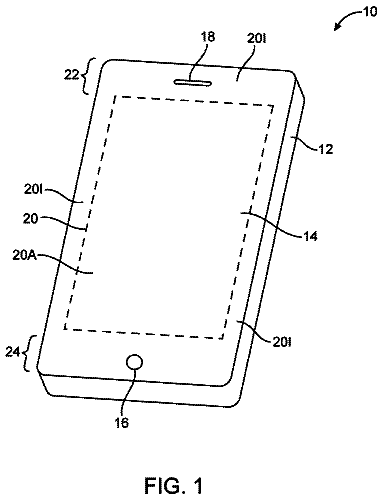
FIG. 1 is a perspective view illustrating the schematic configuration of a mobile electronic device of an embodiment.
FIG. 2 is a block diagram illustrating the schematic configuration of a function of the mobile electronic device illustrated in FIG. 1.
FIG. 3 is an explanatory view illustrating a state where an image is projected by the mobile electronic device illustrated in FIG. 1.
FIG. 4 is a flowchart illustrating an example of the operation of the mobile electronic device.
FIG. 5 is a graph illustrating an example of a change in temperature of the mobile electronic device.
FIG. 6 is a flowchart illustrating another example of the operation of the mobile electronic device.
FIG. 7 is a flowchart specifically illustrating the operation of the flowchart illustrated in FIG. 6.
FIG. 8 is a flowchart specifically illustrating the operation of the flowchart illustrated in FIG. 6.
FIG. 9 is a flowchart specifically illustrating the operation of the flowchart illustrated in FIG. 6.
FIG. 10 is an explanatory view illustrating the operation of the mobile electronic device illustrated in FIG. 6.
FIG. 11 is a flowchart illustrating another example of the operation of the mobile electronic device.
FIG. 12 is a flowchart specifically illustrating the operation of the flowchart illustrated in FIG. 11.
FIG. 13 is a flowchart specifically illustrating the operation of the flowchart illustrated in FIG. 11.
FIG. 14 is an explanatory view illustrating the operation of the mobile electronic device illustrated in FIG. 11.
FIG. 15 is a flowchart illustrating another example of the operation of the mobile electronic device.
FIG. 16 is a flowchart illustrating another example of the mobile electronic device.
FIG. 17 is an explanatory view illustrating the operation of the mobile electronic device illustrated in FIG. 16.
FIG. 18 is a flowchart illustrating another example of the operation of the mobile electronic device.
Description of embodiments
Hereinafter, the embodiments will be described in detail with reference to the drawings. The following description is not intended to limit the invention. The components in the following description include those that can be easily thought of by persons skilled in the art, and substantially equivalents or those in an equivalent scope. Hereinafter, although a mobile phone is will be described as an example of a mobile electronic device, the application of the invention is not limited to mobile phones. For example, the invention may also be applied to Personal Handy-phone Systems (PHS), PDAs, mobile navigation devices, notebook personal computers, gaming devices, or the like.
First, the configuration of the appearance of a mobile electronic device will be described. FIG. 1 is a perspective view illustrating the schematic configuration of an embodiment of a mobile electronic device. A mobile electronic device 10 is a mobile phone having wireless communication function. The mobile electronic device 10 is a straight mobile phone in which respective units are accommodated inside a single box-shaped housing 11. Although the housing 11 has a single box shape in the present embodiment, it may be a foldable housing in which two members are connected to each other by a hinge, or it may be a housing in which two members are slid. A housing in which three or more members are connected to each other may be used.
The housing 11 is provided with a display 12 illustrated in FIG. 1 as a display unit. The display 12 displays a standby image as a predetermined image when the mobile electronic device 10 stands by for reception, a menu screen which is used to assist an operation on the mobile electronic device 10, or the like.
The housing 11 is provided with a plurality of operation keys 13 for accepting the input of the telephone number of the called party or letters at the time of mail composition or the like. The operation keys 13 constitute an operation unit 28 (see FIG. 2) of the mobile electronic device 10. The housing 11 is also provided with a microphone 15 which receives sound at the time of a call of the mobile electronic device 10, a receiver 16 which outputs sound at the time of a call of the mobile electronic device 10 (outputs sound relating to communication), and a cooling fan 38 which makes heat dissipate from the housing 11.
The upper surface (of which one side is a short side in a surface, which is close to the receiver 16, from among four surfaces perpendicular to the surface in which the operation keys 13 are provided) of the housing 11 is provided with a light emitting unit 34a of the projector 34 which projects an image.
FIG. 2 is a block diagram illustrating the schematic configuration of a function of the mobile electronic device illustrated in FIG. 1. As illustrated in FIG. 2, the mobile electronic device 10 includes a control unit 22, a storage unit 24, a transmitting/receiving unit 26, an operation unit 28, a sound processing unit 30, a display unit 32, a projector 34, a battery 36, the cooling fan 38, and a temperature sensor 39. The mobile electronic device 10 includes a speaker 17 and an earphone output unit 18 as a portion for outputting sound, in addition to the receiver 16. The speaker 17 directly outputs sound, and the earphone output unit 18 causes sound to be output from an earphone connected to the earphone output unit 18.
The control unit 22 is a processing unit, such as a Central Processing Unit (CPU), which integrally controls the whole operation of the mobile electronic device 10. That is, The control unit 22 controls the operations of the transmitting/receiving unit 26, the sound processing unit 30, the display unit 32, and the like in such a way that various processes of the mobile electronic device 10 are performed in an appropriate sequence in accordance with an operation from the operation unit 28 or software which is stored in the storage unit 24 of the mobile electronic device 10. The various processes of the mobile electronic device 10 include, for example, voice call which is performed through a line switching network, composition and transmission/reception of electronic mail, browsing of World Wide Web (Web) sites on Internet, and the like. The operations of the transmitting/receiving unit 26, the sound processing unit 30, the display unit 32, and the like include, for example, the transmission/reception of signals by the transmitting/receiving unit 26, input/output of sound by the sound processing unit 30, display of images by the display unit 32, and the like.
The control unit 22 performs a process based on program(s) (for example, an operating system program, an application program, or the like) stored in the storage unit 24. The control unit 22 includes, for example, a micro processor unit (MPU), and performs various processes of the mobile electronic device 10 in accordance with a sequence instructed by software. That is, the control unit 22 performs processes by sequentially reading command codes from an operating system program, an application program, or the like stored in the storage unit 24.
The control unit 22 has a function of executing a plurality of application programs. As the application programs which are executed by the control unit 22, for example, there are a plurality of application programs including an application program which performs control on the basis of a detection value by the temperature sensor, an application program which controls the driving of the projector, an image reproduction application program which reproduces a still image or a motion image, game application programs which run various games, and the like.
The storage unit 24 stores software and data which is used in the process performed in the control unit 22, and also stores a task which runs an application program for performing the controls on the basis of a detection value by the temperature sensor, a task which runs an application program for controlling the driving of the projector, a task which runs an image reproduction application program for reproducing a still image or a motion image, and a task which runs game application programs for running various games.
In addition to these tasks, the storage unit 24 also stores, for example, communications, downloaded sound data, software which is used by the control unit 22 for the control of the storage unit 24, an address book for saving and managing telephone numbers and e-mail addresses and the like of call parties, sound files, such as a dial tone or ring tone, temporary data which is used for the process of software, or the like. A computer program and/or temporary data which is used in the process of software is temporarily stored in a work area which is allocated to the storage unit 24 by the control unit 22. The storage unit 24 is constituted by, for example, a nonvolatile storage device (a nonvolatile semiconductor memory, such as a Read Only Memory (ROM), a hard disk, or the like), a readable/writable storage device (for example, Static Random Access Memory (SRAM), Dynamic Random Access Memory (DRAM)), or the like.
The transmitting/receiving unit 26 includes an antenna 26a, and it establishes a wireless signal path by a CDMA system or the like with a base station through a channel allocated by the base station and performs telephone communication and information communication with the base station.
The operation unit 28 is constituted by the operation keys 13, such as a power key, a call key, numeric keys, letter keys, direction keys, an OK key, and a send key, to which various functions are allocated. If each key is input by an operation of the user, a signal corresponding to the operation content is generated. The generated signal is input to the control unit 22 as an instruction of the user.
The sound processing unit 30 performs a process on a sound signal input to the microphone 15 or a sound signal output from the receiver 16, the speaker 17, or the earphone output unit 18. That is, the sound processing unit 30 amplifies sound input from the microphone 15, performs Analog Digital Conversion (AD conversion) and a signal process, such as encoding, to convert sound to digital sound data, and outputs digital sound data to the control unit 22. Processes, such as decoding, Digital Analog Conversion (DA conversion), and amplification, are performed on sound data transmitted from the control unit 22 to convert the sound data to an analog sound signal, and the analog sound signal is output to at least one of the receiver 16, the speaker 17, and the earphone output unit 18. Sound indicating an incoming call, call sound at the time of a hands-free operation, music, or the like can be output from the speaker 17. Call sound at the time of a hands-free operation, music, or the like can be output from the earphone output unit 18. The speaker 17 is a sound output mechanism which can output sound louder than the receiver 16.
The display unit 32 includes a display panel (the above-described display 12 etc.) which is constituted by a liquid crystal display (LCD) or an organic Electro-Luminescence (OEL) panel, and displays video based on video data or an image based on image data supplied from the control unit 22 on the display panel. With regard to the display unit 32, in addition to the display 12, for example, a sub display may be provided at a position which is exposed to the outside.
The projector 34 is an image projection system which projects an image and, as described above, is provided with the light emitting unit 34a which projects an image on the upper surface of the housing 11. FIG. 3 is an explanatory view illustrating a state where an image is projected on the mobile electronic device illustrated in FIG. 1. The mobile electronic device 10 projects an image from the light emitting unit 34a of the projector 34, that is, emits light which forms an image so that, as illustrated in FIG. 3, an image can be projected in a given area (projection area) of a wall surface or a screen which faces the upper surface of the housing 11. The projector 34 operates under the control of the control unit 22, and allows various kinds of images, for example, movies or presentation materials, to be transmitted from the control unit 22 and to be displayed in the projection area.
The projector 34 includes a light source and an optical system which switches the operation mode between whether or not to project light emitted from the light source in accordance with image data. For example, the projector 34 may be a projector in which a halogen light, an LED light source, or an LD light source is used as the light source, and a Liquid Crystal Display (LCD) or a Digital Micro-mirror Device (DMD) is used as the optical system. In this case, pixels of the optical system are disposed on the entire surface of the projection area to correspond to each pixel thereof, and turn on and off the light emitted from the light source according to an image to make the image projected on the entire surface of the projection area. Alternatively, the projector 34 may be a projector in which laser light is used as the light source, and a switching element for switching the operation mode between whether or not to transmit light emitted from the light source and a mirror for raster-scanning light passed through the switching element are uses as the optical system. In this case, the angle of light emitted from laser light is changed by the mirror such that light irradiated from the light source scans the entire surface of the projection area, thereby projecting an image in the projection area.
The battery (power supply) 36 is a rechargeable cell, and supplies charged power to the control unit 22 and the respective units through the control unit 22. The battery 36 is detachably held in the housing 11. The battery 36 is charged with power supplied from an external power supply through terminals or the like. The battery 36 may directly supply power to the respective units without passing through the control unit 22. The battery 36 may be embedded inside the housing 11 and may not be detachable.
The cooling fan 38 is a cooling mechanism which cools the respective units disposed inside the housing 11, in particular, the light-emitting portion of the projector 34. The cooling fan 38 includes blades 38a which rotates to cause air convection, a motor which rotates the blades 38a, and the like. The cooling fan 38 cools the respective units disposed inside the housing 11, thereby suppressing the failure of the mobile electronic device 10 due to overheating or excessive power consumption. In order to improve the cooling efficiency, the cooling fan 38 may be provided with a heat sink or the like in a region where the air is convected by the fan.
The temperature sensor 39 is temperature detection means disposed inside the housing 11, such as a thermocouple, a thermistor, a bimetal thermometer, etc. The temperature sensor 39 detects the temperature at a predetermined position inside the housing 11. The temperature sensor 39 sends the information of the detected temperature to the control unit 22. In the present embodiment, the control unit 22 performs an arithmetic operation using the temperature detected by the temperature sensor 39, thereby detecting the temperature of a predetermined portion. That is, a temperature detection unit of the invention is constituted by the functions of the temperature sensor 39 and the control unit 22. The mobile electronic device 10 basically has the above-described configuration.
Next, the operation of the mobile electronic device 10, specifically, the processing operation of the control unit 22 based on the detection result of the temperature sensor 39 will be described with reference to FIG. 4. FIG. 4 is a flowchart illustrating an example of the operation of the mobile electronic device. The flowchart illustrated in FIG. 4 is a flowchart illustrating a processing operation when there is an incoming call from another terminal. The control unit 22 reads a task, which runs an application program for performing control on the basis of a detection value by the temperature sensor 39, from the storage unit 24, and runs the application program for performing control on the basis of a detection value by the temperature sensor 39.
First, the control unit 22 of the mobile electronic device 10 determines whether there is an incoming call event at Step S12. That is, it is determined whether there is an incoming call from another terminal but talking has not been started. If it is determined at Step S12 that there is no incoming call event (No), the control unit 22 ends the process.
If it is determined at Step S12 that there is an incoming call event (Yes), the control unit 22 acquires the terminal temperature at Step S14. The terminal temperature is the temperature of the surface of the housing 11, and in the present embodiment, the temperature at a predetermined position near the receiver 16. The terminal temperature is obtained from the detection value of the temperature sensor 39. Specifically, if the temperature near the temperature sensor 39 can be regarded as the temperature at the predetermined position near the receiver 16, the detection value of the temperature sensor 39 is set as the terminal temperature as it is. If the temperature sensor 39 is apart from the predetermined position, and the temperature near the temperature sensor 39 cannot be regarded as the temperature at the predetermined position near the receiver 16, the relation between the temperature of the temperature sensor 39 and the temperature at the predetermined position is calculated in advance, and the terminal temperature is calculated on the basis of the relation calculated in advance and the detected temperature of the temperature sensor 39. In this case, it is preferable to calculate the terminal temperature taking into consideration the operation situation of each unit, in particular, the driving state of the projector 34. Thus, it is possible to more accurately calculate the terminal temperature.
After the terminal temperature is acquired at Step S14, the control unit 22 determines whether the terminal temperature is within a reference temperature, that is, lower than the reference temperature, at Step S16. The reference temperature is the temperature at which the operator determines to be hot, and for example, 45 degrees. The reference temperature may be determined on the basis of room temperature or ambient temperature. For example, a temperature higher than the room temperature or ambient temperature by 10 degrees may be set as the reference temperature. The room temperature may be calculated from the difference between the temperature sensor 39 and a second temperature sensor provided at a position different from the temperature sensor 39. With regard to the ambient temperature, information on the ambient temperature of a place at which the mobile electronic device 10 is present may be acquired from a server or the like through the transmitting/receiving unit 26.
If it is determined at Step S16 that the terminal temperature is lower than the reference temperature (Yes), the control unit 22 performs a normal call at Step S18. A normal call refers to a call method in which sound from a call party is output from the receiver 16, and the operator bends his/her ear to the receiver 16 to perform a call. The mobile electronic device 10 is configured in such a manner that the operator can select various call methods other than the normal call when the normal call can be performed. When the normal call is performed, a call can be performed in an arbitrary mode selected by the operator. After performing the normal call at Step S18, the control unit 22 ends the process.
If it is determined at Step S16 that the terminal temperature is not lower than the reference temperature (No), that is, the terminal temperature is equal to or higher than the reference temperature, the control unit 22 performs a hands-free call at Step S20. When the hands-free call is performed, sound from a call party is output from the speaker 17 to perform the call. After performing the hands-free call at Step S20, the control unit 22 ends the process. The control unit 22 repeats the above-described process.
When the terminal temperature is equal to or higher than the reference temperature, the mobile electronic device 10 performs the hands-free call. Thus, when the housing 11 is at equal to or higher than a given temperature, the operator can perform a call without bending his/her ear to the receiver 16. That is, when the terminal temperature is equal to or higher than the reference temperature, the mobile electronic device 10 can prevent the operator from bending his/her face to the housing 11. Therefore, it is possible to suppress the use of the mobile electronic device 10 while the user feels that the device is hot or heated.
Hereinafter, a specific example will be described. FIG. 5 is a graph illustrating an example of a change in temperature of a mobile electronic device. In the graph of FIG. 5, the vertical axis represents the terminal temperature [.degree. C.], and the horizontal axis represents time [second]. The graph illustrated in FIG. 5 is an example where an image is projected by the projector 34 and the terminal temperature increases. As illustrated in FIG. 5, in a state where the projector 34 is not driven, the terminal temperature is detected as a temperature higher than the room temperature. In this state, if the projector 34 is activated and projection starts at the time t.sub.1, the terminal temperature gradually increases and exceeds the reference temperature when a certain time has elapsed (in the drawing, the time t.sub.2). Thereafter, the terminal temperature further increases and then gets constant at a certain temperature. While the projector 34 is being driven, the terminal temperature keeps constant at a certain high temperature which exceeds the reference temperature. Thereafter, if the driving of the projector 34 is stopped at the time t.sub.3, the terminal temperature gradually drops to be lower than the reference temperature when a certain time has elapsed (in the drawing, the time t.sub.4). Subsequently, the terminal temperature gradually drops to the temperature before the projector 34 is activated. The terminal temperature changes in the above-described manner, and when there is the event of an incoming call during a range of the time in which the reference temperature (including the temperature equal to the reference temperature) is reached (that is, from the time t.sub.2 to the time t.sub.4) as in FIG. 5, a call with a call party can be performed by a hands-free call, instead of a normal call. Therefore, when the housing 11 is at an equal or higher temperature than a given temperature, the volume level louder than a normal call is emitted, in such a way that the operator can perform a call without bending his/her ear to the receiver 16, thereby preventing the operator from feeling that the device is hot or heated at the time of a call.
The control unit 22 may be configured to display a message or symbol indicating that the temperature has increased or a message or symbol indicating that a call is performed by a hands-free call on the display unit 32 before a hands-free call is set at Step S20. In this way, the operator can accurately recognize the state of the mobile electronic device 10.
Step S S14 to S18 or Step S20 may be performed after the operator inputs an instruction to start a call. Alternatively, Step S S14 to S18 or Step S20 may be performed before the operator inputs the instruction to start a call, so that the operator is notified of a hands-free call or a normal call by the display unit 32 or the like, and after the operator inputs the instruction to start a call, a call may be performed by a set method. The instruction to start a call is input by the depression of a button (call key), sound input, the depression of a switch of a cradle, or the like.
In the foregoing embodiment, a case has been described where, at Step S12, there is an incoming call event, that is, an incoming call from another terminal. However, when a call is made from the mobile electronic device 10 to another terminal, that is, when an outgoing call is made, the same control may be performed. Step S S14 to S18 or Step S20 may be performed even during a call, so that if the terminal temperature is equal to or higher than the reference temperature, switching to a hands-free call may occur, and if the terminal temperature is lower than the reference temperature, switching to a normal call may occur. The switching from a hands-free call to a normal call may not automatically occur and may be selectable. As described above, when a call is placed, the above-described control is performed depending on the terminal temperature, in such a way that the operator can be prevented from feeling that the device is hot at the time of a call, making it possible to perform a call by an appropriate call method.
Next, another example of the operation of the mobile electronic device 10, specifically, the processing operation of the control unit 22 and the projection operation of the projector 34, based on the detection result of the temperature sensor 39, will be described with reference to FIGS. 6 to 10. FIG. 6 is a flowchart illustrating another example of the operation of the mobile electronic device. In this example, the control unit 22 reads, from the storage unit 24, a task which runs an application program for controlling the driving of the projector and a task which runs an application program for performing the controls on the basis of the detection value by the temperature sensor, and runs the application program for controlling the driving of the projector 34 and the application program for performing the controls on the basis of the detection value by the temperature sensor.
First, as illustrated in FIG. 6, the control unit 22 stands by for an event at Step S30, and if the event is detected, proceeds to perform the process of Step S32. An event refers to an input such as an instruction from the operator, a notification from another terminal or a base station, or the like, which is necessary for a process by (an application program of) the control unit 22.
If the event is detected at Step S30, the control unit 22 determines whether the detected event is a projection start event at Step S32. A projection start event refers to an instruction for starting the projection of an image by the projector 34. If it is determined at Step S32 that the detected event is the projection start event (Yes), the control unit 22 performs a process of a projection start mode at Step S34, then proceeds to perform the process of Step S30, and returns to a state standing by for an event.
The process of the projection start mode will be described with reference to FIG. 7. FIG. 7 is a flowchart specifically illustrating the process of the projection start mode of Step S34. If it is determined at Step S32 that the detected event is the projection start event, the control unit 22 determines whether a call is being performed at Step S60.
If it is determined at Step S60 that a call is being performed (Yes), the control unit 22 proceeds to perform the process of Step S66. If it is determined at Step S60 that a call is not being performed (No), the control unit 22 determines whether the terminal temperature is lower than a reference temperature at Step S62. The reference temperature at Step S62 may be equal to or different from the reference temperature as the reference for the determination on whether the above-described call is performed by a hands-free call or a normal call. The reference temperature at Step S62 can be set to be higher than the reference temperature for setting a call method, and as the reference for setting, the temperature at which the performance of the projector 34 is likely to be degraded is exemplified. If it is determined at Step S62 that the terminal temperature is lower than the reference temperature (Yes), the control unit 22 starts the projection of an image by the projector 34 at Step S64. The control unit 22 proceeds to perform the process of Step S30 while projecting an image from the projector 34.
If it is determined at Step S60 to be Yes or at Step S62 that the terminal temperature is not lower than the reference temperature (No), the control unit 22 displays a warning at Step S66. The warning display is a notification which is output toward the operator, and is displayed on the display unit 32. The warning display may differ between when it is determined at Step S60 to be Yes and when it is determined at Step S62 to be No. For example, when it is determined at Step S60 to be Yes, since a call is being performed, the warning display indicating that the projector 34 cannot be activated unless a call is stopped may be performed. When it is determined at Step S62 to be No, the warning display indicating that the projector 34 cannot be activated because the terminal temperature is equal to or higher than a prescribed temperature may be performed. After the warning is displayed at Step S66, the control unit 22 proceeds to perform the process of Step S30.
Returning to FIG. 6, if it is determined at Step S32 that the detected event is not the projection start event (No), the control unit 22 determines whether the detected event is a projection stop event at Step S36. A projection stop event refers to an instruction for stopping the projection of an image by the projector 34. If it is determined at Step S36 that the detected event is the projection stop event (Yes), the control unit 22 stops the projection of an image by the projector 34 at Step S38, then proceeds to perform the process of Step S30, and returns to a state standing by for an event.
If it is determined at Step S36 that the detected event is not the projection stop event (No), the control unit 22 determines whether the detected event is an incoming call event at Step S40. An incoming call event refers to an input indicating that an incoming call from another terminal is detected. If it is determined at Step S40 that the detected event is the incoming call event (Yes), the control unit 22 performs a process of an incoming call mode at Step S42, then proceeds to perform the process of Step S30, and returns to a state standing by for an event.
The process of the incoming call mode will be described with reference to FIG. 8. FIG. 8 is a flowchart specifically illustrating the process of the incoming call mode of Step S42. If it is determined at Step S40 that the detected event is the incoming call event, the control unit 22 determines whether projection is being performed at Step S70. That is, it is determined whether an image is being projected by the projector 34. If it is determined at Step S70 that projection is not performed (No), the control unit 22 proceeds to perform the process of Step S76.
The description continues in the full USPTO document.
 Lapsed, fee not paid6 drawings