Lapsed, fee not paid12 drawings
Software & Apps · US 8,527,314 B2
Optimum service selection assisting system
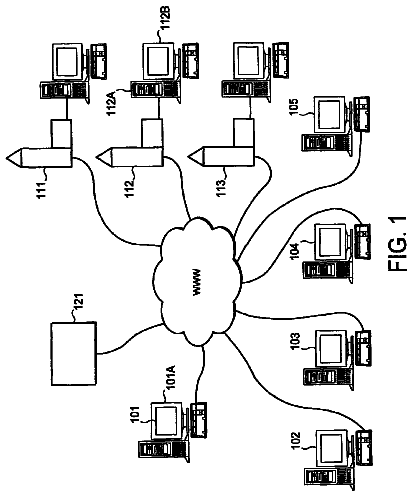
A user terminal is connected through the Internet to a server.
US 8,527,339 B2 · Assignee: Microsoft Corporation · Inventors: Gunawardana; Asela J. et al.
Sheet 1 of 5 from the published document. All sheets in the USPTO PDF
A "Quality-Based Ad Pricer" prices ads as a function of how users respond to a particular page and/or domain to which they are sent by an online advertisement. User experience is improved by ensuring that advertisements that are more relevant to a user are priced less than an ads which are less relevant to the user. In particular, a quality factor for each ad is determined as a property of the advertiser's site based on measured user behaviors with respect to that site. This quality factor is then used in ranking, selecting, and pricing ads in an automated online auction. Further, while ad aggregators are not excluded from the ad market by the pricing rules of the Quality-Based Ad Pricer, these rules ensure that there is a "level playing field" such that ads of merchants are not excluded by the ads of ad aggregators.
Online advertising is quickly growing industry. For example, one organization that provides online searches via a "search engine" reported revenues of over US$10 billion for the first three quarters of 2007 for embedding advertisements into search result pages generated in response to user queries entered into the search engine maintained by that organization. Much of this revenue comes from pay-per-click "search advertising" or "syndicated contextual advertising." Generally, in search advertising, advertisers bid to have short text ads shown with search engine results that are also clicked on by search engine users. The ads that are displayed are generally chosen through a generalized second price (GSP), auction or a Vickrey-type auction, which also determines the price each advertiser is charged when their ad is clicked. Advertisers are charged only when their ad is clicked, not when i
1 of 5 drawing sheets so far from the published document, cropped to the drawing. Every sheet is in the USPTO PDF.
What the patent claimed, word for word. All of it is now free to use.
A "Quality-Based Ad Pricer" provides techniques for pricing advertisements, and in particular, various techniques for explicitly adjusting ad pricing based on advertiser redirection rates and statistical quality determinations computed from measured user responses to advertiser web sites that allow merchants who do not aggregate to compete fairly with ad aggregators to improve user experience.
Online advertising is quickly growing industry. For example, one organization that provides online searches via a "search engine" reported revenues of over US$10 billion for the first three quarters of 2007 for embedding advertisements into search result pages generated in response to user queries entered into the search engine maintained by that organization. Much of this revenue comes from pay-per-click "search advertising" or "syndicated contextual advertising."
Generally, in search advertising, advertisers bid to have short text ads shown with search engine results that are also clicked on by search engine users. The ads that are displayed are generally chosen through a generalized second price (GSP), auction or a Vickrey-type auction, which also determines the price each advertiser is charged when their ad is clicked. Advertisers are charged only when their ad is clicked, not when it is displayed. Unlike traditional advertising, search engine advertising is highly targeted both because the advertiser selects which search queries trigger the display of their ads and because search engines only display ads that are likely to be clicked. The existence of multiple search engines that offer auctions for pay-per-click search ads means that the sets of participants in these auctions can differ. Therefore, the per-click prices on different search engines can also differ.
In contrast, with syndicated contextual advertising the search engine "syndicates" the ads, which then appear on third-party publisher websites rather than on the search results page. Generally, the third party publisher has little or no control over the specific ads that are served on their site. These ads are also sold on a pay-per-click basis. However, in this case, the payment is shared between the search engine and the third-party publisher. In contrast to search ads, where the ads are chosen based on an explicit user query, in contextual advertising the search engine attempts to match the ads to the content of third-party publisher sites, usually based on site content. This matching theoretically provides users with links to other pages or products that might have some relationship to the page the user is currently viewing, and is this presumably interested in.
As with search advertising, syndicated contextual advertising ads are also selected through an auction. As noted above, in search advertising, advertisers bid in an auction to have their ads displayed on the results page for searches on particular keywords. In contrast, with syndicated ads, advertising, keywords are extracted from participating web pages, and advertisers bid in auctions to have their ads shown on pages that appear to correspond to particular keywords. Note that in both cases, these auctions are automated processes that generally operate based on maximum bids submitted by individual advertisers for each unique advertisement.
In either case, online advertisements ("ads") are often ranked by expected cost per impression (i.e., the probability of click times bid), and the ads are displayed in the rank order, with higher ranked ads costing more money (i.e., requiring higher bids). When an ad is clicked, the advertiser is charged the minimum they would have had to bid to retain their rank. Users that click on these ads are directed to a webpage chosen by the corresponding advertiser. Thus, which ads are displayed and how much advertisers have to pay per click have nothing to do with how much value the advertiser's webpage delivers to the advertiser or to the user. In particular, reputable sites that sell the goods advertised on the ad pay the same as deceptive sites that promise cheap goods in their ad but then take the user to a page full of ads, or harvest personal information, as long as they have the same click-through-rate (CTR) or click-through probability.
The existence of both search and syndicated advertising markets has allowed the practice of "ad aggregation." Ad aggregators place syndicated ads on their web pages, and then attract traffic to these web pages by placing search ads. They are profitable when they pay less for incoming clicks on their search ads than they receive for outgoing clicks on the syndicated ads that they host. Because ad aggregation involves buying clicks in one market and selling them in another for a profit, this practice is sometimes referred to "click arbitrage." However, in contrast to true market arbitrage, which is generally considered to increase market efficiency, click arbitrage is generally considered to have a negative effect on both individual users and on true merchants that are attempting to advertise their goods using either search advertising or syndicated advertising.
In particular, a closer examination of ad aggregation reveals that it is not simply arbitrage. For example, ad aggregators generally attempt to induce incoming users to click on multiple syndicated ads, thereby generating higher revenue for themselves. In this process, the term "redirection rate" is used to denote the number of outgoing syndicated clicks an aggregator gets per incoming click. When an aggregator's redirection rate exceeds unity, they are able to sell more clicks than they buy. As a result, ad aggregators are profitable even if their buying and selling per-click prices are the same. This contrasts with arbitrage, which can only be profitable in the presence of a price imbalance.
Such practices are considered to harm both individuals and true merchants attempting to advertise their goods, since when ad aggregators win advertising slots, instead of merchants, they prevent consumers from reaching merchants directly. Unfortunately, most merchants cannot compete with ad aggregators since the aggregators are generally willing to pay higher prices for clicks, since they expect to resell more clicks than they pay for. In fact, it has been observed that the majority of the top advertisers in a real ad market are aggregators that use this advantage to displace merchants from advertising slots.
Therefore, aggregators who achieve high redirection rates directly displace merchants since the aggregators bid more than the merchants are willing or able to pay. Further, the user experience is degraded by the practice of ad aggregation since the ad aggregator specifically designs their pages to capture the users' attention and induce them to click on more syndicated ads, rather than specifically designing their pages to provide what the user may actually be looking for. In fact, what the user generally wants, but rarely receives, is an ad that links them directly to the merchant that is selling the product that they are specifically looking for.
Recently, quality issues have begun to receive some attention. For example, one conventional search engine uses a "quality score" as a dynamic variable assigned to each keyword (i.e., a word included in the user's search query). This quality score is calculated using a variety of factors, and generally measures how relevant a particular keyword is to the ad text and to a user's search query. These quality scores then influence the position of ads on the search results page. Further, the quality score is also used in part to determine minimum bids for particular keywords. In general, the higher the quality score, the better the ad position and the lower the corresponding minimum bid. In general, the "formula" for calculating the "quality score" of this conventional search engine varies depending on whether it is calculating minimum bids or assigning ad position. It also varies based on whether it is affecting a keyword-targeted ad on a search network, a keyword-targeted ad on a content network, or a placement-targeted ad.
In other work, one conventional study models user attention, user surplus, and the resulting externalities of advertisers on each other. In particular, a model is suggested wherein users incur a "cost" every time they click on an ad, gain a "constant utility" when their need is met from an ad, and decide to stop browsing further ads when the cost of another click exceeds the expected benefit of continued browsing. This model illustrates some of the excess negative externality imposed on other advertisers by advertisers that have high click-through probability and high bid, but low probability of meeting the user's need, as such an advertiser would reduce the user's expectation of the utility of continued browsing.
This work then proposes a mechanism that takes into account the advertisers' probabilities of meeting a user's need, and describes how such a mechanism maximizes user surplus. However, while the study describes how "search-diverting sites" can lead to merchants dropping out of the publishing engine's auction, the proposed model described therein assumes counterfactually that all advertisers derive an expected per-click payoff given by the advertiser's probability of meeting the user's click times a constant. In other words, this study erroneously assumes that an advertiser's payoff is contingent on meeting a user's need, and that meeting a user's need results in the same payoff for all advertisers. As such, the concept of ad aggregation is not properly considered or modeled.
This Summary is provided to introduce a selection of concepts in a simplified form that are further described below in the Detailed Description. This Summary is not intended to identify key features or essential features of the claimed subject matter, nor is it intended to be used as an aid in determining the scope of the claimed subject matter.
In general, a "Quality-Based Ad Pricer" provides various techniques for implementing automated ad pricing rules for search ads and syndicated contextual ads. The ad pricing rules provided by the Quality-Based Ad Pricer directly address various problems caused by ad aggregation, such as displacement of actual merchant ads by ad aggregators, and degraded user experience. These issues are addressed by using statistical evaluations of user behavior with respect to particular ads, particular ad landing pages (i.e., the page served to the user upon clicking an ad), particular advertiser domains, etc., to generate statistical "quality factors" that are used in determining ad prices. Thus, the automated ad pricing rules provided by the Quality-Based Ad Pricer improve user experience while allowing merchants who do not aggregate to compete fairly with ad aggregators. At the same time, the ad pricing rules provided by the Quality-Based Ad Pricer allows ad aggregators to take advantage of pricing imbalances, thereby facilitating ad price convergence.
More specifically, the Quality-Based Ad Pricer provides an environment in which ads are priced, in part, as a function of how users respond to a particular page and/or domain to which they are sent by a particular ad. As such, user experience is improved by ensuring that ads that are more relevant to the user, such as ads that link directly to a merchant, for example, are priced less and ranked higher, than an ad which is less relevant to the user, such as the page of an ad aggregator. Further, while ad aggregators are not excluded from the ad market by the pricing rules of the Quality-Based Ad Pricer, these rules ensure that there is a "level playing field" such that ads of merchants are not excluded by the ads of ad aggregators.
In view of the above summary, it is clear that the Quality-Based Ad Pricer described herein provides various unique techniques for explicitly adjusting ad pricing as a function of statistical quality determinations computed from measured user responses to advertiser web sites to improve user experience while allowing merchants who do not aggregate to compete fairly with ad aggregators. In addition to the just described benefits, other advantages of the Quality-Based Ad Pricer will become apparent from the detailed description that follows hereinafter when taken in conjunction with the accompanying drawing figures.
The specific features, aspects, and advantages of the claimed subject matter will become better understood with regard to the following description, appended claims, and accompanying drawings where:
FIG. 1 provides an exemplary architectural flow diagram that illustrates program modules for implementing various embodiments of a "Quality-Based Ad Pricer," as described herein.
FIG. 2 illustrates a search results page of a first real-world search engine for a query term "red quilts," showing that ads of ad aggregators occupy the top slots (i.e., the most desirable slots) while ads of actual merchants occupy lower slots (i.e., less desirable slots).
FIG. 3 illustrates a "landing page" reached by clicking one of the aggregator ads shown in FIG. 2.
FIG. 4 illustrates a general system flow diagram that illustrates exemplary methods for implementing various embodiments of the Quality-Based Ad Pricer, as described herein.
FIG. 5 is a general system diagram depicting a simplified general-purpose computing device having simplified computing and I/O capabilities for use in implementing various embodiments of the Quality-Based Ad Pricer, as described herein.
In the following description of the embodiments of the claimed subject matter, reference is made to the accompanying drawings, which form a part hereof, and in which is shown by way of illustration specific embodiments in which the claimed subject matter may be practiced. It should be understood that other embodiments may be utilized and structural changes may be made without departing from the scope of the presently claimed subject matter.
1.0 Introduction:
As is known to those skilled in the art of online advertising, "ad aggregators" generally operate to extract more value per click than any non-aggregating merchant as long as they can induce users to click on multiple syndicated ads. As described in further detail herein, such aggregators can defeat non-aggregating merchants in ad auctions, and dominate the market. In extreme cases, this effect can lead to no ads from merchants being displayed, which is arguably suboptimal for both users and merchants. Further, ad aggregators may also allow one ad platform or engine (such as, for example, a search engine or contextual advertising platform or engine) to manipulate prices on another.
A "Quality-Based Ad Pricer," as described herein, provides an environment in which ads are priced, in part, as a function of how users respond to a particular page and/or domain to which they are sent by a particular ad. As such, user experience is improved by ensuring that ads that are more relevant to a user, such as ads that link directly to a merchant, for example, are priced less than an ad which is less relevant to the user, such as the page of an ad aggregator. Further, while ad aggregators are not excluded from the ad market by the pricing rules of the Quality-Based Ad Pricer, these rules ensure that there is a "level playing field" such that ads of merchants are not excluded by the ads of ad aggregators.
More specifically, the Quality-Based Ad Pricer provides an aggregator pricing rule that a publishing engine (e.g., a search engine such as Microsoft.RTM. Live Search, YAHOO! .RTM. Search, Google.TM., etc.) can use in order to guard against the negative impact that ad aggregators can otherwise have. Various embodiments of this pricing rule is implemented within various types of online auctions, such as, for example, a modified generalized second price (GSP) auction or a modified Vickrey-type auction, that incorporate a quality factor, Q, in ranking and pricing. Note that in contrast to conventional pricing schemes, the quality factor computed by the Quality-Based Ad Pricer is determined as a property of the advertiser's site based on measured user behaviors with respect to that site, as opposed to a factor that merely accounts for a particular ad or an advertiser's click-through probability.
1.1 System Overview:
As noted above, the Quality-Based Ad Pricer provides various techniques for explicitly adjusting ad pricing as a function of statistical quality determinations computed from measured user responses to advertiser web sites. The result is an improved user experience which allows merchants who do not aggregate to compete fairly with ad aggregators. The processes summarized above are illustrated by the general system diagram of FIG. 1.
In particular, the system diagram of FIG. 1 illustrates the interrelationships between program modules for implementing various embodiments of the Quality-Based Ad Pricer, as described herein. Furthermore, while the system diagram of FIG. 1 illustrates a high-level view of various embodiments of the Quality-Based Ad Pricer, FIG. 1 is not intended to provide an exhaustive or complete illustration of every possible embodiment of the Quality-Based Ad Pricer as described throughout this document.
In addition, it should be noted that any boxes and interconnections between boxes that are represented by broken or dashed lines in FIG. 1 represent alternate embodiments of the Quality-Based Ad Pricer described herein, and that any or all of these alternate embodiments, as described below, may be used in combination with other alternate embodiments that are described throughout this document.
In general, as illustrated by FIG. 1, the Quality-Based Ad Pricer begins operation by using a statistics capture module 100 to collect statistics 105 from a plurality of clients (110, 112, and 114). In general, as described in Section 2.6, these statistics 105 describe user interaction and responses to ads served on search result pages 120 or third party syndicated ad pages 125.
The search result pages 125 are provided to the user in response to user entry of a query into a search engine or the like. Ads included on the search result page 125 are typically matched to keywords entered by the user as a part of the search query, and are provided in a ranked order which is determined as a function of several factors, including computed statistical quality factors 140, that are computed by a quality factor computation module 135 from the collected statistics 105.
In contrast, third party syndicated ad pages 125 are generally one of two types of web pages. For example, in a first type, the third party page 125 is simply a web page that allows syndicated contextual advertising to be automatically placed within the page by an ad syndication engine that chooses the ads displayed, typically based on a keyword association with various content of that web page. A second type of third party web page 125 is that of an "ad aggregator." In general, ad aggregators place syndicated ads on their web pages, and then specifically act to attract traffic to these web pages by placing search ads. In both cases, the third party page 125 will receive income when a user clicks on an ad on that page. However, in the second case, the third party page 125 is also considered to be an ad landing page 130.
In general, an ad landing page 130 is simply a page that is presented to the user whenever a user selects an ad by clicking on that ad. In some cases, the ad landing page 130 is that of a merchant 132, with no further ads, while in other cases, the ad landing page is that of an ad aggregator 134 (including "aggregating merchants," as described in Section 2.5.1) which includes additional ads.
In any case, whether the page being displayed to the user is a search result page 120, a third party syndicated ad page 125, or an ad landing page 130 of an ad aggregator, the ads that are displayed are selected based on a process that specifically considers the quality factors 140 computed from the collected statistics 105.
In particular, as described in detail in Section 2.7, once the quality factors 140 have been computed, an ad sorting module 145 sorts the ads in decreasing order of the product of their quality factor, click-through probability, and the advertisers bid. Note that the concept of a click-through probability is a well-known concept that generally describes a probability of a user clicking on a particular ad. It should also be noted that the click-through probability can be specifically computed by the statistics capture module 100 and stored with the statistics 105. The bid is simply the maximum amount that the advertiser is willing to pay to have a particular ad displayed
Further, it should also be noted that while the following discussion generally assumes the use of a click-through probability for purposes of explanation, other click-based probabilities are used in various embodiments in place of the click-through probabilities depending upon the advertising payment scheme being used. For example, in various embodiments, ads are paid using a variety of payment schemes, including, for example, pay-per-click, pay-per-impression, pay-per-action, etc., advertising schemes. In the case of pay-per-impression advertising, ads are paid for whenever they are placed for the user to view. In this case, a probability of "1" can be used in place of the click-through probability. With respect to pay-per-action type advertising, "action probabilities" are used instead of click-through probabilities, where some predefined action by the user triggers a payment from the advertiser when the user action is performed. Clearly, those skilled in the art will appreciate that the Quality-Based Ad Pricer can be used in combination with any desired payment scheme (e.g., pay-per-click, pay-per-impression, pay-per-conversion, pay-per-action, etc.) by simply replacing the click-through-probabilities described herein with the appropriate "payment probability" corresponding to the selected advertising payment scheme.
In general, each advertiser, 155 and 160, submits their ads and corresponding bids 170 (relative to one or more keywords) to an ad/bid input module 165. As noted above, the bids 170 are used by the ad sorting module 145 in combination with the quality factors 140 to determine the sorted ads 150. This information is then provided to a quality-based auction module 175. In the case of a modified GSP-type auction, the quality-based auction module 175 selects the top sorted ads 150 for display, and assigns a price per click, P, to each selected ad based on the quality factor of the ad, the click-through probability of the ad, relative to quality, and click-through probability of the next ad in the sorted list, and the bid corresponding to that next ad, as illustrated by Equation
in Section 2.7. In various embodiments, the quality-based auction module 175 uses other online auction techniques, such as, for example, a modified Vickrey-Clarke-Groves (VCG) type auction that selects the top sorted ads for display, and assigns a price per click, P, to each selected ad based on the quality factor of the ad, the click-through probability of the ad, as well as the quality, click-through probability, and bid of all ads following it in the sorted list.
Then, having priced each of the ads the quality-based auction module 175 outputs selected ads 180 with their price per click for use by an ad server module 185 that serves the ranked ads to either a search result module 190 or an ad syndication module 195. In general, the search result module 190 simply populates the aforementioned search result page 120 with ads that best match the user query in terms of the selected ads 180 provided by the quality-based auction module 175. Similarly, the ad syndication module 195 simply populates either the third party syndicated ad page 125, or the ad landing page 130 of the ad aggregator 134.
2.0 Operation Overview:
The above-described program modules are employed for implementing various embodiments of the Quality-Based Ad Pricer. As summarized above, the Quality-Based Ad Pricer provides various techniques for explicitly adjusting ad pricing as a function of statistical quality determinations computed from measured user responses to advertiser web sites to improve user experience while allowing merchants who do not aggregate to compete fairly with ad aggregators. The following sections provide a detailed discussion of the operation of various embodiments of the Quality-Based Ad Pricer, and of exemplary methods for implementing the program modules described in Section 1 with respect to FIG. 1.
2.1 Operational Details of the Quality-Based Ad Pricer:
In general, the Quality-Based Ad Pricer provides various techniques for adjusting ad pricing as a function of statistical quality determinations computed from measured user responses. The following paragraphs provide examples and operational details of various embodiments of the Quality-Based Ad Pricer, including: a discussion of conventional advertisement arbitrage in an Internet type environment; conventional ad aggregation; the impact of ad aggregation on merchants, users and ad syndication engines; exemplary user behaviors in response to ads and ad aggregation; collection and evaluation of statistical data for measuring user responses to ads and aggregations; aggregator pricing rules provided by the Quality-Based Ad Pricer.
2.2 Conventional Advertisement Arbitrage:
Arbitrage is usually defined as the practice of taking advantage of a difference in the price of a good or asset in two different markets by buying the good in the cheaper market and selling it in the more expensive market. Much of the literature in this area deals with "perfect" arbitrage, where the sale and the purchase are accomplished simultaneously, which provides a profit with no commitment of capital and no risk. It is somewhat of a folk theorem that arbitrage results in the prices in the two markets converging, resulting in the "Law of One Price" (LOP).
The general idea is that arbitrage leads to increased supply in the expensive market, and increased demand in the cheaper market, driving the prices to converge. In less idealized settings, the transaction may involve some costs (such as transportation), and risks (such as spoilage), so that a profit can be made only if the price difference is large enough. Thus, small price differences may persist, but large differences are quickly arbitraged away. A key feature is that arbitrage opportunities are temporary; arbitrage brings about price convergence, which eliminates the arbitrage opportunity, so that arbitrageurs effectively put themselves out of business.
Arbitrage in asymmetric cases, such as when one market has import barriers (such as high tariffs, regulations, etc), or when the other market has export barriers are relevant ideas in describing some of the features of the Quality-Based Ad Pricer. In classic asymmetric arbitrage cases, one market can only be a source in cross-market transactions, while the other can only be a sink. Arbitrage can only operate in one direction--from the source to the sink. The trade barrier removes the arbitrage opportunity when the price in the source market is higher than the price in the sink market so that the price difference can persist. However, if the price in the source market is lower than the price in the sink market, an arbitrage opportunity exists, and the difference will be arbitraged away. Thus, when an asymmetric barrier to trade exists, the full LOP cannot operate. Still, the temporary nature of arbitrage is preserved under this "half LOP."
2.2.1 Search Ad Arbitrage:
In pay-per-click search ad markets, advertisers bid to have their ads displayed on the results page corresponding to particular queries. Clicks on the ads lead users to "landing pages" controlled by the advertisers, and result in a payment from the advertiser to the search engine. Thus, advertisers are often described as buying clicks, while search engines are described as selling clicks. The choice of which ads are displayed, and the pricing of corresponding clicks on those ads, are usually determined through a Generalized Second Price (GSP) auction or a Vickrey-type auction.
In particular, in a conventional GSP auction, for each ad that is a candidate for being displayed for a particular query (i.e., search terms or keywords entered into a search engine), its expected maximum cost per impression is computed by multiplying the corresponding bid by an estimate of the probability that the ad will be clicked. The ads are then sorted in order of decreasing expected maximum cost per impression, and the top ads are displayed so that their relative prominence mirrors the sort order. Then, when an ad is clicked, the advertiser is charged the minimum they would have had to bid to still retain the position in which the ad was displayed.
Since each search engine that offers pay-per-click search advertising has its own independent auction, there are separate markets for clicks. Consequently, the price charged for an ad click on a particular search query can vary between these markets, which could present an arbitrage opportunity. However, this can only be an arbitrage opportunity if a mechanism existed to "transport" clicks between these markets. Thus, for purposes of explanation, a hypothetical mechanism, termed "transparent syndication" enables arbitrage between ad markets.
In transparent syndication, a syndicating engine provides a syndication feed consisting of the ads and their current per-click prices. Arbitrageurs can then enter the ads into the auction on a publishing engine. The arbitrageur makes no change to the ad, except for directing clicks on the ad to themselves instead of the original advertiser. The arbitrager then redirects these clicks to the syndicating engine, who in turn redirects them to the corresponding advertiser. The advertiser then pays the syndicating engine the per-click price determined on the syndicating engine, and the syndicating engine passes this payment on to the arbitrageur. In turn, the arbitrageur pays the publishing engine the per-click price determined on the publishing engine. The mechanism is transparent to the users, in that they cannot distinguish between ads entered into the publishing engine by the arbitrageur from those that are entered into the engine by the original advertisers, and it is transparent to advertisers in that they cannot distinguish between clicks from users on the syndicating and publishing engines.
When the per-click price of an ad is higher on one engine than on the other, an arbitrageur would be able to use the transparent syndication mechanism to buy clicks in the inexpensive market and sell them in the expensive one. Since this option is open to multiple arbitrageurs, and the price they can afford to pay per click is set by the per-click price on the expensive market, they would compete with each other, driving up the per-click price on the inexpensive market. Thus, transparent syndication would allow arbitrage, which in turn would cause price convergence. Any costs associated with this trade (including any fee retained by the syndicating engine) are analogous to transportation costs and risks in goods arbitrage. If the expensive market does not provide a transparent syndication feed, then arbitrage cannot take place, whereas the inexpensive market not providing a feed has no effect on arbitrage, just as in the case of goods arbitrage in the presence of a trade barrier.
2.3 Conventional Ad Aggregation:
While the hypothetical "transparent syndication" mechanism described in Section 2.2 does not explicitly exist, a different mechanism for ad syndication does. In real-world ad syndication, a syndicating engine provides ads which third-party websites display. These websites and the syndicating engine share the revenue resulting from clicks on these ads.
More specifically, while the publishing engine does not directly publish the syndicated ads, the third-party websites can advertise on the publishing engine, and pay the publishing engine for clicks on the ad. If the users that arrive on the third-party website though this ad then click on the syndicated ads they find there, the website earns revenue. Such third-party websites are referred to as "ad aggregators." An ad aggregator is profitable if they earn more from clicks on syndicated ads on their site than they have to pay the publishing engine for incoming clicks. For this reason, ad aggregators are often thought of as engaging in arbitrage, and are often described as "search engine arbitrageurs." Note that for purposes of explanation, "keyword arbitrageurs" are not specifically addressed by the discussion of search engine arbitrageurs and ad aggregators provided herein. However, it should be understood that similar considerations apply to the case of keyword arbitrageurs.
Ad aggregation differs from the idealization of "transparent syndication" described in Section 2.2 in a number of significant ways. For example, an aggregator does not insert a separate ad into the publishing engine's auction corresponding to each syndicated ad. Instead, the aggregator submits a single ad to the publishing engine' auction. When a user clicks on this ad, the aggregator is billed for the click, and the user is taken to the aggregator's landing page, which displays the syndicated ads. Thus, real-world ad syndication is not transparent to the user. When the user clicks on an ad on the aggregator's page, they are redirected through the syndicating engine to the advertiser landing page, and the syndicating engine charges the advertiser and pays the aggregator. Syndicating engines usually inform the advertiser that the click was on a syndicated ad rather than a search ad, and often give their advertisers a discount (compared to the price charged for clicks on search ads). In addition, the syndicating engine only passes on a portion of this payment to the aggregator, retaining the balance as a syndication fee. Thus, the economics of aggregation are subtly different from the economics of ad arbitrage. These differences are discussed in further detail in the remainder of this section.
2.3.1 Aggregator Price Equilibria:
For purposes of explanation, consider an asymmetric world with two search engines, S and P, where S syndicates its ads, but P does not. This case is modeled because it is an idealization of a real-world search engine, where most aggregators carry ads from an ad syndication program associated with that real-world ad syndication program, but where the search engine itself does not display many ads from aggregators.
For purposes of explanation, a single search query will be considered, and it will be assumed that the market for clicks is highly competitive, so that all advertisers on S have the same bid B.sub.S and therefore pay B.sub.S per click. It is also assumed that all ads on P (including ads from aggregators) will have the same click-through probability if shown in the same position, so that per-click prices are only a function of the bids. The argument carries through when these assumptions are relaxed.
Let .alpha. be a discount factor so that the syndicating engine S charges its advertiser .alpha.B.sub.S rather than B.sub.S per syndicated click, and let the syndication fee be .alpha.(1-.beta.)B.sub.S so that an aggregator receives .alpha..beta.B.sub.S per syndicated click. The factor .beta. is purely under the control of the syndicating engine, S. Finally, let N be the number of ads displayed by each engine.
2.3.2 Ideal Ad Aggregation:
Suppose an "ideal" aggregator is one where a user clicking on the aggregator's ad on P will click on exactly one syndicated ad on the aggregator's page. Of course, this is an idealization, as real users often become distracted or frustrated and leave the aggregator's page before clicking on an ad, or in some cases, the user may click on multiple ads on the aggregator page. However, it is instructive to see that an ideal aggregator could afford to pay up to .alpha..beta.B.sub.S per click on P (ignoring overhead costs for hosting and/or maintaining the aggregator's landing page).
The above described idealizations and definitions lead to the following Theorem:
Theorem 1:
The equilibrium price of a click on the i.sup.th ad on P is no lower than .alpha..beta.B.sub.S as long as i<N, and as long as at least i+1 ideal aggregators exist.
Proof of Theorem 1:
It is assumed that the equilibrium price of a click on the i.sup.th slot on P is B.sub.P<.alpha..beta.B.sub.S to prove the theorem by contradiction. This means that the (i+1).sup.st bid is B.sub.P. Thus, i+1 ideal aggregators could bid amount B.sub.A on P, where .alpha..beta.B.sub.S>B.sub.A>B.sub.P. Each aggregator would then win a slot and make a profit of at least (.alpha..beta.B.sub.S-B.sub.A)>0 on each click. The (i+1).sup.st bid is now B.sub.A>B.sub.P, so that the price of a click on the i.sup.th slot is now B.sub.A>B.sub.P. This contradicts the assumption that that the equilibrium price of a click on the i.sup.th slot on P is B.sub.P.
Thus, when .alpha.=1 and .beta.=1, ideal aggregation behaves like arbitrage. The discount rate .alpha. and the syndication fee factor .beta. both introduce friction, and are analogous to transportation costs in goods arbitrage. In fact, ideal aggregation is entirely equivalent to goods arbitrage in the presence of an asymmetric trade barrier. If both search engines were to syndicate ads, and to allow ads from aggregators, arbitrage in both directions would lead to a Law of One Price.
2.3.3 User Attention and Ad Aggregation:
However, in contrast to the idealized aggregations assumptions described above, aggregation tends to be imperfect in the presence of real-world users. To address this issue, the following discussion considers how the equilibrium price on P is affected when aggregation is imperfect. In particular, the following discussion removes the assumption that a user clicking on an aggregator's ad clicks on exactly one of the syndicated ads displayed by the aggregator. The term "redirection rate" is used to denote the average number of syndicated ads a user clicks on each time he or she arrives at the aggregator page from P. The redirection rate, r, depends on a number of factors, including whether or not the user is attracted to the aggregator page, whether or not they return to P, and whether or not they terminate their search or click on an ad. In short, it depends on what the user chooses to pay attention to.
An aggregator that is more successful at capturing the users' attention will induce users to remain on the aggregator's site (as opposed to returning to the publishing engine) or to keep returning to it, and perhaps to click on more syndicated ads. Such an aggregator can thereby attain a higher redirection rate. This is important because the aggregator earns .alpha..beta.B.sub.S per click on a syndicated ad, and therefore earns r.alpha..beta.B.sub.S per click on their ad on P. Following the same argument as above, Theorem 2, presented below, is proved:
Theorem 2:
The equilibrium price of a click on the i.sup.th ad on P is no lower than r.alpha..beta.B.sub.S as long as i<N and at least i+1 aggregators with redirect rates of at least r exist.
The description continues in the full USPTO document.
About 6,290 words. The USPTO PDF has it with every drawing.
Fees are due 3.5, 7.5 and 11.5 years after grant. This patent expired on September 3, 2025, so the fee marked "not paid" was the one that went unpaid.
QUALITY BASED PRICING AND RANKING FOR ONLINE ADS
Filed Jun 2008 · published Dec 2009Quality based pricing and ranking for online ads
Filed Jun 2008 · granted Sep 2013Earlier publications, parents and continuations. None of them can still be enforced, or this patent would not be listed.
Prior art cited by the examiner or applicant. Useful when you check your own idea for novelty.
Everything on this page comes from the documents linked above.