Background
The present disclosure relates to the field of electronic data processing and, more specifically, to automatically adapting of a search configuration of a search engine of a search service.
In order to handle large data collections search services may be used. Such search services enable retrieving and presenting information from those large data collections in response to queries executed on the data collections. The data processing executed by a search service is defined by a search configuration. In order to adjust a search service to specific requirements or preferences of different users, the search service may allow modifying search configurations. However, modifying search configurations may require state of the art knowledge of the search engine used by the search service. Without that knowledge, there may be a risk for misconfigurations resulting from modifications implemented by users, which may lead to performance degradation and/or system misbehavior, when executing searches.
Summary
Various embodiments provide a method for automatically adapting a search configuration of a search engine of a search service as well as a computer program product and a computer system for executing the method as described by the subject matter of the independent claims. Advantageous embodiments are described in the dependent claims. Embodiments of the present invention can be freely combined with each other if they are not mutually exclusive.
In one aspect, the invention relates to a method for automatically adapting a search configuration of a search engine of a search service based on repeatedly occurring events. The search configuration is represented by a set of one or more configuration parameters. The method comprises monitoring one or more configuration changes applied to the search configuration. Each configuration change is defined by a set of one or more configuration parameter changes applied to one or more of the configuration parameters of the set of configuration parameters. A set of one or more time series of a set of one or more performance indicators of the search service is generated using the search configuration. The generating of the set of time series comprises monitoring the set of performance indicators. A set of one or more events is detected using the set of time series of the set of performance indicators. Each event is assigned to a time frame. A set of one or more associations is determined. Each association is an association between an event of the set of events detected for the search configuration and a configuration change of the one or more configuration changes monitored for the search configuration. For each event of the set of events a first likelihood of an occurrence of the respective event within a first predefined time frame is calculated and, if the first likelihood exceeds a predefined threshold, at the start of the first predefined time frame in anticipation of the respective event the search configuration is automatically adapted using the set of configuration parameter changes of the configuration change, which is associated with the respective event.
In a further aspect, the invention relates to a computer program product comprising a non-volatile computer-readable storage medium having computer-readable program code embodied therewith for automatically adapting a search configuration of a search engine of a search service based on periodically occurring events. The search configuration is represented by a set of one or more configuration parameters. The automatic adapting comprises monitoring one or more configuration changes applied to the search configuration. Each configuration change is defined by a set of one or more configuration parameter changes applied to one or more of the configuration parameters of the set of configuration parameters. A set of one or more time series of a set of one or more performance indicators of the search service is generated using the search configuration. The generating of the set of time series comprises monitoring the set of performance indicators. A set of one or more events is detected using the set of time series of the set of performance indicators. Each event is assigned to a time frame. A set of one or more associations is determined. Each association is an association between an event of the set of events detected for the search configuration and a configuration change of the one or more configuration changes monitored for the search configuration. For each event of the set of events a first likelihood of an occurrence of the respective event within a first predefined time frame is calculated and, if the first likelihood exceeds a predefined threshold, at the start of the first predefined time frame in anticipation of the respective event the search configuration is automatically adapted using the set of configuration parameter changes of the configuration change, which is associated with the respective event.
In a further aspect, the invention relates to a computer system for automatically adapting a search configuration of a search engine of a search service based on periodically occurring events. The search configuration is represented by a set of one or more configuration parameters. The computer system comprises a processor and a memory storing machine-executable program instructions. Executing the program instructions by the processor causes the processor to control the computer system to monitor one or more configuration changes applied to the search configuration. Each configuration change is defined by a set of one or more configuration parameter changes applied to one or more of the configuration parameters of the set of configuration parameters. A set of one or more time series of a set of one or more performance indicators of the search service is generated using the search configuration. The generating of the set of time series comprises monitoring the set of performance indicators. A set of one or more events is detected using the set of time series of the set of performance indicators. Each event is assigned to a time frame. A set of one or more associations is determined. Each association is an association between an event of the set of events detected for the search configuration and a configuration change of the one or more configuration changes monitored for the search configuration. For each event of the set of events a first likelihood of an occurrence of the respective event within a first predefined time frame is calculated and, if the first likelihood exceeds a predefined threshold, at the start of the first predefined time frame in anticipation of the respective event the search configuration is automatically adapted using the set of configuration parameter changes of the configuration change, which is associated with the respective event.
Brief description of the several views of the drawings
In the following, embodiments of the invention are explained in greater detail, by way of example only, making reference to the drawings in which:
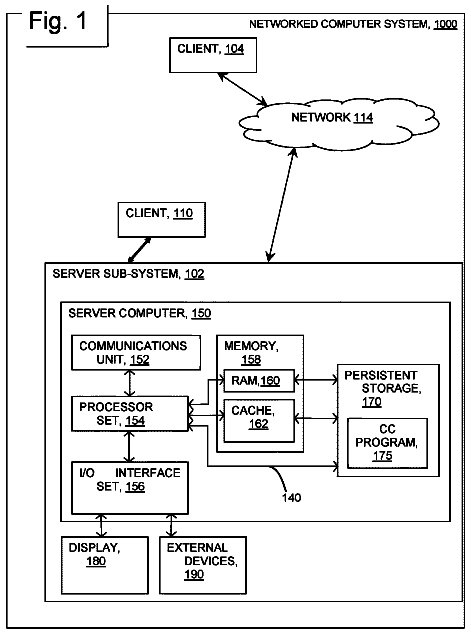
FIG. 1 depicts a schematic diagram illustrating an exemplary cloud computing node according to an embodiment,
FIG. 2 depicts a schematic diagram illustrating an exemplary cloud computing environment according to an embodiment,
FIG. 3 depicts schematic diagram illustrating exemplary abstraction model layers according to an embodiment,
FIG. 4 depicts a schematic diagram illustrating an exemplary system for automatically adapting search configurations,
FIG. 5 depicts a schematic diagram illustrating an exemplary method for monitoring configuration changes and performance indicators, and
FIG. 6 depicts a schematic flow diagram of an exemplary method for automatically adapting search configurations.
Detailed description
The descriptions of the various embodiments of the present invention are being presented for purposes of illustration, but are not intended to be exhaustive or limited to the embodiments disclosed. Many modifications and variations will be apparent to those of ordinary skill in the art without departing from the scope and spirit of the described embodiments. The terminology used herein was chosen to best explain the principles of the embodiments, the practical application or technical improvement over technologies found in the marketplace, or to enable others of ordinary skill in the art to understand the embodiments disclosed herein.
Embodiments may have the beneficial effect of relating configuration changes applied to a search configuration with events. The configuration parameters may define the processing of documents for indexing or searching as well as the behavior of the search engine. Events are detected using time series of performance indicators, i.e. events are represented by characteristic evolution patterns of values or performance indicators over time. Thus, each event is assigned to a time frame within which the same occurs. An event may for example be represented by a phase of high load of a search engine due to a high customer demand, i.e. high search intensity, at a specific time of the year, of the month, of the week, or of the day. In order to handle the high load, the configuration of the search engine may be adapted. The respective event represented by the high load may be associated with a configuration change applied to the search configuration at the time of the respective event.
A predefined time frame, a likelihood of an occurrence of the respective event is calculated. If the first likelihood exceeds a predefined threshold, the respective configuration change is scheduled for an automatically adapting the search configuration in anticipation of the respective event. Thus, at the start of the predefined time frame, the respective configuration change is implemented, i.e. the configuration change is used for adapting the search configuration, thereby preparing the search service for the respective event which is expected to occur.
By using configuration changes which have been applied successfully in the past, the risk of misconfigurations resulting from inadequate configuration changes may be minimized. Thus, errors during indexing and querying, insufficient search quality, performance degradation and/or system misbehavior, like e.g. memory mismanagement, may be avoided.
The search configuration may provide configuration parameters which are used by the search service, i.e. the search engine of the search service, for defining indexing, querying, ranking behavior and/or data management and memory management aspects of the search service. For example, the search configuration may define a schema, i.e. a data structure, for documents of a collection of documents to be searched, field types, analyzers and tokenizers to be used for each field type during indexing and querying, configuration parameters for the respective analyzers and tokenizers, like e.g. definitions of which synonyms to use for a synonym filter, and/or configuration parameters for query and request handlers, like e.g. definitions of which kind of queries, index uploads, etc. are supported. A search service may allow tenants to define or change a tenant specific search configuration. However, this requires state of the art knowledge of the search engine used. Thus, there may be a potential for misconfigurations resulting from definitions and/or changes implemented by a tenant, leading to errors during indexing and querying, insufficient search quality, performance degradation and/or system misbehavior, like e.g. memory mismanagement.
Embodiments may have the beneficial effect of enabling automatic adaptions of search configurations based on repeatedly occurring events. The automatic adaptions may be implemented using a method for analyzing search configuration changes, detecting configuration changes related to events, and automatically performing configuration changes in anticipation of future events. For example, the search engine may be extended by a configuration adaptation (CA) component. This component, e.g. a software component, may provide functionality for analyzing search configuration changes, detecting configuration changes relating to events, and automatically performing configuration changes in anticipation of events.
A search service is a service enabling discovering, crawling, transforming and/or storing information, e.g. text-based information, for retrieval and presentation in response to a query. A search service may comprise one or more search configuration, each search configuration being represented by a set of one or more configuration parameters defining a configuration of the search service. A search configuration may for example be assigned to a tenant. Furthermore, a search service may comprise a search façade, a search engine as well as one or more search indexes. A search façade, also referred to as a search interface, is configured for receiving requests providing search queries and evaluating access rights. Furthermore, a search façade may ensure that individual tenants only see their own data, i.e. data which is assigned to them and/or for which they have access rights. A search engine is an information retrieval software program configured for discovering, crawling, transforming and/or storing information for retrieval and presentation in response to a query. The search engine may comprise a crawler, indexer and/or a database. A crawler may be configured for traversing websites to retrieve their content, e.g. as documents, to store them in a search collection, i.e. a collection of data, in order to provide a collection of documents to be searched. For deriving the documents to be stored in the search collection, a crawler may e.g. deconstructing datasets provided by the websites, like e.g. document texts, and/or assigning surrogates for storage in a search index. The indexer may be configured for generating and amending search indexes. The search index may be stored in a database assigned to the search engine. A search engine may furthermore store images, link data and/or metadata of the data, e.g. documents, comprised by the search collections. A search engine may for example execute operations required to index documents and perform text-based searches using the indexed documents. A search engine may for example be configured as a web search engine for searching information on the world wide web or as a database search engine configured for searching information on a database. A search index, also referred to as a search collection, is an index generated for a collection of data, e.g. documents, to be searched. A search index may be configured for and assigned to an individual tenant. Search engine indexing refers to collecting, parsing, and storing data from a collection of data to be searched in order to facilitate fast and accurate information retrieval.
A search service may for example be provided in form of a cloud service. Such a cloud-based service may be configured for serving multiple tenants with one deployment. A tenant is a group of users, e.g. a company, who share a common access with specific privileges to the search engine. Data to be searched may be defined as tenant specific data with access rights only for the respective tenant to which it is assigned. The search service may ensure that tenant specific data is isolated from other tenants. The search service may comprise a plurality of search configurations, each search configuration assigned to an individual tenant. Service requests received from clients may contain a tenant id of the tenant which is associated with a request. The respective tenant id may allow the search service and/or the infrastructure providing the search service to identify a search configuration assigned to the respective tenant and to be used for processing the received request.
A search service may provide functionality for searching in unstructured data, like e.g. text documents. For this purpose, a search service provides functionality to create a search index by indexing content items, i.e. data to be searched, like e.g. text documents. A search index may contain a representation of a data content to be searched, in a representation which is suited, e.g. improved, for processing by the search service. The search service may provide an application programming interface API for indexing content items, which makes the respective content items searchable by the search service. Further the search service may provide a query API allowing a client, e.g. another service or an application, to issue a search query. A search query may contain a set of query parameters specifying search criteria for searching content items, like e.g. a set of search terms. The search service may process the query by selecting and ranking a set of content items according to a search query. The ranking may determine a scoring or an order of the respective content items relative to the search query, which represents for each of the content items a level of relevance in relation to the respective search query. A search query may also contain parameters for controlling the ranking, like e.g. a ranking query, a boost query and/or a boost function. Furthermore or alternatively, a search service may automatically select one or more heuristics and/or parameters for a search ranking. A search ranking may for example be based on statistics about the search collection and the search terms used for a search. Furthermore, the search ranking may be based on statistics of an occurrence of search terms in specific content items.
For a ranking, e.g. the tf-idf method (term frequency-inverse document frequency) may be used, which is a numerical statistic intended to reflect an importance or relevance of a word for a document in a search collection. Tf-idf values may be used in search service as weighting factors in ranking a document's relevancy relative to a given search query. An tf-idf value increases proportionally to the number of times a word appears in a document and is offset by the frequency of appearance of the word in the search collection.
A search service may manage multiple search indexes, e.g. assigned to multiple tenants. Thus, a search service may be used in a multi-tenant environment e.g. by creating a separate search index for each tenant. In this case, search client services may be required to correctly select the correct index to use for search requests depending on a tenant context.
A search service may be designed to provide efficiently full text search results. Documents to be searched may be provided to a search service, which analyzes the documents and puts the relevant data in a search index. Search indexes may also be used to separate data. In modern multi-tenant content management systems, like e.g. Watson® Content Hub, search collections are used to separate data from different tenants. Watson® Content Hub is a cloud-based content management system (CMS) allowing to content-enable applications, e.g. mobile apps, single-page applications, billboards, embedded devices, etc.
A search index may be associated with a specific search configuration, consisting of multiple configuration parameters defining settings which control search functionality, behavior and e.g. the structure of the content items in a search index. Search configuration parameters may be updatable and/or changeable via a search service API or by uploading a set of configuration parameter changes, e.g. in form of one or more configuration files, to the search service, a file system or a persistent storage the search service is using.
A search index may be configured according to a search index individual index schema. The index schema may define how to build an index from input documents. Each index schema may comprise one or more fields. Fields of an index schema may comprise different types of data. A name field, for example, may comprise text, i.e. character data, size field may comprise a floating-point number.
A search service may further be configured to collect statistics on a search index and its use. For example, a search service may enable querying top searched terms for a field of choice of a search index. A search service may further provide search suggestions and/or a spellchecking. Search suggestions and/or a spellchecking provided by the search service may comprise a definition for an implementation of a lookup and/or a dictionary. Additionally, a search service may provide a request handler for processing search suggestion/spellchecking requests. A search configuration may therefor also comprise configuration parameters for configuring the respective request handler.
A time series is a series of data values, e.g. values of a performance indicator, indexed in time order providing a sequence of discrete-time data. For example, the time series may be a sequence data values determined at successive equally or unequally spaced points in time.
Time series analysis provides methods for analyzing time series data in order to extract meaningful statistics and other characteristics of the data comprised by the time series. Time series forecasting may be used to predict future data values based on previously observed data values.
A time series analysis may use for example frequency-domain methods or time-domain methods. Frequency-domain methods may e.g. include spectral analysis and wavelet analysis, may e.g. include auto-correlation and cross-correlation analysis. Furthermore, the time series analysis techniques may comprise parametric and non-parametric methods. Parametric approaches assume that the underlying stationary stochastic process has a certain structure which can be described using a small number of parameters, e.g. using an autoregressive or moving average model. Parametric approaches aim to estimate the respective parameters of the model describing the stochastic process. Non-parametric approaches may estimate the covariance or the spectrum of the process without assuming any particular structure for the process.
For performing a time series analysis, e.g., the time series analysis algorithm STL (seasonal-trend decomposition procedure based on loess) may be used. The STL algorithm comprises a decomposition of a time series into three components, i.e. i) a trend component, ii) a seasonal component, and iii) a remainder. The trend component describes whether the data generally rises or falls during the observation period. The seasonal component describes the cyclical aspect of the data, while the remainder describes data that cannot be explained by the previous two components.
For performing a time series forecasting, there is a large number of suitable time series forecasting models which may be used. For example, a time series forecasting model based on vector machines, an artificial neural network or a stochastic model may be used. According to embodiments an autoregressive-moving-average model, which is based on stochastics, is used.
According to embodiments, the method further comprises at the end of the first predefined time frame reverting each of the configuration changes implemented by adapting the search configuration with the sets of configuration parameter changes used at the start of the first predefined time frame. Embodiments may have the beneficial effect that after the expected event, the search configuration is set back to its initial state before the start of the predefined time frame. Thus, event specific modification of the search configuration may be implemented exclusively for the time frame to which the respective event is assigned.
According to embodiments, the method further comprises for each event of the set of events calculating a second likelihood of an occurrence of the respective event within a second predefined time frame. The second predefined time frame follows the first predefined time frame, and, if the second likelihood exceeds the predefined threshold, at the end of the first predefined time frame in anticipation of the respective event the search configuration is automatically adapted using the set of configuration parameter changes of the configuration change, which is associated with the respective event.
Embodiments may have the beneficial effect of implementing a configuration change at the end of the first predefined time frame in anticipation of an event which is expected to occur next in the second predefined time frame following the first predefined time frame. Thus, rather than returning to the initial state before the start of the first predefined time frame, the search configuration may be changed further, in order to be adjusted to the event expected to occur next in the second predefined time frame.
According to embodiments, the predefined threshold is a threshold predefined commonly for all events. Predefining a common threshold for all events may help standardize the evaluation of likelihoods of occurrence of different events. According to embodiments, the predefined threshold is an event specific threshold. Embodiments may have the beneficial effect that the threshold may depend on the event and/or the set of configuration parameter changes associated with the respective event. For example, the threshold may be predefined the higher the larger the number of configuration parameter changes comprised by the respective set of configuration parameter changes is and/or the more extensive the effects of the configuration parameter changes are. According to embodiments, configuration parameters of the search configuration which are allowed to be changed may be classified depending on their relevance for search service. The threshold may depend on the classes of the configuration parameters to be changed. The higher the relevance assigned to the respective classes, the higher the threshold may be defined.
According to embodiments, the detecting of the set of events comprises for each time series of the set of time series determining one or more phases of the respective time series. The one or more determined time series phases are clustered and the one or more clustered time series phases are classified. Embodiments may have the beneficial effect of detecting efficiently events using times series of performance indicators. An event is characterized by a specific pattern of performance indicators in time. By clustering and classifying time series phases such a pattern may be determined and the events represented may be identified. A cluster or combination of clusters to which the time series phases are grouped or assigned is classified, i.e. a class or type of event is identified which is represented by the respective cluster or combination of clusters. For example, a phase of high load may be classified as an event representing a high customer search demand before a specific time of the year.
A clustering refers to the task of grouping a set of data objects, e.g. phases of the time series, in such a way that data objects in the same group, i.e. in the same cluster, are more similar according to one or more criteria to each other than to those data objects in clusters. A clustering may be implemented using various algorithms. The clustering may e.g. be a connectivity-based clustering, also known as hierarchical clustering, a centroid-based clustering, like e.g. k-means clustering, a distribution-based clustering, like e.g. Gaussian mixture model clustering, or a density-based clustering. Thus, the clustering may e.g. be based on distances between the data objects in a specific representation of the respective data objects, dense areas of the data space, intervals or particular statistical distributions.
The clustering may be referred to as a type of unsupervised learning. Unsupervised learning refers to a branch of machine learning that learns from test data that has not been labeled, clustered or classified. Rather than responding to feedback, unsupervised learning identifies commonalities in data provided and reacts based on a detected presence or absence of the respective commonalities in each new dataset.
Classification refers to the task of identifying to which of a set of classes or categories a data object or set of data objects belongs. Classification is an example of pattern recognition. Regarding the clustered time series phases, the respective clusters are classified into events or types of events, i.e. it is determined which type of event one or more clusters of time series phases resulting from the clustering are representing. A phase of high load on the search engine may for example be classified into an event representing the high customer demand at a certain time of the year. The classification may be implemented as an instance of supervised learning, i.e. a learning where a training set of correctly classified data objects, e.g. clusters of time series phases, is available. Supervised learning refers to the machine learning task of learning a function that maps an input, e.g. one or more clusters of time series phases, to an output, e.g. one or more types of events, based on example input-output pairs. The function may be inferred from labeled training data consisting of a set of training examples. Each training example may comprise a pair consisting of an input data and a desired output data. Thus, a supervised learning algorithm analyzes the training data and produces an inferred function, which may be used for mapping new input data. An algorithm implementing a classification, i.e. implementing a mathematical function for mapping input data to output data, may be referred to as classifier.
According to embodiments, the detecting of the one or more events comprises using an autoregressive-moving-average model. Embodiments may have the beneficial effect that the autoregressive-moving-average model provides an efficient and effective approach for detecting events. Autoregressive-moving-average (ARMA) models provide a parsimonious description of a weakly stationary stochastic process in terms of two polynomials. A first polynomial for an autoregression (AR) and a second polynomial for a moving average (MA). Given a time series of data X.sub.t, the ARMA model may be used for understanding and/or predicting future data values in the respective time series. The AR part of an ARMA-model comprises regressing a variable on its own past values. The MA part of an ARMA-model involves modeling an error term as a linear combination of error terms occurring contemporaneously and at various times in the past. The resulting model is usually referred to as the ARMA(p,q) model with p being the order of the AR part and q being the order of the MA part.
According to embodiments, the calculating the first likelihood comprises using Bayesian statistics. Embodiments may have the beneficial effect that Bayesian statistics provide an efficient and effective approach for calculating the respective likelihoods. Bayesian statistics refers to a theory in the field of statistics based on the Bayesian interpretation of probability, i.e. probability is considered as an expression of a degree of belief in an event. The respective degree of belief may be based on prior knowledge about the event, such as the results of monitoring the event in the past in case of a repeatedly occurring event. Bayesian statistical methods use Bayes' theorem to compute and update probabilities after obtaining new data. Bayes' theorem describes a conditional probability of an event based on data as well as prior information about the event and/or conditions related to the event.
According to embodiments, the configuration parameters define one or more of the following executed by the search engine: an indexing, a querying, a ranking, a data management and a memory management. Embodiments may have the beneficial effect that by changing the configuration parameters the indexing, querying, ranking, as well as the data management and/or the memory management of the search service may be adjusted to s specific event expected to occur during a predefined time frame. In case the event occurs as expected, the search service is optimized to handle the respective event due to the respective change of the configuration parameters.
According to embodiments, the set of performance indicators comprise indicators for one or more of the following features of the search service using the search configuration: a response-time, an error rate, a memory consumption and a CPU consumption. Embodiments may have the beneficial effect of defining the events in terms of performance indicators of the search service, like e.g. response-time, error rate, memory consumption and CPU consumption. Improving these performance indicators, preventing these performance indicators from degrading or restricting a degrading of these performance indicators may efficiently be achieved by implementing search configuration changes known from previous occurrences of the respective events.
A search service may consume system resources depending on the number of search collections the search services needs to manage. The larger the number of search collections, the larger the consume of system resources may be. System resources may comprise system memory, CPU cycles, space required for persistent data storage with a dependency on the number of search collections available. System memory used may comprise a search collection specific caching. Over average CPU cycles may require updating search collections. Persistent data storage may depend on factors like e.g. the amount of metadata, size of a vocabulary and/or occurrences of individual terms spread over indexed documents.
According to embodiments, the method further comprises providing one or more additional search configurations of the search engine. Each additional search configuration is represented by a set of one or more additional configuration parameters. For each of the additional search configurations one or more additional configuration changes applied to the respective additional search configuration are monitored. Each additional configuration change is defined by a set of one or more additional configuration parameter changes applied to one or more of the additional configuration parameters of the set of additional configuration parameters representing the respective additional search configuration. For each of the additional search configurations a set of one or more additional time series of the set of performance indicators of the search service is generated using the respective additional search configuration. The generating of the set of additional time series comprises monitoring the set of performance indicators. For each of the additional search configurations a set of one or more additional events is detected using the set of additional time series of the set of performance indicators of the search service using the respective additional search configuration. Each additional event is assigned to a time frame. For each of the additional search configurations as set of one or more additional associations is determined. Each additional association is an association between an additional event of the set of additional events detected for the respective additional search configuration and an additional configuration change of the set of additional configuration changes monitored for the respective additional search configuration. For each of the additional events of the set of additional events a third likelihood of an occurrence of the respective event within a third predefined time frame is calculated and, if the third likelihood exceeds the predefined threshold, at the start of the third predefined time frame in anticipation of the respective additional event the search configuration is automatically adapted using the set of additional configuration parameter changes of the additional configuration change, which is associated with the respective additional event.
Embodiments may have the beneficial effect that search configuration changes used for a different search configuration, e.g. a search configuration of a different tenant, may be used to improve a given search configuration for handling an event expected to occur based on probability. Search configuration changes taken into account for an adapting a search configuration may not be limited to search configuration changes applied to this specific search configuration in the past, but search configuration changes applied to additional search configurations may be included.
According to embodiments, the third predefined time frame is identical with the first predefined time frame. Embodiments may have the beneficial effect that search configuration changes applied to different search configurations in the past may simultaneously be applied to improve the search configuration during the same predefined time frame.
According to embodiments, the third predefined time frame is different from the first predefined time frame. Embodiments may have the beneficial effect that different search configuration changes applied to different search configurations in the past may be used to improve the search configuration during different predefined time frames.
According to embodiments, the search configuration and the additional search configurations are each assigned to a different tenant. Embodiments may have the beneficial effect that search configuration changes from different search configurations may be used and/or combined. According to embodiments, the additional search configurations is assigned to the same tenant as the search configuration.
According to embodiments, the method further comprises at the end of the third predefined time frame reverting the additional configuration changes implemented by adapting the search configuration with the set of additional configuration parameter changes used at the start of the third predefined time frame. Embodiments may have the beneficial effect that after the expected event, the search configuration is set back to its initial state before the start of the respective predefined time frame. Thus, event specific modification of the search configuration may be implemented exclusively for the time frame to which the respective event is assigned.
According to embodiments, the method further comprises for each additional event of the sets of additional events calculating a fourth likelihood of an occurrence of the respective additional event within a fourth predefined time frame. The fourth predefined time frame follows the third predefined time frame, and, if the fourth likelihood exceeds the predefined threshold, at the end of the third predefined time frame in anticipation of the respective additional event the search configuration is automatically adapted using the set of additional configuration parameter changes of the additional configuration change, which is associated with the respective additional event.
Embodiments may have the beneficial effect of implementing a configuration change at the end of the third predefined time frame in anticipation of an event which is expected to occur next in the fourth predefined time frame following the third predefined time frame. Thus, rather than returning to the initial state before the start of the third predefined time frame, the search configuration may be changed further, in order to be adjusted to the event expected to occur next in the fourth predefined time frame.
According to embodiments, the computer program product further comprises computer-readable program code configured to implement any of the embodiments of the method for automatically adapting a search configuration of a search engine of a search service based on repeatedly occurring events described herein.
The description continues in the full USPTO document.
 Lapsed, fee not paid8 drawings