Lapsed, fee not paid3 drawings
Medical Devices · US 11,213,611 B2
Cross-linked bioprosthetic tissue using bio-orthogonal binding pairs
Methods for treating a bioprosthetic tissue and treated bioprosthetic tissue are described.
US 11,213,642 B2 · Assignee: Healthy Humming, LLC · Inventors: Bogan; Richard K. et al.
Sheet 1 of 4 from the published document. All sheets in the USPTO PDF
A therapeutic device for treating one or more conditions associated with a user's nasal cavities, sinuses, and/or ear canals includes a vibration generator having an acoustic device operable to provide a sound; a seal configured to cover a nose, but not a mouth, of the user to form an air-tight chamber around the nose of the user; the vibration generator disposed in a housing connected to the seal; and a stand extending from the housing and including a ball bearing and a seat on which the ball bearing may rest, the stand including a hollow member and an orifice, the orifice disposed in the seat. The vibration generator provides the sound directly to the nose of the user. A positive pressure is created in the air-tight chamber when the user exhales, the positive pressure generating a lift force to lift the ball bearing from the seat.
Many individuals suffer from sinusitis, which is characterized by upper airway mucosal edema, inflammation and obstruction. Normally, the sinuses are filled with air, but inflammation and edema cause obstructions, fluid (e.g., mucus, drainage, etc.) and/or infectious material (e.g., bacteria, viruses, etc.) to accumulate. Sinusitis causes many uncomfortable symptoms, including pain resulting from pressure in the sinus cavities, nasal mucus discharge, headaches, and many others. Accordingly, there is a need to treat sinusitis, including acute, subacute, recurrent and/or chronic sinusitis. In addition, Eustachian equilibrium may be lost when a person encounters sudden changes in pressure, such as when an airplane takes off and/or lands, which causes the pressure in the ear canals to become unbalanced. There is a need to treat this loss of Eustachian equilibrium that results from sudden cha
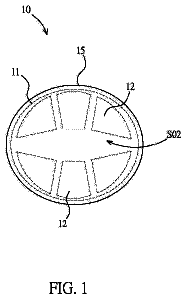
1 of 4 drawing sheets so far from the published document, cropped to the drawing. Every sheet is in the USPTO PDF.
What the patent claimed, word for word. All of it is now free to use.
Many individuals suffer from sinusitis, which is characterized by upper airway mucosal edema, inflammation and obstruction. Normally, the sinuses are filled with air, but inflammation and edema cause obstructions, fluid (e.g., mucus, drainage, etc.) and/or infectious material (e.g., bacteria, viruses, etc.) to accumulate. Sinusitis causes many uncomfortable symptoms, including pain resulting from pressure in the sinus cavities, nasal mucus discharge, headaches, and many others. Accordingly, there is a need to treat sinusitis, including acute, subacute, recurrent and/or chronic sinusitis.
In addition, Eustachian equilibrium may be lost when a person encounters sudden changes in pressure, such as when an airplane takes off and/or lands, which causes the pressure in the ear canals to become unbalanced. There is a need to treat this loss of Eustachian equilibrium that results from sudden changes in pressure.
According to an implementation, described herein, a therapeutic device for treating one or more conditions associated with a user's nasal cavities, sinuses, and/or ear canals, the therapeutic device may include a vibration generator configured to provide a vibration to a nasal interface of the user, the nasal interface located over a nose, around the nose or in the nose of the user. The therapeutic device may also include a gas module configured to provide a gas having a positive pressure to the user at a chamber and a seal configured to maintain the positive pressure at the chamber. The therapeutic device may also include a power module configured to provide power to the vibration generator to create the vibration and a housing which the user may hold and which is connected to the vibration generator, the gas module, and the power module. The therapeutic device may further include a user interface mounted to the housing and operable by the user to control one or more of the following functions of the therapeutic device: increase the positive pressure of the gas; decrease the positive pressure of the gas; modulate the positive pressure of the gas; increase the frequency of the modulation of the positive pressure of the gas; decrease the frequency of the modulation of the positive pressure of the gas; turn on the positive pressure of the gas; turn off the positive pressure of the gas; increase the vibration produced by the vibration generator; or decrease the vibration produced by the vibration generator. The gas module of the therapeutic device may serve as the vibration generator by modulating the positive pressure of the gas. The therapeutic device may further include a medication module configured to provide a medication to the user and a user interface mounted to the housing and operable by the user to control one or more of the following functions of the therapeutic device: turn on the medication module to provide medication to the user; turn off the medication module to stop medication from being provided to the user; increase the amount of medication provided to the user via the medication module; or decrease the amount of medication provided to the user via the medication module. The therapeutic device may include a seal on the housing and/or a chamber located within the housing. The therapeutic device may further include a nasal pillow extending from the housing and connected to the vibration generator. The seal may be located on the nasal pillow, and the chamber may be located within the nostril associated with the nasal pillow. The vibration may be delivered to the user via the nasal pillow, and the nasal pillow may further include ballast. The power module may provide power generated by the breath of the user or a crank operated by the user to the vibration generator to provide the vibration to the user. The power provided by the power module may be electrical power or rotational power. The therapeutic device may further include at least one of a temperature control module to warm the gas or a humidity control module to increase or decrease the humidity of the gas. The gas may correspond to one or more of: air, oxygen, nitrogen, helium, carbon dioxide, water vapor, exhaled breath of the user, or helox. The positive pressure of the gas may be from four to twenty-five centimeters of water or from four to ten centimeters of water. The therapeutic device may include a valve that prevents the positive pressure in the chamber from exceeding a threshold.
According to another implementation, described herein, a manually operated therapeutic device for treating one or more conditions associated with a user's nasal cavities, sinuses, and/or ear canals, may include a vibration generator configured to provide a vibration to a nasal interface of the user, the nasal interface being located over a nose, around the nose or in the nose of the user. The therapeutic device may further include a power module configured to provide power generated by the user to the vibration generator and a gas module configured to provide a gas having a positive pressure to the user at a chamber. The gas module may include a reservoir that may be filled by the exhaled breath of the user to provide the positive pressure of the gas. The therapeutic device may further include a seal configured to maintain the positive pressure at the chamber and a housing that the user may hold and that is connected to the seal, the vibration generator, the power module and the gas module. The power generated by the user may come from the exhaled breath of the user or a crank rotated by the user. The therapeutic device may include a cover.
According to another implementation, described herein, a method for treating one or more conditions associated with a user's nasal cavities, sinuses, and/or ear canals, may include providing a therapeutic device that includes a vibration generator configured to provide a vibration to a nasal pillow located at a nasal interface of the user, the nasal interface located in a nose of the user. The therapeutic device may further include a gas module configured to provide a gas having a positive pressure to the user at a chamber and a seal configured to maintain the positive pressure at the chamber. The method may further include operating the therapeutic device to provide the vibration to the nasal pillow and operating the therapeutic device to provide the gas to the chamber.
According to another implementation, described herein, a therapeutic device for treating one or more conditions associated with a user's nasal cavities, sinuses, and/or ear canals includes a vibration generator that includes an acoustic device configured to provide a sound. The therapeutic device further includes a seal that may be applied to a nasal interface of the user, the nasal interface being located around the nose and/or mouth of the user. The therapeutic device further includes a housing which the user may hold and which is connected to the vibration generator and the seal. The vibration generator may apply the sound to the nasal interface of the user when the seal is applied to the nasal interface of the user. The therapeutic device may further include an air-tight chamber formed within the housing when the seal is applied to the nasal interface of the user and a gas module connected to the housing and configured to provide a positive pressure in the air-tight chamber. The positive pressure may be generated by an exhaled breath of the user. The therapeutic device may further include a poppet valve that limits the positive pressure. The therapeutic device may further include a check valve that prevents a vacuum from being created in the air-tight chamber. The therapeutic device may further include a user interface that is operable by the user to control one or more of the following functions of the therapeutic device: turn the sound on; turn the sound off; increase a sound level produced by the vibration generator; decrease the sound level produced by the vibration generator; increase a frequency of the sound; or decrease the frequency of the sound. The therapeutic device may further include a power module. The power module may be located within the vibration generator. The vibration generator may include a signal source. The vibration generator may receive a signal from an external source, the signal being used by the acoustic device to generate the sound. The acoustic device may be a speaker, an electroacoustic transducer, a tone generator, a tone module, an ultrasonic generator, an ultra-low frequency generator, or a buzzer. The sound may resemble humming. The sound may have a frequency of from about 100 hertz to about 150 hertz. The sound may have a sound level of from about 20 decibels to about 100 decibels. The gas module may produce a vibration.
According to another implementation, described herein, a therapeutic device for treating one or more conditions associated with a user's nasal cavities, sinuses, and/or ear canals includes a vibration generator that includes an acoustic device that converts a signal to a sound. The signal is generated by the vibration generator or an external device. The therapeutic device further includes a housing that the user may hold and that is connected to the vibration generator. The housing is connectable to a nasal interface of the user to provide the sound to the nasal cavities, sinuses and/or ear canals of the user. The therapeutic device may further include a gas module that is connected to the housing and powered by the exhaled breath of the user to provide a positive pressure to the user or to provide a vibration to the user.
According to another implementation, described herein, a method for treating one or more conditions associated with a user's nasal cavities, sinuses, and/or ear canals includes providing a therapeutic device including a vibration generator configured to provide a sound. The method further includes applying the therapeutic device to a nasal interface of the user. The method further includes operating the therapeutic device to apply the sound to the nasal interface of the user. The method may further include exhaling by the user to provide a positive pressure to the nasal interface of the user or to provide a vibration to the nasal interface of the user. The method may further include a sound that has a frequency of from about 100 hertz to about 150 hertz.
According to another implementation, described herein, a therapeutic device for treating one or more conditions associated with a user's nasal cavities, sinuses, and/or ear canals includes a vibration generator that includes an acoustic device operable to provide a sound and a seal configured to cover a nose, but not a mouth, of the user, the seal forming an air-tight chamber around the nose of the user when the seal is applied around the nose of the user. The therapeutic device further includes a housing that is holdable and in which the vibration generator is disposed, the seal connected to the housing. A stand extends from the housing, the stand including a ball bearing and a seat on which the ball bearing may rest. The stand further includes a hollow member and an orifice, the orifice disposed in the seat. When the seal is applied to the nose of the user, a positive pressure is created in the air-tight chamber when the user exhales and the vibration generator provides the sound directly to the nose of the user when the acoustic device is operated to provide the sound such that the sound may travel into the nose of the user to treat the one or more conditions. Further, when the seal is applied to the nose of the user and the user exhales, the positive pressure generates a lift force that passes through the hollow member to the orifice to lift the ball bearing from the seat to limit the positive pressure. The therapeutic device may further include a check valve that prevents a vacuum from being created in the air-tight chamber. The sound may have a frequency of from 100 hertz to 150 hertz. The therapeutic device may further include a power module located within the housing. The vibration generator may include a signal source that provides a signal, the signal being used by the acoustic device to generate the sound. The vibration generator may receive a signal from an external source, the signal being used by the acoustic device to generate the sound. The acoustic device may correspond to at least one of a speaker, an electroacoustic transducer, a tone generator, a tone module, an ultrasonic generator, an ultra-low frequency generator, or a buzzer. The sound may have a sound level of from 20 decibels to 100 decibels. The stand may further include a cap, the ball bearing contacting the cap when the positive pressure creates a lift force that exceeds the weight of the ball bearing.
According to another implementation, described herein, a method for treating one or more conditions associated with a user's nasal cavities, sinuses, and/or ear canals includes providing a therapeutic device including a vibration generator configured to provide a sound, the therapeutic device including a seal configured to provide an air-tight chamber around the nose. The therapeutic device further includes a housing that is holdable and in which the vibration generator is disposed, the seal extending from the housing. A stand extends from the housing, the stand including a ball bearing and a seat on which the ball bearing may rest, the seat including an orifice. A hollow member is disposed in the stand under the orifice. The method includes applying the therapeutic device to cover the nose, but not the mouth, of the user to create an air-tight chamber around the nose of the user and operating the therapeutic device to apply the sound directly to the nose of the user such that the sound can enter the nose of the user. The method further includes exhaling through the nose by the user to create a positive pressure in the air-tight chamber around the nose such that the positive pressure is delivered into the nose of the user, the positive pressure generating a lift force that passes through the hollow member to the orifice to lift the ball bearing from the seat to limit the positive pressure. The housing may further include a cap opposite the ball bearing from the seat, the ball bearing contacting the cap when the positive pressure generates a lift force that exceeds the weight of the ball bearing and contacting the seat when the lift force is reduced below the weight of the ball bearing. The deal may further include a check valve that prevents a vacuum from being created in the air-tight chamber. The method may further include inhaling through the nose by the user, the check valve opening to allow the user to inhale. The vibration generator may include a speaker. The sound may have a sound level of from 20 decibels to 100 decibels or a frequency of from 100 hertz to 150 hertz.
FIG. 1 represents an example environment in which the technology, described herein, may be implemented.
FIG. 2 represents a non-limiting example embodiment of the therapeutic device of FIG. 1 .
FIG. 3 depicts an alternative embodiment of the therapeutic device of FIGS. 1 & 2 .
FIGS. 4A and 4B depict an alternative, non-limited example embodiment of the therapeutic device of FIG. 1 .
The apparatus, systems, methods, technologies and/or techniques (hereinafter “technology”) described herein may provide a therapeutic device for the treatment of sinus conditions as well as methods by which users use the therapeutic device to treat sinusitis, and various other ailments of the sinuses, nasal cavities, ear, nose throat, etc. The technology may be described in FIGS. 1-4B . FIGS. 1-4B are attached hereto and incorporated herein by reference. The following detailed description refers to the accompanying FIGS. 1-4B . The same reference numbers in different figures may identify the same or similar elements. The embodiments depicted in FIGS. 1-4B are example embodiments, but the present technology may be embodied in many different embodiments.
FIG. 1 depicts a non-limiting example environment in which the technology described herein may be implemented. As shown in FIG. 1 , environment 100 may include a user 110 , who may apply a therapeutic device 120 to form a seal 130 at/around the nasal passages (covered by the therapeutic device 120 in FIG. 1 ) of the user. The user 110 may position the therapeutic device 120 by placing the therapeutic device 120 on, over, around or within the nostrils, nose, mouth, and/or face of a user. The seal may form a chamber associated with the nasal passages of a user 110 , which chamber may be substantially air-tight and/or water-tight. The seal 130 may maintain a pressure within a chamber, may prevent or limit an amount of gas from entering and/or escaping the therapeutic device into the environment and/or may ensure that the user inhales some or all of the gas/medication/etc. being provided by the therapeutic device (e.g. via the chamber). The user 110 may suffer from one or more sinus conditions (e.g. mucus, drainage, infection, inflammation, pressure imbalance in sinuses and/or ear canals, etc.) that may be treated by therapeutic device 120 . The seal may be located in the nasal passages, outside of the nasal passages, on the face around the nasal passages (as shown in FIG. 1 ), around the mouth and/or nose, etc. The therapeutic device may include a gas module (which may further including temperature and humidity controls), a vibration generator, a power module, a medication module, a valve, nasal pillows, and/or ballast for the purpose of treating sinus conditions as further described herein. The components illustrated in FIG. 1 are provided for explanatory purposes only, and the disclosure herein is not intended to be limited to the components provided therein. There may be additional components, fewer components, different components, and/or differently arranged components that illustrated in FIG. 1 . Also, in some implementations, one or more of the components/modules of the therapeutic device of FIG. 1 may perform one or more functions described as being performed by another one or more of the components/modules of the therapeutic device of FIG. 1 . Further, the therapeutic device 120 of FIG. 1 is depicted as a device having a single-body construction. The therapeutic device may be formed as a single component and/or multiple components in a variety of structural designs and/or arrangements. FIG. 1 depicts an example environment 100 in which the technology may be implemented. Sample embodiments employing the technology are further described below.
FIG. 2 depicts an example embodiment of the therapeutic device 120 of FIG. 1 . As shown in FIG. 2 , therapeutic device 120 may include a housing 210 having a user interface 211 , a valve 212 , a seal 220 , a vibration generator 230 , nasal pillows 240 , a gas module 250 , a power source 260 and a medication module 270 . The components illustrated in FIG. 2 are provided for explanatory purposes only, and the disclosure herein is not intended to be limited to, or to require, the components provided therein. There may be additional components, fewer components, different components, and/or differently arranged components than illustrated in FIG. 2 . Also, in some implementations, one or more of the components/modules of the therapeutic device of FIG. 2 may perform one or more functions described as being performed by another one or more of the components/modules of the therapeutic device of FIG. 2 . For example, and not limitation, the functions of vibration generator 230 may be provided by gas module 250 and/or power source 260 .
The therapeutic device may include one or more modules that can impart a controlled amount of vibration to the user, via the nasal interface, in a manner that stimulates the nasal and sinus cavities of the user and/or relieves conditions related to the sinuses, nasal cavities, ears, nose and/or throat. The therapeutic device may also, or alternatively, include one or more modules that may provide a gas to a user, via the nasal interface, in a manner that stimulates the nasal and sinus cavities of the user and/or relieves conditions related to the sinuses, nasal cavities, ears, nose and/or throat. The therapeutic device may also, or alternatively, include one or more modules to control the temperature and/or humidity level of the gas, and/or combine a controlled amount of medication (e.g., in liquid and/or powder form) with the gas. The therapeutic device may include a power module that stores power (e.g., a battery, battery pack, etc.) and/or receives power (e.g., a power supply that receives and/or controls power from an alternating current source), and/or can be manually powered by the user (e.g., by inhaling, exhaling, or some other means of manual power).
Housing 210 may be held by the user when using therapeutic device 120 to treat a sinus condition. Additionally, or alternatively, housing 210 may provide a chamber (e.g. when seal 220 is applied to the nasal interface) that may store a gas at a pressure and/or a medication to be delivered to a user to treat one or more of the conditions described herein. Additionally, or alternatively, one or more of the components of therapeutic device 120 may be permanently and/or removably mounted, installed and/or attached to housing 210 so that therapeutic device 120 may be more compact, convenient and/or be a one-piece design. Housing 210 may enclose one or more of the modules, discussed herein. Housing 210 may include a user interface 211 formed by one or more buttons, levers, displays, touch screens, dials, etc. with which the user may interact to control the therapeutic device (e.g. control vibration; control gas pressure, temperature, flow and/or humidity; medication delivery, etc.). Additionally, or alternatively, user interface 211 may be placed on any other component of therapeutic device 120 , including the vibration generator 230 , one of the modules, etc. User interface 211 may be a single unit, as displayed in FIG. 2 , or may composed of separate components in different locations (e.g. the on/off switch in one location, and controls that adjust vibrations, etc., in another location) on therapeutic device 120 . The user interface 211 may include a power switch, one or more buttons or user interfaces to control the settings associated with the modules described herein such as, for example, gas pressure, dosage, vibration level, vibration frequency, temperature, humidity, etc. The user interface may include a display, which may present information that identifies parameters associated with the modules described herein, such as charge level, gas level, pressure level, medication level, moisture level, vibration level, vibration frequency, temperature, etc.
Housing 210 may further include a valve 212 , which may regulate the pressure and/or flow of gas into and/or from a chamber associated with housing 210 . For example, and not limitation, valve 212 may correspond to a poppet valve, which may prevent the pressure within the chamber from exceeding a certain threshold associated with an opening pressure of the poppet valve. Additionally, or alternatively, valve 212 may correspond to a check valve, which may prevent a vacuum and/or pressure below ambient pressure from being created (e.g. when the user inhales) within chamber. Additionally, or alternatively, valve may correspond to a pressure regulation and/or flow regulation valve, which may limit the pressure within the chamber and/or the flow rate of a gas into and/or from the chamber.
Housing 210 may be formed from a material or materials of sufficient strength and rigidity (e.g. a polymer, a metal alloy, fiberglass, composite, etc.) to support the static and/or dynamic loads (e.g. forces, torques, tensions, compressions, stresses, strains, etc.) imparted on the housing 210 by the components of therapeutic device 120 (such as when they are installed on housing, apply pressure to housing, etc.), to support the handling of therapeutic device by the user, to support the pressures and/or vibrations imparted to the housing 120 by the user and/or the components of the therapeutic device 120 . Seal 220 may be the interface between therapeutic device 120 and the user, so the treatments (e.g. vibrations, pressures, medications, etc.), described herein, may be provided via seal 220 (e.g. vibrations passing through seal 220 , pressure passing to user as a result of seal 220 , etc.).
Seal 220 may be separate component that is permanently and/or removably attached to housing 210 , nasal pillows 240 and/or some other portion of therapeutic device 120 that may create a chamber at the nasal interface of a user. A user may apply the seal 220 (e.g. by grasping housing and pressing seal around a nasal interface) to the user to form a chamber within which a gas (e.g. a pressurized gas, a therapeutic gas, etc.), medication, humidity, etc. may reside prior to being inhaled by the user. Seal 220 may be completely and/or partially air-tight. In the embodiment depicted in FIG. 2 , seal 220 is located on a surface of housing 210 that comes in contact with the face of the user. Additionally, or alternatively, seal 220 may be placed in other locations, such as nasal pillows 240 . As depicted in FIG. 1 , seal 220 may be formed in a shape (e.g., a mask, cover, etc.) that can fit over or around the nose of the user and/or the nose and mouth of the user. In this example, seal 220 may enable a positive pressure (e.g. above ambient pressure) to be created, controlled and/or maintained within a chamber (e.g. volume inside of the housing 210 , etc.) when a gas is provided to the user by the therapeutic device 120 . As further discussed herein, the pressure may be constant, modulated, may cause a vibration, etc. Additionally, or alternatively, therapeutic device 120 may provide a treatment (e.g. vibration, humidity, medication, temperature controlled gasses and/or medications, etc.) from one or more of the modules to the user via seal 220 .
Seal 220 may be formed from a material or materials of sufficient strength and rigidity (e.g. polymers, rubbers, metals, etc.) to support the static and/or dynamic loads (e.g. forces, torques, tensions, compressions, stresses, strains, etc.) imparted on the seal by other components of therapeutic device 120 . For example, and not limitation, seal 220 may support vibration loads associated with pressure variation and/or a vibration generation device, may support pressure loads associated with the application of a pressure to the user. Additionally or alternatively, seal 220 may be formed from a material or materials of sufficient flexibility and resilience to be compressed by a user (such as when forming a seal at and/or around the nasal interface) and/or to be comfortably used by the user. For example, seal 220 may be formed from a gasket-like material, which may be comfortable to the user and/or may maintain pressure within a chamber formed by the seal 220 . Seal 220 may be removable to allow seal 220 to be cleaned and/or replaced.
Vibration generator 230 may provide mechanical vibrations to the user via the nasal interface (e.g. at seal 220 , nasal pillows 240 , etc.). Vibration generator 230 may contain one or more mechanical vibration-generating components (e.g., offset weight devices, cam-driven devices, etc.). For example, vibration generator may include one or more electrically driven vibration components, including, but not limited to, an eccentric rotating mass motor, an offset weight motor, a linear resonant actuator, a piezoelectric bender, etc. Additionally, or alternatively, the vibration generator may be mechanically driven. For example, the user may power a vibration device by breathing into the nasal interface. By inhaling and/or exhaling, the user may rotate a set of blades (e.g., a rotor blade, turbine blade, fan blade, etc.) that may be attached to a shaft associated with a mass that is offset from the center of the shaft. As the shaft rotates, the offset weight is rotated which creates a centrifugal force that is applied to the user when, for instance, the shaft is connected to (e.g. the shaft is allowed to rotate in a bearing and transfer the vibration forces, etc.) the nasal interface (e.g. connected to a member associated with nasal pillows 240 , seal 220 , etc.) Additionally, or alternatively, the user may exhale to fill a reservoir (e.g. such as a reservoir located within gas module 250 ) with exhaled breath (e.g. through a check valve that allows exhaled air to enter but not escape, etc.), and the pressure created and/or stored within the reservoir may be used (e.g. when another valve is operated, such as controlled by user interface 211 , to allow gas to escape the reservoir, etc.) to rotate the set of blades to rotate the shaft that generates the vibration. Additionally, or alternatively, the user may manually operate a shaft (e.g., by operating a crank, etc.) to create vibrations, such as in the ways described herein. The scope of the present disclosure is not limited to the foregoing examples of vibration generation. Any type of known vibration device may be used. For example, an internal mass may be attached to a spring that may be depressed by a shaft that rides along a cam, which may be connected to a shaft that is driven by the user (e.g., the user's breath, by hand, etc.). Transferring the vibrations to the user via a nasal interface may stimulate the nasal and/or sinus cavities in a manner that breaks up and/or loosens liquid, mucus, solids and/or an obstruction within the nasal and/or sinus cavities of the user. Such stimulation may promote drainage of the nasal and/or sinus cavities. Additionally, or alternatively, the vibrations may open the ear canal to relieve pressure from the ear drum, which may be created by an infection, mucus, and/or changes in pressure (e.g., taking off and/or landing in an airplane).
Additionally, or alternatively, vibration generator 230 may be acoustically driven. Vibration generator 230 may include one or more acoustic devices that generate an acoustic vibration and/or a sound (a “sound”). Acoustic device may correspond to any sound generation device, including, for instance, a speaker, an electroacoustic transducer, a tone generator, tone module, ultrasonic generator, ultra-low frequency generator, buzzer, etc. The acoustic device may receive a signal (e.g. electrical signal that is converted to a sound by acoustic device etc.) from power module 260 or some external device and use such signal to generate the sound. Additionally, or alternatively, vibration generator 230 may include a signal source. A user may control the vibration generator 230 , such as via the user interface 211 , to adjust the sound (i.e. turn the sound on or off, increase the frequency of the sound, decrease the frequency of the sound, increase the sound level of the sound, decrease the sound level of the sound, increase sound pressure, decrease sound pressure, increase vibrations associated with the sound, decrease vibrations associated with the sound, etc.). The sound may correspond to a vibration associated with a change in pressure that may be audible (e.g. within a frequency of about 20 Hertz to about 20,000 Hz, a sound level from about 0 decibels to 100 decibels or more, etc.) or inaudible (e.g. low frequency sound known as infrasound; high frequency sound known as ultrasound, etc.). The sound applied may be depend upon a comfort level of a user (i.e. sound level is not so high that it becomes uncomfortable) and/or usefulness of the sound at producing therapeutic vibrations (e.g. at or near a resonance frequency associated with, for instance, therapeutic device 120 , the cilia within a user's sinuses, the bones and/or cartilage of the user's sinuses, etc.). The vibration generator may provide the sound to the user at constant rate or variable rate of amplitude, frequency and/or sound pressure. For example, the sound may resemble humming (e.g. a sound at a frequency of about 100 to 150 Hz, more particularly, from about 115 to about 140 Hertz, etc.) at a range of sound levels (e.g. from about 20 decibels to about 100 decibels). The sound may vary depending upon the amount of congestion in the user, the pressure in the ears of the user, etc. The vibration generator may generate a sound that causes therapeutic device 120 , or a portion thereof, to vibrate. These vibrations may be transferred to the user via seal 220 and/or nasal pillows 240 . Additionally, or alternatively, sound from the vibration generator 230 may cause vibrations within the user (e.g. cilia in the user's sinuses may vibrate, the bones and cartilage of the sinuses may vibrate, mucus in the user's sinuses may vibrate, etc.).
The sound may be created from a signal generated by the vibration generator 230 when the vibration generator 230 includes a signal source. The signal source may generate one or more signals (e.g. electrical signals, etc.) that are used by the acoustic device of vibration generator 230 to generate the sound waves or patterns of sound waves described herein. The signal source may correspond to, for example, a device that may produce a sound signal (e.g. a tone generator, etc.) or a medium (e.g. a hard drive, a storage medium, etc. that may store digital or analog signals) that may store a signal and an output (e.g. a digital to analog converter, etc.) that may read the signal from the medium and deliver the signal to the acoustic device to generate the sound. The signal may be provided to acoustic device when, for instance, therapeutic device is turned on, when a user controls the user interface to turn the signal on or to modify the signal etc. Additionally, or alternatively, vibration generator 230 may receive a signal, for instance from power module 260 or an external device, that may be used by acoustic device of vibration generator 230 to generate the sound described herein. Vibration generator 230 may also include an amplifier, which may increase the strength of the signal generated and/or received by the vibration generator 230 .
Nasal pillows 240 may be one or more members that fit within the nose of the user. Nasal pillows 240 may transfer vibrations to the user, such as vibrations generated by vibration generator 230 , pressure module 250 , etc. Additionally, or alternatively, nasal pillows 240 may form a seal (e.g. by including a seal, such as seal 220 ) in the nasal passages of a user to permit a treatment (e.g. a pressurized gas, medication, etc.) to be provided to the user in a chamber within the nose via nasal pillows 240 . For instance, nasal pillows 240 may include one or more passageways (e.g. penetrations/tubes, etc.) (not shown) through which medication, pressurized gas, etc. may be transferred from one of the modules, described herein, to the user.
Nasal pillows 240 may include one or more ballast components that are attached to, integrated into and/or formed as part of the nasal pillows. Additionally, or alternatively, ballast components may be attached to, integrated into, and/or formed as a part of another component of therapeutic device 120 associated with transferring vibrations to the user, such as seal 220 or housing 210 . Ballast components may be formed by high density materials (e.g., steel, copper, lead, molybdenum, silver, gold, tungsten, platinum, high density polymers such as Ecomass®, high gravity compound ceramics, etc.). The high density materials may be ergonomically shaped to fit in, over, or around the nostrils, nose, mouth and/or face of the user. For example, and not limitation, the high density materials may form a seal (similar to seal 220 except at nasal pillows) within the nostrils of a user. The mass, inertia, and/or momentum of the ballast components may enable vibrations to be imparted to the user via the nasal interface (e.g. at the nasal pillows 240 , at seal 220 , housing 210 , etc.). Ballast components may cause vibrations to be transferred to the user in a manner that causes the nasal and/or sinus cavities of the user to vibrate accordingly. Such vibration may stimulate the nasal and/or sinus cavities in a manner that causes the fluids, mucus, solids and/or other obstructions, within the nasal and/or sinus cavities, to be loosened, drained and/or otherwise removed from the nasal and/or sinus cavities. The vibrational forces provided to the user via ballast components as described above, may be generated by the vibration generator 230 , by gas module 250 (e.g. modulated gas pressure may cause the nasal interface and/or the ballast components to vibrate in a manner that imparts the vibrational forces to the user) and/or by another component and/or module of therapeutic device 120 that may generate vibrations as described herein. Nasal pillows 240 may extend from housing 210 (e.g. be connected to housing and/or ballast components associated with housing, etc.), vibration generator 230 , gas module 250 (such as when gas module 250 is formed as a part of housing 210 , etc.), etc. to the nostrils of user when the user uses therapeutic device 120 as described herein.
Gas module 250 may provide a gas (e.g., air, water vapor, oxygen, nitrogen, helium, helox, carbon dioxide, or a combination of gases, etc.) to a user via the nasal interface (e.g. within a chamber formed by housing 210 and seal 220 , within the nostrils via nasal pillows, etc.) at a positive pressure (e.g. above ambient pressure). Gas module 250 may provide gas at different modes, such as a constant mode where a constant pressure is applied when a user inhales, exhales or both; a modulated pressure, where the pressure varies; upon request by the user, etc. Gas module 250 may be connected to (e.g. formed as a part of, via an airtight connection, etc.) housing 210 , nasal pillows 240 and/or another component of therapeutic device 120 in a way that allows pressurized gas to be administered to and/or received from the user. Gas module 250 may include to a pressure vessel that may receive, contain, and/or administer a gas at a positive pressure (e.g. above ambient pressure). For example, gas module 250 may include a reservoir that may be filled with a compressed gas that, as further discussed herein, may be regulated to provide the gas to the user at a pressure below the pressure at which the gas is stored in the reservoir. Additionally, or alternatively, gas module 250 may include a pump (e.g. an electric pump, a hand-driven pump, etc.) that may generate pressurized gas, such as compressed air, for use by the therapeutic device 120 . Gas module 250 may also, or alternatively, provide pressure to the user that is created when the user exhales. For example, a user may generate a pressure by exhaling (e.g. normally exhaling, exhaling in a manner similar to blowing up a balloon, etc.) into a chamber (e.g. within housing 210 , a chamber formed within nostrils by nasal pillows 240 , etc.) formed by therapeutic device 120 . Gas module 250 may include a valve, such as the poppet valve of housing 210 , which may limit the pressure in the chamber, such as by opening to allow gas to escape the chamber. The pressure may be maintained by, for instance, seal 220 and/or nasal pillows 240 . The pressure may be stored in the chamber and/or redirected to a reservoir of gas module 250 and used to provide gas pressure to the user (such as when inhaling and/or exhaling) as described herein. Additionally, or alternatively, the gas pressure may be used to create vibrations as described herein.
The description continues in the full USPTO document.
About 6,584 words. The USPTO PDF has it with every drawing.
Fees are due 3.5, 7.5 and 11.5 years after grant. This patent expired on January 4, 2026, so the fee marked "not paid" was the one that went unpaid.
THERAPEUTIC DEVICE FOR TREATMENT OF CONDITIONS RELATING TO THE SINUSES, NASAL CAVITIES, EAR, NOSE AND THROAT
Filed Feb 2018 · published Jul 2018THERAPEUTIC DEVICE FOR TREATMENT OF CONDITIONS RELATING TO THE SINUSES, NASAL CAVITIES, EAR, NOSE AND THROAT
Filed Jun 2021 · published Sep 2021Therapeutic device for treatment of conditions relating to the sinuses, nasal cavities, ear, nose and throat
Filed Jun 2021 · granted Jan 2022Earlier publications, parents and continuations. None of them can still be enforced, or this patent would not be listed.
Prior art cited by the examiner or applicant. Useful when you check your own idea for novelty.
Everything on this page comes from the documents linked above.