 Expired, full term2 drawings
Biotech & Lab · US 6,779,674 B1
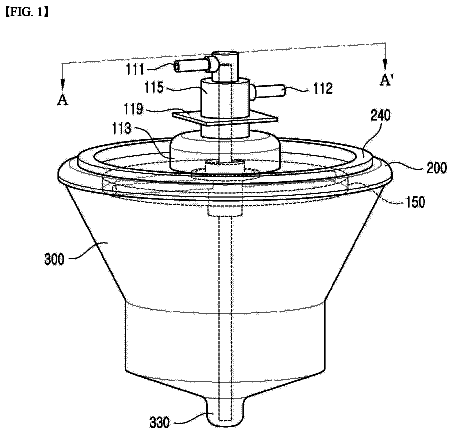
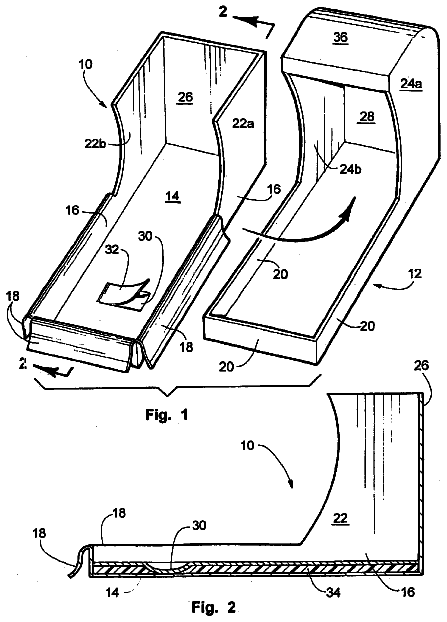
Disposable splash pan liner
A snug disposable liner for a laboratory splash pan, with a reservoir for polishing agents, so the pan needn't be disinfected after each use.
US 2019/0264156 A1 · Title as filed: SIPHON TYPE CULTIVATION METHOD · Inventors: HAGIHARA; Masahiko et al.
Sheet 1 of 6 from the published document. All sheets in the USPTO PDF
A cell culture device with a siphon that drains and refills medium through a porous film automatically.
The present invention provides a cell cultivation device comprising a polymer porous film, and a cell cultivation method using said cell cultivation device. Provided is a cell cultivation device that has a siphon structure or a shishi-odoshi structure, said cell cultivation device comprising: a polymer porous film; a cell cultivation part that accommodates the polymer porous film; a liquid reservoir part that has the cell cultivation part stored in an interior thereof; a culture medium supply means that is positioned at an upper section of the liquid reservoir part; a culture medium discharge means that is positioned at a lower section of the liquid reservoir part; and a culture medium recovery means that recovers the culture medium that is collected in the liquid reservoir part and is intermittently expelled.
In recent years, proteins such as enzymes, hormones, antibodies, cytokines, viruses (viral proteins) used for treatment and vaccine are industrially produced using cultured cells. However, such a protein production technology is expensive, raising medical cost. Accordingly, there have been demands for innovating technologies for culturing cells at high density and for increasing protein production, aiming at great reduction of cost. As cells for protein production, anchorage-dependent adherent cells which adhere to a culture substrate may be sometimes used. Since such cells grow anchorage-dependently, they need to be cultured while being adhered onto the surface of a dish, plate or chamber. Conventionally, in order to culture such adherent cells in a large amount, it was preferable to increase the surface area to be adhered. However, increasing the culturing area inevitably requires to i
The first 3 of 6 drawing sheets from the published document, cropped to the drawing. Every sheet is in the USPTO PDF.
Independent claims and the claims that build on them, read from each claim's text.
What the application claimed, word for word. All of it is now free to use.
The present invention relates to a cell culture device comprising a porous polymer film, and further relates to a cell culture method using the cell culture device comprising the porous polymer film.
In recent years, proteins such as enzymes, hormones, antibodies, cytokines, viruses (viral proteins) used for treatment and vaccine are industrially produced using cultured cells. However, such a protein production technology is expensive, raising medical cost. Accordingly, there have been demands for innovating technologies for culturing cells at high density and for increasing protein production, aiming at great reduction of cost.
As cells for protein production, anchorage-dependent adherent cells which adhere to a culture substrate may be sometimes used. Since such cells grow anchorage-dependently, they need to be cultured while being adhered onto the surface of a dish, plate or chamber. Conventionally, in order to culture such adherent cells in a large amount, it was preferable to increase the surface area to be adhered. However, increasing the culturing area inevitably requires to increase the space, which is responsible for increase in cost.
As a method to culture a large amount of adherent cells while decreasing the culture space, a method for culture using a microporous carrier, especially a microcarrier, has been developed (for example, PTL 1). In a cell culturing system using microcarriers, it is preferable to carry out sufficient stirring and diffusion so that the microcarriers do not aggregate together. Since this requires a volume allowing adequate agitation and diffusion of the medium in which the microcarriers are dispersed, there is an upper limit to the density at which the cells can be cultured. In order to separate the microcarrier from the medium, separation is preferably performed using a filter which can separate fine particles, possibly resulting in increased cost. Considering the foregoing, there is a demand for innovative methodology for cell culture which cultures cells at high density. Porous Polyimide Film
Porous polyimide films have been utilized in the prior art for filters and low permittivity films, and especially for battery-related purposes, such as fuel cell electrolyte membrane and the like. PTLs 2 to 4 describe porous polyimide films with numerous macrovoids, having excellent permeability to objects such as gases, high porosity, excellent smoothness on both surfaces, relatively high strength and, despite high porosity, excellent resistance against compression stress in the film thickness direction. All of these are porous polyimide films formed via amic acid.
The cell culture method which includes applying cells to a porous polyimide film and culturing them is reported (PTL 5). CITATION LIST Patent Literature
WO2003/054174
WO2010/038873
[PTL 3] Japanese Unexamined Patent Publication (Kokai) No. 2011-219585
[PTL 4] Japanese Unexamined Patent Publication (Kokai) No. 2011-219586
[PTL 5] WO2015/012415 SUMMARY Technical Problem
The object of the present invention is to provide a cell culture device comprising a porous polymer film and to provide a cell culture method using the cell culture device comprising the porous polymer film. Solution To Problem
The inventors of the present invention discovered that a porous polymer film having a predetermined structure not only provides an optimal space in which a large number of cells can be cultured, but also provides a moist environment that is resistant to drying and completed an device that cultures cells by the exposure thereof to a gas phase and a culture method using same. In other words, the present invention preferably includes, but is not limited to, the following modes.
[10] A cell culture device characterized by comprising:
a porous polymer film;
a cell culture part that accommodates the porous polymer film;
a liquid storage part that stores the cell culture part therein;
a medium supply means disposed on an upper part of the liquid storage part;
an inverted U-shaped tube communicating with a bottom part of the liquid storage part;
a medium recovery means provided below the other end of the inverted U-shaped tube; and
a medium discharge means disposed on the medium recovery means;
wherein the porous polymer films are a three-layer structure porous polymer film having a surface layer A and a surface layer B, the surface layers having a plurality of pores, and a macrovoid layer sandwiched between the surface layers A and B;
wherein an average pore diameter of the pores present in the surface layer A is smaller than an average pore diameter of the pores present in the surface layer B;
wherein the macrovoid layer has a partition wall bonded to the surface layers A and B, and a plurality of macrovoids surrounded by such a partition wall and the surface layers A and B; and
wherein when the liquid surface of the medium supplied to the liquid storage part from the medium supply means reaches a top part of the inverted U-shaped tube, the medium is intermittently discharged into the medium recovery means due to the siphon principle.
[2] A cell culture device characterized by comprising:
a porous polymer film;
a box-shaped body, one end of which is a liquid storage part, the other end of which is a bottom part, provided with a cell culture part in the liquid storage part that accommodates the porous polymer film;
a rotary shaft provided in a part at the bottom surface side of the box-shaped body;
a bearing supporting the rotary shaft;
a medium supply means disposed above the liquid storage part; and
a medium recovery means disposed below the liquid storage part;
wherein the porous polymer films are a three-layer structure porous polymer film having a surface layer A and a surface layer B, the surface layers having a plurality of pores, and a macrovoid layer sandwiched between the surface layers A and B;
wherein an average pore diameter of the pores present in the surface layer A is smaller than an average pore diameter of the pores present in the surface layer B;
wherein the macrovoid layer has a partition wall bonded to the surface layers A and B, and a plurality of macrovoids surrounded by such a partition wall and the surface layers A and B; and
wherein when the medium supplied to the liquid storage part from the medium supply means exceeds the weight of the bottom part of the box-shaped body, the medium from the liquid storage part is intermittently discharged into the medium recovery means.
[3] The cell culture device according to [1] or [2], further comprising:
a culture liquid discharge line communicating with the medium recovery means at one end; and
a culture liquid supply line communicating with the medium at one end;
wherein the other end of the discharge line communicates with the other end of the culture liquid supply line via a pump such that the culture liquid can be circulated.
[4] The cell culture device according to any one of [1] to [3], wherein the culture liquid distribution means is a mist supplying nozzle.
[5] The cell culture device according to any one of [1] to [4], wherein the porous polymer films are installed in the plane flow path, with the films:
i) being folded up;
ii) being wound into a roll-like shape;
iii) concatenating sheets or pieces thereof with a thread-like structure;
iv) being tied together into a rope-like shape; and/or
v) two or more thereof being stacked.
[6] The cell culture device according to any one of [1] to [5], wherein the porous polymer films are modularized porous polymer films fitted with a casing;
wherein the modularized porous polymer films fitted with a casing are contained within the casing with:
(i) the two or more independent porous polymer films being aggregated;
(ii) the porous polymer films being folded up;
(iii) the porous polymer films being wound into a roll-like shape; and/or
(iv) the porous polymer films being tied together into a rope-like shape;
wherein the modularized porous polymer films fitted with the casing are installed in the planar flow path.
[7] The cell culture device according to any one of [1] to [6], wherein the porous polymer film has a plurality of pores having an average pore diameter of 0.01 to 100 μm.
[8] The cell culture device according to any one of [1] to [7], wherein an average pore diameter of the surface layer A is 0.01 to 50 μm.
[9] The cell culture device according to any one of [1] to [8], wherein the average pore diameter of the surface layer B is 20 to 100 μm.
[10] The cell culture device according to any one of [1] to [9], wherein a total film thickness of the porous polymer film is 5 to 500 μm.
[11] The cell culture device according to any one of [1] to [10], wherein the porous polymer film is a porous polyimide film.
[12] The method according to [11], wherein the porous polyimide film is a porous polyimide film comprising a polyimide derived from tetracarboxylic dianhydride and diamine.
[13] The cell culture device according to [11] or [12], wherein the porous polyimide film is a colored porous polyimide film that is obtained by molding a polyamic acid solution composition comprising a polyamic acid solution derived from tetracarboxylic dianhydride and diamine, and a coloring precursor, and subsequently heat-treating the resultant composition at 250° C. or higher.
[14] The cell culture device according to any one of [1] to [10], wherein the porous polymer film is a porous polyethersulfone film.
[15] A method for culturing a cell which uses the cell culture device according to any one of [1] to [14]. Advantageous Effects of Invention
The present invention allows simple and efficient continuous cell culturing even under conditions requiring little space and little culture medium by using a porous polymer film as a cell culture support. Further, as the porous polymer film has pores with slightly hydrophilic properties, stable liquid retention is achieved within the porous polymer film and a moist environment that is resistant to drying is maintained. Thus, survival and proliferation of cells can be achieved even with very little medium compared to conventional cell culture devices. Furthermore, as culturing is possible even if a part of or the entire porous polymer film is exposed to air, oxygen can be efficiently supplied to the cells and a large number of cells can be cultured.
According to the present invention, a stable oxygen supply can be steadily achieved by directly exposing a cell culture part to a gaseous phase by a siphon mechanism or a “shishi odoshi” mechanism and thus a large number of cells can be cultured without the use of an oxygen supply system. Further, as the system spontaneously repeats movement of the liquid part, the operation thereof can be continued without the use of special equipment or energy other than for the flow of liquid. Furthermore, as the cells and a medium storage unit at a lower part (also referred to as “cell recovery means”) are separate, when, for example, adjustments such as adjustments in pH or in the addition of glucose are made, even vigorous stirring, foaming and the like, which are disapproved of with respect to cells, can be performed. This allows for a greater number of options at the work facility, a release from theoretical upper limits to the scale of cell culture, and the possibility of developing extra-large facilities, etc.
FIG. 1 is a diagram illustrating a siphon-type cell culture device according to an embodiment.
FIG. 2 is a diagram illustrating a “shishi odoshi”—type cell culture device according to an embodiment
FIG. 3(A) is a diagram illustrating a dry heat sterilization type siphon type cell culture device (heat-resistant siphon-type reactor) according to an embodiment and (B) is a diagram illustrating a module.
FIG. 4 is a conceptual diagram illustrating the form of a medium dripped from a droplet forming medium supply means in a cell culture device according to an embodiment. (A) illustrates a drop type, (B) illustrates a mesh type, and (C) illustrates a shower type. (D) is a diagram illustrating a lid used in a cell culture device according to one embodiment used for supplying droplets from the drop type and mesh type. A mesh bundle formed by winding up a stainless steel mesh is inserted into a medium supply port in the lid.
FIG. 5 is a graph illustrating the amount of fibronectin produced from human dermal fibroblasts when the cell culture device of the present invention is used in one embodiment. As a control, the amount of fibronectin produced from cultured human dermal fibroblasts in a normal culture dish is illustrated (dish day 8 ).
FIG. 6 shows a drawing of a cell culture model using a porous polymer film.
The embodiments of the present invention will be described below referring to the drawings as needed. The configurations of these embodiments are exemplary, and the configurations of the present invention are not limited thereto.
1. Porous Polymer Film
An average pore diameter of the pore present on a surface layer A (hereinafter referred to as “surface A” or “mesh surface”) in the porous polymer film used for the present invention is not particularly limited, but is, for example, 0.01 μm or more and less than 200 μm, 0.01 to 150 μm, 0.01 to 100 μm, 0.01 to 50 μm, 0.01 to 40 μm, 0.01 to 30 μm, 0.01 to 20 μm, or 0.01 to 15 μm, preferably 0.01 to 15 μm.
The average pore diameter of the pore present on a surface layer B (hereinafter referred to as “surface B” or “large pore surface”) in the porous polymer film used for the present invention is not particularly limited so long as it is larger than the average pore diameter of the pore present on the surface A, but is, for example, greater than 5μm and 200 μm or less, 20 μm to 100 μm, 30 μm to 100 μm, 40 μm to 100 μm, 50 μm to 100 μm, or 60 μm to 100 μm, preferably 20 μm to 100 μm.
The average pore diameter on the surface of the porous polymer film is determined by measuring pore area for 200 or more open pore portions, and calculated an average diameter according to the following Equation
from the average pore area assuming the pore shape as a perfect circle. [Math. 1] Average Pore Diameter=2×√{square root over (( S a /π))}
(wherein Sa represents the average value for the pore areas)
The thicknesses of the surface layers A and B are not particularly limited, but is, for example, 0.01 to 50 μm, preferably 0.01 to 20 μm.
The average pore diameter of macrovoids in the planar direction of the film in the macrovoid layer in the porous polymer film is not particularly limited but is, for example, 10 to 500 μm, preferably 10 to 100 μm, and more preferably 10 to 80 μm. The thicknesses of the partition wall in the macrovoid layer are not particularly limited, but is, for example, 0.01 to 50 μm, preferably 0.01 to 20 μm. In an embodiment, at least one partition wall in the macrovoid layer has one or two or more pores connecting the neighboring macrovoids and having the average pore diameter of 0.01 to 100 μm, preferably 0.01 to 50 μm. In another embodiment, the partition wall in the macrovoid layer has no pore.
The total film thickness of the porous polymer film used for the invention is not particularly limited, but may be 5 μm or more, 10 μm or more, 20 μm or more or 25 μm or more, and 500 μm or less, 300 μm or less, 100 μm or less, 75 μm or less, or 50 μm or less. It is preferably 5 to 500 μm, and more preferably 25 to 75 μm.
The film thickness of the porous polymer film used for the invention can be measured using a contact thickness gauge.
The porosity of the porous polymer film used in the present invention is not particularly limited but is, for example, 40% or more and less than 95%.
The porosity of the porous polymer film used for the invention can be determined by measuring the film thickness and mass of the porous film cut out to a prescribed size, and performing calculation from the basis weight according to the following Equation (2). [Math. 2] Porosity (%)=(1− w /( S×d×D ))×100
(wherein S represents the area of the porous film, d represents the total film thickness, w represents the measured mass, and D represents the polymer density. The density is defined as 1.34 g/cm.sup.3 when the polymer is a polyimide.)
The porous polymer film used for the present invention is preferably a porous polymer film which includes a three-layer structure porous polymer film having a surface layer A and a surface layer B, the surface layers having a plurality of pores, and a macrovoid layer sandwiched between the surface layers A and B; wherein the average pore diameter of the pore present on the surface layer A is 0.01 μm to 15 μm, and the average pore diameter of the pore present on the surface layer B is 20 μm to 100 μm; wherein the macrovoid layer has a partition wall bonded to the surface layers A and B, and a plurality of macrovoids surrounded by such a partition wall and the surface layers A and B, the thickness of the macrovoid layer, and the surface layers A and B is 0.01 to 20 μm; wherein the pores on the surface layers A and B communicate with the macrovoid, the total film thickness is 5 to 500 μm, and the porosity is 40% or more and less than 95%. In an embodiment, at least one partition wall in the macrovoide layer has one or two or more pores connecting the neighboring macrovoids with each other and having the average pore diameter of 0.01 to 100 μm, preferably 0.01 to 50 μm. In another embodiment, the partition wall does not have such pores.
The porous polymer film used for the present invention is preferably sterilized. The sterilization treatment is not particularly limited, but any sterilization treatment such as dry heat sterilization, steam sterilization, sterilization with a disinfectant such as ethanol, electromagnetic wave sterilization such as ultraviolet rays or gamma rays, and the like can be mentioned.
The porous polymer film used for the present invention is not particularly limited so long as it has the structural features described above and includes, preferably a porous polyimide film or porous polyethersulfone film.
1-1. Porous Polyimide Film
Polyimide is a general term for polymers containing imide bonds in the repeating unit, and usually it refers to an aromatic polyimide in which aromatic compounds are directly linked by imide bonds. An aromatic polyimide has an aromatic-aromatic conjugated structure via an imide bond, and therefore has a strong rigid molecular structure, and since the imide bonds provide powerful intermolecular force, it has very high levels of thermal, mechanical and chemical properties.
The porous polyimide film usable for the present invention is a porous polyimide film preferably containing polyimide (as a main component) obtained from tetracarboxylic dianhydride and diamine, more preferably a porous polyimide film composed of tetracarboxylic dianhydride and diamine. The phrase “including as the main component” means that it essentially contains no components other than the polyimide obtained from a tetracarboxylic dianhydride and a diamine, as constituent components of the porous polyimide film, or that it may contain them but they are additional components that do not affect the properties of the polyimide obtained from the tetracarboxylic dianhydride and diamine.
In an embodiment, the porous polyimide film usable for the present invention includes a colored porous polyimide film obtained by forming a polyamic acid solution composition including a polyamic acid solution obtained from a tetracarboxylic acid component and a diamine component, and a coloring precursor, and then heat treating it at 250° C. or higher.
A polyamic acid is obtained by polymerization of a tetracarboxylic acid component and a diamine component. A polyamic acid is a polyimide precursor that can be cyclized to a polyimide by thermal imidization or chemical imidization.
The polyamic acid used may be any one that does not have an effect on the invention, even if a portion of the amic acid is imidized. Specifically, the polyamic acid may be partially thermally imidized or chemically imidized.
When the polyamic acid is to be thermally imidized, there may be added to the polyamic acid solution, if necessary, an imidization catalyst, an organic phosphorus-containing compound, or fine particles such as inorganic fine particles or organic fine particles. In addition, when the polyamic acid is to be chemically imidized, there may be added to the polyamic acid solution, if necessary, a chemical imidization agent, a dehydrating agent, or fine particles such as inorganic fine particles or organic fine particles. Even if such components are added to the polyamic acid solution, they are preferably added under conditions that do not cause precipitation of the coloring precursor.
In this specification, a “coloring precursor” is a precursor that generates a colored substance by partial or total carbonization under heat treatment at 250° C. or higher.
Coloring precursors usable for the production of the porous polyimide film are preferably uniformly dissolved or dispersed in a polyamic acid solution or polyimide solution and subjected to thermal decomposition by heat treatment at 250° C. or higher, preferably 260° C. or higher, even more preferably 280° C. or higher and more preferably 300° C. or higher, and preferably heat treatment in the presence of oxygen such as air, at 250° C., preferably 260° C. or higher, even more preferably 280° C. or higher and more preferably 300° C. or higher, for carbonization to produce a colored substance, more preferably producing a black colored substance, with carbon-based coloring precursors being most preferred.
The coloring precursor, when being heated, first appears as a carbonized compound, but compositionally it contains other elements in addition to carbon, and also includes layered structures, aromatic crosslinked structures and tetrahedron carbon-containing disordered structures.
Carbon-based coloring precursors are not particularly restricted, and for example, they include tar or pitch such as petroleum tar, petroleum pitch, coal tar and coal pitch, coke, polymers obtained from acrylonitrile-containing monomers, ferrocene compounds (ferrocene and ferrocene derivatives), and the like. Of these, polymers obtained from acrylonitrile-containing monomers and/or ferrocene compounds are preferred, with polyacrylonitrile being preferred as a polymer obtained from an acrylonitrile-containing monomer.
Moreover, in another embodiment, examples of the porous polyimide film which may be used for the preset invention also include a porous polyimide film which can be obtained by molding a polyamic acid solution derived from a tetracarboxylic acid component and a diamine component followed by heat treatment without using the coloring precursor.
The porous polyimide film produced without using the coloring precursor may be produced, for example, by casting a polyamic acid solution into a film, the polyamic acid solution being composed of 3 to 60% by mass of polyamic acid having an intrinsic viscosity number of 1.0 to 3.0 and 40 to 97% by mass of an organic polar solvent, immersing or contacting in a coagulating solvent containing water as an essential component, and imidating the porous film of the polyamic acid by heat treatment. In this method, the coagulating solvent containing water as an essential component may be water, or a mixed solution containing 5% by mass or more and less than 100% by mass of water and more than 0% by mass and 95% by mass or less of an organic polar solvent. Further, after the imidation, one surface of the resulting porous polyimide film may be subjected to plasma treatment.
The tetracarboxylic dianhydride which may be used for the production of the porous polyimide film may be any tetracarboxylic dianhydride, selected as appropriate according to the properties desired. Specific examples of tetracarboxylic dianhydrides include biphenyltetracarboxylic dianhydrides such as pyromellitic dianhydride, 3,3′,4,4′-biphenyltetracarboxylic dianhydride (s-BPDA) and 2,3,3′,4′-biphenyltetracarboxylic dianhydride (a-BPDA), oxydiphthalic dianhydride, diphenylsulfone-3,4,3′,4′-tetracarboxylic dianhydride, bis(3,4-dicarboxyphenyl)sulfide dianhydride, 2,2-bis(3,4-dicarboxyphenyl)-1,1,1,3,3,3-hexafluoropropane dianhydride, 2,3,3′,4′-benzophenonetetracarboxylic dianhydride, 3,3′,4,4′-benzophenonetetracarboxylic dianhydride, bis(3,4-dicarboxyphenyl)methane dianhydride, 2,2-bis(3,4-dicarboxyphenyl)propane dianhydride, p-phenylenebis(trimellitic acid monoester acid anhydride), p-biphenylenebis(trimellitic acid monoester acid anhydride), m-terphenyl-3,4,3′,4′-tetracarboxylic dianhydride, p-terphenyl-3,4,3′,4′-tetracarboxylic dianhydride, 1,3-bis(3,4-dicarboxyphenoxy)benzene dianhydride, 1,4-bis(3,4-dicarboxyphenoxy)benzene dianhydride, 1,4-bis(3,4-dicarboxyphenoxy)biphenyl dianhydride, 2,2-bis[(3,4-dicarboxyphenoxy)phenyl)]propane dianhydride, 2,3,6,7-naphthalenetetracarboxylic dianhydride, 1,4,5,8-naphthalenetetracarboxylic dianhydride, 4,4′-(2,2-hexafluoroisopropylidene)diphthalic dianhydride, and the like. Also preferably used is an aromatic tetracarboxylic acid such as 2,3,3′,4′-diphenylsulfonetetracarboxylic acid. These may be used alone or in appropriate combinations of two or more.
Particularly preferred among these are at least one type of aromatic tetracarboxylic dianhydride selected from the group consisting of biphenyltetracarboxylic dianhydride and pyromellitic dianhydride. As a biphenyltetracarboxylic dianhydride there may be suitably used 3,3′,4,4′-biphenyltetracarboxylic dianhydride.
As diamine which may be used for the production of the porous polyimide film, any diamine may be used. Specific examples of diamines include the following.
1) Benzenediamines with one benzene nucleus, such as 1,4-diaminobenzene(paraphenylenediamine), 1,3-diaminobenzene, 2,4-diaminotoluene and 2,6-diaminotoluene;
2) diamines with two benzene nuclei, including diaminodiphenyl ethers such as 4,4′-diaminodiphenyl ether and 3,4′-diaminodiphenyl ether, and 4,4′-diaminodiphenylmethane, 3,3′-dimethyl-4,4′-diaminobiphenyl, 2,2′-dimethyl-4,4′-diaminobiphenyl, 2,2′-bis(trifluoromethyl)-4,4′-diaminobiphenyl, 3,3-dimethyl-4,4′-diaminodiphenylmethane, 3,3′-dicarboxy-4,4′-diaminodiphenylmethane, 3,3′,5,5′-tetramethyl-4,4′-diaminodiphenylmethane, bis(4-aminophenyl)sulfide, 4,4′-diaminobenzanilide, 3,3′-dichlorobenzidine, 3,3′-dimethylbenzidine, 2,2′-dimethylbenzidine, 3,3′-dimethoxybenzidine, 2,2′-dimethoxybenzidine, 3,3′-diaminodiphenyl ether, 3,4′-diaminodiphenyl ether, 4,4′-diaminodiphenyl ether, 3,3′-diaminodiphenyl sulfide, 3,4′-diaminodiphenyl sulfide, 4,4′-diaminodiphenyl sulfide, 3,3′-diaminodiphenylsulfone, 3,4′-diaminodiphenylsulfone, 4,4′-diaminodiphenylsulfone, 3,3′-diaminobenzophenone, 3,3′-diamino-4,4′-dichlorobenzophenone, 3,3′-diamino-4,4′-dimethoxybenzophenone, 3,3′-diaminodiphenylmethane, 3,4′-diaminodiphenylmethane, 4,4′-diaminodiphenylmethane, 2,2-bis(3-aminophenyl)propane, 2,2-bis(4-aminophenyl)propane, 2,2-bis(3-aminophenyl)-1,1,1,3,3,3-hexafluoropropane, 2,2-bis(4-aminophenyl)-1,1,1,3,3,3-hexafluoropropane, 3,3′-diaminodiphenyl sulfoxide, 3,4′-diaminodiphenyl sulfoxide and 4,4′-diaminodiphenyl sulfoxide;
3) diamines with three benzene nuclei, including 1,3-bis(3-aminophenyl)benzene, 1,3-bis(4-aminophenyl)benzene, 1,4-bis(3-aminophenyl)benzene, 1,4-bis(4-aminophenyl)benzene, 1,3-bis(4-aminophenoxy)benzene, 1,4-bis(3-aminophenoxy)benzene, 1,4-bis(4-aminophenoxy)benzene, 1,3-bis(3-aminophenoxy)-4-trifluoromethylbenzene, 3,3′-diamino-4-(4-phenyl)phenoxybenzophenone, 3,3′-diamino-4,4′-di(4-phenylphenoxy)benzophenone, 1,3-bis(3-aminophenyl sulfide)benzene, 1,3-bis(4-aminophenyl sulfide)benzene, 1,4-bis(4-aminophenyl sulfide)benzene, 1,3-bis(3-aminophenylsulfone)benzene, 1,3-bis(4-aminophenylsulfone)benzene, 1,4-bis(4-aminophenylsulfone)benzene, 1,3-bis[2-(4-aminophenyl)isopropyl]benzene, 1,4-bis[2-(3-aminophenyl)isopropyl]benzene and 1,4-bis[2-(4-aminophenyl)isopropyl]benzene;
4) diamines with four benzene nuclei, including 3,3′-bis(3-aminophenoxy)biphenyl, 3,3′-bis(4-aminophenoxy)biphenyl, 4,4′-bis(3-aminophenoxy)biphenyl, 4,4′-bis(4-aminophenoxy)biphenyl, bis[3-(3-aminophenoxy)phenyl]ether, bis[3-(4-aminophenoxy)phenyl]ether, bis[4-(3-aminophenoxy)phenyl]ether, bis[4-(4-aminophenoxy)phenyl]ether, bis[3-(3-aminophenoxy)phenyl]ketone, bis[3-(4-aminophenoxy)phenyl]ketone, bis[4-(3-aminophenoxy)phenyl]ketone, bis[4-(4-aminophenoxy)phenyl]ketone, bis[3-(3-aminophenoxy)phenyl]sulfide, bis[3-(4-aminophenoxy)phenyl]sulfide, bis[4-(3-aminophenoxy)phenyl]sulfide, bis[4-(4-aminophenoxy)phenyl]sulfide, bis[3-(3-aminophenoxy)phenyl]sulfone, bis[3-(4-aminophenoxy)phenyl]sulfone, bis[4-(3-aminophenoxy)phenyl]sulfone, bis[4-(4-aminophenoxy)phenyl]sulfone, bis[3-(3-aminophenoxy)phenyl]methane, bis[3-(4-aminophenoxy)phenyl]methane, bis[4-(3-aminophenoxy)phenyl]methane, bis[4-(4-aminophenoxy)phenyl]methane, 2,2-bis[3-(3-aminophenoxy)phenyl]propane, 2,2-bis[3-(4-aminophenoxy)phenyl]propane, 2,2-bis[4-(3-aminophenoxy)phenyl]propane, 2,2-bis[4-(4-aminophenoxy)phenyl]propane, 2,2-bis[3-(3-aminophenoxy)phenyl]-1,1,1,3,3,3-hexafluoropropane, 2,2-bis[3-(4-aminophenoxy)phenyl]-1,1,1,3,3,3-hexafluoropropane, 2,2-bis[4-(3-aminophenoxy)phenyl]-1,1,1,3,3,3-hexafluoropropane and 2,2-bis[4-(4-aminophenoxy)phenyl]-1,1,1,3,3,3-hexafluoropropane.
These may be used alone or in mixtures of two or more. The diamine used may be appropriately selected according to the properties desired.
Preferred among these are aromatic diamine compounds, with 3,3′-diaminodiphenyl ether, 3,4′-diaminodiphenyl ether, 4,4′-diaminodiphenyl ether, paraphenylenediamine, 1,3-bis(3-aminophenyl)benzene, 1,3-bis(4-aminophenyl)benzene, 1,4-bis(3-aminophenyl)benzene, 1,4-bis(4-aminophenyl)benzene, 1,3-bis(4-aminophenoxy)benzene and 1,4-bis(3-aminophenoxy)benzene being preferred for use. Particularly preferred is at least one type of diamine selected from the group consisting of benzenediamines, diaminodiphenyl ethers and bis(aminophenoxy)phenyl.
From the viewpoint of heat resistance and dimensional stability under high temperature, the porous polyimide film which may be used for the invention is preferably formed from a polyimide obtained by combination of a tetracarboxylic dianhydride and a diamine, having a glass transition temperature of 240° C. or higher, or without a distinct transition point at 300° C. or higher.
From the viewpoint of heat resistance and dimensional stability under high temperature, the porous polyimide film which may be used for the invention is preferably a porous polyimide film comprising one of the following aromatic polyimides.
(i) An aromatic polyimide comprising at least one tetracarboxylic acid unit selected from the group consisting of biphenyltetracarboxylic acid units and pyromellitic acid units, and an aromatic diamine unit,
(ii) an aromatic polyimide comprising a tetracarboxylic acid unit and at least one type of aromatic diamine unit selected from the group consisting of benzenediamine units, diaminodiphenyl ether units and bis(aminophenoxy)phenyl units, and/or,
(iii) an aromatic polyimide comprising at least one type of tetracarboxylic acid unit selected from the group consisting of biphenyltetracarboxylic acid units and pyromellitic acid units, and at least one type of aromatic diamine unit selected from the group consisting of benzenediamine units, diaminodiphenyl ether units and bis(aminophenoxy)phenyl units.
The porous polyimide film used in the present invention is preferably a three-layer structure porous polyimide film having a surface layer A and a surface layer B, the surface layers having a plurality of pores, and a macrovoid layer sandwiched between the surface layers A and B; wherein an average pore diameter of the pores present in the surface layer A is 0.01 μm to 15 μm, and the mean pore diameter present on the surface layer B is 20 μm to 100 μm; wherein the macrovoid layer has a partition wall bonded to the surface layers A and B, and a plurality of macrovoids surrounded by such a partition wall and the surface layers A and B; wherein the thickness of the macrovoid layer, and the surface layers A and B is 0.01 to 20 μm, wherein the pores on the surface layers A and B communicate with the macrovoid, the total film thickness is 5 to 500 μm, and the porosity is 40% or more and less than 95%. In this case, at least one partition wall in the macrovoid layer has one or two or more pores connecting the neighboring macrovoids and having the average pore diameter of 0.01 to 100 μm, preferably 0.01 to 50 μm.
For example, porous polyimide films described in WO2010/038873, Japanese Unexamined Patent Publication (Kokai) No. 2011-219585 or Japanese Unexamined Patent Publication (Kokai) No. 2011-219586 may be used for the present invention.
1-2. Porous Polyethersulfone Film (Porous PES Film)
The porous polyethersulfone film which may be used for the present invention contains polyethersulfone and typically consists substantially of polyethersulfone. Polyethersulfone may be synthesized by the method known to those skilled in the art. For example, it may be produced by a method wherein a dihydric phenol, an alkaline metal compound and a dihalogenodiphenyl compound are subjected to polycondensation reaction in an organic polar solvent, a method wherein an alkaline metal di-salt of a dihydric phenol previously synthesized is subjected to polycondensation reaction dihalogenodiphenyl compound in an organic polar solvent or the like.
Examples of an alkaline metal compound include alkaline metal carbonate, alkaline metal hydroxide, alkaline metal hydride, alkaline metal alkoxide and the like. Particularly, sodium carbonate and potassium carbonate are preferred.
Examples of a dihydric phenol compound include hydroquinone, catechol, resorcin, 4,4′-biphenol, bis (hydroxyphenyl)alkanes (such as 2,2-bis(hydroxyphenyl)propane, and 2,2-bis(hydroxyphenyl)methane), dihydroxydiphenylsulfones, dihydroxydiphenyl ethers, or those mentioned above having at least one hydrogen on the benzene rings thereof substituted with a lower alkyl group such as a methyl group, an ethyl group, or a propyl group, or with a lower alkoxy group such as a methoxy group, or an ethoxy group. As the dihydric phenol compound, two or more of the aforementioned compounds may be mixed and used.
Polyethersulfone may be a commercially available product. Examples of a commercially available product include SUMIKAEXCEL 7600P, SUMIKAEXCEL 5900P (both manufactured by Sumitomo Chemical Company, Limited).
The logarithmic viscosity of the polyethersulfone is preferably 0.5 or more, more preferably 0.55 or more from the viewpoint of favorable formation of a macrovoid of the porous polyethersulfone film; and it is preferably 1.0 or less, more preferably 0.9 or less, further preferably 0.8 or less, particularly preferably 0.75 or less from the viewpoint of the easy production of a porous polyethersulfone film.
Further, from the viewpoints of heat resistance and dimensional stability under high temperature, it is preferred that the porous polyether sulfone film or polyethersulfone as a raw material thereof has a glass transition temperature of 200° C. or higher, or that a distinct glass transition temperature is not observed.
The method for producing the porous polyether sulfone film which may be used for the present invention is not particularly limited. For example, the film may be produced by a method including the following steps:
a step in which polyethersulfone solution containing 0.3 to 60% by mass of polyethersulfone having logarithmic viscosity of 0.5 to 1.0 and 40 to 99.7% by mass of an organic polar solvent is casted into a film, immersed in or contacted with a coagulating solvent containing a poor solvent or non-solvent of polyethersulfone to produce a coagulated film having pores; and
a step in which the coagulated film having pores obtained in the above-mentioned step is heat-treated for coarsening of the aforementioned pores to obtain a porous polyether sulfone film;
wherein the heat treatment includes the temperature of the coagulated film having the pores is raised higher than the glass transition temperature of the polyethersulfone, or up to 240° C. or higher.
The porous polyether sulfone film which can be used in the present invention is preferably a porous polyether sulfone film having a surface layer A, a surface layer B, and a macrovoid layer sandwiched between the surface layers A and B,
wherein the macrovoid layer has a partition wall bonded to the surface layers A and B, and a plurality of macrovoids surrounded by such a partition wall and the surface layers A and B, the macrovoids having the average pore diameter in the planar direction of the film of 10 to 500 μM;
wherein the thickness of the macrovoid layer is 0.1 to 50 μm,
each of the surface layers A and B has a thickness of 0.1 to 50 μm,
wherein one of the surface layers A and B has a plurality of pores having the average pore diameter of more than 5μm and 200 μm or less, while the other has a plurality of pores having the average pore diameter of 0.01 μm or more and less than 200 μm,
wherein one of the surface layers A and B has a surface aperture ratio of 15% or more while other has a surface aperture ratio of 10% or more,
wherein the pores of the surface layers A and B communicate with the macrovoids,
wherein the porous polyether sulfone film has total film thickness of 5 to 500 μm and a porosity of 50 to 95%.
As the aforementioned porous polymer film used as a cell culture support in the cell culture device of the present invention has pores with slightly hydrophilic properties, stable liquid retention is achieved within the porous polymer film and a moist environment that is resistant to drying is maintained. Thus, survival and proliferation of cells can be achieved even with very little medium compared to conventional cell culture devices that use a cell culture support. Furthermore, as culturing is possible even if a part of or the entire porous polymer film is exposed to air, oxygen can be efficiently supplied to the cells and a large number of cells can be cultured.
According to the present invention, very little medium is used, and as the porous polymer film used as the culture support can be exposed to a gaseous phase, the supply of oxygen to the cells can be sufficiently performed through diffusion. Thus, there is no particular need for an oxygen supply device in the present invention.
2. Cell Culture Device
The present invention relates to a cell culture device having a siphon configuration or a “shishi odoshi” configuration and comprises a porous polymer film, a cell culture part that accommodates the porous polymer film, a liquid storage part in which the cell culture part is stored, a medium supply means disposed above the liquid storage part, and a medium reservoir part provided with a medium discharge means and disposed below the liquid storage part characterized in that the medium temporarily stored in the liquid storage part is discharged intermittently into the medium reservoir part. The cell culture device according to the present invention is typically exemplified using a siphon-type cell culture device and a “shishi odoshi”—type cell culture device. However, as described above, provided the cell culture device is characterized by intermittently discharging medium temporarily stored in a liquid storage part into a medium reservoir part, there is no need for such classifications. These cell culture devices are generally referred to herein as “the cell culture device of the present invention”. The following embodiments of the cell culture device of the present invention will be described with reference to the drawings.
Siphon-Type Cell Culture Device
One embodiment of the present invention relates to a cell culture device comprising:
The description continues in the full USPTO document.
SIPHON TYPE CULTIVATION METHOD
Filed Jul 2017 · published Aug 2019Earlier publications, parents and continuations. None of them can still be enforced, or this patent would not be listed.
No US citations on record.
Names, summaries, modern angles and build ratings are Patent Yard's editorial notes. Everything else on this page comes from the documents linked above.