 Lapsed, fee not paid3 drawings
Agriculture & Food Tech · US 8,677,845 B2
Grain bin sensor pendulum
A protected pendulum of sensors hung in stored grain that measures temperature and moisture from inside the pile.
US 2019/0045755 A1 · Title as filed: VIVARIUM SYSTEM · Inventors: ENGELHARDT; Karl
Sheet 1 of 6 from the published document. All sheets in the USPTO PDF
Combinable plant containers and climbing aids that stick magnetically to prepared walls and ceilings.
The invention relates to a vivarium system which is composed of combinable individual containers (II) and plant climbing aids and is provided with magnetic adhesion to ferromagnetically equipped walls and ceilings (I) having a painted and/or plastered and/or lined surface. Vitalization of inner spaces, facades and free spaces by a module system that can be combined in a variable manner and is composed of small biotopes such as aquariums, terrariums, aviaries, paludariums and other vivariums for small animals, birds, insects and plants, for the fastening to walls and ceilings without causing damage to the visible surfaces by drillings for dowels, pins and screws and without rigid bonds with the fastening base.
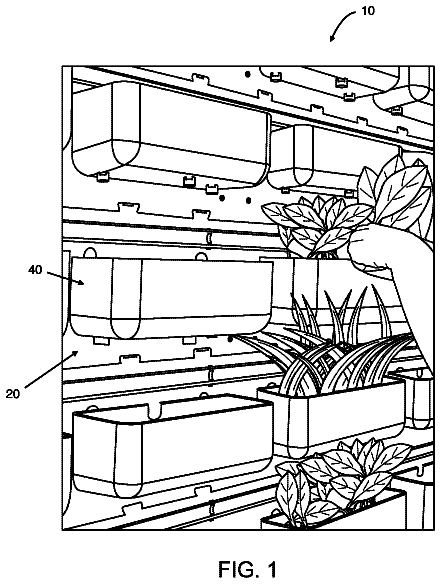
The first 3 of 6 drawing sheets from the published document, cropped to the drawing. Every sheet is in the USPTO PDF.
Independent claims and the claims that build on them, read from each claim's text.
What the application claimed, word for word. All of it is now free to use.
The invention relates to a combinable system of containers for small biotopes, plant growth supports, and wall designs according to the preamble of claim 1 .
The previously known aquaria, terraria, paludaria and climbing systems all have the property that they have to be placed either on the floor, on cabinets or other storage areas or shelves or have to be fixed by a strong connection such as gluing, dowelling or screwing to stand frames, cross members, brackets or walls.
The invention is based on the object of presenting a system that can be extended and connected in stages from a small individual cell to a larger complex structure, even with different kinds of small biotopes, and can also be variably adapted to changing conditions in interior rooms in a space-saving manner without any great additional effort for attachment, clearing up and secondary work. In addition, animals can be kept in a more species-appropriate manner even in small vessels, since small animals are provided with an extended and more diverse habitat because they are able to move around between vessels.
Aquaria, terraria, paludaria and plant containers are available in sizes from a mini container with integrated filtration, ventilation and lighting system through simple or more complex shaped large containers up to a whole-room system with display windows, in many variations. With the vivarium system invented here, self-supporting systems can be spread on to the wall area or separate, exclusively wall-based systems can be constructed. No additional or other provisions have to be made for this purpose, apart from the previous installation of an invisibly integrated presentation wall surface, as described in patent no. DE 10 2004 049 206.
The individual modules are subdivided into containers, bottom and lid parts, connecting tubes, holders and supports, in each of which the retaining magnets and the supply systems for electricity, water and nutrients, and optionally the discharge pipes for waste and fecal matter, are integrated invisibly or with an esthetic design.
The essential novelty lies in the design freedom and variability and the configuration as a biotope network or chain system with different habitats by simple, non-destructive attachment to conventionally designed and/or wipeable and ferromagnetically coated wall surfaces and/or in association with self-supporting components and/or in combination with other reversible wall designs and/or wall uses from a magnetic bulletin board with wipeable wall decoration or inscription, to presentation, signage, play, depositing and storage functions.
The small biotopes are supplied with electricity, water, oxygen and nutrients along the strings of biotopes by way of conduits integrated into the connecting tubes from a central auxiliary container with power supply technology, which is set up near to a socket; either as a self-contained processing system with freshwater and wastewater tanks or as an automatic open system connected to a domestic water supply and drainage. The automatic processing of the substrate medium and atmosphere medium using air and water is based on known methods of aquarium and vivarium care, hydroponics and floriculture.
In general, a small-scale system composed of 1 to 5 containers with strong magnets integrated on the back is attached to a wall unit or presentation wall that has been previously provided with ferromagnetic properties using iron plaster or sheet steel plates. Multiple individual containers are connected using multifunctional tubes. These generally transparent tubes serve to connect the biotopes, are sized to allow fish or small animals to pass through and have electrical cables with contacts and/or fine channels with airtight and watertight terminations integrated in a largely invisible or unobtrusive manner.
Large-scale systems composed of magnetic wall elements and/or free-standing and/or ceiling-hanging container combinations can also be constructed, among which climbing plants also grow by means of simple climbing aids. Thus, interior spaces can be enlivened in a wide variety of ways and expansions or modifications can be carried out without the need for any unattractive holes, Halfen rails, wall or ceiling hooks or for any repair or restoration work to be undertaken afterwards. In this way, very vivid, extremely interesting and variable interior designs can be achieved with high-quality, as well as multifunctional, wall areas (presentation, projection, magnetic bulletin board, whiteboard etc.) in a kind of living building block system. Furthermore, individually fabricated add-ons can also be integrated into this basic system.
The vivarium elements can be arranged in a flat, spatially angled, step-shaped, network-like, spiral-shaped, arc-shaped, circular or cylindrical manner. Multiple connection apertures that are perforated and/or prefabricated in a grid offer a choice here between an aligned, slightly offset or highly offset arrangement or rotation.
The overall system is supplemented by magnetic holders, for rods, ropes, nets, hoses, hooks, baskets and other accessories, for fixing to ferromagnetic wall and/or ceiling and/or floor surfaces, as well as by stands or spacers for the free arrangement of interconnected individual containers.
The system drawing FIG. 1 shows the rudimentary ways of varying the main components in a grid design for two configured system examples.
FIG. 2 shows two connected containers (II) in section, with integrally formed, water-tight connection apertures in the bottom part (Ill) and the lid part (IV), connecting tubes with electrical cables and transport channels (V) shown in the tube cross-section, air- and water-tight aperture cover (VI), the arrangement of the strong magnets (VII), functional accessories (VIII) for apertures provided with power supply technology or other services and simple tools for maintenance when the biotope containers are filled, for partial emptying or cleaning and for blocking off the connection apertures to prevent small animals from escaping.
The system drawing FIG. 3 shows the front and side view of an aquarium container with 6 connection openings, for example in the form of a cuboid glass container (II) with, bonded in a load-bearing manner, a bottom part (III) and a lid part (IV) made of (stainless) steel, attached by means of the integrated strong magnet (VII) to a ferromagnetic, ferrous wall coating (I).
FIG. 4 shows a simple container (X) made of glass, ceramic or plastic with holding magnets (VII) integrated on the back and a simple magnetic holder (XI), here for example with an irrigation hose (XII), on the magnetic wall area (I).
The system drawing FIG. 5 shows an overview of the essential, schematic, individual components of the modular system in a grid.
The system drawing FIG. 6 shows an exemplary embodiment solely for house plants, and the universal magnetic holder (XI) with a screw-in, rotatable retaining lug and a screw-in clamping cap as a visual finishing touch in an enlarged detail illustration, and the strong magnet (VII) embedded in the base disc as well as a holder connection (XII) which is to be inserted in the holes of the retaining lug. The extended variation as a vertical holder (XIII) is used for the additional fixing, in a minimalist manner, of shelves projecting further into the room, countertops and/or excessively heavy fittings or those which are docked on the wall in only a horizontal plane, such as the exemplary hydroponic culture vessel with a glass container attached only by magnets in the bottom of the vessel. In the case of ceiling mounting, magnetic iron materials are likewise installed in a tension-resistant manner in the surface of the ceiling to which the base discs adhere by means of strong magnets. This can be, but does not have to be, the case on floor areas.
The system drawing FIG. 7 shows a schematic exemplary embodiment with biotope containers adhering to the wall in a flat manner, said containers being connected by means of tubes and having climbing plants growing among them, which are planted in simpler magnetic pots, and which climb and grow along holders and rods in the rest of the wall area. Two smaller biotope containers project into the room in a self-adhesive manner, and a large biotope container is fixed to the wall only by a narrow side, for example, to prevent it from swinging, and is additionally secured with vertical ceiling hangers and/or feet.
In each of the 7 drawings in the figures of the annex, the references denote the following:
I > the ferromagnetic wall surface
II > the transparent biotope container made of glass, plastic or metal bars
III > the bottom part with connection apertures as a substrate trough and sand trap
IV > the lid part with connection apertures for lamps, sensors, pumps, filters etc.
V > the connecting tube with integrated electrical cables and transport conduits for supply purposes
VI > the leakproof bottom and lid closure and/or service part with no additional function
VII > an integrated strong magnet for sticking to ferromagnetic wall areas
VIII > the leakproof bottom and lid closure part with lamp, sensor, pump, filter etc.
IX > an auxiliary device with control, processing technology and central circulation pump
X > a single container (flower pot, basket etc.) with integrated holding magnets
XI > a combinable universal holder with a strong magnetic base disc
XII > a holder connection by means of a bar, rope, net, chain or hose etc.
XIII > a vertical multi-purpose holder with magnetic ceiling and/or base disc
XIV > a maintenance tool with screen or stopper for closing during filling
VIVARIUM SYSTEM
Filed Feb 2017 · published Feb 2019Earlier publications, parents and continuations. None of them can still be enforced, or this patent would not be listed.
No US citations on record.
Names, summaries, modern angles and build ratings are Patent Yard's editorial notes. Everything else on this page comes from the documents linked above.