Lapsed, fee not paidUS 11,198,037 B2
Sports & Fitness · US 11,198,037 B2
US 11,198,054 B1 · Inventors: Holtey; Adam Webb
Sheet 1 of 5 from the published document. All sheets in the USPTO PDF
A universal Cribbage board for playing multiple versions of a Cribbage game and method of play provides a universal Cribbage game board adapted to mark points accumulated during card play. The board game is configured for play with multiple versions of a traditional Cribbage card game. The game board has a continuous scoring track that is color-coded and extended to 130 peg holes to accommodate different versions of the traditional Cribbage game. A method of playing variations of the traditional Cribbage card game that are fundamentally the same as traditional Cribbage games, but differ in card scoring combinations, final scores, sequences of playing the cards, privileges, dealer advantages, strategic options, alternative point values, and different odds, in addition to the normal rules of the traditional Cribbage card game. The versions of the Cribbage game include a Holtey 500 Cribbage game, a Dealer's Cribbage game, and a Magic Cribbage game.
The following background information may present examples of specific aspects of the prior art (e.g., without limitation, approaches, facts, or common wisdom) that, while expected to be helpful to further educate the reader as to additional aspects of the prior art, is not to be construed as limiting the present invention, or any embodiments thereof, to anything stated or implied therein or inferred thereupon. Generally, a Cribbage card game includes a card game that is played in conjunction with a Cribbage game board to mark points accumulated during card play. The Cribbage game board is used for scoring rather than usual pencil and paper. The game board is equipped with holes that accommodate playing pegs. Two or more people can play the game. Or four people can play two against two as partners. Typically, a standard 52-card deck is used. The cards in play are: Ace card, 2 card, 3 card
1 of 5 drawing sheets so far from the published document, cropped to the drawing. Every sheet is in the USPTO PDF.
What the patent claimed, word for word. All of it is now free to use.
The present invention relates generally to a universal cribbage board for multi-variation cribbage games and method of play. More so, the present invention relates to a universal cribbage board that is configured for play with the Cribbage card game, defined by a scoring track that is continuous, color-coded, and extended to accommodate various versions of the traditional Cribbage card game; and further includes a method of playing variations of the traditional Cribbage card game that are fundamentally the same as the traditional Cribbage card game, but differ in the card scoring combinations, final scores, sequences of playing the cards, dealer advantages, strategic options, alternative point values, and different odds, in addition to the normal rules of the traditional Cribbage card game.
The following background information may present examples of specific aspects of the prior art (e.g., without limitation, approaches, facts, or common wisdom) that, while expected to be helpful to further educate the reader as to additional aspects of the prior art, is not to be construed as limiting the present invention, or any embodiments thereof, to anything stated or implied therein or inferred thereupon.
Generally, a Cribbage card game includes a card game that is played in conjunction with a Cribbage game board to mark points accumulated during card play. The Cribbage game board is used for scoring rather than usual pencil and paper. The game board is equipped with holes that accommodate playing pegs. Two or more people can play the game. Or four people can play two against two as partners.
Typically, a standard 52-card deck is used. The cards in play are: Ace card, 2 card, 3 card, 4 card, 5 card, 6 card, a 7 card, an 8 card, a 9 card, a 10 card, a Jack card, a Queen card, a King card, and a Joker card. Each card is assigned a value. For example, four suits of cards including spades, hearts, diamonds, and clubs, with each suit including an Ace card. The point value of each card is combined with the card value of opposing player cards to create pairs, straights, point limits, and other point objectives, garnering points for the players. The points are recorded by advancing the peg across the peg scoring holes.
It is known in the art that the objective of the Cribbage game is to be the first player to move the pegs all the way up and down the board twice and end in the in the game hole. Or put another way, to be the first to score 121 points. Note that the game ends immediately either player reaches the final hole even if this is during the play or when the dealer pegs “two for his heels”. There is no requirement to get exactly 121—it is simply the first to reach the target score. Competitions are normally played as the best of 3 games, a game being to either 61 or 121. Players take turns to deal the first hand of each game.
Typically, players cut for the deal—lowest card wins. After the first hand, players take turns to deal. The dealer shuffles, asks his opponent to cut and then deals six cards each. Both players discard two cards face down and these two cards are henceforth referred to as “the crib” or “the box”. This crib is effectively an extra hand scored for the dealer. So the dealer aims to discard cards into the crib that will give a good chance of a high scoring hand whereas the opponent aims to confound this objective. Most of the skill in the game of Cribbage is down to the choice of cards discarded at this point. Next the dealer asks his opponent to cut the cards another time. The top portion of cards is placed underneath the lower portion and the new top-most card is turned face upwards. If this card is a Jack, the dealer pegs two points and says “Two for his heels”.
In general, the opposing player begins play by laying one of his four cards face up while clearly stating its numerical value. All royal cards count ten, the ace counts one and other cards are worth their pip value. The dealer then lays a card separately in front of himself and announces the total of both cards. Play continues like this with each player alternately laying a card on the pile in front of him while verbally keeping tally of the current joint total. The total must not go above 31, however.
Often, when a player cannot play without taking the total above 31, that player says “go” and, if possible, the remaining player must carry on alone until that player, too, cannot play without taking the total above 31. When neither player can play any card without taking the total above 31, the player who laid the last card pegs 1 point saying “One for last”. Should either player manage to take the total to exactly 31, that player pegs 2 points instead of 1, saying “Two for thirty-one”. Then the cards already played are turned over and the player who did not lay the last card starts a new play. When one player's cards are exhausted, the other player continues alone. The last card played scores 1 “for last” (unless the amount is 31 in which case 2 points are scored).
Typically during play, the following events are scored and the appropriate amounts are immediately recorded on the cribbage board. If any player lays down a card which brings the total to 15, 2 points are scored. If any player lays down a card of the same type as the previous one, 2 points are scored (“2 for a pair”). In this context, the numerical value is not used so, for instance, a Jack cannot be paired with a Queen. If any player lays down a third card of the same type, 6 points are scored (“6 for a pair royal”). If any player lays down a fourth card of the same type, 12 points are scored “12 for a double pair royal”). If any player lays down a card such that with the two preceding cards, a run can be scored, 3 points are scored. The cards do not have to be of the same suit nor do they have to have been laid in sequential order. Aces count low so Queen, King, Ace is not a run. Similarly, if any player lays a card such that with the three or more preceding cards, a run can be constructed, the number of cards which would make up that run are scored. e.g. suppose cards were laid in the following order: 8,6,4,5,7. The fourth card would score 3 points, the fifth card would score five points.
Generally, each player counts the score of the four cards in his hand plus the turned up card. The non-dealer shows first and this is important because it can often make the difference between winning and losing. Fifteen—All combinations of cards that add up to fifteen count 2 points. A pair, a pair royal or a double pair royal—count 2, 6 or 12 respectively. A run—A point for each card in a run. A flush—Four or five cards of the same suit. A point is scored for each card. A 4-point flush can only be scored using cards from the hand. The turned up card can ONLY be used in a five card flush.
Typically, flushes do not count in the play. One for his nob—a jack of the same suit as the turned up card. This is always scored last so that the score is tallied by finishing with the satisfying phrase “and one for his nob”. The highest possible score in the show is 29 points— 3 fives and a Jack in the hand with the turned up card another five of the same suit as the held Jack. Finally, the dealer counts the score of the cards in the crib plus the turned up card and adds these points to his total. Scoring is done in exactly the same way as for the show except that a crib can only score a flush if all five cards are of the same suit for five points.
Other proposals have involved variations on the game of Cribbage. The problem with these Cribbage games is that they do not level the playing field by allowing each player to deal five times. Also, the capacity to request a re-deal, re-cut, fifth card for play, and request to see the opponent's hand of cards is not taught. Also, a Cribbage game board with 131 peg holes is not taught. Even though the above cited Cribbage card games meets some of the needs of the market, a universal cribbage board for multi-variation cribbage games and method of play that provides a universal cribbage board that is configured for play with the Cribbage card game, defined by a scoring track that is continuous, color-coded, and extended to accommodate various versions of the traditional Cribbage card game; and further includes a method of playing variations of the traditional Cribbage card game that are fundamentally the same as the traditional Cribbage card game, but differ in the card scoring combinations, final scores, sequences of playing the cards, dealer advantages, strategic options, alternative point values, and different odds, in addition to the normal rules of the traditional Cribbage card game, is still desired.
Illustrative embodiments of the disclosure are generally directed to a universal Cribbage board for multi-variation cribbage games and method of play. The Cribbage game provides a universal Cribbage game board configured to mark points accumulated during card play. The Cribbage game board is configured for play with multiple variations of the traditional Cribbage card game. The game board has a continuous scoring track that is color-coded and extended to 131 peg holes to accommodate different versions of the traditional Cribbage game. A method of playing variations of the traditional Cribbage card game that are fundamentally the same as the traditional Cribbage game, but differ in the card scoring combinations, final scores, sequences of playing the cards, dealer advantages, strategic options, alternative point values, and different odds, in addition to the normal rules of the traditional Cribbage card game. The versions of the Cribbage game include a Holtey 500 Cribbage game, a Dealer's Cribbage game, and a Magic Cribbage game.
In one aspect a method of playing a Holtey 500 Cribbage game, comprises an initial Step of providing a deck of cards and a game board, the game board comprising a pair of continuous scoring tracks defined by a first section, a second section, a third section, and a fourth section, each section having a starting peg hole and an ending peg hole, each section having a unique indicium.
Another Step includes providing multiple sets of playing pegs, each set of playing pegs having a unique indicium.
In some embodiments, a Step comprises placing the playing pegs in the starting peg hole of a corresponding section of the scoring tracks. As the players accumulate points, the playing pegs advance along their respective sections, as described below.
Another possible Step can include shuffling the deck of cards. The dealer shuffles the entire deck and offers the cards to the other player(s) to cut.
In some embodiments, a Step may include dealing each player a hand of six cards from the deck of cards.
A Step includes allowing each player to deal five times during the game. Each player receives five deals.
In some embodiments, a Step may include placing, by each player, two cards from the dealt hand of cards into a Crib. Each player picks up the six dealt cards and discards two cards face-down from the six cards. Those four Crib cards (two from each player) go into the Crib, forming a third hand of four cards that the dealer uses to produce points.
A Step comprises cutting a Starter card from the deck of cards. The Starter card becomes part of all three hands, the dealer's hand, the non-dealers hand, and the Crib.
The method may further comprise a Step includes playing, by each player, at least one card from the dealt hand to form a first scoring combination. The first scoring combination generates points for the players, based on the type of scoring combination.
In some embodiments, a Step comprises audibly counting points that are scored. The player must audibly indicate to the other players the running count of points produced by playing the card.
A subsequent Step includes audibly indicating if a player cannot play a card without causing the card count of all the played cards to exceed 34 points. In one non-limiting embodiment, if the player has to exceed 34 points, the player must call “Go”. The opposing player(s) then continue to play until no player can play without the count exceeding 34 points. If a player fails to audibly count any points in the hand or crib, the opposing player can call “muggings,” and score these points for himself.
A Step includes advancing, by each player, the first set of pegs along the first section of the scoring tracks, in correspondence with the scored points from the first scoring combination. As the peg advances, it is significant to note that one scoring peg hole equates to one point. And the two pegs hop over each other in alternating advancements, so that the game board always shows how many points are recorded on the last score.
The method further includes a Step of playing, by each player, at least one card from the dealt hand, and the Starter card to form a second scoring combination. The second scoring combination is produced scoring 4 points by playing the cards in the player's hand, and the Starter card that is cut from the deck of cards.
A Step comprises advancing, by each player, the peg into the scoring peg holes along a second section of the scoring tracks, in correspondence with the scored points produced from the second scoring combination. The second scoring lane is actually the third lane in starting from the outside of the board. This is because the third lane is actually the second lane in from the outside of the board.
The method further includes a Step of playing, by each player, the Starter card, and the cards in the Crib, so as to form a third scoring combination. The Starter card and the Crib cards are counted in multiple combinations, so as to tally points. In one embodiment, the third scoring combination from playing the Starter card and the cards in the Crib produces 6 points.
A Step includes advancing, by each player, the peg into the scoring peg holes along a third section of the scoring tracks, in correspondence with the scored points produced from the third scoring combination.
A final Step includes winning the game by scoring the most points tallied from the first, second, and third scoring combinations
In another aspect, a method for playing Dealer's Cribbage card game, comprises an initial Step of providing a deck of cards and a game board, the game board comprising a pair of continuous scoring tracks defined by a first section, a second section, a third section, and a fourth section, each section having a starting peg hole and an ending peg hole, each section having a unique indicium.
The method may further comprise a Step of placing two matching pegs in a starting peg hole of the scoring tracks.
In some embodiments, a Step comprises shuffling the deck of cards.
A Step includes requesting a re-cut of the deck of cards. In this feature, the consequence of receiving a poor hand is minimized. A re-cut is marked in a Re-cut peg hole of the Privileges Section of the game board.
A Step includes dealing a hand of six cards from the deck of cards.
A Step includes selectively re-dealing. A re-deal is marked in a Re-deal peg hole of the Privileges Section of the game board.
Continuing with the method, a Step comprises placing, by each player, two cards from the dealt hand of cards into a Crib. Each player picks up the six dealt cards and discards two cards face-down from the six cards. Those four cards (two from each player) go into the Crib, forming a third hand of four cards that the dealer uses to produce points. The non-dealer places his Crib cards down first, face up, so the dealer can see them before throwing his own Crib cards face down.
In some embodiments, a Step may include playing a fifth card from the dealt hand of cards. This is referred to as “Pleading the Fifth”, and is marked in a Plead The 5.sup.th peg hole of the Privileges Section of the game board. Pleading the Fifth occurs when players desire playing five cards from their hand instead of four cards. This allows players to utilize the fifth card from their hand when scoring, instead of, or in addition to, the cut card.
A Step comprises cutting a Starter card from the deck of cards.
The method also includes a Step of requesting, by one player, that an opposing player shows the hand of cards. Requesting a “Showing” of the hand of cards is marked in a Show peg hole of the Privileges Section of the game board.
The method may further comprise a Step includes playing, by each player, a card from the dealt hand to form a scoring combination. The scoring combination may generate points for the players, based on the type of scoring combination.
In some embodiments, a Step comprises audibly counting points that are scored.
A subsequent Step includes audibly indicating if a player cannot play a card without causing the card count of all the played cards to exceed 31 or 34 points.
In some embodiments, a Step may include advancing, by each player, a playing peg into the scoring peg holes along the scoring tracks, in correspondence with the scored points.
A Step comprises producing points by playing the cards in the player's hand, the cards in the Crib, and the Starter card to form the at least one card scoring combination.
A final Step includes winning the game by scoring 121 points and advancing the playing peg to an ending peg hole of the scoring tracks
In yet another aspect, a method for playing a Magic Cribbage card game, comprises an initial Step of providing a deck of cards and a game board, the game board comprising a pair of continuous scoring tracks defined by a first section, a second section, a third section, and a fourth section, each section having a starting peg hole and an ending peg hole, each section having a unique indicium.
A Step includes placing two matching pegs in a starting peg hole of the scoring tracks.
In some embodiments, a Step comprises shuffling the deck of cards.
A Step includes dealing a hand of six cards from the deck of cards.
In some embodiments, a Step may include placing, by each player, two cards from the dealt hand of cards into a Crib. Each player picks up the six dealt cards and discards two cards face-down from the six cards. Those four cards (two from each player) go into the Crib, forming a third hand of four cards that the dealer uses to produce points.
A Step comprises cutting a Starter card from the deck of cards.
The method may further comprise a Step includes playing, by each player, a card from the dealt hand to form a first scoring combination.
The method may further comprise a Step of producing points by playing the cards in the player's hand, the Starter card, the cards in the Crib card to form a second scoring combination.
In some embodiments, a Step comprises audibly counting points that are scored.
A subsequent Step includes audibly indicating if a player cannot play a card without causing the card count of all the played cards to exceed 34 points.
A Step comprises advancing, by each player, a peg into the scoring peg holes along the scoring tracks, in correspondence with the scored points, whereby one scoring peg hole equates to one point.
A final Step includes winning the game by scoring 131 points and advancing the peg to an ending peg hole.
One objective of the present invention is to provide variations on the traditional Cribbage card game.
Another objective is to provide a Cribbage game board that can be used with the Holtey 500 Cribbage game, the Dealers Cribbage game, and the Magic Cribbage game.
Yet another objective is to level the playing field by removing unfair advantages inherent in the traditional Cribbage game.
Yet another objective is to remove the advantage of the dealer by allowing all players to have 5 deals.
Yet another objective is to allow players to re-cut or re-shuffle the deck.
Yet another objective is to allow players the option to see other player's hand of cards on a limited basis.
Yet another objective is to increase the point count tally to 34 points before a player loses their turn.
Yet another objective is to provide multiple, entertaining variations of the traditional Cribbage card game.
Other systems, devices, methods, features, and advantages will be or become apparent to one with skill in the art upon examination of the following drawings and detailed description. It is intended that all such additional systems, methods, features, and advantages be included within this description, be within the scope of the present disclosure, and be protected by the accompanying claims and drawings.
The invention will now be described, by way of example, with reference to the accompanying drawings, in which:
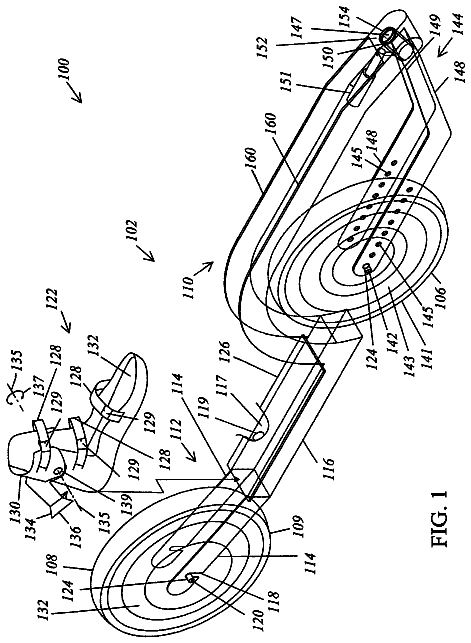
FIG. 1 illustrates a top view of an exemplary universal Cribbage game board used in playing multiple versions of a Cribbage game, in accordance with an embodiment of the present invention;
FIG. 2 illustrates a top view of a deck of cards used in playing multiple versions of the Cribbage game, in accordance with an embodiment of the present invention;
FIG. 3 illustrates a flowchart of an exemplary method of playing a Holtey 500 Cribbage card game with a universal Cribbage game board, in accordance with an embodiment of the present invention;
FIG. 4 illustrates a flowchart of an exemplary method of playing a Dealer's Cribbage card game with a universal Cribbage game board, in accordance with an embodiment of the present invention; and
FIG. 5 illustrates a flowchart of an exemplary method of playing a Magic Cribbage card game with a universal Cribbage game board, in accordance with an embodiment of the present invention.
Like reference numerals refer to like parts throughout the various views of the drawings.
The following detailed description is merely exemplary in nature and is not intended to limit the described embodiments or the application and uses of the described embodiments. As used herein, the word “exemplary” or “illustrative” means “serving as an example, instance, or illustration.” Any implementation described herein as “exemplary” or “illustrative” is not necessarily to be construed as preferred or advantageous over other implementations. All of the implementations described below are exemplary implementations provided to enable persons skilled in the art to make or use the embodiments of the disclosure and are not intended to limit the scope of the disclosure, which is defined by the claims. For purposes of description herein, the terms “upper,” “lower,” “left,” “rear,” “right,” “front,” “vertical,” “horizontal,” and derivatives thereof shall relate to the invention as oriented in FIG. 1 . Furthermore, there is no intention to be bound by any expressed or implied theory presented in the preceding technical field, background, brief summary or the following detailed description. It is also to be understood that the specific devices and processes illustrated in the attached drawings, and described in the following specification, are simply exemplary embodiments of the inventive concepts defined in the appended claims. Specific dimensions and other physical characteristics relating to the embodiments disclosed herein are therefore not to be considered as limiting, unless the claims expressly state otherwise.
A universal cribbage board 100 for multi-variation cribbage games and a method 300 , 300 , 400 of play is referenced in FIGS. 1-5 . The universal Cribbage game board 100 is configured for play with the traditional Cribbage card game, and variations of the traditional Cribbage card game.
As referenced in FIG. 1 , the universal Cribbage game board 100 is defined by a scoring track that is continuous, color-coded, and extended, so as to accommodate multiple versions of the traditional Cribbage card game. Each section of color along the scoring tracks are played with a variation of the traditional Cribbage card game. The scoring track comprises 130 scoring peg holes that mark points that are accumulated from playing a hand of cards. It is known in the art that the Cribbage board is used for scoring rather than the usual pencil and paper. The game board is equipped with holes that accommodate pegs. The game board works to speed up scoring, because pegging reduces the chances for errors in computing scores.
In some embodiments, a method 300 of playing the variations of the traditional Cribbage card game can be played by two or more people. Or four people can play two against two as partners. The players strategically play different sequences of playing the cards dealt to them to produce points through different point combinations of cards played against the backdrop of the traditional rules of a Cribbage card game. The player's hand of cards is strategically played against an opposing player's hand of cards and a crib hand of cards to score a winning amount of 121 or 131 points, depending on the version of Cribbage card game being played. The methods 300 , 400 , 500 of play includes at least three variations of the traditional Cribbage card game, which include: a “Holtey 500 Cribbage” card game; a “Dealer's Cribbage” card game; and a “Magic Cribbage” card game.
The fundamentals of the variations of the Cribbage card games are similar in many ways to that of the traditional Cribbage card game. The card scoring combinations, final scores, point values, and dealer advantages, and strategic options vary, however, for the three versions of Cribbage. Further, in all versions described herein, the players are dealt a hand of cards from a standard 52 deck of cards 200 .
The standard 52-card deck 200 is used. As FIG. 2 illustrates, the cards in play are: Ace card 202 , 2 card 204 , 3 card 206 , 4 card 208 , 5 card 210 , 6 card 212 , a 7 card 214 , an 8 card 216 , a 9 card 218 , a 10 card 220 , a Jack card 222 , a Queen card 224 , a King card 226 , and a Joker card 228 . Each card is assigned a value. For example, four suits of cards including spades, hearts, diamonds, and clubs, with each suit including an Ace card. The Ace card 202 is given a value of one point. The 2-10 cards 204 - 220 are given a point value of two through ten points, corresponding to the face value of the card. The Jack card 222 , Queen card 224 , and King card 226 are given a value of ten points. The point value of each card is combined with the card value of opposing player cards to create pairs, straights, point limits, and other point objectives, garnering points for the players. The points are recorded by advancing the peg across the peg scoring holes, as described below.
Initial rules for distributing the cards 200 to the players are as follows. From a shuffled deck of cards 200 face down, each player cuts a card, leaving at least four cards at wither end of the deck. If both players cut cards of the same rank, each player redraws. The player with the lower card deals the first hand. Thereafter, the turn to deal alternates between the players, except that the loser of the game deals first if another game is played. The dealer player has the right to shuffle last, and presents the cards to the non-dealer player for the cut, prior to dealing the cards. The dealer distributes six cards face down to ach player, beginning with the opposing player. One of three versions of the Cribbage game may then commence, as described below.
The dealt hands of cards are strategically played by the players to achieve different point combinations and odds available to each player. The cards are also played to maximize the player's chance of winning based on the best offensive and defensive strategies presented in each hand of cards. Nonetheless, the strategy for playing the hand of cards is different for each variation of the traditional Cribbage card game. In one embodiment, a first version of the Cribbage card game comprises a Holtey 500 Cribbage card game. A second version of the Cribbage card game comprises a Dealer's Cribbage card game. A third variation of the Cribbage card game comprises a Magic Cribbage card game. All variations, including the traditional Cribbage card game, however, are configured to be played on the universal Cribbage game board 100 , described below.
In one embodiment, illustrated in FIG. 1 , the universal Cribbage game board 100 is designed to mark points accumulated during card play, such as a peg board. In some embodiments, the game board 100 is defined by a flat panel having multiple continuous scoring tracks 102 a , 102 b . The scoring tracks 102 a - b include a plurality of scoring peg holes 118 a - n . As players accumulate points during card play, the playing pegs 124 a , 124 b , 124 c are incrementally advanced through the peg holes, along the scoring tracks 102 a - b to mark the points for the players. Pegs 124 d , and 124 e are used to mark, or track, the number of deals by each player. One player can get a white peg 124 d , and the other player receives a black peg 124 e , for example.
In one non-limiting embodiment, the flat panel is a game board having a flat, rectangular configuration, as is known in the art of board games. The game board may be constructed of suitable rigid material including but not limited to wood, metal or plastic. Further, the game board 100 may fold in half for efficient stowage.
The universal Cribbage game board 100 is of the type of continuous track Cribbage boards which, as the name implies, have one continuous line of 120 scoring peg holes for each player. The universal Cribbage game board 100 is placed to one side between the two players, and each player takes two pegs 124 a - d of the same color. (The pegs are placed in the game holes until the game begins.) Each time a player scores, they advance a peg along a row on their side of the board, counting one hole per point. Two pegs are used, and the rearmost peg jumps over the first peg to show the first increment in score. After another increase in score, the peg behind jumps over the peg in front to the appropriate hole to show the player's new score, and so on. In one possible embodiment, the players “go down” (away from the game holes) on the outer rows and “come up” on the inner rows.
In one embodiment of the game board 100 , the continuous scoring track is defined by 120 peg holes representing a total of 120 points in the traditional Cribbage card game. In other embodiments, the continuous scoring track has an additional 10 peg holes appended to the 120 peg holes, for a total of 130 peg holes; thereby representing a total of 130 points for playing a third variation of the traditional Cribbage card game. In yet another embodiment, both the 120 peg hole, and the 130 peg hole versions are on the same game board 100 , but color-coded to differentiate therebetween.
In one non-limiting embodiment, the universal Cribbage game board 100 comprises two separate scoring tracks 102 a , 102 b —one for each player. A central panel separates each track 102 a , 102 b . After drawing a card, and scoring points, the players advance a peg along the scoring peg holes 118 a - n in the continuous scoring tracks 102 a , 102 b to tally and mark points that scored from playing the hand of cards. The general goals of the game are to start at a starting peg hole 112 a - c at a first terminus of the scoring tracks 102 a , 102 b ; accumulate a maximum number of points based on playing of the cards, and traverse the scoring tracks 102 a , 102 b until reaching an ending peg hole 114 a - c disposed at the opposing terminus of the scoring tracks 102 a , 102 b . Thus, the starting points for both players are 124 a . The terminus for both players is 112 d.
Each player attempts to place the peg(s) into the ending peg hole 114 a - d before opposing player(s) reach the ending peg hole 114 a - d . A first ending peg hole 114 a begins at first section 104 of scoring tracks 102 a - b . A second ending peg hole 114 b begins at second section 106 of scoring tracks. A third ending peg hole 114 c begins at third section 106 of scoring tracks. A fourth ending peg hole 114 d begins at fourth section 108 of scoring tracks. Thus, the starting points for both players are 124 a . The terminus for both players is 112 d.
Each player, or team, is assigned one of the two scoring tracks 102 a - b . In one non-limiting embodiment, the scoring tracks 102 a - b follow an S-shaped path. The scoring tracks 102 a - b are defined by 130 scoring peg holes 118 a - n representing a total of 130 points in the multiple variations of the Cribbage card game. In one non-limiting embodiment, the scoring peg holes 118 a - n are defined by indicia distinguishing the scoring peg holes 118 a - n from each other. The indicia may include digits from 1 to 130, with each indicium representing a single point. Though in other embodiments, indicia are not displayed with each scoring peg hole.
In one embodiment, the continuous scoring tracks 102 a - b uses three distinct colors of rows to differentiate between the different versions of the traditional Cribbage card game. The scoring tracks 102 a - b are also defined by a first section 104 having a first color, a second section 106 having a second color, a third section 108 having a third color, and a fourth section 110 having a fourth color. The colors are a form of color-coding sections of the scoring tracks 102 a , 102 b for different variations of the Cribbage card game.
In one non-limiting embodiment, the first color 104 is green; the second color is 106 is red; the third color 108 is yellow; and the fourth color 110 is purple. In another embodiment, the 10 additional peg holes that complete 130 peg holes are color-coded (purple) to indicate a different variation from the traditional Cribbage card game. Any combination of colors or patterns may be used to distinguish between sections 104 , 106 , 108 , 110 of the scoring tracks 102 a - b.
In some embodiments of the universal Cribbage game board 100 , the first, second, and third sections 104 , 106 , 108 of the scoring tracks 102 a , 102 b are defined by 120 scoring peg holes. These first three sections of the scoring track are played with the first version of the Cribbage card game (Holtey 500 Cribbage card game), and the second version of the Cribbage card game (Dealer's Cribbage card game).
Further, the first, second, third sections 104 , 106 , 108 ; and additionally, the fourth sections 110 of the scoring tracks 102 a , 102 b are played with the third version of the Cribbage card (Magic Cribbage card game). The fourth section 110 of the scoring track is required because Magic Cribbage card game is a higher scoring game, and thus, requires more scoring peg holes.
Continuing with the configuration of the universal Cribbage game board 100 , the scoring tracks 102 a , 102 b also include a Privileges Section 116 a - d . This can include four sets (eight rows) of privilege peg holes 116 a - d , which are disposed adjacent to the ending peg hole 114 a - d . The Privilege Section 116 a - d are used to mark unique playing features of the second variation of the Cribbage card game (Dealer's Cribbage card game). This is because the second variation requires playing with such privilege rules—designed to make the game livelier and more dynamic.
The privilege peg holes 116 a - d can be disposed as four separate rows of privilege peg holes 116 a , 116 b , 116 c , 116 d arranged in a parallel, spaced-apart relationship with a corresponding four rows of privilege peg holes. These include: Re-deal peg holes 116 a , where players request a hand be redealt; Plead the Fifth peg holes 116 b where players utilize a fifth card from their dealt cards; Re-cut peg holes, where players request the deck be re-cut; Show peg holes 116 d , where a player can request to see the opposing players hand of cards. Additionally, a card dealing section 122 of the game board 100 allows players to mark the deal, or distribution of cards.
Turning now to FIGS. 3A-5B , the method of playing the traditional Cribbage card game requires the universal Cribbage game board 100 ( FIG. 1 ), described above, and a standard deck of cards 200 ( FIG. 2 ). The three versions of the Cribbage game are substantially the same, expect for a few scoring and card dealing variations. In all three methods 300 , 400 , 500 of playing the Cribbage game, two players may play the game. It is also possible that more than two players (3 or 4, and up to 8) play, forming 2-4 teams or playing individually. One of the players serves as the dealer.
Initially, each player places two matching pegs 124 a - d in the start peg holes 112 a - d of their respective scoring track 102 a , 102 b . The deck of cards 200 is then shuffled by the dealer, who is one of the players. Next, the dealer distributes each player a hand of at least four cards from the deck of cards 200 . In one embodiment, six cards are initially distributed by the dealer. Next, each player places two cards from the dealt hand of six cards into a crib. The crib is formed for future point scoring in a card counting portion of the Cribbage card game. The cut-card from the initial deck of cards becomes the fifth card of each player's hand and of the crib hand.
The first player, who serves as the dealer, cuts a starter card from the deck of playing cards. The players then sequentially play cards from their hand of cards. As each player plays a card, they audibly call out the point value of the card being played. The point value for the cards is as follows: The Jack card 222 , Queen card 224 , and King card 226 count ten points each; the Ace card 202 counts one point; and every other card counts its face value. The players have to audibly count any points that are scored. Failing to audibly count out points can be penalized, as described below. Audibly calling out played cards continues as the players take turns announcing a running total of points reached by the addition of the last card to all of those previously played. For example, the non-dealer player begins with a 4 card 208 , saying “Four.” The dealer then plays a 9 card 218 and audibly calls “Thirteen.”
The players strategically play cards to achieve a scoring combination. One scoring combination is a “15 Combination”, where the sum of the cards is 15. For example, in the “15” card scoring combination, the card played brings the running total of cards played to achieve the “15 Combination”. This scores 2 points for the player who dealt the last card. The peg 124 a is then advanced 2 spaces, corresponding to the 2 points. Every “15 Combination” created from the player's hand and crib scores 2 points. For example, a 5 card 210 and a 10 card 220 sum up to a “15 Combination”. A 7 card 214 and an 8 card 216 also sum up to a “15 Combination”. Other “15 Combinations” include: 3-2-10 cards, 4-5-6 cards, etc.
In another card scoring combination, a “Pair Combination” of same cards scores 2 points. Thus, when a card is played that is the same value (or same face-card rank) as the prior played card the “Pair Combination” wins 2 points in each hand or crib.
In another card scoring combination, 6 points are scored if the played card is the “Third of a Kind” sequentially in card play. The “Third of a Kind” scores 6 points in each hand or crib. For example, three sequential King cards constitute a “Third of a Kind”.
In another card scoring combination, 12 points are scored if the played card is the “Fourth of a Kind” sequentially in card play. The “Fourth of a Kind” scores 6 points in each hand or crib. For example, four sequential cards having the same coat constitute a “Fourth of a Kind”.
The description continues in the full USPTO document.
About 7,058 words. The USPTO PDF has it with every drawing.
Fees are due 3.5, 7.5 and 11.5 years after grant. This patent expired on December 14, 2025, so the fee marked "not paid" was the one that went unpaid.
Universal cribbage board for multi-variation cribbage games and method of play
Filed May 2020 · granted Dec 2021Earlier publications, parents and continuations. None of them can still be enforced, or this patent would not be listed.
Prior art cited by the examiner or applicant. Useful when you check your own idea for novelty.
Everything on this page comes from the documents linked above.