 Lapsed, fee not paid8 drawings
Consumer Products · US 11,278,152 B2
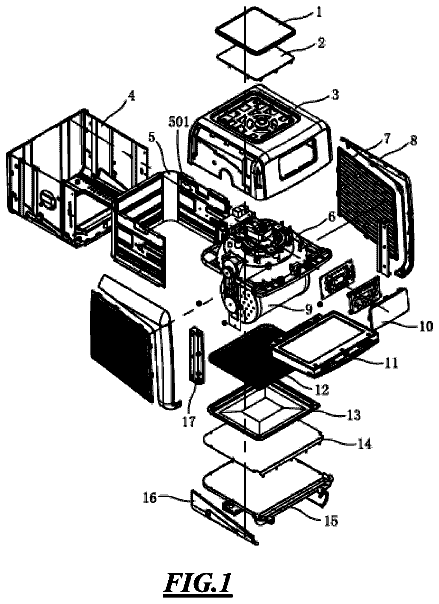
Rotisserie air-fryer oven
An air-fryer oven with a motorized rotating cage inside, so food tumbles in the hot air for even cooking.
US 8,507,778 B2 · Title as filed: Self-assembled polyhedra · Inventors: Olson; Arthur J.
Sheet 1 of 11 from the published document. All sheets in the USPTO PDF
Magnetic or snap-fit tiles that shake together into closed polyhedra, the way virus shells assemble themselves.
Self-assembling multimeric physical models of closed polyhedral structures made of structurally symmetric units, and which mimic the structure and self-assembly characteristics of naturally occurring systems such as viral capsids, are provided. Also provided are methods of creating structurally symmetric units, kits for forming self-assembling physical models of polyhedral structures, and methods of forming the same.
The present invention relates generally to self-assembly and modeling of stochastic phenomena, and, more particularly, to pattern-selective self-assembly of component articles, spanning from the molecular level to the macroscopic range. Nature is driven and controlled primarily by stochastic processes and events. A stochastic process is based on random occurrences of individual events, which cannot be predicted, although measuring the distribution of all observations usually follows a predictable pattern that can be quantified statistically. An example of a stochastic event is the decay of radioactive material. While it is impossible to predict when an individual atom will undergo decay and emit radiation, the behavior of a clump of radioactive matter can be characterized by a measurable and thus predictable half-life time. An example of a stochastic process is pressure in a gas. Even th
The first 3 of 11 drawing sheets from the published document, cropped to the drawing. Every sheet is in the USPTO PDF.
Independent claims and the claims that build on them, read from each claim's text.
What the patent claimed, word for word. All of it is now free to use.
The present invention relates generally to self-assembly and modeling of stochastic phenomena, and, more particularly, to pattern-selective self-assembly of component articles, spanning from the molecular level to the macroscopic range.
Nature is driven and controlled primarily by stochastic processes and events. A stochastic process is based on random occurrences of individual events, which cannot be predicted, although measuring the distribution of all observations usually follows a predictable pattern that can be quantified statistically.
An example of a stochastic event is the decay of radioactive material. While it is impossible to predict when an individual atom will undergo decay and emit radiation, the behavior of a clump of radioactive matter can be characterized by a measurable and thus predictable half-life time.
An example of a stochastic process is pressure in a gas. Even though each molecule is moving deterministically, a collection of molecules in the gaseous state is practically and computationally unpredictable. Yet the behavior of a large enough collection of molecules in the gaseous state will exhibit predictable properties which emerge from the stochastic characteristics of the system, such as filling an enclosure, exerting equal pressure on its walls, diffusing at a known rate along concentration gradients, and the likes.
Another example of a stochastic process in the natural world is protein folding. The polypeptide chain is characterized by a particular sequence of amino acids, which comprises a long polymeric molecule having many free-to-rotate backbone bonds and thus can take an enormous number of conformations. Yet, typically, a given protein will assume one particular configuration when allowed to exist in its native environment. Driven by temperature-dependent stochastic events, the protein will reach a local energetic minima manifested by a unique and functional three-dimensional structure.
Small and large natural systems are driven by stochastic process, spanning from chemical reactions, via the assembly of multi-component systems to the planetary weather system and the earth tectonic movements. Modeling such events and processes has challenged natural scientists, mathematicians and computer experts for decades. Super-computer still struggles to solve problems and to depict even simple stochastic systems, thus the formidable hurdle of measuring and fully describing such systems remains a challenge.
The formation of a viral capsid is a classical example of a stochastically controlled process of an assembly of a multi-component system, wherein multiple individual units, namely capsomeres, self-assemble to form the capsid. A capsomere is often a complexed yet symmetric multimeric structure which is comprised of several sub-structural units, each made of several protein chains having distinct sequences (viral coat proteins). After solving several crystal structures of viral coat proteins, capsomeres and intact whole capsids, scientists turned to the question of the metrics of such smilingly simple stochastic assembly process of inanimate objects, which is undoubtedly one of nature's wonders.
A capsomere is a protein-based subunit of a viral capsid, designed to have strong affinity to other identical capsomeres so as to form a particular structure and, upon reaching a minimal number of subunits, self-assemble to form that structure, namely the capsid. Many viral capsids are spheroids, or have one circular dimension (cylindrical, helical etc.). The sphere is the simplest finite surface that partitions space. Nature uses this form at all scales in both the inanimate and living world for the basic physical property of encapsulation. Spherical virus capsids, for example, enclose space by utilizing the geometry of the icosahedron, thus exploiting the economy of this form in terms of both surface-to-volume ratio and genetic efficiency of subunit-based symmetric assembly.
Icosahedron-shaped capsids have six 5-fold rotation axes, ten 3-fold axes, and fifteen 2-fold axes, providing equivalent environments for 60 identical subunits, similar to a pentakis dodecahedron, which is a truncated icosahedron having 60 faces. Icosahedral symmetry provides the largest surface-to-volume ratio for identical assembly units, and many virus capsids, such as the bean pod mottle virus, the turnip crinkle virus, the picornaviruses (family Picornaviridae, a large group of the smallest known RNA viruses), the comovirus and the poliovirus, utilize this symmetry to create particles ranging in size from 200 .ANG. to 2000 .ANG. (see, FIG. 1). Such capsids form spontaneously from their components under the proper conditions, and come apart under other conditions, facilitating the viral life cycle. The ubiquitous icosahedral symmetry characterizes many other natural objects, including microscopic quasicrystals and Buckminsterfullerene (C60), which are characterized by a small interior that can accommodate single atoms or small molecules.
There are several reasons why viruses adopt icosahedral symmetry. One is that triangulating (dividing into three-sided polygons) a dome into twenty is the most efficient way of producing a shell of equivalently bound identical structures. This arrangement of twenty triangles also forms a stable structure from minimal free energy considerations, however all known viruses have more than twenty coat proteins. Viral coats are assumed to have more than twenty proteins due to size consideration, namely the volume enclosed by twenty protein subunits would not be sufficient to encapsulate the genetic material needed for the viral replication. Another reason there are no icosahedral viral capsids with only 20 proteins is that the individual proteins themselves would have to exhibit perfect 3-fold symmetry. Since it is theoretically impossible for a single protein chain, having two ends, to posses true 3-fold symmetry, it is genetically more efficient for three identical protein chains to assemble and form one symmetric trimer. Sixty subunits can easily be arranged symmetrically to form an icosahedron, yet only very few viruses have such a small number of coat proteins, mostly since it is difficult to maintain an integral particle with a small number of subunits from free energy considerations.
Icosahedral viral capsids typically comprise 60.times.T coat proteins, wherein T is oftentimes referred to as the triangulation number, and takes the values of 1, 3, 4, 7, 9, 12 and even higher. Each of the twenty facets of a T=1 icosahedron has an actual icosahedral 3-fold symmetry; hence each triangle can be subdivided into 3 equal subunits. Considering each subunit contains one coat protein, the capsid comprises a total of 20.times.3=60 coat proteins; each protein is in exactly the same neighboring environment as all the others, and the coat proteins are all chemically identical, namely, have the same amino acid sequence. If the proteins which constitute together the viral coat are not chemically identical, and the proteins are quasi- or pseudo-equivalent, then a quasi 3-fold axis is formed and typically referred to as a pseudo 3-fold axis. However, the different protein chains of the poliovirus and rhinovirus are not quasi-equivalent, but rather assemble into the basic building block of a T=1 structure. The triangulation number of poliovirus and rhinovirus is mathematically T=1, yet the structure of the virion closely resembles that of a T=3 virus and thus these viruses are said to posses a p=3 triangulation number, namely a pseudo-T=3 number. Quasi-equivalence occurs when identical protein chains form a capsid with T>1 (i.e. when there are more than 60 identical units in the capsid), in which case the environments around the identical chains cannot all be exactly identical. However, more than sixty subunits cannot be arranged in an equivalent fashion in an icosahedron, namely some will experience a different neighboring environment than others. In a T=3 virus, such as poliovirus, there are 3 different subunits per 60 triangles. The bean pod mottle virus is subtly different; it is composed of 60 triangular units, as in a pentakis dodecahedron, wherein each unit is composed of 3 antiparallel beta-barrel coat proteins. The minimum free energy solution for a T=4 virus, such as the hepatitis B virus, is to further divide each triangle into four triangles and place a subunit at each corner, thus there will be 12.times.20=240 coat proteins, with 12 pentamers and 30 hexamers, which do not experience an equivalent environment except 180 of them while the remaining 60 are making similar contacts and are said to be quasi-equivalent.
The structure of the envelope (outer coat) of the human immunodeficiency virus (HIV) has an overall shape which is considered to be icosahedral, having a skewed icosahedral symmetry with a triangulation number of 71. The capsid of HIV is also icosahedral and may contain 1890 coat proteins with a triangulation number of 63. It is still unknown if the nucleocapsid of HIV (inner-most coat) adopts an icosahedral structure, or a helical nucleofilament structure.
It is evident that the challenge of truly describing natural stochastic assemblies such as the formation of an icosahedral capsid from its capsomeres is still beyond currently available supercomputing machines, and hence has not been modeled computationally at the absolute level heretofore. A solid or rigid model which can represent a physical analog of a stochastically assembled system, capable of simulating these self-assembly and disassembly processes and take into account all the abovementioned symmetry and energy considerations, including the complexity of the coat-protein population, its environmental-, sequence- and structural equivalency, quasi-equivalency, nonequivalency and interrelationships etc., is also a formidable challenge, practically unattainable hitherto.
U.S. Application having publication number 20050227213 teaches a molecular modeling kit that comprises three-dimensional bodies, which provide a physical representation of one or more atoms that can attach to one another by self-reorienting magnets. As much as these bodies can represent atoms such as carbon atoms, at least in the sense of the number of bonds each atom can form, these bodies are not designed to self-assemble into a defined structure and hence must be constructed by hand.
U.S. Pat. No. 4,836,787 teaches a construction kit educational aid and toy which comprises sheet material building units in the shape of different regular polygons having strips of hook-and-pile fastening materials along their side edges. According to the teachings of this patent, different units can be connected edge-to-edge by simply placing the desired edges in contact to form a wide variety of two-dimensional or three-dimensional arrays or shapes. However, other than providing the means to construct three dimensional symmetric solids, U.S. Pat. No. 4,836,787 does not teach any of the basic aspects of forming a model of a closed, self-assembled chemical multimer (e.g., a model of icosahedral capsid assembly, such as self-assembly and capsomere/subunit/coat protein lack of equivalency).
U.S. Pat. No. 5,906,530 teaches polyhedral structural systems of releasable joined balloons, which can be used as a novelty article, an educational mean, or play item. According to the teachings of this patent, the system comprises modular inflated cells having connection members placed about each cells periphery, and configured to form various polyhedral shapes. Again, as in U.S. Pat. No. 4,836,787, other than providing the means to construct three dimensional symmetric assemblies, U.S. Pat. No. 5,906,530 neither teaches self-assembly nor other basic aspects of forming a model of a closed, self-assembled chemical multimer such as icosahedral capsid assembly.
U.S. Pat. No. 6,507,989 teaches self-assembly of mesoscale objects, which include component articles that can be pinned at a fluid/fluid interface, or provided in a fluid, or provided in proximity of a surface, and caused to self-assemble optionally via agitation. According to the teachings of this patent, a self-assembling electrical circuit can be constructed. While U.S. Pat. No. 6,507,989 teaches a physical model of a self-assembled system, it fails to provide the means to self-assemble a highly symmetrical three-dimensional object, let alone an icosahedral. It also fails to address the issue of dissimilar subunits, which are typical and essential to viral capsid formation.
Other disclosures, such as U.S. Pat. Nos. 6,517,763 and 7,007,370, teach self-assembled super-structures composed of three-dimensional and highly symmetrical sub-structures, but fail to teach the self-assembly of the symmetrical sub-structures or any of the concepts of the stochastic assembly of viral capsids.
The tools and methods for creating physical models of macromolecules exist and used for almost a century, as presented by Bailey, M. J. et al. in "The use of solid physical models for the study of macromolecular assembly" [Current Opinion in Structural Biology 1998, 8:202-208], yet these models are typically used to study the outer surface of macromolecules and their interactions with the outer surface of others in a static manner, and are not used to study dynamic stochastic processes.
There is thus a widely recognized need for, and it would be highly advantageous to have, a physical analog which can model stochastic assembly of viral capsids and other self-assembled structures, devoid of the above limitations.
According to one aspect of the present invention there is provided a method of creating a closed and self-assembled multimer model structure, the method includes:
(a) providing several structurally symmetric units that form the self-assembled multimer structure, each of the units having several types of basic components, the basic components comprise more than one type of attachment entity being positioned in or on a portion thereof, the units having structural complementarity to one another so as to form the closed and self-assembled multimer structure upon inducing proximity and orientation of the attachment entities; and
(b) encouraging the units to physically interact therebetween via the attachment entities, thereby creating the closed and self-assembled multimer structure.
According to features in preferred embodiments of the invention described below, the closed and self-assembled multimer structure is a physical model of a closed and self-assembled chemical multimer structure, whereas the structurally symmetric units are atomic model units of structurally symmetric chemical monomers that form the self-assembled chemical multimer structure.
According to further features in preferred embodiments of the invention, the attachment entities are for modeling chemical affinity moieties of the structurally symmetric chemical monomers.
According to still further features in preferred embodiments of the invention, encouraging the units to physically interact therebetween is effected by applying a kinetic energy to the structurally symmetric units.
According to still further features in preferred embodiments of the invention, kinetic energy is applied via a technique selected from the group consisting of shaking, agitating, afloating, mixing, tossing, tumbling and colliding.
According to still further features in preferred embodiments of the invention, the attachment entities are directional.
According to still further features in the described preferred embodiments, the attachment entities are selected from the group consisting of magnetic entities, electromagnetic entities, static charge entities, hook-and-loop entities, spline-and-groove entities and a combination thereof.
According to still further features in the described preferred embodiments, the self-assembled multimer structure is selected from the group consisting of a model of a viral capsid and a model of a closed hull particle.
According to still further features in the described preferred embodiments, the viral capsid has an icosahedral morphology.
According to still further features in the described preferred embodiments, the closed hull particle has a morphology selected from the group consisting of tetrahedral morphology, icosahedral morphology, cubical morphology, octahedral morphology and dodecahedral morphology.
According to still further features in the described preferred embodiments, each of the structurally symmetric units has a 5-fold rotational symmetry.
According to still further features in the described preferred embodiments, each of the structurally symmetric units has a rotational symmetry selected from the group of 3-fold rotational symmetry, 4-fold rotational symmetry and 5-fold rotational symmetry.
According to still further features in preferred embodiments of the invention, the structurally symmetric units are structurally identical to one another.
According to still further features in preferred embodiments of the invention, the position and direction of the attachment entities in each of the basic components is identical.
According to still further features in preferred embodiments of the invention, the structurally symmetric units comprise at least two different types of basic components.
According to still further features in preferred embodiments of the invention, the direction of the attachment entities in one type of the basic components is reversed with respect a direction of the attachment entities in another type of the basic components.
According to still further features in preferred embodiments of the invention, each of the structurally symmetric units has a 5-fold rotational symmetry and the direction of the attachment entities in one type of the basic components is reversed with respect a direction of the attachment entities in another type of the basic components.
According to still further features in preferred embodiments of the invention, the structurally symmetric units comprise two different types of basic components.
According to another aspect of the present invention there is provided a method of modeling a self-assembly process of a closed and self-assembled multimer structure, the method includes:
(a) providing a plurality of structurally symmetric units that form the self-assembled multimer structure, each of the structurally symmetric units having a plurality of at least one type of basic components, the basic components comprise at least one type of attachment entity being positioned in or on a portion thereof, the units having structural complementarity to one another so as to form the closed and self-assembled multimer structure upon inducing proximity and orientation of the attachment entities;
(b) encouraging the plurality of the units to physically interact therebetween via the attachment entities; and
(c) determining if a self-assembled multimer structure is created, whereby creation of a closed and self-assembled multimer structure is indicative for the self-assembly process.
According to further features in preferred embodiments of the invention, the modeling of a self-assembly process is capable of predicting a structure of the closed and self-assembled multimer structure and predicting an effect of a structural change in at least of the structurally symmetric units or at least one of the basic components or a change in at least one of the attachment entity.
According to yet another aspect of the present invention there is provided a kit for creating a physical model of a closed and self-assembled multimer structure, the kit includes several structurally symmetric units that form the self-assembled multimer structure, each of the structurally symmetric units having several types of basic components, the basic components comprise at least one type of attachment entity being positioned in or on a portion thereof, the structurally symmetric units having structural complementarity to one another so as to form the closed and self-assembled multimer structure upon inducing proximity and orientation of the attachment entities, such that by encouraging the plurality of the units to physically interact therebetween via the attachment entities, the closed and self-assembled multimer structure is formed.
According to features in preferred embodiments of the invention, the kit further includes a container for holding the structurally symmetric units that form the self-assembled multimer structure.
According to still another aspect of the present invention there is provided a closed and self-assembled multimer model structure, comprising several structurally symmetric units that form the self-assembled multimer structure, each of the units having several types of basic components, the basic components comprise at least one type of attachment entity being positioned in or on a portion thereof, the units having structural complementarity to one another so as to form the closed and self-assembled multimer structure upon inducing proximity and orientation of the attachment entities.
According to features in preferred embodiments of the invention, the closed and self-assembled multimer model structure is a physical model of a closed and self-assembled chemical multimer structure.
According to still further features in preferred embodiments of the invention, the structurally symmetric units are atomic model units of structurally symmetric chemical monomers that form the self-assembled chemical multimer structure.
According to still further features in preferred embodiments of the invention, the attachment entities are for modeling chemical affinity moieties of the chemical monomers.
According to still another aspect of the present invention there is provided a method of creating a structurally symmetric unit that form a closed and self-assembled multimer model structure, the method includes forming the unit and positioning least one type of attachment entity in or on the unit; whereas the structurally symmetric unit having structural complementarity to identical or different structurally symmetric units, so as to form the closed and self-assembled multimer structure upon inducing proximity and orientation of the attachment entities.
According to features in preferred embodiments of the invention, the formation the unit is selected from the group consisting of 3D printing, molding, casting and sculpturing.
According to still another aspect of the present invention there is provided a structurally symmetric unit that can be used in forming a closed and self-assembled multimer model structure, the structurally symmetric unit comprising at least one type of attachment entity being positioned in or on the structurally symmetric unit, the structurally symmetric unit having structural complementarity to identical or different structurally symmetric units, so as to form the closed and self-assembled multimer model structure upon inducing proximity and orientation of the attachment entities.
Unless otherwise defined, all technical and scientific terms used herein have the same meaning as commonly understood by one of ordinary skill in the art to which this invention belongs. Although methods and materials similar or equivalent to those described herein can be used in the practice or testing of the present invention, suitable methods and materials are described below. In case of conflict, the patent specification, including definitions, will control. In addition, the materials, methods, and examples are illustrative only and not intended to be limiting.
As used herein, the singular form "a", "an" and "the" include plural references unless the context clearly dictates otherwise. For example, the term "a protein" or "at least one protein" may include a plurality of proteins, including mixtures thereof.
As used herein the term "about" refers to .+-.10%.
Throughout this disclosure, various aspects of this invention can be presented in a range format. It should be understood that the description in range format is merely for convenience and brevity and should not be construed as an inflexible limitation on the scope of the invention. Accordingly, the description of a range should be considered to have specifically disclosed all the possible subranges as well as individual numerical values within that range. For example, description of a range such as from 1 to 6 should be considered to have specifically disclosed subranges such as from 1 to 3, from 1 to 4, from 1 to 5, from 2 to 4, from 2 to 6, from 3 to 6 etc., as well as individual numbers within that range, for example, 1, 2, 3, 4, 5, and 6. This applies regardless of the breadth of the range.
Whenever a numerical range is indicated herein, it is meant to include any cited numeral (fractional or integral) within the indicated range. The phrases "ranging/ranges between" a first indicate number and a second indicate number and "ranging/ranges from" a first indicate number "to" a second indicate number are used herein interchangeably and are meant to include the first and second indicated numbers and all the fractional and integral numerals therebetween.
As used herein throughout, the term "comprising" means that other steps and ingredients that do not affect the final result can be added. This term encompasses the terms "consisting of" and "consisting essentially of".
The phrase "consisting essentially of" means that the composition or method may include additional ingredients and/or steps, but only if the additional ingredients and/or steps do not materially alter the basic and novel characteristics of the claimed composition or method.
The term "method" or "process" refers to manners, means, techniques and procedures for accomplishing a given task including, but not limited to, those manners, means, techniques and procedures either known to, or readily developed from known manners, means, techniques and procedures by practitioners of the chemical, pharmacological, biological, biochemical and medical arts.
The invention is herein described, by way of example only, with reference to the accompanying drawings. With specific reference now to the drawings in detail, it is stressed that the particulars shown are by way of example and for purposes of illustrative discussion of the preferred embodiments of the present invention only, and are presented in the cause of providing what is believed to be the most useful and readily understood description of the principles and conceptual aspects of the invention. In this regard, no attempt is made to show structural details of the invention in more detail than is necessary for a fundamental understanding of the invention, the description taken with the drawings making apparent to those skilled in the art how the several forms of the invention may be embodied in practice.
In the drawings:
FIGS. 1a-c present a computer-generated illustration of the three dimensional structure of an icosahedral viral capsid of Satellite Tobacco Mosaic Virus (PDB entry 1a34, FIG. 1a), an icosahedral viral capsid of Polio Virus Type 3 (Sabin Strain, PDB: 1pvc, FIG. 1b), and an icosahedral viral capsid of Reovirus core (PDB: 1ej6, FIG. 1c), showing how evolution creates closed hull particles from proteins which can range in size from 200 .ANG. to 2000 .ANG. (the three structure illustrations are drawn on the same scale);
FIGS. 2a-e present basic model units of capsomeres of the Poliovirus capsid as a computer-generated illustration of the surface of two poliovirus pentameric capsomeres, wherein the positively charged portions of the capsomere-to-capsomere interaction interface area are marked in black and negatively charged portions thereof are marked in white, showing the complementarity between the two sides in the interface of two capsomeres (FIG. 2b), as a computer-generated illustration of one poliovirus pentameric capsomere, highlighting one subunit of the pentameric capsomere as opaque and the other four subunits as semi-transparent (FIG. 2b), and as three serial photographs taken during a stochastic self-assembly experiment effected by shaking 12 identical physical model units of the pentameric poliovirus capsomere in a glass vial, showing no assembly and no interaction between the model units prior to commencing the shaking (FIG. 2c), partially formed capsid intermediates (FIG. 2d), and a fully formed model of the poliovirus capsid self-assembled after 1-2 minutes of manual shaking (FIG. 2e);
FIGS. 3a-d present the components and assembly of simple tapered five-fold symmetric pentagonal tiles of thickness t into an intact dodecahedral container, wherein twelve identical pentagonal tiles attach by means of two
cylindrical magnets imbedded on each of the five sides of each tile, to form aligned complementary magnetic interactions between tiles. FIG. 3A shows an individual pentagonal tile
with magnets
showing opposite polarities (N and S) on their outward faces, which are inserted into cylindrical holes
on each face of the pentagonal tile showing the 5-fold symmetry axis of the tile (4). All edges between the top and bottom pentagonal faces of the tile are constructed such that extending the edge line inward it will pass through the center of the completely assembled dodecahedral container. FIG. 3B shows two pentagonal tiles
aligning to one another along one edge, so that the magnets have complementary faces aligning. FIG. 3C shows six such pentagonal tiles assembled into half a dodecahedral container, with all magnets paired except for those on the exposed open edge of five of the tiles. FIG. 3D shows the last step in the assembly of the dodecahedral container, wherein one
pentagonal tile
aligns with an assembly of eleven pentagonal tiles
such that the magnets on each have complementary faces aligned, causing its attachment.
FIGS. 4a-c present the components and assembly of simple three-fold symmetric triangular tiles of thickness t into an intact tetrahedral container, wherein four identical triangular tiles attach by means two
cylindrical magnets imbedded on each of the three sides of each tile, to form aligned complementary magnetic interactions between tiles. FIG. 4A shows an individual 3-fold symmetric triangular tile
sighting down the three fold axis, with magnets
on one edge face aligned with the cylindrical holes
in that edge face of the tile, but not yet inserted, and magnets
on the other two edge faces inserted into the cylindrical holes in the tile. FIG. 4b shows two triangular tiles
adjoined through aligned complementary magnet interactions, to form two faces of the assembled tetrahedral container. FIG. 4c shows the last step in the assembly of the tetrahedral container, wherein one triangular tile
aligns with an assembly of three triangular tiles
such that the magnets on each have complementary faces aligned, causing its attachment.
FIGS. 5a-b present two serial photographs taken during a simulation experiment of the stochastic self-assembly, wherein twelve identical copies of dark grey tiles
(physical model units of the pentameric poliovirus capsomere) and twelve identical light grey tiles
were placed in a 132 cm.sup.2 plastic vial (FIG. 5a), which are chiral enantiomers with respect to one group to the other by virtue of reversing the polarity of the magnets along the tile's edges, and shaken vigorously by hand for about 10 minutes until two spheres, each containing only one color scheme (FIG. 5b), have self-resolved and assembled into two capsids each composed of only one type of colored (homochiral) tile;
FIGS. 6a-c present a pentakis dodecahedron-shaped capsid system composed of two heterogeneous capsomere (tile) types having two inter-complimentary edge types, as a schematic illustration of the combinatorial scheme (FIG. 6a) wherein one edge type is marked in black which binds to the other edge type marked in grey, thus constituting the two tile types system which includes two copies of one tile type having 5 identical "black edges", and ten copies of the other tile type having two "black edges" and 3 "grey edges", wherein the dashed lines connect between a "black edge" and a "grey edge" which are in contact in the resulting pentakis dodecahedron, and in two photographs of the physical model thereof showing all twelve tiles of the disassembled capsid (FIG. 6b) and the resulting assembled capsid (FIG. 6c);
FIGS. 7a-c present a pentakis dodecahedron-shaped capsid system composed of four heterogeneous capsomere (tile) types having two inter-complimentary edge types, one marked in black and the other in grey, as schematic illustrations of three combinatorial schemes, each having one tile having 5 identical "black edges", one tile having 5 identical "grey edges", five tile having four "black edges" and one "grey edge", and 5 tiles having four "grey edges" and one "black edge", wherein the dashed lines connect between a "black edge" and a "grey edge" which are in contact in the resulting pentakis dodecahedron;
FIGS. 8a-c present molecular illustrations of a corannulene molecule, showing the natural curvature of corannulene as emphasized in a side view (FIG. 8a), the 5-fold symmetry in a "ball-and-stick" diagram (FIG. 8b) and a "space-filling" diagram of corannulene (FIG. 8c), demonstrating why corannulene is an ideal core molecule (atomic model unit) for a closed chemical multimer; and
FIGS. 9a-c present the chemical monomer sym-penta-.gamma.-lactam-corannulene, with a schematic illustration of two different modes of hydrogen bond network configurations between three sym-penta-.gamma.-lactam-corannulene molecules (FIG. 9a), marked as Mode A on the left and Mode B on the right, with a photograph of two physical and magnet-fitted model units of a sym-penta-.gamma.-lactam-corannulene molecule (FIG. 9b), wherein the model unit on the left-hand side of the photograph shows the concave face of the model unit and the magnets placed on the N-hydrogen and oxygen atoms, and wherein the model unit on the right-hand side shows the convex face of the model unit and obscuring the magnets due to the curvature thereof, and with a photograph of two physical models of dodecahedral hemispheres, each constructed from six identical magnet-fitted physical model units of sym-penta-.gamma.-lactam-corannulene (FIG. 9c), wherein the hemisphere on the right-hand side of the photograph is built according to the hydrogen bond network configuration shown in Mode A, and wherein the hemisphere on the left-hand side of the photograph is built according to the hydrogen bond network configuration shown in Mode B.
The present invention is of multimeric physical models which are capable of self-assembling into closed polyhedral structures. More specifically, the present invention is of closed self-assembled multimeric models which are made of structurally symmetric units, each having a basic asymmetric component that is characterized by an attachment entity for attachment to the other basic components of the model. In some embodiments of the present invention, the polyhedral models mimic the structure and self-assembly characteristics of naturally occurring viral capsids, and further offer a mean to investigate stochastic assembly processes which take place in microscopic molecular scale, such as viral capsids assembly as well as other chemical systems. The present invention is further of methods of creating structurally symmetric units which can be used in, for example, parts in a kit for forming multimeric physical models therefrom, and further of methods of forming the same.
The principles and operation of the present invention may be better understood with reference to the drawings and accompanying descriptions.
Before explaining at least one embodiment of the invention in detail, it is to be understood that the invention is not limited in its application to the details set forth in the following description or exemplified by the Examples. The invention is capable of other embodiments or of being practiced or carried out in various ways. Also, it is to be understood that the phraseology and terminology employed herein is for the purpose of description and should not be regarded as limiting.
As discussed hereinabove, one of the more intriguing phenomena in nature is the self-assembly of viral capsids, which constitute some of the more efficiently ordered and highly symmetric structures in the natural world, from fundamentally asymmetric, and currently still considered rather inconsistent, incoherent and illogical structures nature can offer, namely proteins. The structural study of viral capsids was forwardly pushed by the elucidation of the first three dimensional structure of the tomato bushy stunt virus by X-ray diffraction at atomic resolution at 1976-7 [Winkler, F. K., Schutt, C. E., Harrison, S. C. and Bricogne G., Nature, 1977, 265, 509-513; and Harrison, S. C., Olson, A. J., Schutt, C. E., Winkler, F. K. and Bricogne G., Nature, 23 Nov. 1978, 276, 368-373]. In this seminal work it was reported that the coat of the tomato bushy stunt virus is built from protein subunits having rigid domains connected by a flexible hinge, and that two states of the hinge are present in the T=3 icosahedral structure. As the field of viral structural studies by X-ray crystallography developed, more and more capsids structures were elucidated, leading to some of the most enlightening discoveries of modern science, particularly in the field of protein structures.
One of the most needed tools of the trade of X-ray crystallography is a 3-dimensional model of the structure under study. This tool is required not only for the realization of the convoluted numeric results of the X-ray diffraction experiment (atomic coordinates), or for the illustration thereof, but also for more in-depth studies of chemical and biologic aspects of the subject under study. With the advancement in computer graphics, most of this requirement is met by computer-generated imagery in two and three dimensions. Yet, for the demonstration of particular cases and features thereof, there is no substitute for a physical model which can be handled and observed manually.
However, the construction of physical models for biologic entities, particularly molecular entities is no trivial matter. To meet that end several new and innovative groups took upon this endeavor and successfully translated numeric structural data into physical models which are as accurate as the experimental crystallographic result. Solid freeform fabrication methods are covered by several technological approaches known as 3D printing, fused deposition modeling (FDM), stereolithography and rapid prototyping. More information regarding some examples of these techniques can be found in, for example, http://www.efunda.com/processes/rapid_prototyping/lom.cfm which presents the laminated object manufacturing (LOM) process, and http://intl.stratasys.com/ which is the official source of FDM prototyping.
One of the features of viral capsids, which are still not practically realized by computer-generated graphics, is the stochastic process of self-assembly of coat proteins into the intact capsids. In practice, the prediction, let alone the visualization of much simpler chemical events, is still not in reach of contemporary computing machines.
The description continues in the full USPTO document.
Fees are due 3.5, 7.5 and 11.5 years after grant. This patent expired on August 13, 2025, so the fee marked "not paid" was the one that went unpaid.
SELF-ASSEMBLED POLYHEDRA
Filed Mar 2008 · published Jul 2010Self-assembled polyhedra
Filed Mar 2008 · granted Aug 2013Earlier publications, parents and continuations. None of them can still be enforced, or this patent would not be listed.
Prior art cited by the examiner or applicant. Useful when you check your own idea for novelty.
Names, summaries, modern angles and build ratings are Patent Yard's editorial notes. Everything else on this page comes from the documents linked above.