 Lapsed, fee not paid8 drawings
Consumer Products · US 11,278,152 B2
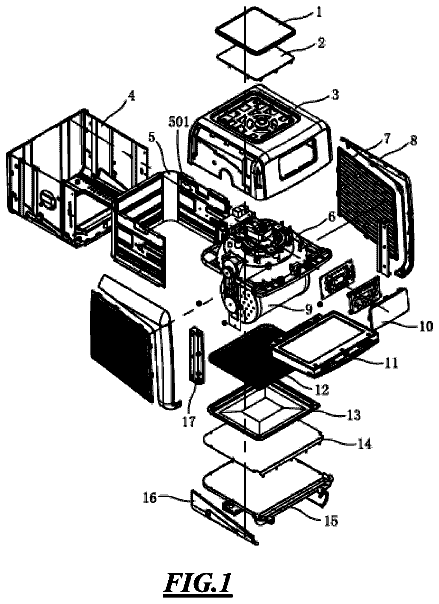
Rotisserie air-fryer oven
An air-fryer oven with a motorized rotating cage inside, so food tumbles in the hot air for even cooking.
US 11,109,720 B2 · Title as filed: Elastic soap container sleeve · Inventors: Lin; Yu
Sheet 1 of 8 from the published document. All sheets in the USPTO PDF
An elastic sleeve around a bar of soap that exposes only a small face, so the bar lasts longer and doesn't go mushy.
An elastic sleeve method and apparatus for use with a bar of soap to limit the surface area of the soap that is exposed, and reduce the rate of shrinkage of the bar of soap. The sleeve comprises a container of elastic material having a top, bottom, and an elastic opening for insertion of a soap cake. The elastic material has form-fitting dimensions adaptable to the shape of an underlying soap cake. The elastic material also has a plurality of apertures to provide atmospheric communication through the elastic sleeve to an inserted soap cake's surface.
An issue arises when a bar of soap is used. Typically the surface area of a bar is in excess of what is necessary to provide an adequate amount of soap for cleaning purposes. As a result, the bar of soap will diminish faster than it needs to. No devices currently available provide an adaptable sleeve that has the ability to contract as a bar of soap shrinks. There are containers on the market for soap, but these are typically made of plastic and only for the transportation of soap, such as in a travel or toiletry bad. Flexible soap containers may be in the form of mesh or fabric bags, but these do not have the ability to shrink as the soap diminishes, leaving a container that is mainly used for exfoliation purposes because the entire bar of soap is still exposed to liquid that flows through the mesh or fabric. Further, all soap containers fall short of allowing for suds and exfoliation,
The first 3 of 8 drawing sheets from the published document, cropped to the drawing. Every sheet is in the USPTO PDF.
Independent claims and the claims that build on them, read from each claim's text.
What the patent claimed, word for word. All of it is now free to use.
The present invention relates to containment devices for bars of soap.
An issue arises when a bar of soap is used. Typically the surface area of a bar is in excess of what is necessary to provide an adequate amount of soap for cleaning purposes. As a result, the bar of soap will diminish faster than it needs to. No devices currently available provide an adaptable sleeve that has the ability to contract as a bar of soap shrinks. There are containers on the market for soap, but these are typically made of plastic and only for the transportation of soap, such as in a travel or toiletry bad. Flexible soap containers may be in the form of mesh or fabric bags, but these do not have the ability to shrink as the soap diminishes, leaving a container that is mainly used for exfoliation purposes because the entire bar of soap is still exposed to liquid that flows through the mesh or fabric. Further, all soap containers fall short of allowing for suds and exfoliation, while at the same time reducing the amount of surface area in any meaningful way as the invention herein.
The instant invention is for an elastic sleeve for use with a bar of soap to limit the surface area of the soap that is exposed, and reduce the rate of shrinkage of the bar of soap. The sleeve comprises a container of elastic material having a top, bottom, and an elastic opening for insertion of a soap cake. The elastic material has form-fitting dimensions adaptable to the shape of an underlying soap cake, capable of expansion to accommodate higher volume soap cakes. The material is also contractible, while keeping a form-fitting tight periphery to the soap cake to stop surface contact with water where the elastic material does not have an aperture. The elastic material also has a plurality of apertures to provide atmospheric communication through the elastic sleeve to a limited area of the inserted soap cake's surface.
Further provided is the elastic material comprised of silicone.
Additionally provided is the top and bottom having a plurality of apertures existing on both top and bottom surfaces that allow water to interact with the soap cake's surface, but the apertures are resilient enough to flex but not tear.
It is an object of this invention to provide a sleeve for soap bars to reduce the surface area exposed and limit the rate of shrinkage of a bar of soap.
It is yet another object to provide a containment sleeve that is expandable and contractible to allow the sleeve to adapt to dimensions of the underlying bar of soap.
It is accordingly an object to provide a sleeve which may be easily gripped by the hand of a user.
The above and yet other objects and advantages of the invention will become apparent from the hereinafter set forth Brief Description of the Drawings, Detailed Description of the Invention, and Claims appended herewith.
FIG. 1 is an isometric view of the elastic soap sleeve.
FIG. 2 is a top view of the soap sleeve of FIG. 1 .
FIG. 3 is a rear view of the soap sleeve of FIG. 1 .
FIG. 4 is a side view of the soap sleeve of FIG. 1 .
FIG. 5 is a front view of the soap sleeve of FIG. 1 .
FIG. 6 is an isometric view of the elastic soap sleeve similar to FIG. 1 , showing proportions in relation to a human hand.
FIG. 7 is a bottom view of the soap sleeve of FIG. 1 .
FIG. 8 is a side view of the soap sleeve of FIG. 1 .
The instant invention provides a sleeve 100 for containing a soap cake, such as a bar of soap, to limit the exposure of the surface area of such a soap cake, and in the case of soap, reduce the amount of water hitting and reacting with the soap to reduce the rate of soap runoff during cleaning, and to limit the rate of shrinkage of a bar of soap during cleaning. This is done by employing form-fitting elastic water-resistant material with resilient apertures 114 that can flex and contract to provide a tight, form-fitting periphery around a soap cake so that the soap cake does not get wet beyond the areas exposed to the aperture 114 .
The invention is comprised of an elastic material, ideally silicone, which can expand and contract to adapt to the size of the soap cake placed inside. The invention is ideally molded into a single silicone case, with apertures 114 either created in the silicone's mold, or cut out after the container 100 has been created. An elastic opening 116 allows for a bar of soap to be inserted in to the container 100 , but provides resistance for the soap to avoid the soap falling out.
Shown in FIGS. 1-8 is the soap sleeve 100 . The sleeve 100 is comprised of a top 102 shown in FIG. 2 , a bottom 104 shown in FIG. 7 , and sides 106 and 108 , as may be seen from FIGS. 4 and 8 respectively. Sides 106 and 108 connect the top 102 to the bottom 104 . Front 110 and back 112 are also shown in FIGS. 5 and 3 respectively, as well as in the isometric views of FIG. 1 .
As seen in FIGS. 1, 2, 6, and 7 , apertures 114 can be seen on the top 102 as well as the bottom 104 of the container 100 . These apertures 114 provide the atmospheric communication for a soap cake placed inside the container sleeve 100 .
FIGS. 1, 5, and 6 also shows an opening 116 , which allows that soap bar or other soap cake to enter the container 100 . This opening 116 is elastic and will provide resistance to the internal soap cake to avoid the soap cake slipping out.
In an additional embodiment, bristles may also be present on the top 102 and bottom 104 surfaces of the container 100 to enhance to the invention's production of suds and efficiency of exfoliation.
The system also provides for a method of using a soap sleeve 100 to increase exfoliation and reduce the rate at which the soap is depleted. In the method, a user provides a soap sleeve 100 constructed as an elastic sleeve 100 for use with a bar of soap to limit the surface area of the soap that is exposed, and reduce the rate of shrinkage of the bar of soap. The sleeve comprises a container 100 of elastic form-fitting material, wherein said container 100 has a top 102 and a bottom 104 and an elastic opening 116 for insertion of a soap cake. The elastic form-fitting material is configurable for dimensions adaptable to the shape of an underlying soap cake. The soap sleeve 100 also includes a plurality of apertures 114 in the elastic material of the top 102 and bottom 104 of the container 100 to provide atmospheric communication through the elastic sleeve 100 to an inserted soap cake's exposed surface areas, while also creating a barrier for unexposed areas of said soap cake.
Once this sleeve 100 is provided, a user will insert a soap cake through the opening 116 on the front 110 side of the soap sleeve 100 . The walls of the soap sleeve 100 expand to accommodate the soap cake, and the material forms a tight fit around the soap cake, sealing off the portions that are not exposed by the apertures 114 .
A user may then use the soap sleeve 100 by rubbing the filled soap sleeve 100 on his or her skin to generate suds. This is accomplished by the interaction of the soap cake and water in the apertures 114 . The slightly abrasive surface created by the apertures 114 also enhances exfoliation of dead skin.
The apertures 114 must be configured to a sufficient depth to be both shallow enough to allow the interaction to form suds, and thick enough to provide structural support to avoid ripping the elastic material of the soap sleeve 100 .
Through the repetition of this process, a user will find that the rate of depletion of the volume and contents of the soap cake will reduce, and the soap cake will hold its volume longer than use of a soap cake without a soap sleeve 100 .
While there has been shown and described above the preferred embodiment of the instant invention it is to be appreciated that the invention may be embodied otherwise than is herein specifically shown and described and that, within said embodiment, certain changes may be made in the form and arrangement of the parts without departing from the underlying ideas or principles of this invention as set forth in the Claims appended herewith.
Fees are due 3.5, 7.5 and 11.5 years after grant. This patent expired on September 7, 2025, so the fee marked "not paid" was the one that went unpaid.
ELASTIC SOAP CONTAINER SLEEVE
Filed Mar 2020 · published Sep 2020Elastic soap container sleeve
Filed Mar 2020 · granted Sep 2021Earlier publications, parents and continuations. None of them can still be enforced, or this patent would not be listed.
Prior art cited by the examiner or applicant. Useful when you check your own idea for novelty.
Names, summaries, modern angles and build ratings are Patent Yard's editorial notes. Everything else on this page comes from the documents linked above.